


2 Kings 17:40
- וְלֹאve·Lo'and notH3808Conj-w ¦ NegParticle Negativeוְandלֹאnot
- שָׁמֵעוּsha·Me·'uthey listenedH8085V-Qal-Perf-3cpVerb Qal Perfect 3rd Plural common gender
- כִּיkithatH3588PrtParticle Conditional
- אִם'imexceptH518PrtParticle Conditional
- כְּמִשְׁפָּטָםke·mish·pa·Tamaccording to their customH4941Prep-k ¦ N-msc ¦ 3mpNoun Singular Masculine Constructכְּaccording toמִשְׁפָּטָcustomםtheir
- הָרִאשׁוֹןha·ri·Shon<the> formerH7223Art ¦ Adj-msAdjective Numerical Position Singular Masculine Absoluteהָ<the>רִאשׁוֹןformer
- הֵםhemtheyH1992Pro-3mpPronoun Personal 3rd Plural Masculine
- עֹשִׂים'o·Sim[were] doingH6213V-Qal-Prtcpl-mpVerb Qal Participle Plural Masculine Absolute
English is a literal word-by-word gloss of the Hebrew, not the KJV's wording. Why?
This is the original text the KJV's translators worked from — each Hebrew word with its own literal English meaning in this verse, prepared by scholars at Tyndale House, Cambridge. The KJV translates whole sentences, not word by word, so its wording differs: one Hebrew word can become several English words, and the KJV may choose “the LORD” where the gloss reads “Yahweh”. Both are faithful — they answer different questions. For the KJV's own rendering, switch to the KJV text.
Details
See on the biblical-era map
Study this verse
Public-domain commentary
Matthew Henry
From his Commentary on the Whole Bible. Henry comments on passages, not single verses — this entry covers 2 Kings 17:24–41. His two-level outline is real structure in the source text, so it is rendered as structure.
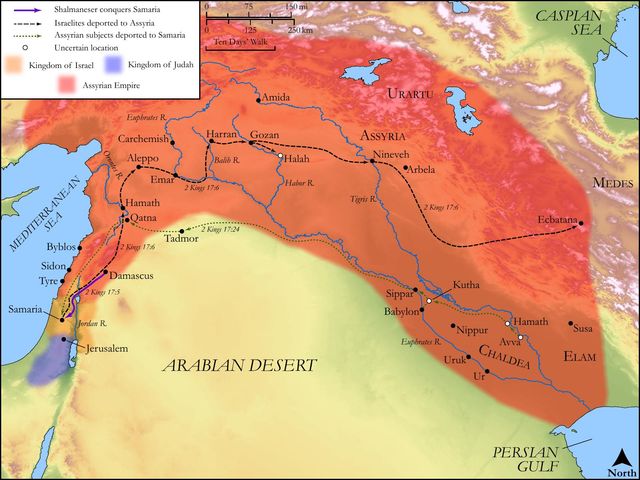
Never was land lost, we say, for want of an heir. When the children of Israel were dispossessed, and turned out of Canaan, the king of Assyria soon transplanted thither the supernumeraries of his own country, such as it could well spare, who should be servants to him and masters to the Israelites that remained; and here we have an account of these new inhabitants, whose story is related here that we may take our leave of Samaria, as also of the Israelites that were carried captive into Assyria.
I.Concerning the Assyrians that were brought into the land of Israel we are here told,
1.That they possessed Samaria and dwelt in the cities thereof, Kg2 17:24. It is common for lands to change their owners, but sad that the holy land should become a heathen land again. See what work sin makes.
2.That at their first coming God sent lions among them. They were probably insufficient to people the country, which occasioned the beasts of the field to multiply against them (Exo 23:29); yet, besides the natural cause, there was a manifest hand of God in it, who is Lord of hosts, of all the creatures, and can serve his own purposes by which he pleases, small or great, lice or lions. God ordered them this rough welcome to check their pride and insolence, and to let them know that though they had conquered Israel the God of Israel had power enough to deal with them - that he could have prevented their settling here, by ordering lions into the service of Israel, and that he permitted it, not for their righteousness, but the wickedness of his own people - and that they were now under his visitation. They had lived without God in their own land, and were not plagued with lions; but, if they do so in this land, it is at their peril.
3.That they sent a remonstrance of this grievance to the king their master, setting forth, it is likely, the loss their infant colony had sustained by the lions and the continual fear they were in of them, and stating that they looked upon it to be a judgment upon them for not worshipping the God of the land, which they could not, because they knew not how, Kg2 17:26. The God of Israel was the God of the whole world, but they ignorantly call him the God of the land, apprehending themselves therefore within his reach, and concerned to be upon good terms with him. Herein they shamed the Israelites, who were not so ready to hear the voice of God's judgments as they were, and who had not served the God of that land, though he was the God of their fathers and their great benefactor, and though they were well instructed in the manner of his worship. Assyrians begged to be taught that which Israelites hated to be taught.
4.That the king of Assyria took care to have them taught the manner of the God of the land (Kg2 17:27, Kg2 17:28), not out of any affection to that God, but to save his subjects from the lions. On this errand he sent back one of the priests whom he had carried away captive. A prophet would have done them more good, for this was but one of the priests of the calves, and therefore chose to dwell at Bethel for old acquaintance' sake, and, though he might teach them to do better than they did, he was not likely to teach them to do well, unless he had taught his own people better. However, he came and dwelt among them, to teach them how they should fear the Lord. Whether he taught them out of the book of the law, or only by word of mouth, is uncertain.
5.That, being thus taught, they made a mongrel religion of it, worshipped the God of Israel for fear and their own idols for love (Kg2 17:33): They feared the Lord, but they served their own gods. They all agreed to worship the God of the land according to the manner, to serve the Jewish festivals and rites of sacrificing, but every nation made gods of their own besides, not only for their private use in their own families, but to be put in the houses of their high places, Kg2 17:9. The idols of each country are here named, Kg2 17:30, Kg2 17:31. The learned are at a loss for the signification of several of these names, and cannot agree by what representations these gods were worshipped. If we may credit the traditions of the Jewish doctors, they tell us that Succoth-Benoth was worshipped in a hen and chickens, Nergal in a cock, Ashima in a smooth goat, Nibhaz in a dog, Tartak in an ass, Adrammelech in a peacock, Anammelech in a pheasant. Our own tell us, more probably, that Succoth-Benoth (signifying the tents of the daughters) was Venus. Nergal, being worshipped by the Cuthites, or Persians, was the fire, Adrammelech and Anammelech were only distinctions of Moloch. See how vain idolaters were in their imaginations, and wonder at their sottishness. Our very ignorance concerning these idols teaches us the accomplishment of that word which God has spoken, that these false gods should all perish (Jer 10:11); they are all buried in oblivion, while the name of the true God shall continue for ever.
6.This medley superstition is here said to continue unto this day (Kg2 17:41), till the time when this book was written and long after, above 300 years in all, till the time of Alexander the Great, when Manasse, brother to Jaddus the high priest of the Jews, having married the daughter of Sanballat, governor of the Samaritans, went over to them, got leave of Alexander to build a temple in Mount Gerizim, drew over many of the Jews to him, and prevailed with the Samaritans to cast away all their idols and to worship the God of Israel only; yet their worship was mixed with so much superstition that our Saviour told them they knew not what they worshipped, Joh 4:22.
II.Concerning the Israelites that were carried into the land of Assyria.
This historian has occasion to speak of them (Kg2 17:22), showing that their successors in the land did as they had done (after the manner of the nations whom they carried away), they worshipped both the God of Israel and those other gods; but what did the captives do in the land of their affliction? Were they reformed, and brought to repentance, by their troubles? No, they did after the former manner, Kg2 17:34. When the two tribes were afterwards carried into Babylon, they were cured by it of their idolatry, and therefore, after seventy years, they were brought back with joy; but the ten tribes were hardened in the furnace, and therefore were justly lost in it and left to perish. This obstinacy of theirs is here aggravated by the consideration,
1.Of the honour God had put upon them, as the seed of Jacob, whom he named Israel, and from him they were so named, but were a reproach to that worthy name by which they were called.
2.Of the covenant he made with them, and the charge he gave them upon that covenant, which is here very fully recited, that they should fear and serve the Lord Jehovah only, who had brought them up out of Egypt (Kg2 17:36), that, having received his statutes and ordinances in writing, they should observe to do them for evermore (Kg2 17:37), and never forget that covenant which God had made with them, the promises and conditions of that covenant, especially that great article of it which is here thrice repeated, because it had been so often inculcated and so much insisted on, that they should not fear other gods. He had told them that, if they kept close to him, he would deliver them out of the hand of all their enemies (Kg2 17:39); yet when they were in the hand of their enemies, and stood in need of deliverance, they were so stupid, and had so little sense of their own interest, that they did after the former manner (Kg2 17:40), they served both the true God and false gods, as if they knew no difference. Ephraim is joined to idols, let him alone. So they did, and so did the nations that succeeded them. Well might the apostle ask, What then, Are we better than they? No, in no wise, for both Jews and Gentiles are all under sin, Rom 3:9.
Continue studying 2 Kings 17:40 across the web’s major study libraries — every link below opens this exact verse, chapter, or book on the destination site.
Read & Compare
 BibleGatewayThis verse in more than 200 translations and 70 languages.
 Bible.comThe YouVersion reader — hundreds of translations, reading plans, and highlights.
 ESV.orgCrossway's official English Standard Version reader.
 NET BibleThe NET translation with 60,000+ translators' notes on every rendering decision.
 STEP BibleTyndale House's free study tool — original text, vocabulary, and scholarly resources.
 BibliaLogos Bible Software's free web reader.
 USCCBThe New American Bible (Revised Edition) with the U.S. bishops' study notes.
Commentaries
 BibleHub CommentariesDozens of classic commentaries on this verse, gathered on one page.
 StudyLightMore than 100 commentary sets — the largest collection on the web.
 BibleRefPlain-English commentary on what this verse means, verse by verse.
 Enduring WordDavid Guzik's free commentary on this chapter, widely used by Bible teachers.
 Bible Study ToolsVerse commentary alongside Greek and Hebrew study aids.
Original Language & Research
- BibleHub InterlinearThe verse word by word — original language, transliteration, and English.
- BibleHub LexiconEvery word's original-language definition and Strong's entry.
 Blue Letter BibleDeep-study tools — Strong's numbers, concordance, and word studies.
 SefariaThe Hebrew text with Rashi and centuries of Jewish commentary.
Sermons, Hymns & Audio


TrulyRandomVerse is not affiliated with these sites and doesn’t control their content. They’re linked because they’re genuinely useful.
Summary
Second Kings 17:40 powerfully encapsulates the unyielding spiritual rebellion of the foreign peoples resettled in Samaria by the Assyrians. Despite receiving direct instruction concerning the Lord, these new inhabitants stubbornly refused to genuinely obey His commands, instead reverting to their deeply ingrained pagan customs and idolatrous practices. This verse serves as a stark commentary on the profound human tendency to resist divine truth and cling to familiar, albeit sinful, ways, highlighting the perilous nature of spiritual syncretism and the non-negotiable call for exclusive devotion to the one true God.
Context
ShowHideLiterary Context
This pivotal verse is situated within the somber and didactic narrative of 2 Kings 17, which meticulously details the tragic fall of the Northern Kingdom of Israel due to their persistent idolatry, covenant breaking, and rejection of God's prophetic warnings. After the deportation of the Israelites, the Assyrian king, as part of a strategic policy, brought in various foreign peoples from Babylon, Cuthah, Ava, Hamath, and Sepharvaim to inhabit the desolate cities of Samaria. These new settlers, unfamiliar with the God of Israel, soon faced problems, notably severe lion attacks, which they superstitiously interpreted as divine judgment from the "god of the land." In response to this perceived supernatural threat, the Assyrian king sent one of the exiled Israelite priests back to Samaria to teach them about the Lord. However, as 2 Kings 17:33 explains, their subsequent worship became a syncretic blend: "They feared the Lord, and served their own gods, after the manner of the nations whom they carried away from thence." Verse 40 functions as a powerful summary statement, emphasizing that despite the instruction and the perceived divine warning, their fundamental allegiance remained tragically divided, and their entrenched pagan practices remained unchanged. It underscores the ultimate failure of this partial, pragmatic attempt at religious instruction.
Historical & Cultural Context
The Assyrian Empire, particularly under powerful rulers like Tiglath-Pileser III and Shalmaneser V, employed a deliberate and brutal policy of mass deportation and resettlement. This was not merely punitive but a calculated strategy to weaken conquered nations, dismantle their national identity, and prevent future rebellions by mixing diverse populations. The foreign settlers brought with them their rich tapestry of religious practices, pantheons of deities, and deeply ingrained cultural traditions. Their encounter with the lions, a common and dangerous threat in the region, was culturally interpreted through the lens of ancient Near Eastern religious beliefs, where local deities were believed to control the land and its creatures. Thus, the lion attacks were seen as a clear sign of the local deity's displeasure, prompting them to seek appeasement. The Assyrian king's decision to send an Israelite priest was a pragmatic, not theological, move, aimed at pacifying the "god of the land" to stabilize the region and ensure tribute flow. However, the deep-seated cultural and religious traditions of these peoples proved far more resilient and influential than the partial, externally imposed instruction they received, leading directly to the mixed, syncretistic worship condemned by the biblical authors. This illustrates the difficulty of genuine spiritual transformation when cultural identity is deeply intertwined with false worship.
Key Themes
ShowHideThe verse, "Howbeit they did not hearken, but they did after their former manner," contributes significantly to several overarching themes within 2 Kings. Persistent Disobedience and Rebellion is starkly illustrated here. Despite being taught about the Lord, the new inhabitants of Samaria, much like the Israelites before them, clung tenaciously to their old, comfortable, and sinful practices. This highlights a universal human tendency to resist spiritual transformation and divine authority, echoing the repeated cycles of rebellion found throughout Israel's history, as seen in the lament of Judges 2:19. The Danger of Syncretism is another central theme. The phrase "they did after their former manner" points directly to the inherent danger and theological unacceptability of mixing true worship with false practices. This spiritual compromise is a recurring motif throughout biblical history, where attempts to serve God alongside idols are always condemned as an abomination. God demands exclusive worship, a principle explicitly stated in the first commandment in Exodus 20:3, and powerfully reiterated in Deuteronomy 6:14. Finally, Spiritual Apathy and Stubbornness are profoundly evident. The phrase "they did not hearken" (from the Hebrew shama', meaning to hear and obey) reveals a profound lack of genuine desire to truly listen to and follow God's way. This spiritual apathy led to a stubborn adherence to their own traditions rather than embracing divine truth, mirroring the spiritual blindness and hardness of heart often described by the prophets, such as in Jeremiah 7:24.
Exposition and Analysis
ShowHideKey Word Analysis
ShowHideThis primitive Hebrew root (H8085) signifies far more than merely perceiving sound with the ears; it implies attentive listening with the intent to understand, internalize, and, crucially, obey. When the text states "they did not hearken," it conveys a deliberate and active refusal to comply with God's commands and instructions. It is not a matter of ignorance or inability to hear, but of willful disregard, a hardened heart that actively rejects divine authority and truth. Their failure to "hearken" indicates a fundamental lack of submission and a conscious preference for their own established ways over God's revealed will.
Derived from the root "to judge," this Hebrew noun (H4941) is broad, encompassing a verdict, a sentence, a formal decree, or abstractly, justice. In the context of "former manner," it refers to their established customs, laws, judgments, and, most pertinently, their religious practices and rituals from their original homelands. Coupled with "former" (H7223, riʼshôwn, meaning first, before, or old time), the phrase "former manner" underscores the deep-seated nature of their pagan traditions, idolatrous worship, and cultural norms, which were intrinsically woven into their identity. Despite being introduced to Yahweh, they clung tenaciously to these old, familiar, and idolatrous "manners," demonstrating a powerful resistance to genuine spiritual change and an unwillingness to abandon their ancestral ways.
Verse Breakdown
ShowHide"Howbeit they did not hearken"
This initial clause serves as a direct and damning indictment of the foreign settlers' response to the instruction they received about the Lord. Despite the perceived divine warning (the lion attacks) and the teaching from an Israelite priest, their hearts remained closed and unresponsive. They actively chose not to listen with an obedient ear, indicating a profound spiritual apathy and a willful rejection of Yahweh's exclusive claims. This was not a passive failure to comprehend, but an active, conscious refusal to submit to divine truth and abandon their old ways, revealing a deep-seated rebellion against God's authority.
"but they did after their former manner"
This contrasting clause reveals the inevitable consequence and tangible manifestation of their refusal to hearken. Instead of abandoning their pagan practices and embracing the exclusive worship of Yahweh, they reverted to or steadfastly maintained their original idolatrous rituals, customs, and ways of life. This demonstrates the powerful, entrenched pull of ingrained tradition and the complete absence of genuine spiritual transformation. It signifies a syncretistic approach where they attempted to merely add Yahweh to their existing pantheon, rather than replacing their idols with Him, thereby violating the fundamental principle of monotheism and exclusive devotion demanded by the God of Israel.
Literary Devices
ShowHideThe verse employs several potent literary devices to convey its profound message of spiritual stubbornness and syncretism. A striking Contrast is immediately evident, juxtaposing the expected outcome of instruction ("they did not hearken") with the actual, rebellious reality ("but they did after their former manner"). This highlights the settlers' deep-seated stubbornness and the futility of partial religious instruction without a willing and submissive heart. There is also a powerful sense of Irony present; these foreign peoples, brought into the land after Israel's exile precisely because of Israel's persistent idolatry, proceed to commit the very same sin of syncretism that led to Israel's downfall. This creates a tragic echo, demonstrating that the problem of human rebellion against God transcends nationality and historical context. Furthermore, the phrase "former manner" acts as a Thematic Echo or Repetition of Israel's own persistent idolatry described throughout 2 Kings, where they continuously reverted to their "own ways" and "high places" despite divine warnings and prophetic appeals. This resonance underscores the universal human propensity for spiritual stubbornness and the alluring, dangerous comfort of familiar sin.
Theological and Thematic Connections
ShowHideThe theological significance of 2 Kings 17:40 extends far beyond the immediate historical context, serving as a powerful and enduring warning against spiritual compromise and the inherent dangers of syncretism. God demands exclusive worship and wholehearted devotion; He cannot be merely one deity among many, nor can His truth be blended with human traditions, cultural norms, or false beliefs. This verse underscores the biblical principle that true faith is not merely intellectual assent or superficial religious observance, but active, obedient submission to God's revealed will. The failure to "hearken" signifies a deeper spiritual problem—a hardened heart that prefers the comfort of familiar sin and self-devised worship over the transformative, demanding claims of divine truth. It reveals that external instruction alone is insufficient for genuine spiritual change; it requires an internal willingness to abandon old ways, repent of idolatry, and embrace God fully and exclusively.
Reflection and Application
ShowHideThe stubborn refusal of the Samaritans to abandon their "former manner" resonates deeply with the human condition across all ages and cultures. For believers today, this verse serves as a potent and sobering reminder of the constant battle against spiritual compromise and the insidious allure of old habits, even after encountering God's truth. God calls for exclusive worship and unreserved obedience, not a superficial mixture of genuine faith and worldly practices. We cannot truly serve God while simultaneously clinging to sinful behaviors, values that contradict His Word, or cultural norms that undermine biblical truth. This passage challenges us to examine our own lives with brutal honesty: are we merely hearing God's Word, or are we truly "hearkening" to it—listening attentively with the intent to understand, internalize, and obey? Breaking old patterns, whether they are deeply ingrained sinful behaviors, ungodly thought processes, or subtle forms of spiritual apathy, requires vigilance, genuine repentance, and a constant, humble reliance on the empowering work of the Holy Spirit. Genuine obedience moves far beyond superficial religious observance to a deep, transformative relationship where our lives are intentionally and comprehensively aligned with God's will, actively putting off the old self and putting on the new.
Questions for Reflection
ShowHideFAQ
ShowHideWhy did the Assyrian king send an Israelite priest to teach them about the Lord?
ShowHideThe Assyrian king's motivation was primarily pragmatic and superstitious, not theological or evangelistic. The new foreign settlers in Samaria were experiencing severe lion attacks, which they interpreted as a sign of divine displeasure from the local deity, "the god of the land." This was a common ancient Near Eastern belief that each conquered land had its own patron deity who needed to be honored to prevent calamity. To appease this perceived deity and ensure stability and control in the newly conquered region, the king was advised to send one of the exiled Israelite priests back to Samaria to teach the settlers the "manner of the god of the land" (2 Kings 17:26). The king's aim was to restore order and prevent further supernatural threats, not to promote genuine, exclusive worship of Yahweh.
What does "their former manner" specifically refer to?
ShowHide"Their former manner" refers to the deeply ingrained pagan religious customs, idolatrous practices, and cultural norms that the various foreign peoples (from Babylon, Cuthah, Ava, Hamath, and Sepharvaim, as mentioned in 2 Kings 17:24) brought with them from their homelands. These practices included worshipping their own national deities, often involving idol worship, various rituals, and possibly even abhorrent practices like child sacrifice (as implied by later verses such as 2 Kings 17:31). Despite being introduced to Yahweh, they continued to practice these ancestral traditions alongside their newfound (and superficial) reverence for the God of Israel, resulting in a syncretistic religion that was anathema to the exclusive demands of Yahweh, who tolerates no rivals.
Christ-Centered Fulfillment
ShowHideThe stubborn refusal to "hearken" and the tenacious adherence to "former manner" in 2 Kings 17:40 find their ultimate spiritual resolution and profound contrast in the person and work of Jesus Christ. The Old Testament consistently portrays humanity's inherent inability to truly "hearken" to God's voice and break free from the "former manner" of sin, self-worship, and idolatry through mere instruction or the demands of the Law. This persistent rebellion highlights the desperate human need for a radical transformation of the heart, a transformation that the Law, by itself, could not provide. Jesus Christ, however, is the perfect embodiment of "hearkening" to God, perfectly obeying the Father's will even unto the ultimate sacrifice on the cross (Philippians 2:8). Through His atoning sacrifice and victorious resurrection, He provides the sole means for believers to truly "hearken" to God's voice, as His sheep hear His voice and follow Him (John 10:27). Furthermore, in Christ, believers are empowered by the Holy Spirit to shed their "former manner"—the old self, enslaved to sin and dead works (Ephesians 4:22), and to walk in glorious newness of life (Romans 6:4). The indwelling Holy Spirit, given through Christ, enables a genuine and profound transformation of the heart, allowing us to put off the old man and put on the new (Colossians 3:9-10), finally fulfilling the divine call for exclusive and wholehearted devotion that the Samaritans of 2 Kings 17 so tragically failed to embrace.