


2 Chronicles 3:17
- וַיָּקֶםvai·Ya·kemand he set upH6965Conj-w ¦ V-Hiphil-ConsecImperf-3msVerb Hiphil Consecutive Imperfect 3rd Singular Masculineוַandיָּקֶםhe set up
- אֶת'et<obj.>H853DirObjMParticle Object Indicator
- הָעַמּוּדִיםha·'a·mu·Dimthe pillarsH5982Art ¦ N-mpNoun Plural Masculine Absoluteהָtheעַמּוּדִיםpillars
- עַל'alonH5921PrepPreposition
- פְּנֵיpe·Nei[the] faceH6440N-mpcNoun Plural Masculine Construct
- הַהֵיכָלha·hei·Khalthe templeH1964Art ¦ N-msNoun Singular Masculine Absoluteהַtheהֵיכָלtemple
- אֶחָד'e·ChadoneH259N-fsNoun Singular Feminine Absolute
- מִיָּמִיןmi·ya·Minfrom [the] southH3225Prep-m ¦ N-fsNoun Singular Feminine Absoluteמִfromיָּמִין[the] south
- וְאֶחָדve·'e·Chadand oneH259Conj-w ¦ N-fsNoun Singular Feminine Absoluteוְandאֶחָדone
- מֵהַשְּׂמֹאולme·ha·se·Molfrom the northH8040Prep-m ¦ Art ¦ N-msNoun Singular Masculine Absoluteמֵfromהַtheשְּׂמֹאולnorth
- וַיִּקְרָאvai·yik·Ra'and he calledH7121Conj-w ¦ V-Qal-ConsecImperf-3msVerb Qal Consecutive Imperfect 3rd Singular Masculineוַandיִּקְרָאhe called
- שֵׁםshem[the] name ofH8034N-mscNoun Singular Masculine Construct
- הַיְמָנִיhay·mi·nithe south [one]H3233Art ¦ Adj-msAdjective Singular Masculine Absoluteהַtheיְמָנִיsouth [one]
- יָכִיןya·KhinJakinH3199N-proper-mNoun Proper Masculine
- וְשֵׁםve·Shemand [the] name ofH8034Conj-w ¦ N-mscNoun Singular Masculine Constructוְandשֵׁם[the] name of
- הַשְּׂמָאלִיha·se·ma·Lithe north [one]H8042Art ¦ Adj-msAdjective Singular Masculine Absoluteהַtheשְּׂמָאלִיnorth [one]
- בֹּעַזBo·'azBoazH1162N-proper-mNoun Proper Masculine
English is a literal word-by-word gloss of the Hebrew, not the KJV's wording. Why?
This is the original text the KJV's translators worked from — each Hebrew word with its own literal English meaning in this verse, prepared by scholars at Tyndale House, Cambridge. The KJV translates whole sentences, not word by word, so its wording differs: one Hebrew word can become several English words, and the KJV may choose “the LORD” where the gloss reads “Yahweh”. Both are faithful — they answer different questions. For the KJV's own rendering, switch to the KJV text.
Details
See on the biblical-era map
Study this verse
Public-domain commentary
Matthew Henry
From his Commentary on the Whole Bible. Henry comments on passages, not single verses — this entry covers 2 Chronicles 3:10–17.
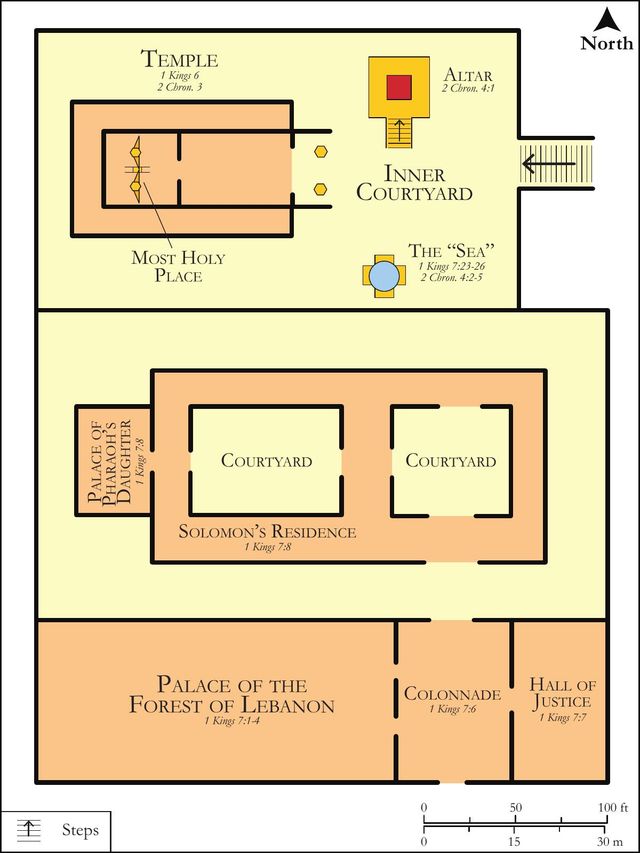
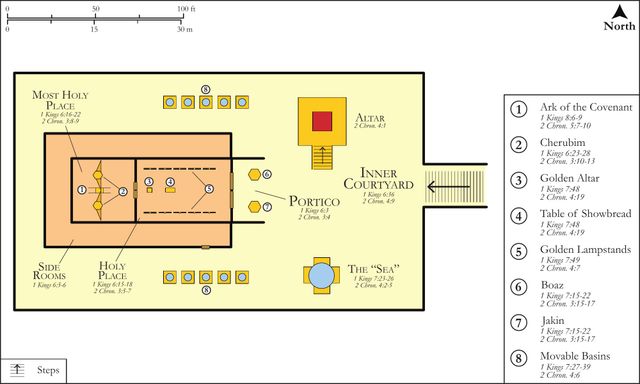
Here is an account of 1. The two cherubim, which were set up in the holy of holies. There were two already over the ark, which covered the mercy-seat with their wings; these were small ones. Now that the most holy place was enlarged, though these were continued (being appurtenances to the ark, which was not to be made new, as all the other utensils of the tabernacle were), yet those two large ones were added, doubtless by divine appointment, to fill up the holy place, which otherwise would have looked bare, like a room unfurnished. These cherubim are said to be of image-work (Ch2 3:10), designed, it is likely, to represent the angels who attend the divine Majesty. Each wing extended five cubits, so that the whole was twenty cubits (Ch2 3:12, Ch2 3:13), which was just the breadth of the most holy place, Ch2 3:8. They stood on their feet, as servants, their faces inward toward the ark (Ch2 3:13), that it might appear they were not set there to be adored (for then they would have been made sitting, as on a throne, and their faces towards their worshippers), but rather as themselves attendants on the invisible God. We must not worship angels, but we must worship with angels; for we have come into communion with them (Heb 12:22), and must do the will of God as the angels do it. The thought that we are worshipping him before whom the angels cover their faces will help to inspire us with reverence in all our approaches to God. Compare Co1 11:10 with Isa 6:2. 2. The veil that parted between the temple and the most holy place, Ch2 3:14. This denoted the darkness of that dispensation, and the distance which the worshippers were kept at; but, at the death of Christ, this veil was rent; for through him we are made nigh, and have boldness not only to look, but to enter, into the holiest. On this he was wrought cherubim. Heb. he caused them to ascend, that is, they were made in raised work, embossed. Or he made them on the wing in an ascending posture, as the other two that stood on their feet in an attending posture, to remind the worshippers to lift up their hearts, and to soar upwards in their devotions. 3. The two pillars which were set up before the temple. Both together were somewhat above thirty-five cubits in length (Ch2 3:15), about eighteen cubits high a-piece. See Kg1 7:15, etc., where we took a view of those pillars, Jachin and Boaz, establishment and strength in temple-work and by it.
Continue studying 2 Chronicles 3:17 across the web’s major study libraries — every link below opens this exact verse, chapter, or book on the destination site.
Read & Compare
 BibleGatewayThis verse in more than 200 translations and 70 languages.
 Bible.comThe YouVersion reader — hundreds of translations, reading plans, and highlights.
 ESV.orgCrossway's official English Standard Version reader.
 NET BibleThe NET translation with 60,000+ translators' notes on every rendering decision.
 STEP BibleTyndale House's free study tool — original text, vocabulary, and scholarly resources.
 BibliaLogos Bible Software's free web reader.
 USCCBThe New American Bible (Revised Edition) with the U.S. bishops' study notes.
Commentaries
 BibleHub CommentariesDozens of classic commentaries on this verse, gathered on one page.
 StudyLightMore than 100 commentary sets — the largest collection on the web.
 BibleRefPlain-English commentary on what this verse means, verse by verse.
 Enduring WordDavid Guzik's free commentary on this chapter, widely used by Bible teachers.
 Bible Study ToolsVerse commentary alongside Greek and Hebrew study aids.
Original Language & Research
- BibleHub InterlinearThe verse word by word — original language, transliteration, and English.
- BibleHub LexiconEvery word's original-language definition and Strong's entry.
 Blue Letter BibleDeep-study tools — Strong's numbers, concordance, and word studies.
 SefariaThe Hebrew text with Rashi and centuries of Jewish commentary.
Sermons, Hymns & Audio


TrulyRandomVerse is not affiliated with these sites and doesn’t control their content. They’re linked because they’re genuinely useful.
Summary
This pivotal verse in 2 Chronicles 3:17 culminates the description of the Temple's exterior, detailing the erection and naming of the two colossal bronze pillars, Jachin and Boaz, positioned prominently before the sacred edifice. Far from mere architectural supports, these magnificent columns, fashioned by Hiram of Tyre, served as profound symbolic declarations, proclaiming divine attributes and covenantal truths to all who approached the dwelling place of God in Jerusalem.
Context
ShowHideLiterary Context
2 Chronicles 3:17 marks the conclusion of the detailed account of Solomon's construction of the Temple, specifically focusing on its exterior features. The preceding verses (2 Chronicles 3:1-16) meticulously describe the dimensions, materials, and internal furnishings of the sanctuary, including the Holy of Holies, the cherubim, and the veil. This verse, therefore, serves as the final touch on the grand entrance, providing a symbolic gateway to the sacred space. It parallels the account found in 1 Kings 7:15-22, offering a consistent historical and architectural record of these unique elements. The Chronicler's emphasis here, as throughout the book, is on the glory and proper worship within the Temple, underscoring the significance of every detail and highlighting God's faithfulness in enabling the completion of His dwelling place.
Historical & Cultural Context
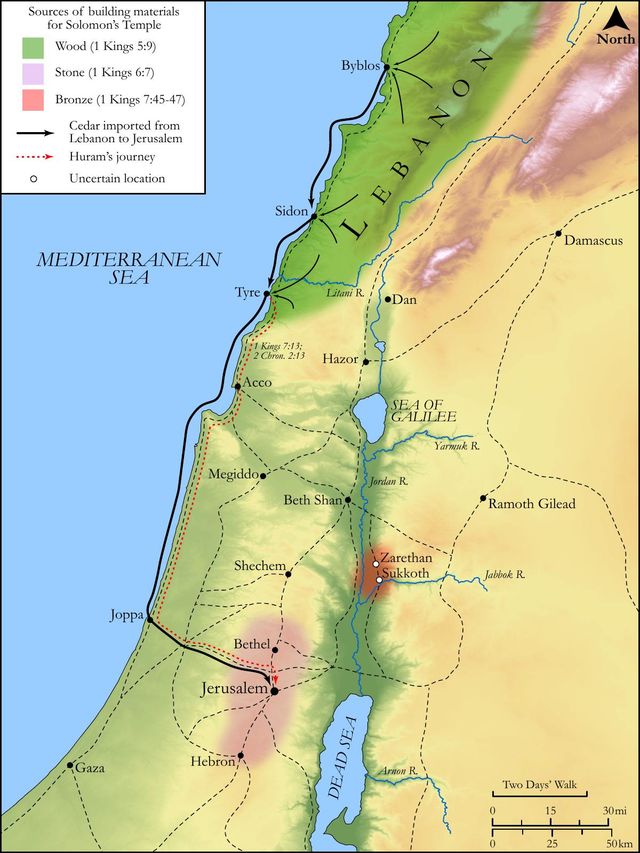
The construction of the First Temple during Solomon's reign (c. 960 BCE) was a monumental undertaking, signifying a new era for Israel as a settled nation with a central place of worship. Prior to this, the Ark of the Covenant resided in a portable tabernacle. The Temple's permanence underscored God's commitment to His people and His chosen city, Jerusalem. The use of Hiram of Tyre, a skilled Phoenician craftsman, highlights the international collaboration and advanced metallurgical techniques of the era. In the ancient Near East, monumental pillars often stood at the entrances of temples or palaces, not primarily for structural support, but as symbolic markers, often bearing inscriptions or names that conveyed the patron's power, divine favor, or the building's purpose. The naming of these pillars, Jachin and Boaz, would have immediately communicated profound theological truths to those familiar with Hebrew word meanings.
Key Themes
ShowHideThis verse powerfully contributes to several overarching themes in 2 Chronicles and the broader Old Testament narrative. Firstly, it emphasizes God's dwelling among His people, as the Temple was the tangible symbol of His presence. Secondly, the names Jachin and Boaz underscore themes of divine faithfulness and covenantal establishment. "Jachin" points directly to God's unwavering promise to establish David's throne and kingdom forever, as detailed in the Davidic Covenant. "Boaz" highlights God's strength and sustaining power, reminding Israel that their security and prosperity derived not from human might but from divine might. Together, these pillars served as a constant visual sermon on God's commitment to His promises and His omnipotence, providing assurance to the worshippers entering the sacred space and reinforcing the idea that the Temple itself was a testament to God's enduring power and presence, echoing the themes found throughout the dedication of the Temple.
Exposition and Analysis
ShowHideKey Word Analysis
ShowHidePlaced on the right (south) side of the Temple entrance, this name means "He shall establish" or "He will establish." This directly points to the unwavering faithfulness of God in fulfilling His covenant promises, particularly His promise to King David to establish his dynasty and kingdom forever (2 Samuel 7:12-16). It signifies divine permanence and the secure foundation God provides for His people and His dwelling place.
Placed on the left (north) side, this name means "In it is strength" or "By strength." While the Strong's definition for the name itself refers to an ancestor of David, its common theological interpretation, derived from the root meaning, signifies that the Temple, and indeed Israel's very existence and security, depended entirely on God's inherent power and might. It served as a powerful reminder that divine strength, not human ingenuity or military prowess, sustained their nation and their worship.
This verb describes the act of erecting the pillars. It conveys more than just physical placement; it implies setting something up firmly, establishing it, or causing it to stand. In this context, it emphasizes the deliberate and permanent nature of the pillars' installation, signifying their lasting symbolic importance at the Temple's entrance.
Verse Breakdown
ShowHide"And he reared up the pillars before the temple"
This clause describes the final act of erecting the two massive bronze columns. The verb "reared up" (from H6965 qûwm) implies not just physical placement but also a sense of permanence and significance, indicating a deliberate act of establishment. Crucially, they stood "before the temple," meaning at the entrance or porch, not within the main structure. This indicates their symbolic, rather than structural, purpose, serving as monumental sentinels guarding the sacred space.
"one on the right hand, and the other on the left"
This specifies the precise positioning of the pillars. When facing the Temple from the east (the direction of approach), the "right hand" would correspond to the south side, and the "left hand" to the north side. This symmetrical placement emphasized their dual yet complementary symbolic roles at the threshold of God's presence, marking the entryway with a balanced declaration.
"and called the name of that on the right hand Jachin, and the name of that on the left Boaz"
The act of naming was profoundly significant in ancient cultures, imbuing an object or person with identity and purpose. By naming these pillars, Solomon, under divine inspiration, transformed them from mere architectural features into active theological statements. The names, "He shall establish" and "In it is strength," functioned as a combined declaration, a "visual sermon" to all who entered, proclaiming that God would establish His dwelling and His people by His own inherent strength.
Literary Devices
ShowHideThe primary literary device at play in 2 Chronicles 3:17 is Symbolism. The two monumental pillars, Jachin and Boaz, are not merely decorative but serve as powerful symbols of God's character and covenantal relationship with Israel. Their very names embody profound theological truths. Furthermore, the verse employs Etymological Significance, as the meaning of the Hebrew names Jachin ("He shall establish") and Boaz ("In it is strength") is central to their symbolic function, conveying a combined message of divine faithfulness and omnipotence. The positioning of "one on the right hand, and the other on the left" can be seen as a form of Merism, encompassing the entire entrance and signifying the totality of God's attributes (establishment and strength) guarding and defining access to His presence.
Theological and Thematic Connections
ShowHideThe naming of Jachin and Boaz at the entrance of Solomon's Temple served as a perpetual theological declaration to all who approached God's house. Together, their names ("He shall establish" and "In it is strength") articulated a foundational truth about God's character and His covenant with Israel: God Himself is the one who establishes His purposes, His people, and His dwelling place, and He does so by His own inherent, unshakeable strength. This was a powerful reminder that Israel's security, the permanence of the Davidic dynasty, and the very existence of the Temple were not dependent on human might or political stability, but solely on the faithful power of Yahweh. It instilled confidence in God's enduring presence and His commitment to His promises, providing assurance to the worshipper and a deterrent to any who might challenge His authority, emphasizing that true stability comes from God alone.
Reflection and Application
ShowHideThe enduring symbolism of Jachin and Boaz offers profound spiritual lessons for believers today. Just as these pillars stood as a constant declaration of God's faithfulness and strength at the threshold of His dwelling, so too are we called to live lives that reflect these divine attributes. God continues to establish His purposes in the world, often through the lives of His people, and He provides the strength necessary to stand firm in faith amidst life's challenges. The combined message "He will establish by strength" reminds us that our spiritual stability and effectiveness do not come from our own abilities or resources, but from our reliance on God's unfailing power and His commitment to His promises. We are to be "spiritual pillars" in our communities, embodying the truth and stability found only in Him, demonstrating His faithfulness and strength to a watching world, and serving as a testament to God's active presence and power in our lives and through His Church.
Questions for Reflection
ShowHideFAQ
ShowHideWere Jachin and Boaz structural components of the Temple?
ShowHideNo, Jachin and Boaz were not structural supports for the Temple building itself. Both the biblical descriptions (here and in 1 Kings 7) and archaeological understanding of ancient Near Eastern temple architecture indicate that such monumental pillars at the entrance were primarily symbolic and decorative. They stood freely before the porch, serving as powerful visual declarations rather than load-bearing elements. Their immense size and elaborate bronze craftsmanship highlighted their significance as theological statements about God's character and covenant, marking the sacred threshold.
Why were these specific names, Jachin and Boaz, chosen for the pillars?
ShowHideThe names Jachin ("He shall establish") and Boaz ("In it is strength" or "By strength") were chosen for their profound theological significance. They functioned as a combined declaration, a "visual sermon" to all who entered the Temple. Jachin pointed to God's unwavering faithfulness in establishing His covenant with David and His dwelling place among His people, confirming His promises. Boaz emphasized that this establishment, and indeed Israel's very existence and security, depended entirely on God's inherent power and might. Together, they proclaimed that God would establish His purposes and His people by His own divine strength, serving as a constant reminder of God's enduring presence, His promises, and His omnipotence, providing comfort and assurance to the worshippers.
Christ-Centered Fulfillment
ShowHideThe symbolism of Jachin and Boaz finds its ultimate fulfillment in Jesus Christ, who is the true and eternal "establisher" and the very embodiment of God's "strength." Just as Jachin declared God's faithfulness to establish, Christ is the one through whom God's eternal covenant promises are definitively established and fulfilled (2 Corinthians 1:20). He is the foundation upon which God's new spiritual Temple, the Church, is built, a Temple that will never be destroyed (Matthew 16:18). Furthermore, as Boaz signified divine strength, Christ is the source of all power and might for believers, enabling them to do all things through Him who strengthens them (Philippians 4:13). He is the "power of God and the wisdom of God" (1 Corinthians 1:24). In Christ, we find the ultimate establishment of God's kingdom and the inexhaustible strength to live out our faith. He is the true "pillar and ground of the truth" (1 Timothy 3:15), upholding all of God's revelation and providing the secure and powerful entrance into God's presence for all who believe, for He is the Way, the Truth, and the Life (John 14:6).