


2 Chronicles 3:13
Bible text: King James Version (1769 Blayney text) · Public domain
Bible text: Berean Standard Bible · Public domain
Bible text: American Standard Version (1901) · Public domain
Bible text: World English Bible, Messianic edition · Public domain
Bible text: Geneva Bible (1599) · Public domain
Bible text: Young's Literal Translation · Public domain
- כַּנְפֵיkan·Fei[the] wings ofH3671N-fdcNoun Dual Feminine Construct
- הַכְּרוּבִיםha·ke·ru·Vimthe cherubimH3742Art ¦ N-mpNoun Plural Masculine Absoluteהַtheכְּרוּבִיםcherubim
- הָאֵלֶּהha·'E·leh<the> theseH428Art ¦ PrtParticle Demonstrativeהָ<the>אֵלֶּהthese
- פֹּרְשִׂיםpo·re·Sim[were] spreading outH6566V-Qal-Prtcpl-mpVerb Qal Participle Plural Masculine Absolute
- אַמּוֹת'a·MotcubitsH520N-fpNoun Plural Feminine Absolute
- עֶשְׂרִים'es·RimtwentyH6242N-mpNoun Plural Masculine Absolute
- וְהֵםve·Hemand theyH1992Conj-w ¦ Pro-3mpPronoun Personal 3rd Plural Masculineוְandהֵםthey
- עֹמְדִים'o·me·Dim[were] standingH5975V-Qal-Prtcpl-mpVerb Qal Participle Plural Masculine Absolute
- עַל'alonH5921PrepPreposition
- רַגְלֵיהֶםrag·lei·Hemtheir feetH7272N-fdc ¦ 3mpNoun Dual Feminine Constructרַגְלֵיfeetהֶםtheir
- וּפְנֵיהֶםu·fe·nei·Hemand their facesH6440Conj-w ¦ N-mpc ¦ 3mpNoun Plural Masculine Constructוּandפְנֵיfacesהֶםtheir
- לַבָּיִתla·Ba·yit[were] to the insideH1004Prep-l ¦ N-msNoun Singular Masculine Absoluteלַ[were] to theבָּיִתinside
English is a literal word-by-word gloss of the Hebrew, not the KJV's wording. Why?
This is the original text the KJV's translators worked from — each Hebrew word with its own literal English meaning in this verse, prepared by scholars at Tyndale House, Cambridge. The KJV translates whole sentences, not word by word, so its wording differs: one Hebrew word can become several English words, and the KJV may choose “the LORD” where the gloss reads “Yahweh”. Both are faithful — they answer different questions. For the KJV's own rendering, switch to the KJV text.
Details
See on the biblical-era maps
Study this verse
Public-domain commentary
Matthew Henry
From his Commentary on the Whole Bible. Henry comments on passages, not single verses — this entry covers 2 Chronicles 3:10–17.
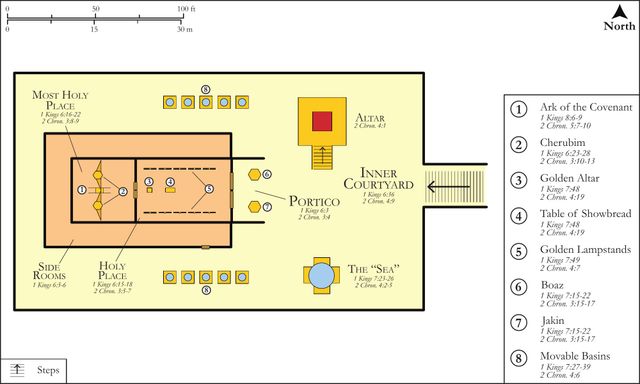
Here is an account of 1. The two cherubim, which were set up in the holy of holies. There were two already over the ark, which covered the mercy-seat with their wings; these were small ones. Now that the most holy place was enlarged, though these were continued (being appurtenances to the ark, which was not to be made new, as all the other utensils of the tabernacle were), yet those two large ones were added, doubtless by divine appointment, to fill up the holy place, which otherwise would have looked bare, like a room unfurnished. These cherubim are said to be of image-work (Ch2 3:10), designed, it is likely, to represent the angels who attend the divine Majesty. Each wing extended five cubits, so that the whole was twenty cubits (Ch2 3:12, Ch2 3:13), which was just the breadth of the most holy place, Ch2 3:8. They stood on their feet, as servants, their faces inward toward the ark (Ch2 3:13), that it might appear they were not set there to be adored (for then they would have been made sitting, as on a throne, and their faces towards their worshippers), but rather as themselves attendants on the invisible God. We must not worship angels, but we must worship with angels; for we have come into communion with them (Heb 12:22), and must do the will of God as the angels do it. The thought that we are worshipping him before whom the angels cover their faces will help to inspire us with reverence in all our approaches to God. Compare Co1 11:10 with Isa 6:2. 2. The veil that parted between the temple and the most holy place, Ch2 3:14. This denoted the darkness of that dispensation, and the distance which the worshippers were kept at; but, at the death of Christ, this veil was rent; for through him we are made nigh, and have boldness not only to look, but to enter, into the holiest. On this he was wrought cherubim. Heb. he caused them to ascend, that is, they were made in raised work, embossed. Or he made them on the wing in an ascending posture, as the other two that stood on their feet in an attending posture, to remind the worshippers to lift up their hearts, and to soar upwards in their devotions. 3. The two pillars which were set up before the temple. Both together were somewhat above thirty-five cubits in length (Ch2 3:15), about eighteen cubits high a-piece. See Kg1 7:15, etc., where we took a view of those pillars, Jachin and Boaz, establishment and strength in temple-work and by it.
Continue studying 2 Chronicles 3:13 across the web’s major study libraries — every link below opens this exact verse, chapter, or book on the destination site.
Read & Compare
 BibleGatewayThis verse in more than 200 translations and 70 languages.
 Bible.comThe YouVersion reader — hundreds of translations, reading plans, and highlights.
 ESV.orgCrossway's official English Standard Version reader.
 NET BibleThe NET translation with 60,000+ translators' notes on every rendering decision.
 STEP BibleTyndale House's free study tool — original text, vocabulary, and scholarly resources.
 BibliaLogos Bible Software's free web reader.
 USCCBThe New American Bible (Revised Edition) with the U.S. bishops' study notes.
Commentaries
 BibleHub CommentariesDozens of classic commentaries on this verse, gathered on one page.
 StudyLightMore than 100 commentary sets — the largest collection on the web.
 BibleRefPlain-English commentary on what this verse means, verse by verse.
 Enduring WordDavid Guzik's free commentary on this chapter, widely used by Bible teachers.
 Bible Study ToolsVerse commentary alongside Greek and Hebrew study aids.
Original Language & Research
- BibleHub InterlinearThe verse word by word — original language, transliteration, and English.
- BibleHub LexiconEvery word's original-language definition and Strong's entry.
 Blue Letter BibleDeep-study tools — Strong's numbers, concordance, and word studies.
 SefariaThe Hebrew text with Rashi and centuries of Jewish commentary.
Sermons, Hymns & Audio


TrulyRandomVerse is not affiliated with these sites and doesn’t control their content. They’re linked because they’re genuinely useful.
Summary
2 Chronicles 3:13 meticulously details the colossal cherubim within the Most Holy Place of Solomon's Temple, specifying their immense wing span, upright posture, and inward gaze. This verse not only highlights the architectural grandeur and precise craftsmanship of the sanctuary but also profoundly underscores the sacredness and divine presence associated with the Ark of the Covenant, which these majestic figures were designed to flank and guard, symbolizing the awe, reverence, and perpetual adoration due to God's unique dwelling place among His people.
Context
ShowHideLiterary Context
This verse is embedded within the chronicler's detailed account of King Solomon's construction of the Temple in Jerusalem, a narrative spanning from 2 Chronicles 2 through 2 Chronicles 7. Specifically, 2 Chronicles 3:10-12 describe the creation of these two large, free-standing cherubim, distinct from the smaller cherubim directly on the Ark of the Covenant. Verse 13 provides their critical dimensions, posture, and orientation, immediately preceding the description of the Temple veil in 2 Chronicles 3:14. This meticulous detail emphasizes the supreme importance of the Most Holy Place as the epicenter of God's dwelling and worship, highlighting the awe-inspiring nature of the divine presence.
Historical & Cultural Context
Solomon's Temple was the zenith of Israelite worship, fulfilling King David's desire to build a permanent dwelling for the Lord. Constructed during a period of relative peace and prosperity in Israel's history (c. 960 BCE), the Temple was not merely a building but the physical manifestation of God's covenantal presence among His people. Cherubim appear in Scripture as guardians of sacred space, set at the east of the garden of Eden to keep the way of the tree of life. Israel's cherubim were uniquely associated with Yahweh's throne and glory, appearing in the Tabernacle's design (Exodus 25:18-22) and later in Ezekiel's visions of God's chariot-throne (Ezekiel 1:5-14). The "cubit" was a standard ancient measurement, typically around 18 inches, making the "twenty cubits" a monumental scale designed to evoke awe and reverence, underscoring the Temple's unique status as God's dwelling.
Key Themes
ShowHideThe description of these cherubim contributes significantly to several overarching themes within Chronicles and the broader biblical narrative. Firstly, it underscores Divine Grandeur and Presence, as their immense size and strategic placement within the Most Holy Place served to visually represent the overwhelming majesty and glory of God, who chose to dwell among His people. Secondly, it highlights Holiness and Awe, emphasizing the profound reverence due to God's presence and the sacredness of the inner sanctuary, which only the High Priest could enter once a year. Thirdly, the cherubim embody Guardianship and Adoration, standing as perpetual sentinels and worshippers focused on the Ark of the Covenant, symbolizing their role in protecting the sanctity of God's throne and their ceaseless attentiveness to His divine will. Finally, the continuity of cherubim from the Garden of Eden (Genesis 3:24) to the Tabernacle and Temple reinforces the theme of God's consistent principles for His sacred dwelling and humanity's access to Him, culminating in the ultimate access through Christ.
Exposition and Analysis
ShowHideKey Word Analysis
ShowHideThe plural form of "cherub," these are celestial beings frequently mentioned in biblical literature. Though the Strong's transliteration kᵉrûwb refers to the singular, the context of 2 Chronicles 3:13 clearly indicates two colossal figures, hence "cherubims." They are consistently associated with guarding sacred spaces (e.g., the Garden of Eden in Genesis 3:24), serving as attendants to God's throne (e.g., the Ark of the Covenant in Exodus 25:18-22), and being part of His divine chariot-throne (as seen in Ezekiel 1:5-14 and Ezekiel 10). In this context, they are colossal, sculpted representations of these heavenly guardians, emphasizing the divine nature of the space they occupy.
An ancient unit of linear measurement, typically the length from the elbow to the tip of the middle finger, varying slightly but generally around 18 inches (approx. 45 cm). The specification of "twenty cubits" (approximately 30 feet or 9 meters) for the combined wing span underscores the monumental scale of these figures, designed to fill the entire width of the Most Holy Place and impress upon observers the vastness and overwhelming presence of the divine. This dimension highlights the meticulous detail and immense resources dedicated to the Temple's construction, reflecting the supreme importance of God's dwelling place.
This word, primarily meaning "house" or "within," is used here adverbially to denote direction, specifically "towards the inside" or "facing inward." In the context of the cherubim, it signifies their gaze being directed towards the Ark of the Covenant, the very representation of God's throne and presence. This orientation symbolizes their perpetual attentiveness, adoration, and protective focus on the divine holiness residing within the Most Holy Place. It implies a ceaseless vigil over the very heart of God's dwelling among His people.
Verse Breakdown
ShowHide"The wings of these cherubims spread themselves forth twenty cubits"
This clause describes the immense horizontal reach of the cherubim's wings. Each cherub had a wing span of ten cubits, with one wing touching the wall and the other touching the wing of the adjacent cherub, making a total span of twenty cubits across the width of the Most Holy Place (1 Kings 6:27). This detail emphasizes the monumental scale of these figures, physically filling the sacred space and visually communicating the overwhelming grandeur and pervasive presence of the God they flanked.
"and they stood on their feet"
This describes the posture of the cherubim. Unlike the cherubim on the mercy seat of the Ark, which were depicted kneeling or hovering, these colossal figures stood upright. This posture conveys a sense of readiness, vigilance, and active service. It suggests a posture of reverence and stability, indicating their role as constant, unwavering guardians of the divine presence, always prepared to fulfill their sacred duty.
"and their faces [were] inward"
This final detail specifies the direction of their gaze. Their faces were turned towards the Ark of the Covenant, which contained the tablets of the law and symbolized God's throne. This "inward" orientation is highly symbolic, representing their perpetual adoration, focused attention on God's presence, and their role in guarding the sanctity of the Most Holy Place. It implies a ceaseless vigil over the very heart of God's dwelling among His people, directing all focus to the divine.
Literary Devices
ShowHideThe description in 2 Chronicles 3:13 employs several literary devices to convey its profound theological meaning. Symbolism is paramount, as the cherubim themselves are powerful symbols of divine presence, holiness, and guardianship. Their immense size (twenty cubits) symbolizes the overwhelming grandeur and majesty of God, physically filling the most sacred space and impressing upon the observer the vastness of the divine. The posture of "standing on their feet" conveys a symbolic sense of readiness, reverence, and active service, indicating their perpetual vigilance. Their "inward" gaze symbolizes perpetual adoration and focused attention on the divine presence, directing all focus to God. The meticulous architectural detail, while literal, also serves as a form of descriptive imagery designed to evoke awe and reverence in the reader, emphasizing the sacredness and inaccessibility of God's dwelling. The chronicler's careful enumeration of dimensions and orientation underscores the divine blueprint and the meticulous care taken in constructing a dwelling worthy of the Holy God.
Theological and Thematic Connections
ShowHideThe cherubim in the Most Holy Place serve as a profound theological statement about God's nature and His relationship with humanity. Their immense scale and position guarding the Ark of the Covenant underscore God's transcendent holiness and the awe-inspiring nature of His presence. They are a visual reminder that God is utterly distinct from His creation, and access to His unmediated presence is restricted, requiring specific divine provision. This concept of guarded access to the divine is consistent throughout biblical history, from the cherubim guarding the Garden of Eden to the elaborate Tabernacle and Temple rituals. The cherubim's "inward" gaze perpetually directs attention to the Ark, the mercy seat, and the very point of God's covenantal presence, emphasizing that all worship and adoration must be singularly focused on the Lord. They represent the heavenly court's ceaseless worship and protection of God's glory, inviting humanity to a similar posture of reverence and focused devotion.
Reflection and Application
ShowHideWhile the physical Temple with its cherubim no longer stands, the principles embodied by 2 Chronicles 3:13 remain profoundly relevant for believers today. The immense scale and sacred function of these cherubim call us to cultivate a deep sense of awe and reverence for God's holiness, recognizing that His presence is not confined to a building but indwells believers through the Holy Spirit (1 Corinthians 6:19). The cherubim's "inward" gaze serves as a powerful metaphor, urging us to direct our spiritual focus, adoration, and attention singularly towards God in our personal lives and corporate worship. We are called to guard the sanctity of our hearts and minds, ensuring that our spiritual "Most Holy Place" is continually oriented towards Him. This verse challenges us to move beyond superficial engagement with faith, inviting us into a posture of profound humility, worship, and vigilant attentiveness to the God who desires to dwell among us and within us, transforming our lives into living temples of His glory.
Questions for Reflection
ShowHideFAQ
ShowHideWhat is the significance of the cherubim's "inward" gaze?
ShowHideThe "inward" gaze of the colossal cherubim in 2 Chronicles 3:13 signifies their perpetual adoration and attentiveness towards the Ark of the Covenant, which represented God's throne and presence in the Most Holy Place. Unlike the cherubim on the mercy seat whose faces were towards each other (Exodus 25:20), these larger figures were positioned to guard and gaze upon the very heart of God's earthly dwelling. This orientation symbolizes their constant reverence, vigilant protection of divine holiness, and the singular focus of all worship on the Lord, underscoring that all glory belongs to God alone.
How large were these cherubim, and why is their size important?
ShowHideEach cherub had wings that spread ten cubits, meaning the total span of both cherubim's wings was twenty cubits (approximately 30 feet or 9 meters), stretching across the entire width of the Most Holy Place (see also 1 Kings 6:27). Their monumental size underscored the overwhelming majesty and grandeur of God's presence. It visually communicated the immense scale of the divine realm intersecting with the earthly, designed to inspire profound awe and reverence for the One who dwelt there, emphasizing that the space was entirely consecrated to His glory and that His presence was vast and all-encompassing.
Christ-Centered Fulfillment
ShowHideThe cherubim in Solomon's Temple, with their immense scale, posture of readiness, and inward gaze, served as powerful symbols of God's transcendent holiness and the guarded access to His presence. They pointed to a profound truth: humanity, in its fallen state, could not directly approach a holy God. However, this Old Testament reality finds its ultimate fulfillment in Jesus Christ. He is the true and living Temple (John 2:19-21), the very embodiment of God dwelling among humanity, "full of grace and truth" (John 1:14). Through His sacrificial death on the cross, the veil separating humanity from the Most Holy Place was torn from top to bottom (Matthew 27:51), signifying that the way to God's presence was now opened. Christ, our great High Priest, has entered the true, heavenly sanctuary, not made with human hands, securing eternal redemption for us (Hebrews 9:11-12). Thus, the awe and reverence once directed towards the Temple's guarded inner sanctum are now rightly directed towards Christ, who is not merely a guardian of God's presence but the very revelation and means of access to the Father (Ephesians 3:12). In Him, the holiness symbolized by the cherubim is perfectly manifested, and through Him, we are invited into intimate fellowship with God, becoming living temples ourselves (1 Peter 2:5).