


2 Chronicles 3:14
Bible text: King James Version (1769 Blayney text) · Public domain
Bible text: Berean Standard Bible · Public domain
Bible text: American Standard Version (1901) · Public domain
Bible text: World English Bible, Messianic edition · Public domain
Bible text: Geneva Bible (1599) · Public domain
Bible text: Young's Literal Translation · Public domain
- וַיַּעַשׂvai·Ya·'asand he madeH6213Conj-w ¦ V-Qal-ConsecImperf-3msVerb Qal Consecutive Imperfect 3rd Singular Masculineוַandיַּעַשׂhe made
- אֶת'et<obj.>H853DirObjMParticle Object Indicator
- הַפָּרֹכֶתha·pa·Ro·khetthe curtainH6532Art ¦ N-fsNoun Singular Feminine Absoluteהַtheפָּרֹכֶתcurtain
- תְּכֵלֶתte·Khe·letvioletH8504N-fsNoun Singular Feminine Absolute
- וְאַרְגָּמָןve·'ar·ga·Manand purpleH713Conj-w ¦ N-msNoun Singular Masculine Absoluteוְandאַרְגָּמָןpurple
- וְכַרְמִילve·khar·Miland crimsonH3758Conj-w ¦ N-msNoun Singular Masculine Absoluteוְandכַרְמִילcrimson
- וּבוּץu·Vutzand fine linenH948Conj-w ¦ N-msNoun Singular Masculine Absoluteוּandבוּץfine linen
- וַיַּעַלvai·Ya·'aland he put upH5927Conj-w ¦ V-Hiphil-ConsecImperf-3msVerb Hiphil Consecutive Imperfect 3rd Singular Masculineוַandיַּעַלhe put up
- עָלָיו'a·Lavon itH5921Prep ¦ 3msPrepositionעָלָיonוit
- כְּרוּבִיםke·ru·VimcherubimH3742N-mpNoun Plural Masculine Absolute
English is a literal word-by-word gloss of the Hebrew, not the KJV's wording. Why?
This is the original text the KJV's translators worked from — each Hebrew word with its own literal English meaning in this verse, prepared by scholars at Tyndale House, Cambridge. The KJV translates whole sentences, not word by word, so its wording differs: one Hebrew word can become several English words, and the KJV may choose “the LORD” where the gloss reads “Yahweh”. Both are faithful — they answer different questions. For the KJV's own rendering, switch to the KJV text.
Details
See on the biblical-era maps
Study this verse
Public-domain commentary
Matthew Henry
From his Commentary on the Whole Bible. Henry comments on passages, not single verses — this entry covers 2 Chronicles 3:10–17.
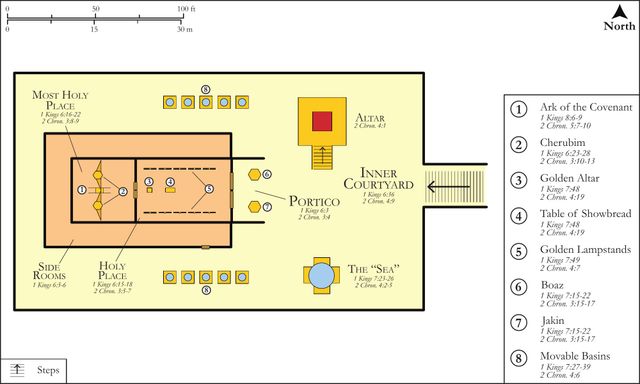
Here is an account of 1. The two cherubim, which were set up in the holy of holies. There were two already over the ark, which covered the mercy-seat with their wings; these were small ones. Now that the most holy place was enlarged, though these were continued (being appurtenances to the ark, which was not to be made new, as all the other utensils of the tabernacle were), yet those two large ones were added, doubtless by divine appointment, to fill up the holy place, which otherwise would have looked bare, like a room unfurnished. These cherubim are said to be of image-work (Ch2 3:10), designed, it is likely, to represent the angels who attend the divine Majesty. Each wing extended five cubits, so that the whole was twenty cubits (Ch2 3:12, Ch2 3:13), which was just the breadth of the most holy place, Ch2 3:8. They stood on their feet, as servants, their faces inward toward the ark (Ch2 3:13), that it might appear they were not set there to be adored (for then they would have been made sitting, as on a throne, and their faces towards their worshippers), but rather as themselves attendants on the invisible God. We must not worship angels, but we must worship with angels; for we have come into communion with them (Heb 12:22), and must do the will of God as the angels do it. The thought that we are worshipping him before whom the angels cover their faces will help to inspire us with reverence in all our approaches to God. Compare Co1 11:10 with Isa 6:2. 2. The veil that parted between the temple and the most holy place, Ch2 3:14. This denoted the darkness of that dispensation, and the distance which the worshippers were kept at; but, at the death of Christ, this veil was rent; for through him we are made nigh, and have boldness not only to look, but to enter, into the holiest. On this he was wrought cherubim. Heb. he caused them to ascend, that is, they were made in raised work, embossed. Or he made them on the wing in an ascending posture, as the other two that stood on their feet in an attending posture, to remind the worshippers to lift up their hearts, and to soar upwards in their devotions. 3. The two pillars which were set up before the temple. Both together were somewhat above thirty-five cubits in length (Ch2 3:15), about eighteen cubits high a-piece. See Kg1 7:15, etc., where we took a view of those pillars, Jachin and Boaz, establishment and strength in temple-work and by it.
Continue studying 2 Chronicles 3:14 across the web’s major study libraries — every link below opens this exact verse, chapter, or book on the destination site.
Read & Compare
 BibleGatewayThis verse in more than 200 translations and 70 languages.
 Bible.comThe YouVersion reader — hundreds of translations, reading plans, and highlights.
 ESV.orgCrossway's official English Standard Version reader.
 NET BibleThe NET translation with 60,000+ translators' notes on every rendering decision.
 STEP BibleTyndale House's free study tool — original text, vocabulary, and scholarly resources.
 BibliaLogos Bible Software's free web reader.
 USCCBThe New American Bible (Revised Edition) with the U.S. bishops' study notes.
Commentaries
 BibleHub CommentariesDozens of classic commentaries on this verse, gathered on one page.
 StudyLightMore than 100 commentary sets — the largest collection on the web.
 BibleRefPlain-English commentary on what this verse means, verse by verse.
 Enduring WordDavid Guzik's free commentary on this chapter, widely used by Bible teachers.
 Bible Study ToolsVerse commentary alongside Greek and Hebrew study aids.
Original Language & Research
- BibleHub InterlinearThe verse word by word — original language, transliteration, and English.
- BibleHub LexiconEvery word's original-language definition and Strong's entry.
 Blue Letter BibleDeep-study tools — Strong's numbers, concordance, and word studies.
 SefariaThe Hebrew text with Rashi and centuries of Jewish commentary.
Sermons, Hymns & Audio


TrulyRandomVerse is not affiliated with these sites and doesn’t control their content. They’re linked because they’re genuinely useful.
Summary
2 Chronicles 3:14 meticulously describes the construction of the Temple's inner veil, a magnificent curtain separating the Holy Place from the Most Holy Place. Crafted from luxurious blue, purple, and crimson fabrics, interwoven with fine linen, and intricately embroidered with cherubim, this sacred barrier was far more than a decorative element. It served as a profound theological boundary, emphasizing God's absolute holiness, His transcendent purity, and the restricted, divinely ordained access to His immediate presence. Its design reflected continuity with the wilderness Tabernacle and underscored the Temple's grandeur as the earthly dwelling place of the Almighty, instilling a deep sense of reverent awe in all who approached.
Context
ShowHideLiterary Context
This verse is strategically placed within the Chronicler's detailed account of Solomon's construction of the Temple in Jerusalem. Following the foundational work and the erection of the main structure (2 Chronicles 3:1-9), the narrative shifts to the interior components, meticulously describing the sacred furnishings and divisions. The veil, or parokhet, is presented as a critical element, immediately preceding the description of the two impressive pillars (2 Chronicles 3:15-17) and the various Temple vessels (2 Chronicles 4). Its inclusion here highlights its central role in defining the Most Holy Place, the sanctum sanctorum, which was destined to house the Ark of the Covenant and symbolize the very presence of God among His people. The Chronicler's emphasis on these precise architectural and material details underscores the Temple's divine blueprint and its direct continuity with the patterns of worship established by God for the Tabernacle in the wilderness.
Historical & Cultural Context
Solomon's Temple, built around the 10th century BCE, represented a monumental shift in Israelite worship from the portable Tabernacle to a permanent, grand edifice in Jerusalem. It became the undisputed spiritual and national center for Israel, a tangible manifestation of God's covenant presence. In Israel, sacred space with progressively restricted access, as at Sinai where bounds were set about the mount and in the Tabernacle behind its veil, uniquely emphasized the transcendent holiness of Yahweh and His absolute purity. The veil, therefore, was not merely a functional divider but a potent theological statement, physically embodying the profound separation between a holy God and a sinful humanity. This barrier ensured that only the High Priest, after rigorous purification rituals and only once a year on the Day of Atonement, was permitted to pass beyond it to perform the most sacred rites of atonement for the nation's sins.
Key Themes
ShowHide2 Chronicles 3:14 contributes significantly to several overarching themes within the book and the broader biblical narrative. Firstly, it powerfully conveys the theme of Divine Separation and Holiness. The veil served as a constant, tangible reminder of God's absolute purity and the reverence required to approach Him, marking the Most Holy Place as uniquely sacred and inaccessible to the common person. Secondly, the Symbolism of Materials and Colors is paramount: "blue" (tᵉkêleth) often represented heaven and divinity; "purple" (ʼargâmân) signified royalty and majesty, befitting the King of the universe; "crimson" (karmîyl) pointed to life, vitality, and crucially, atonement and sacrifice; and "fine linen" (bûwts) symbolized purity and righteousness. The Cherubim embroidered on the veil reinforced this theme of guarded holiness, echoing their role in guarding the Garden of Eden after the Fall. Thirdly, the verse highlights Continuity and Perfection in God's prescribed worship, as the Temple's veil meticulously mirrored the Tabernacle's, demonstrating consistency in divine instruction across generations. The lavishness of the materials also showcased the Temple's grandeur, reflecting the immense honor and glory due to the Almighty.
Exposition and Analysis
ShowHideKey Word Analysis
ShowHideThis specific Hebrew term (H6532) refers exclusively to the inner curtain that separated the Holy Place from the Most Holy Place in both the Tabernacle and the Temple. It is distinct from other curtains or screens. Its primary function was to act as a barrier, signifying the sacred, unapproachable nature of God's immediate presence. The pôreketh was not merely a physical divider but a profound theological symbol of the chasm between a holy God and sinful humanity, a chasm that could only be bridged by divinely ordained means.
This term (H3758) denotes a deep red color, often associated with richness and sacrifice. In the context of the Temple veil, alongside blue and purple, it contributed to the visual representation of God's majesty and the solemnity of His dwelling. The use of such a vibrant, costly color for a sacred textile underscored the preciousness of God's presence and the significance of the atonement rituals performed within the Most Holy Place.
These are celestial beings (H3742) frequently depicted in Scripture as guardians of God's holy presence and glory. They appear in Genesis guarding the way to the tree of life, in Ezekiel's visions of God's throne-chariot, and as decorative elements in the Tabernacle and Temple. Their presence on the veil was not merely artistic but functional: they visually reinforced the sanctity and guarded nature of the Holy of Holies, serving as a constant reminder that this space was off-limits to all but the High Priest, and then only under strict, divinely prescribed conditions. They symbolized the divine protection of God's holiness.
Verse Breakdown
ShowHide"And he made the vail"
This opening clause attributes the construction of this crucial element directly to King Solomon, acting under divine instruction. The "vail" (pôreketh) was not an optional or incidental feature but a central, divinely mandated component, essential for defining the sacred space and regulating access to God's immediate presence. Its creation was an act of profound obedience and worship, meticulously fulfilling the patterns established in the wilderness Tabernacle.
"[of] blue, and purple, and crimson, and fine linen"
This specifies the luxurious and symbolically rich materials comprising the veil. The deliberate selection of these colors and fine linen was not arbitrary; they were divinely prescribed for the most sacred textiles of both the Tabernacle and the Temple (e.g., Exodus 26:31). Each material carried profound theological weight: blue for the heavens and divinity, purple for royalty and majesty, crimson for life and atonement, and fine linen for purity and righteousness. Their combined lavishness communicated the immense value and honor ascribed to God's presence.
"and wrought cherubims thereon"
This describes the intricate embroidery of cherubim onto the fabric of the veil. The term "wrought" (from H5927, ʻâlâh, here implying "caused to ascend" or "worked upon") indicates skilled craftsmanship, suggesting these angelic figures were intricately woven into the very fabric. Their depiction served as a powerful visual reminder of God's transcendence and the guarded nature of His holiness. Just as cherubim guarded the entrance to Eden after the Fall, so too did their presence on the veil signify that access to God's unmediated presence was restricted and protected, emphasizing the profound separation between God and humanity due to sin.
Literary Devices
ShowHideThe verse employs several significant literary devices to convey its profound theological message. Symbolism is paramount, as the entire veil, its specific colors, luxurious materials, and embroidered cherubim are deeply imbued with meaning, collectively representing divine holiness, royalty, atonement, purity, and the guarded, restricted access to God's presence. The precise listing of colors—"blue, and purple, and crimson, and fine linen"—functions as a form of Merism, where a comprehensive reality (the veil's rich and divinely ordained composition) is conveyed by enumerating its key, representative components. Furthermore, the veil itself, as a physical and theological barrier to God's immediate presence, serves as a powerful instance of Foreshadowing. It subtly points forward to a future time when this barrier would be removed, hinting at a new and more direct access to God. The detailed description also acts as a form of Emphasis, highlighting the extreme importance and sacredness of this particular element within the Temple structure, underscoring its role in defining the very core of Israelite worship and theology.
Theological and Thematic Connections
ShowHideThe veil of the Temple, as described in 2 Chronicles 3:14, stands as a profound theological statement about the nature of God and humanity's relationship with Him under the Old Covenant. It vividly depicted God's unapproachable holiness, His transcendent purity, and the absolute necessity of a divinely appointed mediator and atonement for sinful humanity to draw near. This physical barrier was a constant, tangible reminder of the consequences of sin—separation from God's immediate presence. Yet, even in its restrictive nature, it paradoxically pointed to God's gracious provision for limited, ritualistic access through the High Priest, thereby foreshadowing a more perfect and permanent way to bridge the chasm between Creator and creature, a way that would ultimately be revealed through Christ.
Reflection and Application
ShowHideThe veil of 2 Chronicles 3:14, with its rich materials, intricate design, and guarded symbolism, serves as a powerful and enduring reminder of God's transcendent holiness and the profound separation that sin creates between humanity and the divine. For the ancient Israelite, it instilled a deep sense of awe, reverence, and humility, underscoring that access to God's immediate presence was not to be taken lightly but was a sacred privilege, tightly regulated by divine command and mediated through specific rituals and individuals. Today, as believers living under the New Covenant, this ancient barrier invites us to reflect on the immense and unfathomable privilege we now have in Jesus Christ. The dramatic tearing of the veil at the moment of Jesus' crucifixion signifies that the way into God's presence is now wide open, not through human merit or ritualistic adherence, but through the perfect, once-for-all sacrifice of the Son. This glorious truth should cultivate in us both a profound gratitude for such unhindered access and a continued, deep reverence for the holy God whom we now approach, not with fear of judgment, but with humble confidence, worship, and a desire to live lives worthy of such a great salvation.
Questions for Reflection
ShowHideFAQ
ShowHideWhat was the primary purpose of the veil in Solomon's Temple?
ShowHideThe primary purpose of the veil (or pôreketh) in Solomon's Temple was to serve as a sacred barrier, physically and symbolically separating the Holy Place from the Most Holy Place (Holy of Holies). This separation underscored the absolute holiness of God and the profound chasm between a holy God and sinful humanity. It restricted access to God's immediate presence, allowing only the High Priest to enter the Most Holy Place once a year on the Day of Atonement to make atonement for the sins of the people. It was a constant visual reminder that direct, unmediated access to God was not possible under the Old Covenant due to humanity's fallen state.
Why were cherubim embroidered onto the veil?
ShowHideThe cherubim embroidered onto the veil were not merely decorative; they carried significant theological meaning. Cherubim are angelic beings consistently associated with guarding God's holy presence and glory throughout Scripture. They were first seen guarding the way to the tree of life after humanity's expulsion from Eden. Their presence on the veil reinforced the sanctity and guarded nature of the Holy of Holies, emphasizing that this was the dwelling place of a holy God, protected from unauthorized access. They visually communicated the awe and reverence required to approach the divine, symbolizing the divine protection of God's sacred space and the inaccessibility of His unmediated presence to sinful humanity.
Christ-Centered Fulfillment
ShowHideThe veil described in 2 Chronicles 3:14, with its profound symbolism of separation, guarded holiness, and restricted access, finds its ultimate and glorious fulfillment in the person and work of Jesus Christ. This physical barrier, which for centuries prevented direct access to God's immediate presence, was dramatically torn in two from top to bottom at the very moment of Christ's death on the cross (Matthew 27:51; Mark 15:38; Luke 23:45). This miraculous event was a divine declaration that the old covenant system, with its limitations, shadows, and barriers, had been superseded. Through His perfect, once-for-all sacrifice, Jesus, our great High Priest, opened a "new and living way" into the very presence of God (Hebrews 10:19-20). His flesh became the "veil" that was torn, allowing all who believe to boldly draw near to the throne of grace with confidence, not fear (Hebrews 4:14-16). The vibrant blue, purple, and crimson colors, along with the cherubim on the ancient veil, pointed to God's heavenly majesty, eternal royalty, and the necessity of atonement; Christ's shed blood is the ultimate crimson, His kingship is eternal, and His sacrifice perfectly atones, granting us direct, unhindered access to the true Holy of Holies, "not made with human hands" (Hebrews 9:11-14). Thus, what the veil symbolized—God's holiness and humanity's separation—Christ perfectly addressed and resolved, bringing reconciliation and intimate communion between God and His redeemed people.