


2 Chronicles 3:15
Bible text: King James Version (1769 Blayney text) · Public domain
Bible text: King James Version with Strong's numbers · Public domain
Bible text: Berean Standard Bible · Public domain
Bible text: American Standard Version (1901) · Public domain
Bible text: World English Bible, Messianic edition · Public domain
Bible text: Geneva Bible (1599) · Public domain
Bible text: Young's Literal Translation · Public domain
- וַיַּעַשׂvai·Ya·'asand he madeH6213Conj-w ¦ V-Qal-ConsecImperf-3msVerb Qal Consecutive Imperfect 3rd Singular Masculineוַandיַּעַשׂhe made
- לִפְנֵיlif·Nei<to> beforeH6440Prep-l ¦ N-mpcNoun Plural Masculine Constructלִ<to>פְנֵיbefore
- הַבַּיִתha·Ba·yitthe houseH1004Art ¦ N-msNoun Singular Masculine Absoluteהַtheבַּיִתhouse
- עַמּוּדִים'a·mu·DimpillarsH5982N-mpNoun Plural Masculine Absolute
- שְׁנַיִםshe·Na·yimtwoH8147N-cdNoun Dual common gender Absolute
- אַמּוֹת'a·MotcubitsH520N-fpNoun Plural Feminine Absolute
- שְׁלֹשִׁיםshe·lo·ShimthirtyH7970N-mpNoun Plural Masculine Absolute
- וְחָמֵשׁve·cha·Meshand fiveH2568Conj-w ¦ N-csNoun Singular common gender Absoluteוְandחָמֵשׁfive
- אֹרֶךְ'O·rekhlengthH753N-msNoun Singular Masculine Absolute
- וְהַצֶּפֶתve·ha·Tze·fetand the capitalH6858Conj-w ¦ Art ¦ N-fsNoun Singular Feminine Absoluteוְandהַtheצֶּפֶתcapital
- אֲשֶׁר'a·SherwhichH834RelParticle Relative
- עַל'al[was] onH5921PrepPreposition
- רֹאשׁוֹro·Shoits topH7218N-msc ¦ 3msNoun Singular Masculine Constructרֹאשׁtopוֹits
- אַמּוֹת'a·Mot[was] cubitsH520N-fpNoun Plural Feminine Absolute
- חָמֵשׁcha·MeshfiveH2568N-csNoun Singular common gender Absolute
English is a literal word-by-word gloss of the Hebrew, not the KJV's wording. Why?
This is the original text the KJV's translators worked from — each Hebrew word with its own literal English meaning in this verse, prepared by scholars at Tyndale House, Cambridge. The KJV translates whole sentences, not word by word, so its wording differs: one Hebrew word can become several English words, and the KJV may choose “the LORD” where the gloss reads “Yahweh”. Both are faithful — they answer different questions. For the KJV's own rendering, switch to the KJV text.
Details
See on the biblical-era maps
Study this verse
Public-domain commentary
Matthew Henry
From his Commentary on the Whole Bible. Henry comments on passages, not single verses — this entry covers 2 Chronicles 3:10–17.
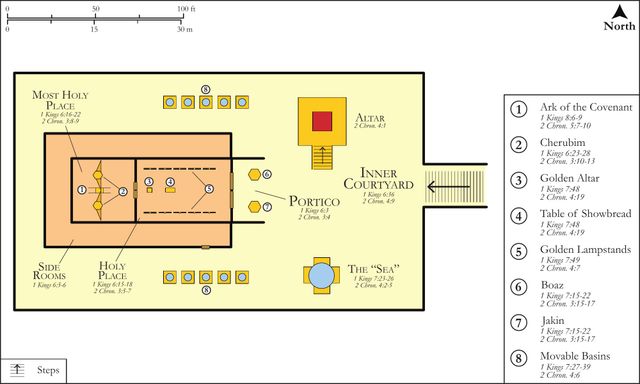
Here is an account of 1. The two cherubim, which were set up in the holy of holies. There were two already over the ark, which covered the mercy-seat with their wings; these were small ones. Now that the most holy place was enlarged, though these were continued (being appurtenances to the ark, which was not to be made new, as all the other utensils of the tabernacle were), yet those two large ones were added, doubtless by divine appointment, to fill up the holy place, which otherwise would have looked bare, like a room unfurnished. These cherubim are said to be of image-work (Ch2 3:10), designed, it is likely, to represent the angels who attend the divine Majesty. Each wing extended five cubits, so that the whole was twenty cubits (Ch2 3:12, Ch2 3:13), which was just the breadth of the most holy place, Ch2 3:8. They stood on their feet, as servants, their faces inward toward the ark (Ch2 3:13), that it might appear they were not set there to be adored (for then they would have been made sitting, as on a throne, and their faces towards their worshippers), but rather as themselves attendants on the invisible God. We must not worship angels, but we must worship with angels; for we have come into communion with them (Heb 12:22), and must do the will of God as the angels do it. The thought that we are worshipping him before whom the angels cover their faces will help to inspire us with reverence in all our approaches to God. Compare Co1 11:10 with Isa 6:2. 2. The veil that parted between the temple and the most holy place, Ch2 3:14. This denoted the darkness of that dispensation, and the distance which the worshippers were kept at; but, at the death of Christ, this veil was rent; for through him we are made nigh, and have boldness not only to look, but to enter, into the holiest. On this he was wrought cherubim. Heb. he caused them to ascend, that is, they were made in raised work, embossed. Or he made them on the wing in an ascending posture, as the other two that stood on their feet in an attending posture, to remind the worshippers to lift up their hearts, and to soar upwards in their devotions. 3. The two pillars which were set up before the temple. Both together were somewhat above thirty-five cubits in length (Ch2 3:15), about eighteen cubits high a-piece. See Kg1 7:15, etc., where we took a view of those pillars, Jachin and Boaz, establishment and strength in temple-work and by it.
Continue studying 2 Chronicles 3:15 across the web’s major study libraries — every link below opens this exact verse, chapter, or book on the destination site.
Read & Compare
 BibleGatewayThis verse in more than 200 translations and 70 languages.
 Bible.comThe YouVersion reader — hundreds of translations, reading plans, and highlights.
 ESV.orgCrossway's official English Standard Version reader.
 NET BibleThe NET translation with 60,000+ translators' notes on every rendering decision.
 STEP BibleTyndale House's free study tool — original text, vocabulary, and scholarly resources.
 BibliaLogos Bible Software's free web reader.
 USCCBThe New American Bible (Revised Edition) with the U.S. bishops' study notes.
Commentaries
 BibleHub CommentariesDozens of classic commentaries on this verse, gathered on one page.
 StudyLightMore than 100 commentary sets — the largest collection on the web.
 BibleRefPlain-English commentary on what this verse means, verse by verse.
 Enduring WordDavid Guzik's free commentary on this chapter, widely used by Bible teachers.
 Bible Study ToolsVerse commentary alongside Greek and Hebrew study aids.
Original Language & Research
- BibleHub InterlinearThe verse word by word — original language, transliteration, and English.
- BibleHub LexiconEvery word's original-language definition and Strong's entry.
 Blue Letter BibleDeep-study tools — Strong's numbers, concordance, and word studies.
 SefariaThe Hebrew text with Rashi and centuries of Jewish commentary.
Sermons, Hymns & Audio


TrulyRandomVerse is not affiliated with these sites and doesn’t control their content. They’re linked because they’re genuinely useful.
Summary
2 Chronicles 3:15 meticulously details the construction of two colossal bronze pillars, each standing thirty-five cubits high with five-cubit capitals, which King Solomon erected at the entrance of the Temple in Jerusalem. This verse underscores the immense scale, precise craftsmanship, and architectural grandeur of the sacred edifice, highlighting its awe-inspiring presence and profound symbolic significance as the designated dwelling place of God among His people.
Context
ShowHideLiterary Context
This verse is intricately woven into 2 Chronicles chapter 3, which serves as the Chronicler's detailed account of King Solomon's construction of the Temple. The Chronicler, writing for a post-exilic audience, emphasizes the Temple's foundational role in Israelite worship and its connection to the enduring Davidic covenant. Chapter 3 meticulously outlines the dimensions, materials, and key architectural features, beginning with the Temple's location on Mount Moriah, the site of Abraham's near-sacrifice of Isaac Genesis 22:2. Verse 15 specifically focuses on the two prominent pillars that stood before the sanctuary, serving as a majestic gateway to the sacred space. While the Chronicler's description here closely parallels and complements the account found in 1 Kings 7:15-22, it presents slight variations in measurements that have been a subject of scholarly discussion, underscoring the Chronicler's unique theological perspective and emphasis on certain details. The inclusion of such precise architectural details underscores both the divine blueprint and the human dedication involved in building God's dwelling.
Historical & Cultural Context
King Solomon's reign (c. 970-931 BC) marked an unparalleled era of prosperity, peace, and architectural achievement in ancient Israel. The construction of the Temple was the crowning project of his reign, fulfilling the vision of his father, King David, to build a permanent house for the Lord and the Ark of the Covenant 2 Samuel 7:1-17. Among the nations of that day, monumental architecture, particularly grand temples, served not only as places of worship but also as powerful symbols of a nation's wealth, power, and divine favor. The "cubit" was a standard unit of measurement, typically representing the length from the elbow to the tip of the middle finger (approximately 18-21 inches or 45-53 cm). The sheer size, material (bronze), and elaborate ornamentation of these pillars would have communicated a profound sense of majesty, permanence, and divine presence to all who approached the Temple, reflecting the glory and transcendence of the God of Israel.
Key Themes
ShowHideThe detailed description of the pillars in 2 Chronicles 3 contributes significantly to several overarching themes central to the book of Chronicles. Firstly, it highlights Architectural Grandeur and Divine Purpose, emphasizing the immense scale and beauty of the Temple, meticulously crafted to honor God. Every dimension and material was intended to reflect the Lord's glory and majesty, serving as a tangible representation of His presence among His people, a theme echoed in the dedication prayer of 2 Chronicles 6. Secondly, the pillars embody the Symbolism of Strength and Stability. In ancient architecture, freestanding pillars often symbolized support, permanence, and divine endorsement. These two pillars, standing prominently at the Temple's entrance, conveyed a sense of enduring strength and the steadfastness of God's covenant with Israel, a vital message for the Chronicler's audience, who had experienced exile and needed reassurance of God's faithfulness. This theme of divine steadfastness is pervasive throughout 2 Chronicles. Finally, the precise figures for height and the chapiters underscore Meticulous Craftsmanship and Obedience, emphasizing that nothing was too grand or too detailed for the Lord's house, reflecting the importance of dedicated service and adherence to divine instruction in all aspects of worship and life.
Exposition and Analysis
ShowHideKey Word Analysis
ShowHideA primitive root meaning "to do or make, in the broadest sense and widest application." In 2 Chronicles 3:15, this verb signifies King Solomon's active role in bringing the Temple's architectural elements into existence. It denotes not just simple construction but a comprehensive act of creation and execution, reflecting the meticulous planning and extensive labor involved in fulfilling the divine mandate for the Temple.
Meaning "a column (as standing); also a stand, i.e. platform." These were monumental, freestanding columns, distinct from the structural supports of the building itself. Their placement "before the house" (i.e., at the entrance porch) indicates their primary function was symbolic and aesthetic, serving as grand, imposing sentinels. In Scripture, a pillar marked the presence and faithfulness of God, as when Jacob set up a stone for a pillar at Bethel, and as the LORD went before Israel in a pillar of cloud by day and a pillar of fire by night; such pillars before the house stood for the stability of God's dwelling.
Meaning "a capital of a column." This term refers to the capital, or the ornamental top, of a pillar. The description of the chapiter being "five cubits" high indicates a substantial and highly decorative element, likely adorned with intricate designs such as lily-work, pomegranates, and network, as detailed in 1 Kings 7:19-20. These elaborate capitals would have added significantly to the visual grandeur and symbolic richness of the pillars, crowning them with beauty and theological meaning.
Verse Breakdown
ShowHide"Also he made before the house two pillars"
This opening clause establishes King Solomon as the orchestrator and builder ("he made") of these significant architectural features. The phrase "before the house" precisely locates their prominent position at the very entrance of the Temple, serving as an imposing and grand gateway or an impressive façade. The mention of "two pillars" immediately draws attention to their dual nature, which often carries symbolic weight in biblical literature, representing balance, witness, or a gateway to the divine presence.
"of thirty and five cubits high"
This provides the principal dimension of the pillars' shafts. The height of thirty-five cubits (approximately 52-61 feet or 16-19 meters) indicates an exceptionally tall and imposing structure, designed to inspire awe and convey the majesty of the God to whom the Temple was dedicated. This measurement, as noted by scholars, is distinct from the "eighteen cubits high" found in 1 Kings 7:15, prompting various interpretive solutions among commentators regarding the precise calculation or textual transmission.
"and the chapiter that [was] on the top of each of them [was] five cubits"
This specifies the height of the ornamental capitals crowning each pillar. The five-cubit (approximately 7.5-8.75 feet or 2.3-2.7 meters) chapiter would have been a substantial and visually striking component, adding significantly to the overall height and decorative complexity of the pillars. The detailed mention of the chapiter underscores the meticulous attention given to every aspect of the Temple's construction, even its decorative elements, reflecting the profound reverence for God's dwelling place.
Literary Devices
ShowHide2 Chronicles 3:15, while primarily descriptive, employs several literary devices to convey its profound message and underscore the significance of the Temple's construction. The most prominent is Precision/Detailing, as the Chronicler provides exact measurements ("thirty and five cubits," "five cubits"). This meticulous enumeration emphasizes the divine origin of the Temple's design and the human obedience required in its construction, highlighting the sacredness and importance of the edifice as a reflection of God's glory. Furthermore, the pillars themselves serve as powerful Symbolism. Though not named in this specific verse, these are the famous pillars Jachin and Boaz (named in 1 Kings 7:21), which symbolize God's promise to "establish" His kingdom and His inherent "strength." Their very presence at the Temple entrance would have been a constant visual sermon, reminding worshippers of the foundational truths of their faith and the steadfastness of God's covenant. The entire description of the Temple's construction, including these magnificent pillars, can also be seen as a form of Metonymy, where the physical structure and its components represent the divine presence, the covenant relationship between God and Israel, and the enduring nature of His promises.
Theological and Thematic Connections
ShowHideThe two pillars described in 2 Chronicles 3:15, later named Jachin and Boaz, were far more than mere architectural elements; they were profound theological statements embedded within the very fabric of God's dwelling place. Their names, "He (God) will establish" (Jachin) and "In Him is strength" (Boaz), proclaimed the very nature of God and His unwavering covenant faithfulness. Standing as majestic sentinels at the Temple's entrance, they served as a constant reminder to all who entered that God is the one who establishes His people, His kingdom, and His promises, and that all true strength, stability, and security are found exclusively in Him. This message resonated deeply with the Chronicler's post-exilic audience, who desperately needed reassurance of God's enduring promises despite their present circumstances of national upheaval and exile. These pillars symbolized the foundational truths upon which Israel's faith and future rested: God's unwavering commitment to His covenant and His omnipotent power to uphold it. They were a visible, tangible testament to the divine presence and the unshakeable stability of God's dwelling among His people.
Reflection and Application
ShowHideThe detailed account of the Temple's construction, including these magnificent pillars, serves as a powerful reminder of the importance of intentionality, excellence, and reverence in our service to God. Just as every cubit and every decorative element of the Temple was carefully considered and meticulously crafted to honor the Lord, so too are we called to live lives that reflect His glory with diligence and devotion. While we no longer build physical temples for God to dwell in, as believers, we are now called to be temples of the Holy Spirit. This calls for meticulous attention to detail in our spiritual lives, ensuring that our foundations are strong, built upon the unshakeable truth of God's Word. The pillars of Jachin and Boaz, symbolizing establishment and strength, invite us to consider where our own sense of security and power truly lies. Do we rely on our own fleeting abilities and shifting circumstances, or do we trust in God to establish our steps and provide His enduring strength for every challenge and season of life? Our lives, like these ancient pillars, should stand as a visible testament to God's faithfulness and power, pointing others to the steadfastness of His character and the enduring nature of His promises.
Questions for Reflection
ShowHideFAQ
ShowHideWhy is there a discrepancy in the height of the pillars between 2 Chronicles 3:15 and 1 Kings 7:15?
ShowHide2 Chronicles 3:15 states each pillar was "thirty and five cubits high," while 1 Kings 7:15 records them as "eighteen cubits high." This is a well-known textual variant that scholars have attempted to reconcile in several ways. One common explanation suggests that the 2 Chronicles account refers to the combined height of the two pillars (18 + 18 = 36, rounded to 35), or perhaps the total length of the bronze casting before it was cut for the two separate pillars. Another theory proposes that the 2 Chronicles account includes the height of the shaft plus the capital, or even the height of the pillar from its base within the foundation to the top of the capital, whereas 1 Kings refers only to the visible shaft above ground level. It's also possible it's a scribal error, where a Hebrew letter representing 18 was misread as 35. Regardless of the exact solution, the core message of their immense size, grandeur, and symbolic importance remains consistent across both accounts, emphasizing the Temple's majesty.
What was the symbolic significance of the names Jachin and Boaz given to these pillars (though not in this specific verse)?
ShowHideWhile 2 Chronicles 3:15 describes the dimensions of the pillars, their names, Jachin (יָכִין - yakhin) and Boaz (בֹּעַז - bo'az), are provided in 1 Kings 7:21. Jachin means "He (God) will establish," and Boaz means "In Him is strength." These names were not merely decorative but were profound theological declarations, serving as a constant sermon to all who approached the Temple. As worshippers entered the sacred space, these monumental pillars served as a constant visual and verbal reminder of God's character and promises. They proclaimed that God is the one who establishes His covenant, His kingdom, and His people, and that all true strength and stability are found in Him. They underscored the divine foundation and enduring power behind the sacred space and the nation's faith, providing reassurance of God's unwavering faithfulness.
Christ-Centered Fulfillment
ShowHideThe mighty pillars of Jachin and Boaz, standing as majestic sentinels before the Jerusalem Temple, powerfully foreshadow the ultimate establishment and strength found exclusively in Jesus Christ. The Temple itself, as the dwelling place of God and the focal point of Israel's worship, finds its ultimate reality and fulfillment in Christ, for He boldly declared, "Destroy this temple, and in three days I will raise it up, speaking of the temple of his body." Just as Jachin proclaimed God's establishment, Christ is the eternal One through whom all things were created and by whom "all things hold together" Colossians 1:17. He is the unshakeable foundation upon which God's eternal kingdom is built, the "chief cornerstone" rejected by men but chosen and precious in the sight of God 1 Peter 2:6-7. Similarly, Boaz, signifying "in Him is strength," points directly to Christ, who is indeed the power of God and the wisdom of God 1 Corinthians 1:24. In Him, believers find not only the strength to endure every trial but also the divine power for new life, spiritual transformation, and victory over sin and death. The permanence, divine establishment, and unwavering strength symbolized by these ancient pillars are fully realized and eternally secured in the person and redemptive work of Christ, who is the unshakeable foundation and the inexhaustible source of strength for His church, the new spiritual temple built of living stones Ephesians 2:19-22, 1 Peter 2:5.