TRV
TRV
- English
- King James KJV
- Complete Jewish CJB
- World English WEBM
- Berean Standard BSB
- American Standard ASV
- Geneva GNV
- Young's Literal YLT
- Douay-Rheims DRC
- International
- Shqip ALB
- العربية SVD
- বাংলা BN-IRV
- မြန်မာ Judson
- 简体文 CUV-S
- 繁體中文 CUV-T
- Čeština BKR
- Nederlands STVE
- Français LSG
- Deutsch SCH
- Ελληνικά Vamvas
- ગુજરાતી GU-IRV
- Hausa HCB
- עברית Hebrew
- हिन्दी HCV
- Magyar KAROLI
- Bahasa Indonesia INDO-TB
- Italiano Diodati
- 日本語 Kougo
- 한국어 Korean
- മലയാളം MAL
- मराठी MRCV
- Norsk DNB
- فارسی OPV
- Polski BG
- Português Almeida
- Română Cornilescu
- Русский Synodal
- Español RVG
- Kiswahili Neno
- Svenska SV1917
- Tagalog TAG-ADB
- தமிழ் TCV
- తెలుగు TSA
- ภาษาไทย THAI-KJV
- Українська Ohienko
- Tiếng Việt CADMAN
- Yorùbá YCB
Judah’s Campaigns in the South
Judah’s Campaigns in the South
Study this passage
Commentary written on this passage, not on a single verse.
- Who
- Where
- When
- About
Where else Scripture says this.
Numbers 10:29
Then Moses said to Hobab, the son of Moses’ father-in-law Reuel the Midianite, “We are setting out for the place of which the LORD said: ‘I will give it to you.’ Come with us, and we will treat you well, for the LORD has promised good things to Israel.”from verse 16Numbers 10:32
If you come with us, we will share with you whatever good things the LORD gives us.”from verse 16Judges 4:11
Now Heber the Kenite had moved away from the Kenites, the descendants of Hobab the father-in-law of Moses, and had pitched his tent by the great tree of Zaanannim, which was near Kedesh.from verse 161 Samuel 15:6
And he warned the Kenites, “Since you showed kindness to all the Israelites when they came up out of Egypt, go on and get away from the Amalekites. Otherwise I will sweep you away with them.” So the Kenites moved away from the Amalekites.from verse 16Judges 1:10
Judah also marched against the Canaanites who were living in Hebron (formerly known as Kiriath-arba), and they struck down Sheshai, Ahiman, and Talmai.from verse 20Joshua 15:63
But the descendants of Judah could not drive out the Jebusites living in Jerusalem. So to this day the Jebusites live there among the descendants of Judah.from verse 8Joshua 15:13
According to the LORD’s command to him, Joshua gave Caleb son of Jephunneh a portion among the sons of Judah—Kiriath-arba, that is, Hebron. (Arba was the forefather of Anak.)from verse 9Deuteronomy 34:3
the Negev, and the region from the Valley of Jericho (the City of Palms) all the way to Zoar.from verse 16Numbers 21:1
When the Canaanite king of Arad, who lived in the Negev, heard that Israel was coming along the road to Atharim, he attacked Israel and captured some prisoners.from verse 16Numbers 21:3
And the LORD heard Israel’s plea and delivered up the Canaanites. Israel devoted them and their cities to destruction; so they named the place Hormah.from verse 17Joshua 11:22
No Anakim were left in the land of the Israelites; only in Gaza, Gath, and Ashdod did any survive.from verse 18Joshua 15:14
And Caleb drove out from there the three sons of Anak—the descendants of Sheshai, Ahiman, and Talmai, the children of Anak.from verse 20
Public-domain commentary
Matthew Henry
From his Commentary on the Whole Bible. Henry comments on passages, not single verses — this entry covers Judges 1:1–8. His three-level outline is real structure in the source text, so it is rendered as structure.
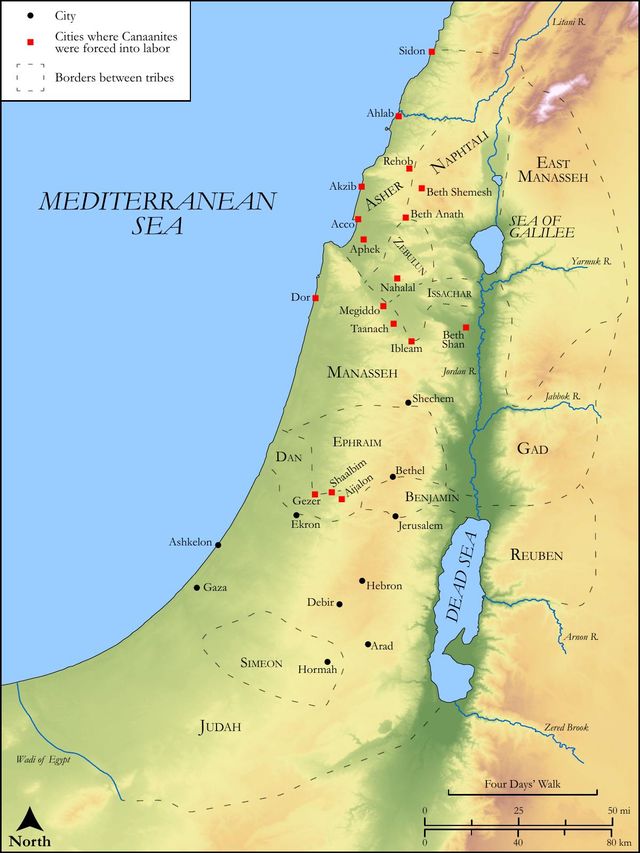
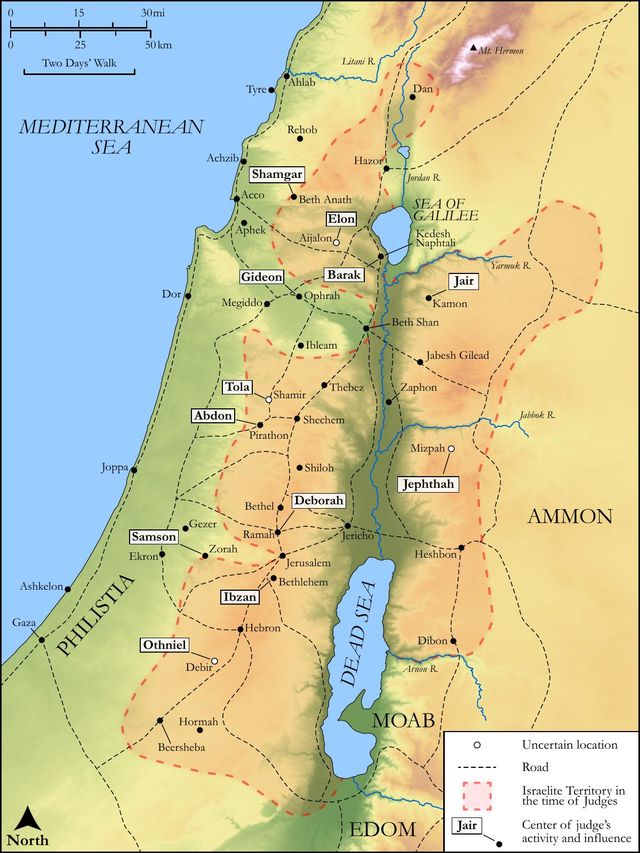
Here, I. The children of Israel consult the oracle of God for direction which of all the tribes should first attempt to clear their country of the Canaanites, and to animate and encourage the rest. It was after the death of Joshua. While he lived he directed them, and all the tribes were obedient to him, but when he died he left no successor in the same authority that he had; but the people must consult the breast-plate of judgment, and thence receive the word of command; for God himself, as he was their King, so he was the Lord of their hosts. The question they ask is, Who shall go up first? Jdg 1:1. By this time, we may suppose, they were so multiplied that the places they were in possession of began to be too strait for them, and they must thrust out the enemy to make room; now they enquire who should first take up arms. Whether each tribe was ambitious of being first, and so strove for the honour of it, or whether each was afraid of being first, and so strove to decline it, does not appear; but by common consent the matter was referred to God himself, who is the fittest both to dispose of honours and to cut out work.
II.God appointed that Judah should go up first, and promised him success (Jdg 1:2):
"I have delivered the land into his hand, to be possessed, and therefore will deliver the enemy into his hand, that keeps him out of possession, to be destroyed." And why must Judah be first in this undertaking?
1.Judah was the most numerous and powerful tribe, and therefore let Judah venture first. Note, God appoints service according to the strength he has given. Those that are most able, from them most work is expected.
2.Judah was first in dignity, and therefore must be first in duty. He it is whom his brethren must praise, and therefore he it is who must lead in perilous services. Let the burden of honour and the burden of work go together.
3.Judah was first served; the lot came up for Judah first, and therefore Judah must first fight.
4.Judah was the tribe out of which our Lord was to spring: so that in Judah, Christ, the Lion of the tribe of Judah, went before them. Christ engaged the powers of darkness first, and foiled them, which animates us for our conflicts; and it is in him that we are more than conquerors. Observe, The service and the success are put together: "Judah shall go up; let him do his part, and then he shall find that I have delivered the land into his hand." His service will not avail unless God give the success; but God will not give the success unless he vigorously apply himself to the service.
III.Judah hereupon prepares to go up, but courts his brother and neighbour the tribe of Simeon (the lot of which tribe fell within that of Judah and was assigned out of it) to join forces with him, Jdg 1:3. Observe here,
1.That the strongest should not despise but desire the assistance even of those that are weaker. Judah was the most considerable of all the tribes, and Simeon the least considerable, and yet Judah begs Simeon's friendship, and prays an aid from him; the head cannot say to the foot, I have no need of thee, for we are members one of another.
2.Those that crave assistance must be ready to give assistance: Come with me into my lot, and then I will go with thee into thine. It becomes Israelites to help one another against Canaanites; and all Christians, even those of different tribes, should strengthen one another's hands against the common interests of Satan's kingdom. Those who thus help one another in love have reason to hope that God will graciously help them both.
IV.The confederate forces of Judah and Simeon take the field:
Judah went up (Jdg 1:4), and Simeon with him, Jdg 1:3. Caleb, it is probable, was commander-in-chief of this expedition; for who so fit as he who had both an old man's head and a young man's hand, the experience of age and the vigour of youth? Jos 14:10, Jos 14:11. It should seem too, by what follows (Jdg 1:10, Jdg 1:11), that he was not yet in possession of his own allotment. It was happy for them that they had such a general as, according to his name, was all heart. Some think that the Canaanites had got together into a body, a formidable body, when Israel consulted who should go and fight against them, and that they then began to stir when they heard of the death of Joshua, whose name had been so dreadful to them; but, if so, it proved they did but meddle to their own hurt.
V.God gave them great success.
Whether they invaded the enemy, or the enemy first gave them the alarm, the Lord delivered them into their hand, Jdg 1:4. Though the army of Judah was strong and bold, yet the victory is attributed to God: he delivered the Canaanites into their hand; having given them authority, he here gives them ability to destroy them - put it in their power, and so tried their obedience to his command, which was utterly to cut them off. Bishop Patrick observes upon this that we meet not with such religious expressions in the heathen writers, concerning the success of their arms, as we have here and elsewhere in this sacred history. I wish such pious acknowledgments of the divine providence had not grown into disuse at this time with many that are called Christians. Now,
1.We are told how the army of the Canaanites was routed in the field, in or near Bezek, the place where they drew up, which afterwards Saul made the place of a general rendezvous (Sa1 11:8); they slew 10,000 men, which blow, if followed, could not but be a very great weakening to those that were already brought so very low.
2.How their king was taken and mortified. His name was Adoni-bezek, which signifies, lord of Bezek. There have been those that called their lands by their own names (Psa 49:11), but here was one (and there has been many another) that called himself by his land's name. He was taken prisoner after the battle, and we are here told how they used him; they cut off his thumbs, to disfit him for fighting, and his great toes, that he might not be able to run away, Jdg 1:6. It had been barbarous thus to triumph over a man in misery, and that lay at their mercy, but that he was a devoted Canaanite, and one that had in like manner abused others, which probably they had heard of. Josephus says, "They cut off his hands and his feet," probably supposing those more likely to be mortal wounds than only the cutting off of his thumbs and his great toes. But this indignity which they did him extorted from him an acknowledgment of the righteousness of God, Jdg 1:7. Here observe,
(1.)What a great man this Adoni-bezek had been, how great in the field, where armies fled before him, how great at home, where kings were set with the dogs of his flock; and yet now himself a prisoner, and reduced to the extremity of meanness and disgrace. See how changeable this world is, and how slippery its high places are. Let not the highest be proud, nor the strongest secure, for they know not how low they may be brought before they die.
(2.)What desolations he had made among his neighbours: he had wholly subdued seventy kings, to such a degree as to have them his prisoners; he that was the chief person in a city was then called a king, and the greatness of their title did but aggravate their disgrace, and fired the pride of him that insulted over them. We cannot suppose that Adoni-bezek had seventy of these petty princes at once his slaves; but first and last, in the course of his reign, he had thus deposed and abused so many, who perhaps were many of them kings of the same cities that successively opposed him, and whom he thus treated to please his own imperious barbarous fancy, and for a terror to others. It seems the Canaanites had been wasted by civil wars, and those bloody ones, among themselves, which would very much facilitate the conquest of them by Israel. "Judah," says Dr. Lightfoot, "in conquering Adoni-bezek, did, in effect, conquer seventy kings." (3.) How justly he was teated as he had treated others. Thus the righteous God sometimes, in his providence, makes the punishment to answer the sin, and observes an equality in his judgments; the spoiler shall be spoiled, and the treacherous dealer dealt treacherously with, Isa 33:1. And those that showed no mercy shall have no mercy shown them, Jam 2:13. See Rev 13:10; Rev 18:6. (4.) How honestly he owned the righteousness of God herein: As I have done, so God has requited me. See the power of conscience, when God by his judgments awakens it, how it brings sin to remembrance, and subscribes to the justice of God. He that in his pride had set God at defiance now yields to him, and reflects with as much regret upon the kings under his table as ever he had looked upon them with pleasure when he had them there. He seems to own that he was better dealt with than he had dealt with his prisoners; for though the Israelites maimed him (according to the law of retaliation, an eye for an eye, so a thumb for a thumb), yet they did not put him under the table to be fed with the crumbs there, because, though the other might well be looked upon as an act of justice, this would have savoured more of pride and haughtiness than did become an Israelite.
VI.Particular notice is taken of the conquest of Jerusalem, Jdg 1:8.
Our translators judge it spoken of here as done formerly in Joshua's time, and only repeated on occasion of Adoni-bezek's dying there, and therefore read it, "they had fought against Jerusalem," and put this verse in a parenthesis; but the original speaks of it as a thing now done, and this seems most probable because it is said to be done by the children of Judah in particular, not by all Israel in general, whom Joshua commanded. Joshua indeed conquered and slew Adoni-zedec, king of Jerusalem (Jos. 10), but we read not there of his taking the city; probably, while he was pursing his conquests elsewhere, this Adoni-bezek, a neighbouring prince, got possession of it, whom Israel having conquered in the field, the city fell into their hands, and they slew the inhabitants, except those who retreated into the castle and held out there till David's time, and they set the city on fire, in token of their detestation of the idolatry wherewith it had been deeply infected, yet probably not so utterly as to consume it, but to leave convenient habitations for as many as they had to put into the possession of it.
Historical interpretation
Twelve Centuries of Reception
8 surviving comments on this passage. Each one is dated, so this reads as a timeline rather than a list.
Select a marker to jump to its quote. Markers stagger vertically where authors wrote within a few decades of each other.
There are two main types of compunction, however. The penitent thirsting for God feels the compunction of fear at first; later on, he experiences the compunction of love. When he considers his sins, he is overcome with weeping because he fears eternal punishment. Then when this fear subsides through prolonged sorrow and penance, a feeling of security emerges from an assurance of forgiveness, and the soul begins to burn with a love for heavenly joys. Now the same person, who wept out of fear of punishment, sheds abundant tears because his entrance to the kingdom of heaven is being delayed. Once we envision the choirs of angels and fix our gaze on the company of the saints and the majesty of an endless vision of God, the thought of having no part in these joys makes us weep more bitterly than the fear of hell and the prospect of eternal misery did before. Thus the compunction of fear, when perfect, leads the soul to the compunction of love.This is beautifully symbolized in one of the historical books of the Bible. There we read that Achsah, the daughter of Caleb, sighed as she sat upon her beast of burden. “And Caleb asked her. ‘What is troubling you?’ She answered, ‘Give me an additional gift! Since you have assigned to me land in the Negeb, give me also pools of water.’ So he gave her the upper and the lower pools.”
We say that Achsah sat on an ass because her soul presided over the irrational movements of her flesh. Just as she begged her father with a sigh for pools of water, so must we with deep groans obtain from our Creator the grace of tears. There are some who have received the gift of speaking out openly for justice, of defending the oppressed, of sharing their possessions with the needy, of professing their faith ardently, who still do not have the grace of tears. These we may say received “land in the Negeb,” that is, “southern and dry land,” but are completely lacking in “pools of water.” It is of utmost importance, however, that those who are zealous for good works and devote much time to performing them should also weep over their past sins, either through fear of eternal punishment or through longing for God’s kingdom.
Caleb gave Achsah the upper and lower pools. These correspond to the two kinds of compunction. The soul receives the upper pools when it weeps because of its longing for heaven; it receives the lower pools when the fear of hell causes it to break forth in tears. Actually, the lower pools are given first; then, only, the upper. Yet, since the compunction of love is greater in dignity, the upper pools were necessarily mentioned first and then the lower.
The city of letters: Perhaps so called from some famous school, or library, kept there.
The city of palms: Jericho, so called from the abundance of palm trees.
Gaza: These were three of the principal cities of the Philistines, famous both in sacred and profane history. They were taken at this time by the Israelites: but as they took no care to put garrisons in them, the Philistines soon recovered them.
Was not able: Through a cowardly fear of their chariots armed with hooks and scythes, and for want of confidence in God.
The Cinite: Jethro the father in law of Moses was called Cinoeus, or the Cinite; and his children who came along with the children of Israel settled themselves among them in the land of Chanaan, embracing their worship and religion. From these the Rechabites sprung, of whom see Jer. 35.-- Ibid.