


Mark 6:8
Bible text: King James Version (1769 Blayney text) · Public domain
Bible text: King James Version with Strong's numbers · Public domain
Bible text: Berean Standard Bible · Public domain
Bible text: American Standard Version (1901) · Public domain
Bible text: World English Bible, Messianic edition · Public domain
Bible text: Geneva Bible (1599) · Public domain
Bible text: Young's Literal Translation · Public domain
- καὶkaiAndG2532CONJConjunction
- παρήγγειλενparēngeilenHe instructedG3853V-AAI-3SVerb Aorist Active Indicative 3rd Singular
- αὐτοῖςautoisto themG846P-DPMPersonal pronoun Dative Plural Masculine
- ἵναinathatG2443CONJConjunction
- μηδὲνmēdennothingG3367A-ASN-NAdjective Accusative Singular Neuter Negative
- αἴρωσινairōsinthey may takeG142V-PAS-3PVerb Present Active Subjunctive 3rd Plural
- εἰςeisfor [the]G1519PREPPreposition
- ὁδὸνhodonjourneyG3598N-ASFNoun Accusative Singular Feminine
- εἰeionlyG1487CONDConjunction
- μὴmēexceptG3361PRT-NNegative Particle Negative
- ῥάβδονrhabdona staffG4464N-ASFNoun Accusative Singular Feminine
- μόνονmononaloneG3441A-ASNAdjective Accusative Singular Neuter
- μὴmēnoG3361PRT-NNegative Particle Negative
- ἄρτονartonbreadG740N-ASMNoun Accusative Singular Masculine
- μὴmēnorG3361PRT-NNegative Particle Negative
- πήρανpēranbagG4082N-ASFNoun Accusative Singular Feminine
- μὴmēnorG3361PRT-NNegative Particle Negative
- εἰςeisinG1519PREPPreposition
- τὴνtēntheG3588T-ASFDefinite article Accusative Singular Feminine
- ζώνηνzōnēnbeltG2223N-ASFNoun Accusative Singular Feminine
- χαλκόνchalkonmoneyG5475N-ASMNoun Accusative Singular Masculine
English is a literal word-by-word gloss of the Greek, not the KJV's wording. Why?
This is the original text the KJV's translators worked from — each Greek word with its own literal English meaning in this verse, prepared by scholars at Tyndale House, Cambridge. The KJV translates whole sentences, not word by word, so its wording differs: one Greek word can become several English words, and the KJV may choose “charity” where the gloss reads “love”. Both are faithful — they answer different questions. For the KJV's own rendering, switch to the KJV text.
Details
See on the biblical-era maps
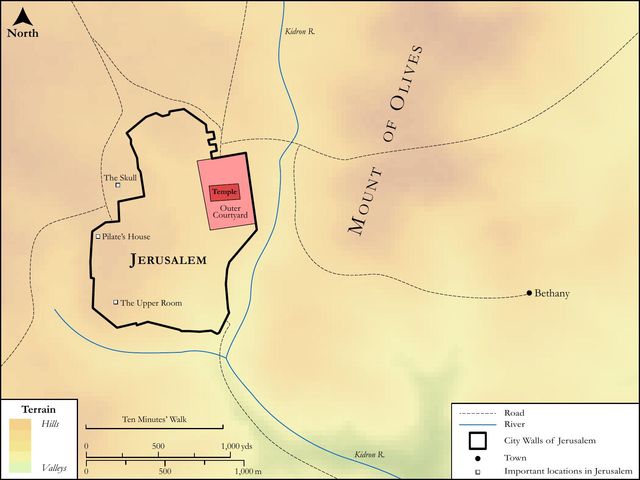
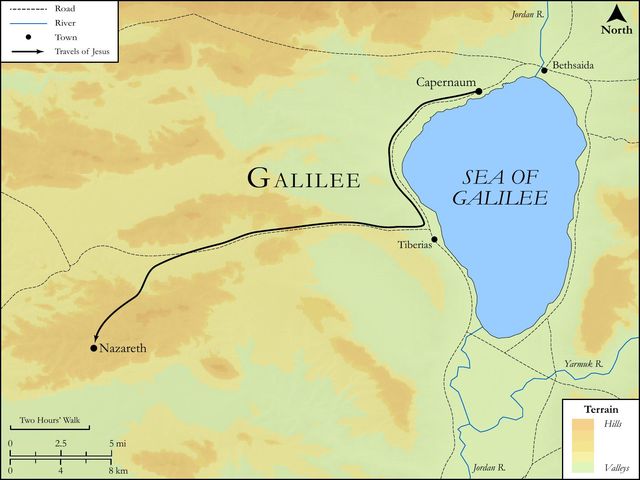
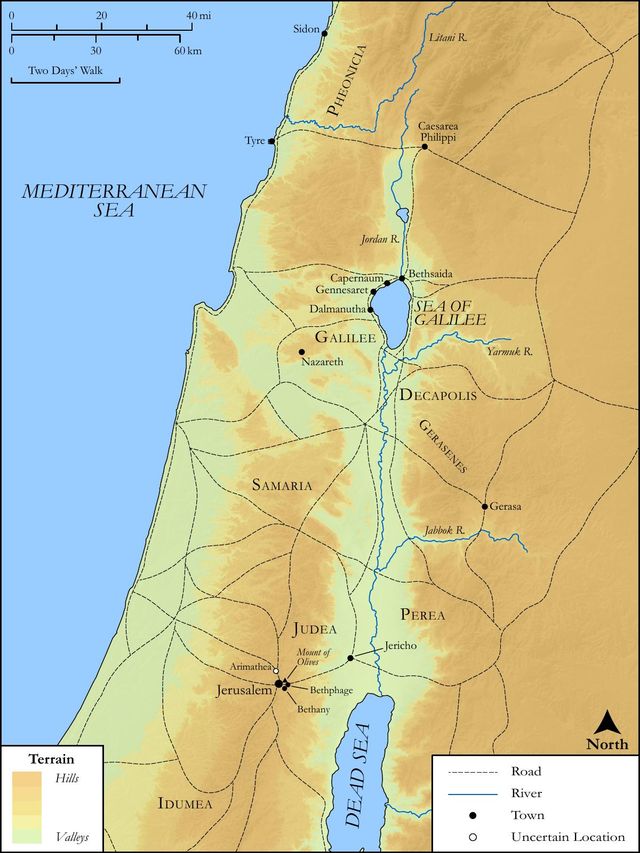
Study this verse
Public-domain commentary
Matthew Henry
From his Commentary on the Whole Bible. Henry comments on passages, not single verses — this entry covers Mark 6:7–13. His two-level outline is real structure in the source text, so it is rendered as structure.
Here is, I. The commission given to the twelve apostles, to preach and work miracles; it is the same which we had more largely, Mt. 10. Mark doth not name them here, as Matthew doth, because he had named them before, when they were first called into fellowship with him, Mar 3:16-19. Hitherto they had been conversant with Christ, and had set at his feet, had heard his doctrine, and seen his miracles; and now he determines to make some use of them; they had received, that they might give, had learned, that they might teach; and therefore now he began to send them forth. They must not always be studying in the academy, to get knowledge, but they must preach in the country, to do good with the knowledge they have got. Though they were not as yet so well accomplished as they were to be, yet, according to their present ability and capacity, they must be set to work, and make further improvements afterward. Now observe here,
1.That Christ sent them forth by two and two; this Mark takes notice of. They went two and two to a place, that out of the mouth of two witnesses every word might be established; and that they might be company for one another when they were among strangers, and might strengthen the hands, and encourage the hearts, one of another; might help one another if any thing should be amiss, and keep one another in countenance. Every common soldier has his comrade; and it is an approved maxim, Two are better than one. Christ would thus teach his ministers to associate, and both lend and borrow help.
2.That he gave them power over unclean spirits. He commissioned them to attack the devil's kingdom, and empowered them, as a specimen of their breaking his interest in the souls of men by their doctrine, to cast him out of the bodies of those that were possessed. Dr. Lightfoot suggests, that they cured diseases, and cast out devils, by the Spirit, but preached that only which they had learned from the mouth of Christ.
3.That he commanded them not to take provisions along with them, neither victuals nor money, that they might appear, wherever they came, to be poor men, men not of this world, and therefore might with the better grace call people off from it to another world. When afterward he bid them take purse and scrip (Luk 22:36), that did not intimate (as Dr. Lightfoot observes) that his care of them was abated from what it had been; but that they should meet with worse times and worse entertainment than they met with at their first mission. In Matthew and Luke they are forbidden to take staves with them, that is, fighting staves; but here in Mark they are bid to take nothing save a staff only, that is, a walking staff, such as pilgrims carried. They must not put on shoes, but sandals only, which were only the soles of shoes tied under their feet, or like pumps, or slippers; they must go in the readiest plainest dress they could, and must not so much as have two coats; for their stay abroad would be short, they must return before winter, and what they wanted, those they preached to would cheerfully accommodate them with.
4.He directed them, whatever city they came to, to make that house their head-quarters, which happened to be their first quarters (Mar 6:10); "There abide, till ye depart from that place. And since ye know ye come on an errand sufficient to make you welcome, have such charity for your friends that first invited you, as to believe they do not think you burthensome."
5.He pronounces a very heavy doom upon those that rejected the gospel they preached (Mar 6:11); "Whosoever shall not receive you, or will not so much as hear you, depart thence (if one will not, another will), and shake off the dust under your feet, for a testimony against them. Let them know that they have had a fair offer of life and happiness made them, witness that dust; but that, since they have refused it, they cannot expect ever to have another; let them take up with their own dust, for so shall their doom be." That dust, like the dust of Egypt (Exo 9:9), shall turn into a plague to them; and their condemnation in the great day, will be more intolerable than that of Sodom: for the angels were sent to Sodom, and were abused there; yet that would not bring on so great a guilt and so great a ruin as the contempt and abuse of the apostles of Christ, who bring with them the offers of gospel grace.
II.The apostles' conduct in pursuance of their commission.
Though they were conscious to themselves of great weakness, and expected no secular advantage by it, yet, in obedience to their Master's order, and in dependence upon his strength, they went out as Abraham, not knowing whither they went. Observe here,
1.The doctrine they preached; They preached that men should repent (Mar 6:12); that they should change their minds, and reform their lives, in consideration of the near approach of the kingdom of the Messiah. Note, The great design of the gospel preachers, and the great tendency of gospel preaching, should be, to bring people to repentance, to a new heart and a new way. They did not amuse people with curious speculations, but told them that they must repent of their sins, and turn to God.
2.The miracles they wrought. The power Christ gave them over unclean spirits, was not ineffectual, nor did they receive it in vain, but used it, for they cast out many devils (Mar 6:13); and they anointed with oil many that were sick, and healed them. Some think this oil was used medicinally, according to the custom of the Jews; but I rather think it was used as a sign of miraculous healing, by the appointment of Christ, though not mentioned; and it was afterward used by those elders of the church, to whom by the Spirit was given the gift of healing, Jam 5:14. It is certain here, and therefore probable there, that anointing the sick with oil, is appropriated to that extraordinary power which has long ceased, and therefore that sign must cease with it.
Historical interpretation
Seven Centuries of Reception
8 surviving comments on this verse. Each one is dated, so this reads as a timeline rather than a list.
Select a marker to jump to its quote. Markers stagger vertically where authors wrote within a few decades of each other.
To wish for nothing more than need demands
Is rest supreme, with simple food and dress
To feed and clothe our bodies and to seek
No more than is prescribed by nature’s wants.
When going on a journey, take no purse,
Nor of a second tunic think, and be
Not anxious for the morrow, lest for food
The belly lack. Our daily bread returns
With every sun. Does any bird take thought
Of tomorrow, certain to be fed by God?
Are all commanded not to have two coats, nor food in their possession, money in their purse, only a staff in the hand and shoes on the feet? Are all commanded to sell all they possess and give it to the poor, and follow Jesus? Of course not. This command is for those who earnestly desire to respond fully to grace.… The Lord says in the Gospel to him who had boasted of having kept the whole law: “If you will be perfect, go and sell all that you have, and give to the poor, and come, follow me.” He said this to those who wish to be wholly mature in faith, that he might not seem to be laying a heavy burden on unwilling shoulders.
(de Con. Evan. 2, 30.) Or else; according to Matthew (Matt. 10:19), the Lord immediately subjoined, The workman is worthy of his meat, which sufficiently proves why He forbade their carrying or possessing such things; not because they were not necessary, but because He sent them in such a way as to show, that they were due to them from the faithful, to whom they preached the Gospel. From this it is evident, that the Lord did not mean by this precept that the Evangelists ought to live only on the gifts of those to whom they preach the Gospel, else the Apostle transgressed this precept, when he procured his livelihood, by the labour of his own hands, but He meant that He had given them a power, in virtue of which, they might be assured, these things were due to them. It is also often asked, how it comes that Matthew and Luke have related that the Lord commanded His disciples not to carry even a staff, whilst Mark says, And he commanded them that they should take nothing for their journey, save a staff only. Which question is solved, by supposing that the word 'staff' has a meaning in Mark, who says that it ought to be carried, different from that which it bears in Matthew and Luke, who affirm the contrary. For in a concise way one might say, Take none of the necessaries of life with you, nay, not a staff, save a staff only; so that the saying, nay not a staff, may mean, nay not the smallest thing; but that which is added, save a staff only, may mean that, through the power received by them from the Lord, of which a rod is the ensign, nothing, even of those things which they do not carry, will be wanting to them. The Lord therefore said both, but because one Evangelist has not given both, men suppose, that he who has said that the staff, in one sense, should be taken, is contrary to him who again has declared, that, in another sense, it should be left behind: now however that a reason has been given, let no one think so. So also when Matthew declares that shoes are not to be worn on the journey, he forbids anxiety about them, for the reason why men are anxious about carrying them, is that they may not be without them. This is also to be understood of the two coats, that no man should be troubled about having only that with which he is clad, from anxiety lest he should need another, when he could always obtain one from the power given by the Lord. In like manner Mark, by saying that they are to be shod with sandals or soles, warns us that this mode of protecting the feet has a mystical signification, that the foot should neither be covered above nor be naked on the ground, that is, that the Gospel should neither be hid, nor rest upon earthly comforts; and in that He forbids their possessing or taking with them, or more expressly their wearing, two coats, He bids them walk simply, not with duplicity. But whosoever thinks that the Lord could not in the same discourse say some things figuratively, others in a literal sense, let him look into His other discourses, and he shall see, how rash and ignorant is his judgment.
(Vict. Ant. e Cat. in Marc.) The Lord also gives them this command, that they might show by their mode of life, how far removed they were from the desire of riches.
(Vict. Ant. e Cat. in Marc.) Or else, Matthew and Luke neither allow shoes nor staff, which is meant to point out the highest perfection. But Mark bids them take a staff and be shod with sandals, which (1 Cor. 7:6) is spoken by permission.
(Vict. Ant. e Cat. in Marc.) Or else, that it might be a witness of the toil of the way, which they sustained for them; or as if the dust of the sins of the preachers was turned against themselves. It goes on, And they went and preached that men should repent. And they cast out many devils, and anointed with oil many that were sick, and healed them. Mark alone mentions their anointing with oil. James however, in his canonical Epistle, says a thing similar. For oil both refreshes our labours, and gives us light and joy; but again, oil signifies the mercy of the unction of God, the healing of infirmity, and the enlightening of the heart, the whole of which is worked by prayer.
(Hom. in Evan. 17) Further, the Lord sent the disciples to preach, two and two, because there are two precepts of charity, namely, the love of God, and of our neighbour; and charity cannot be between less than two; by this therefore He implies to us, that he who has not charity towards his neighbour, ought in no way to take upon himself the office of preaching. There follows, And he commanded them, that they should take nothing for their journey, save a staff only; no scrip, no bread, no money in their purse: but be shod with sandals; and not put on two coats.
(in Marc. 2, 24) Now our kind and merciful Lord and Master did not grudge His servants and their disciples His own virtues, and as He Him self had healed every sickness and every infirmity, so also He gave the same power to His disciples. Wherefore it goes on: And he called unto him the twelve, and began to send them forth by two and two; and gave them power over unclean spirits. Great is the difference between giving and receiving. Whatsoever He does, is done in His own power, as Lord; if they do any thing, they confess their own weakness and the power of the Lord, saying in the name of Jesus, Arise, and walk.
(ubi sup.) For such should be the preacher's trust in God, that, though he takes no thought for supplying his own wants in this present world, yet he should feel most certain that these will not be left unsatisfied, lest whilst his mind is taken up with temporal things, he should provide less of eternal things to others.
(ubi sup.) Again, by the two tunics He seems to me to mean two sets of clothes; not that in places like Scythia, covered with the ice and snow, a man should be content with only one garment, but by coat, I think a suit of clothing is implied, that being clad with one, we should not keep another through anxiety as to what may happen.
(ubi sup.) Again, allegorically; under the figure of a scrip is pointed out the burdens of this world, by bread is meant temporal delights, by money in the purse, the hiding of wisdom; because he who receives the office of a doctor, should neither be weighed down by the burden of worldly affairs, nor be made soft by carnal desires, nor hide the talent of the word committed to him under the ease of an inactive body. It goes on, And he said unto them, In what place soever ye enter into an house, there abide till ye depart from that place. Where He gives a general precept of constancy, that they should look to what is due to the tie of hospitality, adding, that it is inconsistent with the preaching of the kingdom of heaven to run about from house to house.
(ubi sup.) Wherefore it is evident from the Apostles themselves, that it is an ancient custom of the holy Church that persons possessed or afflicted with any disease whatever, should be anointed with oil consecrated by priestly blessing.
And he commanded them to take nothing for the journey except a staff only. No bag, no bread, nor money in their belt, but be shod with sandals, and not put on two tunics. Such a preacher ought to have trust in God, that even if he does not provide for the needs of this life, he should surely know these things will not be lacking. Lest his mind be occupied with temporal things, he would provide less for others eternals. However, it is often questioned how Matthew and Luke recall that the Lord said to the disciples not to carry a staff, while Mark says: And he commanded them to take nothing for the journey except a staff only. This is resolved by understanding that the staff, which according to Mark is to be carried, is understood under a different signification than that which, according to Matthew and Luke, is not to be carried: just as temptation is understood under another signification in the saying, God tempts no one, and in another is said, The Lord your God tempts you, to know whether you love him. The former is of deception, the latter is of probation. Thus both sayings are to be taken as spoken by the Lord to the apostles, and to not carry a staff, and to carry nothing except a staff. For when he said to them according to Matthew: Do not possess gold, nor silver, etc.; he immediately added: For the laborer is worthy of his food. This clearly shows why he did not want them to possess or carry these things. Not that they are not necessary for the sustenance of this life, but because he was sending them out in such a way that he demonstrated these things would be owed to them by those to whom they proclaim the Gospel and believe. It is clear, however, that the Lord did not command these things in such a way that evangelists should not live from anywhere else than from those to whom they preach the Gospel. Otherwise, the apostle who sustained himself by the labor of his hands so as not to burden anyone would have acted against this precept; but he gave the authority by which they knew these things were owed to them. When, however, something is commanded by the Lord, unless it is performed, it is a fault of disobedience. When authority is given, it is permissible for anyone not to use it and to relinquish their right. Therefore, the Lord ordaining this, which the apostle says he ordained, that those who proclaim the Gospel should live from the Gospel, spoke to the apostles so that they, secure, would not possess nor carry the necessary things for this life, neither great nor small. Therefore, he added, Nor a staff, showing that all things are owed by his faithful to his ministers, requiring nothing superfluous. Thus by adding, For the laborer is worthy of his food, he completely revealed and clarified the source of these words. Therefore, he signified this authority by the name of the staff when he said to take nothing for the journey except a staff only, so it is understood that through the authority received from the Lord (which is signified by the name of the staff), even things not carried will not be lacking. This is also to be understood about two tunics, that nothing besides the one he wears should be thought necessary to be carried by him, concerned that it would be needed, since it could be received by that authority. Therefore, Mark, by saying they should be shod with sandals or shoes, suggests that this footwear has some mystical signification, so that the foot is neither covered nor naked to the ground, that is, neither the Gospel should be hidden, nor should it rely on earthly comforts.
The Lord not only preached in the cities, but also in villages, that we may learn not to despise little things, nor always to seek for great cities, but to sow the word of the Lord, in abandoned and lowly villages. Wherefore it is said, And he went round about the villages, teaching.
Again He sends the Apostles two and two that they, might become more active; for, as says the Preacher, Two are better than one. (Eccl. 4:9) But if He had sent more than two, there would not have been a sufficient number to allow of their being sent to many villages.
Instructing them also by this means not to be fond of receiving gifts, in order too that those, who saw them proclaim poverty, might be reconciled to it, when they saw that the Apostles themselves possessed nothing.
That is, lest they should be accused of gluttony in passing from one to another. It goes on, And whoever shall not receive you, &c. This the Lord commanded them, that they might show that they had walked a long way for their sakes, and to no purpose. Or, because they received nothing from them, not even dust, which they shake off, that it might be a testimony against them, that is, by way of convicting themv.
It also means, the grace of the Holy Ghost, by which we are eased from our labours, and receive light and spiritual joy.
Continue studying Mark 6:8 across the web’s major study libraries — every link below opens this exact verse, chapter, or book on the destination site.
Read & Compare
 BibleGatewayThis verse in more than 200 translations and 70 languages.
 Bible.comThe YouVersion reader — hundreds of translations, reading plans, and highlights.
 ESV.orgCrossway's official English Standard Version reader.
 NET BibleThe NET translation with 60,000+ translators' notes on every rendering decision.
 STEP BibleTyndale House's free study tool — original text, vocabulary, and scholarly resources.
 BibliaLogos Bible Software's free web reader.
 USCCBThe New American Bible (Revised Edition) with the U.S. bishops' study notes.
Commentaries
 BibleHub CommentariesDozens of classic commentaries on this verse, gathered on one page.
 StudyLightMore than 100 commentary sets — the largest collection on the web.
 BibleRefPlain-English commentary on what this verse means, verse by verse.
 Enduring WordDavid Guzik's free commentary on this chapter, widely used by Bible teachers.
 Bible Study ToolsVerse commentary alongside Greek and Hebrew study aids.
Original Language & Research
- BibleHub InterlinearThe verse word by word — original language, transliteration, and English.
- BibleHub LexiconEvery word's original-language definition and Strong's entry.
 Blue Letter BibleDeep-study tools — Strong's numbers, concordance, and word studies.
 CNTR CollationThe earliest Greek manuscripts of this verse, collated letter by letter.
Sermons, Hymns & Audio


TrulyRandomVerse is not affiliated with these sites and doesn’t control their content. They’re linked because they’re genuinely useful.
Summary
Mark 6:8 details Jesus' specific and radical instructions to His twelve disciples as He commissions them for their first significant missionary journey. This command, given as they are sent out "two by two," emphasizes an extraordinary level of trust in divine provision and a complete detachment from material encumbrances, allowing them to focus solely on the urgent proclamation of the Kingdom of God and the exercise of the authority Jesus had granted them.
Context
ShowHideLiterary Context
Mark 6:8 is an integral part of Jesus' commissioning of the twelve apostles, following His earlier ministry and the disciples' initial exposure to His teachings and miracles. The preceding verse, Mark 6:7, explicitly states that Jesus "began to send them forth by two and two; and gave them power over unclean spirits." This immediate context highlights the authority granted to them and the strategic nature of their mission. The instructions in verse 8, therefore, are not merely practical advice but a theological statement about the nature of their ministry, immediately preceding their active engagement in healing and preaching repentance, as described in Mark 6:12-13. Their subsequent return and report in Mark 6:30 underscore the completion of this specific phase of their training and mission.
Historical & Cultural Context
In the ancient Near East, travel often involved carrying provisions, money, and extra clothing for sustenance and trade, especially when embarking on journeys through diverse towns and villages where hospitality might not always be guaranteed or sufficient. Travelers would typically carry a "scrip" (a leather bag for food), bread, and money in their belt or purse for daily needs. Jesus' command to take "nothing" save a staff only, was a radical departure from these norms. It challenged the conventional wisdom of self-reliance and preparedness, placing the disciples in a position of complete vulnerability and dependence. This counter-cultural directive would have been startling to the disciples, forcing them to rely entirely on the hospitality of strangers and the direct provision of God, thereby demonstrating the unique nature and divine backing of their mission.
Key Themes
ShowHideThis verse powerfully contributes to several overarching themes within Mark's Gospel and the broader biblical narrative. The most prominent is Radical Dependence on God, where the disciples are called to absolute trust in divine provision over self-sufficiency. This theme is echoed in Jesus' teaching on worry in Matthew 6:25-34. Another key theme is the Urgency and Focus of the Mission, as the lack of provisions removes any hindrances or distractions, allowing the disciples to move swiftly and concentrate solely on proclaiming the Kingdom of God and healing. This also highlights the Authority and Power of the Gospel, demonstrating that the mission is not sustained by human resources but by divine power. Finally, it underscores the theme of Simplicity in Discipleship, advocating for a lifestyle unburdened by material possessions, which aligns with Jesus' call to discipleship found in passages like Luke 9:23.
Exposition and Analysis
ShowHideKey Word Analysis
ShowHideThis word signifies more than a mere suggestion; it denotes a formal injunction, a strict order, or a charge. Jesus is not offering advice but issuing an authoritative directive. This highlights the non-negotiable nature of the instructions and the absolute authority by which Jesus sends out His disciples.
Meaning "to lift up" or "to take up or away," this verb emphasizes the act of carrying or picking up. In this context, it specifically refers to what they were not to carry for their journey, underscoring the active prohibition against self-provision. The disciples were to actively refrain from gathering typical travel necessities.
While literally meaning "belt" or "girdle," in this context, it functions as a "purse" or a place where money was commonly carried by travelers in ancient times. The prohibition against carrying money in their belt explicitly removes any financial self-reliance, forcing them to depend on the hospitality of others for their monetary needs.
Verse Breakdown
ShowHide"And commanded them that they should take nothing for their journey"
This opening clause establishes the absolute nature of Jesus' directive. The disciples were to embark on their mission utterly devoid of the typical provisions that any traveler would consider essential. This command immediately sets a radical tone, emphasizing complete reliance on God rather than human foresight or preparation. It signifies a profound act of faith and a departure from worldly security.
"save a staff only;"
This is the single exception to the otherwise absolute prohibition. A staff (or rod) was a common and necessary item for walking in rough terrain, providing support, defense against animals, or even as a symbol of authority (though here, likely practical). Its allowance underscores that while material provision was forbidden, basic, functional tools for the journey were permitted, distinguishing between essential practicalities and provisions for comfort or self-sufficiency.
"no scrip, no bread, no money in their purse:"
This final clause provides specific examples of what "nothing" entails, reinforcing the radical nature of the command. "Scrip" (a leather bag for provisions) and "bread" directly address food, meaning they were not to carry their own sustenance. "Money in their purse" (or belt) explicitly forbids financial resources. These prohibitions collectively strip the disciples of all conventional means of self-support, compelling them to trust in God's daily provision through the hospitality of those they encountered.
Literary Devices
ShowHideMark 6:8 employs several literary devices to convey its profound message. Hyperbole is evident in the extreme nature of the command to take "nothing" for the journey. While a staff is permitted, the overall directive is an exaggeration of typical travel preparations, designed to shock and impress upon the disciples the radical nature of their dependence on God. Symbolism is also at play: the absence of scrip, bread, and money symbolizes a complete surrender of self-reliance and a tangible expression of faith in divine provision. Conversely, the permitted staff can symbolize the basic, functional support provided by God, or perhaps even the authority with which they were sent, distinguishing it from items of comfort or self-sufficiency. The verse also utilizes Contrast, setting Jesus' counter-cultural instructions against the common practices of the day, thereby highlighting the unique and divinely empowered nature of the disciples' mission.
Theological and Thematic Connections
ShowHideMark 6:8 is a powerful theological statement about the nature of discipleship and mission, emphasizing radical trust in God's provision and a single-minded focus on the Kingdom. It teaches that God's work is sustained not by human resources or foresight, but by divine power and faithfulness. This command forces the disciples into a position of absolute dependence, where every need met becomes a direct testimony to God's care. It challenges the common human tendency to rely on material security, redirecting faith towards the unseen hand of God. This principle transcends the specific historical context, calling believers in every age to prioritize spiritual mission over worldly accumulation, trusting that God will supply all that is truly needed for His purposes.
Reflection and Application
ShowHideThe radical instructions in Mark 6:8 serve as a profound challenge to contemporary believers, urging us to examine the true source of our security and provision. While few of us are literally sent out on missionary journeys without a wallet or food, the underlying principles remain profoundly relevant. This passage calls us to cultivate a deeper trust in God's faithfulness, prioritizing His Kingdom and mission above personal comfort or material accumulation. It encourages a lifestyle of simplicity, detaching ourselves from the anxieties that often accompany the pursuit of worldly possessions, and freeing us to be more responsive and available for God's call. When we step out in faith, even in small acts of obedience that feel vulnerable, we often experience God's provision in unexpected and miraculous ways, which profoundly strengthens our faith and deepens our relationship with Him. This verse reminds us that true security is found not in what we possess, but in the One who possesses us.
Questions for Reflection
ShowHideFAQ
ShowHideWas this command for all disciples for all time, or specific to this mission?
ShowHideWhile the immediate context of Mark 6:8 indicates these instructions were specific to the initial commissioning of the twelve disciples for this particular journey, the underlying principles of radical dependence on God, urgency in mission, and simplicity in lifestyle are enduring truths for all believers. Jesus later revisits the topic of provisions in Luke 22:35-36, where He asks if they lacked anything during their first journey (to which they replied "Nothing") and then gives different instructions for future missions, including taking a purse and a scrip. This suggests that the literal application of Mark 6:8 was for a specific pedagogical purpose—to teach the disciples absolute reliance on God and experience His miraculous provision firsthand—rather than a universal, perpetual command for all Christian ministry. However, the spiritual lessons of trust and focus remain timeless.
Christ-Centered Fulfillment
ShowHideMark 6:8, with its radical call to dependence and simplicity for the sake of mission, finds its ultimate fulfillment and deepest meaning in Christ Himself. Jesus, the one who "commanded" these instructions, perfectly embodied this radical trust in His Father's provision throughout His earthly ministry. He had "nowhere to lay His head" (Matthew 8:20), relying entirely on the Father for sustenance and direction, even as He ministered to thousands. He is the ultimate "bread of life" (John 6:35) and the true "staff" of His people, the very source of their strength and provision. The disciples' mission, stripped of worldly encumbrances, foreshadows the unburdened nature of the Gospel itself—a message of grace freely given, not earned or purchased. Their reliance on hospitality points to Christ as the ultimate host, inviting all into His Kingdom. Ultimately, their journey, undertaken in faith, mirrors Christ's own journey of self-emptying (Philippians 2:5-8) and complete dependence on God to accomplish the greatest mission of all: the salvation of humanity, secured not by earthly means, but by divine power and sacrificial love.