


Judges 7:14
- וַיַּעַןvai·Ya·'anand he answeredH6030Conj-w ¦ V-Qal-ConsecImperf-3msVerb Qal Consecutive Imperfect 3rd Singular Masculineוַandיַּעַןhe answered
- רֵעֵהוּre·'E·huhis neighborH7453N-msc ¦ 3msNoun Singular Masculine Constructרֵעֵneighborהוּhis
- וַיֹּאמֶרvai·Yo·merand he saidH559Conj-w ¦ V-Qal-ConsecImperf-3msVerb Qal Consecutive Imperfect 3rd Singular Masculineוַandיֹּאמֶרhe said
- אֵין'einnotH369N-mscNoun Singular Masculine Construct
- זֹאתZotthisH2063PrtParticle Demonstrative
- בִּלְתִּיbil·Ti[is] exceptH1115N-csNoun Singular common gender Absolute
- אִם'im<if>H518PrtParticle Conditional
- חֶרֶבChe·rev[the] sword ofH2719N-fscNoun Singular Feminine Construct
- גִּדְעוֹןgid·'onGideonH1439N-proper-mNoun Proper Masculine
- בֶּןben[the] son ofH1121N-mscNoun Singular Masculine Construct
- יוֹאָשׁyo·'AshJoashH3101N-proper-mNoun Proper Masculine
- אִישׁ'isha man ofH376N-mscNoun Singular Masculine Construct
- יִשְׂרָאֵלYis·ra·'ElIsraelH3478N-properNoun Proper Location
- נָתַןna·Tanhe has givenH5414V-Qal-Perf-3msVerb Qal Perfect 3rd Singular Masculine
- הָאֱלֹהִיםha·'E·lo·Him<the> GodH430Art ¦ N-mpNoun Plural Masculine Absoluteהָ<the>אֱלֹהִיםGod
- בְּיָדוֹbe·ya·Doin his handH3027Prep-b ¦ N-csc ¦ 3msNoun Singular common gender Constructבְּinיָדhandוֹhis
- אֶת'et<obj.>H853DirObjMParticle Object Indicator
- מִדְיָןmid·YanMidianH4080N-properNoun Proper Location
- וְאֶתve·'Etand <obj.>H853Conj-w ¦ DirObjMParticle Object Indicatorוְandאֶת<obj.>
- כָּלkolallH3605N-mscNoun Singular Masculine Construct
- הַמַּחֲנֶהHa·ma·cha·Nehthe armyH4264Art ¦ N-fsNoun Singular Feminine Absoluteהַtheמַּחֲנֶהarmy
English is a literal word-by-word gloss of the Hebrew, not the KJV's wording. Why?
This is the original text the KJV's translators worked from — each Hebrew word with its own literal English meaning in this verse, prepared by scholars at Tyndale House, Cambridge. The KJV translates whole sentences, not word by word, so its wording differs: one Hebrew word can become several English words, and the KJV may choose “the LORD” where the gloss reads “Yahweh”. Both are faithful — they answer different questions. For the KJV's own rendering, switch to the KJV text.
Details
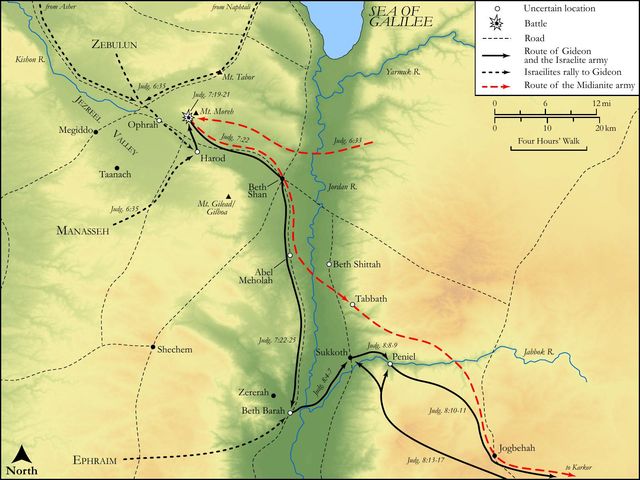
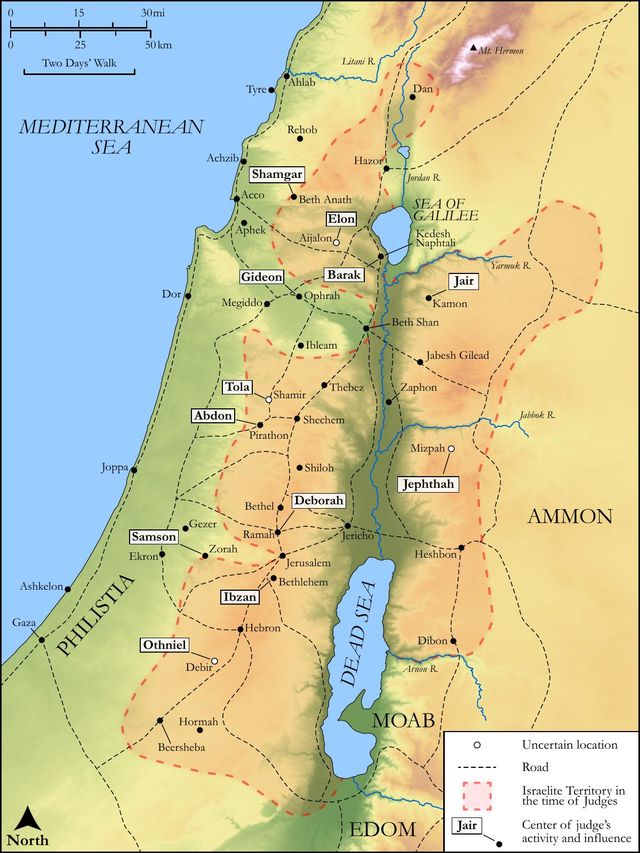
See on the biblical-era map
Study this verse
Public-domain commentary
Matthew Henry
From his Commentary on the Whole Bible. Henry comments on passages, not single verses — this entry covers Judges 7:9–15. His three-level outline is real structure in the source text, so it is rendered as structure.
Gideon's army being diminished as we have found it was, he must either fight by faith or not at all; God therefore here provides recruits for his faith, instead of recruits for his forces.
I.He furnishes him with a good foundation to build his faith upon.
Nothing but a word from God will be a footing for faith. He has this as full and express as he can desire, Jdg 7:9.
1.A word of command to warrant the action, which otherwise seemed rash and indiscreet, and unbecoming a wise general: Arise, get thee down with this handful of men unto the host.
2.A word of promise to assure him of the success, which otherwise seemed very improbable: I have delivered it into thy hand; it is all thy own. This word of the Lord came to him the same night, when he was (we may suppose) greatly agitated and full of care how he should come off; in the multitude of his thoughts within him these comforts did delight his soul. Divine consolations are given in to believers not only strongly but seasonably.
II.He furnishes him with a good prop to support his faith with.
1.He orders him to be his own spy, and now in the dead of the night to go down privately into the host of Midian, and see what intelligence he could gain: "If thou fear to go down to fight, go first only with thy own servant (Jdg 7:10) and hear what they say" (Jdg 7:11); and it is intimated to him that he should hear that which would greatly strengthen his faith. God knows the infirmities of his people, and what great encouragement they may sometimes take from a small matter; and therefore, knowing beforehand what would occur to Gideon, in that very part of the camp to which he would go down, he orders him to go down and hearken to what they said, that he might the more firmly believe what God said. He must take with him Phurah his servant, one that he could confide in, probably one of the ten that had helped him to break down the altar of Baal. He must take him and no one else with him, must take him with him to be a witness of what he should hear the Midianites say, that out of the mouth of these two witnesses, when the matter came to be reported to Israel, the word might be established. He must take his servant with him, because two are better than one and a little help is better than none.
2.Being so, he orders him the sight of something that was discouraging. It was enough to frighten him to discern, perhaps by moon-light, the vast numbers of the enemy (Jdg 7:12), the men like grasshoppers for multitude, and they proved no better than grasshoppers for strength and courage; the camels one could not count, any more than the sand. But,
3.He causes him to hear that which was to him a very good omen; and when he had heard it he went back again immediately, supposing he now had what he was sent thither for. He overheard two soldiers of the enemy, that were comrades, talking; probably they were in bed together, waking in the night.
(1.)One of them tells his dream, and as our dreams generally are, and therefore not worth telling again, it is a very foolish one. He dreamed that he saw a barley-cake come rolling down the hill into the camp of the Midianites, and "methought," says he (for so we speak in telling our dreams), "this rolling cake struck one of our tents" (perhaps one of the chief of their tents) "and with such violence that" (would you think it?) "it overturned the tent, forced down the stakes, and broke the cords at one blow, so that the tent lay along and buried its inhabitants," Jdg 7:13. In multitudes of dreams there are divers vanities, says Solomon, Ecc 5:7. One would wonder what odd incoherent things are often put together by a ludicrous fancy in our dreams.
(2.)The other, it may be between sleeping and waking, undertakes to interpret this dream, and the interpretation is very far-fetched: This is nothing else save the sword of Gideon, Jdg 7:14. Our expositors now can tell us how apt the resemblance was, that Gideon, who had threshed corn for his family, and made cakes for his friend (Jdg 6:11-19), was fitly represented by a cake, - that he and his army were as inconsiderable as a cake made of a little flour, as contemptible as a barley-cake, hastily got together as a cake suddenly baked upon the coals, and as unlikely to conquer this great army as a cake to overthrow a tent. But, after all, do not interpretations belong to God? He put it into the head of the one to dream and into the mouth of the other to give the sense of it; if Gideon had heard the dream only, and he and his servant had been left to interpret it themselves, it had so little significancy in it that it would have done him little service; but, having the interpretation from the mouth of an enemy, it not only appeared to come from God, who has all men's hearts and tongues in his hand, but it was likewise an evidence that the enemy was quite dispirited, and that the name of Gideon had become so formidable to them that it disturbed their sleep. The victory would easily be won which was already so tamely yielded: Into his hand hath God delivered Midian. Those were not likely to fight who saw God fighting against them.
Lastly, Gideon, observing the finger of God pointing him to this very place, at this very time, to hear this dream and the interpretation of it, was exceedingly encouraged by it against the melancholy apprehensions he had upon the reducing of his army. He was very well pleased to hear himself compared to a barley-cake, when it proved to effect such great things. Being hereby animated, we are told (Jdg 7:15), 1. How he gave God the glory of it; he worshipped immediately, bowed his head, or, it may be, lifted up his eyes and hands, and in a short ejaculation thanked God for the victory he was now sure of, and for this encouragement to expect it. Wherever we are, we may speak to God, and worship him, and find a way open heavenward. God must have the praise of that which is encouraging to our faith, and his providence must be acknowledged in those events which, though minute and seemingly accidental, prove serviceable to us. 2. How he gave his friends a share in the encouragements he had received: Arise, prepare to march presently; the Lord has delivered Midian into your hand.
Continue studying Judges 7:14 across the web’s major study libraries — every link below opens this exact verse, chapter, or book on the destination site.
Read & Compare
 BibleGatewayThis verse in more than 200 translations and 70 languages.
 Bible.comThe YouVersion reader — hundreds of translations, reading plans, and highlights.
 ESV.orgCrossway's official English Standard Version reader.
 NET BibleThe NET translation with 60,000+ translators' notes on every rendering decision.
 STEP BibleTyndale House's free study tool — original text, vocabulary, and scholarly resources.
 BibliaLogos Bible Software's free web reader.
 USCCBThe New American Bible (Revised Edition) with the U.S. bishops' study notes.
Commentaries
 BibleHub CommentariesDozens of classic commentaries on this verse, gathered on one page.
 StudyLightMore than 100 commentary sets — the largest collection on the web.
 BibleRefPlain-English commentary on what this verse means, verse by verse.
 Enduring WordDavid Guzik's free commentary on this chapter, widely used by Bible teachers.
 Bible Study ToolsVerse commentary alongside Greek and Hebrew study aids.
Original Language & Research
- BibleHub InterlinearThe verse word by word — original language, transliteration, and English.
- BibleHub LexiconEvery word's original-language definition and Strong's entry.
 Blue Letter BibleDeep-study tools — Strong's numbers, concordance, and word studies.
 SefariaThe Hebrew text with Rashi and centuries of Jewish commentary.
Sermons, Hymns & Audio


TrulyRandomVerse is not affiliated with these sites and doesn’t control their content. They’re linked because they’re genuinely useful.
Summary
Judges 7:14 marks a pivotal moment of divine assurance for Gideon, just prior to his improbable victory over the Midianite forces. This verse captures the unsolicited interpretation of a dream by one Midianite soldier to another, unknowingly revealing God's sovereign plan to Gideon, who was secretly listening. This enemy prophecy not only confirms the Lord's intention to deliver the vast Midianite army into Gideon's hand but also serves as a powerful, unexpected sign that fortifies Gideon's faith and emboldens him for the daunting task ahead.
Context
ShowHideLiterary Context
Judges 7:14 is strategically placed within the narrative of Gideon's campaign against the Midianites. The preceding verses detail God's dramatic reduction of Gideon's army from 32,000 to a mere 300 men, a deliberate act to ensure that the impending victory would be undeniably attributed to divine power, not human might, as stated in Judges 7:2. Despite this divine assurance, Gideon still harbors apprehension, prompting God to instruct him to infiltrate the Midianite camp with his servant Purah (Judges 7:9-11). It is during this clandestine reconnaissance that Gideon overhears a Midianite soldier recounting a dream about a humble barley cake overturning a tent, and his comrade's profound interpretation in this very verse, which directly addresses Gideon and the fate of Midian. This moment is the climax of God's preparation of Gideon, providing the final, crucial boost of faith needed before the battle commences.
Historical & Cultural Context
The period of the Judges was characterized by cyclical apostasy, oppression, and deliverance. Midian, an Arabian people, had severely oppressed Israel for seven years, raiding their crops and livestock, leading to widespread famine and despair (Judges 6:1-6). In the ancient Near East, dreams were often considered significant channels of divine communication, and their interpretation was a serious matter, believed to reveal the will of the gods or foretell future events. The Midianite soldiers' discussion of a dream, therefore, was not merely casual chatter but a reflection of a culture that took such omens seriously. Furthermore, the psychological impact of such a dream and its interpretation, even among the enemy, would have been considerable, potentially sowing seeds of doubt and fear within the Midianite ranks, which Gideon's subsequent actions would exploit.
Key Themes
ShowHideThis verse powerfully underscores several overarching themes in the book of Judges and beyond. Primarily, it highlights Divine Confirmation, where God provides an undeniable sign to His chosen instrument, Gideon, through the unexpected and unwitting testimony of the enemy. This reinforces the theme of God's Sovereignty, demonstrating His absolute control over all circumstances, even the thoughts and words of His adversaries. The declaration that "into his hand hath God delivered Midian" emphasizes that the victory is not a result of human strength or strategy, but a direct act of God's power, aligning with the principle that God often uses the weak to shame the strong. The "barley cake" of the dream (Judges 7:13) symbolically represents Gideon's humble origins and the smallness of his army, contrasting sharply with the vast Midianite host, further illustrating God's ability to achieve His purposes through seemingly insignificant means. This entire episode also showcases the strategic element of Psychological Warfare, as God uses this overheard conversation to bolster Gideon's courage while simultaneously undermining the morale of the enemy.
Exposition and Analysis
ShowHideKey Word Analysis
ShowHideWhile literally meaning a physical weapon, in this context, "the sword of Gideon" is a powerful metaphor for the divine authority, power, and destructive force that God has invested in Gideon. It signifies not Gideon's personal weapon, but the instrument through which God's judgment and victory would be executed against Midian. This metaphorical usage emphasizes that Gideon is merely God's chosen agent, and the true power behind the "sword" is divine.
This verb means "to give," "to place into the hand," or "to hand over." Its use here, "into his hand hath God delivered Midian," strongly conveys the absolute and decisive nature of God's action. It is not a suggestion or a possibility, but a declaration of a completed divine transaction. God has already, in His sovereign will, transferred control of the Midianite host into Gideon's authority, making the impending battle a mere formality of what has already been decreed in the heavens.
Referring to the entire military encampment or army, this word highlights the immense scale of the Midianite forces. The Midianites and Amalekites, along with other eastern peoples, were described as "like locusts for multitude" (Judges 7:12). The fact that God has "delivered... all the host" into Gideon's hand underscores the magnitude of the victory God is about to achieve through such a small, seemingly insignificant force, further magnifying God's power.
Verse Breakdown
ShowHide"And his fellow answered and said,"
This opening clause establishes the dialogue between the two Midianite soldiers, emphasizing that the interpretation is not a personal musing but a shared understanding within the enemy camp. The fact that it is a "fellow" soldier, presumably one with some insight or reputation, lends credibility to the interpretation within their own cultural context, making its impact on Gideon all the more profound.
"This [is] nothing else save the sword of Gideon the son of Joash, a man of Israel:"
This is the core of the Midianite's interpretation. The "this" refers to the barley cake dream recounted in the previous verse. The Midianite soldier correctly identifies the "barley cake" as a symbol of Gideon, a humble and seemingly insignificant figure from Israel, contrasting with the vastness of their own army. The phrase "the sword of Gideon" is a metaphorical declaration of Gideon's impending destructive power, divinely ordained. The mention of "the son of Joash, a man of Israel" grounds Gideon in his identity, making the prophecy specific and undeniable.
"[for] into his hand hath God delivered Midian, and all the host."
This concluding clause provides the theological rationale for the interpretation. The Midianite soldier attributes the impending defeat directly to "God" (אֱלֹהִים, Elohim), acknowledging a higher power at work. The use of "delivered" (נָתַן, nâthan) signifies a completed divine act, not a future possibility. This is a powerful, unsolicited confession from the enemy's own lips that their immense "host" has already been supernaturally surrendered to Gideon's authority by divine decree.
Literary Devices
ShowHideJudges 7:14 is rich with literary artistry that amplifies its theological significance. The most prominent device is Irony, as the very enemies of Israel unwittingly become prophets of their own destruction, delivering a message of assurance to the man destined to defeat them. This serves as a powerful testament to God's sovereign control, even over those who oppose Him. Symbolism is central, with the "barley cake" from the preceding verse representing Gideon's humble nature and the apparent weakness of his army, contrasting sharply with the formidable Midianite tent (representing their vast, imposing force). The "sword of Gideon" acts as a potent Metaphor, not for a literal weapon, but for the divinely empowered force and authority that Gideon embodies. The entire scene also functions as a moment of Foreshadowing, predicting the swift and decisive victory that is about to unfold. Furthermore, the narrative employs Divine Intervention through the medium of a dream and its interpretation, showcasing God's active involvement in human affairs and His meticulous preparation of His chosen instruments.
Theological and Thematic Connections
ShowHideJudges 7:14 serves as a profound theological statement on God's sovereignty, His methods of deliverance, and His commitment to His people. It illustrates that God's plans are not contingent upon human strength or overwhelming numbers, but upon His own power and faithfulness. The fact that the confirmation comes from the lips of an enemy soldier underscores God's ability to use any means, even the most unexpected, to achieve His purposes and strengthen the faith of His servants. This divine assurance, delivered through an unwitting prophecy, transforms Gideon's fear into courage, demonstrating that true victory belongs to the Lord. It teaches us that God often works in ways that defy human logic, choosing the weak and humble to accomplish mighty deeds, thereby ensuring that all glory redounds to Him alone.
Reflection and Application
ShowHideJudges 7:14 offers timeless encouragement for believers navigating their own daunting challenges. It reminds us that when we feel overwhelmed, outnumbered, or inadequate for the tasks before us, God often provides unexpected confirmations of His presence and purpose. Just as Gideon received an unsolicited prophecy from the enemy camp, we may find divine assurance in surprising ways – through a timely word from a friend, an unexpected breakthrough, or even an affirmation from an unlikely source. This verse calls us to cultivate a radical dependence on God, understanding that our victories are ultimately His work, not merely the result of our own efforts or strength. It challenges us to embrace humility, recognizing that God delights in using the seemingly weak or insignificant to accomplish His grand designs, ensuring that all glory belongs to Him. Therefore, when facing impossible odds, our trust should not be in our resources, but in the sovereign God who can deliver the "host" into our hands, even through a humble "barley cake."
Questions for Reflection
ShowHideFAQ
ShowHideWhy did God choose to reveal His plan to Gideon through the dream of a Midianite soldier?
ShowHideGod's choice to reveal His plan through a Midianite soldier's dream and its interpretation was a masterstroke of divine strategy, serving multiple purposes. Firstly, it provided Gideon with an undeniable, external confirmation of God's promise, originating from the very heart of the enemy camp. This unsolicited prophecy would have been far more impactful than another direct word from God, as it demonstrated God's absolute sovereignty over even His adversaries' thoughts and words. Secondly, it served to bolster Gideon's wavering faith and courage just before the battle, transforming his apprehension into conviction. God had already reduced Gideon's army to 300 men (Judges 7:2-7), making the task seem impossible from a human perspective. This overheard conversation was the final, crucial piece of assurance. Thirdly, it subtly suggests that a sense of dread or foreboding was already present within the Midianite camp, undermining their morale even before the battle began. God used their own cultural belief in dreams and omens to sow fear and division among them, demonstrating His power to work through the psychological landscape of the enemy. This method ensured that the victory would be clearly seen as God's doing, not Gideon's might.
Christ-Centered Fulfillment
ShowHideJudges 7:14, with its depiction of God delivering a vast enemy into the hands of a humble, divinely empowered leader, finds its ultimate and most profound fulfillment in the person and work of Jesus Christ. Gideon, a man of Israel, was God's chosen instrument to deliver His people from physical oppression, but Jesus is the ultimate Lamb of God who takes away the sin of the world, delivering humanity from the far greater enemies of sin, death, and the devil. The "sword of Gideon," a metaphor for divine authority and power, pales in comparison to the spiritual "sword" of Christ, which is the word of God, sharper than any two-edged sword that penetrates to the depths of the soul and brings judgment and salvation. Just as God used the seemingly weak "barley cake" to signify Gideon's victory, so too did God accomplish the greatest victory through the apparent weakness of Christ's crucifixion, where He disarmed the rulers and authorities and put them to open shame by triumphing over them in Him. The Midianite soldier's unwitting prophecy of defeat foreshadows the ultimate, cosmic defeat of Satan and his forces, a victory secured not by human might, but by the sovereign power of God through His Son, Jesus Christ, who came to destroy the works of the devil and lead us into eternal deliverance.