


Joshua 5:11
Bible text: King James Version (1769 Blayney text) · Public domain
Bible text: Berean Standard Bible · Public domain
Bible text: American Standard Version (1901) · Public domain
Bible text: World English Bible, Messianic edition · Public domain
Bible text: Geneva Bible (1599) · Public domain
Bible text: Young's Literal Translation · Public domain
- וַיֹּאכְלוּvai·Yo·khe·Luand they ateH398Conj-w ¦ V-Qal-ConsecImperf-3mpVerb Qal Consecutive Imperfect 3rd Plural Masculineוַandיֹּאכְלוּthey ate
- מֵעֲבוּרme·'a·Vursome of [the] produce ofH5669Prep-m ¦ N-mscNoun Singular Masculine Constructמֵsome ofעֲבוּר[the] produce of
- הָאָרֶץha·'A·retzthe landH776Art ¦ N-fsNoun Singular Feminine Absoluteהָtheאָרֶץland
- מִמָּחֳרַתmi·mo·cho·Ratfrom [the] next day ofH4283Prep-m ¦ N-fscNoun Singular Feminine Constructמִfromמָּחֳרַת[the] next day of
- הַפֶּסַחha·Pe·sachthe passoverH6453Art ¦ N-msNoun Title Singular Masculine Absoluteהַtheפֶּסַחpassover
- מַצּוֹתma·Tzotunleavened bread<s>H4682N-fpNoun Plural Feminine Absolute
- וְקָלוּיve·ka·Luiand roasted [grain]H7033Conj-w ¦ V-Qal-PassPrtcpl-msVerb Qal Participle Passive Singular Masculine Absoluteוְandקָלוּיroasted [grain]
- בְּעֶצֶםbe·'E·tzemon [the] substance ofH6106Prep-b ¦ N-fscNoun Singular Feminine Constructבְּonעֶצֶם[the] substance of
- הַיּוֹםhai·Yomthe dayH3117Art ¦ N-msNoun Singular Masculine Absoluteהַtheיּוֹםday
- הַזֶּהha·Zeh<the> thisH2088Art ¦ PrtParticle Demonstrativeהַ<the>זֶּהthis
English is a literal word-by-word gloss of the Hebrew, not the KJV's wording. Why?
This is the original text the KJV's translators worked from — each Hebrew word with its own literal English meaning in this verse, prepared by scholars at Tyndale House, Cambridge. The KJV translates whole sentences, not word by word, so its wording differs: one Hebrew word can become several English words, and the KJV may choose “the LORD” where the gloss reads “Yahweh”. Both are faithful — they answer different questions. For the KJV's own rendering, switch to the KJV text.
Details
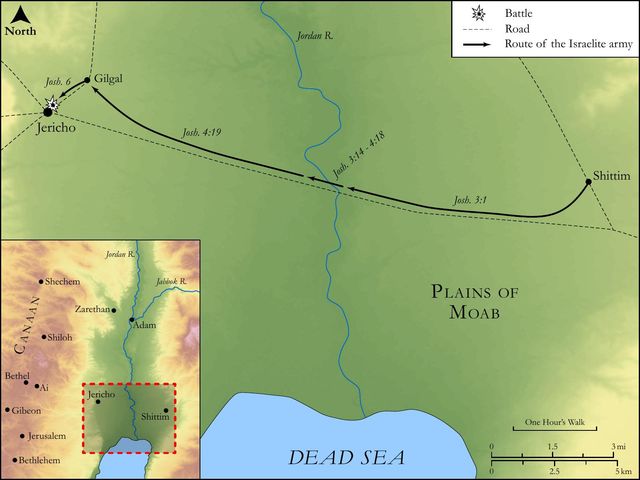
See on the biblical-era map
Study this verse
Public-domain commentary
Matthew Henry
From his Commentary on the Whole Bible. Henry comments on passages, not single verses — this entry covers Joshua 5:10–12. His three-level outline is real structure in the source text, so it is rendered as structure.
We may well imagine that the people of Canaan were astonished, and that when they observed the motions of the enemy they could not but think them very strange. When soldiers take the field they are apt to think themselves excused from religious exercises (they have not time nor thought to attend to them), yet Joshua opens the campaign with one act of devotion after another. What was afterwards said to another Joshua might truly be said to this, Hear now, O Joshua! thou and thy fellows that sit before thee are men wondered at (Zac 3:8), and yet indeed he took the right method. that is likely to end well which begins with God. Here is,
I.A solemn passover kept, at the time appointed by the law, the fourteenth day of the first month, and in the same place where they were circumcised, v. 10. While they were wandering in the wilderness they were denied the benefit and comfort of this ordinance, as a further token of God's displeasure; but now, in answer to the prayer of Moses upon the passing of that sentence Psa 90:15, God comforted them again, after the time that he had afflicted them, and therefore now that joyful ordinance is revived again. Now that they had entered into Canaan it was very seasonable to remember those wondrous works of divine power and goodness by which they were brought out of Egypt. The finishing of mercies should bring to mind the beginning of them; and when it is perfect day we must not forget how welcome the morning-light was when we had long waited for it. The solemn passover followed immediately after the solemn circumcision; thus, when those that received the word were baptized, immediately we find them breaking bread, Act 2:41, Act 2:42. They dept this passover in the plains of Jericho, as it were in defiance of the Canaanites that were round about them and enraged against them, and yet could not give them any disturbance. Thus God gave them an early instance of the performance of that promise that when they went up to keep the feasts their land should be taken under the special protection of the divine Providence. Exo 34:24, Neither shall any man desire thy land. He now prepared a table before them in the presence of their enemies, Psa 23:5.
II.Provision made for their camp of the corn of the land, and the ceasing of the manna thereupon, Jos 5:11, Jos 5:12.
Manna was a wonderful mercy to them when they needed it. But it was the mark of a wilderness state; it was the food of children; and therefore, though it was angel's food, and not to be complained of a light bread, yet it would be more acceptable to them to eat of the corn of the land, and this they are now furnished with.
1.The country people, having retired for safety into Jericho, had left their barns and fields, and all that was in them, which served for the subsistence of this great army. And the supply came very seasonably, for,
(1.)After the passover they were to keep the feast of unleavened bread, which they could not do according to the appointment when they had nothing but manna to live upon; and perhaps this was one reason why it was intermitted in the wilderness. But now they found old corn enough in the barns of the Canaanites to supply them plentifully for that occasion; thus the wealth of the sinner is laid up for the just, and little did those who laid it up think whose all these things should be which they had provided.
(2.)On the morrow after the passover-sabbath they were to wave the sheaf of first-fruits before the Lord, Lev 23:10, Lev 23:11. And this they were particularly ordered to do when they came into the land which God would vice them: and they were furnished for this with the fruit of the land that year (Jos 5:12), which was then growing and beginning to be ripe. Thus they were well provided for, both with old and new corn, as good householders. See Mat 13:52. And as soon as ever the fruits of this good land came to their hands they had an opportunity of honouring God with them, and employing them in his service according to his appointment. And thus, behold, all things were clean and comfortable to them. Calvin is of opinion that they had kept the passover every year in its season during their wandering in the wilderness, though it is not mentioned, and that God dispensed with their being uncircumcised, as he did, notwithstanding that, admit them to offer other sacrifices. but some gather from Amo 5:25 that after the sentence passed upon them there were no sacrifices offered till they came to Canaan, and consequently no passover was kept. And it is observable that after that sentence (Num. 14) the law which follows (Num. 15) concerning sacrifices begins thus: "When you shall have come into the land of your habitations" you shall do so and so.
2.Notice is taken of the ceasing of the manna as soon as ever they had eaten the old corn of the land,
(1.)To show that it did not come by chance or common providence, as snow or hail does, but by the special designation of divine wisdom and goodness; for, as it came just when they needed it, so it continued as long as they had occasion for it and no longer.
(2.)To teach us not to expect extraordinary supplies when supplies may be had in an ordinary way. If God had dealt with Israel according to their deserts, the manna would have ceased when they called it light bread; but as long as they needed it God continued it, though they despised it; and now that they needed it not God withdrew it, though perhaps some of them desired it. He is a wise Father, who knows the necessities of his children, and accommodates his gifts to them, not to their humours. The word and ordinances of God are spiritual manna, with which God nourishes his people in this wilderness, and, though often forfeited, yet they are continued while we are here; but when we come to the heavenly Canaan this manna will cease, for we shall no longer have need of it.
Historical interpretation
Historical reception
2 surviving comments on this verse. Each one is dated, so this reads as a timeline rather than a list.
Now if the law is to be understood only according to the letter, without doubt the sons of Israel will be found to have received poorer things from the promise since they had been partaking of better things—for they were receiving manna from heaven. When they had forsaken the prior food of Egypt, a better food by all means had followed, the manna from heaven. Now in what manner will it be reckoned that with a better food ceasing, a worse has followed, unless a greater and truer account is discovered in a spiritual understanding rather than in the literal text.
After they observed the Passover in Egypt, they began the exodus. In the book of Joshua, however, after the crossing of the Jordan, on the tenth day of the first month they encamped in Gilgal.…Then the sons of Israel observed the Passover on the fourteenth day of the month much more cheerfully than the one in Egypt, seeing that they also "ate unleavened bread and fresh from the grain of the holy land," a food better than the manna.
For God does not feed them on lesser foods when they have received the land according to promise, nor do they obtain inferior bread through Jesus [Joshua] who is so great. This will be clear to the one who has perceived the true holy land and the Jerusalem above.
Continue studying Joshua 5:11 across the web’s major study libraries — every link below opens this exact verse, chapter, or book on the destination site.
Read & Compare
 BibleGatewayThis verse in more than 200 translations and 70 languages.
 Bible.comThe YouVersion reader — hundreds of translations, reading plans, and highlights.
 ESV.orgCrossway's official English Standard Version reader.
 NET BibleThe NET translation with 60,000+ translators' notes on every rendering decision.
 STEP BibleTyndale House's free study tool — original text, vocabulary, and scholarly resources.
 BibliaLogos Bible Software's free web reader.
 USCCBThe New American Bible (Revised Edition) with the U.S. bishops' study notes.
Commentaries
 BibleHub CommentariesDozens of classic commentaries on this verse, gathered on one page.
 StudyLightMore than 100 commentary sets — the largest collection on the web.
 BibleRefPlain-English commentary on what this verse means, verse by verse.
 Enduring WordDavid Guzik's free commentary on this chapter, widely used by Bible teachers.
 Bible Study ToolsVerse commentary alongside Greek and Hebrew study aids.
Original Language & Research
- BibleHub InterlinearThe verse word by word — original language, transliteration, and English.
- BibleHub LexiconEvery word's original-language definition and Strong's entry.
 Blue Letter BibleDeep-study tools — Strong's numbers, concordance, and word studies.
 SefariaThe Hebrew text with Rashi and centuries of Jewish commentary.
Sermons, Hymns & Audio


TrulyRandomVerse is not affiliated with these sites and doesn’t control their content. They’re linked because they’re genuinely useful.
Summary
Joshua 5:11 records a pivotal moment for the Israelites, detailing their first consumption of the Promised Land's produce immediately following their Passover celebration in Canaan. This event profoundly marks the cessation of forty years of miraculous manna provision in the wilderness and the commencement of a new era of settled life, sustained by the natural bounty of the land, thereby powerfully demonstrating God's unwavering faithfulness to His covenant promises and His people.
Context
ShowHideLiterary Context
This verse is strategically positioned at the culmination of a series of highly significant events in the book of Joshua. It follows the miraculous crossing of the Jordan River on dry ground, an event that echoed the earlier Red Sea deliverance and solidified God's presence with Joshua, as detailed in Joshua 3:17. Immediately prior to this, the male Israelites underwent mass circumcision at Gilgal, an act that removed "the reproach of Egypt" and renewed their covenant identity, as recounted in Joshua 5:9. Following this spiritual renewal, the nation observed their first Passover in the Promised Land near Jericho, as described in Joshua 5:10. Joshua 5:11 then provides the immediate, tangible consequence of these acts of obedience and divine intervention: the cessation of manna and the commencement of eating the land's bounty, thereby setting the stage for the imminent conquest of Canaan.
Historical & Cultural Context
For four decades, the Israelites had been sustained by manna, a miraculous daily provision from God that underscored their absolute dependence on Him throughout their nomadic wilderness journey, a period extensively chronicled in Exodus 16. Their entry into Canaan represented a monumental transition from a nomadic, wilderness existence to a settled, agricultural life. The act of eating the "old corn of the land" (stored grain) and "parched corn" (roasted grain) immediately upon arrival vividly demonstrates that the land was indeed "flowing with milk and honey," as promised in Exodus 3:8, providing abundant and immediate sustenance. This act not only fulfilled ancient divine promises but also culturally integrated the Israelites into the agricultural rhythms of the land they were about to inherit, signifying a profound new phase of their national and spiritual identity.
Key Themes
ShowHideJoshua 5:11 powerfully encapsulates several major theological and narrative themes central to the book of Joshua and the broader Pentateuch. First, it profoundly underscores God's Faithful Provision, demonstrating His unwavering commitment to His covenant promises made to Abraham regarding the land of Canaan, as seen in Genesis 15:18. Second, the verse marks a definitive End of an Era and the Beginning of a New One, as the miraculous wilderness provision of manna ceases the very next day, as explicitly stated in Joshua 5:12, being replaced by the natural produce of their new homeland. This transition symbolizes Israel's maturity and their readiness to live by the fruit of their labor in the land. Third, it powerfully illustrates the principle of Obedience and Blessing, as the Israelites' faithful celebration of Passover immediately upon entering the land, as described in Joshua 5:10, is swiftly followed by this tangible blessing of sustenance directly from the land itself, affirming God's immediate favor upon their acts of faith and renewed covenant relationship.
Exposition and Analysis
ShowHideKey Word Analysis
ShowHideFrom a primitive root meaning "to eat (literally or figuratively)." In this context, it signifies the literal act of consuming food, but its deeper implication is the reception of sustenance, marking a fundamental shift in how Israel was nourished. This act of eating the land's produce signifies not just physical intake but also the appropriation of their inheritance and the tangible fulfillment of God's promise.
This term refers to stored grain, specifically produce from a previous harvest that has been kept over. Its use here is crucial because it indicates that the Israelites did not have to wait for their own crops to grow and mature. Instead, they immediately benefited from the existing agricultural bounty of Canaan, likely the stores left by the fleeing or conquered inhabitants. This emphasizes the immediacy and completeness of God's provision.
Derived from a root meaning "to pass over" or "exemption," this term technically refers to the Jewish festival commemorating God's deliverance of Israel from slavery in Egypt. Its celebration immediately prior to eating the land's produce underscores the continuity of God's redemptive work. The timing links their physical sustenance directly to their spiritual identity and obedience, highlighting that their inheritance is rooted in God's saving acts.
Verse Breakdown
ShowHide"And they did eat of the old corn of the land"
This clause signifies a monumental and immediate shift in God's provision for the nation of Israel. After forty years of miraculous, daily manna, their sustenance now transitions to come from the natural, agricultural produce of the Promised Land. The phrase "old corn" specifically denotes existing stores, likely from the previous season's harvest of the Canaanites, powerfully underscoring the immediate and abundant provision God granted them upon entry, without requiring them to sow or reap first.
"on the morrow after the passover"
The precise timing of this event is profoundly significant. This new mode of provision follows directly on the heels of their faithful celebration of the Passover, a foundational memorial of God's deliverance and covenant. This chronological link firmly connects their physical sustenance and the fulfillment of the land promise to their spiritual obedience and renewed covenant identity, demonstrating God's immediate blessing upon their faithful acts.
"unleavened cakes, and parched [corn]"
These phrases specify the forms in which the land's produce was consumed. "Unleavened cakes" directly connect to the Passover celebration and the subsequent Feast of Unleavened Bread, during which leaven was strictly forbidden as a symbol of purification and haste in their departure from Egypt. "Parched corn" refers to roasted grains, a simple, common, and immediate way to prepare grain for eating. Both items emphasize the direct, unadorned consumption of the land's bounty, signifying a practical and immediate transition to a new way of life.
"in the selfsame day"
This concluding phrase powerfully emphasizes the simultaneity and immediacy of their new sustenance. The miraculous manna ceased, and on that very day, without any gap or delay, they began to eat from the land. This detail vividly illustrates the seamless transition from one form of divine care to another, leaving no doubt about God's continuous and perfectly timed provision.
Literary Devices
ShowHideJoshua 5:11 is rich in Symbolism. The cessation of manna and the eating of the land's produce profoundly symbolizes the definitive end of the wilderness wandering and the full, tangible entry into the Promised Land. Manna represented a period of miraculous, daily dependence on God for basic sustenance, while the land's produce symbolized a new era of settled life, agricultural labor, and the fulfillment of God's promise of a land of abundance and blessing. There is also a clear Contrast between the miraculous, heavenly "bread from heaven" of the wilderness and the natural, earthly produce of Canaan, highlighting God's dynamic and adaptable nature in His provision for His people. The immediate timing, precisely "on the morrow after the passover" and "in the selfsame day," creates a powerful sense of Immediacy and divine precision, reinforcing the idea that God's blessings are prompt and directly linked to obedience and covenant faithfulness. Furthermore, the verse serves as a form of Foreshadowing, signaling the beginning of Israel's settled life, the imminent commencement of the conquest of the land, and the new way in which they would now be sustained by its own bounty.
Theological and Thematic Connections
ShowHideJoshua 5:11 stands as a powerful testament to God's unwavering covenant faithfulness and His dynamic, perfectly timed provision for His people. It marks a significant theological transition, demonstrating that while God's methods of sustenance may change, His fundamental commitment to provide for His people never wavers. The cessation of manna, which had served to teach Israel daily, absolute dependence on God in the wilderness, and the commencement of eating the land's produce, signifies their readiness to enter a new phase of responsible stewardship, labor, and settled life within the inheritance God had prepared. This verse profoundly underscores the principle that divine blessing often follows faithful obedience, as the immediate provision of the land's bounty directly followed their renewed covenant with God through circumcision and the faithful celebration of Passover. It is a tangible sign that God's promises are not merely spiritual but also material, encompassing every aspect of His people's well-being and demonstrating His comprehensive care.
Reflection and Application
ShowHideJoshua 5:11 offers a profound and enduring lesson for believers today: God's faithfulness endures through every season of life, even as His specific methods of provision may change dramatically. Just as He transitioned the Israelites from the miraculous daily manna to the natural bounty of the land, God often leads us through different phases in our lives, adapting His provision to our current needs, circumstances, and spiritual growth. This verse encourages us to cultivate deep trust in His timing and His ways, knowing with certainty that He will always supply what is needed for the journey ahead, even if that provision looks vastly different from what we've experienced before. It challenges us to be spiritually discerning, recognizing when God is orchestrating a shift in our season of provision, and to be prepared to embrace and utilize the new blessings, resources, and responsibilities He provides as we step into new phases of our spiritual journey, moving from a period of intense, visible dependence to one of stewardship, cultivation, and active participation within the "promised land" of our current calling and circumstances.
Questions for Reflection
ShowHideFAQ
ShowHideWhy did the manna stop after they ate the produce of the land?
ShowHideThe cessation of manna, explicitly detailed in Joshua 5:12, was a clear and definitive sign that Israel's wilderness wandering had concluded and they had fully entered the Promised Land. Manna was specifically provided as miraculous sustenance for their nomadic journey in the desert, serving to teach them daily dependence on God and humility, as articulated in Deuteronomy 8:3. Once they were in the fertile land of Canaan, a land they were about to inherit and cultivate, where they could sow, harvest, and gather their own food, the miraculous provision of manna was no longer necessary. This transition beautifully illustrates that God's provision changes with the season and the need, moving from the supernatural to the natural, yet always demonstrating His unwavering faithfulness and perfect timing.
What is the significance of eating "old corn" and "parched corn"?
ShowHideThe "old corn" refers to grain that was already harvested and stored, likely by the Canaanite inhabitants of the land from the previous season. This signifies that God immediately provided for Israel from the existing abundance of the land, without them having to wait for their own first harvest. It highlights the immediacy, generosity, and completeness of God's blessing upon their entry. "Parched corn" refers to roasted grains, a simple, common, and immediate method of preparing grain for consumption. Both terms emphasize that the Israelites had instant, ready-to-eat sustenance from their new home, underscoring the seamless and practical transition from the miraculous manna to the natural bounty of the land, and the tangible reality of their new, settled life as inheritors of God's promise.
Christ-Centered Fulfillment
ShowHideJoshua 5:11, with its profound depiction of Israel entering the Promised Land and partaking of its bounty immediately after the Passover, powerfully foreshadows the spiritual inheritance and abundant sustenance found in Christ. The manna in the wilderness, though miraculously provided and sustaining physical life, was ultimately temporary and insufficient for eternal life; Jesus Himself declared, "Your fathers ate the manna in the wilderness, and they died" (John 6:49). He then presented Himself as the true "bread of life" who came down from heaven, offering eternal life to all who believe and partake of Him by faith (John 6:35 and John 6:51). The transition from manna to the "old corn of the land" can be seen as a type of the transition from the old covenant, which provided temporary, earthly sustenance and pointed to a greater reality, to the new covenant in Christ, which offers ultimate and eternal spiritual nourishment. Furthermore, just as Israel entered their physical inheritance and rest after the Passover, believers enter into their spiritual inheritance and true rest in Christ, our ultimate Passover Lamb, whose sacrifice cleanses us (1 Corinthians 5:7) and secures our entry into the "heavenly places" and the true "rest" that remains for the people of God (Hebrews 4:9). Thus, Joshua 5:11 profoundly points to Christ as the ultimate fulfillment of God's provision, the inexhaustible source of our true spiritual sustenance, and the guarantor of our eternal inheritance in Him.