


Job 38:20
Bible text: King James Version (1769 Blayney text) · Public domain
Bible text: Berean Standard Bible · Public domain
Bible text: American Standard Version (1901) · Public domain
Bible text: World English Bible, Messianic edition · Public domain
Bible text: Geneva Bible (1599) · Public domain
Bible text: Young's Literal Translation · Public domain
- כִּיkithatH3588PrtParticle Conditional
- תִקָּחֶנּוּTi·ka·che·nuyou will take itH3947V-Qal-Imperf-2ms ¦ 3msVerb Qal Imperfect 2nd Singular Masculineתִקָּחֶyou will takeנּוּit
- אֶל'eltoH413PrepPreposition
- גְּבוּלוֹge·vu·Loits territoryH1366N-msc ¦ 3msNoun Singular Masculine Constructגְּבוּלterritoryוֹits
- וְכִיve·khiand thatH3588Conj-w ¦ PrtParticle Conditionalוְandכִיthat
- תָבִיןta·Vinyou will discernH995V-Qal-Imperf-2msVerb Qal Imperfect 2nd Singular Masculine
- נְתִיבוֹתne·ti·Vot[the] paths ofH5410N-fpcNoun Plural Feminine Construct
- בֵּיתוֹbei·Toits houseH1004N-msc ¦ 3msNoun Singular Masculine Constructבֵּיתhouseוֹits
English is a literal word-by-word gloss of the Hebrew, not the KJV's wording. Why?
This is the original text the KJV's translators worked from — each Hebrew word with its own literal English meaning in this verse, prepared by scholars at Tyndale House, Cambridge. The KJV translates whole sentences, not word by word, so its wording differs: one Hebrew word can become several English words, and the KJV may choose “the LORD” where the gloss reads “Yahweh”. Both are faithful — they answer different questions. For the KJV's own rendering, switch to the KJV text.
Details
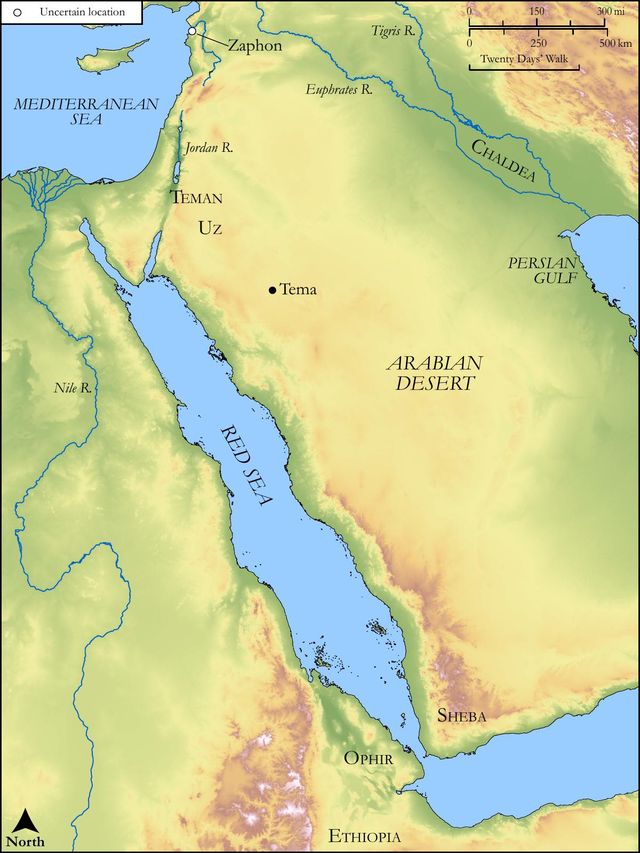
See on the biblical-era map
Study this verse
Public-domain commentary
Matthew Henry
From his Commentary on the Whole Bible. Henry comments on passages, not single verses — this entry covers Job 38:12–24. His two-level outline is real structure in the source text, so it is rendered as structure.
The Lord here proceeds to ask Job many puzzling questions, to convince him of his ignorance, and so to shame him for his folly in prescribing to God. If we will but try ourselves with such interrogatories as these, we shall soon be brought to own that what we know is nothing in comparison with what we know not. Job is here challenged to give an account of six things: -
I.Of the springs of the morning, the day-spring from on high, Job 38:12-15.
As there is no visible being of which we may be more firmly assured that it is, so there is none which we are more puzzled in describing, nor more doubtful in determining what it is, than the light. We welcome the morning, and are glad of the day-spring; but,
1.It is not commanded since our days, but what it is it was long before we were born, so that it was neither made by us nor designed primarily for us, but we take it as we find it and as the many generations had it that went before us. The day-spring knew its place before we knew ours, for we are but of yesterday.
2.It was not we, it was not any man that commanded the morning-light at first, or appointed the place of its springing up and shining forth, or the time of it. The constant and regular succession of day and night was no contrivance of ours; it is the glory of God that it shows, and his handy work, not ours, Psa 19:1, Psa 19:2.
3.It is quite out of our power to alter this course: "Hast thou countermanded the morning since thy days? Hast thou at any time raised the morning light sooner than its appointed time, to serve thy purpose when thou hast waited for the morning, or ordered the day-spring for thy convenience to any other place than its own? No, never. Why then wilt thou pretend to direct the divine counsels, or expect to have the methods of Providence altered in favour of thee?" We may as soon break the covenant of the day and of the night as any part of God's covenant with his people, and particularly this, I will chasten them with the rod of men.
4.It is God that has appointed the day-spring to visit the earth, and diffuses the morning light through the air, which receives it as readily as the clay does the seal (Job 38:14), immediately admitting the impressions of it, so as of a sudden to be all over enlightened by it, as the seal stamps its image on the wax; and they stand as a garment, or as if they were clothed with a garment. The earth puts on a new face every morning, and dresses itself as we do, puts on light as a garment, and is then to be seen.
5.This is made a terror to evil-doers. Nothing is more comfortable to mankind than the light of the morning; it is pleasant to the eyes, it is serviceable to life and the business of it, and the favour of it is universally extended, for it takes hold of the ends of the earth (Job 38:13), and we should dwell, in our hymns to the light, on its advantages to the earth. But God here observes how unwelcome it is to those that do evil, and therefore hate the light. God makes the light a minister of his justice as well as of his mercy. It is designed to shake the wicked out of the earth, and for that purpose it takes hold of the ends of it, as we take hold of the ends of a garment to shake the dust and moths out of it. Job had observed what a terror the morning light is to criminals, because it discovers them (Job 24:13, etc.), and God here seconds the observation, and asks him whether the world was indebted to him for that kindness? No, the great Judge of the world sends forth the beams of the morning light as his messengers to detect criminals, that they may not only be defeated in their purposes and put to shame, but that they may be brought to condign punishment (Job 38:15), that their light may be withholden from them (that is, that they may lose their comfort, their confidence, their liberties, their lives) and that their high arm, which they have lifted up against God and man, may be broken, and they deprived of their power to do mischief. Whether what is here said of the morning light was designed to represent, as in a figure, the light of the gospel of Christ, and to give a type of it, I will not say; but I am sure it may serve to put us in mind of the encomiums given to the gospel just at the rising of its morning-star by Zecharias in his Benedictus (Luk 1:78, By the tender mercy of our God the day-spring from on high has visited us, to give light to those that sit in darkness, whose hearts are turned to it as clay to the seal, Co2 4:6), and by the virgin Mary in her Magnificat (Luk 1:51), showing that God, in his gospel, has shown strength with his arm, scattered the proud, and put down the mighty, by that light by which he designed to shake the wicked, to shake wickedness itself out of the earth, and break its high arm.
II.Of the springs of the sea (Job 38:16):
"Hast thou entered into them, or hast thou walked in the search of the depth? Knowest thou what lies in the bottom of the sea, the treasures there hidden in the sands? Or canst thou give an account of the rise and original of the waters of the sea? Vapours are continually exhaled out of the sea. Dost thou know how the recruits are raised by which it is continually supplied? Rivers are constantly poured into the sea. Dost thou know how they are continually discharged, so as not to overflow the earth? Art thou acquainted with the secret subterraneous passages by which the waters circulate?" God's way in the government of the world is said to be in the sea, and in the great waters (Psa 77:19), intimating that it is hidden from us and not to be pried into by us.
III.Of the gates of death: Have these been open to thee? Job 38:16. Death is a grand secret.
1.We know not beforehand when, and how, and by what means, we or others shall be brought to death, by what road we must go the way whence we shall not return, what disease or what disaster will be the door to let us into the house appointed for all living. Man knows not his time.
2.We cannot describe what death is, how the knot is untied between body and soul, nor how the spirit of a man goes upward (Ecc 3:21), to be we know not what and live we know not how, as Mr. Norris expresses; with what dreadful curiosity (says he) does the soul launch out into the vast ocean of eternity and resign to an untried abyss! Let us make it sure that the gates of heaven shall be opened to us on the other side death, and then we need not fear the opening of the gates of death, though it is a way we are to go but once.
3.We have no correspondence at all with separate souls, nor any acquaintance with their state. It is an unknown undiscovered region to which they are removed; we can neither hear from them nor send to them. While we are here, in a world of sense, we speak of the world of spirits as blind men do of colours, and when we remove thither we shall be amazed to find how much we are mistaken.
IV.Of the breadth of the earth (Job 38:18):
Hast thou perceived that? The knowledge of this might seem most level to him and within his reach; yet he is challenged to declare this if he can. We have our residence on the earth, God has given it to the children of men. But who ever surveyed it, or could give an account of the number of its acres? It is but a point to the universe? yet, small as it is, we cannot be exact in declaring the dimensions of it. Job had never sailed round the world, nor any before him; so little did men know the breadth of the earth that it was but a few ages ago that the vast continent of America was discovered, which had, time out of mind, lain hidden. The divine perfection is longer than the earth and broader than the sea; it is therefore presumption for us, who perceive not the breadth of the earth, to dive into the depth of God's counsels.
V.Of the place and way of light and darkness.
Of the day-spring he had spoken before (Job 38:12) and he returns to speak of it again (Job 38:19): Where is the way where light dwells? And again (Job 38:24): By what way is the light parted? He challenges him to describe,
1.How the light and darkness were at first made. When God, in the beginning, first spread darkness upon the face of the deep, and afterwards commanded the light to shine out of darkness, by that mighty word, Let there be light, was Job a witness to the order, to the operation? can he tell where the fountains of light and darkness are, and where those mighty princes keep their courts distance, while in one world they rule alternately? Though we long ever so much either for the shining forth of the morning or the shadows of the evening, we know not whither to send, or go, to fetch them, nor can tell the paths to the house thereof, Job 38:20. We were not then born, nor is the number of our days so great that we can describe the birth of that first-born of the visible creation, Job 38:21. Shall we then undertake to discourse of God's counsels, which were from eternity, or to find out the paths to the house thereof, to solicit for the alteration of them? God glories in it that he forms the light and creates the darkness; and if we must take those as we find them, take those as they come, and quarrel with neither, but make the best of both, then we must, in like manner, accommodate ourselves to the peace and the evil which God likewise created. Isa 45:7.
2.How they still keep their turns interchangeably. It is God that makes the outgoings of the morning and of the evening to rejoice (Psa 65:8); for it is his order, and no order of ours, that is executed by the outgoings of the morning light and the darkness of the night. We cannot so much as tell whence they come nor whither they go (Job 38:24): By what way is the light parted in the morning, when, in an instant, it shoots itself into all the parts of the air above the horizon, as if the morning light flew upon the wings of an east wind, so swiftly, so strongly, is it carried, scattering the darkness of the night, as the east wind does the clouds? Hence we read of the wings of the morning (Psa 139:9), on which the light is conveyed to the uttermost parts of the sea, and scattered like an east wind upon the earth. It is a marvellous change that passes over us every morning by the return of the light and every evening by the return of the darkness; but we expect them, and so they are no surprise nor uneasiness to us. If we would, in like manner, reckon upon changes in our outward condition, we should neither in the brightest noon expect perpetual day nor in the darkest midnight despair of the return of the morning. God has set the one over against the other, like the day and night; and so must we, Ecc 7:14.
VI.Of the treasures of the snow and hail (Job 38:22, Job 38:23):
"Hast thou entered into these and taken a view of them?" In the clouds the snow and hail are generated, and thence they come in such abundance that one would think there were treasures of them laid up in store there, whereas indeed they are produced extempore - suddenly, as I may say, and pro re nata - for the occasion. Sometimes they come so opportunely, to serve the purposes of Providence, in God's fighting for his people and against his and their enemies, that one would think they were laid up as magazines, or stores of arms, ammunition, and provisions, against the time of trouble, the day of battle and war, when God will either contend with the world in general (as in the deluge, when the windows of heaven were opened, and the waters fetched out of these treasures to drown a wicked world, that waged war with Heaven) or with some particular persons or parties, as when God out of these treasures fetched great hail-stones wherewith to fight against the Canaanites, Jos 10:11. See what folly it is to strive against God, who is thus prepared for battle and war, and how much it is our interest to make our peace with him and to keep ourselves in his love. God can fight as effectually with snow and hail, if he please, as with thunder and lightning or the sword of an angel!
Historical interpretation
Historical reception
1 surviving comment on this verse from the historical church.
“Where is the way to the dwelling of light, and where is the place of darkness?” He says what he had said before but more clearly, that is, that the course of human life is regulated by the alternation of times, so that at one time people dedicate themselves to work; in another time, the vigor of the body, which exhaustion had taken away, is returned to them.“Did you know then that you would be born?” These words are not said without purpose but to demonstrate that God’s benevolence is the reason for everything. If you owe the fact that you exist to my benevolence, since you did not exist before, he says, how can you think that [benevolence] is denied to you, now that you live and are able to function?
Continue studying Job 38:20 across the web’s major study libraries — every link below opens this exact verse, chapter, or book on the destination site.
Read & Compare
 BibleGatewayThis verse in more than 200 translations and 70 languages.
 Bible.comThe YouVersion reader — hundreds of translations, reading plans, and highlights.
 ESV.orgCrossway's official English Standard Version reader.
 NET BibleThe NET translation with 60,000+ translators' notes on every rendering decision.
 STEP BibleTyndale House's free study tool — original text, vocabulary, and scholarly resources.
 BibliaLogos Bible Software's free web reader.
 USCCBThe New American Bible (Revised Edition) with the U.S. bishops' study notes.
Commentaries
 BibleHub CommentariesDozens of classic commentaries on this verse, gathered on one page.
 StudyLightMore than 100 commentary sets — the largest collection on the web.
 BibleRefPlain-English commentary on what this verse means, verse by verse.
 Enduring WordDavid Guzik's free commentary on this chapter, widely used by Bible teachers.
 Bible Study ToolsVerse commentary alongside Greek and Hebrew study aids.
Original Language & Research
- BibleHub InterlinearThe verse word by word — original language, transliteration, and English.
- BibleHub LexiconEvery word's original-language definition and Strong's entry.
 Blue Letter BibleDeep-study tools — Strong's numbers, concordance, and word studies.
 SefariaThe Hebrew text with Rashi and centuries of Jewish commentary.
Sermons, Hymns & Audio


TrulyRandomVerse is not affiliated with these sites and doesn’t control their content. They’re linked because they’re genuinely useful.
Summary
Job 38:20 presents a profound rhetorical challenge from God, spoken from the whirlwind, to Job's limited human understanding. Following Job's extended laments and the theological debates with his friends, God intervenes not to explain the "why" of suffering, but to assert His unparalleled power, infinite knowledge, and absolute sovereignty over all creation. This verse, specifically referencing the elements of light and darkness, highlights the vast chasm between finite human comprehension and the divine wisdom that orchestrates the universe's intricate workings, its origins, and its appointed limits.
Context
ShowHideLiterary Context
This verse is deeply embedded within God's dramatic first speech to Job, which commences in Job 38. After chapters of Job's passionate complaints and his friends' attempts to explain suffering through conventional theological frameworks, God finally speaks from a tempest, directly addressing Job's challenges to divine justice and wisdom. The series of questions in Job 38:1-38 is meticulously designed to humble Job by demonstrating his utter lack of knowledge regarding the fundamental forces and intricate design of the natural world. Specifically, verse 20 continues the line of questioning from Job 38:19, where God asks about the dwelling places of light and darkness. The "it" in verse 20 refers directly back to these elements, emphasizing God's sole authority over their very existence, movement, and boundaries. The entire divine discourse serves as a profound reorientation, shifting Job's focus from his personal suffering to the Creator's incomprehensible majesty and meticulous governance of creation.
Historical & Cultural Context
The book of Job is situated in the land of Uz, a region often associated with Edom. In the land of Uz, the concept of divine wisdom and the order of creation was paramount. Ancient peoples, including the Israelites, frequently grappled with the apparent chaos of the natural world and sought explanations for its phenomena. Unlike the often capricious or limited pagan deities, the God of Israel is presented as the sole, omnipotent Creator who established and consistently maintains the universe's precise order. The imagery of "bounds" and "paths" would resonate deeply with a people who understood the critical importance of established boundaries for land and the necessity of clear paths for travel and commerce. God's questions about light and darkness tap into universal human experiences, as these elements were fundamental to daily life and often held profound symbolic significance (e.g., light representing knowledge, life, and divine presence; darkness representing ignorance, chaos, and death). The challenge to Job's understanding of these basic, yet mysterious, elements underscores the cultural understanding that only a divine being could truly comprehend and control such foundational forces.
Key Themes
ShowHideJob 38:20 powerfully contributes to several overarching themes within the book of Job and broader biblical theology. First, it profoundly underscores God's Omniscience and Omnipotence. God alone possesses comprehensive knowledge of creation's origins, processes, and boundaries, thereby demonstrating His absolute power over all things. This theme is echoed throughout Scripture, such as in Psalm 104:24, which marvels at the profound wisdom displayed in God's works, and Isaiah 40:28, which speaks of God's unsearchable understanding. Second, the verse highlights Human Limitation and Humility. The rhetorical questions are meticulously designed to expose the vast gulf between finite human understanding and infinite divine wisdom, prompting Job—and all humanity—to acknowledge their limited knowledge and humble themselves before the Creator. This aligns perfectly with the wisdom tradition found in Proverbs 3:5-6, which urges trust in the Lord rather than reliance on one's own understanding. Third, the passage speaks compellingly to Divine Order and Design. The very existence of "bounds" and "paths" for these elements implies a universe that is not chaotic but operates according to an intelligent, purposeful, and meticulously designed plan established by God. This theme is foundational to the creation accounts in Genesis 1, where God brings intricate order out of primordial chaos.
Exposition and Analysis
ShowHideKey Word Analysis
ShowHideThis noun (H1366) refers to a "boundary," "border," or "limit." In the context of Job 38:20, it signifies the appointed extent or precise confines within which light and darkness operate. God is asking if Job has the power or knowledge to set these parameters, emphasizing divine control over the very reach and scope of natural phenomena. It speaks to the ordered nature of creation, where everything has its place and its limits, meticulously established by the Creator.
This noun (H5410) denotes a "way," "course," or "track." It implies not just a general direction but specific, intricate routes or processes. God's question challenges Job's understanding of the precise mechanisms and systematic movements by which light and darkness function. It suggests a detailed, systematic operation of creation that is fully known only to its Maker, highlighting the complexity and order of creation.
While literally meaning "house" or "dwelling place," in this poetic context, "house" (H1004) functions as a powerful metaphor for the origin, source, or ultimate abode of light and darkness. The question probes whether Job knows the very wellspring from which these fundamental elements emerge or where they ultimately reside, highlighting the profound mystery of their existence and God's exclusive knowledge of their ultimate genesis and sustaining power.
Verse Breakdown
ShowHide"That thou shouldest take it to the bound thereof"
This clause directly challenges Job's ability to control or direct light and darkness. God asks if Job possesses the power to guide these fundamental forces to their appointed limits or boundaries. The implicit answer is a resounding "no," underscoring human incapacity to manage even the most basic elements of the universe, let alone comprehend God's grand design or question His justice. It emphatically asserts God's exclusive role as the one who sets and maintains the universal order, demonstrating His absolute sovereignty over creation.
"and that thou shouldest know the paths [to] the house thereof?"
This second clause deepens the challenge, moving from the realm of control to profound comprehension. God inquires if Job understands the intricate "paths" or processes by which light and darkness operate, or if he knows the "house"—the ultimate origin or dwelling place—of these elements. This question highlights human ignorance regarding the fundamental nature and ultimate source of creation's elements, asserting God's unparalleled and exhaustive knowledge of every detail of His handiwork, from its genesis to its ongoing operation and sustenance.
Literary Devices
ShowHideJob 38:20, like much of God's majestic speech in the book of Job, is richly endowed with literary devices that amplify its theological impact and rhetorical power. The most prominent device is the Rhetorical Question. God poses these questions not to elicit information, but to make an undeniable point: Job's (and by extension, humanity's) profound ignorance and God's infinite wisdom and power. These questions serve to humble Job and decisively silence his complaints by demonstrating the vast gulf between his limited understanding and God's comprehensive knowledge of creation. Personification is also subtly evident, as light and darkness are implicitly given human-like attributes, having "bounds" to be taken to and "paths" leading to a "house." This device makes abstract forces more tangible and relatable, while simultaneously emphasizing God's supreme mastery over them. Furthermore, the use of "house" is a potent Metaphor, representing the ultimate source or origin of light and darkness, rather than a literal dwelling. This poetic language elevates the discourse, inviting the reader to ponder the profound mystery of creation's beginnings and the Creator's exclusive access to that knowledge. The entire passage also employs a subtle layer of Irony, as Job, who has sought to understand God's ways and justice, is confronted with his inability to even grasp the basic mechanics of the physical world God meticulously created.
Theological and Thematic Connections
ShowHideJob 38:20 serves as a profound theological anchor, reminding humanity of God's utter transcendence and the inherent limits of human reason. It challenges any notion of human autonomy or comprehensive understanding, compelling a posture of humility and awe before the Creator. The verse underscores that God's ways are inscrutable to human minds, not because He is arbitrary or uncaring, but because His wisdom and knowledge are infinitely beyond our grasp. This divine incomprehensibility is not an invitation to despair but an impetus to trust, recognizing that the One who meticulously orders creation also holds our lives in His sovereign hand, even amidst suffering. It redirects our focus from our limited perspective and personal grievances to the boundless majesty of the One who knows the "paths" and "bounds" of all things, fostering a deeper reliance on His perfect wisdom and unwavering faithfulness.
Reflection and Application
ShowHideJob 38:20 stands as a timeless reminder of our humble place within God's vast and intricately designed creation. In a world that often prioritizes human intellect, scientific discovery, and self-sufficiency, this verse calls us back to a profound sense of awe and reverence for the Creator. It encourages us to cultivate genuine humility, recognizing that our knowledge, however advanced and impressive, remains infinitesimally finite when compared to God's boundless and perfect wisdom. When faced with life's most perplexing questions, particularly those concerning suffering, injustice, or seemingly inexplicable circumstances, this passage invites us to release our need for exhaustive explanations and instead embrace a posture of trust in God's sovereign and benevolent plan. If God meticulously orchestrates the "paths" and "bounds" of light and darkness, then He surely holds our individual lives and complex circumstances in His capable and loving hands, even when we cannot fully discern His purposes. This understanding fosters a deeper, more authentic worship, prompting us to see the wonders of the natural world as constant, breathtaking testaments to God's immense power, infinite wisdom, and meticulous design, thereby transforming our perspective from questioning to adoration and unwavering faith.
Questions for Reflection
ShowHideFAQ
ShowHideWhat is the "it" God refers to in Job 38:20?
ShowHideThe "it" in Job 38:20 refers directly back to the elements of light and darkness, which God questions Job about in the preceding verse, Job 38:19. God is challenging Job's knowledge and control over these fundamental phenomena, asking if Job knows where they originate, how they operate, or where their precise boundaries lie. This highlights Job's limited understanding of the very fabric of creation.
Why does God use rhetorical questions instead of direct answers to Job's suffering?
ShowHideGod uses rhetorical questions throughout Job 38-41 not to provide direct, specific answers to the "why" of Job's suffering, but to profoundly reorient Job's perspective. The questions serve to vividly display God's infinite power, wisdom, and sovereignty over all creation, including the natural forces that are far beyond human comprehension or control. By demonstrating Job's utter inability to understand or manage creation, God establishes His own unquestionable authority and wisdom, encouraging Job (and all readers) to trust in God's character and plan rather than demanding explanations for every circumstance. This approach highlights that true wisdom and peace are found in humble submission to the Creator, as powerfully articulated in Romans 9:20.
How does this verse relate to modern scientific understanding?
ShowHideJob 38:20 does not negate scientific inquiry; rather, it places it within the grander, overarching context of divine creation. Modern science can meticulously explore the "paths" and "bounds" of natural phenomena—uncovering the laws of physics, the origins of light, and the intricate mechanisms of the universe. However, this verse profoundly suggests that while humanity can discover how creation works, it cannot fully grasp the ultimate "house" (source) or the ultimate why and who behind it without acknowledging the Creator. It highlights the inherent limits of human knowledge, even with advanced tools and methodologies, in comprehending the ultimate source and purpose of existence, pointing to a divine intelligence that undergirds and enables all scientific discovery.
Christ-Centered Fulfillment
ShowHideWhile Job 38:20 speaks of God's incomprehensible wisdom in creation, its ultimate fulfillment and deepest meaning are gloriously revealed in the person of Jesus Christ. The very "paths" and "bounds" of light and darkness, and indeed all creation, are not merely established by an abstract deity but are held together and orchestrated by the Son of God. Colossians 1:16-17 declares with profound clarity that "by him were all things created, that are in heaven, and that are in earth, visible and invisible... all things were created by him, and for him: And he is before all things, and by him all things consist." Jesus is the divine wisdom of God incarnate, the one through whom God's creative power is perfectly expressed (1 Corinthians 1:24). The "house" or ultimate source of light, which Job could not know, is fully embodied in Christ, who proclaimed, "I am the light of the world: he that followeth me shall not walk in darkness, but shall have the light of life" (John 8:12). He is the one who brings spiritual light into the profound darkness of humanity, fulfilling the prophecy of those "which sat in darkness and in the shadow of death, light is sprung up" (Matthew 4:16). Thus, the One who knows the "paths" and "bounds" of all creation is none other than the Lamb of God, who not only sustains the universe but also redeems humanity, offering ultimate wisdom, salvation, and eternal light to all who humbly trust in Him.