


Job 26:10
Bible text: King James Version (1769 Blayney text) · Public domain
Bible text: Berean Standard Bible · Public domain
Bible text: American Standard Version (1901) · Public domain
Bible text: World English Bible, Messianic edition · Public domain
Bible text: Geneva Bible (1599) · Public domain
Bible text: Young's Literal Translation · Public domain
- חֹקchoka limitH2706N-msNoun Singular Masculine Absolute
- חָגchaghe has drawn a circleH2328V-Qal-Perf-3msVerb Qal Perfect 3rd Singular Masculine
- עַל'alonH5921PrepPreposition
- פְּנֵיpe·nei[the] surface ofH6440N-mpcNoun Plural Masculine Construct
- מָיִםMa·yim[the] watersH4325N-mpNoun Plural Masculine Absolute
- עַד'adtoH5704PrepPreposition
- תַּכְלִיתtakh·Lit[the] end ofH8503N-fscNoun Singular Feminine Construct
- אוֹר'orlightH216N-fsNoun Singular Feminine Absolute
- עִם'imwithH5973PrepPreposition
- חֹשֶׁךְCho·shekhdarknessH2822N-msNoun Singular Masculine Absolute
English is a literal word-by-word gloss of the Hebrew, not the KJV's wording. Why?
This is the original text the KJV's translators worked from — each Hebrew word with its own literal English meaning in this verse, prepared by scholars at Tyndale House, Cambridge. The KJV translates whole sentences, not word by word, so its wording differs: one Hebrew word can become several English words, and the KJV may choose “the LORD” where the gloss reads “Yahweh”. Both are faithful — they answer different questions. For the KJV's own rendering, switch to the KJV text.
Details
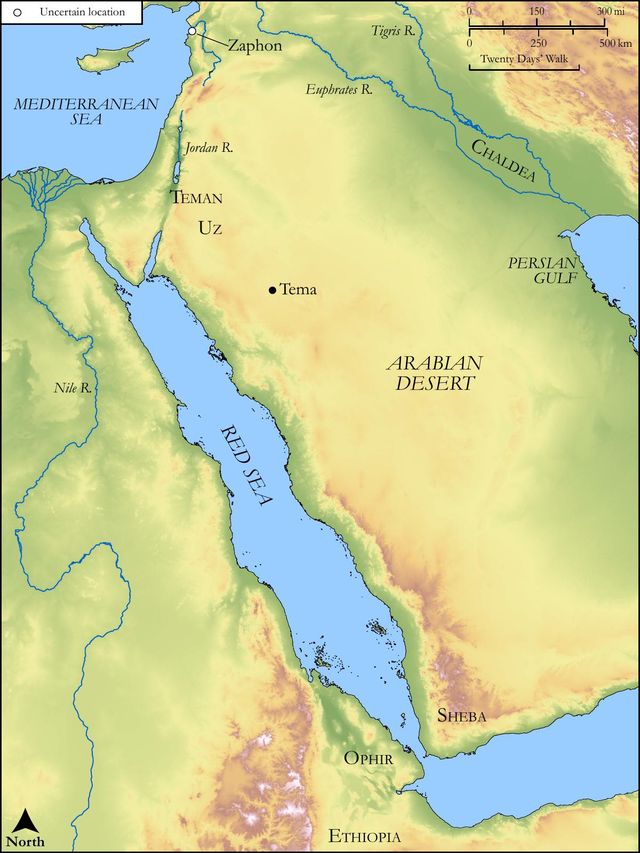
See on the biblical-era map
Study this verse
Public-domain commentary
Matthew Henry
From his Commentary on the Whole Bible. Henry comments on passages, not single verses — this entry covers Job 26:5–14. His three-level outline is real structure in the source text, so it is rendered as structure.
The truth received a great deal of light from the dispute between Job and his friends concerning those points about which they differed; but now they are upon a subject in which they were all agreed, the infinite glory and power of God. How does truth triumph, and how brightly does it shine, when there appears no other strife between the contenders than which shall speak most highly and honourably of God and be most copious in showing forth his praise! It were well if all disputes about matters of religion might end thus, in glorifying God as Lord of all, and our Lord, with one mind and one mouth (Rom 15:6); for to that we have all attained, in that we are all agreed.
I.Many illustrious instances are here given of the wisdom and power of God in the creation and preservation of the world.
1.If we look about us, to the earth and waters here below, we shall see striking instances of omnipotence, which we may gather out of these verses.
(1.)He hangs the earth upon nothing, Job 26:7. The vast terraqueous globe neither rests upon any pillars nor hangs upon any axle-tree, and yet, by the almighty power of God, is firmly fixed in its place, poised with its own weight. The art of man could not hang a feather upon nothing, yet the divine wisdom hangs the whole earth so. It is ponderibus librata suis - poised by its own weight, so says the poet; it is upheld by the word of God's power, so says the apostle. What is hung upon nothing may serve us to set our feet on, and bear the weight of our bodies, but it will never serve us to set our hearts on, nor bear the weight of our souls.
(2.)He sets bounds to the waters of the sea, and compasses them in (Job 26:10), that they may not return to cover the earth; and these bounds shall continue unmoved, unshaken, unworn, till the day and night come to an end, when time shall be no more. Herein appears the dominion which Providence has over the raging waters of the sea, and so it is an instance of his power, Jer 5:22. We see too the care which Providence takes of the poor sinful inhabitants of the earth, who, though obnoxious to his justice and lying at his mercy, are thus preserved from being overwhelmed, as they were once by the waters of a flood, and will continue to be so, because they are reserved unto fire.
(3.)He forms dead things under the waters. Rephaim-giants, are formed under the waters, that is, vast creatures, of prodigious bulk, as whales, giant-like creatures, among the innumerable inhabitants of the water. So bishop Patrick.
(4.)By mighty storms and tempests he shakes the mountains, which are here called the pillars of heaven (Job 26:11), and even divides the sea, and smites through its proud waves, Job 26:12. At the presence of the Lord the sea flies and the mountains skip, Psa 114:3, Psa 114:4. See Hab 3:6, etc. A storm furrows the waters, and does, as it were, divide them; and then a calm smites through the waves, and lays them flat again. See Psa 89:9, Psa 89:10. Those who think Job lived at, or after, the time of Moses, apply this to the dividing of the Red Sea before the children of Israel, and the drowning of the Egyptians in it. By his understanding he smiteth through Rahab; so the word is, and Rahab is often put for Egypt; as Psa 87:4; Isa 51:9.
2.If we consider hell beneath, though it is out of our sight, yet we may conceive the instances of God's power there. By hell and destruction (Job 26:6) we may understand the grave, and those who are buried in it, that they are under the eye of God, though laid out of our sight, which may strengthen our belief of the resurrection of the dead. God knows where to find, and whence to fetch, all the scattered atoms of the consumed body. We may also consider them as referring to the place of the damned, where the separate souls of the wicked are in misery and torment. That is hell and destruction, which are said to be before the Lord (Pro 15:11), and here to be naked before him, to which it is probable there is an allusion, Rev 14:10, where sinners are to be tormented in the presence of the holy angels (who attended the Shechinah) and in the presence of the Lamb. And this may give light to Job 26:5, which some ancient versions read thus (and I think more agreeably to the signification of the word Rephaim): Behold, the giants groan under the waters, and those that dwell with them; and then follows, Hell is naked before him, typified by the drowning of the giants of the old world; so the learned Mr. Joseph Mede understands it, and with it illustrates Pro 21:16, where hell is called the congregation of the dead; and it is the same word which is here used, and which he would there have rendered the congregation of the giants, in allusion to the drowning of the sinners of the old world. And is there any thing in which the majesty of God appears more dreadful than in the eternal ruin of the ungodly and the groans of the inhabitants of the land of darkness? Those that will not with angels fear and worship shall for ever with devils fear and tremble; and God therein will be glorified.
3.If we look up to heaven above, we shall see instances of God's sovereignty and power.
(1.)He stretches out the north over the empty place, Job 26:7. So he did at first, when he stretched out the heavens like a curtain (Psa 104:2); and he still continues to keep them stretched out, and will do so till the general conflagration, when they shall be rolled together as a scroll, Rev 6:14. He mentions the north because his country (as ours) lay in the northern hemisphere; and the air is the empty place over which it is stretched out. See Psa 89:12. What an empty place is this world in comparison with the other!
(2.)He keeps the waters that are said to be above the firmament from pouring down upon the earth, as once they did (Job 26:8): He binds up the waters in his thick clouds, as if they were tied closely in a bag, till there is occasion to use them; and, notwithstanding the vast weight of water so raised and laid up, yet the cloud is not rent under them, for then they would burst and pour out as a spout; but they do, as it were, distil through the cloud, and so come drop by drop, in mercy to the earth, in small rain, or great rain, as he pleases.
(3.)He conceals the glory of the upper world, the dazzling lustre of which we poor mortals could not bear (Job 26:9): He holds back the face of his throne, that light in which he dwells, and spreads a cloud upon it, through which he judges, Job 22:13. God will have us to live by faith, not by sense; for this is agreeable to a state of probation. It were not a fair trial if the face of God's throne were visible now as it will be in the great day.
Lest his high throne, above expression bright,
With deadly glory should oppress our sight,
To break the dazzling force he draws a screen
Of sable shades, and spreads his clouds between.
- Sir R. Blackmore
(4.)The bright ornaments of heaven are the work of his hands (Job 26:13): By his Spirit, the eternal Spirit that moved upon the face of the waters, the breath of his mouth (Psa 33:6), he has garnished the heavens, not only made them, but beautified them, has curiously bespangled them with stars by night and painted them with the light of the sun by day. God, having made man to look upward (Os homini sublime dedit - To man he gave an erect countenance), has therefore garnished the heavens, to invite him to look upward, that, by pleasing his eye with the dazzling light of the sun and the sparkling light of the stars, their number, order, and various magnitudes, which, as so many golden studs, beautify the canopy drawn over our heads, he may be led to admire the great Creator, the Father and fountain of lights, and to say, "If the pavement be so richly inlaid, what must the palace be! If the visible heavens be so glorious, what are those that are out of sight!" From the beauteous garniture of the ante-chamber we may infer the precious furniture of the presence-chamber. If stars be so bright, what are angels! What is meant here by the crooked serpent which his hands have formed is not certain. Some make it part of the garnishing of the heavens, the milky-way, say some; some particular constellation, so called, say others. It is the same word that is used for leviathan (Isa 27:1), and probably may be meant of the whale or crocodile, in which appears much of the power of the Creator; and why may not Job conclude with that inference, when God himself does so? ch. 41.
II.He concludes, at last, with an awful et caetera (Job 26:14):
Lo, these are parts of his ways, the out-goings of his wisdom and power, the ways in which he walks and by which he makes himself known to the children of men. Here,
1.He acknowledges, with adoration, the discoveries that were made of God. These things which he himself had said, and which Bildad had said, are his ways, and this is heard of him; this is something of God. But,
2.He admires the depth of that which is undiscovered. This that we have said is but part of his ways, a small part. What we know of God is nothing in comparison with what is in God and what God is. After all the discoveries which God has made to us, and all the enquiries we have made after God, still we are much in the dark concerning him, and must conclude, Lo, these are but parts of his ways. Something we hear of him by his works and by his word; but, alas! how little a portion is heard of him? heard by us, heard from us! We know but in part; we prophesy but in part. When we have said all we can, concerning God, we must even do as St. Paul does (Rom 11:33); despairing to find the bottom, we must sit down at the brink, and adore the depth: O the depth of the wisdom and knowledge of God! It is but a little portion that we hear and know of God in our present state. He is infinite and incomprehensible; our understandings and capacities are weak and shallow, and the full discoveries of the divine glory are reserved for the future state. Even the thunder of his power (that is, his powerful thunder), one of the lowest of his ways here in our own region, we cannot understand. See Job 37:4, Job 37:5. Much less can we understand the utmost force and extent of his power, the terrible efforts and operations of it, and particularly the power of his anger, Psa 90:11. God is great, and we know him not.
Historical interpretation
Historical reception
1 surviving comment on this verse from the historical church.
So God has gathered the waters that were spread on earth at the beginning and has imposed a limit on them. His command has surrounded them like a circle, so that they might not exceed it. He has set a “boundary between light and darkness.” This means that he has ordered the light and the darkness to occupy their given times in good harmony and not to prevail on one another.
Continue studying Job 26:10 across the web’s major study libraries — every link below opens this exact verse, chapter, or book on the destination site.
Read & Compare
 BibleGatewayThis verse in more than 200 translations and 70 languages.
 Bible.comThe YouVersion reader — hundreds of translations, reading plans, and highlights.
 ESV.orgCrossway's official English Standard Version reader.
 NET BibleThe NET translation with 60,000+ translators' notes on every rendering decision.
 STEP BibleTyndale House's free study tool — original text, vocabulary, and scholarly resources.
 BibliaLogos Bible Software's free web reader.
 USCCBThe New American Bible (Revised Edition) with the U.S. bishops' study notes.
Commentaries
 BibleHub CommentariesDozens of classic commentaries on this verse, gathered on one page.
 StudyLightMore than 100 commentary sets — the largest collection on the web.
 BibleRefPlain-English commentary on what this verse means, verse by verse.
 Enduring WordDavid Guzik's free commentary on this chapter, widely used by Bible teachers.
 Bible Study ToolsVerse commentary alongside Greek and Hebrew study aids.
Original Language & Research
- BibleHub InterlinearThe verse word by word — original language, transliteration, and English.
- BibleHub LexiconEvery word's original-language definition and Strong's entry.
 Blue Letter BibleDeep-study tools — Strong's numbers, concordance, and word studies.
 SefariaThe Hebrew text with Rashi and centuries of Jewish commentary.
Sermons, Hymns & Audio


TrulyRandomVerse is not affiliated with these sites and doesn’t control their content. They’re linked because they’re genuinely useful.
Summary
Job 26:10 stands as a profound declaration of God's immense power and meticulous control over the natural world, particularly the vast and potentially chaotic waters. It is an integral part of Job's eloquent discourse where he magnifies the Creator's unsearchable wisdom and absolute sovereignty, asserting that God has precisely ordered and perpetually sustains all creation, setting unbreachable limits that endure as long as the current temporal order of day and night exists. This verse encapsulates a deep theological truth about divine governance over creation.
Context
ShowHideLiterary Context
This verse is embedded within Job's final, magnificent response to Bildad (Job 25), where Job articulates a soaring poem extolling God's unsearchable power and wisdom in creation. Far from agreeing with his friends' simplistic theology of suffering, Job asserts God's incomprehensible majesty, detailing His dominion over all things from the depths of Sheol to the celestial bodies (Job 26:5-9). Job 26:10 specifically contributes to this grand depiction of God as the sovereign Creator who imposes order on the chaotic elements of the universe, setting the stage for God's own dramatic appearance and discourse from the whirlwind in Job 38, which further elaborates on His creative power and wisdom, echoing Job's own profound insights.
Historical & Cultural Context
In Scripture, "the waters" are the deep of Genesis 1:2, which God shut up with doors and bars, saying, "Hitherto shalt thou come, but no further." The nations round about depicted their gods as struggling with or barely containing such chaotic forces, often through violent conflict. Against this backdrop, Job's declaration that God "hath compassed the waters with bounds" is a powerful affirmation of Yahweh's absolute and effortless sovereignty. It asserts that God, unlike the gods of surrounding nations, does not struggle with chaos but rather establishes perfect, enduring order by divine decree, ensuring the stability and predictability of the natural world essential for human existence. This demonstrates a unique understanding of divine power that transcends pagan mythologies.
Key Themes
ShowHideJob 26:10 powerfully contributes to several key themes pervasive in the book of Job and the broader biblical narrative. Firstly, it underscores Divine Sovereignty over Creation, illustrating God's absolute authority over the seemingly chaotic elements of nature. By "compassing the waters with bounds," God imposes order and limits on what could otherwise be destructive forces, demonstrating His ultimate control, a theme resonating with the creation accounts in Genesis 1:9-10. Secondly, the phrase "until the day and night come to an end" emphasizes the Established Order and Stability of God's decrees regarding creation, highlighting their permanence and unwavering nature. These boundaries are not temporary; they are fixed and enduring, ensuring the reliability of God's ordinances for heaven and earth, a concept also affirmed in Jeremiah 33:20-21. Thirdly, the precision implied in "compassing the waters with bounds" highlights God's Infinite Wisdom and intricate design inherent in God's creative acts, suggesting a deliberate, intelligent ordering of creation far beyond human comprehension.
Exposition and Analysis
ShowHideKey Word Analysis
ShowHideThis verb, derived from a primitive root meaning "to describe a circle," conveys the idea of God drawing a precise, unbreachable perimeter around the waters. It speaks to the exactness, intention, and comprehensive nature of divine creation, not merely containing but perfectly defining the boundaries of the vast oceans. It implies an intentional, deliberate act of design.
This noun refers to water, often used in a dual sense to denote the vast, expansive waters of the sea or the primordial deep. In Scripture, these "waters" frequently symbolize the untamed, chaotic, and potentially destructive forces. Thus, God's act of setting bounds upon them signifies His absolute power to bring order, stability, and safety out of potential destruction.
Derived from a root meaning "to engrave" or "to decree," this noun refers to an enactment, statute, or prescribed limit. It reinforces the idea that these are not arbitrary or natural barriers but divinely ordained laws governing the natural world. These "bounds" are God's unchangeable decrees, establishing the permanent order of creation and demonstrating His sovereign authority.
Verse Breakdown
ShowHide"He hath compassed the waters with bounds"
This clause identifies God as the active, sovereign agent, the "He" who performs this magnificent act. "The waters" represent the vast, deep, and potentially chaotic oceans or primordial deep. God's act of "compassing... with bounds" signifies His absolute power to bring order out of chaos, to define and limit what is otherwise boundless. This is a deliberate, precise, and powerful act of creation, establishing the very conditions for life and stability on earth. It speaks to divine omnipotence and meticulous design.
"until the day and night come to an end."
This phrase specifies the duration of God's established boundaries. It does not imply a temporary limit but rather emphasizes the permanence and unwavering nature of God's decree for the current order of creation. As long as the cycle of day and night continues, God's boundaries for the waters will remain, underscoring His faithfulness in upholding His creation and the reliability of His established laws. It points to the enduring stability and reliability of the created order, reflecting God's unchanging character.
Literary Devices
ShowHideJob 26:10 employs several potent literary devices to convey its profound theological message. Metaphor is central, as "compassing the waters with bounds" serves as a powerful metaphor for God's absolute control over chaos and His ability to impose order on the seemingly uncontrollable forces of nature. The image of drawing a circle around the waters suggests a master architect, precisely designing and containing. Merism is present in the phrase "until the day and night come to an end," which signifies an enduring, almost eternal, duration for the current order of creation, emphasizing the unwavering permanence of God's decrees. The juxtaposition of "day and night" encompasses all time, indicating an indefinite, ongoing stability. Furthermore, Anthropomorphism is subtly used, as God is depicted performing an action (compassing/drawing) that implies a deliberate, active, and almost human-like engagement in the process of creation, though on the scale of all creation. The verse also utilizes vivid Imagery, painting a picture of a vast, potentially destructive force (the waters) held firmly in check by an omnipotent, precise, and wise Creator.
Theological and Thematic Connections
ShowHideJob 26:10 profoundly speaks to the theological truth of God's absolute sovereignty and His meticulous ordering of creation. It asserts that the universe is not a product of chance or chaotic forces, but rather a divinely designed and sustained creation, held in perfect balance by God's unchanging decrees. This inherent order provides a foundation of stability and predictability, assuring humanity that the same God who sets limits for the oceans also governs the intricate details of existence. This truth invites both awe at God's incomprehensible power and deep trust in His unfailing wisdom and faithfulness, fostering a profound sense of security in His providential care.
Reflection and Application
ShowHideJob 26:10 offers profound comfort and calls for awe in the face of God's majesty. In a world that often feels chaotic, unpredictable, and overwhelming, this verse reminds us that a sovereign God holds all things in His hands. His established order provides a foundation of stability, assuring us that even the most powerful natural forces are under His control. This perspective encourages us to trust in His unfailing wisdom and power, knowing that the same God who sets limits for the oceans also governs the details of our lives. It fosters a spirit of worship and reliance on the Creator who maintains the very fabric of existence, reminding us that His decrees are as reliable as the cycle of day and night. This truth should inspire confidence in His ability to bring order to our personal chaos and to fulfill His promises.
Questions for Reflection
ShowHideFAQ
ShowHideWhat is the significance of "the waters" in this verse?
ShowHideIn Scripture, "the waters" recall the deep of Genesis 1:2, the vast, untamed oceans that the nations pictured as the abode of mythical sea monsters. God's act of setting bounds signifies His absolute power to bring order, stability, and safety out of potential destruction, establishing the conditions necessary for life. It highlights His unique sovereignty over all creation, contrasting with the limited powers of pagan deities who often struggled to contain such forces.
How does this verse relate to the broader message of the book of Job?
ShowHideJob 26:10 is part of Job's profound declaration of God's unsearchable wisdom and power, serving as a counterpoint to his friends' limited and often misinformed understanding of divine justice. It highlights that God's ways are beyond human comprehension and His power is absolute, preparing the reader for God's own majestic speech from the whirlwind in Job 38, which further demonstrates His creative and sustaining power and underscores the limits of human understanding.
Does "until the day and night come to an end" imply a temporary boundary?
ShowHideNo, it signifies the duration of the current order of creation. It means these boundaries will remain as long as day and night exist, emphasizing the permanence and unwavering nature of God's decrees regarding creation. It points to the reliability of God's established laws and His faithfulness in upholding His creation, as also seen in Jeremiah 33:20-21, assuring humanity of the stability of the natural world.
Christ-Centered Fulfillment
ShowHideJob 26:10, with its majestic portrayal of God's power over creation, finds its ultimate and most profound fulfillment in the person and work of Jesus Christ. The "He" who "hath compassed the waters with bounds" is revealed in the New Testament to be the pre-existent Son, through whom "all things were created, in heaven and on earth, visible and invisible, whether thrones or dominions or rulers or authorities—all things were created through him and for him. And he is before all things, and in him all things hold together" Colossians 1:16-17. The very boundaries and order established by God are sustained by Christ, who "upholds the universe by the word of his power" Hebrews 1:3. This divine control is dramatically demonstrated in the Gospels when Jesus commands the wind and the sea, and "they obeyed him" Mark 4:41, revealing the Creator's authority dwelling in human flesh. Furthermore, the phrase "until the day and night come to an end" points to the eschatological reality where Christ will bring about a new heavens and a new earth, where the old order, including the sea as we know it, will pass away Revelation 21:1. In the New Jerusalem, there will be no need for the sun or moon, for "the Lord God will give them light" Revelation 22:5, signifying the ultimate fulfillment of God's eternal reign where the temporal cycle of day and night is transcended by His glorious, unending presence.