


Jeremiah 7:22
- כִּיkiforH3588PrtParticle Conditional
- לֹאlo'notH3808NegParticle Negative
- דִבַּרְתִּיdi·Bar·tiI spokeH1696V-Piel-Perf-1csVerb Piel Perfect 1st Singular common gender
- אֶת'etwithH854PrepPreposition
- אֲבוֹתֵיכֶם'a·vo·tei·Khemyour ancestorsH1N-fpc ¦ 2mpNoun Plural Feminine Constructאֲבוֹתֵיancestorsכֶםyour
- וְלֹאve·Lo'and notH3808Conj-w ¦ NegParticle Negativeוְandלֹאnot
- צִוִּיתִיםtzi·vi·TimI commanded themH6680V-Piel-Perf-1cs ¦ 3mpVerb Piel Perfect 1st Singular common genderצִוִּיתִיI commandedםthem
- בְּיוֹםbe·Yomon [the] dayH3117Prep-b ¦ N-mscNoun Singular Masculine Constructבְּonיוֹם[the] day
- הוֹצִיאִיho·tzi'I brought outH3318V-Hiphil-Inf ¦ 1csVerb Hiphil Infinitive Constructהוֹצִיאִbrought outיI
- אוֹתָם'o·Tam<obj.> themH853DirObjM ¦ 3mpParticle Object Indicatorאוֹתָ<obj.>םthem
- מֵאֶרֶץme·'E·retzfrom [the] land ofH776Prep-m ¦ N-fscNoun Singular Feminine Constructמֵfromאֶרֶץ[the] land of
- מִצְרָיִםmitz·Ra·yimEgyptH4714N-properNoun Proper Location
- עַל'alonH5921PrepPreposition
- דִּבְרֵיdiv·Reimatters ofH1697N-mpcNoun Plural Masculine Construct
- עוֹלָהo·Lahburnt offeringH5930N-fsNoun Singular Feminine Absolute
- וָזָבַחva·Za·vachand sacrificeH2077Conj-w ¦ N-msNoun Singular Masculine Absoluteוָandזָבַחsacrifice
English is a literal word-by-word gloss of the Hebrew, not the KJV's wording. Why?
This is the original text the KJV's translators worked from — each Hebrew word with its own literal English meaning in this verse, prepared by scholars at Tyndale House, Cambridge. The KJV translates whole sentences, not word by word, so its wording differs: one Hebrew word can become several English words, and the KJV may choose “the LORD” where the gloss reads “Yahweh”. Both are faithful — they answer different questions. For the KJV's own rendering, switch to the KJV text.
Details
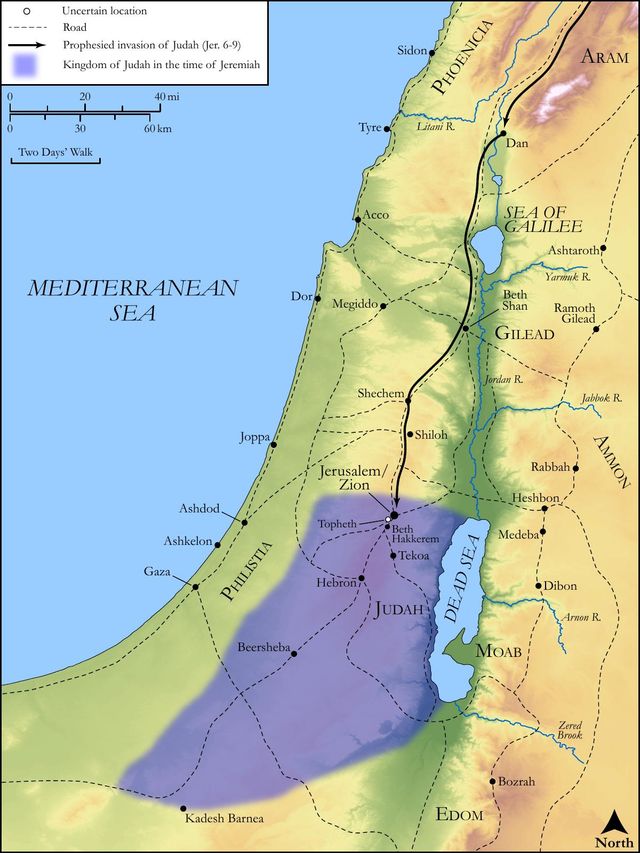
See on the biblical-era map
Study this verse
Public-domain commentary
Matthew Henry
From his Commentary on the Whole Bible. Henry comments on passages, not single verses — this entry covers Jeremiah 7:21–28. His two-level outline is real structure in the source text, so it is rendered as structure.
God, having shown the people that the temple would not protect them while they polluted it with their wickedness, here shows them that their sacrifices would not atone for them, nor be accepted, while they went on in disobedience. See with what contempt he here speaks of their ceremonial service (Jer 7:21). "Put your burnt-offerings to your sacrifices; go on in them as long as you please; add one sort of sacrifice to another; turn your burnt-offerings (which were to be wholly burnt to the honour of God) into peace-offerings" (which the offerer himself had a considerable share of), "that you may eat flesh, for that is all the good you are likely to have from your sacrifices, a good meal's meat or two; but expect not any other benefit by them while you live at this loose rate. Keep your sacrifices to yourselves" (so some understand it); "let them be served up at your own table, for they are no way acceptable at God's altars." For the opening of this,
I.He shows them that obedience was the only thing he required of them, Jer 7:22, Jer 7:23.
He appeals to the original contract, by which they were first formed into a people, when they were brought out of Egypt. God made them a kingdom of priests to himself, not that he might be regaled with their sacrifices, as the devils, whom the heathen worshipped, which are represented as eating with pleasure the fat of their sacrifices and drinking the wine of their drink-offerings, Deu 32:38. No: Will God eat the flesh of bulls? Psa 50:13. I spoke not to your fathers concerning burnt-offerings or sacrifices, not of them at first. The precepts of the moral law were given before the ceremonial institutions; and those came afterwards, as trials of their obedience and assistances to their repentance and faith. The Levitical law begins thus: If any man of you will bring an offering, he must do so and so (Lev 1:2, Lev 2:1), as if it were intended rather to regulate sacrifice than to require it. But that which God commanded, which he bound them to by his supreme authority and which he insisted upon as the condition of the covenant, was, Obey my voice; see Exo 15:26, where this was the statute and the ordinance by which God proved them: Hearken diligently to the voice of the Lord thy God. The condition of their being God's peculiar people was this (Exo 19:5), If you will obey my voice indeed. "Make conscience of the duties of natural religion, observe positive institutions from a principle of obedience, and then I will be your God and you shall be my people," which is the greatest honour, happiness, and satisfaction, that any of the children of men are capable of. "Let your conversation be regular, and in every thing study to comply with the will and word of God; walk within the bounds that I have set you, and in all the ways that I have commanded you, and then you may assure yourselves that it shall be well with you." The demand here is very reasonable, that we should be directed by Infinite Wisdom to that which is fit, that he that made us should command us, and that he should give us law who gives us our being and all the supports of it; and the promise is very encouraging: Let God's will be your rule and his favour shall be your felicity.
II.He shows them that disobedience was the only thing for which he had a quarrel with them.
He would not reprove them for their sacrifices, for the omission of them; they had been continually before him (Psa 50:8); with them they hoped to bribe God, and purchase a license to go on in sin. That therefore which God had all along laid to their charge was breaking his commandments in the course of their conversation, while they observed them, in some instances, in the course of their devotion, Jer 7:24, Jer 7:25, etc.
1.They set up their own will in competition with the will of God: They hearkened not to God and to his law; they never heeded that; it was to them as if it had never been given or were of no force; they inclined not their ear to attend to it, much less their hearts to comply with it. But they would have their own way, would do as they chose, and not as they were bidden. Their own counsels were their guide, and not the dictates of divine wisdom; that shall be lawful and good with them which they think so, though the word of God says quite contrary. The imagination of their evil heart, the appetites and passions of it, shall be a law to them, and they will walk in the way of it, and in the sight of their eyes.
2.If they began well, yet they did not proceed, but soon flew off. They went backward, when they talked of making a captain, and returning to Egypt again, and would not go forward under God's conduct. They promised fair: All that the Lord shall say unto us we well do; and, if they would but have kept in that good mind, all would have been well; but, instead of going on in the way of duty, they drew back into the way of sin, and were worse than ever.
3.When God sent to them by word of mouth to put them in mind of the written word, which was the business of the prophets, it was all one; still they were disobedient. God had servants of his among them in every age, since they came out of Egypt unto this day, some or other to tell them of their faults and put them in mind of their duty, whom he rose up early to send (as before, Jer 7:13), as men rise up early to call servants to their work; but they were as deaf to the prophets as they were to the law (Jer 7:26): Yet they hearkened not, nor inclined their ear. This had been their way and manner all along; they were of the same stubborn refractory disposition with those that went before them; it had all along been the genius of the nation, and an evil genius it was, that continually haunted them till it ruined them at last.
4.Their practice and character were still the same. They are worse, and not better, than their fathers. (1.) Jeremiah can himself witness against them that they were disobedient, or he shall soon find it so (Jer 7:27): "Thou shalt speak all these words to them, shalt particularly charge them with disobedience and obstinacy. But even that will not work upon them: They will not hearken to thee, nor heed thee. Thou shalt go, and call to them with all the plainness and earnestness imaginable, but they will not answer thee; they will either give thee no answer at all or not an obedient answer; they will not come at thy call." (2.) He must therefore own that they deserved the character of a disobedient people, that were ripe for destruction, and must go to them and tell them so to their faces (Jer 7:28): "Say unto them, This is a nation that obeys not the voice of the Lord their God. They are notorious for their obstinacy; they sacrifice to the Lord as their God, but they will not be ruled by him as their God; they will not receive either the instruction of his word or the correction of his rod; they will not be reclaimed or reformed by either. Truth has perished among them; they cannot receive it; they will not submit to it nor be governed by it. They will not speak truth; there is no believing a word they say, for it is cut off from their mouth, and lying comes in the room of it. They are false both to God and man."
Historical interpretation
Three Centuries of Reception
4 surviving comments on this verse. Each one is dated, so this reads as a timeline rather than a list.
Select a marker to jump to its quote. Markers stagger vertically where authors wrote within a few decades of each other.
He has therefore abolished these things, that the new law of our Lord Jesus Christ, which is without the yoke of necessity, might have a human oblation. And again He says to them, "Did I command your fathers, when they went out from the land of Egypt, to offer unto Me burnt-offerings and sacrifices? But this rather I commanded them, Let no one of you cherish any evil in his heart against his neighbour, and love not an oath of falsehood." We ought therefore, being possessed of understanding, to perceive the gracious intention of our Father; for He speaks to us, desirous that we, not going astray like them, should ask how we may approach Him. To us, then, He declares, "A sacrifice [pleasing] to God is a broken spirit; a smell of sweet savour to the Lord is a heart that glorifieth Him that made it." We ought therefore, brethren, carefully to inquire concerning our salvation, lest the wicked one, having made his entrance by deceit, should hurl us forth from our [true] life.
You are blessed who are delivered from the curse. Christ, the Son of God, by his coming has confirmed and completed the law but has taken away the additional precepts, although not all of them, yet at least the more grievous ones. He confirmed the former and abolished the latter, and he has again set the free will of humankind at liberty. He does not subject them to the penalty of a temporal death but gives laws to them according to another constitution. For this reason, he says, “If anyone will come after me, let him come.” And again, “Will you also go away?” And besides, before his coming he refused the sacrifices of the people, while they frequently offered them, when they sinned against him and thought he was to be appeased by sacrifices but not by repentance.
(Verse 21 onwards) Thus says the Lord of hosts, the God of Israel: Add your burnt offerings to your sacrifices, and eat the flesh. For I did not speak to your fathers, or command them concerning burnt offerings and sacrifices when I brought them out of the land of Egypt. But this is what I commanded them, saying, 'Obey My voice, and I will be your God, and you shall be My people. And walk in all the ways that I have commanded you, that it may be well with you.' When He condemns the temple, He consequently condemns the sacrifices as well; and He indirectly accuses them because they offer victims not out of reverence for Him, but out of a desire for feasts. Moreover, when He says, 'I did not speak with your fathers, nor did I command them concerning burnt offerings and sacrifices, it is clearly understood that He first gave the Decalogue on stone tablets, written by the finger of God, and after the offense of idolatry and the worship of the golden calf, He then ordered sacrifices to be made to Him instead of to the demons, thus setting aside the pure worship of God's commandments and allowing the offering of blood and the desire for meat.
It is made clear also from this that the obsolete prescriptions of the law had been imposed because of Israel’s limitations. Since they had learned in Egypt how to sacrifice to idols, he wanted to separate them from those practices—in all the prophets he rejects them, remember—yet out of consideration for their limitations he utters this remark, “Eat flesh,” that is, Although I reject the sacrifices, I shall not oppose your partaking of flesh. After all, he declares in the law that those wishing to partake of flesh in their own cities and towns should “perform the sacrifice, but pour out the blood on the ground and then partake of the sacrifice,” not as though they were offering it as a sacrifice but as ordinary flesh, as part of the prohibition imposed on performing sacred rites outside the designated place.
Continue studying Jeremiah 7:22 across the web’s major study libraries — every link below opens this exact verse, chapter, or book on the destination site.
Read & Compare
 BibleGatewayThis verse in more than 200 translations and 70 languages.
 Bible.comThe YouVersion reader — hundreds of translations, reading plans, and highlights.
 ESV.orgCrossway's official English Standard Version reader.
 NET BibleThe NET translation with 60,000+ translators' notes on every rendering decision.
 STEP BibleTyndale House's free study tool — original text, vocabulary, and scholarly resources.
 BibliaLogos Bible Software's free web reader.
 USCCBThe New American Bible (Revised Edition) with the U.S. bishops' study notes.
Commentaries
 BibleHub CommentariesDozens of classic commentaries on this verse, gathered on one page.
 StudyLightMore than 100 commentary sets — the largest collection on the web.
 BibleRefPlain-English commentary on what this verse means, verse by verse.
 Enduring WordDavid Guzik's free commentary on this chapter, widely used by Bible teachers.
 Bible Study ToolsVerse commentary alongside Greek and Hebrew study aids.
Original Language & Research
- BibleHub InterlinearThe verse word by word — original language, transliteration, and English.
- BibleHub LexiconEvery word's original-language definition and Strong's entry.
 Blue Letter BibleDeep-study tools — Strong's numbers, concordance, and word studies.
 SefariaThe Hebrew text with Rashi and centuries of Jewish commentary.
Sermons, Hymns & Audio


TrulyRandomVerse is not affiliated with these sites and doesn’t control their content. They’re linked because they’re genuinely useful.
Summary
Jeremiah 7:22 presents a profound prophetic challenge to the superficial religiosity prevalent in Judah, asserting that God's foundational covenant with Israel, established at their exodus from Egypt, was not primarily centered on ritualistic burnt offerings and sacrifices. Instead, the divine emphasis from the very beginning was on a deeper, relational obedience and a genuine, heartfelt commitment to His voice, thereby exposing the people's misguided reliance on outward ceremonies while neglecting the core principles of justice, righteousness, and true devotion to the Lord.
Context
ShowHideLiterary Context
Jeremiah 7:22 is a pivotal declaration embedded within Jeremiah's powerful "Temple Sermon," delivered at the very gate of the Jerusalem temple (see Jeremiah 7:1-15). This sermon serves as a scathing indictment against the people of Judah, who had developed a false sense of security, believing that their mere presence at the temple and performance of rituals would guarantee God's protection and their safety, even as they engaged in widespread moral corruption, idolatry, and oppression. The verses immediately preceding this statement (such as Jeremiah 7:8-11) vividly expose their hypocrisy: they were stealing, murdering, committing adultery, swearing falsely, burning incense to Baal, and following other gods, yet still audacious enough to claim, "We are safe!" (Jeremiah 7:10). Verse 22 functions as a crucial theological cornerstone, clarifying God's true priorities and setting the stage for the explicit command in Jeremiah 7:23, which unequivocally emphasizes obedience as the true essence of the covenant.
Historical & Cultural Context
The prophetic ministry of Jeremiah unfolded during a tumultuous and morally declining period in Judah's history, spanning the reigns of several kings leading up to the devastating Babylonian exile (late 7th to early 6th centuries BCE). The nation was steeped in spiritual apostasy, characterized by syncretism—the blending of Yahweh worship with pagan practices, particularly Baal worship—and a dangerous, false sense of security derived from the physical presence of the Temple in Jerusalem. A pervasive cultural belief held that God would never allow His dwelling place to be destroyed, regardless of the people's moral and spiritual state. Within this context, the divinely instituted sacrificial system, originally intended as a means of atonement, fellowship, and expression of devotion, had tragically degenerated into a mechanistic ritual, devoid of genuine repentance, faith, or ethical living. Jeremiah's message directly confronts this profound perversion, reminding them of the original intent of their covenant with the God who powerfully delivered them from the land of Egypt.
Key Themes
ShowHideThis verse powerfully contributes to several overarching themes found throughout the book of Jeremiah and the broader prophetic tradition. It underscores the theme of Obedience Over Ritual, asserting that God's primary demand for His people has always been a life of faithful adherence to His commands, rather than mere ceremonial observance. This challenges the prevailing misunderstanding of the covenant, where the people had inverted God's priorities, focusing on external acts while neglecting internal transformation and ethical living. It highlights the theme of True Worship, defining it not by the quantity of sacrifices offered but by the quality of one's relationship with God, characterized by hearing and obeying His voice. This prophetic critique of empty ritualism echoes earlier divine pronouncements, such such as God's desire for mercy rather than sacrifice found in Hosea 6:6, and the declaration that obedience is better than sacrifice from the time of Samuel.
Exposition and Analysis
ShowHideKey Word Analysis
ShowHideA primitive root, perhaps properly meaning "to arrange," but used figuratively (of words) to speak. It encompasses declaring, commanding, communing, and uttering. In this context, the negation "spake not" emphasizes the priority of what God communicated at the inception of the covenant, rather than a complete absence of instruction regarding sacrifices later on. It signifies the primary, foundational nature of God's initial communication.
A primitive root, used intensively to mean "to constitute, enjoin." It signifies giving a charge, issuing an authoritative command, or setting something in order. This word reinforces the binding and authoritative nature of God's directives. Its parallel negation with "spake" further emphasizes that the initial, foundational commands given at Sinai were not primarily focused on ritual sacrifices.
From a feminine active participle meaning "a step or (collectively, stairs, as ascending)," but commonly referring to a holocaust, "as going up in smoke." This was a specific type of sacrifice entirely consumed by fire on the altar, symbolizing complete dedication and atonement. Its mention here highlights a prominent type of ritual sacrifice that the people had come to prioritize incorrectly, believing it to be the essence of their covenant with God.
From a root meaning "to slaughter," properly referring to the flesh of an animal; by implication, a sacrifice (the victim or the act). This is a broader term encompassing various types of offerings beyond just burnt offerings, such as peace offerings, sin offerings, etc. Its inclusion alongside "burnt offerings" covers the full scope of the ritual system, emphasizing that the entire system was not the initial, primary focus of God's covenant demands.
Verse Breakdown
ShowHide"For I spake not unto your fathers, nor commanded them"
This phrase employs a powerful rhetorical negation. It does not deny that God later spoke about or commanded sacrifices (which He clearly did in the Mosaic Law), but rather it emphasizes that these rituals were not the initial or primary focus of His covenant relationship with Israel. The thrust is on the priority of God's commands at the inception of the covenant, highlighting that His fundamental expectation was not ceremonial but relational and ethical.
"in the day that I brought them out of the land of Egypt"
This clause precisely specifies the critical moment of covenant formation – the Exodus from Egypt and the subsequent giving of the Law at Mount Sinai. It points to the foundational period when God established His unique relationship with Israel as His chosen people, underscoring that the core demands at that pivotal time were not ceremonial practices but rather profound ethical principles and a call to exclusive, obedient devotion.
"concerning burnt offerings or sacrifices"
This explicitly names the ritual practices that had become central to the people's misguided worship. By stating that these were not the initial, paramount commands, God underscores that the essence of the covenant was never about external rites but about internal obedience, a transformed heart, and a life lived in accordance with His moral will, which were the true prerequisites for a flourishing relationship with Him.
Literary Devices
ShowHideJeremiah 7:22 employs several potent literary devices to convey its profound message. The most prominent is Hyperbole, where God states that He "spake not... nor commanded them... concerning burnt offerings or sacrifices." This is not a literal denial, as the Mosaic Law clearly instituted a detailed system of sacrifices (e.g., Leviticus 1-7). Rather, it is an emphatic overstatement designed to underscore the relative unimportance or secondary nature of ritual compared to the absolute priority of obedience and covenant faithfulness. This hyperbole creates a stark, albeit implied, Antithesis between the people's misplaced focus on external ritual and God's true desire for internal, ethical obedience. The passage also functions as an implied Rhetorical Question, challenging the people's deeply ingrained assumptions about worship and prompting them to critically reconsider what God truly desires from His covenant people.
Theological and Thematic Connections
ShowHideJeremiah 7:22 delivers a timeless theological truth: God's ultimate desire for His people is not mere ritualistic performance but genuine obedience flowing from a heart devoted to Him. This verse clarifies that while the sacrificial system was divinely ordained as a means of atonement and maintaining fellowship, it was always secondary to the foundational covenant demand for ethical living, justice, and a personal relationship with God. The people of Judah had tragically inverted this divine priority, believing that adherence to ceremony could compensate for a lack of moral integrity, thus transforming a means of grace into a superstitious charm. This prophetic critique serves as a constant reminder that true worship is holistic, encompassing both outward expressions and inward transformation, with the latter always taking precedence as the wellspring of authentic faith.
Reflection and Application
ShowHideJeremiah 7:22 speaks powerfully to the contemporary believer, urging us to scrutinize the authenticity and priorities of our faith. In an age where religious activity can often overshadow genuine devotion, this verse challenges us to ask whether our spiritual practices—church attendance, giving, service, prayer, or even theological study—are truly expressions of a heart submitted to God's will, or if they have become ends in themselves, perhaps even a means to assuage guilt, earn favor, or project an image of piety. God's primary desire remains a covenant relationship built on love, trust, and radical obedience to His voice, as articulated in His Word. True worship is not confined to sacred spaces or specific rituals but permeates every aspect of our daily lives, manifesting in how we treat others, pursue justice, exercise compassion, and live out the ethical demands of the Gospel. It calls us to move beyond superficial religiosity to a vibrant, authentic faith that prioritizes a living relationship with the Lord, marked by a responsive and obedient heart.
Questions for Reflection
ShowHideFAQ
ShowHideDoes Jeremiah 7:22 mean God never commanded sacrifices in the Old Testament?
ShowHideNo, Jeremiah 7:22 does not mean that God never commanded sacrifices. The Mosaic Law, given after the Exodus, clearly instituted a detailed system of sacrifices and offerings (e.g., Leviticus 1-7). The phrase "I spake not... nor commanded them... concerning burnt offerings or sacrifices" is a rhetorical device, specifically hyperbole, used to emphasize a critical point. God is not literally denying the institution of sacrifices. Instead, He is highlighting that when He first established His covenant with Israel at Sinai, the primary and foundational command was for obedience to His voice and adherence to His moral and ethical laws (e.g., Exodus 19:5-6). The sacrificial system was given later as a means to deal with sin and maintain fellowship within that covenant, but it was always secondary to the people's fundamental commitment to obey God's voice and walk in His ways. Jeremiah's point is that the people had reversed God's priorities, focusing on the rituals while neglecting the more weighty matters of justice, righteousness, and true devotion.
Christ-Centered Fulfillment
ShowHideJeremiah 7:22 finds its ultimate Christ-centered fulfillment in the New Covenant established through Jesus Christ. The Old Testament sacrificial system, which the people of Jeremiah's day so gravely misunderstood and misused, was always a temporary and incomplete shadow pointing to the perfect, once-for-all sacrifice of Jesus. The prophet's emphasis on obedience over ritual profoundly foreshadows Jesus' own life of perfect obedience to the Father, even unto death on the cross (Philippians 2:8). Jesus Himself taught that true worship is not about location or ritual, but about spirit and truth, a worship that flows from an internal reality rather than external performance (John 4:23-24), powerfully echoing Jeremiah's critique of externalism. The New Testament unequivocally affirms that the blood of bulls and goats could never truly take away sins (Hebrews 10:4), but Jesus' single, perfect offering perfectly accomplished what the Old Covenant sacrifices could only foreshadow (Hebrews 10:10-14). Thus, the New Covenant, prophesied by Jeremiah himself as one where God would write His law on hearts (Jeremiah 31:31-34), fully embodies the principle that a transformed heart and obedient life are infinitely more valuable than any outward ritual, because Christ's perfect sacrifice has made true access and relationship with God possible for all who believe.