


Jeremiah 7:26
- וְלוֹאve·Lo'and notH3808Conj-w ¦ NegParticle Negativeוְandלוֹאnot
- שָׁמְעוּsha·me·'Uthey listenedH8085V-Qal-Perf-3cpVerb Qal Perfect 3rd Plural common gender
- אֵלַי'e·Laito meH413Prep ¦ 1csPreposition Definiteאֵלַtoיme
- וְלֹאve·Lo'and notH3808Conj-w ¦ NegParticle Negativeוְandלֹאnot
- הִטּוּhi·Tuthey inclinedH5186V-Hiphil-Perf-3cpVerb Hiphil Perfect 3rd Plural common gender
- אֶת'et<obj.>H853DirObjMParticle Object Indicator
- אָזְנָם'a·ze·Namtheir earH241N-fsc ¦ 3mpNoun Singular Feminine Constructאָזְנָearםtheir
- וַיַּקְשׁוּvai·yak·Shuand they stiffenedH7185Conj-w ¦ V-Hiphil-ConsecImperf-3mpVerb Hiphil Consecutive Imperfect 3rd Plural Masculineוַandיַּקְשׁוּthey stiffened
- אֶת'et<obj.>H853DirObjMParticle Object Indicator
- עָרְפָּם'a·re·Pamtheir neckH6203N-msc ¦ 3mpNoun Singular Masculine Constructעָרְפָּneckםtheir
- הֵרֵעוּhe·Re·'uthey did evilH7489V-Hiphil-Perf-3cpVerb Hiphil Perfect 3rd Plural common gender
- מֵאֲבוֹתָםme·'a·vo·Tammore than their ancestorsH1Prep-m ¦ N-fpc ¦ 3mpNoun Plural Feminine Constructמֵmore thanאֲבוֹתָancestorsםtheir
English is a literal word-by-word gloss of the Hebrew, not the KJV's wording. Why?
This is the original text the KJV's translators worked from — each Hebrew word with its own literal English meaning in this verse, prepared by scholars at Tyndale House, Cambridge. The KJV translates whole sentences, not word by word, so its wording differs: one Hebrew word can become several English words, and the KJV may choose “the LORD” where the gloss reads “Yahweh”. Both are faithful — they answer different questions. For the KJV's own rendering, switch to the KJV text.
Details
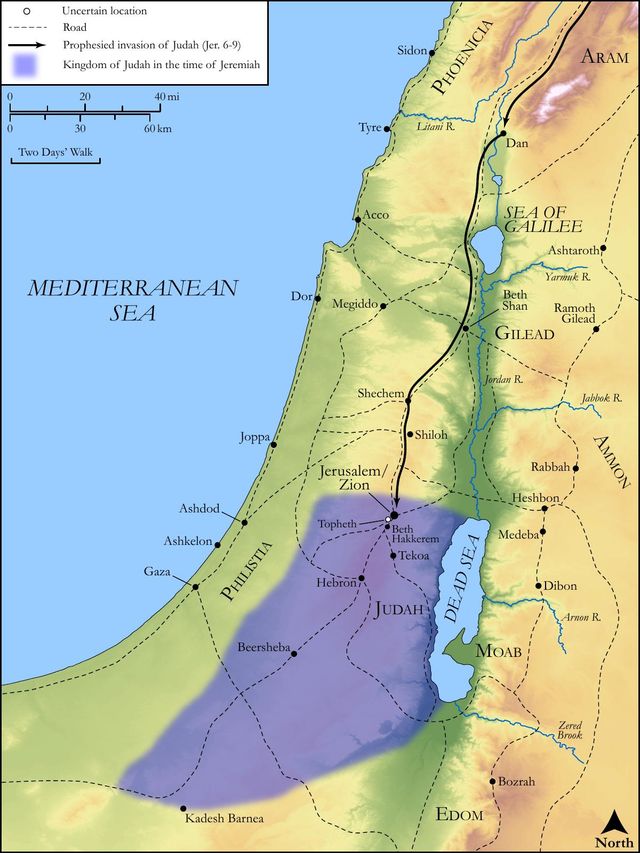
See on the biblical-era map
Study this verse
Public-domain commentary
Matthew Henry
From his Commentary on the Whole Bible. Henry comments on passages, not single verses — this entry covers Jeremiah 7:21–28. His two-level outline is real structure in the source text, so it is rendered as structure.
God, having shown the people that the temple would not protect them while they polluted it with their wickedness, here shows them that their sacrifices would not atone for them, nor be accepted, while they went on in disobedience. See with what contempt he here speaks of their ceremonial service (Jer 7:21). "Put your burnt-offerings to your sacrifices; go on in them as long as you please; add one sort of sacrifice to another; turn your burnt-offerings (which were to be wholly burnt to the honour of God) into peace-offerings" (which the offerer himself had a considerable share of), "that you may eat flesh, for that is all the good you are likely to have from your sacrifices, a good meal's meat or two; but expect not any other benefit by them while you live at this loose rate. Keep your sacrifices to yourselves" (so some understand it); "let them be served up at your own table, for they are no way acceptable at God's altars." For the opening of this,
I.He shows them that obedience was the only thing he required of them, Jer 7:22, Jer 7:23.
He appeals to the original contract, by which they were first formed into a people, when they were brought out of Egypt. God made them a kingdom of priests to himself, not that he might be regaled with their sacrifices, as the devils, whom the heathen worshipped, which are represented as eating with pleasure the fat of their sacrifices and drinking the wine of their drink-offerings, Deu 32:38. No: Will God eat the flesh of bulls? Psa 50:13. I spoke not to your fathers concerning burnt-offerings or sacrifices, not of them at first. The precepts of the moral law were given before the ceremonial institutions; and those came afterwards, as trials of their obedience and assistances to their repentance and faith. The Levitical law begins thus: If any man of you will bring an offering, he must do so and so (Lev 1:2, Lev 2:1), as if it were intended rather to regulate sacrifice than to require it. But that which God commanded, which he bound them to by his supreme authority and which he insisted upon as the condition of the covenant, was, Obey my voice; see Exo 15:26, where this was the statute and the ordinance by which God proved them: Hearken diligently to the voice of the Lord thy God. The condition of their being God's peculiar people was this (Exo 19:5), If you will obey my voice indeed. "Make conscience of the duties of natural religion, observe positive institutions from a principle of obedience, and then I will be your God and you shall be my people," which is the greatest honour, happiness, and satisfaction, that any of the children of men are capable of. "Let your conversation be regular, and in every thing study to comply with the will and word of God; walk within the bounds that I have set you, and in all the ways that I have commanded you, and then you may assure yourselves that it shall be well with you." The demand here is very reasonable, that we should be directed by Infinite Wisdom to that which is fit, that he that made us should command us, and that he should give us law who gives us our being and all the supports of it; and the promise is very encouraging: Let God's will be your rule and his favour shall be your felicity.
II.He shows them that disobedience was the only thing for which he had a quarrel with them.
He would not reprove them for their sacrifices, for the omission of them; they had been continually before him (Psa 50:8); with them they hoped to bribe God, and purchase a license to go on in sin. That therefore which God had all along laid to their charge was breaking his commandments in the course of their conversation, while they observed them, in some instances, in the course of their devotion, Jer 7:24, Jer 7:25, etc.
1.They set up their own will in competition with the will of God: They hearkened not to God and to his law; they never heeded that; it was to them as if it had never been given or were of no force; they inclined not their ear to attend to it, much less their hearts to comply with it. But they would have their own way, would do as they chose, and not as they were bidden. Their own counsels were their guide, and not the dictates of divine wisdom; that shall be lawful and good with them which they think so, though the word of God says quite contrary. The imagination of their evil heart, the appetites and passions of it, shall be a law to them, and they will walk in the way of it, and in the sight of their eyes.
2.If they began well, yet they did not proceed, but soon flew off. They went backward, when they talked of making a captain, and returning to Egypt again, and would not go forward under God's conduct. They promised fair: All that the Lord shall say unto us we well do; and, if they would but have kept in that good mind, all would have been well; but, instead of going on in the way of duty, they drew back into the way of sin, and were worse than ever.
3.When God sent to them by word of mouth to put them in mind of the written word, which was the business of the prophets, it was all one; still they were disobedient. God had servants of his among them in every age, since they came out of Egypt unto this day, some or other to tell them of their faults and put them in mind of their duty, whom he rose up early to send (as before, Jer 7:13), as men rise up early to call servants to their work; but they were as deaf to the prophets as they were to the law (Jer 7:26): Yet they hearkened not, nor inclined their ear. This had been their way and manner all along; they were of the same stubborn refractory disposition with those that went before them; it had all along been the genius of the nation, and an evil genius it was, that continually haunted them till it ruined them at last.
4.Their practice and character were still the same. They are worse, and not better, than their fathers. (1.) Jeremiah can himself witness against them that they were disobedient, or he shall soon find it so (Jer 7:27): "Thou shalt speak all these words to them, shalt particularly charge them with disobedience and obstinacy. But even that will not work upon them: They will not hearken to thee, nor heed thee. Thou shalt go, and call to them with all the plainness and earnestness imaginable, but they will not answer thee; they will either give thee no answer at all or not an obedient answer; they will not come at thy call." (2.) He must therefore own that they deserved the character of a disobedient people, that were ripe for destruction, and must go to them and tell them so to their faces (Jer 7:28): "Say unto them, This is a nation that obeys not the voice of the Lord their God. They are notorious for their obstinacy; they sacrifice to the Lord as their God, but they will not be ruled by him as their God; they will not receive either the instruction of his word or the correction of his rod; they will not be reclaimed or reformed by either. Truth has perished among them; they cannot receive it; they will not submit to it nor be governed by it. They will not speak truth; there is no believing a word they say, for it is cut off from their mouth, and lying comes in the room of it. They are false both to God and man."
Historical interpretation
Two Centuries of Reception
4 surviving comments on this verse. Each one is dated, so this reads as a timeline rather than a list.
Select a marker to jump to its quote. Markers stagger vertically where authors wrote within a few decades of each other.
“Obey my voice, and I will be your God, and you will be my people; and you will walk in all my ways, which I have commanded you.” This was God’s invitation. “But,” it says, “they did not listen, nor inclined their ear.” This was Israel’s refusal. “They departed, and walked every one in the imagination of their evil heart.” I have bought a field, I have purchased oxen, I have married a wife. So again he adds: “I have sent to you all my servants the prophets, rising early even before daylight”—this would be the Holy Spirit who calls to those who are feasting—“Yet my people did not listen to me, nor inclined their ear, but stiffened their neck.”
(Verse 26) And I sent to you all my servants the prophets, rising up early and sending them, saying, 'Turn now everyone from his evil way and amend your doings, and do not go after other gods to serve them, and you shall dwell in the land which I have given to you and to your fathers.' But you have not inclined your ear nor listened to me. Instead, you have stiffened your neck and done worse than your fathers. Therefore, the anger of the Lord was kindled against this people, and it has poured out and not been quenched.'
When I said, “Hear my voice and I will be your God,” “they did not listen or incline their ears” but followed the desires of their own hearts and, contrary to the principle of the apostle, who forgot what was in the past and strived for what lay before him, they did the opposite, pining for the past and despising the future. He also reports that they acted offensively against the Lord “from the day on which their ancestors left the land of Egypt until the present time.” Hence, the grace of the gospel was necessary to save them, not due to their own merits but to the Lord’s mercy.
When the whole world was oppressed by the darkness of the devil. When the gloom brought on by sin had laid hold of the world. At the last age, when night had already fallen, this sun deigned to bring forth the rising of his birth. Before the light, before the sun of justice shone, he sent the oracle of the prophets as a kind of dawning, as it is written: “I sent my prophets before the light.”
Continue studying Jeremiah 7:26 across the web’s major study libraries — every link below opens this exact verse, chapter, or book on the destination site.
Read & Compare
 BibleGatewayThis verse in more than 200 translations and 70 languages.
 Bible.comThe YouVersion reader — hundreds of translations, reading plans, and highlights.
 ESV.orgCrossway's official English Standard Version reader.
 NET BibleThe NET translation with 60,000+ translators' notes on every rendering decision.
 STEP BibleTyndale House's free study tool — original text, vocabulary, and scholarly resources.
 BibliaLogos Bible Software's free web reader.
 USCCBThe New American Bible (Revised Edition) with the U.S. bishops' study notes.
Commentaries
 BibleHub CommentariesDozens of classic commentaries on this verse, gathered on one page.
 StudyLightMore than 100 commentary sets — the largest collection on the web.
 BibleRefPlain-English commentary on what this verse means, verse by verse.
 Enduring WordDavid Guzik's free commentary on this chapter, widely used by Bible teachers.
 Bible Study ToolsVerse commentary alongside Greek and Hebrew study aids.
Original Language & Research
- BibleHub InterlinearThe verse word by word — original language, transliteration, and English.
- BibleHub LexiconEvery word's original-language definition and Strong's entry.
 Blue Letter BibleDeep-study tools — Strong's numbers, concordance, and word studies.
 SefariaThe Hebrew text with Rashi and centuries of Jewish commentary.
Sermons, Hymns & Audio


TrulyRandomVerse is not affiliated with these sites and doesn’t control their content. They’re linked because they’re genuinely useful.
Summary
Jeremiah 7:26 serves as a poignant summary of Judah's deep-seated rebellion against God, a central theme in Jeremiah's prophetic ministry. Despite the Lord's consistent and patient calls to obedience, the people of Judah persistently refused to listen or respond, choosing instead to stiffen their resolve and resist divine instruction. This verse tragically highlights a profound spiritual decline, indicating that the current generation had not only perpetuated but significantly intensified the sins and disobedience of their ancestors, leading them further down a path of inevitable judgment.
Context
ShowHideLiterary Context
Jeremiah 7:26 is a climactic statement within the prophet Jeremiah's powerful "Temple Sermon," delivered at the entrance of the Lord's house in Jerusalem (found in Jeremiah 7 through Jeremiah 10). This sermon directly challenges Judah's misguided reliance on the physical Temple and their participation in religious rituals as a shield against impending divine judgment, even while their lives were characterized by pervasive idolatry, oppression, and flagrant disregard for God's covenant commands. The verses immediately preceding 7:26 (Jeremiah 7:23-25) recount God's consistent call for obedience and the people's equally consistent refusal to heed His voice, opting instead to walk in the stubbornness of their own evil hearts. This particular verse encapsulates their historical and ongoing spiritual apathy, setting the stage for the severe consequences outlined in the subsequent chapters, including the destruction of the Temple and the Babylonian exile.
Historical & Cultural Context
Jeremiah's prophetic ministry unfolded during a tumultuous period in Judah's history, primarily spanning the reigns of Kings Josiah, Jehoiakim, and Zedekiah (late 7th to early 6th century BCE). This era was marked by significant geopolitical instability, with the decline of the Assyrian Empire and the formidable rise of Babylon threatening Judah's sovereignty. Spiritually, despite the significant reforms initiated by King Josiah, the nation quickly reverted to widespread idolatry, syncretism, and deep-seated social corruption after his death. The phrase "hardened their neck" is a potent Hebrew idiom, deeply embedded in Israel's historical narrative, used to describe obstinate rebellion against divine authority. It vividly evokes the image of a stubborn ox refusing to submit to the yoke or a rebellious servant resisting instruction. This cultural understanding powerfully underscores the deliberate, unyielding, and defiant nature of Judah's disobedience, contrasting sharply with the posture of humble submission expected from a people in covenant with their Lord, as seen historically in God's description of Israel in Exodus 32:9.
Key Themes
ShowHideJeremiah 7:26 powerfully articulates several core themes prevalent throughout the book of Jeremiah and the broader Old Testament narrative. Firstly, it highlights Persistent Disobedience, emphasizing a deliberate and continuous refusal to heed God's voice despite His repeated warnings and patient calls to repentance. This is portrayed not as a momentary lapse, but as a deeply ingrained pattern of rebellion. Secondly, the verse vividly portrays Stubbornness and Hardness of Heart through the evocative idiom "hardened their neck," signifying an unyielding resistance to divine authority and instruction, which effectively prevents genuine listening or turning to God. Thirdly, the chilling declaration "they did worse than their fathers" underscores Generational Decline, revealing a profound spiritual regression where the current generation not only repeated but intensified the sins of their ancestors, failing to learn from historical consequences or divine judgments (a theme also seen in Judges 2:19). Finally, implicit in the verse is the profound tension between Divine Patience and Human Rejection, as God's enduring faithfulness in calling His people is met by their consistent and escalating rejection, underscoring the tragic nature of their choices and the inevitability of judgment.
Exposition and Analysis
ShowHideKey Word Analysis
ShowHideThis primitive root signifies "to hear intelligently," often carrying the profound implication of attention, understanding, and, crucially, obedience. In this context, the negative "hearkened not" denotes far more than a mere physical inability to hear sounds; it points to a deliberate spiritual refusal to listen with a willingness to comply with God's commands and warnings.
Derived from a root meaning "to be dense" or "tough," this verb describes something severe, difficult, or unyielding. When applied to the neck, it vividly conveys the idea of becoming stiff, obstinate, or intractable. It points to an active, internal resistance to change or submission, a deliberate stiffening against divine guidance, correction, or the yoke of God's will.
This primitive root means "to spoil," "to make good-for-nothing," or "to be bad" in a comprehensive sense—physically, socially, or morally. Here, it indicates a moral and spiritual deterioration that not only matches but surpasses the wickedness and rebellion of previous generations. It signifies not merely a continuation of sin, but an escalation, pointing to a deeper level of depravity and an intensified rejection of God.
Verse Breakdown
ShowHide"Yet they hearkened not unto me,"
This initial clause establishes the fundamental problem: a profound and persistent failure on the part of the people to listen to God's voice. It implies a lack of attentive reception and, more significantly, a deliberate refusal to obey the divine commands, instructions, and warnings that God had consistently delivered through His prophets.
"nor inclined their ear,"
This phrase serves to intensify the preceding statement, underscoring the deliberate and active nature of their rejection. To "incline the ear" signifies a posture of attentiveness, humility, and a genuine willingness to receive instruction and wisdom. Their failure to adopt this posture indicates a closed-mindedness, a profound spiritual apathy, and an unwillingness to even consider God's message.
"but hardened their neck:"
This powerful and widely recognized idiom vividly portrays their active resistance and obstinacy. Like a stubborn animal refusing to be guided by a yoke or a plow, they stiffened their resolve against God's will, rendering themselves unyielding and defiantly rebellious. This was not passive neglect or ignorance, but an active, conscious defiance of divine authority.
"they did worse than their fathers."
This chilling and deeply sobering statement reveals a profound generational spiritual decline. It indicates that the current generation had not merely repeated the sins and errors of their ancestors but had surpassed them in wickedness and rebellion, demonstrating an even deeper level of depravity, an increased capacity for evil, and a tragic unwillingness to learn from past judgments or divine grace.
Literary Devices
ShowHideJeremiah 7:26 masterfully employs several potent literary devices to convey its message of Israel's escalating rebellion. The most prominent is Idiom, specifically the deeply ingrained biblical expression "hardened their neck." This phrase functions as a powerful Metaphor, drawing on the vivid image of a stubborn animal refusing to submit to the yoke, effectively illustrating Judah's unyielding and defiant resistance to God's authority and guidance. There is also a striking element of Contrast between the expected posture of "inclining their ear" (which implies attentive listening and obedient submission) and the actual behavior of "hardening their neck" (which signifies stubborn defiance and active rebellion). Furthermore, the concluding statement, "they did worse than their fathers," functions as a form of Intensification or even Hyperbole, emphasizing the extreme depth of their spiritual depravity and the escalating nature of their sin across generations, highlighting a tragic moral regression rather than mere repetition of ancestral faults.
Theological and Thematic Connections
ShowHideJeremiah 7:26 stands as a stark testament to the human capacity for persistent and escalating rebellion against a holy, patient, and covenant-keeping God. Theologically, it profoundly underscores the gravity of covenant disobedience, revealing how a repeated refusal to heed divine instruction leads to a progressive hardening of the heart and an alarming escalation of sin. This verse highlights God's unwavering faithfulness in consistently speaking to His people through His prophets, even as His warnings and invitations are met with increasing defiance. It powerfully challenges the false security derived from external religious observance when internal spiritual transformation is absent, emphasizing that a true and living relationship with God necessitates attentive listening and humble, obedient submission. The generational aspect ("did worse than their fathers") points to the cumulative and compounding nature of sin, illustrating the tragic reality of spiritual decline that can plague a community or nation, ultimately leading to just divine judgment.
Reflection and Application
ShowHideJeremiah 7:26 serves as a timeless and convicting mirror for profound self-examination, urging us to honestly consider the posture of our own hearts towards God's revealed Word. In an age characterized by abundant information and accessible spiritual teaching, are we genuinely "inclining our ear" to the Lord, seeking to understand and obey His will, or are we selectively hearing only what aligns with our preconceived notions or personal desires, effectively "hardening our neck" against uncomfortable truths or challenging commands? This verse stands as a solemn warning against the insidious danger of spiritual apathy and stubbornness, which can gradually desensitize us to God's voice and lead to a perilous hardening of the heart, as soberly highlighted in Hebrews 3:13. It calls us to actively cultivate a posture of humility, responsiveness, and a teachable spirit, constantly examining whether we are genuinely seeking to obey God's will in all areas of our lives, or if we are resisting His transformative work. Furthermore, the sobering truth that "they did worse than their fathers" challenges us to critically identify and intentionally break any generational cycles of spiritual indifference, compromise, or outright sin that may exist within our families, communities, or even our personal histories. We are called not merely to avoid repeating past mistakes, but to pursue a deeper, more radical, and more Christ-like obedience to God than those who came before us, ensuring that our lives bear authentic witness to genuine repentance and transformative faith.
Questions for Reflection
ShowHideFAQ
ShowHideWhat does the phrase "hardened their neck" mean in a biblical context?
ShowHideThe phrase "hardened their neck" (Hebrew: qasheh oref) is a powerful and frequently used Hebrew idiom that vividly describes stubbornness, obstinacy, and an unwillingness to submit to authority, particularly divine authority. It evokes the image of a stubborn animal, like an ox, that stiffens its neck and refuses to be guided by the yoke or plow, resisting its master's direction. In the biblical narrative, it is consistently used to characterize Israel's persistent rebellion against God's commands and covenant, despite His patient instruction, warnings, and acts of deliverance. It signifies a deliberate and unyielding resistance to God's will, a refusal to turn, repent, or yield to His guidance, as seen in passages describing Israel's wilderness wanderings (Deuteronomy 9:6) and their behavior throughout their history (Nehemiah 9:17).
Why is Jeremiah 7:26 significant for understanding Israel's relationship with God?
ShowHideJeremiah 7:26 is profoundly significant because it encapsulates the tragic culmination of Israel's long and tumultuous history of disobedience and rebellion against their covenant Lord. It highlights God's consistent, persistent, and loving efforts to reach His people ("hearkened not unto me, nor inclined their ear"), contrasted sharply with their equally consistent, escalating, and defiant rejection ("but hardened their neck: they did worse than their fathers"). This verse underscores the deep-seated spiritual apathy, moral decline, and outright defiance that characterized Judah in Jeremiah's time, demonstrating that their sin was not an isolated incident but a pervasive, generational pattern of increasing wickedness. It explains why divine judgment was not arbitrary or capricious but a just and necessary consequence of their unrepentant rebellion, despite God's enduring patience and grace. Ultimately, it reveals the profound tragedy of a people who, despite being uniquely chosen, blessed, and instructed by God, repeatedly and increasingly turned away from their covenant relationship.
Christ-Centered Fulfillment
ShowHideJeremiah 7:26, with its lament over Israel's hardened hearts and persistent, escalating disobedience, finds its ultimate and profound fulfillment in the person and redemptive work of Jesus Christ. Israel's tragic failure to "hearken" and "incline their ear" to God's voice, culminating in their "hardened neck" and doing "worse than their fathers," stands in stark and glorious contrast to Jesus, the perfectly obedient Son. Where Israel rebelled, Jesus perfectly submitted to the Father's will, even to the point of obedient death on a cross (Philippians 2:8). His life, death, and resurrection directly address the very problem of humanity's hardened heart that Jeremiah so deeply mourned. Through His atoning work, the New Covenant prophesied by Jeremiah himself (Jeremiah 31:31-34) is inaugurated, promising a radical transformation where God's law is no longer resisted but written upon the heart, and His Spirit enables true, willing obedience (Ezekiel 36:26-27). Jesus Himself, in His earthly ministry, lamented over Jerusalem's unwillingness to be gathered and protected, echoing the divine sorrow over a stubborn people (Matthew 23:37). Ultimately, Christ offers the only true remedy for a hardened neck and deaf ear: a new heart of flesh in place of a heart of stone, enabling us, by His grace, to truly hear, incline our ear, and joyfully obey the voice of God, becoming a "new creation" in Him (2 Corinthians 5:17).