


Jeremiah 7:27
- וְדִבַּרְתָּve·di·bar·Taand you will sayH1696Conj-w ¦ V-Piel-ConsecPerf-2msVerb Piel Consecutive Perfect 2nd Singular Masculineוְandדִבַּרְתָּyou will say
- אֲלֵיהֶם'a·lei·Hemto themH413Prep ¦ 3mpPreposition Definiteאֲלֵיtoהֶםthem
- אֶת'et<obj.>H853DirObjMParticle Object Indicator
- כָּלkolallH3605N-mscNoun Singular Masculine Construct
- הַדְּבָרִיםha·de·va·Rimthe wordsH1697Art ¦ N-mpNoun Plural Masculine Absoluteהַtheדְּבָרִיםwords
- הָאֵלֶּהha·'E·leh<the> theseH428Art ¦ PrtParticle Demonstrativeהָ<the>אֵלֶּהthese
- וְלֹאve·Lo'and notH3808Conj-w ¦ NegParticle Negativeוְandלֹאnot
- יִשְׁמְעוּyish·me·'Uthey will listenH8085V-Qal-Imperf-3mpVerb Qal Imperfect 3rd Plural Masculine
- אֵלֶיךָ'e·Lei·khato youH413Prep ¦ 2msPreposition Definiteאֵלֶיtoךָyou
- וְקָרָאתָve·ka·Ra·taand you will callH7121Conj-w ¦ V-Qal-ConsecPerf-2msVerb Qal Consecutive Perfect 2nd Singular Masculineוְandקָרָאתָyou will call
- אֲלֵיהֶם'a·lei·Hemto themH413Prep ¦ 3mpPreposition Definiteאֲלֵיtoהֶםthem
- וְלֹאve·Lo'and notH3808Conj-w ¦ NegParticle Negativeוְandלֹאnot
- יַעֲנוּכָהya·'a·Nu·khahthey will answer youH6030V-Qal-Imperf-3mp ¦ 2msVerb Qal Imperfect 3rd Plural Masculineיַעֲנוּthey will answerכָהyou
English is a literal word-by-word gloss of the Hebrew, not the KJV's wording. Why?
This is the original text the KJV's translators worked from — each Hebrew word with its own literal English meaning in this verse, prepared by scholars at Tyndale House, Cambridge. The KJV translates whole sentences, not word by word, so its wording differs: one Hebrew word can become several English words, and the KJV may choose “the LORD” where the gloss reads “Yahweh”. Both are faithful — they answer different questions. For the KJV's own rendering, switch to the KJV text.
Details
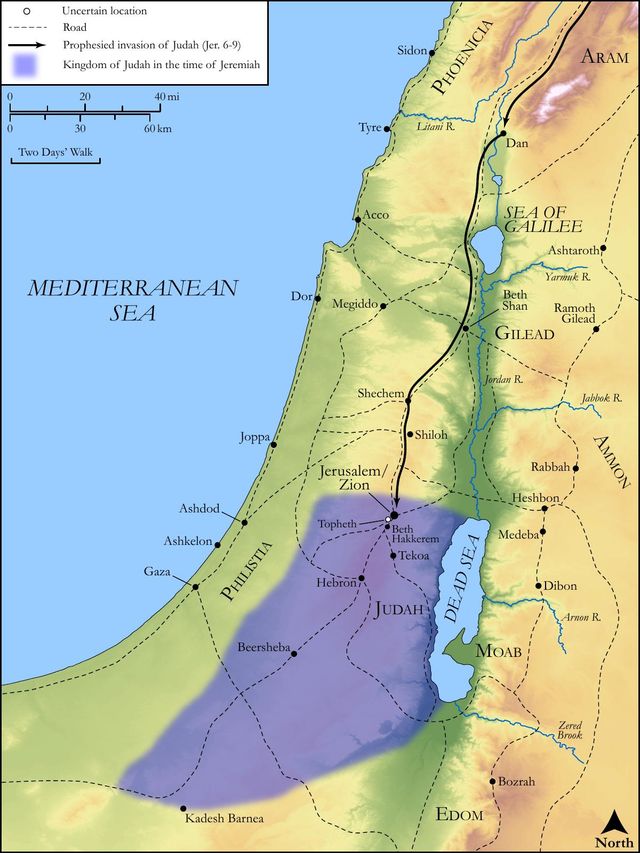
See on the biblical-era map
Study this verse
Public-domain commentary
Matthew Henry
From his Commentary on the Whole Bible. Henry comments on passages, not single verses — this entry covers Jeremiah 7:21–28. His two-level outline is real structure in the source text, so it is rendered as structure.
God, having shown the people that the temple would not protect them while they polluted it with their wickedness, here shows them that their sacrifices would not atone for them, nor be accepted, while they went on in disobedience. See with what contempt he here speaks of their ceremonial service (Jer 7:21). "Put your burnt-offerings to your sacrifices; go on in them as long as you please; add one sort of sacrifice to another; turn your burnt-offerings (which were to be wholly burnt to the honour of God) into peace-offerings" (which the offerer himself had a considerable share of), "that you may eat flesh, for that is all the good you are likely to have from your sacrifices, a good meal's meat or two; but expect not any other benefit by them while you live at this loose rate. Keep your sacrifices to yourselves" (so some understand it); "let them be served up at your own table, for they are no way acceptable at God's altars." For the opening of this,
I.He shows them that obedience was the only thing he required of them, Jer 7:22, Jer 7:23.
He appeals to the original contract, by which they were first formed into a people, when they were brought out of Egypt. God made them a kingdom of priests to himself, not that he might be regaled with their sacrifices, as the devils, whom the heathen worshipped, which are represented as eating with pleasure the fat of their sacrifices and drinking the wine of their drink-offerings, Deu 32:38. No: Will God eat the flesh of bulls? Psa 50:13. I spoke not to your fathers concerning burnt-offerings or sacrifices, not of them at first. The precepts of the moral law were given before the ceremonial institutions; and those came afterwards, as trials of their obedience and assistances to their repentance and faith. The Levitical law begins thus: If any man of you will bring an offering, he must do so and so (Lev 1:2, Lev 2:1), as if it were intended rather to regulate sacrifice than to require it. But that which God commanded, which he bound them to by his supreme authority and which he insisted upon as the condition of the covenant, was, Obey my voice; see Exo 15:26, where this was the statute and the ordinance by which God proved them: Hearken diligently to the voice of the Lord thy God. The condition of their being God's peculiar people was this (Exo 19:5), If you will obey my voice indeed. "Make conscience of the duties of natural religion, observe positive institutions from a principle of obedience, and then I will be your God and you shall be my people," which is the greatest honour, happiness, and satisfaction, that any of the children of men are capable of. "Let your conversation be regular, and in every thing study to comply with the will and word of God; walk within the bounds that I have set you, and in all the ways that I have commanded you, and then you may assure yourselves that it shall be well with you." The demand here is very reasonable, that we should be directed by Infinite Wisdom to that which is fit, that he that made us should command us, and that he should give us law who gives us our being and all the supports of it; and the promise is very encouraging: Let God's will be your rule and his favour shall be your felicity.
II.He shows them that disobedience was the only thing for which he had a quarrel with them.
He would not reprove them for their sacrifices, for the omission of them; they had been continually before him (Psa 50:8); with them they hoped to bribe God, and purchase a license to go on in sin. That therefore which God had all along laid to their charge was breaking his commandments in the course of their conversation, while they observed them, in some instances, in the course of their devotion, Jer 7:24, Jer 7:25, etc.
1.They set up their own will in competition with the will of God: They hearkened not to God and to his law; they never heeded that; it was to them as if it had never been given or were of no force; they inclined not their ear to attend to it, much less their hearts to comply with it. But they would have their own way, would do as they chose, and not as they were bidden. Their own counsels were their guide, and not the dictates of divine wisdom; that shall be lawful and good with them which they think so, though the word of God says quite contrary. The imagination of their evil heart, the appetites and passions of it, shall be a law to them, and they will walk in the way of it, and in the sight of their eyes.
2.If they began well, yet they did not proceed, but soon flew off. They went backward, when they talked of making a captain, and returning to Egypt again, and would not go forward under God's conduct. They promised fair: All that the Lord shall say unto us we well do; and, if they would but have kept in that good mind, all would have been well; but, instead of going on in the way of duty, they drew back into the way of sin, and were worse than ever.
3.When God sent to them by word of mouth to put them in mind of the written word, which was the business of the prophets, it was all one; still they were disobedient. God had servants of his among them in every age, since they came out of Egypt unto this day, some or other to tell them of their faults and put them in mind of their duty, whom he rose up early to send (as before, Jer 7:13), as men rise up early to call servants to their work; but they were as deaf to the prophets as they were to the law (Jer 7:26): Yet they hearkened not, nor inclined their ear. This had been their way and manner all along; they were of the same stubborn refractory disposition with those that went before them; it had all along been the genius of the nation, and an evil genius it was, that continually haunted them till it ruined them at last.
4.Their practice and character were still the same. They are worse, and not better, than their fathers. (1.) Jeremiah can himself witness against them that they were disobedient, or he shall soon find it so (Jer 7:27): "Thou shalt speak all these words to them, shalt particularly charge them with disobedience and obstinacy. But even that will not work upon them: They will not hearken to thee, nor heed thee. Thou shalt go, and call to them with all the plainness and earnestness imaginable, but they will not answer thee; they will either give thee no answer at all or not an obedient answer; they will not come at thy call." (2.) He must therefore own that they deserved the character of a disobedient people, that were ripe for destruction, and must go to them and tell them so to their faces (Jer 7:28): "Say unto them, This is a nation that obeys not the voice of the Lord their God. They are notorious for their obstinacy; they sacrifice to the Lord as their God, but they will not be ruled by him as their God; they will not receive either the instruction of his word or the correction of his rod; they will not be reclaimed or reformed by either. Truth has perished among them; they cannot receive it; they will not submit to it nor be governed by it. They will not speak truth; there is no believing a word they say, for it is cut off from their mouth, and lying comes in the room of it. They are false both to God and man."
Historical interpretation
Historical reception
3 surviving comments on this verse. Each one is dated, so this reads as a timeline rather than a list.
The wrath of the Lord, therefore, is just. It is kindled and poured out on a contemptuous and stiff-necked people who are unwilling to hear the words of God. Yet, as we said above, how God continued to send prophets to them all day long and even through the night!
(Verse 27, 28.) And you shall speak to them all these words, and they will not listen to you. And you shall call to them, and they will not respond to you. And you shall say to them: This is a people who has not heard the voice of their Lord God, nor received discipline. Faith has perished and has been taken away from their mouth. Do not doubt, he says, that they have hardened their neck, and have done worse than their fathers. Behold, I give them a place for repentance: and yet I do not speak that they may become, but because they will be, therefore I foretell. Speak now to them with my words, and yet they will not listen to you; and you will call to them, and they will not respond to you. For their pride will be so great that when you call them to hear, no one will deign to respond. And you will say to them: This is a nation that has not heard the voice of their God, nor received discipline. Beautifully, as I have said before, he calls not his people, but a nation. Although this was done in part during the time of the Prophets, and it has preceded in shadow and in image, it is more fully fulfilled in Christ, when they refused to receive discipline and despised the voice of their Lord. Where elegantly is inferred: Faith has perished, which properly belongs to Christians; and it has been taken away from their lips: namely, all confession of the Son of God and of faith.
“Have no doubt,” he says, “that they are stiff-necked and that their works are worse than those of their ancestors. Behold, I give them a place of penance. I do not speak that they may repent, but I only predict what is coming. In any event, you will now speak my word to them and they will not listen to you, and you will call them and they will not answer you, for they are so prideful that when you ask them for a hearing, no one will even bother to respond. And you should then say to them: This is the generation who did not listen to the voice of the Lord their God or accepted his discipline.” It is beautiful, as I said before, not that he calls his own people, but that he calls the human race. For, although at the time of the prophets, it was done in part and as a foreshadowing, it was only fulfilled in Christ, when they refused to accept discipline and despised the voice of their Lord. Thus, Jeremiah has the apt phrase: “faith has perished”—which is distinctive of Christians—“and was removed from their mouth,” clearly referring to the confession of faith of the child of God.
Continue studying Jeremiah 7:27 across the web’s major study libraries — every link below opens this exact verse, chapter, or book on the destination site.
Read & Compare
 BibleGatewayThis verse in more than 200 translations and 70 languages.
 Bible.comThe YouVersion reader — hundreds of translations, reading plans, and highlights.
 ESV.orgCrossway's official English Standard Version reader.
 NET BibleThe NET translation with 60,000+ translators' notes on every rendering decision.
 STEP BibleTyndale House's free study tool — original text, vocabulary, and scholarly resources.
 BibliaLogos Bible Software's free web reader.
 USCCBThe New American Bible (Revised Edition) with the U.S. bishops' study notes.
Commentaries
 BibleHub CommentariesDozens of classic commentaries on this verse, gathered on one page.
 StudyLightMore than 100 commentary sets — the largest collection on the web.
 BibleRefPlain-English commentary on what this verse means, verse by verse.
 Enduring WordDavid Guzik's free commentary on this chapter, widely used by Bible teachers.
 Bible Study ToolsVerse commentary alongside Greek and Hebrew study aids.
Original Language & Research
- BibleHub InterlinearThe verse word by word — original language, transliteration, and English.
- BibleHub LexiconEvery word's original-language definition and Strong's entry.
 Blue Letter BibleDeep-study tools — Strong's numbers, concordance, and word studies.
 SefariaThe Hebrew text with Rashi and centuries of Jewish commentary.
Sermons, Hymns & Audio


TrulyRandomVerse is not affiliated with these sites and doesn’t control their content. They’re linked because they’re genuinely useful.
Summary
Jeremiah 7:27 presents a poignant divine commission to the prophet Jeremiah, revealing God's profound foreknowledge of Judah's unyielding rebellion and spiritual deafness. Despite God's persistent efforts to communicate His will and call His people to repentance through His prophet, He instructs Jeremiah to continue delivering the message, knowing full well that they will refuse to listen or respond. This verse powerfully underscores the nation's deep-seated obstinacy and the challenging, often unrewarding, nature of the prophetic ministry in the face of such hardened hearts.
Context
ShowHideLiterary Context
Jeremiah 7:27 is strategically positioned within Jeremiah's seminal "Temple Sermon" (Jeremiah 7:1-15), a direct divine address delivered at the very gate of the Lord's house. This sermon vehemently confronts Judah's misplaced and dangerous security in the mere physical presence of the Temple, while their societal and religious practices were riddled with idolatry, injustice, and moral decay. The verses immediately preceding this passage (Jeremiah 7:21-26) underscore God's unwavering preference for sincere obedience over ritualistic sacrifice, meticulously detailing how their ancestors consistently turned away from Him, thereby establishing a historical pattern of stubbornness that the current generation tragically mirrors. Consequently, Jeremiah 7:27 functions as a stark and bleak summation, declaring the inevitable outcome of Jeremiah's faithful proclamation, reinforcing the cyclical pattern of rejection that has historically plagued God's covenant people.
Historical & Cultural Context
The historical backdrop for Jeremiah 7:27 is Jerusalem during the tumultuous late 7th and early 6th centuries BCE, a period rapidly approaching the cataclysmic Babylonian exile. Under the reign of King Jehoiakim, the people of Judah had plunged into profound apostasy, syncretistically blending the worship of Yahweh with abhorrent pagan practices and perpetrating widespread oppression. Culturally, a pervasive and dangerously misguided belief had taken root: that the sheer existence of the Temple in Jerusalem guaranteed God's unconditional protection and presence, irrespective of their moral and spiritual conduct, as explicitly challenged in Jeremiah 7:4. This false confidence fostered a deep spiritual complacency and an entrenched unwillingness to heed the urgent prophetic warnings, even as the formidable geopolitical storm clouds of Babylonian power ominously gathered on the horizon, threatening the very fabric of their national existence.
Key Themes
ShowHideThis verse powerfully contributes to and illuminates several critical themes pervasive within the book of Jeremiah and the broader prophetic literature. Firstly, it highlights Divine Foreknowledge and Sovereignty, as God, in His omniscience, declares the people's future and determined rejection even before Jeremiah utters a single word. Secondly, it profoundly underscores the theme of Persistent Disobedience and Spiritual Deafness of Judah, revealing a deep-seated and deliberate unwillingness to "hearken" or "answer" God's repeated call for repentance, a tragic pattern observed consistently from the Exodus generation through the succession of prophets, as seen in Jeremiah 25:4. Thirdly, it vividly portrays the Difficult and Unpopular Nature of the Prophetic Calling, emphasizing Jeremiah's unwavering obedience to God's command despite the guaranteed lack of positive human response—a theme central to Jeremiah's profound personal struggles and laments, exemplified in his initial commission in Jeremiah 1:7-8. Finally, it tragically foreshadows the Futility of Unheeded Warnings, where the consistent and deliberate rejection of divine counsel inevitably culminates in divine judgment.
Exposition and Analysis
ShowHideKey Word Analysis
ShowHideThis primitive root primarily signifies "to arrange," but is most frequently used figuratively to mean "to speak." In the context of Jeremiah 7:27, it denotes God's authoritative command to Jeremiah to articulate and deliver His divine message. This is not merely casual conversation but implies a formal, deliberate, and weighty declaration, emphasizing the gravity, divine origin, and comprehensive nature ("all these words") of the prophetic utterance.
This crucial word means "to hear intelligently," consistently carrying the profound implication of attentive listening, understanding, and, most importantly, obedience. When the text states "they will not hearken," it signifies a deliberate, active, and stubborn refusal to internalize God's word, to truly pay attention to its profound meaning, and, critically, to act upon its demands for repentance and transformative change. It transcends the mere auditory perception of sound; it is a profound rejection of the will of God.
This root properly means "to eye" or "to heed," and by implication, "to respond." In this prophetic context, it refers to a positive, affirmative, and obedient response to God's urgent call or divine appeal. The people's refusal to "answer" signifies their complete lack of positive engagement with God's message, their deep-seated unwillingness to acknowledge their sin, and their stubborn rejection of the path to restoration and reconciliation with God.
Verse Breakdown
ShowHide"Therefore thou shalt speak all these words unto them;"
This opening clause underscores God's unwavering and absolute command to His prophet. Despite God's perfect foreknowledge of the impending rejection, He insists that His message be delivered in its entirety ("all these words"). This highlights God's faithfulness in providing comprehensive warning to His people and His profound commitment to offering them every conceivable opportunity to repent, even when His omniscience reveals their predetermined obstinacy.
"but they will not hearken to thee:"
This phrase reveals the anticipated, yet deeply tragic, response of the people of Judah. Their resolute refusal to "hearken" signifies a profound, deep-seated spiritual deafness and a deliberate, active unwillingness to listen with genuine understanding and obedient intent. It represents a rejection not primarily of the messenger, Jeremiah, but of the divine message itself, and ultimately, of the sovereign God who sent it.
"thou shalt also call unto them;"
This clause powerfully reiterates the prophet's unyielding duty to persist in his divinely appointed ministry. The word "call" (from H7121, qârâʼ) implies an urgent summons, a fervent invitation, or a public proclamation. Jeremiah is commanded to continue appealing to them, perhaps with increasing urgency or through various forms of address, thereby demonstrating God's enduring patience and His persistent, yearning desire for their return.
"but they will not answer thee."
This concluding phrase profoundly mirrors and intensifies the earlier rejection, reinforcing the people's complete and utter unresponsiveness. It signifies their absolute refusal to engage, to repent, or to respond positively and affirmatively to God's repeated, gracious invitations. This powerful double negative ("not hearken," "not answer") serves to underscore with stark clarity the totality and finality of their rebellion.
Literary Devices
ShowHideJeremiah 7:27 employs several potent literary devices to convey its stark and unyielding message. Repetition is profoundly evident in the parallel structure of the two clauses, "they will not hearken to thee" and "they will not answer thee," which powerfully emphasizes the absolute and unwavering nature of the people's rejection. This creates a strong sense of Parallelism, where the second half of the verse not only reinforces but also intensifies the first, highlighting both the prophet's persistent, divinely commanded effort and the people's consistent, willful refusal. There is also a profound Irony at play: God's chosen people, who were providentially set apart and intended to be His voice and light to the surrounding nations, are themselves tragically deaf and unresponsive to His own divine voice. Furthermore, the verse subtly yet powerfully conveys Divine Pathos, as God, in His omniscience, knows the deep pain of His word being rejected, yet He faithfully commands its proclamation, revealing His enduring love, patience, and unwavering justice even in the face of profound human rebellion.
Theological and Thematic Connections
ShowHideJeremiah 7:27 is a stark portrayal of the recurring biblical theme of divine communication met with human resistance. It highlights God's unwavering commitment to speaking His truth, even when His foreknowledge dictates that His message will be rejected. This divine persistence, coupled with human stubbornness, inexorably sets the stage for the inevitable consequences of unheeded warnings. The verse underscores the profound responsibility that comes with hearing God's word and the tragic spiritual consequences of hardening one's heart against it. It is a testament to God's justice, which allows humanity to choose its path, even if that path leads to judgment, while simultaneously affirming His grace in providing ample warning and opportunity for repentance.
Reflection and Application
ShowHideJeremiah 7:27 serves as a profound and challenging mirror for contemporary believers and the church, compelling us to critically examine the posture of our hearts towards God's living word. It powerfully reminds us that mere auditory hearing is insufficient; true spiritual vitality and genuine faith necessitate "hearkening"—listening with profound attention, deep understanding, and an immediate, active readiness to obey. In a world saturated with an overwhelming influx of information and a cacophony of competing voices, the insidious danger of spiritual deafness remains potently real, often leading to a gradual hardening of hearts that can render us tragically unresponsive to divine truth and guidance. For those divinely called to proclaim God's truth, this verse offers both a sobering reality check regarding the potential for rejection and a powerful, unwavering encouragement: faithfulness to the divine message is paramount, regardless of the immediate human reception or perceived success. Our sacred calling is to speak God's "all these words," trusting Him implicitly with the ultimate outcome, even when met with profound indifference, apathy, or outright hostility. It calls us to cultivate a spirit of profound humility, consistent responsiveness, and radical obedience, ensuring that when God speaks, we are not only listening intently but are actively ready to answer with transformative obedience and genuine spiritual transformation.
Questions for Reflection
ShowHideFAQ
ShowHideDoes God's foreknowledge of their rejection negate the people's free will?
ShowHideNo, God's foreknowledge does not negate the people's free will. Jeremiah 7:27 powerfully demonstrates God's omniscience, meaning He perfectly knows what choices people will make before they make them. However, this divine knowledge does not cause or compel their choices. The people of Judah freely and deliberately chose to harden their hearts and reject God's word, despite His repeated and gracious warnings delivered through Jeremiah. God's explicit command for Jeremiah to "speak all these words unto them" underscores that the opportunity for genuine repentance was authentically offered, and their ultimate rejection was a direct result of their own deliberate and culpable will, not a divine predetermination of their actions. This profound tension between divine sovereignty and human responsibility is a consistent and foundational theme woven throughout the fabric of Scripture, affirming both God's ultimate control and humanity's moral accountability for their choices.
What is the significance of the repetition of "they will not hearken" and "they will not answer"?
ShowHideThe repetition of "they will not hearken to thee" and "they will not answer thee" is profoundly significant and deliberate. It serves to emphasize the absolute, comprehensive, and unyielding nature of Judah's spiritual rebellion and unresponsiveness. "Hearken" (Hebrew shâmaʻ) implies not just the mere auditory perception of sound, but listening with deep understanding and a readiness to obey. "Answer" (Hebrew ʻânâh) implies a positive, affirmative, and responsive engagement to a call or appeal, particularly a divine call to repentance. By explicitly stating both, the text powerfully highlights that the people were not merely passively ignoring God's message; they were actively, deliberately, and stubbornly refusing to comprehend, internalize, or respond positively to His divine message. This powerful double negative underscores the profound depth of their spiritual deafness and the tragic futility of Jeremiah's faithful efforts to persuade them, a futility that stemmed not from his failure, but from the impenetrable hardness of their own hearts.
Christ-Centered Fulfillment
ShowHideJeremiah 7:27, with its somber portrayal of a prophet faithfully delivering God's word only to be met with unyielding rejection, finds its ultimate and most profound fulfillment in the person and ministry of Jesus Christ. Just as Jeremiah was divinely commanded to speak "all these words" to a rebellious people who would not "hearken" or "answer," so too did Jesus, the very Word made flesh, come to His own people, speaking the eternal words of God with perfect authority, unparalleled grace, and divine truth. Yet, tragically, He was met with the same, if not greater, spiritual deafness and profound rejection. John 1:11 poignantly laments, "He came to His own, and His own people did not receive Him." Jesus Himself expressed profound sorrow and divine pathos over Jerusalem's unyielding unwillingness to embrace His divine invitation: "O Jerusalem, Jerusalem... How often I wanted to gather your children together, just as a hen gathers her brood under her wings, and you were unwilling!" (Matthew 23:37). The prophet's experience in Jeremiah 7:27 vividly foreshadows the ultimate rejection of the Messiah, who spoke truth, performed miraculous signs, and offered eternal salvation, yet was ultimately crucified by those He came to redeem. His suffering and sacrificial death on the cross represent the pinnacle of humanity's refusal to "hearken" or "answer" God's ultimate call, yet it is through this very rejection that God's redemptive plan was miraculously accomplished, offering a path to true hearing and responsive faith for all who believe in Him (John 3:16).