


Genesis 43:18
- וַיִּירְאוּvai·yi·re·'Uand they were afraidH3372Conj-w ¦ V-Qal-ConsecImperf-3mpVerb Qal Consecutive Imperfect 3rd Plural Masculineוַandיִּירְאוּthey were afraid
- הָאֲנָשִׁיםha·'a·na·Shimthe menH582Art ¦ N-mpNoun Plural Masculine Absoluteהָtheאֲנָשִׁיםmen
- כִּיkithatH3588PrtParticle Conditional
- הוּבְאוּhu·ve·'Uthey were broughtH935V-Hophal-Perf-3cpVerb Hophal Perfect 3rd Plural common gender
- בֵּיתbeit[the] house ofH1004N-mscNoun Singular Masculine Construct
- יוֹסֵףyo·SefJosephH3130N-proper-mNoun Proper Masculine
- וַיֹּאמְרוּvai·yo·me·Ruand they saidH559Conj-w ¦ V-Qal-ConsecImperf-3mpVerb Qal Consecutive Imperfect 3rd Plural Masculineוַandיֹּאמְרוּthey said
- עַל'alonH5921PrepPreposition
- דְּבַרde·Var[the] matter ofH1697N-mscNoun Singular Masculine Construct
- הַכֶּסֶףha·Ke·sefthe silverH3701Art ¦ N-msNoun Singular Masculine Absoluteהַtheכֶּסֶףsilver
- הַשָּׁבha·Shavwhich returnedH7725Art ¦ V-Qal-Prtcpl-msVerb Qal Participle Singular Masculine Absoluteהַwhichשָּׁבreturned
- בְּאַמְתְּחֹתֵינוּbe·'am·te·cho·Tei·nuin our sacksH572Prep-b ¦ N-fpc ¦ 1cpNoun Plural Feminine Constructבְּinאַמְתְּחֹתֵיsacksנוּour
- בַּתְּחִלָּהba·te·chi·Lahat the beginningH8462Prep-b ¦ N-fsNoun Singular Feminine Absoluteבַּat theתְּחִלָּהbeginning
- אֲנַחְנוּ'a·Nach·nuweH587Pro-1cpPronoun Personal 1st Plural common gender
- מוּבָאִיםmu·va·'Im[are] being broughtH935V-Hophal-PassPrtcpl-mpVerb Hophal Participle Passive Plural Masculine Absolute
- לְהִתְגֹּלֵלle·hit·go·Lelto roll himselfH1556Prep-l ¦ V-Hithpael-InfVerb Hithpael Infinitive Constructלְtoהִתְגֹּלֵלroll himself
- עָלֵינוּ'a·Lei·nuon usH5921Prep ¦ 1cpPrepositionעָלֵיonנוּus
- וּלְהִתְנַפֵּלu·le·hit·na·Peland to throw himselfH5307Conj-w ¦ Prep-l ¦ V-Hithpael-InfVerb Hithpael Infinitive Constructוּandלְtoהִתְנַפֵּלthrow himself
- עָלֵינוּ'a·Lei·nuon usH5921Prep ¦ 1cpPrepositionעָלֵיonנוּus
- וְלָקַחַתve·la·Ka·chatand to takeH3947Conj-w ¦ Prep-l ¦ V-Qal-InfVerb Qal Infinitive Constructוְandלָtoקַחַתtake
- אֹתָנוּ'o·Ta·nu<obj.> usH853DirObjM ¦ 1cpParticle Object Indicatorאֹתָ<obj.>נוּus
- לַעֲבָדִיםla·'a·va·Dimto slavesH5650Prep-l ¦ N-mpNoun Plural Masculine Absoluteלַtoעֲבָדִיםslaves
- וְאֶתve·'Etand <obj.>H853Conj-w ¦ DirObjMParticle Object Indicatorוְandאֶת<obj.>
- חֲמֹרֵינוּcha·mo·Rei·nuour donkeysH2543N-cpc ¦ 1cpNoun Plural common gender Constructחֲמֹרֵיdonkeysנוּour
English is a literal word-by-word gloss of the Hebrew, not the KJV's wording. Why?
This is the original text the KJV's translators worked from — each Hebrew word with its own literal English meaning in this verse, prepared by scholars at Tyndale House, Cambridge. The KJV translates whole sentences, not word by word, so its wording differs: one Hebrew word can become several English words, and the KJV may choose “the LORD” where the gloss reads “Yahweh”. Both are faithful — they answer different questions. For the KJV's own rendering, switch to the KJV text.
Details
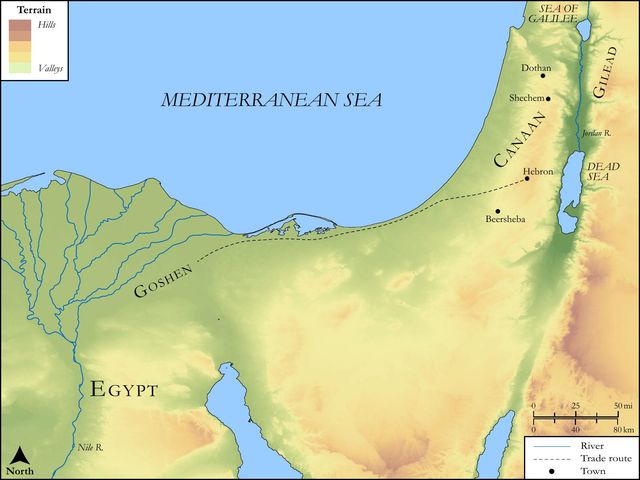
See on the biblical-era map


Study this verse
Public-domain commentary
Matthew Henry
From his Commentary on the Whole Bible. Henry comments on passages, not single verses — this entry covers Genesis 43:15–25.
Jacob's sons, having got leave to take Benjamin with them, were observant of the orders their father had given them, and went down the second time into Egypt to buy corn. If we should ever know what a famine of the word means, let us not think it much to travel as far for spiritual food as they did for corporal food. Now here we have an account of what passed between them and Joseph's steward, who, some conjecture, was in the secret, and knew them to be Joseph's brethren, and helped to humour the thing; I rather think not, because no man was permitted to be present when Joseph afterwards made himself known to them, Gen 45:1. Observe, 1. Joseph's steward has orders from his master (who was busy selling corn, and receiving money) to take them to his house, and make ready for their entertainment. Though Joseph saw Benjamin there, he would not leave his work at working-time, nor trust another with it. Note, Business must take place of civility in its season. Our needful employments must not be neglected, no, not to pay respect to our friends. 2. Even this frightened them: They were afraid, because they were brought into Joseph's house, Gen 43:18. The just challenges of their own consciences, and Joseph's violent suspicions of them, forbade them to expect any favour, and suggested to them that this was done with a bad design upon them. Note, Those that are guilty and timorous are apt to make the worst of every thing. Now they thought they should be reckoned with about the money in the sacks' mouths, and should be charged as cheats, and men not fit to be dealt with, who had taken advantage of the hurry of the market to carry off their corn unpaid for. They therefore laid the case before the steward, that he, being apprized of it, might stand between them and danger; and, as a substantial proof of their honesty, before they were charged with taking back their money they produced it. Note, Integrity and uprightness will preserve us, and will clear themselves as the light of the morning. 3. The steward encouraged them (Gen 43:23): Peace be to you, fear not; though he knew not what his master drove at, yet he was aware these were men whom he meant no harm to, while he thus amused them; and therefore he directs them to look at the divine Providence in the return of their money: Your God, and the God of your father, has given you treasure in your sacks. Observe, (1.) Hereby he shows that he had no suspicion at all of dishonesty in them: for of what we get by deceit we cannot say, "God gives it to us." (2.) Hereby he silences their further enquiry about it. "Ask not how it came thither; Providence brought it to you, and let that satisfy you." (3.) It appears by what he said that, by his good master's instructions, he was brought to the knowledge of the true God, the God of the Hebrews. It may justly be expected that those who are servants in religious families should take all fit occasions to speak of God and his providence with reverence and seriousness. (4.) He directs them to look up to God, and acknowledge his providence in the good bargain they had. We must own ourselves indebted to God, as our God and the God of our fathers (a God in covenant with us and them) for all our successes and advantages, and the kindnesses of our friends; for every creature is that to us, and no more, which God makes it to be. The steward encouraged them, not only in words but in deeds; for he made very much of them till his master came, Gen 43:24.
Historical interpretation
Historical reception
1 surviving comment on this verse from the historical church.
But when the [brothers] saw Joseph’s servants hurrying to unburden their beasts and to bring in their baggage, they said to themselves, grieving, “We have bereaved our father of Benjamin, and we shall never again see the face of our father. It was with treachery that our money was put into the openings of our packs, so that if we escape [the charge of] spying they might seize us and make us slaves [on the charge] of theft. Let us confess to the steward about the money before he begins to accuse us so that our brother Benjamin might free us from [the charge of] spying and the confession of our lips from [the charge of] theft.”
Continue studying Genesis 43:18 across the web’s major study libraries — every link below opens this exact verse, chapter, or book on the destination site.
Read & Compare
 BibleGatewayThis verse in more than 200 translations and 70 languages.
 Bible.comThe YouVersion reader — hundreds of translations, reading plans, and highlights.
 ESV.orgCrossway's official English Standard Version reader.
 NET BibleThe NET translation with 60,000+ translators' notes on every rendering decision.
 STEP BibleTyndale House's free study tool — original text, vocabulary, and scholarly resources.
 BibliaLogos Bible Software's free web reader.
 USCCBThe New American Bible (Revised Edition) with the U.S. bishops' study notes.
Commentaries
 BibleHub CommentariesDozens of classic commentaries on this verse, gathered on one page.
 StudyLightMore than 100 commentary sets — the largest collection on the web.
 BibleRefPlain-English commentary on what this verse means, verse by verse.
 Enduring WordDavid Guzik's free commentary on this chapter, widely used by Bible teachers.
 Bible Study ToolsVerse commentary alongside Greek and Hebrew study aids.
Original Language & Research
- BibleHub InterlinearThe verse word by word — original language, transliteration, and English.
- BibleHub LexiconEvery word's original-language definition and Strong's entry.
 Blue Letter BibleDeep-study tools — Strong's numbers, concordance, and word studies.
 SefariaThe Hebrew text with Rashi and centuries of Jewish commentary.
Sermons, Hymns & Audio


TrulyRandomVerse is not affiliated with these sites and doesn’t control their content. They’re linked because they’re genuinely useful.
Summary
Genesis 43:18 powerfully depicts the intense fear and profound suspicion gripping Joseph's brothers as they are unexpectedly ushered into the Egyptian viceroy's opulent house. Their acute anxiety is rooted in the mysterious return of their payment money in their sacks during their previous journey, leading them to conclude that this summons is a calculated trap. They are convinced the viceroy intends to fabricate an accusation against them, overpower them, seize their property, and ultimately reduce them to slavery.
Context
ShowHideLiterary Context
This verse is a pivotal moment following a series of dramatic encounters between Joseph and his brothers. A severe famine has driven Jacob's family to Egypt for sustenance, leading to their initial, tense meeting with the powerful viceroy, whom they do not recognize as Joseph. During their first visit, Joseph orchestrated Simeon's imprisonment and demanded the return of their youngest brother, Benjamin, to Egypt. The brothers' distress was compounded by the inexplicable discovery of their payment money returned in their sacks upon their return journey to Canaan, a discovery that filled them with dread and confusion (Genesis 42:28). Now, on their second perilous journey, with Benjamin reluctantly accompanying them, the unexpected invitation to the viceroy's personal residence, rather than offering relief or hospitality, intensifies their apprehension. Their deep-seated guilt over their past sin of selling Joseph into slavery predisposes them to anticipate punitive actions, coloring their interpretation of every event.
Historical & Cultural Context
The ancient Near East was a complex landscape where famine was a recurring threat, often forcing migrations and interactions between different peoples. Egypt, a powerful and centralized empire, held significant sway. Foreigners, or "aliens," often occupied a precarious position, vulnerable to the whims of local authorities and susceptible to accusations that could lead to enslavement for debt or alleged wrongdoing. The concept of "bondmen" (slaves) was a harsh reality, and the loss of property, such as "asses" (donkeys), represented not merely material loss but the complete forfeiture of one's means of livelihood, transport, and thus, freedom and survival. The brothers' fear is therefore not irrational but deeply rooted in the socio-economic realities and legal practices of their time, where their status as outsiders made them particularly susceptible to exploitation.
Key Themes
ShowHideGenesis 43:18 contributes to several overarching themes within the Joseph narrative and the broader book of Genesis. Foremost is the theme of Divine Providence, where God's unseen hand orchestrates events for His redemptive purposes, even amidst human misunderstanding and fear. The brothers' profound Guilt and its distorting effects on perception are vividly portrayed; their past sin of selling Joseph causes them to misinterpret Joseph's benevolent actions as hostile traps. This highlights the theme of Misunderstanding and Misperception, as Joseph's true identity and intentions remain hidden, leading to a dramatic irony. The passage also touches on the Vulnerability of the Alien and the precarious nature of life for those outside their homeland, emphasizing themes of justice, hospitality, and the potential for exploitation in ancient societies.
Exposition and Analysis
ShowHideThe brothers' immediate and visceral reaction in Genesis 43:18 is one of profound fear, expressed by their conviction that being brought into Joseph's house is a hostile act rather than an invitation to hospitality. They swiftly conclude that the inexplicably returned money from their first journey, which they discovered in their sacks, is now being used as a pretext for accusation. Their minds leap to the worst-case scenario: that the official intends to "seek occasion against us, and fall upon us, and take us for bondmen, and our asses."
Key Word Analysis
ShowHideThis primitive root signifies more than simple fear; it encompasses dread, terror, and even reverence. In this context, it highlights the brothers' profound apprehension and the overwhelming sense of dread that grips them. Their fear is not a fleeting emotion but a deep-seated terror stemming from their perceived vulnerability and the weight of their past actions.
This root implies "to roll," and figuratively, "to roll over someone," "to find a pretext," or "to seize an opportunity." The brothers believe Joseph intends to deliberately manufacture a reason or excuse to overpower them, to "roll over" them with an accusation, rather than genuinely welcoming them. It speaks to their conviction that they are being set up for a punitive encounter.
Derived from the root "to serve," this term refers to a servant or slave. The brothers' ultimate fear is not just the loss of their property but the complete forfeiture of their freedom and dignity, becoming enslaved in a foreign land. This was a very real and terrifying prospect in the ancient world for those accused of crimes or unable to pay debts.
Verse Breakdown
ShowHide"And the men were afraid, because they were brought into Joseph's house"
This opening clause immediately establishes the brothers' emotional state. Their fear is not a general anxiety but a direct, intense reaction to the specific act of being led into the viceroy's personal residence. This unexpected summons, rather than an anticipated release or a simple transaction, triggers their deepest anxieties, as it deviates from their expectations of a typical official encounter.
"and they said, Because of the money that was returned in our sacks at the first time are we brought in"
This reveals the brothers' immediate and desperate attempt to rationalize their predicament. They connect their current situation directly to the inexplicable discovery of their money in their sacks during their first journey. They interpret this past event not as a gesture of kindness but as a deliberate trap, a pre-arranged "evidence" for a future accusation. Their guilty consciences immediately jump to the most incriminating explanation.
"that he may seek occasion against us, and fall upon us, and take us for bondmen, and our asses"
This clause articulates the full scope of their perceived threat. They envision a multi-stage process: first, the viceroy will "seek occasion" (find a pretext or excuse) using the money; second, he will "fall upon us" (attack or overpower them, implying a swift and decisive action); and finally, he will "take us for bondmen, and our asses," signifying their complete subjugation and the confiscation of their most valuable possessions, leaving them utterly destitute and enslaved. This reveals their deep vulnerability as foreigners.
Literary Devices
ShowHideThe passage employs several potent literary devices to convey the brothers' psychological state and the narrative's underlying tension. Irony is central, as Joseph's true intentions are benevolent and aimed at reconciliation, yet his brothers perceive his actions as hostile and malicious. Their fear is based on a profound misinterpretation of reality, creating a stark contrast between what is happening and what they believe is happening. The narrative also builds suspense, as the reader knows Joseph's identity, but the brothers' ignorance prolongs the dramatic tension. Furthermore, the passage exhibits strong psychological realism, vividly portraying how a burdened and guilty conscience can distort perception, leading individuals to project their own anxieties and expectations of judgment onto external circumstances, even when kindness is extended.
Theological and Thematic Connections
ShowHideThe brothers' reaction in Genesis 43:18 profoundly illustrates how fear, especially when intertwined with a guilty conscience, can lead to a complete misinterpretation of circumstances and intentions. They project their own anxieties and expectations of judgment onto Joseph's actions, failing to see the benevolent, divinely orchestrated plan unfolding before them. This highlights a crucial theological truth: God's sovereign providence often operates in ways that are mysterious and initially appear threatening to human understanding, yet ultimately work for good and the fulfillment of His purposes. Joseph's act of returning their money, intended as a kindness and a test of character, is perceived by the brothers as a trap for accusation, showcasing a recurring biblical theme where divine grace or benevolent actions are initially misunderstood or feared by those who feel unworthy or anticipate judgment.
Reflection and Application
ShowHideGenesis 43:18 offers a poignant reflection on the human condition, revealing how easily fear and a burdened conscience can lead to profound misinterpretation. When we carry unresolved guilt, harbor past regrets, or feel vulnerable in unfamiliar situations, we may project our anxieties onto others' intentions, assuming the worst even when circumstances are meant for our good. This passage encourages us to pause and consider that what appears to be a threat might, in fact, be an unseen act of grace, a test of faith, or an integral part of a larger, benevolent plan orchestrated by a sovereign God. It challenges us to cultivate a posture of trust in God's overarching wisdom and goodness, even when immediate circumstances seem alarming or incomprehensible, reminding us that His ways are higher than our ways and His thoughts than our thoughts.
Questions for Reflection
ShowHideFAQ
ShowHideWhy were Joseph's brothers so afraid of being brought into his house?
ShowHideThe brothers were terrified because they had previously found their payment money returned in their sacks upon their first journey, which they believed would be used as a pretext for an accusation of theft or wrongdoing. As foreigners in a powerful land, they felt incredibly vulnerable to exploitation and false charges. They feared that the viceroy intended to "seek occasion against" them, overpower them, and then "take" them "for bondmen, and their asses," meaning they would be enslaved and lose their valuable property. This was a common consequence for those accused of wrongdoing or unable to pay debts in ancient societies, and their past guilt over selling Joseph likely amplified their suspicion and fear of retribution.
Does the brothers' fear relate to their past actions?
ShowHideYes, their fear is deeply intertwined with their past actions, particularly their profound guilt over selling Joseph into slavery many years prior. This past sin created a burdened conscience that made them prone to suspicion and to interpreting Joseph's seemingly kind actions (like returning their money) as a setup for accusation and punishment. A guilty conscience often distorts perception, leading individuals to anticipate judgment even when grace is extended, as seen in their immediate assumption that the returned money was a trap rather than a benevolent gesture.
Christ-Centered Fulfillment
ShowHideThe profound fear and misinterpretation displayed by Joseph's brothers in Genesis 43:18, where a benevolent act is perceived as a hostile trap, subtly foreshadows humanity's often-misguided response to God's ultimate act of grace in Christ. Burdened by sin and guilt, humanity often struggles to comprehend or accept God's unconditional love and redemptive plan, frequently fearing judgment where salvation is freely offered. Just as Joseph's brothers could not see their brother's saving purpose behind his seemingly harsh and mysterious actions, so too did many fail to recognize the saving purpose of God in Christ, who came "not to condemn the world, but to save the world through him" (John 3:17). Christ, the greater Joseph, orchestrates a divine plan that appears mysterious or even threatening to the uncomprehending, yet ultimately leads to reconciliation, forgiveness, and the preservation of life for all who believe. Through His sacrifice, God was "reconciling the world to himself in Christ, not counting people's sins against them" (2 Corinthians 5:19), demonstrating His love while we were still sinners (Romans 5:8).