


Genesis 34:4
Bible text: King James Version (1769 Blayney text) · Public domain
Bible text: Berean Standard Bible · Public domain
Bible text: American Standard Version (1901) · Public domain
Bible text: World English Bible, Messianic edition · Public domain
Bible text: Geneva Bible (1599) · Public domain
Bible text: Young's Literal Translation · Public domain
- וַיֹּאמֶרvai·Yo·merand he saidH559Conj-w ¦ V-Qal-ConsecImperf-3msVerb Qal Consecutive Imperfect 3rd Singular Masculineוַandיֹּאמֶרhe said
- שְׁכֶםshe·KhemShechemH7927N-proper-mNoun Proper Masculine
- אֶל'eltoH413PrepPreposition
- חֲמוֹרcha·MorHamorH2544N-proper-mNoun Proper Masculine
- אָבִיו'a·Vivhis fatherH1N-msc ¦ 3msNoun Singular Masculine Constructאָבִיfatherוhis
- לֵאמֹרle·Mor<to> sayingH559Prep-l ¦ V-Qal-InfVerb Qal Infinitive Constructלֵ<to>אמֹרsaying
- קַחkachgetH3947V-Qal-Imp-2msVerb Qal Imperative 2nd Singular Masculine
- לִיlifor <the> mePrep-l ¦ 1csSuffix Personal 1st Singular common genderלִfor <the>יme
- אֶת'et<obj.>H853DirObjMParticle Object Indicator
- הַיַּלְדָּהhai·yal·Dahthe girlH3207Art ¦ N-fsNoun Singular Feminine Absoluteהַtheיַּלְדָּהgirl
- הַזֹּאתha·Zot<the> thisH2063Art ¦ PrtParticle Demonstrativeהַ<the>זֹּאתthis
- לְאִשָּׁהle·'i·Shahto a wifeH802Prep-l ¦ N-fsNoun Singular Feminine Absoluteלְtoאִשָּׁהa wife
English is a literal word-by-word gloss of the Hebrew, not the KJV's wording. Why?
This is the original text the KJV's translators worked from — each Hebrew word with its own literal English meaning in this verse, prepared by scholars at Tyndale House, Cambridge. The KJV translates whole sentences, not word by word, so its wording differs: one Hebrew word can become several English words, and the KJV may choose “the LORD” where the gloss reads “Yahweh”. Both are faithful — they answer different questions. For the KJV's own rendering, switch to the KJV text.
Details
See on the biblical-era maps


Study this verse
Public-domain commentary
Matthew Henry
From his Commentary on the Whole Bible. Henry comments on passages, not single verses — this entry covers Genesis 34:1–5.
Dinah was, for aught that appears, Jacob's only daughter, and we may suppose her therefore the mother's fondling and the darling of the family, and yet she proves neither a joy nor a credit to them; for those children seldom prove either the best or the happiest that are most indulged. She is reckoned now but fifteen or sixteen years of age when she here occasioned so much mischief. Observe, 1. Her vain curiosity, which exposed her. She went out, perhaps unknown to her father, but by the connivance of her mother, to see the daughters of the land (Gen 34:1); probably it was at a ball, or on some public day. Being an only daughter, she thought herself solitary at home, having none of her own age and sex to converse with; and therefore she must needs go abroad to divert herself, to keep off melancholy, and to accomplish herself by conversation better than she could in her father's tents. Note, It is a very good thing for children to love home; it is parents' wisdom to make it easy to them, and children's duty then to be easy in it. Her pretence was to see the daughters of the land, to see how they dressed, and how they danced, and what was fashionable among them. She went to see, yet that was not all, she went to be seen too; she went to see the daughters of the land, but, it may be, with some thoughts of the sons of the land too. I doubt she went to get an acquaintance with those Canaanites, and to learn their way. Note, The pride and vanity of young people betray them into many snares. 2. The loss of her honour by this means (Gen 34:2): Shechem, the prince of the country, but a slave to his own lusts, took her, and lay with her, it should seem, not so much by force as by surprise. Note, Great men think they may do any thing; and what more mischievous than untaught and ungoverned youth? See what came of Dinah's gadding: young women must learn to be chaste, keepers at home; these properties are put together, Tit 2:5, for those that are not keepers at home expose their chastity. Dinah went abroad to look about her; but, if she had looked about her as she ought, she would not have fallen into this snare. Note, The beginning of sin is as the letting forth of water. How great a matter does a little fire kindle! We should therefore carefully avoid all occasions of sin and approaches to it. 3. The court Shechem made to her, after he had defiled her. This was fair and commendable, and made the best of what was bad; he loved her (not as Amnon, Sa2 13:15), and he engaged his father to make a match for him with her, Gen 34:4. 4. The tidings brought to poor Jacob, Gen 34:5. As soon as his children grew up they began to be a grief to him. Let not godly parents, that are lamenting the miscarriages of their children, think their case singular or unprecedented. The good man held his peace, as one astonished, that knows not what to say: or he said nothing, for fear of saying amiss, as David (Psa 39:1, Psa 39:2); he smothered his resentments, lest, if he had suffered them to break out, they should have transported him into any decencies. Or, it should seem, he had left the management of his affairs very much (too much I doubt) to his sons, and he would do nothing without them: or, at least, he knew they would make him uneasy if he did, they having shown themselves, of late, upon all occasions, bold, forward, and assuming. Note, Things never go well when the authority of a parent runs low in a family. Let every man bear rule in his own house, and have his children in subjection with all gravity.
Continue studying Genesis 34:4 across the web’s major study libraries — every link below opens this exact verse, chapter, or book on the destination site.
Read & Compare
 BibleGatewayThis verse in more than 200 translations and 70 languages.
 Bible.comThe YouVersion reader — hundreds of translations, reading plans, and highlights.
 ESV.orgCrossway's official English Standard Version reader.
 NET BibleThe NET translation with 60,000+ translators' notes on every rendering decision.
 STEP BibleTyndale House's free study tool — original text, vocabulary, and scholarly resources.
 BibliaLogos Bible Software's free web reader.
 USCCBThe New American Bible (Revised Edition) with the U.S. bishops' study notes.
Commentaries
 BibleHub CommentariesDozens of classic commentaries on this verse, gathered on one page.
 StudyLightMore than 100 commentary sets — the largest collection on the web.
 BibleRefPlain-English commentary on what this verse means, verse by verse.
 Enduring WordDavid Guzik's free commentary on this chapter, widely used by Bible teachers.
 Bible Study ToolsVerse commentary alongside Greek and Hebrew study aids.
Original Language & Research
- BibleHub InterlinearThe verse word by word — original language, transliteration, and English.
- BibleHub LexiconEvery word's original-language definition and Strong's entry.
 Blue Letter BibleDeep-study tools — Strong's numbers, concordance, and word studies.
 SefariaThe Hebrew text with Rashi and centuries of Jewish commentary.
Sermons, Hymns & Audio


TrulyRandomVerse is not affiliated with these sites and doesn’t control their content. They’re linked because they’re genuinely useful.
Summary
Genesis 34:4 records Shechem's direct and imperative appeal to his father, Hamor, demanding Dinah as his wife immediately following his violent defilement of her. This pivotal verse reveals Shechem's desire to legitimize his relationship with Dinah through the culturally accepted institution of marriage, yet it is profoundly rooted in an act of profound dishonor and sexual violence. This request sets the stage for complex and fraught negotiations between the two families, ultimately leading to the tragic and deceitful retaliation by Dinah's brothers, Simeon and Levi, against the men of Shechem.
Context
ShowHideLiterary Context
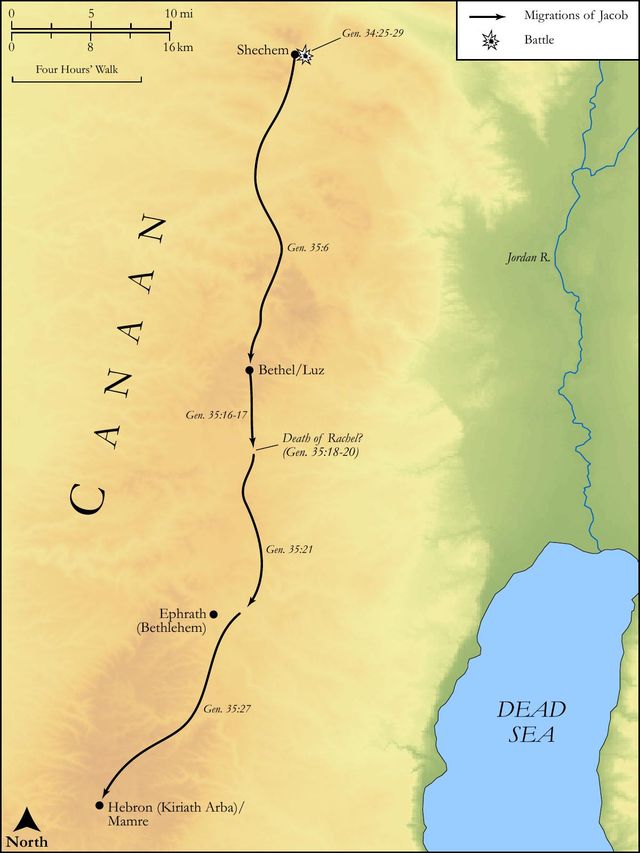
This verse is a critical turning point in the tragic narrative of Dinah, the daughter of Jacob and Leah. It directly follows the abhorrent act of sexual violence committed by Shechem against Dinah, as detailed in Genesis 34:1-2. While Genesis 34:3 notes Shechem's subsequent "affection" for Dinah and his attempts to comfort her, verse 4 immediately shifts to his pragmatic, possessive demand for her as his wife, bypassing any notion of repentance or restitution for the initial crime. This request initiates the formal, albeit twisted, negotiations between the Hivite and Israelite families, setting the stage for the deceitful and violent retribution carried out by Dinah's brothers, Simeon and Levi, against the entire city of Shechem, culminating in the massacre described in Genesis 34:25-29.
Historical & Cultural Context
In the patriarchal households of that day, significant authority within the family unit rested with the father. Marriage arrangements were typically negotiated between the heads of households, often involving a bride-price (mohar) and various customs to formalize the union. While sexual violence was condemned, the concept of "making amends" often involved a forced marriage to the victim, sometimes with a penalty paid to her father, as seen in laws like Deuteronomy 22:28-29. Shechem's appeal to his father, Hamor, aligns with this cultural protocol, demonstrating that he sought to legitimize his actions through established social customs, albeit in a deeply flawed manner given the preceding violence. The Hivites were one of the Canaanite peoples inhabiting the land, and Jacob's family had recently settled peacefully near their city, as narrated in Genesis 33:18, making the subsequent events a profound breach of hospitality and trust.
Key Themes
ShowHideThis verse contributes significantly to several overarching themes within Genesis and the broader biblical narrative. It starkly highlights the consequences of sin and unrighteous desire, demonstrating how one act of violence (Shechem's defilement of Dinah) immediately begets further problematic actions (his possessive demand for marriage) and ultimately leads to a cascade of tragic events, including deceit and mass murder. The theme of patriarchal authority and responsibility is central, as Hamor's willingness to engage in negotiations on his son's behalf implicates the entire Hivite community in the unfolding tragedy. Furthermore, the narrative underscores the profound importance of honor and integrity in relationships, particularly marriage, contrasting Shechem's violent acquisition with the divine ideal of covenantal union. The events also touch on the theme of Israel's distinctiveness and separation from the Canaanite peoples, as the intermarriage proposal and the subsequent Hivite circumcision become a point of contention and ultimately, a catalyst for violent separation.
Exposition and Analysis
ShowHideKey Word Analysis
ShowHideThis primitive root, meaning "to say," is used with great latitude, encompassing not just simple speech but also to command, declare, demand, or appoint. In this context, Shechem's use of "spake" (and the subsequent "saying") carries the weight of a direct, authoritative request, almost a demand, to his father. It signifies his intent to initiate a formal process to acquire Dinah, reflecting his position as a prince and his desire to assert control over the situation.
This primitive root means "to take" in its widest variety of applications, including to accept, bring, buy, seize, or acquire. Here, it is used in the imperative form, "Get me," underscoring Shechem's possessive and acquisitive attitude. He views Dinah as an object to be obtained or seized, rather than a person to be honored or courted with respect, reinforcing the violent nature of his initial interaction with her. The verb choice reveals a mindset focused on acquisition rather than genuine, respectful union.
This feminine noun, meaning "a lass" or "girl," emphasizes Dinah's youth and vulnerability. The use of this term highlights the power imbalance inherent in the situation. Shechem, a prince, is demanding a young, vulnerable girl whom he has already violated. This word choice, while descriptive, implicitly underscores the egregious nature of his actions against someone so young and defenseless.
Verse Breakdown
ShowHide"And Shechem spake unto his father Hamor, saying,"
This clause establishes the immediate action and the primary actors. Shechem, the perpetrator of the initial violence, takes the initiative to address his father, Hamor, who is the leader of the Hivite community. The act of "speaking" here is not a plea but a declaration, setting in motion the formal process of negotiation for marriage, reflecting the patriarchal social structure where such matters were handled by the male heads of families.
"Get me this damsel to wife."
This is the direct quote of Shechem's demand, revealing his intent and his view of Dinah. The imperative "Get me" (from lâqach) signifies a command, not a request, and emphasizes his possessive desire to acquire Dinah as his property. The phrase "this damsel" dehumanizes Dinah, reducing her to an object of desire rather than acknowledging her as a person who has been deeply wronged. His immediate move to make her his "wife" reveals his attempt to normalize and legitimize a relationship that began with violence and dishonor, without any indication of remorse or true repentance for his initial transgression.
Literary Devices
ShowHideThe verse prominently employs Direct Speech, allowing Shechem's exact words to be heard, which immediately conveys his character and intentions. His imperative "Get me this damsel to wife" reveals a sense of entitlement and possessiveness rather than remorse or respect. There is profound Irony in Shechem's request for marriage, an institution meant to be built on honor, consent, and covenant, immediately following an act of violent defilement. The very act of seeking a legitimate union is undermined by the illegitimate and violent foundation upon which it is based. Furthermore, the verse serves as significant Foreshadowing. This seemingly simple request, aimed at resolving a volatile situation, instead precipitates a chain of events marked by deceit, treachery, and bloodshed, signaling the tragic and violent climax that will engulf both families and the city of Shechem.
Theological and Thematic Connections
ShowHideGenesis 34:4 powerfully illustrates the profound consequences that ripple out from a single act of sin, particularly when that sin is rooted in unbridled desire and a lack of respect for another's dignity. Shechem's attempt to normalize his violent act through the institution of marriage, rather than through genuine repentance and restitution, reveals a heart focused on self-gratification and acquisition. This narrative underscores that even legitimate institutions like marriage cannot sanctify a foundation built on injustice and violence. The story serves as a stark reminder that sin, left unaddressed and unrepented of, often spirals into greater conflict and destruction, impacting not just individuals but entire communities.
Reflection and Application
ShowHideGenesis 34:4 serves as a profound cautionary tale about the dangers of acting on impulse and desire without regard for moral boundaries, the dignity of others, or the sanctity of relationships. Shechem's attempt to cover his sin with a marriage proposal only escalates the conflict, demonstrating that one act of sin often leads to a chain of further complications and destructive outcomes, not just for the individual but for entire communities. This narrative reminds us that true repentance involves more than simply desiring a particular outcome or attempting to normalize a situation born of injustice; it requires acknowledging wrong, seeking forgiveness, and making genuine amends. For believers, this means cultivating a heart that prioritizes righteousness, respect, and the well-being of others above personal gratification. It calls us to examine our own desires and actions, ensuring they are aligned with God's will and not driven by selfish motives that could lead to harm or dishonor. The tragic events that follow this seemingly simple request highlight the profound impact of personal choices on family and community, urging believers to seek wisdom and integrity in all their dealings.
Questions for Reflection
ShowHideFAQ
ShowHideWas Shechem's request for marriage sincere, or just an attempt to cover his crime?
ShowHideWhile Genesis 34:3 indicates Shechem's "soul clave unto Dinah" and he "loved the damsel," suggesting genuine affection, his initial actions were violent and dishonorable. His request for marriage, though a cultural means of legitimizing a relationship and potentially a way to assuage his own conscience or social standing, appears to be an attempt to normalize a situation he created through force. It lacks any indication of true repentance or remorse for the profound harm inflicted upon Dinah and her family. It was a desire to possess and integrate, not necessarily to honor, restore, or genuinely atone.
Why did Shechem speak to his father Hamor instead of directly to Jacob?
ShowHideIn the patriarchal households of that day, it was customary for a young man to approach his father to initiate marriage proceedings. The father, as the head of the household and tribal leader, would then be responsible for negotiating with the bride's family, including discussions about bride-price (mohar) and other terms. This protocol reflects the societal structure where family heads, rather than individuals, conducted such significant inter-family affairs. Shechem's appeal to Hamor was the culturally appropriate first step in seeking to formalize the union, even given the highly problematic circumstances.
Christ-Centered Fulfillment
ShowHideThe tragic narrative initiated by Shechem's actions and his subsequent demand for Dinah highlights humanity's brokenness and the futility of attempting to rectify sin through human means that lack true repentance and honor. Shechem's desire to "get" Dinah, born of violence and possessiveness, stands in stark contrast to Christ's approach to humanity. Where Shechem sought to acquire and legitimize a relationship through force and cultural custom, Christ, in His boundless love, does not "get" or take us by force, but rather, He gives Himself for us, offering redemption and reconciliation for our sins (as seen in Ephesians 5:25). The flawed foundation of Shechem's desire led to further bloodshed and deceit, but Christ establishes a new covenant founded on grace, truth, and the cleansing power of His sacrifice (as prophesied in Jeremiah 31:31-34 and fulfilled in Luke 22:20). He is the true Bridegroom who pursues His Church not with coercion but with sacrificial love, making all things new and establishing relationships on a foundation of righteousness and genuine, transforming love, utterly unlike the self-serving desires seen in Genesis 34:4 (Revelation 21:2).