


Galatians 6:5
Bible text: King James Version (1769 Blayney text) · Public domain
Bible text: Berean Standard Bible · Public domain
Bible text: American Standard Version (1901) · Public domain
Bible text: World English Bible, Messianic edition · Public domain
Bible text: Geneva Bible (1599) · Public domain
Bible text: Young's Literal Translation · Public domain
- ἕκαστοςhekastosEachG1538A-NSMAdjective Nominative Singular Masculine
- γὰρgarforG1063CONJConjunction
- τὸto<the>G3588T-ASNDefinite article Accusative Singular Neuter
- ἴδιονidion[his] ownG2398A-ASNAdjective Accusative Singular Neuter
- φορτίονphortionloadG5413N-ASNNoun Accusative Singular Neuter
- βαστάσειbastaseiwill bearG941V-FAI-3SVerb Future Active Indicative 3rd Singular
English is a literal word-by-word gloss of the Greek, not the KJV's wording. Why?
This is the original text the KJV's translators worked from — each Greek word with its own literal English meaning in this verse, prepared by scholars at Tyndale House, Cambridge. The KJV translates whole sentences, not word by word, so its wording differs: one Greek word can become several English words, and the KJV may choose “charity” where the gloss reads “love”. Both are faithful — they answer different questions. For the KJV's own rendering, switch to the KJV text.
Details
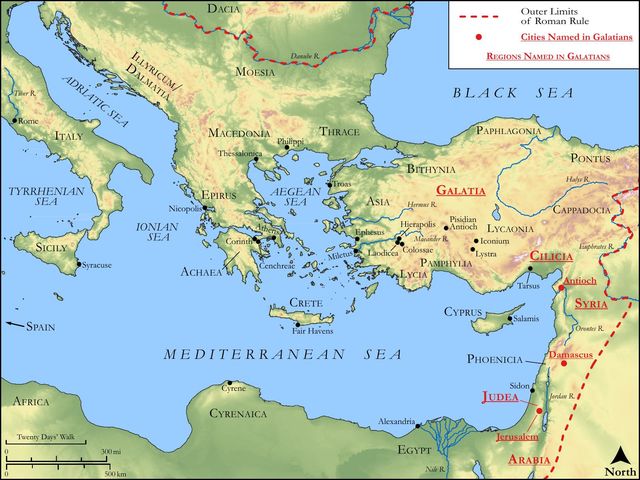
See on the biblical-era maps

Study this verse
Public-domain commentary
Matthew Henry
From his Commentary on the Whole Bible. Henry comments on passages, not single verses — this entry covers Galatians 6:1–10. His three-level outline is real structure in the source text, so it is rendered as structure.
The apostle having, in the foregoing chapter, exhorted Christians by love to serve one another (Gal 6:13), and also cautioned us (Gal 6:16) against a temper which, if indulged, would hinder us from showing the mutual love and serviceableness which he had recommended, in the beginning of this chapter he proceeds to give some further directions, which, if duly observed, would both promote the one and prevent the other of these, and render our behaviour both more agreeable to our Christian profession and more useful and comfortable to one another: particularly,
I.We are here taught to deal tenderly with those who are overtaken in a fault, Gal 6:1.
He puts a common case: If a man be overtaken in a fault, that is, be brought to sin by the surprise of temptation. It is one thing to overtake a fault by contrivance and deliberation, and a full resolution in sin, and another thing to be overtaken in a fault. The latter is the case here supposed, and herein the apostle shows that great tenderness should be used. Those who are spiritual, by whom is meant, not only the ministers (as if none but they were to be called spiritual persons), but other Christians too, especially those of the higher form in Christianity; these must restore such a one with the spirit of meekness. Here observe,
1.The duty we are directed to - to restore such; we should labour, by faithful reproofs, and pertinent and seasonable councils, to bring them to repentance. The original word, katartizete, signifies to set in joint, as a dislocated bone; accordingly we should endeavour to set them in joint again, to bring them to themselves, by convincing them of their sin and error, persuading them to return to their duty, comforting them in a sense of pardoning mercy thereupon, and having thus recovered them, confirming our love to them.
2.The manner wherein this is to be done: With the spirit of meekness; not in wrath and passion, as those who triumph in a brother's falls, but with meekness, as those who rather mourn for them. Many needful reproofs lose their efficacy by being given in wrath; but when they are managed with calmness and tenderness, and appear to proceed from sincere affection and concern for the welfare of those to whom they are given, they are likely to make a due impression.
3.A very good reason why this should be done with meekness: Considering thyself, lest thou also be tempted. We ought to deal very tenderly with those who are overtaken in sin, because we none of us know but it may some time or other be our own case. We also may be tempted, yea, and overcome by the temptation; and therefore, if we rightly consider ourselves, this will dispose us to do by others as we desire to be done by in such a case.
II.We are here directed to bear one another's burdens, Gal 6:2.
This may be considered either as referring to what goes before, and so may teach us to exercise forbearance and compassion towards one another, in the case of those weaknesses, and follies, and infirmities, which too often attend us - that, though we should not wholly connive at them, yet we should not be severe against one another on account of them; or as a more general precept, and so it directs us to sympathize with one another under the various trials and troubles that we may meet with, and to be ready to afford each other the comfort and counsel, the help and assistance, which our circumstances may require. To excite us hereunto, the apostle adds, by way of motive, that so we shall fulfil the law of Christ. This is to act agreeably to the law of his precept, which is the law of love, and obliges us to a mutual forbearance and forgiveness, to sympathy with and compassion towards each other; and it would also be agreeable to his pattern and example, which have the force of a law to us. He bears with us under our weaknesses and follies, he is touched with a fellow-feeling of our infirmities; and therefore there is good reason why we should maintain the same temper towards one another. Note, Though as Christians we are freed from the law of Moses, yet we are under the law of Christ; and therefore, instead of laying unnecessary burdens upon others (as those who urged the observance of Moses's law did), it much more becomes us to fulfil the law of Christ by bearing one another's burdens. The apostle being aware how great a hindrance pride would be to the mutual condescension and sympathy which he had been recommending, and that a conceit of ourselves would dispose us to censure and contemn our brethren, instead of bearing with their infirmities and endeavouring to restore them when overtaken with a fault, he therefore (Gal 6:3) takes care to caution us against this; he supposes it as a very possible thing (and it would be well if it were not too common) for a man to think himself to be something - to entertain a fond opinion of his own sufficiency, to look upon himself as wiser and better than other men, and as fit to dictate and prescribe to them - when in truth he is nothing, has nothing of substance or solidity in him, or that can be a ground of the confidence and superiority which he assumes. To dissuade us from giving way to this temper he tells us that such a one does but deceive himself; while he imposes upon others, by pretending to what he has not, he puts the greatest cheat upon himself, and sooner or later will find the sad effects of it. This will never gain him that esteem, either with God or good men, which he is ready to expect; he is neither the freer from mistakes nor will he be the more secure against temptations for the good opinion he has of his own sufficiency, but rather the more liable to fall into them, and to be overcome by them; for he that thinks he stands has need to take heed lest he fall. Instead therefore of indulging such a vain-glorious humour, which is both destructive of the love and kindness we owe to our fellow-christians and also injurious to ourselves, it would much better become us to accept the apostle's exhortation (Phi 2:3), Do nothing through strife nor vain-glory; but in lowliness of mind let each esteem others better than himself. Note, Self-conceit is but self-deceit: as it is inconsistent with that charity we owe to others (for charity vaunteth not itself, is not puffed up, Co1 13:4), so it is a cheat upon ourselves; and there is not a more dangerous cheat in the world than self-deceit. As a means of preventing this evil,
III.We are advised every one to prove his own work, Gal 6:4.
By our own work is chiefly meant our own actions or behaviour. These the apostle directs us to prove, that is seriously and impartially to examine them by the rule of God's word, to see whether or no they are agreeable to it, and therefore such as God and conscience do approve. This he represents as the duty of every man; instead of being forward to judge and censure others, it would much more become us to search and try our own ways; our business lies more at home than abroad, with ourselves than with other men, for what have we to do to judge another man's servant? From the connection of this exhortation with what goes before it appears that if Christians did duly employ themselves in this work they might easily discover those defects and failings in themselves which would soon convince them how little reason they have either to be conceited of themselves or severe in their censures of others; and so it gives us occasion to observe that the best way to keep us from being proud of ourselves is to prove our ownselves: the better we are acquainted with our own hearts and ways, the less liable shall we be to despise and the more disposed to compassionate and help others under their infirmities and afflictions. That we may be persuaded to this necessary and profitable duty of proving our own work, the apostle urges two considerations very proper for this purpose: -
1.This is the way to have rejoicing in ourselves alone. If we set ourselves in good earnest to prove our own work, and, upon the trial, can approve ourselves to God, as to our sincerity and uprightness towards him, then may we expect to have comfort and peace in our own souls, having the testimony of our own consciences for us (as Co2 1:12), and this, he intimates, would be a much better ground of joy and satisfaction than to be able to rejoice in another, either in the good opinion which others may have of us or in having gained over others to our opinion, which the false teachers were wont to glory in (as we see Gal 6:13), or by comparing ourselves with others, as, it should seem, some did, who were ready to think well of themselves, because they were not so bad as some others. Too many are apt to value themselves upon such accounts as these; but the joy that results thence is nothing to that which arises from an impartial trial of ourselves by the rule of God's word, and our being able thereupon to approve ourselves to him. Note,
(1.)Though we have nothing in ourselves to boast of, yet we may have the matter of rejoicing in ourselves: our works can merit nothing at the hand of God; but, if our consciences can witness for us that they are such as he for Christ's sake approves and accepts, we may upon good ground rejoice therein.
(2.)The true way to have rejoicing in ourselves is to be much in proving our own works, in examining ourselves by the unerring rule of God's word, and not by the false measures of what others are, or may think of us.
(3.)It is much more desirable to have matter of glorying in ourselves than in another. If we have the testimony of our consciences that we are accepted of God, we need not much concern ourselves about what others think or say of us; and without this the good opinion of others will stand us in little stead.
2.The other argument which the apostle uses to press upon us this duty of proving our own work is that every man shall bear his own burden (Gal 6:5), the meaning of which is that at the great day every one shall be reckoned with according as his behaviour here has been. He supposes that there is a day coming when we must all give an account of ourselves to God; and he declares that then the judgment will proceed, and the sentence pass, not according to the sentiments of the world concerning us, or any ungrounded opinion we may have had of ourselves, or upon our having been better or worse than others, but according as our state and behaviour have really been in the sight of God. And, if there be such an awful time to be expected, when he will render to every one according to his works, surely there is the greatest reason why we should prove our own works now: if we must certainly be called to an account hereafter, surely we ought to be often calling ourselves to an account here, to see whether or no we are such as God will own and approve then: and, as this is our duty, so if it were more our practice we should entertain more becoming thoughts both of ourselves and our fellow-christians, and instead of bearing hard upon one another, on account of any mistakes or failings we may be guilty of, we should be more ready to fulfil that law of Christ by which we must be judged in bearing one another's burdens.
IV.Christians are here exhorted to be free and liberal in maintaining their ministers (Gal 6:6):
Let him that is taught in the word communicate to him that teacheth, in all good things. Here we may observe,
1.The apostle speaks of it as a thing known and acknowledged, that, as there are some to be taught, so there are others who are appointed to teach them. The office of the ministry is a divine institution, which does not lie open in common to all, but is confined to those only whom God has qualified for it and called to it: even reason itself directs us to put a difference between the teachers and the taught (for, if all were teachers, there would be none to be taught), and the scriptures sufficiently declare that it is the will of God we should do so.
2.It is the word of God wherein ministers are to teach and instruct others; that which they are to preach is the word, Ti2 4:2. That which they are to declare is the counsel of God, Act 20:27. They are not lords of our faith, but helpers of our joy, Co2 1:24. It is the word of God which is the only rule of faith and life; this they are concerned to study, and to open, and improve, for the edification of others, but they are no further to be regarded than as they speak according to this rule.
3.It is the duty of those who are taught in the word to support those who are appointed to teach them; for they are to communicate to them in all good things, freely and cheerfully to contribute, of the good things with which God has blessed them, what is needful for their comfortable subsistence. Ministers are to give attendance to reading, to exhortation, to doctrine (Ti1 4:13); they are not to entangle themselves with the affairs of this life (Ti2 2:4), and therefore it is but fit and equitable that, while they are sowing to others spiritual things, they should reap their carnal things. And this is the appointment of God himself; for as, under the law, those who ministered about holy things lived of the things of the temple, so hath the Lord ordained that those who preach the gospel should live of the gospel, Co1 9:11, Co1 9:13, Co1 9:14.
V.Here is a caution to take heed of mocking God, or of deceiving ourselves, by imagining that he can be imposed upon by mere pretensions or professions (Gal 6:7): Be not deceived, God is not mocked. This may be considered as referring to the foregoing exhortation, and so the design of it is to convince those of their sin and folly who endeavoured by any plausible pretences to excuse themselves from doing their duty in supporting their ministers: or it may be taken in a more general view, as respecting the whole business of religion, and so as designed to take men off from entertaining any vain hopes of enjoying its rewards while they live in the neglect of its duties. The apostle here supposes that many are apt to excuse themselves from the work of religion, and especially the more self-denying and chargeable parts of it, though at the same time they may make a show and profession of it; but he assures them that this their way is their folly, for, though hereby they may possibly impose upon others, yet they do but deceive themselves if they think to impose upon God, who is perfectly acquainted with their hearts as well as actions, and, as he cannot be deceived, so he will not be mocked; and therefore, to prevent this, he directs us to lay down as a rule to ourselves, That whatsoever a man soweth that shall he also reap; or that according as we behave ourselves now, so will our account be in the great day. Our present time is seed-time: in the other world there will be a great harvest; and, as the husbandman reaps in the harvest according as he sows in the seedness, so we shall reap then as we sow now. And he further informs us (Gal 6:8) that, as there are two sorts of seedness, sowing to the flesh and sowing to the Spirit, so accordingly will the reckoning be hereafter: If we sow to the flesh, we shall of the flesh reap corruption. If we sow the wind, we shall reap the whirlwind. Those who live a carnal sensual life, who instead of employing themselves to the honour of God and the good of others, spend all their thoughts, and care, and time, about the flesh, must expect no other fruit of such a course than corruption - a mean and short-lived satisfaction at present, and ruin and misery at the end of it. But, on the other hand, those who sow to the Spirit, who under the guidance and influence of the Spirit do live a holy and spiritual life, a life of devotedness to God and of usefulness and serviceableness to others, may depend upon it that of the Spirit they shall reap life everlasting - they shall have the truest comfort in their present course, and an eternal life and happiness at the end of it. Note, Those who go about to mock God do but deceive themselves. Hypocrisy in religion is the greatest folly as well as wickedness, since the God we have to do with can easily see through all our disguises, and will certainly deal with us hereafter, not according to our professions, but our practices.
VI.Here is a further caution given us, not to be weary in well doing, Gal 6:9.
As we should not excuse ourselves from any part of our duty, so neither should we grow weary in it. There is in all of us too great a proneness to this; we are very apt to flag and tire in duty, yea to fall off from it, particularly that part of it to which the apostle has here a special regard, that of doing good to others. This therefore he would have us carefully to watch and guard against; and he gives this very good reason for it, because in due season we shall reap, if we faint not, where he assures us that there is a recompence of reward in reserve for all who sincerely employ themselves in well doing; that this reward will certainly be bestowed on us in the proper season - if not in this world, yet undoubtedly in the next; but then that it is upon supposition that we faint not in the way of our duty; if we grow weary of it, and withdraw from it, we shall not only miss of this reward, but lose the comfort and advantage of what we have already done; but, if we hold on and hold out in well-doing, though our reward may be delayed, yet it will surely come, and will be so great as to make us an abundant recompence for all our pains and constancy. Note, Perseverance in well-doing is our wisdom and interest, as well as our duty, for to this only is the reward promised.
VII.Here is an exhortation to all Christians to do good in their places (Gal 6:10):
As we have therefore an opportunity, etc. It is not enough that we be good to others, if we would approve ourselves to be Christians indeed. The duty here recommended to us is the same that is spoken of in the foregoing verses; and, as there the apostle exhorts us to sincerity and perseverance in it, so here he directs us both as to the objects and rule of it.
1.The objects of this duty are more generally all men. We are not to confine our charity and beneficence within too narrow bounds, as the Jews and judaizing Christians were apt to do, but should be ready to extend it to all who partake of the same common nature with us, as far as we are capable and they stand in need of us. But yet, in the exercise of it, we are to have a special regard to the household of faith, or to those who profess the same common faith, and are members of the same body of Christ, with us: though others are not to be excluded, yet these are to be preferred. The charity of Christians should be extensive charity: but yet therein a particular respect is to be had to good people. God does good to all, but in an especial manner he is good to his own servants; and we must in doing good be followers of God as dear children.
2.The rule which we are to observe in doing good to others is as we have opportunity, which implies, (1.) That we should be sure to do it while we have opportunity, or while our life lasts, which is the only season wherein we are capable of doing good to his own servants; and we must in doing good be followers of God as dear children. 2. The rule which we are to observe in doing good to others is as we have opportunity, which implies, (1.) That we should be sure to do it while we have opportunity, or while our life lasts, which is the only season wherein we are capable of doing good to others. If therefore we would behave ourselves aright in this matter, we must not, as too many do, neglect it in our life-time, and defer it till we come to die, under a pretence of doing something of this nature then: for, as we cannot be sure that we shall then have an opportunity for it, so neither, if we should, have we any ground to expect that what we do will be so acceptable to God, much less that we can atone for our past neglects by leaving something behind us for the good of others, when we can no longer keep it ourselves. But we should take care to do good in our life-time, yea, to make this the business of our lives. And, (2.) That we be ready to improve every opportunity for it: we should not content ourselves in having done some good already; but, whenever fresh occasions offer themselves, as far as our capacity reaches we should be ready to embrace them too, for we are directed to give a portion to seven and also to eight, Ecc 11:2. Note, [1.] As God has made it our duty to do good to others, so he takes care in his providence to furnish us with opportunities for it. The poor we have always with us, Mat 26:11. [2.] Whenever God gives us an opportunity of being useful to others, he expects we should improve it, according to our capacity and ability. [3.] We have need of godly wisdom and discretion to direct us in the exercise of our charity or beneficence, and particularly in the choice of the proper objects of it; for, though none who stand in need of us are to be wholly overlooked, yet there is a difference to be made between some and others.
Historical interpretation
Historical reception
3 surviving comments on this verse. Each one is dated, so this reads as a timeline rather than a list.
Select a marker to jump to its quote. Markers stagger vertically where authors wrote within a few decades of each other.
Finally he wants it to be clear to those who are proud that nobody is incriminated for another’s sin. So no one should be afraid to associate with a sinner or to aid him if he comes to him so that he may be of benefit to him.
"For each man shall bear his own burden."
He appears to state a reason prohibitory of boasting against another; but at the same time he corrects the boaster, so that he may no more entertain high thoughts of himself by bringing to his remembrance his own errors, and pressing upon his conscience the idea of a burden, and of being heavily laden.
For each one will bear his own burden. It seems to contradict what was said before, where it says: Bear one another's burdens: for if each one bears his own burden, he will not be able to bear another's burdens. But it must be understood that there he commanded that we, as sinners in this life, bear one another's burdens and help each other in this present age. But here he is speaking about the judgment of the Lord upon us, which is not based on comparing one person's sin to another's, but rather according to our own work, whether we are judged as sinners or as saints, each one receiving according to his own work. Although we are being taught by this little saying, there is a new doctrine that is hidden: while we are in this present age, whether by prayers or by counsels, we are able to help one another. But when we come before the judgement seat of Christ, neither Job, nor Daniel, nor Noah will be able to pray for anyone, but each person will carry their own work (Ezekiel 14).
Continue studying Galatians 6:5 across the web’s major study libraries — every link below opens this exact verse, chapter, or book on the destination site.
Read & Compare
 BibleGatewayThis verse in more than 200 translations and 70 languages.
 Bible.comThe YouVersion reader — hundreds of translations, reading plans, and highlights.
 ESV.orgCrossway's official English Standard Version reader.
 NET BibleThe NET translation with 60,000+ translators' notes on every rendering decision.
 STEP BibleTyndale House's free study tool — original text, vocabulary, and scholarly resources.
 BibliaLogos Bible Software's free web reader.
 USCCBThe New American Bible (Revised Edition) with the U.S. bishops' study notes.
Commentaries
 BibleHub CommentariesDozens of classic commentaries on this verse, gathered on one page.
 StudyLightMore than 100 commentary sets — the largest collection on the web.
 BibleRefPlain-English commentary on what this verse means, verse by verse.
 Enduring WordDavid Guzik's free commentary on this chapter, widely used by Bible teachers.
 Bible Study ToolsVerse commentary alongside Greek and Hebrew study aids.
Original Language & Research
- BibleHub InterlinearThe verse word by word — original language, transliteration, and English.
- BibleHub LexiconEvery word's original-language definition and Strong's entry.
 Blue Letter BibleDeep-study tools — Strong's numbers, concordance, and word studies.
 CNTR CollationThe earliest Greek manuscripts of this verse, collated letter by letter.
Sermons, Hymns & Audio


TrulyRandomVerse is not affiliated with these sites and doesn’t control their content. They’re linked because they’re genuinely useful.
Summary
Galatians 6:5, "For every man shall bear his own burden," serves as a crucial counterpoint to the preceding instruction to "bear one another's burdens" in Galatians 6:2. This verse emphasizes the individual's inherent responsibility and accountability before God for their own life, actions, and spiritual walk. It clarifies that while Christians are called to communal support in times of overwhelming difficulty, each person also has a personal "load" or "task" that is uniquely theirs to carry and for which they will ultimately give an account.
Context
ShowHideLiterary Context
Galatians 6 opens with practical instructions for Christian living, building upon Paul's earlier exposition of Christian liberty and walking by the Spirit (Galatians 5). The immediate context begins with a call for spiritual restoration and mutual support among believers: "Brethren, if a man be overtaken in a fault, ye which are spiritual, restore such an one in the spirit of meekness; considering thyself, lest thou also be tempted. Bear ye one another's burdens, and so fulfil the law of Christ" (Galatians 6:1-2). This communal responsibility is then balanced by a strong emphasis on individual accountability in the verses that follow: "For if a man think himself to be something, when he is nothing, he deceiveth himself. But let every man prove his own work, and then shall he have rejoicing in himself alone, and not in another" (Galatians 6:3-4). Verse 5, therefore, concludes this thought, affirming that despite communal aid, each person has a unique, personal responsibility.
Historical & Cultural Context
Paul's letter to the Galatians was written to churches in the region of Galatia, likely to counter the influence of "Judaizers" who insisted that Gentile converts must observe aspects of the Mosaic Law, such as circumcision, in addition to faith in Christ for salvation. This theological dispute forms the backbone of the entire epistle, with Paul passionately defending salvation by grace through faith alone. Within this broader theological battle, Paul also provides ethical instructions for how believers, now freed from the law, ought to live by the Spirit. The emphasis on individual responsibility in Galatians 6:5 can be seen as a safeguard against both antinomianism (the idea that grace negates moral law) and a communal complacency where individuals might shirk their personal duties by relying solely on the community. It underscores the personal nature of one's walk with God, even within a supportive community.
Key Themes
ShowHideThis verse contributes significantly to several key themes within Galatians and Pauline theology. Firstly, it highlights Personal Responsibility and Accountability, asserting that each believer is ultimately answerable for their own spiritual journey, choices, and obedience before God. This theme is reinforced by the call in Galatians 6:4 for individuals to "prove his own work." Secondly, it clarifies the Distinct Kinds of "Burdens", resolving the apparent tension with Galatians 6:2. Paul uses different Greek words to distinguish between overwhelming, crushing loads that require communal support (βάρη, barē) and the manageable, personal "pack" of duties and responsibilities that each individual is expected to carry (φορτίον, phortíon). This linguistic precision underscores that while we assist with crushing burdens, we must not neglect our own assigned tasks. This distinction aligns with Jesus' teaching that His "burden" (φορτίον, phortíon) is light (Matthew 11:30). Finally, the verse reinforces the theme of Individual Assessment and Judgment, reminding believers that their spiritual walk is a personal matter for which they will give an account, a concept echoed in other New Testament passages concerning the judgment seat of Christ.
Exposition and Analysis
ShowHideKey Word Analysis
ShowHideDerived from a word implying "afar," this term emphasizes individuality, meaning "each" or "every single one." In this context, it underscores that the principle applies universally to every person, without exception, highlighting the personal and non-transferable nature of the responsibility being discussed.
This verb signifies "to lift," "to carry," or "to sustain." While it can imply a heavy load, its use here, in conjunction with phortíon, suggests the act of carrying one's assigned or appropriate load, rather than being crushed by it. It denotes the active engagement in taking up and managing one's responsibilities.
A diminutive of phórtos (a load, cargo), phortíon refers to a lighter, more manageable load, often one's personal pack, task, or assigned duty. It contrasts sharply with barē (βάρη) in Galatians 6:2, which denotes an oppressive, crushing weight. Here, phortíon represents the personal responsibilities, duties, and accountability that properly belong to each individual.
Verse Breakdown
ShowHide"For every man"
This opening phrase, introduced by the conjunction "For" (G1063 gár), signals a reason or explanation for the preceding statements, particularly the call for self-examination in Galatians 6:4. The term "every man" (G1538 hékastos) emphasizes the universal and individual nature of the principle. It means that this truth applies to each and every person without exception, highlighting that personal accountability is not optional or transferable.
"shall bear his own"
The verb "shall bear" (G941 bastázō) indicates an active and necessary carrying. The possessive "his own" (G2398 ídios) further reinforces the personal nature of this action. It signifies that the responsibility is uniquely individual, belonging to oneself and not to another. This is not a burden to be shared or delegated, but one that must be personally taken up and managed.
"burden"
The noun "burden" (G5413 phortíon) is the crux of the verse's meaning. As distinct from the "heavy burdens" (βάρη, barē) of Galatians 6:2 that necessitate communal help, this "burden" refers to one's personal responsibilities, duties, and the inherent accountability of their own life before God. It is the manageable "pack" or "load" that each individual is equipped to carry as part of their journey and for which they are personally accountable.
Literary Devices
ShowHidePaul employs a significant Contrast in this passage, particularly between Galatians 6:2 and Galatians 6:5, which is elucidated by his precise use of two distinct Greek words for "burden" (βάρη and φορτίον). This Juxtaposition highlights the nuanced balance between communal support and individual responsibility within the Christian life. The "burden" itself serves as a Metaphor for the sum of one's personal duties, responsibilities, and the accountability for one's own actions and spiritual walk. The phrase "every man" also provides Emphasis, underscoring the universal and inescapable nature of this individual accountability.
Theological and Thematic Connections
ShowHideGalatians 6:5 profoundly shapes our understanding of Christian responsibility. It asserts that while the body of Christ is called to compassionately assist those overwhelmed by crushing difficulties, there remains a fundamental sphere of personal accountability that cannot be outsourced or ignored. This "burden" is not a punitive weight but the inherent responsibility of managing one's own spiritual life, choices, and duties before God. It underscores the individual's direct relationship with God and the necessity of personal diligence in faith, obedience, and character development. This principle ensures that Christian liberty does not devolve into irresponsibility, but rather empowers individuals to live out their unique calling with integrity.
Reflection and Application
ShowHideGalatians 6:5 serves as a vital reminder that while we are part of a supportive community, our spiritual journey and personal accountability before God are ultimately our own. This verse calls us to embrace a healthy sense of personal responsibility for our faith, our actions, and our growth. It challenges us to honestly assess our own "pack" – our unique gifts, callings, and duties – and to diligently carry them, rather than expecting others to do so or becoming complacent in our walk. This balance between communal support and individual diligence is crucial for a mature and thriving Christian life, fostering both interdependence and personal integrity. It encourages us to be proactive stewards of our lives, knowing that we will each stand before God to give an account of how we have lived.
Questions for Reflection
ShowHideFAQ
ShowHideWhat is the difference between "burden" in Galatians 6:5 and "burdens" in Galatians 6:2?
ShowHideThe distinction lies in the original Greek words Paul uses. In Galatians 6:2, the word for "burdens" is barē (βάρη), which refers to heavy, oppressive, or crushing loads—like overwhelming trials, faults, or severe difficulties that are too much for an individual to bear alone. This necessitates communal help and compassionate support. In contrast, in Galatians 6:5, the word for "burden" is phortíon (φορτίον). This term denotes a lighter, more manageable load, such as one's personal responsibilities, duties, or the life task assigned by God. It's the "pack" that each individual is expected and able to carry on their own journey. Jesus uses this same word when He says, "For my yoke is easy, and my burden ( phortíon) is light" (Matthew 11:30). Thus, Paul teaches a beautiful balance: we help each other with crushing weights, but each person must diligently carry their own personal responsibilities and answer for their own life before God.
Christ-Centered Fulfillment
ShowHideWhile Galatians 6:5 emphasizes individual responsibility, its ultimate fulfillment and deepest meaning are found in Christ. Humanity's greatest "burden" (not a phortíon but an unbearable barē) is the crushing weight of sin and its consequence, separation from God. This is a burden no "man" could "bear his own." It is here that Christ steps in, not merely to help us with our barē, but to completely take it upon Himself. He bore the ultimate burden of our sin and the judgment it deserved on the cross, becoming "sin for us, who knew no sin" (2 Corinthians 5:21). By His atoning sacrifice, Jesus bore the weight that would have crushed us eternally, fulfilling the prophecies of the suffering servant who "bore our griefs and carried our sorrows" (Isaiah 53:4). Therefore, the "burden" that believers now "bear" in Christ—our personal responsibilities and duties—is transformed. It is no longer a burden of earning salvation or appeasing God, but a "light" and "easy" yoke (Matthew 11:30) that we carry in joyful obedience, empowered by the Spirit, knowing that our ultimate burden has been borne by our Savior. Our individual accountability is now lived out in grateful response to the One who bore it all.