


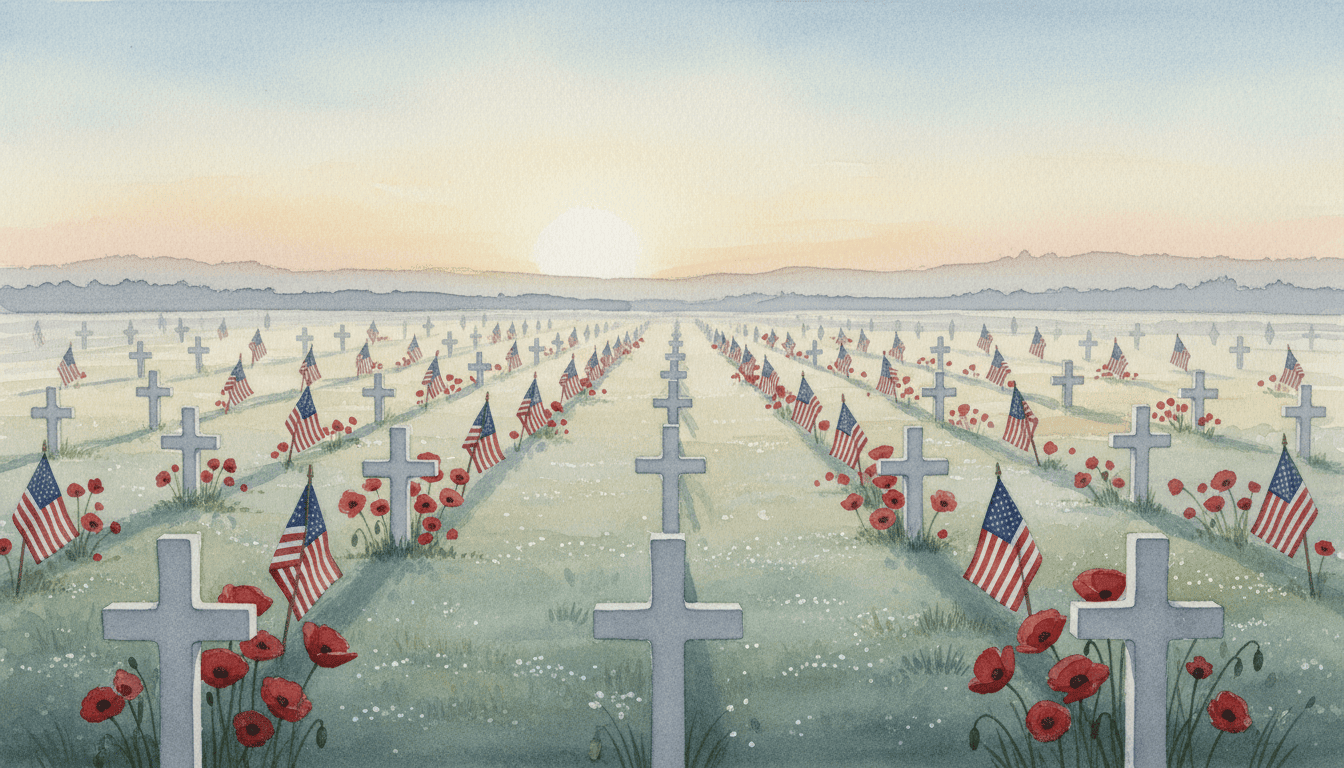
Memorial DaySacrifice and Remembrance
Introduction
Memorial Day honors those who gave their lives in military service, paying the ultimate price for freedom and protecting others from harm. While Memorial Day is an American civic observance, its themes of sacrifice, courage, and remembrance resonate with biblical principles. Jesus declared that no one has greater love than to lay down one's life for one's friends. Throughout Scripture we find brave men and women who risked or sacrificed their lives for God's people. Memorial Day is an occasion to reflect on the cost of freedom — physical and spiritual — to honor those who made the ultimate sacrifice, and to remember that our eternal freedom was purchased by Christ's sacrificial death on the cross.
Greater Love: Laying Down One's Life
Jesus set the standard for sacrificial love: greater love has no one than this, that a man lay down his life1 for his friends. True love is measured not by words or feelings but by willingness to surrender oneself for another. This is the love Jesus displayed on the cross and the love he calls his followers to embody.
Greater love hath no man than this, that a man lay down his life for his friends.
John 15:13
KJV
Memorial Day commemorates those who embodied this sacrificial love in military service. They placed themselves in harm's way, knowing they might not return, so that others could live in safety. Their sacrifice reflects, in a limited earthly way, the divine sacrifice of Christ, who died that we might live eternally. Augustine guarded the distinction carefully: the martyrs and the fallen imitate Christ's love, yet "no martyr's blood is ever shed for the remission of the sins of brethren, as was the case in what He did for us; and in this respect He bestowed not on us aught for imitation, but something for congratulation" (Tractates on John 84). Human sacrifice honors Christ's; it never replaces it.
Christ's sacrifice surpasses every human one, because he died not for friends but for enemies. As Paul writes, while we were still sinners — still his enemies — Christ died for us.
¶ For when we were yet without strength, in due time Christ died for the ungodly. For scarcely for a righteous man will one die: yet peradventure for a good man some would even dare to die. But God commendeth his love toward us, in that, while we were yet sinners, Christ died for us.
Romans 5:6-8
KJV
Gregory the Great saw this as the very summit of love: "The highest, the only proof of love, is to love our adversary, as did the Truth Himself, who while He suffered on the cross, showed His love for His persecutors... Our Lord came to die for His enemies" (Homily 27). The soldier lays down his life for his friends and his country; Christ laid his down for those who hated him.
Biblical Examples of Military Sacrifice
Scripture records many soldiers who fought courageously for God's people. David's mighty men performed extraordinary feats of valor. Three of his chief warriors broke through Philistine lines to bring David water from the well of Bethlehem — yet David poured it out as an offering to the Lord, refusing to drink what men had risked their lives to obtain.
And three of the thirty chief went down, and came to David in the harvest time unto the cave of Adullam: and the troop of the Philistines pitched in the valley of Rephaim. And David was then in an hold, and the garrison of the Philistines was then in Bethlehem. And David longed, and said, Oh that one would give me drink of the water of the well of Bethlehem, which is by the gate! And the three mighty men brake through the host of the Philistines, and drew water out of the well of Bethlehem, that was by the gate, and took it, and brought it to David: nevertheless he would not drink thereof, but poured it out unto the LORD. And he said, Be it far from me, O LORD, that I should do this: is not this the blood of the men that went in jeopardy of their lives? therefore he would not drink it. These things did these three mighty men.
Jonathan, Saul's son, showed remarkable courage when he and his armor-bearer attacked a Philistine garrison, trusting that God could save by many or by few. Though vastly outnumbered, they routed the enemy and brought deliverance to Israel.
And Jonathan said to the young man that bare his armour, Come, and let us go over unto the garrison of these uncircumcised: it may be that the LORD will work for us: for there is no restraint to the LORD to save by many or by few. And his armourbearer said unto him, Do all that is in thine heart: turn thee; behold, I am with thee according to thy heart. Then said Jonathan, Behold, we will pass over unto these men, and we will discover ourselves unto them. If they say thus unto us, Tarry until we come to you; then we will stand still in our place, and will not go up unto them. But if they say thus, Come up unto us; then we will go up: for the LORD hath delivered them into our hand: and this shall be a sign unto us. And both of them discovered themselves unto the garrison of the Philistines: and the Philistines said, Behold, the Hebrews come forth out of the holes where they had hid themselves. And the men of the garrison answered Jonathan and his armourbearer, and said, Come up to us, and we will shew you a thing. And Jonathan said unto his armourbearer, Come up after me: for the LORD hath delivered them into the hand of Israel. And Jonathan climbed up upon his hands and upon his feet, and his armourbearer after him: and they fell before Jonathan; and his armourbearer slew after him. And that first slaughter, which Jonathan and his armourbearer made, was about twenty men, within as it were an half acre of land, which a yoke of oxen might plow. And there was trembling in the host, in the field, and among all the people: the garrison, and the spoilers, they also trembled, and the earth quaked: so it was a very great trembling.
1 Samuel 14:6-15
KJV
The Maccabees, though from the intertestamental period, were willing to die rather than compromise their faith. When Antiochus Epiphanes demanded that Jews violate God's law, many chose martyrdom over apostasy, and their sacrifice preserved Jewish faith and identity for future generations.
The Cost of Freedom
Freedom is never free; it is purchased with blood — though Scripture is careful about whose. At the Exodus, the death of Egypt's firstborn was not a price paid to ransom Israel; it was God's judgment on Egypt and its gods, the last and heaviest of the plagues. What shielded Israel was something else entirely — the blood of a Passover lamb struck on the doorposts, a substitute dying in the firstborn's place, so that the LORD would pass over the blood-marked homes.
And the blood shall be to you for a token upon the houses where ye are: and when I see the blood, I will pass over you, and the plague shall not be upon you to destroy you, when I smite the land of Egypt.
Exodus 12:13
KJV
That lamb's blood — not the judgment that fell on Egypt — is what Scripture carries forward to the cross, where "Christ our passover is sacrificed for us." God redeemed his people with an outstretched arm and with great judgments, yet the blood that bought their safety was the blood of the lamb.
Wherefore say unto the children of Israel, I am the LORD, and I will bring you out from under the burdens of the Egyptians, and I will rid you out of their bondage, and I will redeem you with a stretched out arm, and with great judgments:
Exodus 6:6
KJV
Spiritual freedom likewise comes at the cost of Christ's blood. We were bought2 with a price, Paul says — the verb is the language of the marketplace, a purchase that transfers ownership. We are not our own; we belong to the One who paid for us.
For ye are bought with a price: therefore glorify God in your body, and in your spirit, which are God's.
Peter presses the same point: we were redeemed3 — ransomed, as a captive is bought back — not with perishable silver or gold, but with the precious blood of Christ, a lamb without blemish. Our freedom from sin's slavery was purchased not with money but with the life of the sinless Son of God.
Forasmuch as ye know that ye were not redeemed with corruptible things, as silver and gold, from your vain conversation received by tradition from your fathers; But with the precious blood of Christ, as of a lamb without blemish and without spot:
1 Peter 1:18-19
KJV
Duty and Honor
Scripture honors the faithful fulfillment of duty, even at personal cost. Paul teaches that civil authority is ordained by God, so that those who serve in its defense fulfill a legitimate and honorable calling.
¶ Let every soul be subject unto the higher powers. For there is no power but of God: the powers that be are ordained of God.
Romans 13:1
KJV
When soldiers asked John the Baptist what they should do, he did not tell them to abandon military service but to conduct themselves with integrity — to do violence to no man, to make no false accusation, and to be content with their wages. Military service is a valid vocation when carried out justly.
And the soldiers likewise demanded of him, saying, And what shall we do? And he said unto them, Do violence to no man, neither accuse any falsely; and be content with your wages.
Luke 3:14
KJV
Cornelius, a Roman centurion, is described as a devout man who feared God, gave alms generously, and prayed continually. His military service did not disqualify him from being a God-fearer or from receiving the gospel. Peter preached to him, and he and his household were filled with the Spirit and baptized.
¶ There was a certain man in Caesarea called Cornelius, a centurion of the band called the Italian band, A devout man, and one that feared God with all his house, which gave much alms to the people, and prayed to God alway.
Acts 10:1-2
KJV
¶ While Peter yet spake these words, the Holy Ghost fell on all them which heard the word. And they of the circumcision which believed were astonished, as many as came with Peter, because that on the Gentiles also was poured out the gift of the Holy Ghost. For they heard them speak with tongues, and magnify God. Then answered Peter, Can any man forbid water, that these should not be baptized, which have received the Holy Ghost as well as we? And he commanded them to be baptized in the name of the Lord. Then prayed they him to tarry certain days.
Acts 10:44-48
KJV
Remembering Sacrifice
God commands his people to remember his mighty acts of deliverance. The Passover was instituted as a perpetual memorial4 — a day kept across the generations precisely so that what deliverance cost would never be forgotten. Remembering guards against ingratitude.
And this day shall be unto you for a memorial; and ye shall keep it a feast to the LORD throughout your generations; ye shall keep it a feast by an ordinance for ever.
Exodus 12:14
KJV
Jesus instituted the Lord's Supper as a memorial of his sacrifice — "this do in remembrance5 of me." We remember his broken body and shed blood, the price of our redemption, lest we forget the costliness of our salvation.
And when he had given thanks, he brake it, and said, Take, eat: this is my body, which is broken for you: this do in remembrance of me. After the same manner also he took the cup, when he had supped, saying, This cup is the new testament in my blood: this do ye, as oft as ye drink it, in remembrance of me.
Memorial Day serves a kindred function for civic life — remembering those who gave their lives so that others might live free. Remembering is active gratitude: honoring sacrifice and refusing to take freedom for granted.
The Good Shepherd Who Lays Down His Life
Jesus described himself as the good shepherd who lays down his life for the sheep. The hired hand flees when danger comes, caring nothing for the flock; but the good shepherd stays, protecting his sheep even at the cost of his own life.
I am the good shepherd: the good shepherd giveth his life for the sheep. But he that is an hireling, and not the shepherd, whose own the sheep are not, seeth the wolf coming, and leaveth the sheep, and fleeth: and the wolf catcheth them, and scattereth the sheep. The hireling fleeth, because he is an hireling, and careth not for the sheep.
John 10:11-13
KJV
And his sacrifice was wholly voluntary. No one took his life from him; he laid it down of his own accord, having authority to lay it down and to take it up again. He chose to die for his sheep — not coerced, but freely given out of love.
No man taketh it from me, but I lay it down of myself. I have power to lay it down, and I have power to take it again. This commandment have I received of my Father.
John 10:18
KJV
This shepherd-image extends to all who guard and serve others. Soldiers, police officers, firefighters, and any who place themselves in harm's way for the vulnerable embody this self-giving spirit, laying down their lives — or risking them — for those entrusted to their care.
The Armor of God: Spiritual Warfare
Paul casts the Christian life in military terms. Believers are engaged in spiritual warfare — wrestling not against flesh and blood but against the powers of darkness — and are to take up the whole armour6 of God: the belt of truth, breastplate of righteousness, shoes of the gospel, shield of faith, helmet of salvation, and sword of the Spirit.
For we wrestle not against flesh and blood, but against principalities, against powers, against the rulers of the darkness of this world, against spiritual wickedness in high places. Wherefore take unto you the whole armour of God, that ye may be able to withstand in the evil day, and having done all, to stand. Stand therefore, having your loins girt about with truth, and having on the breastplate of righteousness; And your feet shod with the preparation of the gospel of peace; Above all, taking the shield of faith, wherewith ye shall be able to quench all the fiery darts of the wicked. And take the helmet of salvation, and the sword of the Spirit, which is the word of God:
Every piece is drawn from the Old Testament — and most strikingly from God's own armor. Isaiah pictures the LORD himself as a warrior who "put on righteousness as a breastplate, and an helmet of salvation upon his head" (Isaiah 59:17). Paul clothes the believer in the very armor God wears; the soldier of Christ goes out dressed in his Commander's own panoply.
| The piece | Paul's image (Ephesians 6) | Old Testament root |
|---|---|---|
| Belt of truth | loins girt about with truth (v. 14) | "righteousness shall be the girdle of his loins" (Isa 11:5) |
| Breastplate of righteousness | the breastplate of righteousness (v. 14) | "he put on righteousness as a breastplate" (Isa 59:17) |
| Shoes of the gospel | feet shod with the gospel of peace (v. 15) | "the feet of him that... publisheth peace" (Isa 52:7) |
| Shield of faith | to quench the fiery darts (v. 16) | "I am thy shield, and thy exceeding great reward" (Gen 15:1) |
| Helmet of salvation | the helmet of salvation (v. 17) | "an helmet of salvation upon his head" (Isa 59:17) |
| Sword of the Spirit | the word of God (v. 17) | "he hath made my mouth like a sharp sword" (Isa 49:2) |
This warfare demands courage, discipline, and a readiness to suffer. Paul charges Timothy to endure hardship as a good soldier7 of Jesus Christ — undistracted by civilian entanglements, fixed singly on pleasing the one who enlisted him.
Thou therefore endure hardness, as a good soldier of Jesus Christ. No man that warreth entangleth himself with the affairs of this life; that he may please him who hath chosen him to be a soldier.
2 Timothy 2:3-4
KJV
The Christian life is not passive but militant: actively resisting evil, advancing God's kingdom, and standing firm against the enemy's schemes, wielding spiritual weapons and trusting in God's power.
The Peace That Comes Through Sacrifice
Isaiah foretold a suffering servant pierced for our transgressions, on whom fell "the chastisement of our peace8" — and by whose stripes we are healed. The Hebrew word means wholeness, the restored well-being of a people set right with God — more than the mere absence of war. That peace came through violence: the violence of the cross, where Christ absorbed the judgment we deserved.
But he was wounded for our transgressions, he was bruised for our iniquities: the chastisement of our peace was upon him; and with his stripes we are healed.
Isaiah 53:5
KJV
Eusebius marveled at the scope of it: Christ "alone did... assume the penalties of our wicked deeds, not when we were half dead but even when already altogether foul and stinking in tombs and graves" (Ecclesiastical History 10). He bore the worst so that we could be made whole.
And so, Paul says, being justified by faith we have peace9 with God through our Lord Jesus Christ. The peace we enjoy was purchased by his blood; he made peace by the cross, reconciling us to God.
¶ Therefore being justified by faith, we have peace with God through our Lord Jesus Christ:
Romans 5:1
KJV
And, having made peace through the blood of his cross, by him to reconcile all things unto himself; by him, I say, whether they be things in earth, or things in heaven.
Colossians 1:20
KJV
Earthly peace, too, is often bought by the sacrifice of those who fight to protect it. We enjoy security because others stood in the gap against those who would take it away. We owe them a debt we cannot repay — as we owe Christ a debt we cannot repay.
Conclusion: Remembering the Cost
Memorial Day calls us to remember and honor those who gave their lives in service to their country. We pause to reflect on their sacrifice, to give thanks for the freedom we enjoy, and to resolve never to take it for granted. As Christians we also remember the ultimate sacrifice — Jesus Christ laying down his life to purchase our eternal freedom. He died that we might live, bore our sins that we might be forgiven, and endured the cross that we might have peace with God. On Memorial Day, let us honor those who have fallen, pray for their families, and remember their sacrifice. And let us worship the One who made the supreme sacrifice, laying down his life for his friends — and for his enemies — so that all who believe might have eternal life.