


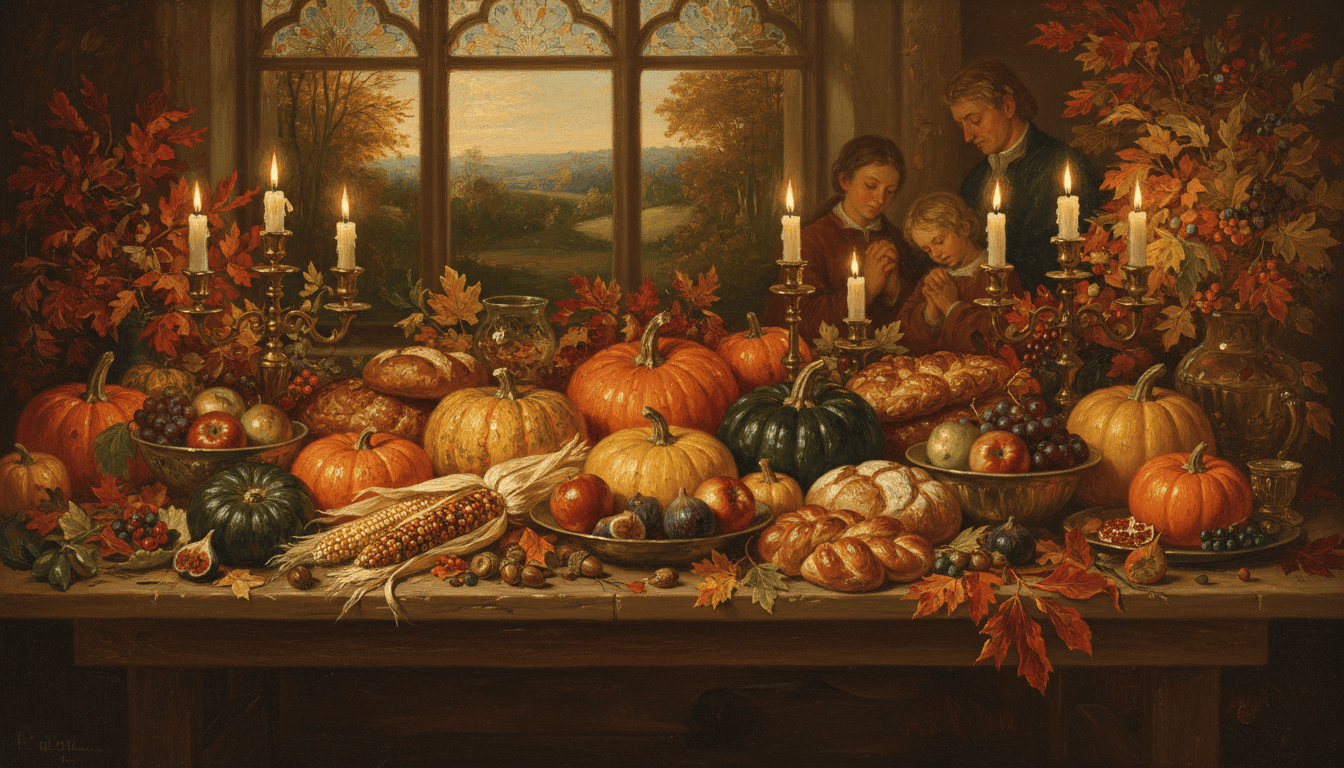
ThanksgivingGratitude in Scripture
Introduction
Thanksgiving is a time to pause and reflect on God's abundant blessings, to cultivate grateful hearts, and to express appreciation for his faithful provision. While the American holiday traces its origins to the Pilgrims' harvest celebration in 1621, the practice of thanksgiving is rooted in Scripture. The Bible commands believers to give thanks in all circumstances, to offer sacrifices of thanksgiving, and to enter God's gates with thanksgiving and his courts with praise. Gratitude is a spiritual discipline that reorients our hearts toward God, recognizes his sovereignty over all things, and guards against the twin sins of pride and entitlement. Thanksgiving reminds us that every good gift comes from above and that we are stewards, not owners, of all we possess.
The Command to Give Thanks
Scripture repeatedly commands thanksgiving. Paul writes, "Give thanks in all circumstances; for this is the will of God in Christ Jesus for you." Thanksgiving is not optional or reserved for favorable situations—it is God's will for believers in every circumstance, whether joyful or sorrowful, prosperous or difficult.
In every thing give thanks: for this is the will of God in Christ Jesus concerning you.
The psalmist exhorts, "Oh give thanks to the Lord, for he is good, for his steadfast love endures forever!" Thanksgiving is grounded in God's character—his goodness and his unfailing love. We give thanks not because our circumstances are always pleasant but because God is always good.
O give thanks unto the LORD, for he is good: for his mercy endureth for ever.
Psalms 107:1
KJV
David declares, "I will give thanks to the Lord with my whole heart; I will recount all of your wonderful deeds." Thanksgiving involves both verbal praise and heartfelt devotion. It is not perfunctory ritual but sincere expression of gratitude for God's mighty works.
To the chief Musician upon Muthlabben, A Psalm of David. I will praise thee, O LORD, with my whole heart; I will shew forth all thy marvellous works.
Psalms 9:1
KJV
Paul instructs believers to overflow with thanksgiving: "And whatsoever ye do in word or deed, do all in the name of the Lord Jesus, giving thanks to God and the Father by him." Thanksgiving should permeate every aspect of life—our speech, our actions, our work, our worship. We live lives saturated with gratitude.
And whatsoever ye do in word or deed, do all in the name of the Lord Jesus, giving thanks to God and the Father by him.
Colossians 3:17
KJV
Entering God's Presence with Thanksgiving
The psalmist instructs, "Enter into his gates with thanksgiving, and into his courts with praise: be thankful unto him, and bless his name." Thanksgiving is the proper posture for approaching God. We do not come demanding or complaining but grateful and worshipful, acknowledging his goodness and grace.
Enter into his gates with thanksgiving, and into his courts with praise: be thankful unto him, and bless his name.
Psalms 100:4
KJV
David appointed Levites to minister before the ark of the Lord with thanksgiving and praise. Worship involves not only petition and confession but gratitude. We recount God's faithfulness, celebrate his mercies, and thank him for answered prayers.
And he appointed certain of the Levites to minister before the ark of the LORD, and to record, and to thank and praise the LORD God of Israel:
Paul writes, "Do not be anxious about anything, but in everything by prayer and supplication with thanksgiving let your requests be made known to God." Prayer should include thanksgiving, even when we are asking for help. We thank God for past provision while requesting present need, trusting his faithfulness.
Be careful for nothing; but in every thing by prayer and supplication with thanksgiving let your requests be made known unto God.
Philippians 4:6
KJV
Thanksgiving for God's Provision
God provides for all our needs—physical, emotional, and spiritual. Jesus taught his disciples to pray for daily bread, acknowledging dependence on God for sustenance. Every meal is a gift from God's hand, deserving gratitude.
Give us this day our daily bread.
Matthew 6:11
KJV
Paul instructs, "For every creature of God is good, and nothing to be refused, if it be received with thanksgiving: for it is sanctified by the word of God and prayer." Food, given by God and received with thanksgiving, becomes a means of communion with him, sanctified by gratitude and prayer.
For every creature of God is good, and nothing to be refused, if it be received with thanksgiving: For it is sanctified by the word of God and prayer.
1 Timothy 4:4-5
KJV
The psalmist declares, "The earth is the LORD'S, and the fulness thereof; the world, and they that dwell therein." We own nothing; we steward what belongs to God. Thanksgiving recognizes this truth, acknowledging that all we have comes from the Lord.
A Psalm of David. The earth is the LORD'S, and the fulness thereof; the world, and they that dwell therein.
Psalms 24:1
KJV
Paul writes, "What do you have that you did not receive? If then you received it, why do you boast as if you did not receive it?" Every talent, opportunity, possession, and blessing is a gift from God. Pride forgets this; gratitude remembers.
For who maketh thee to differ from another? and what hast thou that thou didst not receive? now if thou didst receive it, why dost thou glory, as if thou hadst not received it?
Thankful Even in Trials
Scripture commands thanksgiving not only in prosperity but also in adversity. Paul writes, "Give thanks in all circumstances," not "for all circumstances" but "in all circumstances." We may not thank God for suffering itself, but we can thank him in the midst of it, trusting his sovereign goodness.
Job, after losing his children, wealth, and health, declared, "The LORD gave, and the LORD hath taken away; blessed be the name of the LORD." In loss, Job worshiped. His thanksgiving was not flippant denial of pain but trust in God's sovereignty.
And said, Naked came I out of my mother's womb, and naked shall I return thither: the LORD gave, and the LORD hath taken away; blessed be the name of the LORD.
Job 1:21
KJV
James writes, "Count it all joy, my brothers, when you meet trials of various kinds, for you know that the testing of your faith produces steadfastness." Trials develop character, deepen faith, and conform us to Christ. We thank God not for the trial itself but for the good he will bring through it.
My brethren, count it all joy when ye fall into divers temptations; Knowing this, that the trying of your faith worketh patience.
James 1:2-3
KJV
Paul and Silas, beaten and imprisoned in Philippi, sang hymns at midnight. Their thanksgiving in suffering demonstrated radical trust in God's goodness. Their praise preceded their miraculous deliverance, revealing that thanksgiving is not contingent on favorable circumstances.
And at midnight Paul and Silas prayed, and sang praises unto God: and the prisoners heard them.
Acts 16:25
KJV
The Danger of Ingratitude
Ingratitude is a serious sin, symptomatic of spiritual decline. Paul describes humanity's fall into idolatry: "For although they knew God, they did not honor him as God or give thanks to him, but they became futile in their thinking, and their foolish hearts were darkened." Failure to give thanks to God led to intellectual futility and moral corruption.
Because that, when they knew God, they glorified him not as God, neither were thankful; but became vain in their imaginations, and their foolish heart was darkened.
Romans 1:21
KJV
Israel's wilderness wanderings demonstrate the consequences of ingratitude. Despite witnessing God's miracles in Egypt, the parting of the Red Sea, manna from heaven, and water from the rock, they grumbled and complained. Their ingratitude revealed unbelief and resulted in judgment.
And the LORD spake unto Moses and unto Aaron, saying, How long shall I bear with this evil congregation, which murmur against me? I have heard the murmurings of the children of Israel, which they murmur against me. Say unto them, As truly as I live, saith the LORD, as ye have spoken in mine ears, so will I do to you: Your carcases shall fall in this wilderness; and all that were numbered of you, according to your whole number, from twenty years old and upward, which have murmured against me,
Numbers 14:26-29
KJV
Ingratitude breeds entitlement, dissatisfaction, and covetousness. It blinds us to God's goodness and fosters resentment. Gratitude, by contrast, cultivates contentment, joy, and worship. The grateful heart sees every blessing as undeserved grace; the ungrateful heart sees every difficulty as unfair treatment.
Paul warns that in the last days, people will be lovers of self, lovers of money, proud, arrogant, abusive, disobedient to parents, ungrateful, unholy. Ingratitude characterizes those who reject God and pursue selfish desires.
For men shall be lovers of their own selves, covetous, boasters, proud, blasphemers, disobedient to parents, unthankful, unholy,
2 Timothy 3:2
KJV
Psalms of Thanksgiving
The book of Psalms includes numerous songs of thanksgiving, celebrating God's deliverance, provision, and faithfulness. Psalm 136 repeats the refrain "for his steadfast love endures forever" twenty-six times, recounting God's mighty works from creation to the Exodus to the conquest of Canaan. Each verse elicits gratitude for a specific manifestation of God's faithful love.
O give thanks unto the LORD; for he is good: for his mercy endureth for ever. O give thanks unto the God of gods: for his mercy endureth for ever. O give thanks to the Lord of lords: for his mercy endureth for ever. To him who alone doeth great wonders: for his mercy endureth for ever. To him that by wisdom made the heavens: for his mercy endureth for ever. To him that stretched out the earth above the waters: for his mercy endureth for ever. To him that made great lights: for his mercy endureth for ever: The sun to rule by day: for his mercy endureth for ever: The moon and stars to rule by night: for his mercy endureth for ever.
Psalms 136:1-9
KJV
Psalm 103 lists specific reasons for thanksgiving: forgiveness of sins, healing of diseases, redemption from the pit, crowning with steadfast love and mercy, satisfaction with good things, renewal of youth, execution of righteousness and justice. David exhorts himself, "Bless the Lord, O my soul, and forget not all his benefits."
Bless the LORD, O my soul, and forget not all his benefits: Who forgiveth all thine iniquities; who healeth all thy diseases; Who redeemeth thy life from destruction; who crowneth thee with lovingkindness and tender mercies; Who satisfieth thy mouth with good things; so that thy youth is renewed like the eagle's.
Psalms 103:2-5
KJV
Psalm 107 recounts how God delivered various groups from distress—those wandering in deserts, prisoners in darkness, the sick, and those caught in storms. After each deliverance, the refrain sounds: "Let them thank the Lord for his steadfast love, for his wondrous works to the children of man!" Deliverance demands thanksgiving.
Oh that men would praise the LORD for his goodness, and for his wonderful works to the children of men!
Psalms 107:8
KJV
The Sacrifice of Thanksgiving
The Old Testament included thanksgiving offerings, sacrifices brought not to atone for sin but to express gratitude for blessings received. These offerings acknowledged that every good gift comes from God and that he deserves public recognition and praise.
The psalmist declares, "Offer to God a sacrifice of thanksgiving, and perform your vows to the Most High." Thanksgiving is presented as a sacrifice, something costly and deliberate, not casual or half-hearted.
Offer unto God thanksgiving; and pay thy vows unto the most High:
Psalms 50:14
KJV
Hebrews applies this concept to New Testament worship: "By him therefore let us offer the sacrifice of praise to God continually, that is, the fruit of our lips giving thanks to his name." Our praises and thanksgiving are spiritual sacrifices, pleasing to God and appropriate responses to his grace.
By him therefore let us offer the sacrifice of praise to God continually, that is, the fruit of our lips giving thanks to his name.
Hebrews 13:15
KJV
Jesus and Thanksgiving
Jesus modeled thanksgiving throughout his ministry. Before feeding the five thousand, he took the loaves, gave thanks, and distributed them. Before raising Lazarus, he prayed, "Father, I thank you that you have heard me." At the Last Supper, he gave thanks for the bread and the cup before distributing them to his disciples.
And Jesus took the loaves; and when he had given thanks, he distributed to the disciples, and the disciples to them that were set down; and likewise of the fishes as much as they would.
John 6:11
KJV
Then they took away the stone from the place where the dead was laid. And Jesus lifted up his eyes, and said, Father, I thank thee that thou hast heard me.
John 11:41
KJV
And he took the cup, and gave thanks, and said, Take this, and divide it among yourselves: For I say unto you, I will not drink of the fruit of the vine, until the kingdom of God shall come. And he took bread, and gave thanks, and brake it, and gave unto them, saying, This is my body which is given for you: this do in remembrance of me.
Luke 22:17-19
KJV
When ten lepers were healed, only one returned to give thanks. Jesus asked, "Were there not ten cleansed? but where are the nine?" The one who returned was a Samaritan, an outsider. Jesus commended his gratitude, saying, "Rise and go your way; your faith has made you well."
And one of them, when he saw that he was healed, turned back, and with a loud voice glorified God, And fell down on his face at his feet, giving him thanks: and he was a Samaritan. And Jesus answering said, Were there not ten cleansed? but where are the nine? There are not found that returned to give glory to God, save this stranger. And he said unto him, Arise, go thy way: thy faith hath made thee whole.
Luke 17:15-19
KJV
This account reveals that gratitude often distinguishes true faith from mere desire for blessing. All ten wanted healing; only one wanted the Healer. Thanksgiving acknowledges not merely the gift but the Giver.
Conclusion: Cultivating Grateful Hearts
Thanksgiving is not a one-day holiday but a daily discipline, a posture of the heart that recognizes God's hand in all things. As we celebrate Thanksgiving, let us not merely count blessings but worship the God who blesses. Let us give thanks not only for prosperity but in adversity, trusting that our good God works all things together for our good. Let us guard against ingratitude, entitlement, and complaint, instead cultivating hearts overflowing with gratitude for his steadfast love. For the Lord is good, his steadfast love endures forever, and his faithfulness continues through all generations. Therefore, let us enter his gates with thanksgiving and his courts with praise!