


Acts 14:21
Bible text: King James Version (1769 Blayney text) · Public domain
Bible text: King James Version with Strong's numbers · Public domain
Bible text: Berean Standard Bible · Public domain
Bible text: American Standard Version (1901) · Public domain
Bible text: World English Bible, Messianic edition · Public domain
Bible text: Geneva Bible (1599) · Public domain
Bible text: Young's Literal Translation · Public domain
- εὐαγγελισάμενοίeuangelisamenoiHaving evangelisedG2097V-AMP-NPMVerb Aorist Middle Participle Nominative Plural Masculine
- τεtethenG5037CONJConjunction
- τὴνtēntheG3588T-ASFDefinite article Accusative Singular Feminine
- πόλινpolincityG4172N-ASFNoun Accusative Singular Feminine
- ἐκείνηνekeinēnthatG1565D-ASFDemonstrative pronoun Accusative Singular Feminine
- καὶkaiandG2532CONJConjunction
- μαθητεύσαντεςmathēteusanteshaving discipledG3100V-AAP-NPMVerb Aorist Active Participle Nominative Plural Masculine
- ἱκανοὺςhikanousmanyG2425A-APMAdjective Accusative Plural Masculine
- ὑπέστρεψανhupestrepsanthey returnedG5290V-AAI-3PVerb Aorist Active Indicative 3rd Plural
- εἰςeistoG1519PREPPreposition
- τὴνtēn<the>G3588T-ASFDefinite article Accusative Singular Feminine
- ΛύστρανLustranLystraG3082N-ASF-LNoun Accusative Singular Feminine Location
- καὶkaiandG2532CONJConjunction
- ἸκόνιονIkonionIconiumG2430N-ASN-LNoun Accusative Singular Neuter Location
- καὶkaiandG2532CONJConjunction
- Ἀντιόχειαν·AntiocheianAntiochG490N-ASF-LNoun Accusative Singular Feminine Location
English is a literal word-by-word gloss of the Greek, not the KJV's wording. Why?
This is the original text the KJV's translators worked from — each Greek word with its own literal English meaning in this verse, prepared by scholars at Tyndale House, Cambridge. The KJV translates whole sentences, not word by word, so its wording differs: one Greek word can become several English words, and the KJV may choose “charity” where the gloss reads “love”. Both are faithful — they answer different questions. For the KJV's own rendering, switch to the KJV text.
Details
See on the biblical-era maps
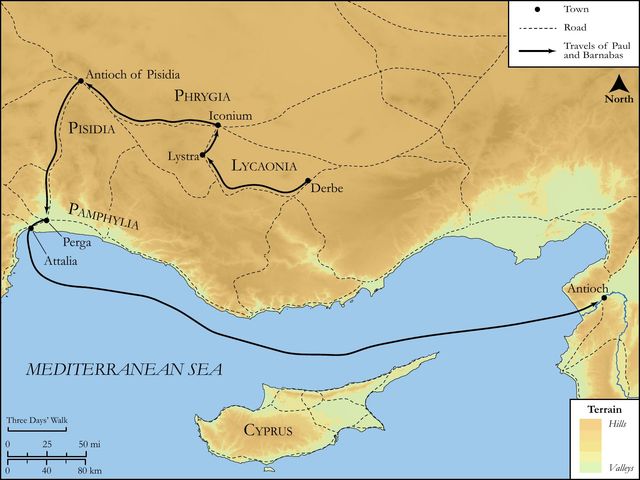
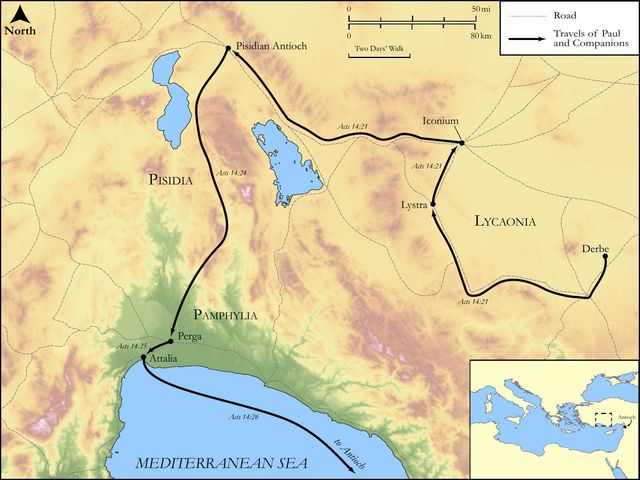
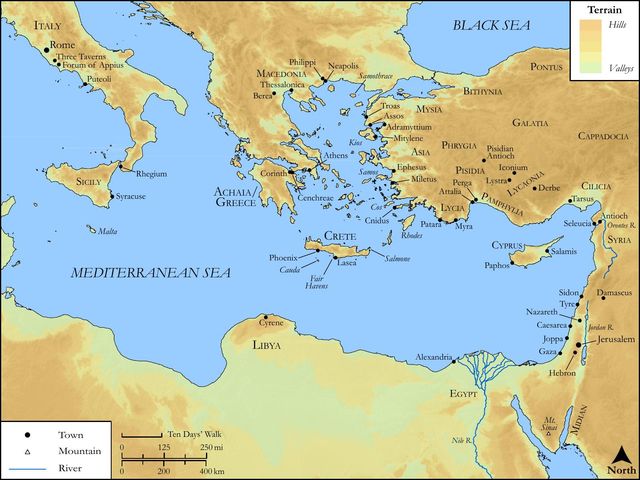
Study this verse
Public-domain commentary
Matthew Henry
From his Commentary on the Whole Bible. Henry comments on passages, not single verses — this entry covers Acts 14:19–28. His four-level outline is real structure in the source text, so it is rendered as structure.
We have here a further account of the services and sufferings of Paul and Barnabas.
I.How Paul was stoned and left for dead, but miraculously came to himself again, Act 14:19, Act 14:20.
They fell upon Paul rather than Barnabas, because Paul, being the chief speaker, galled and vexed them more than Barnabas did. Now observe here,
1.How the people were incensed against Paul; not by any injury they pretended he had done them (if they took it for an affront that he would not let them misplace divine honours upon him, when they considered themselves they would easily forgive him that wrong), but there came certain Jews from Antioch, hearing, it is likely, and vexed to hear, what respect was shown to Paul and Barnabas at Lystra; and they incensed the people against them, as factious, seditious, dangerous persons, not fit to be harboured. See how restless the rage of the Jews was against the gospel of Christ; they could not bear that it should have footing any where.
2.To what degree they were incensed by these barbarous Jews: they were irritated to such a degree that the mob rose and stoned Paul, not by a judicial sentence, but in a popular tumult; they threw stones at him, with which they knocked him down, and then drew him out of the city, as one not fit to live in it, or drew him out upon a sledge or in a cart, to bury him, supposing he had been dead. So strong is the bias of the corrupt and carnal heart to that which is evil, even in contrary extremes, that, as it is with great difficulty that men are restrained from evil on one side, so it is with great ease that they are persuaded to evil on the other side. See how fickle and mutable the minds of carnal worldly people are, that do not know and consider things. Those that but the other day would have treated the apostles as more than men now treat them as worse than brutes, as the worst of men, as the worst of male-factors. Today Hosanna, tomorrow Crucify; today sacrificed to, tomorrow sacrificed. We have an instance of a change the other way, ch. 28. This man is a murderer, Act 28:4; no doubt he is a god, Act 28:6. Popular breath turns like the wind. If Paul would have been Mercury, he might have been enthroned, nay, he might have been enshrined; but, if he will be a faithful minister of Christ, he shall be stoned, and thrown out of the city. Thus those who easily submit to strong delusions hate to receive the truth in the love of it. 3. How he was delivered by the power of God: When he was drawn out of the city, the disciples stood round about him, Act 28:20. It seems there were some here at Lystra that became disciples, that found the mean between deifying the apostles and rejecting them; and even these new converts had courage to own Paul when he was thus run down, though they had reason enough to fear that the same that stoned him would stone them for owning him. They stood round about him, as a guard to him against the further outrage of the people - stood about him to see whether he were alive or dead; and all of a sudden he rose up. Though he was not dead, yet he was ill crushed and bruised, no doubt, and fainted away; he was in a deliquium, so that it was not without a miracle that he came so soon to himself, and was so well as to be able to go into the city. Note, God's faithful servants, though they may be brought within a step of death, and may be looked upon as dead both by friends and enemies, shall not die as long as he has work for them to do. They are cast down, but not destroyed, Co2 4:9.
II.How they went on with their work, notwithstanding the opposition they met with.
All the stones they threw at Paul could not beat him off from his work: They drew him out of the city (Act 14:19), but, as one that set them at defiance, he came into the city again, to show that he did not fear them; none even of these things move him. However, their being persecuted here is a known indication to them to seek for opportunities of usefulness elsewhere, and therefore for the present they quit Lystra.
1.They went to break up and sow fresh ground at Derbe. Thither the next day Paul and Barnabas departed, a city not far off; there they preached the gospel, there they taught many, Act 14:21. And it should seem that Timothy was of that city, and was one of the disciples that now attended Paul, had met him at Antioch and accompanied him in all this circuit; for, with reference to this story, Paul tells him how fully he had known the afflictions he endured at Antioch, Iconium, and Lystra, Ti2 3:10, Ti2 3:11. Nothing is recorded that happened at Derbe.
2.They returned, and went over their work again, watering what they had sown; and, having staid as long as they thought fit at Derbe, they came back to Lystra, to Iconium, and Antioch, the cities where they had preached, Act 14:21. Now, as we have had a very instructive account of the methods they took in laying the foundation, and beginning the good work, so here we have the like of their building upon that foundation, and carrying on that good work. Let us see what they did,
(1.)They confirmed the souls of the disciples; that is, they inculcated that upon them which was proper to confirm them, Act 14:22. Young converts are apt to waver, and a little thing shocks them. Their old acquaintances beg they will not leave them. Those that they look upon to be wiser than themselves set before them the absurdity, indecency, and danger, of a change. They were allured, by the prospect of preferment, to stick to the traditions of their fathers; they are frightened with the danger of swimming against the stream. All this tempts them to think of making a retreat in time; but the apostles come and tell them that this is the true grace of God wherein they stand, and therefore they must stand to it that there is no danger like that of losing their part in Christ, no advantage like that of keeping their hold of him; that, whatever their trials may be, they shall have strength from Christ to pass through them; and, whatever their losses may be, they shall be abundantly recompensed. And this confirms the souls of the disciples; it fortifies their pious resolutions, in the strength of Christ, to adhere to Christ whatever it may cost them. Note,
[1.]Those that are converted need to be confirmed; those that are planted need to be rooted. Ministers' work is to establish saints as well as to awaken sinners. Non minor est virtus quam quoerere parta tueri - To retain is sometimes as difficult as to acquire. Those that were instructed in the truth must know the certainty of the things in which they have been instructed; and those that are resolved must be fixed in their resolutions.
[2.]True confirmation is confirmation of the soul; it is not binding the body by severe penalties on apostates, but binding the soul. The best ministers can do this only by pressing those things which are proper to bind the soul; it is the grace of God, and nothing less, that can effectually confirm the souls of the disciples, and prevent their apostasy.
(2.)They exhorted them to continue in the faith; or, as it may be read, they encouraged them. They told them it was both their duty and interest to persevere; to abide in the belief of Christ's being the Son of God, and the Saviour of the world. Note, Those that are in the faith are concerned to continue in the faith, notwithstanding all the temptations they may be under to desert it, from the smiles or frowns of this world. And it is requisite that they should often be exhorted to do so. Those that are continually surrounded with temptations to apostasy have need to be continually attended with pressing exhortations to perseverance.
(3.)That which they insisted most upon was that we must through much tribulation enter into the kingdom of God. Not only they must, but we must; it must be counted upon that all who will go to heaven must expect tribulation and persecution in their way thither. But is this the way to confirm the souls of the disciples, and to engage them to continue in the faith? One would think it would rather shock them, and make them weary. No, as the matter is fairly stated and taken entire, it will help to confirm them, and fix them for Christ. It is true they will meet with tribulation, with much tribulation; that is the worst of it: but then,
[1.]It is so appointed. They must undergo it, there is no remedy, the matter is already fixed, and cannot be altered. He that has the sovereign disposal of us has determined it to be our lot that all that will live godly in Christ Jesus should suffer persecution; and he that has the sovereign command over us has determined this to be our duty, that all that will be Christ's disciples must take up their cross. When we gave up our names to Jesus Christ it was what we agreed to; when we sat down and counted the cost, if we reckoned aright, it was what we counted upon; so that if tribulation and persecution arise because of the word it is but what we had notice of before, it must be so: he performeth the thing that is appointed for us. The matter is fixed unalterably; and shall the rock be for us removed out of its place?
[2.]It is the lot of the leaders in Christ's army, as well as of the soldiers. It is not only you, but we, that (if it be thought a hardship) are subject to it; therefore, as your own sufferings must not be a stumbling-block to you, so neither must ours; see Th1 3:3. Let none be moved by our afflictions, for you yourselves know that we are appointed thereunto. As Christ did not put the apostles upon any harder service than what he underwent before them, so neither did the apostles put the ordinary Christians.
[3.]It is true we must count upon much tribulation, but this is encouraging, that we shall get through it; we shall not be lost and perish in it. It is a Red Sea, but the Lord has opened a way through it, for the redeemed of the Lord to pass over. We must go down to trouble, but we shall come up again.
[4.]We shall not only get through it, but get through it into the kingdom of God; and the joy and glory of the end will make abundant amends for all the difficulties and hardships we may meet with in the way. It is true we must go by the cross, but it is as true that if we keep in the way, and do not turn aside nor turn back, we shall go to the crown, and the believing prospect of this will make the tribulation easy and pleasant.
(4.)They ordained them elders, or presbyters, in every church. Now at this second visit they settled them in some order, formed them into religious societies under the guidance of a settled ministry, and settled that distinction between those that are taught in the word and those that teach.
[1.]Every church had its governors or presidents, whose office it was to pray with the members of the church, and to preach to them in their solemn assemblies, to administer all gospel ordinances to them, and to take the oversight of them, to instruct the ignorant, warn the unruly, comfort the feeble-minded, and convince gainsayers. It is requisite that every particular church should have one or more such to preside in it.
[2.]Those governors were then elders, that had in their qualification the wisdom and gravity of seniors, and had in their commission the authority and command of seniors: not to make new laws (this is the prerogative of the Prince, the great Lawgiver; the government of the church is an absolute monarchy, and the legislative power entirely in Christ), but to see to the observance and execution of the laws Christ has made; and so far they are to be obeyed and submitted to.
[3.]These elders were ordained. The qualifications of such as were proposed or proposed themselves (whether the apostles or the people put them up) were judged of by the apostles, as most fit to judge; and they, having devoted themselves, were solemnly set apart to the work of the ministry, and bound to it.
[4.]These elders were ordained to them, to the disciples, to their service, for their good. Those that are in the faith have need to be built up in it, and have need of the elders' help therein - the pastors and teachers, who are to edify the body of Christ.
(5.)By prayer joined with fasting they commended them to the Lord, to the Lord Jesus, on whom they believed. Note,
[1.]Even when persons are brought to believe, and that sincerely, yet ministers' care concerning them is not over; there is need of watching over them still, instructing and admonishing them still; there is still that lacking in their faith which needs to be perfected.
[2.]The ministers that take most care of those that believe must after all commend them to the Lord, and put them under the protection and guidance of his grace: Lord, keep them through thine own name. To his custody they must commit themselves, and their ministers must commit them.
[3.]It is by prayer that they must be commended to the Lord. Christ, in his prayer (Jn. 17), commended his disciples to his Father: Thine they were, and thou gavest them to me. Father, keep them.
[4.]It is a great encouragement to us, in commending the disciples to the Lord, that we can say, "It is he in whom they believed; we commit to him those who have committed themselves to him, and who know they have believed in one who is able to keep what they and we have committed to him against that day," Ti2 1:12.
[5.]It is good to join fasting with prayer, in token of our humiliation for sin, and in order to add vigour to our prayers.
[6.]When we are parting with our friends, the best farewell is to commend them to the Lord, and to leave them with him.
3.They went on preaching the gospel in other places where they had been, but, as it should seem had not made so many converts as that now at their return they could form them into churches; therefore thither they came to pursue and carry on conversion-work. From Antioch they passed through Pisidia, the province in which that Antioch stood; thence they came into the province of Pamphylia, the head-city of which was Perga, where they had been before (Act 13:13), and came thither again to preach the word (Act 14:25), making a second offer, to see if they were now better disposed than they were before to receive the gospel. What success they had there we are not told, but that thence they went down to Attalia, a city of Pamphylia, on the sea-coast. They staid not long at a place, but wherever they came endeavoured to lay a foundation which might afterwards be built upon, and to sow the seeds which would in time produce a great increase. Now Christ's parables were explained, in which he compared the kingdom of heaven to a little leaven, which in time leavened the whole lump - to a grain of mustard-seed, which, though very inconsiderable at first, grew to a great tree - and to the seed which a man sowed in his ground, and it sprung up he knew not how.
III.How they at length came back to Antioch in Syria, whence they had been sent forth upon this expedition. From Attalia they came by sea to Antioch, Act 14:26. And we are here told,
1.Why they came thither: because thence they had been recommended to the grace of God, and such a value did they put upon a solemn recommendation to the grace of God, though they had themselves a great interest in heaven, that they never thought they could show respect enough to those who had so recommended them. The brethren having recommended them to the grace of God, for the work which they fulfilled, now that they had fulfilled it they thought they owed them an account of it, that they might help them by their praises, as they had been helped by their prayers.
2.What account they gave them of their negociation (Act 14:27): They gathered the church together. It is probable that there were more Christians at Antioch than ordinarily met, or could meet, in one place, but on this occasion they called together the leading men of them; as the heads of the tribes are often called the congregation of Israel, so the ministers and principal members of the church at Antioch are called the church. Or perhaps as many of the people as the place would hold came together on this occasion. Or some met at one time, or in one place, and others at another. But when they had called them together, they gave them an account of two things - (1.) Of the tokens they had had of the divine presence with them in their labours: They rehearsed all that God had done with them. They did not tell what they had done (this would have savoured of vain-glory), but what God had done with them and by them. Note, The praise of all the little good we do at any time must be ascribed to God; for it is he that not only worketh in us both to will and to do, but then worketh with us to make what we do successful. God's grace can do any thing without ministers' preaching; but ministers' preaching, even Paul's, can do nothing without God's grace; and the operations of that grace must be acknowledged in the efficacy of the word. (2.) Of the fruit of their labours among the heathen. They told how God had opened the door of faith unto the Gentiles; had not only ordered them to be invited to the gospel feast, but had inclined the hearts of many of them to accept the invitation. Note, [1.] There is no entering into the kingdom of Christ but by the door of faith; we must firmly believe in Christ, or we have no part in him. [2.] It is God that opens the door of faith, that opens to us the truths we are to believe, opens our hearts to receive them, and makes this a wide door, and an effectual, into the church of Christ. [3.] We have reason to be thankful that God has opened the door of faith to the Gentiles, has both sent them his gospel, which is made known to all nations for the obedience of faith (Rom 16:26), and has also given them hearts to entertain the gospel. Thus the gospel was spread, and it shone more and more, and none was able to shut this door which God had opened; not all the powers of hell and earth.
3.How they disposed of themselves for the present: There they abode a long time with the disciples (Act 14:28), longer than perhaps at first they intended, not because they feared their enemies, but because they loved their friends, and were loth to part from them.
Historical interpretation
Historical reception
3 surviving comments on this verse. Each one is dated, so this reads as a timeline rather than a list.
Then they went over all the cities in which they had been in danger. "And on the morrow," it says, "he went forth with Barnabas to Derbe. And when they had preached the Gospel to that city, and had taught many, they returned again to Lystra, and to Iconium, and Antioch, confirming the souls of the disciples, and exhorting them to continue in the faith, and that we must through much tribulation enter into the kingdom of God." This they said, this they showed. But it is purposely so done, not only by the Apostles, but by the disciples also, that they may learn from the very outset both the might of the preaching, and that they must themselves also suffer such things, that they may stand nobly, not idly gaping for the miracles, but much more ready for the trials. Therefore also the Apostle himself said, "Having the same conflict which ye saw in me and heard." Persecutions succeeded to persecutions: wars, fightings, stonings.
These things, not less than the miracles, both made them more illustrious, and prepared for them a greater rejoicing. The Scripture nowhere says that they returned rejoicing because they had done miracles, but it does say that they rejoiced, that "they were counted worthy for that Name to suffer shame." And this they were taught of Christ, saying, "Rejoice not that the devils obey you." For the joy indeed and without alloy is this, to suffer aught for Christ's sake. "And that through much tribulation:" what sort of cheering is this? how did they persuade them, by telling them at the outset of tribulations?
"Then on the morrow," etc. And observe, first he goes forth to Derbe, and then comes back to Lystra and Iconium and Antioch, giving way to them while their passions are roused, but when they have ceased, then attacking them again. Do you mark, that it was not by supernatural grace that they managed all that they did, but by their own diligence? "Confirming," it says "the souls of the disciples:" "further establishing;" so that they were established, but they added more thereto. "And that we must," etc.: they foretold this, that they might not be offended.
Continue studying Acts 14:21 across the web’s major study libraries — every link below opens this exact verse, chapter, or book on the destination site.
Read & Compare
 BibleGatewayThis verse in more than 200 translations and 70 languages.
 Bible.comThe YouVersion reader — hundreds of translations, reading plans, and highlights.
 ESV.orgCrossway's official English Standard Version reader.
 NET BibleThe NET translation with 60,000+ translators' notes on every rendering decision.
 STEP BibleTyndale House's free study tool — original text, vocabulary, and scholarly resources.
 BibliaLogos Bible Software's free web reader.
 USCCBThe New American Bible (Revised Edition) with the U.S. bishops' study notes.
Commentaries
 BibleHub CommentariesDozens of classic commentaries on this verse, gathered on one page.
 StudyLightMore than 100 commentary sets — the largest collection on the web.
 BibleRefPlain-English commentary on what this verse means, verse by verse.
 Enduring WordDavid Guzik's free commentary on this chapter, widely used by Bible teachers.
 Bible Study ToolsVerse commentary alongside Greek and Hebrew study aids.
Original Language & Research
- BibleHub InterlinearThe verse word by word — original language, transliteration, and English.
- BibleHub LexiconEvery word's original-language definition and Strong's entry.
 Blue Letter BibleDeep-study tools — Strong's numbers, concordance, and word studies.
 CNTR CollationThe earliest Greek manuscripts of this verse, collated letter by letter.
Sermons, Hymns & Audio


TrulyRandomVerse is not affiliated with these sites and doesn’t control their content. They’re linked because they’re genuinely useful.
Summary
Acts 14:21 marks a pivotal moment in Paul and Barnabas's First Missionary Journey, summarizing their fruitful ministry in Derbe and setting the stage for an audacious and courageous return to cities where they had faced brutal persecution. This verse highlights their unwavering commitment to the gospel and the nascent Christian communities, demonstrating a profound dedication to nurturing the faith of new believers despite personal risk.
Context
ShowHideLiterary Context
This verse immediately follows one of the most dramatic and life-threatening incidents in Paul's ministry: his stoning in Lystra, where he was left for dead outside the city walls (Acts 14:19). Miraculously, he recovered and, with Barnabas, proceeded to Derbe, a city further east. In Derbe, their ministry was evidently successful, marked by both "preaching the gospel" and "teaching many," seemingly without the intense opposition encountered elsewhere. The decision to "return again to Lystra, and to Iconium, and Antioch" (of Pisidia) is a significant narrative turn, as these were precisely the places where they had been violently persecuted, threatened, or expelled (Acts 14:5, Acts 14:19, Acts 13:50). This return was not a retreat but a deliberate and dangerous act of strengthening the new believers and organizing the fledgling churches, leading directly into the appointment of elders and the final leg of their journey back to Antioch in Syria (Acts 14:22-28).
Historical & Cultural Context
Paul and Barnabas were operating within the Roman province of Galatia, a region known for its diverse populations, including Roman colonists, Greek-speaking natives, and Jewish communities. Travel in the ancient world was arduous and dangerous, often fraught with bandits, harsh terrain, and the constant threat of local unrest or official suspicion. For Christian missionaries, the danger was compounded by the novelty of their message, which often challenged established religious and social norms. Returning to cities like Lystra and Iconium, where they had faced mob violence and official expulsion, was an act of extraordinary courage. Stoning, while primarily a Jewish form of execution, could be instigated by a mob, as seen in Lystra, indicating the deep hostility they faced. Their willingness to re-enter such hostile environments underscores their conviction that the spiritual needs of the new converts outweighed their personal safety, reflecting a profound commitment to the mission given to them by God.
Key Themes
ShowHideThis verse powerfully encapsulates several key themes central to the book of Acts and the broader New Testament. First, it highlights Unwavering Perseverance in the face of severe adversity. Paul and Barnabas exemplify extraordinary courage and resilience, choosing to re-engage with dangerous areas rather than avoid them. This demonstrates a deep commitment to the spiritual well-being of new converts, prioritizing discipleship over personal safety, a theme echoed in Paul's later letters regarding his sufferings for the gospel (2 Corinthians 11:23-28). Second, the verse underscores the dual nature of their ministry: Effective Evangelism and Discipleship. The phrase "preached the gospel" (Greek: euangelizō) signifies their initial outreach and proclamation of the good news, while "taught many" (Greek: mathēteúō) emphasizes the comprehensive nature of their ministry, moving beyond mere conversion to include ongoing instruction and spiritual formation. This aligns perfectly with the Great Commission to make disciples of all nations, teaching them to obey everything Christ commanded. Finally, their return signifies the crucial importance of Strengthening the Early Church. This follow-up was vital for consolidating the nascent Christian communities, providing encouragement, further instruction, and likely the appointment of elders, as detailed in Acts 14:23. This commitment to follow-up and church organization was foundational for the stability and growth of the early Christian movement.
Exposition and Analysis
ShowHideKey Word Analysis
ShowHideFrom eu (good) and angelos (messenger), this verb means "to announce good news," specifically the gospel of Jesus Christ. It signifies the active, public proclamation of the saving message of Christ's death and resurrection. In Acts 14:21, it denotes the initial outreach and communication of the core Christian message that led to conversions in Derbe.
Derived from mathētēs (disciple), this verb means "to become a pupil" or, transitively, "to disciple" or "to enrol as a scholar." It implies a deeper, ongoing process of instruction, training, and spiritual formation beyond initial conversion. This word highlights the comprehensive nature of Paul and Barnabas's ministry, which extended to nurturing and equipping new believers for life in Christ.
This compound verb, from hypo (under/behind) and strephō (to turn), means "to turn back" or "to return." In this context, it emphasizes the deliberate and purposeful act of retracing their steps to cities from which they had been driven out. It underscores their unwavering resolve and commitment to the churches they had planted, despite the significant personal danger involved.
Verse Breakdown
ShowHide"And when they had preached the gospel to that city"
This clause describes the successful initial phase of Paul and Barnabas's ministry in Derbe. "That city" refers to Derbe, where they proclaimed the good news of Jesus Christ. The use of "preached the gospel" (euangelizō) indicates the foundational evangelistic work that led to the establishment of a Christian community there.
"and had taught many"
Following the initial proclamation, this phrase indicates the subsequent and equally vital work of discipleship. "Taught many" (mathēteúō) suggests a period of instruction and spiritual formation for the new converts in Derbe, moving them beyond mere belief to a deeper understanding and application of Christian truth. This highlights the comprehensive nature of their ministry, which included both conversion and spiritual growth.
"they returned again to Lystra, and to Iconium, and Antioch"
This final clause reveals the astonishing and courageous decision of Paul and Barnabas. Instead of continuing their journey to safer territories, they deliberately retraced their steps through cities where they had faced severe persecution—Lystra (where Paul was stoned), Iconium (where they faced a plot to stone them), and Antioch of Pisidia (from which they were expelled). This return was not a retreat but a strategic and dangerous act of pastoral care and church consolidation, demonstrating their profound commitment to the fledgling Christian communities they had established.
Literary Devices
ShowHideActs 14:21 employs several effective literary devices. The most prominent is Juxtaposition, specifically the stark contrast between the successful, relatively peaceful ministry in Derbe and the perilous decision to return to Lystra, Iconium, and Antioch—cities previously marked by intense persecution and violence against the apostles. This highlights the extraordinary courage and commitment of Paul and Barnabas. There is also a strong sense of Narrative Progression as the verse marks a turning point from outward expansion to inward consolidation, setting the stage for the strengthening of the new churches. The repeated mention of the cities (Lystra, Iconium, Antioch) serves as a form of Anaphora (though not strictly at the beginning of clauses, it's a list that emphasizes the specific, dangerous destinations), underscoring the deliberate and challenging nature of their return journey. Furthermore, the verse implicitly uses Understatement regarding the dangers involved; simply stating "they returned again" belies the immense risk and the miraculous nature of their previous survival in these very places.
Theological and Thematic Connections
ShowHideActs 14:21 profoundly illustrates the nature of authentic apostolic ministry, which transcends personal safety for the sake of the gospel and the spiritual well-being of the flock. It underscores the divine imperative not only to proclaim the good news but also to nurture, instruct, and organize those who respond. This commitment reflects God's own faithfulness in sustaining His people and His work, even amidst intense opposition. The apostles' actions demonstrate that the mission of the church is not merely about making converts but about building mature, resilient communities of faith capable of enduring trials and carrying forward the gospel. Their perseverance in the face of suffering directly mirrors the suffering of Christ and serves as a model for all who would follow Him, emphasizing that the path of discipleship often involves hardship for the sake of the Kingdom.
Reflection and Application
ShowHideActs 14:21 offers a compelling blueprint for Christian living and ministry, challenging believers to embrace a faith characterized by courage, perseverance, and a deep commitment to discipleship. Paul and Barnabas's willingness to return to places of persecution reminds us that following Christ often means stepping into uncomfortable or even dangerous situations for the sake of His Kingdom. It calls us to prioritize the spiritual growth and stability of others, even when it demands personal sacrifice. This verse encourages us to move beyond initial evangelism to the vital, often unseen, work of teaching, nurturing, and strengthening fellow believers. It highlights the enduring importance of the local church as the primary vehicle for spiritual formation and community, urging us to invest in its health and growth. Ultimately, it is a call to courageous, comprehensive, and Christ-centered discipleship, modeling a life lived fully for God's purposes, regardless of the cost.
Questions for Reflection
ShowHideFAQ
ShowHideWhy did Paul and Barnabas return to cities where they had been persecuted?
ShowHidePaul and Barnabas returned to Lystra, Iconium, and Antioch (of Pisidia) not out of recklessness, but out of a profound pastoral commitment to the new believers and churches they had established. Their primary motivation was to strengthen, encourage, and organize these nascent Christian communities. As the subsequent verses in Acts 14:22-23 explain, they were "strengthening the souls of the disciples, encouraging them to continue in the faith, and saying that through many tribulations we must enter the kingdom of God." They also appointed elders in every church, ensuring leadership and stability. This demonstrates their understanding that evangelism is incomplete without discipleship and the establishment of functioning, resilient local churches. Their return was a testament to their unwavering dedication to the gospel and the spiritual well-being of their converts, prioritizing the growth of God's Kingdom over their personal safety.
Christ-Centered Fulfillment
ShowHideActs 14:21, though describing the actions of Paul and Barnabas, finds its ultimate Christ-centered fulfillment in the very nature and mission of Jesus Himself. Just as the apostles "preached the gospel" and "taught many," so too did Jesus tirelessly proclaim the good news of the Kingdom of God and instruct His disciples (Mark 1:14-15, Matthew 4:23). Their courageous "return" to hostile territories echoes Christ's own unwavering commitment to His mission, even knowing it would lead to suffering and death in Jerusalem (Luke 9:51). Jesus, the Good Shepherd, did not abandon His flock but laid down His life for them (John 10:11). The apostles' perseverance in the face of persecution directly mirrors the suffering and triumph of Christ, who endured the cross for the joy set before Him (Hebrews 12:2). Their work of strengthening the early church is a continuation of Christ's foundational work of building His church, against which the gates of hell will not prevail (Matthew 16:18). Thus, Acts 14:21 is not merely a record of human courage, but a demonstration of the Spirit-empowered, Christ-like dedication required for the advancement of God's redemptive plan, ultimately fulfilled in the ongoing work of the resurrected Lord through His body, the Church (Ephesians 1:22-23).