


2 Samuel 12:28
- וְעַתָּהve·'a·Tahand thereforeH6258Conj-w ¦ AdvAdverbוְandעַתָּהtherefore
- אֱסֹף'e·SofgatherH622V-Qal-Imp-2msVerb Qal Imperative 2nd Singular Masculine
- אֶת'et<obj.>H853DirObjMParticle Object Indicator
- יֶתֶרYe·ter[the] rest ofH3499N-mscNoun Singular Masculine Construct
- הָעָםha·'Amthe peopleH5971Art ¦ N-msNoun Singular Masculine Absoluteהָtheעָםpeople
- וַחֲנֵהva·cha·Nehand encampH2583Conj-w ¦ V-Qal-Imp-2msVerb Qal Imperative 2nd Singular Masculineוַandחֲנֵהencamp
- עַל'alonH5921PrepPreposition
- הָעִירha·'Irthe cityH5892Art ¦ N-fsNoun Singular Feminine Absoluteהָtheעִירcity
- וְלָכְדָהּve·la·khe·Dahand capture itH3920Conj-w ¦ V-Qal-Imp-2ms ¦ 3fsVerb Qal Imperative 2nd Singular Masculineוְandלָכְדָcaptureהּit
- פֶּןpenlestH6435PrtParticle Conditional
- אֶלְכֹּד'el·KodI should takeH3920V-Qal-Imperf-1csVerb Qal Imperfect 1st Singular common gender
- אֲנִי'a·NiIH589Pro-1csPronoun Personal 1st Singular common gender
- אֶת'et<obj.>H853DirObjMParticle Object Indicator
- הָעִירha·'Irthe cityH5892Art ¦ N-fsNoun Singular Feminine Absoluteהָtheעִירcity
- וְנִקְרָאve·nik·Ra'and it will be calledH7121Conj-w ¦ V-Niphal-ConsecPerf-3msVerb Niphal Consecutive Perfect 3rd Singular Masculineוְandנִקְרָאit will be called
- שְׁמִיshe·Mimy nameH8034N-msc ¦ 1csNoun Singular Masculine Constructשְׁמִnameיmy
- עָלֶיהָ'a·Lei·haon itH5921Prep ¦ 3fsPreposition Definiteעָלֶיonהָit
English is a literal word-by-word gloss of the Hebrew, not the KJV's wording. Why?
This is the original text the KJV's translators worked from — each Hebrew word with its own literal English meaning in this verse, prepared by scholars at Tyndale House, Cambridge. The KJV translates whole sentences, not word by word, so its wording differs: one Hebrew word can become several English words, and the KJV may choose “the LORD” where the gloss reads “Yahweh”. Both are faithful — they answer different questions. For the KJV's own rendering, switch to the KJV text.
Details
See on the biblical-era map
Study this verse
Public-domain commentary
Matthew Henry
From his Commentary on the Whole Bible. Henry comments on passages, not single verses — this entry covers 2 Samuel 12:26–31.
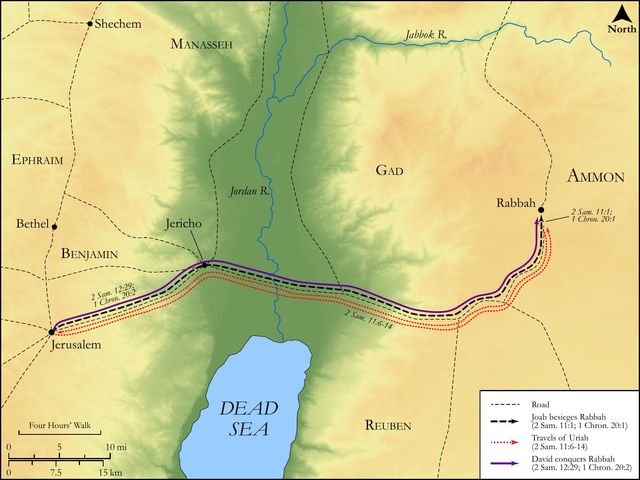
We have here an account of the conquest of Rabbah, and other cities of the Ammonites. Though this comes in here after the birth of David's child, yet it is most probable that it was effected a good while before, and soon after the death of Uriah, perhaps during the days of Bath-sheba's mourning for him. Observe, 1. That God was very gracious in giving David this great success against his enemies, notwithstanding the sin he had been guilty of just at that time when he was engaged in this war, and the wicked use he had made of the sword of the children of Ammon in the murder of Uriah. Justly might he have made that sword, thenceforward, a plague to David and his kingdom; yet he breaks it, and makes David's sword victorious, even before he repents, that this goodness of God might lead him to repentance. Good reason had David to own that God dealt not with him according to his sins, Psa 103:10. 2. That Joab acted very honestly and honourably; for when he had taken the city of waters, the royal city, where the palace was, and from which the rest of the city was supplied with water (and therefore, upon the cutting off of that, would be obliged speedily to surrender), he sent to David to come in person to complete this great action, that he might have the praise of it, Sa2 12:26-28. Herein he showed himself a faithful servant, that sought his master's honour, and his own only in subordination to his, and left an example to the servants of the Lord Jesus, in every thing they do, to consult his honour. Not unto us, but to thy name, give glory. 3. That David was both too haughty and too severe upon this occasion, and neither so humble nor so tender as he should have been. (1.) He seems to have been too fond of the crown of the king of Ammon, Sa2 12:30. Because it was of extraordinary value, by reason of the precious stones with which it was set, David would have it set upon his head, though it would have been better to have cast it at God's feet, and at this time to have put his own mouth in the dust, under guilt. The heart that is truly humbled for sin is dead to worldly glory and looks upon it with a holy contempt. (2.) He seems to have been too harsh with his prisoners of war, Sa2 12:31. Taking the city by storm, after it had obstinately held out against a long and expensive siege, if he had put all whom he found in arms to the sword in the heat of battle, it would have been severe enough; but to kill them afterwards in cold blood, and by cruel tortures, with saws and harrows, tearing them to pieces, did not become him who, when he entered upon the government, promised to sing of mercy as well as judgment, Psa 101:1. Had he made examples of those only who had abused his ambassadors, or advised or assisted in it, that being a violation of the law of nations, it might have been looked upon as a piece of necessary justice for terror to other nations; but to be thus severe with all the cities of the children of Ammon (that is, the garrisons or soldiers of the cities) was extremely rigorous, and a sign that David's heart was not yet made soft by repentance, else the bowels of his compassion would not have been thus shut up - a sign that he had not yet found mercy, else he would have been more ready to show mercy.
Continue studying 2 Samuel 12:28 across the web’s major study libraries — every link below opens this exact verse, chapter, or book on the destination site.
Read & Compare
 BibleGatewayThis verse in more than 200 translations and 70 languages.
 Bible.comThe YouVersion reader — hundreds of translations, reading plans, and highlights.
 ESV.orgCrossway's official English Standard Version reader.
 NET BibleThe NET translation with 60,000+ translators' notes on every rendering decision.
 STEP BibleTyndale House's free study tool — original text, vocabulary, and scholarly resources.
 BibliaLogos Bible Software's free web reader.
 USCCBThe New American Bible (Revised Edition) with the U.S. bishops' study notes.
Commentaries
 BibleHub CommentariesDozens of classic commentaries on this verse, gathered on one page.
 StudyLightMore than 100 commentary sets — the largest collection on the web.
 BibleRefPlain-English commentary on what this verse means, verse by verse.
 Enduring WordDavid Guzik's free commentary on this chapter, widely used by Bible teachers.
 Bible Study ToolsVerse commentary alongside Greek and Hebrew study aids.
Original Language & Research
- BibleHub InterlinearThe verse word by word — original language, transliteration, and English.
- BibleHub LexiconEvery word's original-language definition and Strong's entry.
 Blue Letter BibleDeep-study tools — Strong's numbers, concordance, and word studies.
 SefariaThe Hebrew text with Rashi and centuries of Jewish commentary.
Sermons, Hymns & Audio


TrulyRandomVerse is not affiliated with these sites and doesn’t control their content. They’re linked because they’re genuinely useful.
Summary
This verse captures Joab's remarkably strategic and selfless message to King David during the final stages of the siege of Rabbah, the Ammonite capital. Having successfully captured the city's vital water supply and brought it to the brink of collapse, Joab, David's seasoned and loyal commander, urges the king to personally lead the final assault. His clear motivation is to ensure that the ultimate victory and the glory of conquering such a significant city are rightly attributed to David, thereby safeguarding the king's honor, solidifying his reign, and preventing any perception that Joab might usurp royal prestige by claiming the conquest for himself.
Context
ShowHideLiterary Context
The immediate literary context of 2 Samuel 12:28 places us at the dramatic climax of the protracted war against the Ammonites, a conflict initiated by King Hanun's egregious insult to David's envoys (as recounted in 2 Samuel 10). Joab, David's most trusted and formidable general, has been leading the arduous siege of Rabbah, the Ammonite capital, for an extended period. This specific message from Joab to David follows the crucial capture of the "city of waters" (likely Rabbah's primary water source), a strategic move that signaled the city's imminent fall and rendered its continued resistance futile. This military triumph unfolds against the backdrop of David's profound moral failures detailed in 2 Samuel 11, where he committed adultery with Bathsheba and orchestrated the death of her husband, Uriah, on the very battlefield where Joab was fighting. 2 Samuel 12 then recounts Nathan the prophet's powerful, divinely inspired confrontation with David and the king's subsequent, albeit painful, repentance. Despite David's grievous personal sins and the divine judgment pronounced upon his house, Joab remains steadfastly loyal, demonstrating a professional dedication that transcends the king's personal integrity. Joab's message in this verse is a direct, politically astute appeal for David to claim the final victory, preventing any ambiguity about who receives the credit for such a significant military triumph and thereby restoring David's public image and authority.
Historical & Cultural Context
The war against the Ammonites was a major undertaking during David's reign, a conflict that arose from a severe diplomatic breach and escalated into a full-scale regional war, as initially described in 2 Samuel 10:1-5. Rabbah (modern Amman, Jordan) was not merely a city but the fortified capital of the Ammonite kingdom, making its capture a monumental military and political achievement. In the ancient Near East, the conquest of a capital city was a defining moment for any monarch, symbolizing their power, divine favor, and the expansion of their dominion. Such victories were invariably attributed directly to the king, solidifying his legitimacy and prestige. The cultural practice of naming cities, monuments, or even entire eras after a victorious conqueror was commonplace, serving as a lasting testament to their renown and legacy. Joab's explicit concern that the city might be "called after my name" directly reflects this deep-seated cultural understanding of how glory and enduring legacy were established. His actions are thus not only militarily sound but also politically sagacious, recognizing the paramount importance of maintaining the king's preeminence in a highly hierarchical society where a powerful and successful general could, intentionally or unintentionally, pose a perceived threat to the monarch's supreme authority.
Key Themes
ShowHideThis verse powerfully contributes to several overarching themes within the Deuteronomistic History, particularly within the books of Samuel. Firstly, it profoundly highlights the theme of loyalty and selfless service. Joab, despite his own considerable military prowess and the clear opportunity for personal aggrandizement, deliberately defers the final, most glorious act of victory to David. This act stands in stark contrast to the self-serving ambition and pursuit of personal glory often observed in other figures, both biblical and historical. Secondly, the verse underscores the critical theme of leadership and accountability. It emphatically reinforces the principle that ultimate credit, and by extension, responsibility, for major national achievements and military triumphs rests squarely with the king. Joab's actions meticulously preserve David's royal authority and prevent any perceived challenge to his preeminence, especially crucial in the wake of David's moral failings described in 2 Samuel 11. Thirdly, it subtly introduces the theme of humility in leadership. Joab's willingness to forgo personal renown for the greater good of the kingdom and the honor of his sovereign is particularly striking given his often ruthless and pragmatic character, showcasing a complex facet of his personality that consistently prioritized the stability and glory of David's reign. Finally, the episode subtly reinforces the theme of divine sovereignty. Even through the flawed actions of human leaders and the complexities of political maneuvering, God's overarching purposes for David's kingdom continue to unfold, with the conquest of Rabbah being a significant step in establishing Israel's regional dominance and fulfilling the promises made to David.
Exposition and Analysis
ShowHideKey Word Analysis
ShowHideThis primitive root (H622) signifies "to collect, assemble, bring in" for any purpose. In this context, it denotes Joab's command for David to assemble the remaining forces, implying that Joab has already executed the arduous preparatory work of the siege, bringing Rabbah to the brink of collapse. The call to "gather" emphasizes the need for David to bring the final, decisive contingent to secure the victory, underscoring the collective effort but ultimately highlighting the king's indispensable role in marshaling the forces for the climax of the conquest.
This primitive root (H3920) means "to catch (in a net, trap or pit); generally, to capture or occupy." Here, it refers to the decisive act of conquering the city. Joab has brought Rabbah to the precipice of fall by capturing its vital water supply, and he now invites David to perform the final "taking," which would be the symbolic and actual culmination of the siege, ensuring the city's complete subjugation and the attribution of its fall to the king.
The verb qârâʼ (H7121) means "to call out to, address by name, proclaim," while shêm (H8034) refers to "an appellation, a mark or memorial of individuality; by implication honor, authority, character." The combined phrase carries immense weight in ancient Near Eastern culture. To have something "called after one's name" implies permanent ownership, lasting association, and the attribution of glory and renown. It is not merely a verbal acknowledgment but the establishment of an enduring legacy. Joab's concern is that if he, rather than David, delivers the final, victorious blow, the city's identity and the glory of its conquest would be permanently linked to him, potentially diminishing David's royal authority and elevating Joab to a dangerous level of prestige that could be perceived as a challenge to the throne.
Verse Breakdown
ShowHide"Now therefore gather the rest of the people together, and encamp against the city, and take it:"
This opening clause presents Joab's direct, urgent, and strategically sound command to King David. Having already secured the "city of waters" (as mentioned in 2 Samuel 12:27), Joab has completed the most difficult preparatory work of the siege, bringing Rabbah to the very brink of collapse. He understands that the final, decisive action requires the king's personal presence, not merely for military reinforcement but, more significantly, for the symbolic weight of royal leadership. This part of the message functions as a pragmatic military instruction, highlighting the immediate necessity for David to assume command and personally oversee the completion of the conquest.
"lest I take the city, and it be called after my name."
This concluding clause reveals Joab's profound loyalty, political acumen, and strategic foresight. He explicitly states his reason for deferring the final, glorious blow: to prevent the glory, renown, and lasting legacy of conquering Rabbah from being attributed to himself. In ancient cultures, a city being "called after" a conqueror signified permanent ownership, an indelible mark of victory, and a lasting legacy that could rival or even overshadow the king's. Joab, despite his immense military power and success, keenly understands the critical importance of preserving the king's unique authority and supreme prestige. He acts decisively to prevent any perception of personal ambition that could undermine David's rule, create a rival center of power, or sow seeds of disunity within the kingdom. This statement powerfully underscores Joab's unwavering commitment to David's throne and his deep understanding of royal protocol and political stability.
Literary Devices
ShowHideThe verse primarily employs Direct Speech, presenting Joab's precise and unadorned words to King David. This directness immediately conveys the urgency of his message and his underlying motivations without the need for narrative interpretation, immersing the reader directly into the strategic moment. There is also a potent use of Irony in the situation: David, the king who should ideally be leading from the front, is called to action by his general, not because the general is incapable, but precisely because the general is too capable and loyal, recognizing the king's desperate need to reclaim his public image and authority after his recent moral failings (as detailed in 2 Samuel 11). Joab's selflessness in this moment stands in stark contrast to David's recent self-indulgence, highlighting the moral complexities of the narrative. Furthermore, the phrase "lest I take the city, and it be called after my name" functions as a form of Prolepsis or Anticipation, as Joab articulates a potential future consequence (his name being glorified over David's) that he actively seeks to avert. This also contains an element of Symbolism, where the "name" represents honor, legacy, and ultimate authority in the ancient world.
Theological and Thematic Connections
ShowHideThis episode profoundly underscores theological truths about leadership, the pursuit of glory, and the nature of selfless service within God's divinely appointed order. Joab's actions exemplify a remarkable humility that deliberately defers personal acclaim for the greater good and the honor of the appointed leader. Theologically, this resonates deeply with the biblical principle that all ultimate glory belongs to God alone, and human leaders are but stewards of His purposes and instruments in His grand design. While Joab attributes the glory of the conquest to David, the narrative implicitly reminds us that David's authority, and thus his legitimate glory, flows directly from his anointing by God. Joab's unwavering loyalty, even to a king who has recently demonstrated profound moral failings, reflects a profound commitment to the divinely established order and the stability of the kingdom. This act of selflessness also stands in stark contrast to the pervasive human tendency towards self-exaltation and the craving for individual recognition, a theme frequently addressed and condemned throughout scripture.
Reflection and Application
ShowHideJoab's message to David offers a powerful and counter-cultural model for contemporary leadership and personal conduct, particularly in contexts where collaboration, shared credit, and the integrity of the collective are paramount. In an age often characterized by relentless self-promotion, the relentless pursuit of individual recognition, and the fear of being overshadowed, Joab's deliberate act of stepping back to ensure the king received the ultimate credit is a profound lesson in humility, selfless service, and strategic foresight. It challenges us to critically examine where our deepest loyalties truly lie: is it with our own personal advancement, or with the overarching success and honor of the mission, the team, the organization, or the leader we serve? This verse powerfully reminds us that true strength in leadership often manifests not in seizing every opportunity for personal glory, but in empowering others, ensuring that credit is appropriately attributed, and upholding the authority of those in ultimate command. It encourages us to cultivate a spirit that prioritizes the collective good and the integrity of the institution over individual accolades, recognizing that such an approach ultimately strengthens the entire enterprise and fosters a healthier, more productive environment.
Questions for Reflection
ShowHideFAQ
ShowHideWhat was the "city of waters" that Joab had captured?
ShowHideThe "city of waters" (Hebrew: 'ir hammayim) likely refers to the primary water supply or a strategically crucial section of Rabbah that controlled access to its essential water source. Capturing this vital point would have severely crippled the city's ability to withstand a prolonged siege, making its final fall inevitable due to thirst and unsanitary conditions. While its precise archaeological location within ancient Rabbah (modern Amman, Jordan) remains a subject of scholarly debate, its strategic importance is unequivocally clear: without a reliable water source, a fortified city could not hold out indefinitely against a besieging army. Joab's capture of this area demonstrated his military acumen and brought the siege to its decisive phase, as explicitly stated in 2 Samuel 12:27.
Why was it so important for the city to be "called after" David's name and not Joab's?
ShowHideIn the ancient Near East, having a city "called after" one's name was a profound and enduring symbol of conquest, absolute ownership, and lasting renown. It signified that the conqueror had established permanent dominion over the territory and that their legacy would be inextricably linked to that monumental victory. For Joab, allowing the city to be named after him would have been an act of self-exaltation that could have severely undermined King David's supreme authority and prestige. Such an act could have been perceived as Joab usurping royal prerogative, challenging the king's preeminence, or even setting himself up as a rival power center within the kingdom. Joab, as David's loyal and politically astute general, understood the critical importance of maintaining the king's supreme authority and ensuring that all major national victories were unequivocally attributed to the monarch, thereby solidifying David's rule and preventing any potential for internal conflict or challenges to the throne, as his message in 2 Samuel 12:28 clearly demonstrates.
Did David ultimately take the city of Rabbah?
ShowHideYes, King David indeed heeded Joab's wise and loyal advice. 2 Samuel 12:29-31 vividly describes David gathering the rest of the Israelite army, personally leading them to Rabbah, launching a decisive attack, and successfully conquering the city. The narrative emphasizes David's personal involvement in the final conquest, including the symbolic act of taking the heavy crown from the Ammonite king's head, which was then placed on David's own head. This act solidified David's victory and ensured that the glory of conquering Rabbah was unequivocally attributed to him, just as Joab had intended, thereby reinforcing David's royal authority and prestige throughout the kingdom.
Christ-Centered Fulfillment
ShowHideJoab's selfless act of deferring glory to King David, ensuring that the ultimate victory and its accompanying renown were attributed to the rightful sovereign, provides a profound and compelling foreshadowing of Christ's perfect humility and His ultimate preeminence. Unlike Joab, who served a flawed earthly king, Jesus, the perfect Son of God, consistently glorified His Father, declaring, "I can do nothing on my own. As I hear, I judge, and my judgment is just, because I seek not my own will but the will of him who sent me" (John 5:30). While Joab deliberately avoided having Rabbah "called after his name" to preserve David's honor, Christ, through His perfect obedience and sacrificial work on the cross, ensures that His name, the name above all names, is eternally exalted, and that "at the name of Jesus every knee should bow, in heaven and on earth and under the earth, and every tongue confess that Jesus Christ is Lord, to the glory of God the Father" (Philippians 2:9-11). The ultimate "city" that Christ conquers is not a physical capital, but the spiritual dominion of sin and death, a victory He achieved not by seeking His own glory but by obediently laying down His life for His sheep (John 10:18). His triumph ensures that all salvation, all redemption, and all eternal life are "called after" Him, the Lamb of God who takes away the sin of the world, the author and perfecter of our faith, and the true King of kings.