


2 Kings 4:5
- וַתֵּלֶךְva·Te·lekhand she wentH1980Conj-w ¦ V-Qal-ConsecImperf-3fsVerb Qal Consecutive Imperfect 3rd Singular Feminineוַandתֵּלֶךְshe went
- מֵאִתּוֹme·'i·Tofrom with <the> himH854Prep-m ¦ Prep ¦ 3msPreposition Definiteמֵfromאִתּwith <the>וֹhim
- וַתִּסְגֹּרva·tis·Gorand she shutH5462Conj-w ¦ V-Qal-ConsecImperf-3fsVerb Qal Consecutive Imperfect 3rd Singular Feminineוַandתִּסְגֹּרshe shut
- הַדֶּלֶתha·De·letthe doorH1817Art ¦ N-fsNoun Singular Feminine Absoluteהַtheדֶּלֶתdoor
- בַּעֲדָהּba·'a·Dahher behindH1157Adj-csc ¦ 3fsAdjective Numerical Singular common gender Constructבַּעֲדָbehindהּher
- וּבְעַדu·ve·'Adand behindH1157Conj-w ¦ Adj-cscAdjective Numerical Singular common gender Constructוּandבְעַדbehind
- בָּנֶיהָba·Nei·haher childrenH1121N-mpc ¦ 3fsNoun Plural Masculine Constructבָּנֶיchildrenהָher
- הֵםhemtheyH1992Pro-3mpPronoun Personal 3rd Plural Masculine
- מַגִּשִׁיםma·gi·Shim[were] bringingH5066V-Hiphil-Prtcpl-mpVerb Hiphil Participle Plural Masculine Absolute
- אֵלֶיהָ'e·Lei·hato herH413Prep ¦ 3fsPrepositionאֵלֶיtoהָher
- וְהִיאve·Hi'and sheH1931Conj-w ¦ Pro-3fsPronoun Personal 3rd Singular Feminineוְandהִיאshe
- מוֹצָקֶתmei·tza·ket[was] pouring outH3332V-Hiphil-Prtcpl-fsVerb Hiphil Participle Singular Feminine Absolute
English is a literal word-by-word gloss of the Hebrew, not the KJV's wording. Why?
This is the original text the KJV's translators worked from — each Hebrew word with its own literal English meaning in this verse, prepared by scholars at Tyndale House, Cambridge. The KJV translates whole sentences, not word by word, so its wording differs: one Hebrew word can become several English words, and the KJV may choose “the LORD” where the gloss reads “Yahweh”. Both are faithful — they answer different questions. For the KJV's own rendering, switch to the KJV text.
Details
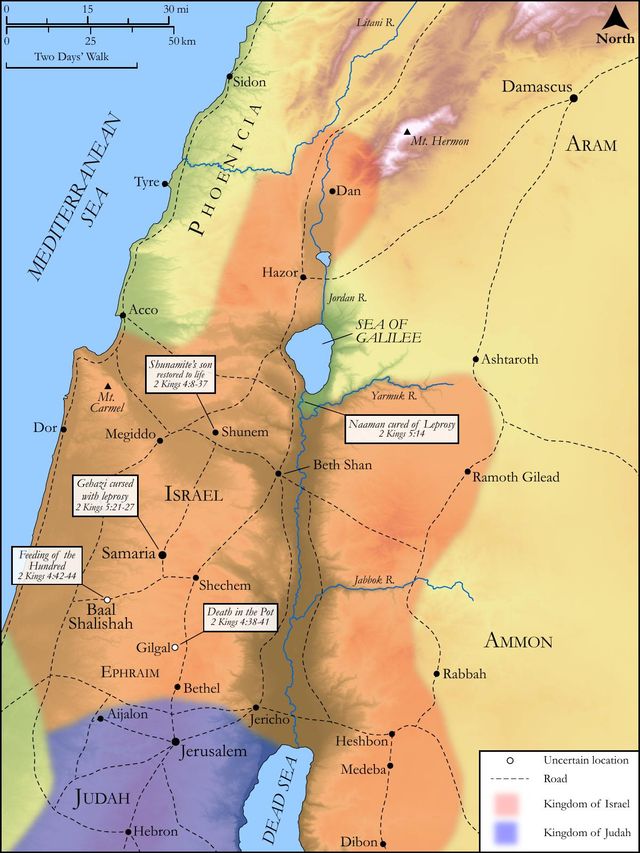
See on the biblical-era map
Study this verse
Public-domain commentary
Matthew Henry
From his Commentary on the Whole Bible. Henry comments on passages, not single verses — this entry covers 2 Kings 4:1–7. His four-level outline is real structure in the source text, so it is rendered as structure.
Elisha's miracles were for use, not for show; this recorded here was an act of real charity. Such also were the miracles of Christ, not only great wonders, but great favours to those for whom they were wrought. God magnifies his goodness with his power.
I.Elisha readily receives a poor widow's complaint.
She was a prophet's widow; to whom therefore should she apply, but to him that was a father to the sons of the prophets, and concerned himself in the welfare of their families? It seems, the prophets had wives as well as the priests, though prophecy went not by entail, as the priesthood did. Marriage is honourable in all, and not inconsistent with the most sacred professions. Now, by the complaint of this poor woman (Kg2 4:1), we are given to understand,
1.That her husband, being one of the sons of the prophets, was well know to Elisha. Ministers of eminent gifts and stations should make themselves familiar with those that are every way their inferiors, and know their character and state.
2.That he had the reputation of a godly man. Elisha knew him to be one that feared the Lord, else he would have been unworthy of the honour and unfit for the work of a prophet. He was one that kept his integrity in a time of general apostasy, one of the 7000 that had not bowed the knee to Baal.
3.That he was dead, though a good man, a good minister. The prophets - do they live for ever? Those that were clothed with the Spirit of prophecy were not thereby armed against the stroke of death.
4.That he died poor, and in debt more than he was worth. He did not contract his debts by prodigality, and luxury, and riotous living, for he was one that feared the Lord, and therefore durst not allow himself in such courses: nay, religion obliges men not to live above what they have, nor to spend more than what God gives them, no, not in expenses otherwise lawful; for thereby, of necessity, they must disable themselves, at last, to give every one his own, and so prove guilty of a continued act of injustice all along. Yet it may be the lot of those that fear God to be in debt, and insolvent, through afflictive providences, losses by sea, or bad debts, or their own imprudence, for the children of light are not always wise for this world. Perhaps this prophet was impoverished by persecution: when Jezebel ruled, prophets had much ado to live, and especially if they had families.
5.That the creditors were very severe with her Two sons she had to be the support of her widowed state, and their labour is reckoned assets in her hand; that must go therefore, and they must be bondmen for seven years (Exo 21:2) to work out this debt. Those that leave their families under a load of debt disproportionable to their estates know not what trouble they entail. In this distress the poor widow goes to Elisha, in dependence upon the promise that the seed of the righteous shall not be forsaken. The generation of the upright may expect help from God's providence and countenance from his prophets.
II.He effectually relieves this poor widow's distress, and puts her in a way both to pay her debt and to maintain herself and her family.
He did not say, Be warmed, be filled, but gave her real help. He did not give her some small matter for her present provision, but set her up in the world to sell oil, and put a stock into her hand to begin with. This was done by miracle, but it is an indication to us what is the best method of charity, and the greatest kindness one can do to poor people, which is, if possible, to help them into a way of improving what little they have by their own industry and ingenuity.
1.He directed her what to do, considered her case: What shall I do for thee? The sons of the prophets were poor, and it would signify little to make a collection for her among them: but the God of the holy prophets is able to supply all her need; and, if she has a little committed to her management, her need must be supplied by his blessing and increasing that little. Elisha therefore enquired what she had to make money of, and found she had nothing to sell but one pot of oil, Kg2 4:2. If she had had any plate or furniture, he would have bidden her part with it, to enable her to be just to her creditors. We cannot reckon any thing really, nor comfortably, our own, but what is so when all our debts are paid. If she had not had this pot of oil, the divine power could have supplied her; but, having this, it will work upon this, and so teach us to make the best of what we have. The prophet, knowing her to have credit among her neighbours, bids her borrow of them empty vessels (Kg2 4:3), for, it seems, she had sold her own, towards the satisfying of her creditors. He directs her to shut the door upon herself and her sons, while she filled all those vessels out of that one. She must shut the door, to prevent interruptions from the creditors, and others while it was in the doing, that they might not seem proudly to boast of this miraculous supply, and that they might have opportunity for prayer and praise to God upon this extraordinary occasion. Observe,
(1.)The oil was to be multiplied in the pouring, as the other widow's meal in the spending. The way to increase what we have is to use it; to him that so hath shall be given. It is not hoarding the talents, but trading with them, that doubles them.
(2.)It must be poured out by herself, not by Elisha nor by any of the sons of the prophets, to intimate that it is in connexion with our own careful and diligent endeavours that we may expect the blessing of God to enrich us both for this world and the other. What we have will increase best in our own hand.
2.She did it accordingly. She did not tell the prophet he designed to make a fool of her; but firmly believing the divine power and goodness, and in pure obedience to the prophet, she borrowed vessels large and many of her neighbours, and poured out her oil into them. One of her sons was employed to bring her empty vessels, and the other carefully to set aside those that were full, while they were all amazed to find their pot, like a fountain of living water, always flowing, and yet always full. They saw not the spring that supplied it, but believed it to be in him in whom all our springs are. Job's metaphor was now verified in the letter (Job 29:6), The rock poured me out rivers of oil. Perhaps this was in the tribe of Asher, part of whose blessing it was that he should dip his foot in oil, Deu 33:24.
3.The oil continued flowing as long as she had any empty vessels to receive it; when every vessel was full the oil stayed (Kg2 4:6), for it was not fit that this precious liquor should run over, and be as water spilt on the ground, which cannot be gathered up again. Note, We are never straitened in God, in his power and bounty, and the riches of his grace; all our straitness is in ourselves. It is our faith that fails, not his promise. He gives above what we ask: were there more vessels, there is enough in God to fill them - enough for all, enough for each. Was not this pot of oil exhausted as long as there were any vessels to be filled from it? And shall we fear lest the golden oil which flows from the very root and fatness of the good olive should fail, as long as there are any lamps to be supplied from it? Zac 4:12.
4.The prophet directed her what to do with the oil she had, Kg2 4:7. She must not keep it for her own use, to make her face to shine. Those whom Providence has made poor must be content with poor accommodations for themselves (this is knowing how to want), and must not think, when they get a little of that which is better than ordinary, to feed their own luxury: no,
(1.)She must sell the oil to those that were rich, and could afford to bestow it on themselves. We may suppose, being produced by miracle, it was the best of its kind, like the wine (Joh 2:10), so that she might have both a good price and a good market for it. Probably the merchants bought it to export, for oil was one of the commodities that Israel traded in, Eze 27:17.
(2.)She must pay her debt with the money she received for her oil. Though her creditors were too rigorous with her, yet they must not therefore lose their debt. Her first care, now that she has wherewithal to do so, must be to discharge that, even before she makes any provision for her children. It is one of the fundamental laws of our religion that we render to all their due, pay every just debt, give every one his own, though we leave ever so little for ourselves; and this, not of constraint but willingly and without grudging; not only for wrath, to avoid being sued, but also for conscience' sake. Those that possess an honest mind cannot with pleasure eat their daily bread, unless it be their own bread.
(3.)The rest must not be laid up, but she and her children must live upon it, not upon the oil, but upon the money received from it, with which they must put themselves into a capacity of getting an honest livelihood. No doubt she did as the man of God directed; and hence,
[1.]Let those that are poor and in distress be encouraged to trust God for supply in the way of duty. Verily thou shalt be fed, though not feasted. It is true we cannot now expect miracles, yet we may expect mercies, if we wait on God and seek to him. Let widows particularly, and prophets' widows in a special manner, depend upon him to preserve them and their fatherless children alive, for to them he will be a husband, a father.
[2.]Let those whom God has blessed with plenty use it for the glory of God and under the direction of his word: let them do justly with it, as this widow did, and serve God cheerfully in the use of it, and as Elisha, be ready to do good to those that need them, be eyes to the blind, and feet to the lame.
Historical interpretation
Two Centuries of Reception
3 surviving comments on this verse. Each one is dated, so this reads as a timeline rather than a list.
Select a marker to jump to its quote. Markers stagger vertically where authors wrote within a few decades of each other.
Here the Scripture relates the other miracle that Elisha performed in order to help the widow. He made flow into the vessels an amount of oil sufficient to pay the debt of her husband and abundantly multiplied it for the nourishment of her children.From the symbolic point of view three aspects must be observed here: first of all it is said that the widow filled the vessels of her neighbors with an oil that gushed out in her house thanks to a gift of God, because the holy church resembles the widow. In fact, she was not abandoned when her husband ascended to heaven, but she filled the hearts of the Gentiles with the oil of the knowledge of salvation which has multiplied and become abundant in her house thanks to the presence of the Holy Spirit. Moreover, the Gentiles, who were separated before, after being filled with that fat oil, glorified with their lips of cheerfulness that God whom they had ignored before.
In the second place, the widow asked for empty vessels and filled with oil those that her children brought to her, both small and large vessels. This signifies the saints who have rejected any worldly passion and are filled with the fat of the holy ointment and the oil of happiness. So their mother, that is, the grace of God gives oil to each of them, both to the great and the little. For God gives his gifts as he likes, so that everything may be ours, as the apostle says: “We must grow up in Christ according to his gift.” But those who are weighed down by their intemperance, drunkenness and worldly interests, those who, as the apostle says, walk in the vanity of their spirit and are obscured in their intelligence, those who have lost their hope and have given themselves to the practice of every sort of paganism and covetousness are deprived of this grace. In fact, they do not desire this oil, and if they desire it, they prepare no vessel to be filled with it.
In the third place, the rest of the oil, which the dead husband had left to his widow, signifies the mercy that [Christ] had shown to the saints while he lived on earth. Solomon says that he who associates himself with the Lord has mercy for the poor, and [the Lord] will reward him according to his works.
Notice, dearly beloved: as long as that widow had oil in her own vessel, it was not enough for her, and she could not pay her debt. It is true, brothers. If a person loves only himself, he does not suffice for himself, and he does not pay the debt of his sins; but when he begins to pour out the oil of charity on all his friends and neighbors and in fact on all people, then he is able to suffice for himself and can free himself from all debts. Truly brothers, such is the nature of holy love and true charity that it increases by being spent, and the more it is paid out to others, the more abundantly it is accumulated in oneself. If you want to give bodily food to the needy, at present you cannot keep what you have given him; but if you offer the bread of charity to one hundred people, it still remains whole. Even if you give it to a thousand, it stays undiminished for you. In fact, if you want to lavish it on the whole world, you will still lose nothing of it; or rather, not only does it not increase, but also the gain of all those on whom you bestowed it increases manifold for you. For example, you had a single loaf of charity; if you had given it to no one you would have it alone, but if you gave it to a thousand you would have acquired a thousand loaves. So great is the possession of charity that it remains entire for each individual and still can be undiminished for them all. Therefore, if you have given to others, you have lost nothing at all; or rather, not only did you not lose anything but also, as I already said, whatever you have conferred on others you have acquired a hundredfold. For this reason, beloved brothers, realize that the widow was freed from her creditors by nothing else than oil; know also that the Catholic church has been freed from its offenses by no other means than the oil of God’s mercy.
Let us now consider what blessed Elisha said to her: “Borrow many vessels of your neighbors and your friends, shut your door, and pour out of that oil into the vessels of your neighbors.” Who were those neighbors, except the Gentiles? Although that widow typified the church, she was still a widow, and so those neighbors from whom she borrowed vessels prefigured the Gentiles. They offered empty vessels in order that they might merit to receive the oil of mercy, because before obtaining the gift of grace all the Gentiles are known to have been without faith, charity and all good works. Finally, all who are offered to the church to receive salutary baptism receive the chrism and oil of benediction, so that they may no longer merit to be empty vessels but full of God as his temples.
Continue studying 2 Kings 4:5 across the web’s major study libraries — every link below opens this exact verse, chapter, or book on the destination site.
Read & Compare
 BibleGatewayThis verse in more than 200 translations and 70 languages.
 Bible.comThe YouVersion reader — hundreds of translations, reading plans, and highlights.
 ESV.orgCrossway's official English Standard Version reader.
 NET BibleThe NET translation with 60,000+ translators' notes on every rendering decision.
 STEP BibleTyndale House's free study tool — original text, vocabulary, and scholarly resources.
 BibliaLogos Bible Software's free web reader.
 USCCBThe New American Bible (Revised Edition) with the U.S. bishops' study notes.
Commentaries
 BibleHub CommentariesDozens of classic commentaries on this verse, gathered on one page.
 StudyLightMore than 100 commentary sets — the largest collection on the web.
 BibleRefPlain-English commentary on what this verse means, verse by verse.
 Enduring WordDavid Guzik's free commentary on this chapter, widely used by Bible teachers.
 Bible Study ToolsVerse commentary alongside Greek and Hebrew study aids.
Original Language & Research
- BibleHub InterlinearThe verse word by word — original language, transliteration, and English.
- BibleHub LexiconEvery word's original-language definition and Strong's entry.
 Blue Letter BibleDeep-study tools — Strong's numbers, concordance, and word studies.
 SefariaThe Hebrew text with Rashi and centuries of Jewish commentary.
Sermons, Hymns & Audio


TrulyRandomVerse is not affiliated with these sites and doesn’t control their content. They’re linked because they’re genuinely useful.
Summary
Second Kings 4:5 vividly portrays the pivotal moment of the destitute widow's immediate and unwavering obedience to the prophet Elisha's instructions. Having diligently gathered numerous empty vessels as commanded, she, along with her sons, sequesters herself within the privacy of her home. This deliberate act of shutting the door initiates the miraculous process of divine provision, where her single pot of oil is supernaturally multiplied, demonstrating God's profound faithfulness to those who trust and obey Him, even in the face of overwhelming need and seemingly impossible circumstances.
Context
ShowHideLiterary Context
This verse serves as the crucial turning point in the miraculous narrative of the widow's oil, situated within 2 Kings 4. The preceding verses, specifically 2 Kings 4:1-4, meticulously establish the dire circumstances: a widow of one of the "sons of the prophets" is in severe debt, facing the imminent and brutal threat of her two sons being taken as bondmen to satisfy her creditors. Her desperate plea to Elisha elicits his question about what she possesses, to which she responds with humble honesty, "Thine handmaid hath not any thing in the house, save a pot of oil." Elisha's subsequent instructions are precise and somewhat unconventional: borrow many empty vessels from neighbors, ensuring "not a few," and then "shut the door upon thee and upon thy sons." 2 Kings 4:5 details her immediate and faithful compliance, setting the stage for the astonishing miraculous outpouring that follows in 2 Kings 4:6. This carefully constructed narrative sequence powerfully highlights the direct cause-and-effect relationship between obedient faith and divine intervention, moving from desperate need to abundant provision.
Historical & Cultural Context
The practice of creditors taking children as bondmen or slaves to settle outstanding debts was a harsh and common reality in ancient Israel and throughout the broader Near East. While Mosaic Law sought to regulate and mitigate its severity, often limiting the term of servitude (e.g., Exodus 21:7 and Nehemiah 5:5), it remained a significant threat for the impoverished. The "sons of the prophets" were members of prophetic guilds or schools, dedicated to spiritual learning and service, but they were not necessarily affluent; their families could still face destitution. The widow's extreme poverty underscores the profound vulnerability of women in a patriarchal society, especially those without male protectors or providers. Elisha, as the leading prophet, served not only as a spiritual guide but often as a practical intercessor and advocate for the lowly, reflecting God's deep concern for the vulnerable as expressed in passages like Deuteronomy 10:18. The miracle itself, involving common household items like oil and vessels, grounds the divine intervention in the everyday realities of the people, making God's power tangible, relatable, and directly applicable to their most pressing needs.
Key Themes
ShowHide2 Kings 4:5 powerfully contributes to several overarching themes within the book of Kings and the broader biblical narrative. Foremost is the theme of Obedience as a Prerequisite for Blessing. The widow's swift, complete, and unquestioning compliance with Elisha's instructions, even the seemingly strange command to "shut the door," is directly and inextricably linked to the miracle's unfolding. This highlights Faith in Action, demonstrating that true faith is not a passive intellectual assent but an active, trusting, and often courageous response to God's revealed word. The subsequent multiplication of the oil vividly portrays Divine Provision, emphasizing God's limitless ability to meet the needs of His people, particularly the vulnerable and the lowly, often using meager starting points (Philippians 4:19). Finally, the act of "shutting the door" introduces the profound theme of Privacy and Intimacy in Divine Encounter, suggesting that some of God's most profound and transformative works occur in a consecrated space of focused devotion, away from external distractions, skepticism, or human interference, fostering a deeper, unobserved trust between the individual and God. This act emphasizes the personal nature of God's miraculous intervention.
Exposition and Analysis
ShowHideKey Word Analysis
ShowHideMeaning "a son (as a builder of the family name), in the widest sense." In this context, the "sons" (H1121) are not merely passive recipients of the miracle but active participants. The Strong's definition hints at their role in building or continuing the family name, which is threatened by their potential servitude. Their inclusion underscores the communal nature of the family's plight and their shared participation in the act of faith, bringing the vessels to their mother. This highlights the collective effort required in preparing for God's provision and the family's unity in facing their crisis.
Meaning "to shut up; figuratively, to surrender." The verb çâgar denotes a deliberate, decisive act of sealing off the space. In this context, it signifies not merely physical closure but a symbolic act of separation and consecration. The shutting of the door creates a private, sacred space where the miraculous work of God can unfold without external interference, doubt, or observation. It emphasizes the intimacy and personal nature of this divine encounter, reinforcing the need for focused faith and a setting apart for divine work. The "surrender" aspect of the definition can subtly imply a surrender to God's method and timing.
Meaning "to pour out (transitive or intransitive); by implication, to melt or cast as metal; by extension, to place firmly, to stiffen or grow hard." This verb describes the continuous action of the oil. While seemingly simple, its repeated use in the subsequent verse underscores the sustained, abundant flow of the oil. There is no magical incantation or complex ritual; the miracle is embedded in the simple, obedient act of pouring. The straightforwardness of the verb highlights the directness of God's provision and the natural way in which the supernatural manifests through faithful action, transforming a liquid (oil) into a firm, overflowing supply for their needs.
Verse Breakdown
ShowHide"So she went from him"
This phrase immediately emphasizes the widow's prompt and unhesitating obedience. Upon receiving Elisha's specific and somewhat unusual instructions, she did not question, delay, or seek further counsel. Her immediate departure from the prophet signifies her swift movement to act on the divine word conveyed through him, demonstrating a fundamental trust in his prophetic authority and, more importantly, in God's power and faithfulness. This sets the tone for the obedient action that follows.
"and shut the door upon her and upon her sons"
This is a highly significant and deliberate action within the narrative. The act of shutting the door creates a private, consecrated space for the miracle to unfold. It serves to exclude the world's skepticism, potential distractions, and any external interference, allowing for an atmosphere of focused faith and expectation. It also protects the sacredness of the moment, emphasizing that God's most profound work often unfolds in intimate, personal settings, fostering a deeper, unobserved bond between the individual and the divine. The explicit inclusion of "her sons" indicates their active participation in this act of faith and their shared experience of the impending, transformative miracle.
"who brought [the vessels] to her"
This crucial clause reveals the active and collaborative participation of the sons in the preparation for the miracle. They are not passive observers but are instrumental in diligently gathering and bringing the empty vessels to their mother. This detail highlights the communal aspect of the family's obedience and their collaboration in preparing for God's provision, underscoring the importance of collective faith and unified effort within the household in response to divine instruction. Their readiness demonstrates their shared trust.
"and she poured out."
This concluding phrase marks the precise beginning of the miraculous outpouring. It is the decisive, faith-filled action that initiates the supernatural multiplication of the oil. The simple past tense "poured out" (implying a continuous action in the Hebrew context) sets the stage for the astonishing abundance described in the subsequent verses. It is the very moment where humble faith in action meets limitless divine power, transforming a meager, finite resource into an overflowing, debt-erasing supply.
Literary Devices
ShowHideThe narrative of 2 Kings 4:5 is rich with Symbolism. The "oil" itself is a potent symbol throughout biblical tradition, frequently representing anointing, blessing, prosperity, and the presence or power of the Holy Spirit. Here, its miraculous multiplication symbolizes God's boundless provision, His ability to transform scarcity into overwhelming abundance, and His anointing for practical needs. The act of "shutting the door" functions as a powerful Metaphor for creating a sacred, private space for divine encounter, emphasizing the critical need for focused faith and the exclusion of worldly distractions, doubt, or interference. This also masterfully builds Anticipation, as the reader is left on the very cusp of the miracle, knowing that the stage is perfectly set for God's extraordinary intervention. The narrative employs remarkable Narrative Economy, swiftly moving from prophetic instruction to immediate, obedient action, thereby highlighting the widow's exemplary faith without unnecessary elaboration or digression. Furthermore, the stark contrast between the widow's initial desperate lack and the impending overflow creates a profound sense of Dramatic Irony, as the reader, privy to the divine plan, knows the miraculous outcome before the characters fully experience it, intensifying the impact of the unfolding miracle.
Theological and Thematic Connections
ShowHideThe widow's story in 2 Kings 4:5 is a profound testament to God's unchanging character as a faithful, compassionate provider and His responsiveness to the obedience of His people. It powerfully illustrates that God often chooses to use seemingly insignificant resources and humble acts of faith as the starting point for His greatest works, demonstrating His power through human vulnerability. The miracle is not an arbitrary display of power but a direct, loving response to a desperate, life-threatening need, mediated through prophetic instruction and the widow's active, trusting compliance. This narrative deeply reinforces the biblical principle that God cares intimately for the vulnerable, the lowly, and those in distress, demonstrating His compassion and power to intervene directly in their practical, material circumstances. It also underscores the importance of creating a consecrated space—whether physical, emotional, or spiritual—where one can focus solely on God, allowing His supernatural work to unfold unhindered by external influences or human skepticism.
Reflection and Application
ShowHideThe widow's story, profoundly shaped by her resolute obedience in 2 Kings 4:5, offers timeless and transformative lessons for contemporary believers. Her willingness to act on Elisha's seemingly illogical or impractical instructions, even in her dire and desperate circumstances, serves as a powerful call to radical obedience and unwavering faith in God's word. We are often tempted to rationalize, question, or delay when God's commands seem impractical, challenge our understanding, or demand a step into the unknown. However, this narrative teaches us that God's limitless power is unleashed precisely when we step out in faith, using what little we have and trusting Him for the impossible. The act of "shutting the door" also reminds us of the profound importance of creating sacred, undistracted spaces in our lives—whether physical quiet times, dedicated prayer rooms, or moments of spiritual solitude—where we can focus intently on God, allowing His intimate work to transform our scarcity into abundance. It encourages us to cultivate a private, deeply personal walk with God, where our faith is nurtured and strengthened away from the world's noise, skepticism, and distractions, thereby preparing us to receive and recognize His miraculous provision.
Questions for Reflection
ShowHideFAQ
ShowHideWhy was it important for the widow to "shut the door" before the miracle?
ShowHideThe act of "shutting the door" in 2 Kings 4:5 holds profound symbolic and practical importance within the narrative. Symbolically, it represents the creation of a private, consecrated space for God's work to unfold. Miracles often require an atmosphere of focused faith, free from the skepticism, distractions, or prying eyes of the outside world. It signifies an intimate, personal encounter between the widow, her sons, and God, fostering an environment of trust, expectation, and reverence. Practically, it ensured privacy for an act that might have seemed unbelievable or even foolish to outsiders, allowing the family to focus on the task without interruption, judgment, or ridicule. It also served to protect the sacredness of the moment, emphasizing that some divine interventions are meant to be deeply personal testimonies of God's faithfulness, reinforcing the family's faith and dependence on God before they shared the miraculous outcome with others. This act highlights the need for a focused, undistracted environment for God's supernatural power to manifest.
Christ-Centered Fulfillment
ShowHideThe miracle of the multiplying oil, initiated by the widow's profound act of obedience in 2 Kings 4:5, finds its ultimate fulfillment and deeper theological meaning in the person and work of Jesus Christ. Just as the oil supernaturally provided for the widow's immediate physical needs and miraculously freed her sons from the bondage of debt, Christ offers spiritual provision and eternal liberation from the bondage of sin. He is the ultimate source of all true abundance, transforming our spiritual poverty and utter destitution into overflowing richness through His atoning sacrifice on the cross (2 Corinthians 8:9). The "pot of oil" can be seen as a powerful foreshadowing of the Holy Spirit, which Christ, as the ascended Lord, pours out abundantly upon all who believe in Him (Acts 2:17). Our "empty vessels" are our lives, our inherent weaknesses, our profound spiritual needs, and our desperate circumstances, which, when brought to Christ in faith and obedience, are filled with His inexhaustible grace, divine power, and perfect sufficiency (2 Corinthians 12:9). The "shutting of the door" can be understood as entering into a personal, intimate, and consecrated relationship with Christ, where we "shut the door" on the world's distractions, temptations, and skepticism, and commune with Him in prayer and devotion (Matthew 6:6). Ultimately, Christ is the One who takes our meager offerings of faith and obedience and multiplies them into eternal life and abundant spiritual blessings, far beyond what we could ever ask or even imagine (Ephesians 3:20). He is the true Provider who turns our spiritual emptiness into overflowing fullness.