


2 Kings 4:19
- וַיֹּאמֶרvai·Yo·merand he saidH559Conj-w ¦ V-Qal-ConsecImperf-3msVerb Qal Consecutive Imperfect 3rd Singular Masculineוַandיֹּאמֶרhe said
- אֶל'eltoH413PrepPreposition
- אָבִיו'a·Vivhis fatherH1N-msc ¦ 3msNoun Singular Masculine Constructאָבִיfatherוhis
- רֹאשִׁיro·Shimy headH7218N-msc ¦ 1csNoun Singular Masculine Constructרֹאשִׁheadיmy
- רֹאשִׁיro·Shimy headH7218N-msc ¦ 1csNoun Singular Masculine Constructרֹאשִׁheadיmy
- וַיֹּאמֶרvai·Yo·merand he saidH559Conj-w ¦ V-Qal-ConsecImperf-3msVerb Qal Consecutive Imperfect 3rd Singular Masculineוַandיֹּאמֶרhe said
- אֶל'eltoH413PrepPreposition
- הַנַּעַרha·Na·'arthe servantH5288Art ¦ N-msNoun Singular Masculine Absoluteהַtheנַּעַרservant
- שָׂאֵהוּsa·'E·hucarry himH5375V-Qal-Imp-2ms ¦ 3msVerb Qal Imperative 2nd Singular Masculineשָׂאֵcarryהוּhim
- אֶל'eltoH413PrepPreposition
- אִמּוֹ'i·Mohis motherH517N-fsc ¦ 3msNoun Singular Feminine Constructאִמּmotherוֹhis
English is a literal word-by-word gloss of the Hebrew, not the KJV's wording. Why?
This is the original text the KJV's translators worked from — each Hebrew word with its own literal English meaning in this verse, prepared by scholars at Tyndale House, Cambridge. The KJV translates whole sentences, not word by word, so its wording differs: one Hebrew word can become several English words, and the KJV may choose “the LORD” where the gloss reads “Yahweh”. Both are faithful — they answer different questions. For the KJV's own rendering, switch to the KJV text.
Details
See on the biblical-era map
Study this verse
Public-domain commentary
Matthew Henry
From his Commentary on the Whole Bible. Henry comments on passages, not single verses — this entry covers 2 Kings 4:18–37. His four-level outline is real structure in the source text, so it is rendered as structure.
We may well suppose that, after the birth of this son, the prophet was doubly welcome to the good Shunammite. He had thought himself indebted to her, but henceforth, as long as she lives, she will think herself in his debt, and that she can never do too much for him. We may also suppose that the child was very dear to the prophet, as the son of his prayers, and very dear to the parents, as the son of their old age. But here is,
I.The sudden death of the child, though so much a darling.
he was so far past the perils of infancy that he was able to go to the field to his father, who no doubt was pleased with his engaging talk, and his joy of his son was greater than the joy of his harvest; but either the cold or the heat of the open field overcame the child, who was bred tenderly, and he complained to his father that his head ached, Kg2 4:19. Whither should we go with our complaints, but to our heavenly Father? Thither the Spirit of adoption brings believers with all their grievances, all their desires, teaching them to cry, with groanings that cannot be uttered, "My head, my head; my heart, my heart." The father sent him to his mother's arms, his mother's lap, little suspecting any danger in his indisposition, but hoping he would drop asleep in his mother's bosom and awake well; but the sickness proved fatal; he slept the sleep of death (Kg2 4:20), was well in the morning and dead by noon: all the mother's care and tenderness could not keep him alive. A child of promise, a child of prayer, and given in love, yet taken away. Little children lie open to the arrests of sickness and death. But how admirably does the prudent pious mother guard her lips under this surprising affliction! Not one peevish murmuring word comes from her. She has a strong belief that the child will be raised to life again: like a genuine daughter of Abraham's faith, as well as loins, she accounts that God is able to raise him from the dead, for thence at first she received him in a figure, Heb 11:19. She had heard of the raising of the widow's son of Sarepta, and that the spirit of Elijah rested on Elisha; and such confidence had she of God's goodness that she was very ready to believe that he who so soon took away what he had given would restore what he had now taken away. By this faith women received their dead raised to life, Heb 11:35. In this faith she makes no preparation for the burial of her dead child, but for its resurrection; for she lays him on the prophet's bed (Kg2 4:21), expecting that he will stand her friend. O woman! great is thy faith. he that wrought it would not frustrate it.
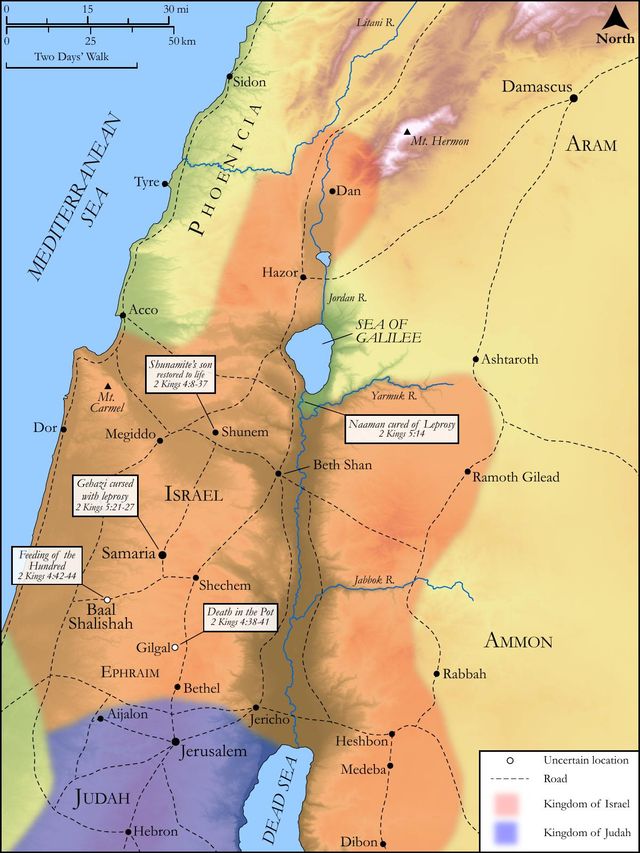
II.The sorrowful mother's application to the prophet on this sad occasion; for it happened very opportunely that he was now at the college upon Mount Carmel, not far off.
1.She begged leave of her husband to go to the prophet, yet not acquainting him with her errand, lest he should not have faith enough to let her go, Kg2 4:22. He objected, It is neither new moon nor sabbath (Kg2 4:23), which intimates that on those feasts of the Lord she used to go to the assembly in which he presided, with other good people, to hear the word, and to join with him in prayers and praises. She did not think it enough to have his help sometimes in her own family, but, though a great woman, attended on public worship, for which this was none of the times appointed; therefore, said the husband, "why wilt thou go to day? What is the matter?" "No harm," said she, "It shall be well, so you will say yourself hereafter." See how this husband and wife vied with each other in showing mutual regard; she was so dutiful to him that she would not go till she had acquainted him with her journey, and he so kind to her that he would not oppose it, though she did not think fit to acquaint him with her business.
2.She made all the haste she could to the prophet (Kg2 4:24), and he, seeing her at a distance, sent his servant to enquire whether any thing was amiss, Kg2 4:25, Kg2 4:26. The questions were particular: Is it well with thee? Is it well with thy husband? Is it well with the child? Note, It well becomes the men of God, with tenderness and concern, to enquire about the welfare of their friends and their families. The answer was general It is well. Gehazi was not the man that she came to complain to, and therefore she put him off with this; she said little, and little said is soon amended (Psa 39:1, Psa 39:2), but what she did say was very patient: "It is well with me, with my husband, with the child" - all well, and yet the child dead in the house. Note, When God calls away our dearest relations by death it becomes us quietly to say, "It is well both with us and them;" it is well, for all is well that God does; all is well with those that are gone if they have gone to heaven, and all well with us that stay behind if by the affliction we are furthered in our way thither.
3.When she came to the prophet she humbly reasoned with him concerning her present affliction. She threw herself at his feet, as one troubled and in grief, which she never showed till she came to him who, she believed, could help her, Kg2 4:27. When her passion would do her service she knew how to discover it, as well as how to conceal it when it would do her disservice. Gehazi knew his master would not be pleased to see her lie at his feet, and therefore would have raised her up; but Elisha waited to hear from her, since he might not know immediately from God, what was the cause of her trouble. God discovered things to his prophets as he saw fit, not always as they desired; God did not show this to the prophet, because he might know it from the good woman herself. What she said was very pathetic. She appealed to the prophet,
(1.)Concerning her indifference to this mercy which was now taken from her: "Did I desire a son of my lord? No, thou knowest I did not; it was thy own proposal, not mine; I did not fret for the want of a son, as Hannah, nor beg, as Rachel, Give me children or else I die." Note, When any creature-comfort is taken from us, it is well if we can say, through grace, that we did not set our hearts inordinately upon it; for, if we did, we have reason to fear it was given in anger and taken away in wrath.
(2.)Concerning her entire dependence upon the prophet's word: Did I not say, Do not deceive me? Yes, she did say so (Kg2 4:16), and this reflection upon it may be considered either,
[1.]As quarrelling with the prophet for deceiving her. She was ready to think herself mocked with the mercy when it was so soon removed, and that it would have been better she had never had this child than to be deprived of him when she began to have comfort in him. Note, The loss of a mercy should not make us undervalue the gift of it. Or,
[2.]As pleading with the prophet for the raising of the child to life again: "I said, Do not deceive me, and I know thou wilt not." Note, However the providence of God may disappoint us, we may be sure the promise of God never did, nor ever will, deceive us: hope in that will not make us ashamed.
III.The raising of the child to life again.
We may suppose that the woman gave Elisha a more express account of the child's death, and he gave her a more express promise of his resurrection, than is here related, where we are briefly told,
1.That Elisha sent Gehazi to go in all haste to the dead child, gave him his staff, and bade him lay that on the face of the child, Kg2 4:29. I know not what to make of this. Elisha knew that Elijah raised the dead child with a very close application, stretching himself upon the child, and praying again and again, and could he think to raise this child by so slight a ceremony as this, especially when nothing hindered him from coming himself? Shall such a power as this be delegated, and to no better man that Gehazi? Bishop Hall suggests that it was done out of human conceit, and not by divine instinct, and therefore it failed of the effect; God will not have such great favours made too cheap, nor shall they be too easily come by, lest they be undervalued.
2.The woman resolved not to go back without the prophet himself (Kg2 4:30): I will not leave thee. She had no great expectation from the staff, she would have the hand, and she was in the right of it. Perhaps God intended hereby to teach us not to put that confidence in creatures, that are servants, which the power of the Creator, their Master and ours, will alone bear the weight of. Gehazi returns re infecta - without success, without the tidings of any sign of life in the child (Kg2 4:31): The child is not awaked, intimating, to the comfort of the mother, that its death was but a sleep, and that he expected that it would shortly be awaked. In the raising of dead souls to spiritual life ministers can do no more by their own power than Gehazi here could; they lay the word, like the prophet's staff, before their faces, but there is neither voice nor hearing, till Christ, by his Spirit, comes himself. The letter alone kills; it is the Spirit that gives life. It is not prophesying upon dry bones that will put life into them, breath must come from heaven and breathe upon those slain.
3.The prophet, by earnest prayer, obtained from God the restoring of this dead child to life again. He found the child dead upon his own bed (Kg2 4:32), and shut the door upon them twain, Kg2 4:33. Even the dead child is spoken of as a person, one of the twain, for it was still in being and not lost. He shut out all company, that he might not seem to glory in the power God had given him, or to use it for ostentation and to be seen of men. Observe,
(1.)How closely the prophet applied himself to this great operation, perhaps being sensible that he had tempted God too much in thinking to effect it by the staff in Gehazi's hand, for which he thought himself rebuked by the disappointment. He now found it a harder task than he then thought, and therefore addressed himself to it with great solemnity.
[1.]He prayed unto the Lord (Kg2 4:33), probably as Elijah had done, Let this child's soul come into him again. Christ raised the dead to life as one having authority - Damsel, arise - young man, I say unto thee, Arise - Lazarus, come forth (for he was powerful and faithful as a Son, the Lord of life), but Elijah and Elisha did it by petition, as servants.
[2.]He lay upon the child (Kg2 4:34), as if he would communicate to him some of his vital heat or spirits. Thus he expressed the earnestness of his desire, and gave a sign of that divine power which he depended upon for the accomplishment of this great work. He first put his mouth to the child's mouth, as if, in God's name, he would breathe into him the breath of life; then his eyes to the child's eyes, to open them again to the light of life; then his hands to the child's hands, to put strength into them. He then returned, and walked in the house, as one full of care and concern, and wholly intent upon what he was about. Then he went up stairs again, and the second time, stretched himself upon the child, Kg2 4:35. Those that would be instrumental in conveying spiritual life to dead souls must thus affect themselves with their case, and accommodate themselves to it, and labour fervently in prayer for them.
(2.)How gradually the operation was performed. At the first application, the flesh of the child waxed warm (Kg2 4:34), which gave the prophet encouragement to continue instant in prayer. After a while, the child sneezed seven times, which was an indication, not only of life, but liveliness. Some have reported it as an ancient tradition that when God breathed into Adam the breath of life the first evidence of his being alive was sneezing, which gave rise to the usage of paying respect to those that sneeze. Some observe here that sneezing clears the head, and there lay the child's distemper.
(3.)How joyfully the child was restored alive to his mother (Kg2 4:36, Kg2 4:37), and all parties concerned were not a little comforted, Act 20:12. See the power of God, who kills and makes alive again. See the power of prayer; as it has the key of the clouds, so it has the key of death. See the power of faith; that fixed law of nature (that death is a way whence there is no returning) shall rather be dispensed with than this believing Shunammite shall be disappointed.
Historical interpretation
Two Centuries of Reception
2 surviving comments on this verse. Each one is dated, so this reads as a timeline rather than a list.
Select a marker to jump to its quote. Markers stagger vertically where authors wrote within a few decades of each other.
“The woman conceived and bore a son at that season, in due time, as Elisha had declared to her,” but after a few years, the child died. His mother placed the corpse on the bed of the prophet in the high room of her house and then rushed to meet him, blessed him and knelt down at his feet, not in order to make a request but to rebuke him. She said, “Did I ask my lord for a son? Did I not say, ‘Do not mislead your servant?’ ” [“Why did you take me and throw me into the pangs of Eve, when I was free of them, and why did you make death, against which I had risen and for which I had no consideration, reign over me? Indeed, thanks to my unlucky sterility I had been away from those two evils. Because of my fear of death I had not asked you for children, and because of the mockeries of the pagans, among whom I live, I did not desire them. So I have said to you: Do not ask that children be given to me.”]5From her lips she gave reproaches, while with her hands she implored him and, catching hold of his feet, besieged him. She swore she would not leave him until he had given her his grace and had brought back to life her son, which death had grasped. So Elisha was profoundly touched by the words of the woman. [Because he did not suffer so much for the death of the child as for the mockeries he would have been obliged to bear on the part of the prophets of Baal.]
When he saw her suffering and anguish, he immediately sent his disciple, entrusting him with his staff, and told him to lay it on the dead child and to inform him about the results of his ministry. He wanted the resurrection of the dead to happen by means of the staff of the master and the hands of the disciple, if his servant was sufficient for the miracle. If that were not sufficient, he would blame himself, because he had outraged with his laziness the coat of arms of the house of Moses.
After the death of her son, that woman went out and prostrated herself at the feet of holy Elisha, but the blessed man gave his staff to his servant and said to him, “Go, and lay my staff on the face of the child. If anyone salutes you, do not return the greeting.” At this point, brothers, see to it that no wicked thought overtake anyone by saying that blessed Elisha wanted to practice fortune telling and that for this reason he commanded the boy not to return the greeting if anyone should salute him on the way. We read this frequently in Scripture, but it is said for the sake of speed and is not a command of something superfluous or a wicked practice. It means, in effect: Walk so quickly that you may not presume to busy yourself on the way or slow yourself with gossip. Therefore, the servant departed and laid the staff on the face of the child, but the boy did not rise at all. That servant typified blessed Moses, whom God sent into Egypt with a staff; without Christ, Moses could scourge the people with the staff, but he could not free or revive them from original or actual sin. As the apostle says, “For the law brought nothing to perfection.” It was necessary that he who had sent the staff should himself come down. The staff without Elisha availed nothing, because the cross without Christ had no power.
Continue studying 2 Kings 4:19 across the web’s major study libraries — every link below opens this exact verse, chapter, or book on the destination site.
Read & Compare
 BibleGatewayThis verse in more than 200 translations and 70 languages.
 Bible.comThe YouVersion reader — hundreds of translations, reading plans, and highlights.
 ESV.orgCrossway's official English Standard Version reader.
 NET BibleThe NET translation with 60,000+ translators' notes on every rendering decision.
 STEP BibleTyndale House's free study tool — original text, vocabulary, and scholarly resources.
 BibliaLogos Bible Software's free web reader.
 USCCBThe New American Bible (Revised Edition) with the U.S. bishops' study notes.
Commentaries
 BibleHub CommentariesDozens of classic commentaries on this verse, gathered on one page.
 StudyLightMore than 100 commentary sets — the largest collection on the web.
 BibleRefPlain-English commentary on what this verse means, verse by verse.
 Enduring WordDavid Guzik's free commentary on this chapter, widely used by Bible teachers.
 Bible Study ToolsVerse commentary alongside Greek and Hebrew study aids.
Original Language & Research
- BibleHub InterlinearThe verse word by word — original language, transliteration, and English.
- BibleHub LexiconEvery word's original-language definition and Strong's entry.
 Blue Letter BibleDeep-study tools — Strong's numbers, concordance, and word studies.
 SefariaThe Hebrew text with Rashi and centuries of Jewish commentary.
Sermons, Hymns & Audio


TrulyRandomVerse is not affiliated with these sites and doesn’t control their content. They’re linked because they’re genuinely useful.
Summary
The verse 2 Kings 4:19 dramatically captures the sudden and severe onset of illness in the Shunammite woman's son, a child miraculously granted through the prophet Elisha's intercession. While assisting his father in the fields during the intense harvest, the boy cries out in profound distress, complaining of overwhelming head pain. This urgent plea prompts his father to immediately send him home to his mother, setting in motion a poignant and pivotal sequence of events that will ultimately lead to a profound demonstration of God's sovereign power through Elisha, highlighting life's fragility and the unwavering faith of a mother.
Context
ShowHideLiterary Context
This verse serves as a crucial turning point within the broader narrative of Elisha's ministry, specifically focusing on his profound relationship with the hospitable Shunammite woman. The preceding verses (2 Kings 4:8-17) meticulously detail Elisha's prophecy of a son for the barren woman as a divine reward for her exceptional kindness, a prophecy miraculously fulfilled. The boy's sudden and acute illness in 2 Kings 4:19 abruptly shifts the narrative's tone from one of joy and divine blessing to immediate crisis and impending despair. This unexpected turn directly precedes the boy's death (2 Kings 4:20) and the mother's determined, faith-filled journey to seek Elisha's help (2 Kings 4:21-25), culminating in the miraculous resurrection of her son (2 Kings 4:32-37). The narrative masterfully builds tension, underscoring the depth of the trial before revealing the triumphant display of divine power.
Historical & Cultural Context
The setting for this dramatic event is Shunem, a town strategically located in the fertile Jezreel Valley, renowned for its rich agricultural output. The detail of the boy being "out in the fields with his father among the reapers" vividly places the scene during the summer harvest season, a period when temperatures in this region could soar to extreme levels. This climatic detail provides a strong contextual clue, suggesting that the boy's sudden and emphatic cry of "My head, my head" was most likely a symptom of severe sunstroke or heatstroke, a common and often fatal affliction in such conditions. The father's immediate instruction to "Carry him to his mother" reflects the prevailing family structure and cultural norms, where the mother was universally recognized as the primary caregiver for young children, especially during illness or distress. This cultural expectation underscores the father's natural, though ultimately insufficient, initial response to the crisis, simultaneously highlighting the profound bond between mother and child and setting the stage for the mother's extraordinary and faith-driven actions.
Key Themes
ShowHideThe events recounted in 2 Kings 4 are replete with profound theological and narrative themes. 2 Kings 4:19 specifically emphasizes the theme of sudden affliction and human vulnerability, even for those who are direct recipients of God's miraculous blessings. It powerfully illustrates that life, even a life miraculously given, remains fragile and susceptible to unexpected trials and suffering within a fallen world. The father's immediate, instinctive response to send the boy to his mother introduces the theme of parental concern and the unique, irreplaceable role of a mother in nurturing and caring for her child, a theme that becomes central to the mother's desperate and unwavering faith in the subsequent narrative. Ultimately, this tragic event serves as a catalyst for a profound demonstration of divine power, revealing God's absolute sovereignty over life and death and His ability to work powerfully through His chosen prophets. It dramatically foreshadows the greater miracle of resurrection, reinforcing the overarching theme of God's unwavering faithfulness even in the face of apparent loss and despair.
Exposition and Analysis
ShowHideKey Word Analysis
ShowHide"to say (used with great latitude); answer, appoint, avouch, bid, boast self, call, certify, challenge, charge, [phrase] (at the, give) command(-ment), commune, consider, declare, demand, [idiom] desire, determine, [idiom] expressly, [idiom] indeed, [idiom] intend, name, [idiom] plainly, promise, publish, report, require, say, speak (against, of), [idiom] still, [idiom] suppose, talk, tell, term, [idiom] that is, [idiom] think, use (speech), utter, [idiom] verily, [idiom] yet." The verb "said" (וַיֹּאמֶר - vayyōʼmer) is used twice in this verse, first for the boy's cry and then for the father's instruction. This common Hebrew verb signifies direct, intentional communication. Its repetition here underscores the immediacy and directness of the exchange: the boy's urgent vocalization of pain and the father's swift, verbal command, highlighting the rapid unfolding of the crisis through spoken word.
"the head (as most easily shaken), whether literal or figurative (in many applications, of place, time, rank, itc.); band, beginning, captain, chapiter, chief(-est place, man, things), company, end, [idiom] every (man), excellent, first, forefront, (be-)head, height, (on) high(-est part, (priest)), [idiom] lead, [idiom] poor, principal, ruler, sum, top." The repetition of "My head, my head" (רֹאשִׁי רֹאשִׁי - ro'shi ro'shi) is a powerful Hebrew idiom for intense emphasis and overwhelming distress. It signifies not merely a localized pain but a profound, incapacitating affliction that has seized the boy's entire being, originating from the most vital part of his body. This double utterance immediately conveys the gravity, suddenness, and life-threatening nature of his condition.
"(concretely) a boy (as active), from the age of infancy to adolescence; by implication, a servant; also (by interch. of sex), a girl (of similar latitude in age); babe, boy, child, damsel (from the margin), lad, servant, young (man)." The term "lad" (נַעַר - naʻar) refers to a young servant or attendant, often one employed in the household or fields. The father's command to a "lad" rather than directly carrying the boy himself or calling for a specific family member suggests the immediate availability of household staff or field workers, indicative of the Shunammite family's "prominent" social standing (2 Kings 4:8). This detail highlights the father's immediate, practical, albeit ultimately insufficient, response to the crisis by delegating the urgent task of transporting his ailing son.
Verse Breakdown
ShowHide"And he said unto his father, My head, my head."
This opening clause delivers the dramatic and abrupt turning point of the narrative. The boy's direct address to his father, coupled with the emphatic, repeated cry of "My head, my head," vividly communicates the sudden onset of severe, incapacitating pain. This is not a gradual illness but an acute, immediate crisis, instantly signaling to the reader that something gravely wrong has occurred. The stark simplicity of the phrase underscores its urgency and the boy's extreme, visceral distress, capturing the reader's attention and sympathy.
"And he said to a lad, Carry him to his mother."
The father's response is immediate, instinctive, and culturally aligned. Recognizing the severity of his son's condition, he delegates the task of transport to a readily available servant. His instruction to "Carry him to his mother" reflects the prevailing cultural understanding that the mother was the primary caregiver for a young child, especially in times of illness or distress. While a natural and understandable reaction, this decision also subtly highlights the father's inability to fully grasp the life-threatening nature of the affliction, or perhaps his hope that the mother's nurturing care would be sufficient. This action sets the stage for the mother's subsequent, more proactive, and ultimately faith-filled response, which transcends conventional human solutions.
Literary Devices
ShowHideThe verse employs several impactful literary devices to convey its dramatic intensity and theological significance. Repetition is prominently featured with the boy's anguished cry, "My head, my head," which powerfully conveys the overwhelming intensity and urgency of his pain, immediately drawing the reader into his suffering. This simple yet emphatic phrase creates a profound sense of pathos, evoking deep sympathy for the afflicted child and foreshadowing the tragic outcome. The suddenness of the illness, juxtaposed with the earlier miraculous birth of the son, creates dramatic irony; the reader knows the boy is a divine gift, making his sudden suffering all the more poignant and mysterious. Furthermore, the entire scene functions as potent foreshadowing, hinting at the boy's imminent death and, more significantly, preparing the reader for Elisha's miraculous intervention, which will demonstrate God's ultimate power over life and death. The abrupt shift from the joyous, life-affirming setting of the harvest to the boy's sudden collapse also serves as a sharp juxtaposition, highlighting the unpredictable nature of life and the swift, often jarring transition from blessing to profound trial.
Theological and Thematic Connections
ShowHideThe sudden illness and subsequent death of the Shunammite son in 2 Kings 4:19 serves as a profound theological statement on God's sovereignty over all aspects of life, including suffering, loss, and death. Even a child miraculously given as a direct divine blessing is not exempt from the trials and vulnerabilities inherent in a fallen world. This event powerfully underscores the inherent fragility of human life and the reality that God's overarching purposes often unfold through unexpected difficulties and periods of profound testing. It is a testament to the truth that God allows trials not as an absence of His care or a sign of His displeasure, but often as a means to reveal His greater power and unwavering faithfulness, to test and refine the faith of His people, and to draw them into deeper, more absolute reliance upon Him. The subsequent narrative of resurrection dramatically demonstrates that God's power extends even beyond the grave, offering ultimate hope in the face of despair and affirming His ultimate dominion over life and death.
Reflection and Application
ShowHideThe scene in 2 Kings 4:19 offers a stark and sobering reminder of life's inherent fragility and unpredictability. In a moment of seemingly ordinary activity—a child with his father in the fields—a vibrant young life is suddenly plunged into acute crisis. This dramatic turn should prompt us to cultivate a profound posture of gratitude for each day, to cherish the blessings we have, and to hold all our gifts with open hands, recognizing that even the most cherished relationships and possessions are ultimately in God's sovereign care. When unexpected trials, suffering, or loss strike, our initial human responses may be to seek immediate, practical, and often limited solutions, much like the father instinctively sending his son to his mother. However, the larger narrative arc of this story profoundly teaches us that true and ultimate help often lies beyond our natural capabilities and human wisdom, requiring us to turn to God and His appointed means of grace. The Shunammite mother's subsequent actions exemplify a faith that refuses to be limited by circumstances or the finality of death, demonstrating that even in the face of overwhelming despair, there is a divine resource available for those who earnestly seek it. This powerful narrative challenges us to deeply consider where we place our ultimate hope and trust when life unravels and our own resources prove insufficient.
Questions for Reflection
ShowHideFAQ
ShowHideWhat was the nature of the boy's illness, and why is it significant?
ShowHideWhile the biblical text does not provide a precise medical diagnosis, the description of the boy being "out in the fields among the reapers" during the harvest season, coupled with his emphatic cry of "My head, my head," strongly suggests sunstroke or heatstroke. This is highly significant because it highlights the sudden, acute, and life-threatening nature of the illness. It was not a lingering sickness but an immediate, incapacitating collapse, emphasizing the extreme fragility of life and the abrupt, unexpected shift from health to crisis. The specific natural cause, while implied, is less important than the effect—a sudden, severe affliction that leads to death and ultimately serves as the divine catalyst for God's miraculous intervention through Elisha, powerfully demonstrating His absolute power over life and death, even in seemingly natural circumstances.
Why did the father send the boy to his mother instead of taking him himself or seeking medical help?
ShowHideThe father's instruction to "Carry him to his mother" reflects the deeply ingrained cultural norms of the time, where the mother was universally recognized as the primary caregiver and nurturer for young children, especially when they were ill or in distress. It was a natural, instinctive, and culturally appropriate response to entrust the child to the one most intimately involved in his daily care and well-being. While it might appear insufficient in hindsight given the boy's rapid decline, it was likely the most immediate and culturally expected action for a father working in the field. Furthermore, the narrative strategically focuses on the mother's subsequent actions, which are driven by a profound faith and an understanding that only divine intervention could save her son, transcending the limitations of conventional human care or the rudimentary ancient medical practices. This decision by the father sets the crucial stage for the mother's extraordinary journey of faith to Elisha, as vividly seen in 2 Kings 4:22-25.
Christ-Centered Fulfillment
ShowHideThe sudden illness and subsequent death of the Shunammite son in 2 Kings 4:19, followed by his miraculous resurrection through Elisha, serves as a powerful Old Testament foreshadowing of the ultimate victory over death achieved by Jesus Christ. Elisha, acting as God's chosen prophet, was an instrument of divine power, bringing temporary life back to a dead body. This miraculous event, much like Elijah's earlier resurrection of the widow of Zarephath's son (1 Kings 17:17-24), points forward to the one who is inherently "the resurrection and the life" (John 11:25). Jesus did not merely act as an instrument of divine power but possessed inherent, sovereign authority over death itself, as profoundly demonstrated by His raising of Jairus's daughter (Mark 5:35-43), the widow of Nain's son (Luke 7:11-17), and most spectacularly, Lazarus after four days in the tomb (John 11:38-44). While the Shunammite son's return to life was a temporary reprieve, Christ's own glorious resurrection from the dead (Matthew 28:1-10) guarantees eternal life and victory over death for all who believe in Him (John 3:16). Thus, the sorrow and subsequent joy experienced in 2 Kings 4 ultimately direct our gaze to the Lamb of God who takes away the sin of the world and conquers death itself, offering a hope that transcends any earthly trial or temporary restoration.