


2 Kings 25:10
Bible text: King James Version (1769 Blayney text) · Public domain
Bible text: Berean Standard Bible · Public domain
Bible text: American Standard Version (1901) · Public domain
Bible text: World English Bible, Messianic edition · Public domain
Bible text: Geneva Bible (1599) · Public domain
Bible text: Young's Literal Translation · Public domain
- וְאֶתve·'Etand <obj.>H853Conj-w ¦ DirObjMParticle Object Indicatorוְandאֶת<obj.>
- חוֹמֹתcho·Mot[the] walls ofH2346N-fpcNoun Plural Feminine Construct
- יְרוּשָׁלִַםye·ru·sha·LimJerusalemH3389N-properNoun Proper Location
- סָבִיבsa·Vivall aroundH5439N-csNoun Singular common gender Absolute
- נָתְצוּna·te·Tzuthey broke downH5422V-Qal-Perf-3cpVerb Qal Perfect 3rd Plural common gender
- כָּלkolallH3605N-mscNoun Singular Masculine Construct
- חֵילcheil[the] army ofH2428N-mscNoun Singular Masculine Construct
- כַּשְׂדִּיםkas·Dim[the] ChaldeansH3778N-properNoun Proper Location
- אֲשֶׁר'a·SherwhoH834RelParticle Relative
- רַבrav[was the] chief ofH7227N-mscNoun Singular Masculine Construct
- טַבָּחִיםta·ba·Chim[the] bodyguardsH2876N-mpNoun Plural Masculine Absolute
English is a literal word-by-word gloss of the Hebrew, not the KJV's wording. Why?
This is the original text the KJV's translators worked from — each Hebrew word with its own literal English meaning in this verse, prepared by scholars at Tyndale House, Cambridge. The KJV translates whole sentences, not word by word, so its wording differs: one Hebrew word can become several English words, and the KJV may choose “the LORD” where the gloss reads “Yahweh”. Both are faithful — they answer different questions. For the KJV's own rendering, switch to the KJV text.
Details
See on the biblical-era maps
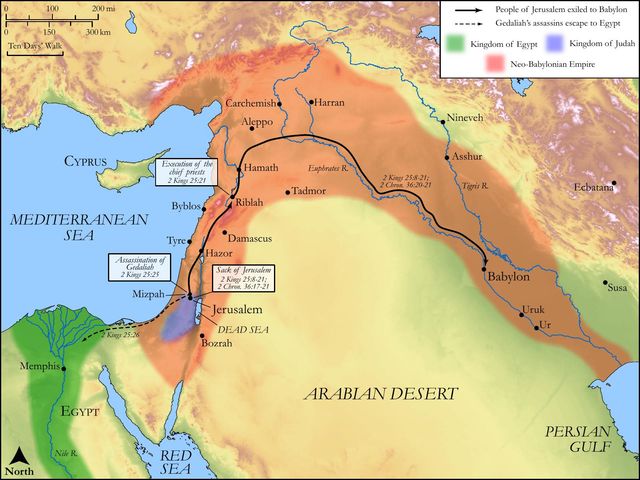
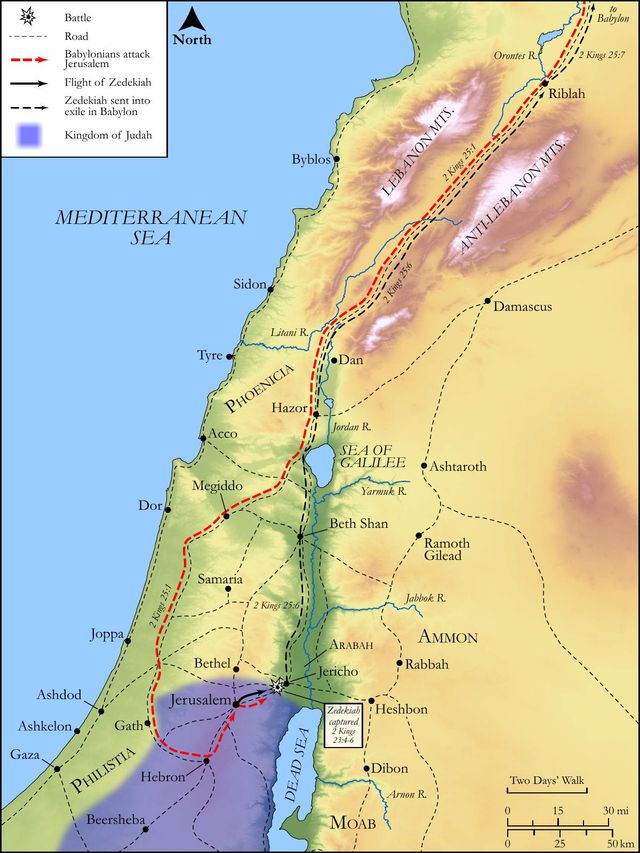
Study this verse
Public-domain commentary
Matthew Henry
From his Commentary on the Whole Bible. Henry comments on passages, not single verses — this entry covers 2 Kings 25:8–21.
Though we have reason to think that the army of the Chaldeans were much enraged against the city for holding out with so much stubbornness, yet they did not therefore put all to fire and sword as soon as they had taken the city (which is too commonly done in such cases), but about a month after (compare Kg2 25:8 with Kg2 25:3) Nebuzar-adan was sent with orders to complete the destruction of Jerusalem. This space God gave them to repent, after all the foregoing days of his patience, but in vain; their hearts (for aught that appears) were still hardened, and therefore execution is awarded to the utmost. 1. The city and temple are burnt, Kg2 25:9. It does not appear that the king of Babylon designed to send any colonies to people Jerusalem and therefore he ordered it to be laid in ashes, as a nest of rebels. At the burning of the king's house and the houses of the great men one cannot so much wonder (the inhabitants had, by their sins, made them combustible), but that the house of the Lord should perish in these flames, that that holy and beautiful house should be burnt with fire (Isa 64:11), is very strange. That house which David prepared for, and which Solomon built at such a vast expense - that house which had the eye and heart of God perpetually upon it (Kg1 9:3) - might not that have been snatched as a brand out of this burning? No, it must not be fire-proof against God's judgments. This stately structure must be turned into ashes, and it is probable the ark in it, for the enemies, having heard how dearly the Philistines paid for the abusing of it, durst not seize that, nor did any of its friends take care to preserve it, for then we should have heard of it again in the second temple. One of the apocryphal writers does indeed tell us that the prophet Jeremiah got it out of the temple, and conveyed it to a cave in Mount Nebo on the other side Jordan, and hid it there (2 Macc. 2:4, 5), but that could not be, for Jeremiah was a close prisoner at that time. By the burning of the temple God would show how little cares for the external pomp of his worship when the life and power of religion are neglected. The people trusted to the temple, as if that would protect them in their sins (Jer 7:4), but God, by this, let them know that when they had profaned it they would find it but a refuge of lies. This temple had stood about 420, some say 430 years. The people having forfeited the promises made concerning it, those promises must be understood of the gospel-temple, which is God's rest for ever. It is observable that the second temple was burnt by the Romans the same month, and the same day of the month, that the first temple was burnt by the Chaldeans, which, Josephus says, was the tenth of August. 2. The walls of Jerusalem are demolished (Kg2 25:10), as if the victorious army would be revenged on them for having kept them out so long, or at least prevent the like opposition another time. Sin unwalls a people and takes away their defence. These walls were never repaired till Nehemiah's time. 3. The residue of the people are carried away captive to Babylon, Kg2 25:11. Most of the inhabitants had perished by sword or famine, or had made their escape when the king did (for it is said, Kg2 25:5, His army was scattered from him), so that there were very few left, who with the deserters, making in all but 832 persons (as appears, Jer 52:29), were carried away into captivity; only the poor of the land were left behind (Kg2 25:12), to till the ground and dress the vineyards for the Chaldeans. Sometimes poverty is a protection; for those that have nothing have nothing to lose. When the rich Jews, who had been oppressive to the poor, were made strangers, nay, prisoners, in an enemy's country, the poor whom they had despised and oppressed had liberty and peace in their own country. Thus Providence sometimes remarkably humbles the proud and favours those of low degree. 4. The brazen vessels, and other appurtenances of the temple, are carried away, those of silver and gold being most of them gone before. Those two famous columns of brass, Jachin and Boaz, which signified the strength and stability of the house of God, were broken to pieces and the brass of them was carried to Babylon, Kg2 25:13. When the things signified were sinned away what should the signs stand there for? Ahaz had profanely cut off the borders of the bases, and put the brazen sea upon a pavement of stones (Kg2 16:17); justly therefore are the brass themselves, and the brazen sea, delivered into the enemy's hand. It is just with God to take away his ordinances from those that profane and abuse them, that curtail and depress them. Some things remained of gold and silver (Kg2 25:15) which were now carried off; but most of this plunder was brass, such a vast quantity of it that it is said to be without weight, Kg2 25:16. The carrying away of the vessels wherewith they ministered (Kg2 25:14) put an end to the ministration. It was a righteous thing with God to deprive those of the benefit of his worship who had slighted it so long and preferred false worships before it. Those that would have many altars shall now have none. 5. Several of the great men are slain in cold blood - Seraiah the chief priest (who was the father of Ezra as appears, Ezr 7:1), the second priest (who, when there was occasion, officiated for him), and three door-keepers of the temple (Kg2 25:18), the general of the army, five privy-counsellors (afterwards they made them up seven, Jer 52:25), the secretary of war, or pay-master of the army, and sixty country gentlemen who had concealed themselves in the city. These, being persons of some rank, were brought to the king of Babylon (Kg2 25:19, Kg2 25:20), who ordered them to be all put to death (Kg2 25:21), when, in reason, they might have hoped that surely the bitterness of death was past. These the king of Babylon's revenge looked upon as most active in opposing him; but divine justice, we may suppose, looked upon them as ringleaders in that idolatry and impiety which were punished by these desolations. This completed the calamity: So Judah was carried away out of their land, about 860 years after they were put in possession of it by Joshua. Now the scripture was fulfilled, The Lord shall bring thee, and the king which thou shalt set over thee, into a nation which thou hast not known, Deu 28:36. Sin kept their fathers forty years out of Canaan, and now turned them out. The Lord is known by those judgments which he executes, and makes good that word which he has spoken, Amo 3:2. You only have I known of all the families of the earth, therefore I will punish you for all your iniquities.
Historical interpretation
Historical reception
1 surviving comment on this verse from the historical church.
What think you of Nebuchadnezzar? Have you not heard from Scripture that he was bloodthirsty, fierce, with the disposition of a lion? Have you not heard that he disinterred the kings? Have you not heard that he brought the people away into captivity? Have you not heard that he put the king’s sons to the sword before Zedekiah’s eyes and then blinded him? Have you not heard that he shattered the cherubim? I do not mean the invisible cherubim—it is blasphemy to think it—but the sculptured images and the mercy seat in the Holy of Holies, from the midst of which God was apt to speak with his voice. He trampled on the veil of sanctification, he took the censer and carried it away to a temple of idols; he seized all the offerings; he burned the temple to its foundations. What punishment did he not deserve for slaying kings, for burning the holy object, for reducing the people to captivity, for putting the sacred vessels in the temples of the idols? Did he not deserve ten thousand deaths?You have seen the enormity of his crimes. Turn now to the loving-kindness of God. Nebuchadnezzar was turned into a wild beast; he dwelled in the wilderness; God scourged him to save him. He had claws like a lion’s, for he had preyed on the saints. He had a lion’s mane, for he had been a ravening, roaring lion. He ate grass like an ox, for he had behaved like a brute beast, not knowing him who had given him his kingdom. His body was drenched with dew, because, after seeing the fire quenched by the dew, he had not believed. And what happened? Afterwards he says, “I, Nebuchadnezzar, raised my eyes to heaven … and I blessed the Most High, and I praised and glorified him who lives forever.” When therefore he acknowledged the Most High, and uttered words of thanksgiving to God, and repented of his past wickedness and recognized his own weakness, in that hour God restored to him his royal dignity.
What then? If God granted pardon and a kingdom to Nebuchadnezzar after such terrible crimes, when he had made confession, will he not grant you the remission of your sins if you repent and the kingdom of heaven if you live worthily? God is merciful and quick to forgiveness but slow to vengeance. Therefore let no one despair of salvation. Peter, the chief and foremost of the apostles, denied the Lord thrice before a little serving maid; but, moved to repentance, he wept bitterly. His weeping revealed his heartfelt repentance, and for that reason not only did he receive pardon for his denial but also retained his apostolic prerogative.
Continue studying 2 Kings 25:10 across the web’s major study libraries — every link below opens this exact verse, chapter, or book on the destination site.
Read & Compare
 BibleGatewayThis verse in more than 200 translations and 70 languages.
 Bible.comThe YouVersion reader — hundreds of translations, reading plans, and highlights.
 ESV.orgCrossway's official English Standard Version reader.
 NET BibleThe NET translation with 60,000+ translators' notes on every rendering decision.
 STEP BibleTyndale House's free study tool — original text, vocabulary, and scholarly resources.
 BibliaLogos Bible Software's free web reader.
 USCCBThe New American Bible (Revised Edition) with the U.S. bishops' study notes.
Commentaries
 BibleHub CommentariesDozens of classic commentaries on this verse, gathered on one page.
 StudyLightMore than 100 commentary sets — the largest collection on the web.
 BibleRefPlain-English commentary on what this verse means, verse by verse.
 Enduring WordDavid Guzik's free commentary on this chapter, widely used by Bible teachers.
 Bible Study ToolsVerse commentary alongside Greek and Hebrew study aids.
Original Language & Research
- BibleHub InterlinearThe verse word by word — original language, transliteration, and English.
- BibleHub LexiconEvery word's original-language definition and Strong's entry.
 Blue Letter BibleDeep-study tools — Strong's numbers, concordance, and word studies.
 SefariaThe Hebrew text with Rashi and centuries of Jewish commentary.
Sermons, Hymns & Audio


TrulyRandomVerse is not affiliated with these sites and doesn’t control their content. They’re linked because they’re genuinely useful.
Summary
2 Kings 25:10 records the definitive and comprehensive demolition of Jerusalem's formidable defensive walls by the Neo-Babylonian army, under the direct command of Nebuzaradan, the captain of the guard. This act was far more than a military maneuver; it was a profound and visible declaration of total conquest, an act of ultimate humiliation, and the unequivocal end of the Kingdom of Judah's sovereignty, security, and national identity, representing the devastating climax of God's long-prophesied judgment against a persistently disobedient nation.
Context
ShowHideLiterary Context
This verse is situated within the tragic final chapter of the Kingdom of Judah, chronicled in 2 Kings 25. The narrative immediately preceding this verse details the harrowing 18-month siege of Jerusalem, which led to severe famine and the eventual breach of the city walls in the ninth year of King Zedekiah's reign (2 Kings 25:1-4). Following the breach, King Zedekiah's desperate attempt to flee was thwarted, leading to his capture, the execution of his sons before his eyes, and his subsequent blinding and deportation to Babylon (2 Kings 25:5-7). Verse 10 directly follows the systematic burning of the Temple, the royal palace, and all the great houses of Jerusalem by Nebuzaradan, the Babylonian commander (2 Kings 25:8-9). Thus, the demolition of the walls solidifies the physical manifestation of Judah's utter defeat and desolation, serving as a stark prelude to the subsequent mass deportation of the remaining populace to Babylon (2 Kings 25:11).
Historical & Cultural Context
The "Chaldees" refers to the Neo-Babylonian Empire, which rose to prominence among the kings of that day during the late 7th and early 6th centuries BCE under the formidable leadership of King Nebuchadnezzar II. Their military strategy often involved not only conquering but utterly devastating rebellious cities to prevent future insurrections and to assert absolute dominance. City walls were far more than mere defensive structures; they were potent symbols of a city's strength, security, and sovereignty. Their destruction was the ultimate act of conquest and humiliation, signifying the reduction of a once-proud capital to an open, defenseless ruin. Nebuzaradan, identified as "the captain of the guard" (Hebrew: rab-ṭabbâch), was a high-ranking official, often translated as "chief of the executioners" or "commander of the imperial guard." He was entrusted with the grim and systematic task of overseeing the destruction of Jerusalem and the subsequent deportation of its inhabitants, underscoring the deliberate and punitive nature of Babylon's actions against Judah.
Key Themes
ShowHideThe destruction described in 2 Kings 25:10 is deeply interwoven with several overarching themes prevalent throughout the book of Kings and the broader prophetic literature. Primarily, it serves as a stark and undeniable demonstration of Divine Judgment against Judah for its persistent idolatry, covenant unfaithfulness, and pervasive moral corruption, despite repeated warnings from prophets like Jeremiah and Ezekiel. This event also powerfully illustrates the Fulfillment of Prophecy, as numerous warnings regarding Jerusalem's inevitable fall and the subsequent exile, often tied to the dire consequences of disobedience to God's covenant, came to pass with terrifying precision (Deuteronomy 28:49-52). Finally, the "breaking down the walls round about" signifies Utter Desolation and Vulnerability, stripping Jerusalem of its physical and symbolic defenses, leaving it exposed and signaling the complete end of an era of independent monarchy and national security, paving the way for the Babylonian Exile, a period of profound theological reflection and spiritual purification for the remnant of Israel.
Exposition and Analysis
ShowHideKey Word Analysis
ShowHideThis term (H2428) denotes a force, whether of men, means, or other resources, encompassing concepts like strength, valor, and military might. In this context, "army" emphasizes the formidable and overwhelming military power of the Chaldeans, highlighting the sheer force brought to bear against Jerusalem. It underscores the futility of Judah's resistance against such a potent and well-resourced invading host.
The verb (H5422) signifies "to tear down," "to demolish," or "to overthrow." It conveys a sense of thorough, deliberate, and systematic destruction, far beyond a mere breach for entry. This was an intentional act of dismantling the city's defenses, ensuring it could not be easily re-fortified. The choice of this verb emphasizes the complete and irreversible nature of the conquest, a statement of total subjugation.
This feminine noun (H2346) refers to a wall of protection, specifically the defensive fortifications of a city. City walls were paramount for security, representing a city's strength, resilience, and even its very identity and sovereignty. Their complete demolition, as described here, symbolized the utter loss of security, national pride, and the definitive end of Jerusalem's status as an independent, fortified capital.
Verse Breakdown
ShowHide"And all the army of the Chaldees"
This opening phrase underscores the collective, unified, and overwhelming military might of the Neo-Babylonian forces. It highlights the vast scale of the power brought to bear against Jerusalem, emphasizing that the city's fall was not due to a minor skirmish but a full-scale, determined assault by a dominant empire.
"that [were with] the captain of the guard"
This specifies the direct command and authority under which the destruction was carried out. Nebuzaradan, as the rab-ṭabbâch (chief of the imperial guard or executioners), was King Nebuchadnezzar's trusted and highest-ranking agent for implementing the king's punitive will. His presence ensures that the devastation was systematic, deliberate, and executed with the full authority of the Babylonian crown.
"brake down the walls of Jerusalem"
This is the core action of the verse, detailing the physical act of demolition. It signifies the end of Jerusalem's physical defenses, rendering it utterly vulnerable to any future attack or occupation. This act was the definitive physical manifestation of the city's defeat and the termination of its status as a fortified capital.
"round about"
This crucial phrase indicates the comprehensive and exhaustive nature of the destruction. It was not merely a strategic breach or the demolition of a single section; rather, it implies a complete and encircling demolition of the entire defensive perimeter. This detail emphasizes the total defenselessness and humiliation inflicted upon Jerusalem, leaving no part of its protective infrastructure intact.
Literary Devices
ShowHideThe verse employs powerful Symbolism. The "walls of Jerusalem" are not merely physical barriers; they profoundly symbolize the city's security, its identity as the capital of Judah, and even the nation's perceived invincibility under God's protection. Their demolition thus signifies the complete collapse of national security, sovereignty, and the shattering of any false sense of divine immunity from judgment. The phrase "round about" functions as a form of Hyperbole or emphatic statement, stressing the exhaustive and total nature of the destruction. It conveys the absolute thoroughness of the Babylonian conquest, leaving no part of the city's defenses intact and underscoring the finality of Judah's defeat. The stark contrast between Jerusalem's former glory and its current state of utter ruin also evokes a deep sense of Tragedy, highlighting the devastating consequences of sustained rebellion against God and the fulfillment of His warnings.
Theological and Thematic Connections
ShowHideThe destruction of Jerusalem's walls, as recorded in 2 Kings 25:10, serves as a profound theological statement within the biblical narrative. It is presented not merely as a historical defeat but as the tangible manifestation of God's righteous judgment against Judah for generations of covenant unfaithfulness, widespread idolatry, and pervasive oppression. This pivotal event underscores God's absolute sovereignty over nations and history, demonstrating that even powerful empires like Babylon were instruments in His divine plan to discipline His people and fulfill His prophetic warnings. The demolition of the walls, once a source of human reliance and pride, exposed the vulnerability of a people who had placed their trust in physical defenses and political alliances rather than in the Lord their God, revealing that true security rests in obedience and faithfulness to the divine covenant.
Reflection and Application
ShowHideThe devastating account of Jerusalem's walls being torn down in 2 Kings 25:10 offers timeless and sobering lessons for believers today. It serves as a potent reminder that while God is infinitely patient and merciful, there are profound and often painful consequences for persistent disobedience and rebellion against His revealed will. Just as Judah's physical defenses crumbled due to their spiritual decay and unfaithfulness, so too can our lives become vulnerable, exposed, and subject to spiritual or relational breakdown when we neglect our relationship with God, relying instead on our own strength, worldly systems, or false securities. This passage calls us to critically examine where we place our ultimate trust and whether our lives truly reflect a vibrant, covenant relationship with the Lord. It compels us to acknowledge God's unwavering sovereignty, even in moments of profound loss and desolation, recognizing that His purposes, though sometimes mysterious and painful, are always just and ultimately redemptive. The fall of Jerusalem was not the end of God's story with His people, but a painful turning point designed to bring about repentance, purification, and a deeper, more authentic reliance on Him.
Questions for Reflection
ShowHideFAQ
ShowHideWhy were the walls of Jerusalem so important, and why was their destruction so significant?
ShowHideThe walls of Jerusalem were critically important for both practical defense and profound symbolic significance. Practically, they provided the primary protection against invading armies, allowing the city to withstand sieges and ensuring the safety of its inhabitants. Symbolically, they represented Jerusalem's strength, sovereignty, and its unique status as the capital of Judah and the dwelling place of God's Temple. Their destruction, as described in 2 Kings 25:10, was therefore the ultimate act of conquest and humiliation. It rendered the city utterly defenseless, signaling the complete end of Jewish national independence and the undeniable fulfillment of prophecies concerning God's judgment on a disobedient people. It was a visible and devastating sign that Judah's protective covenant relationship with God had been severely strained and broken by their persistent unfaithfulness.
Who were the "Chaldees" and the "captain of the guard" mentioned in this verse?
ShowHideThe "Chaldees" were the people of Chaldea, a region in southern Mesopotamia, and the term is used interchangeably with "Babylonians" in the biblical text. They constituted the dominant power of the Neo-Babylonian Empire under King Nebuchadnezzar II, who was responsible for the destruction of Jerusalem and the exile of Judah. The "captain of the guard" refers to Nebuzaradan, a high-ranking military officer and chief executioner (or chief of the imperial guard) in Nebuchadnezzar's army. He was the official delegated by Nebuchadnezzar to oversee the final, systematic stages of Jerusalem's destruction, including the burning of the Temple and royal palace (2 Kings 25:9) and the methodical demolition of its walls, as well as the subsequent deportation of the populace (2 Kings 25:11).
What happened to Jerusalem and its people immediately after the walls were broken down?
ShowHideImmediately after the walls were broken down, the systematic destruction of Jerusalem continued and intensified. The Temple, the royal palace, and all the great houses were burned down (2 Kings 25:9), leaving the city in ruins. Following this, the remaining population, except for the poorest of the land who were left to be vine-dressers and farmers, was systematically deported to Babylon. This mass deportation included the skilled craftsmen, soldiers, and any prominent citizens. King Zedekiah himself had already been captured, forced to witness the execution of his sons, blinded, and taken in chains to Babylon (2 Kings 25:7). This mass exile, described in 2 Kings 25:11-12, marked the beginning of the Babylonian Exile, a pivotal and transformative period in Israelite history that lasted for approximately 70 years.
Christ-Centered Fulfillment
ShowHideWhile 2 Kings 25:10 depicts the devastating physical destruction of Jerusalem, it ultimately points forward to the spiritual and eternal security found exclusively in Christ. The crumbling walls of earthly Jerusalem symbolized the failure of human defenses and the dire consequences of a broken covenant, yet God's redemptive plan did not end in desolation. Just as the prophets foretold a future restoration and the establishment of a new, unbreakable covenant (Jeremiah 31:31-34), Jesus Christ came to build a spiritual kingdom whose walls are impregnable and whose foundations are eternal. He declared, "I will build my church, and the gates of hell shall not prevail against it" (Matthew 16:18), contrasting the temporal vulnerability of earthly Jerusalem with the enduring strength and invincibility of His spiritual body. Through His atoning sacrifice on the cross, Christ broke down the spiritual "dividing wall of hostility" that separated God from humanity and Jew from Gentile (Ephesians 2:14), ushering in a new covenant of grace and peace. The ultimate fulfillment of this imagery is found in the glorious vision of the New Jerusalem in Revelation, a city with "a great, high wall" but whose true security and illumination are the glory of God and the Lamb, where "its gates will never be shut by day—and there will be no night there" (Revelation 21:23-25). Thus, the physical ruin of Jerusalem's walls tragically foreshadows the spiritual triumph of Christ, who offers true, eternal security and an unshakeable kingdom to all who believe and trust in Him.