


2 Kings 25:12
Bible text: King James Version (1769 Blayney text) · Public domain
Bible text: King James Version with Strong's numbers · Public domain
Bible text: Berean Standard Bible · Public domain
Bible text: American Standard Version (1901) · Public domain
Bible text: World English Bible, Messianic edition · Public domain
Bible text: Geneva Bible (1599) · Public domain
Bible text: Young's Literal Translation · Public domain
- וּמִדַּלַּתu·mid·da·Latand some of [the] poor people ofH1803Conj-w ¦ Prep-m ¦ N-fscNoun Singular Feminine Constructוּandמִsome ofדַּלַּת[the] poor people of
- הָאָרֶץha·'A·retzthe landH776Art ¦ N-fsNoun Singular Feminine Absoluteהָtheאָרֶץland
- הִשְׁאִירhish·'Irhe left behindH7604V-Hiphil-Perf-3msVerb Hiphil Perfect 3rd Singular Masculine
- רַבrav[the] chief ofH7227N-mscNoun Singular Masculine Construct
- טַבָּחִיםta·ba·Chim[the] bodyguardsH2876N-mpNoun Plural Masculine Absolute
- לְכֹרְמִיםle·kho·re·Mimto vinedressersH3755Prep-l ¦ N-mpNoun Plural Masculine Absoluteלְtoכֹרְמִיםvinedressers
- וּלְיֹגְבִיםu·le·yo·ge·Vimand to ploughmenH3009Conj-w ¦ Prep-l ¦ V-Qal-Prtcpl-mpVerb Qal Participle Plural Masculine Absoluteוּandלְtoיֹגְבִיםploughmen
English is a literal word-by-word gloss of the Hebrew, not the KJV's wording. Why?
This is the original text the KJV's translators worked from — each Hebrew word with its own literal English meaning in this verse, prepared by scholars at Tyndale House, Cambridge. The KJV translates whole sentences, not word by word, so its wording differs: one Hebrew word can become several English words, and the KJV may choose “the LORD” where the gloss reads “Yahweh”. Both are faithful — they answer different questions. For the KJV's own rendering, switch to the KJV text.
Details
See on the biblical-era maps
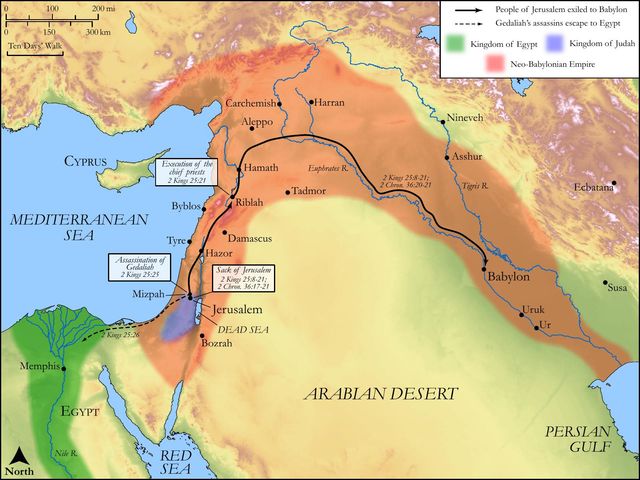
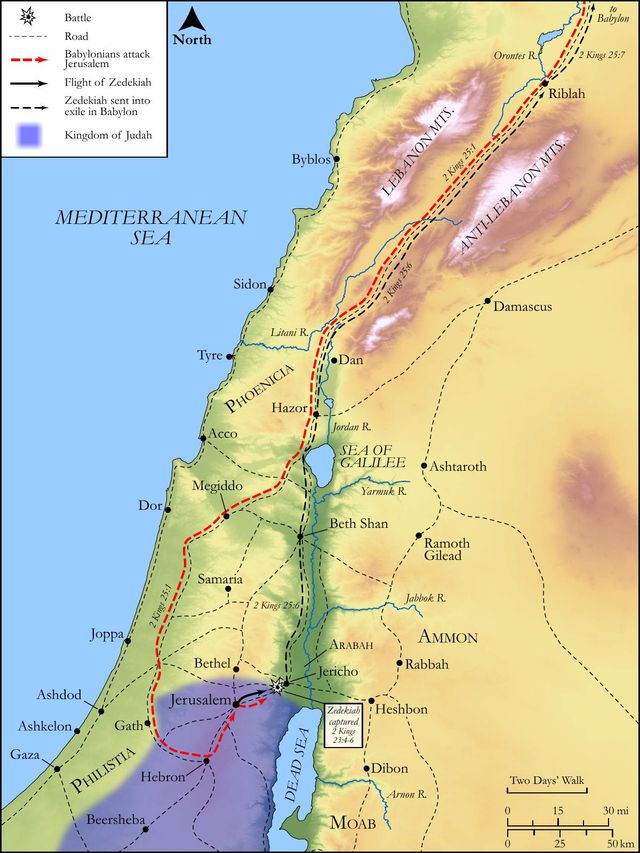
Study this verse
Public-domain commentary
Matthew Henry
From his Commentary on the Whole Bible. Henry comments on passages, not single verses — this entry covers 2 Kings 25:8–21.
Though we have reason to think that the army of the Chaldeans were much enraged against the city for holding out with so much stubbornness, yet they did not therefore put all to fire and sword as soon as they had taken the city (which is too commonly done in such cases), but about a month after (compare Kg2 25:8 with Kg2 25:3) Nebuzar-adan was sent with orders to complete the destruction of Jerusalem. This space God gave them to repent, after all the foregoing days of his patience, but in vain; their hearts (for aught that appears) were still hardened, and therefore execution is awarded to the utmost. 1. The city and temple are burnt, Kg2 25:9. It does not appear that the king of Babylon designed to send any colonies to people Jerusalem and therefore he ordered it to be laid in ashes, as a nest of rebels. At the burning of the king's house and the houses of the great men one cannot so much wonder (the inhabitants had, by their sins, made them combustible), but that the house of the Lord should perish in these flames, that that holy and beautiful house should be burnt with fire (Isa 64:11), is very strange. That house which David prepared for, and which Solomon built at such a vast expense - that house which had the eye and heart of God perpetually upon it (Kg1 9:3) - might not that have been snatched as a brand out of this burning? No, it must not be fire-proof against God's judgments. This stately structure must be turned into ashes, and it is probable the ark in it, for the enemies, having heard how dearly the Philistines paid for the abusing of it, durst not seize that, nor did any of its friends take care to preserve it, for then we should have heard of it again in the second temple. One of the apocryphal writers does indeed tell us that the prophet Jeremiah got it out of the temple, and conveyed it to a cave in Mount Nebo on the other side Jordan, and hid it there (2 Macc. 2:4, 5), but that could not be, for Jeremiah was a close prisoner at that time. By the burning of the temple God would show how little cares for the external pomp of his worship when the life and power of religion are neglected. The people trusted to the temple, as if that would protect them in their sins (Jer 7:4), but God, by this, let them know that when they had profaned it they would find it but a refuge of lies. This temple had stood about 420, some say 430 years. The people having forfeited the promises made concerning it, those promises must be understood of the gospel-temple, which is God's rest for ever. It is observable that the second temple was burnt by the Romans the same month, and the same day of the month, that the first temple was burnt by the Chaldeans, which, Josephus says, was the tenth of August. 2. The walls of Jerusalem are demolished (Kg2 25:10), as if the victorious army would be revenged on them for having kept them out so long, or at least prevent the like opposition another time. Sin unwalls a people and takes away their defence. These walls were never repaired till Nehemiah's time. 3. The residue of the people are carried away captive to Babylon, Kg2 25:11. Most of the inhabitants had perished by sword or famine, or had made their escape when the king did (for it is said, Kg2 25:5, His army was scattered from him), so that there were very few left, who with the deserters, making in all but 832 persons (as appears, Jer 52:29), were carried away into captivity; only the poor of the land were left behind (Kg2 25:12), to till the ground and dress the vineyards for the Chaldeans. Sometimes poverty is a protection; for those that have nothing have nothing to lose. When the rich Jews, who had been oppressive to the poor, were made strangers, nay, prisoners, in an enemy's country, the poor whom they had despised and oppressed had liberty and peace in their own country. Thus Providence sometimes remarkably humbles the proud and favours those of low degree. 4. The brazen vessels, and other appurtenances of the temple, are carried away, those of silver and gold being most of them gone before. Those two famous columns of brass, Jachin and Boaz, which signified the strength and stability of the house of God, were broken to pieces and the brass of them was carried to Babylon, Kg2 25:13. When the things signified were sinned away what should the signs stand there for? Ahaz had profanely cut off the borders of the bases, and put the brazen sea upon a pavement of stones (Kg2 16:17); justly therefore are the brass themselves, and the brazen sea, delivered into the enemy's hand. It is just with God to take away his ordinances from those that profane and abuse them, that curtail and depress them. Some things remained of gold and silver (Kg2 25:15) which were now carried off; but most of this plunder was brass, such a vast quantity of it that it is said to be without weight, Kg2 25:16. The carrying away of the vessels wherewith they ministered (Kg2 25:14) put an end to the ministration. It was a righteous thing with God to deprive those of the benefit of his worship who had slighted it so long and preferred false worships before it. Those that would have many altars shall now have none. 5. Several of the great men are slain in cold blood - Seraiah the chief priest (who was the father of Ezra as appears, Ezr 7:1), the second priest (who, when there was occasion, officiated for him), and three door-keepers of the temple (Kg2 25:18), the general of the army, five privy-counsellors (afterwards they made them up seven, Jer 52:25), the secretary of war, or pay-master of the army, and sixty country gentlemen who had concealed themselves in the city. These, being persons of some rank, were brought to the king of Babylon (Kg2 25:19, Kg2 25:20), who ordered them to be all put to death (Kg2 25:21), when, in reason, they might have hoped that surely the bitterness of death was past. These the king of Babylon's revenge looked upon as most active in opposing him; but divine justice, we may suppose, looked upon them as ringleaders in that idolatry and impiety which were punished by these desolations. This completed the calamity: So Judah was carried away out of their land, about 860 years after they were put in possession of it by Joshua. Now the scripture was fulfilled, The Lord shall bring thee, and the king which thou shalt set over thee, into a nation which thou hast not known, Deu 28:36. Sin kept their fathers forty years out of Canaan, and now turned them out. The Lord is known by those judgments which he executes, and makes good that word which he has spoken, Amo 3:2. You only have I known of all the families of the earth, therefore I will punish you for all your iniquities.
Continue studying 2 Kings 25:12 across the web’s major study libraries — every link below opens this exact verse, chapter, or book on the destination site.
Read & Compare
 BibleGatewayThis verse in more than 200 translations and 70 languages.
 Bible.comThe YouVersion reader — hundreds of translations, reading plans, and highlights.
 ESV.orgCrossway's official English Standard Version reader.
 NET BibleThe NET translation with 60,000+ translators' notes on every rendering decision.
 STEP BibleTyndale House's free study tool — original text, vocabulary, and scholarly resources.
 BibliaLogos Bible Software's free web reader.
 USCCBThe New American Bible (Revised Edition) with the U.S. bishops' study notes.
Commentaries
 BibleHub CommentariesDozens of classic commentaries on this verse, gathered on one page.
 StudyLightMore than 100 commentary sets — the largest collection on the web.
 BibleRefPlain-English commentary on what this verse means, verse by verse.
 Enduring WordDavid Guzik's free commentary on this chapter, widely used by Bible teachers.
 Bible Study ToolsVerse commentary alongside Greek and Hebrew study aids.
Original Language & Research
- BibleHub InterlinearThe verse word by word — original language, transliteration, and English.
- BibleHub LexiconEvery word's original-language definition and Strong's entry.
 Blue Letter BibleDeep-study tools — Strong's numbers, concordance, and word studies.
 SefariaThe Hebrew text with Rashi and centuries of Jewish commentary.
Sermons, Hymns & Audio


TrulyRandomVerse is not affiliated with these sites and doesn’t control their content. They’re linked because they’re genuinely useful.
Summary
Following the catastrophic Babylonian conquest of Jerusalem and the widespread deportation of its inhabitants, 2 Kings 25:12 meticulously records the strategic decision of Nebuzaradan, the captain of Nebuchadnezzar's guard, to preserve a small, impoverished segment of the population within the land of Judah. These individuals, identified as "the poor of the land," were intentionally designated as agricultural laborers—specifically vinedressers and husbandmen—to ensure the continued productivity and economic viability of the conquered territory under foreign dominion, thereby underscoring both the profound desolation inflicted upon Judah and the fragile, yet divinely sustained, continuity of a connection to the covenant land.
Context
ShowHideLiterary Context
2 Kings 25 serves as the somber culmination of the Deuteronomistic History, detailing the final, tragic downfall of the Kingdom of Judah and the definitive end of the Davidic monarchy. The preceding verses vividly portray the brutal siege of Jerusalem, the capture and blinding of King Zedekiah, and the systematic destruction of the holiest sites—the Temple, the royal palace, and the city walls—by Nebuzaradan, Nebuchadnezzar's chief executioner, as recounted in 2 Kings 25:8-10. This devastation is immediately followed by the mass deportation of the remaining populace, including the elite, skilled artisans, and a significant portion of the general populace, to Babylon, as described in 2 Kings 25:11. Verse 12 thus acts as a stark, yet crucial, counterpoint to this narrative of wholesale destruction and exile, shifting focus to the minute fraction of the population deliberately left behind. It provides a vital glimpse into the immediate aftermath of the conquest and the initial administrative actions taken by the Babylonian conquerors, paralleling similar accounts found in the prophetic books, notably Jeremiah 39:10 and Jeremiah 52:16.
Historical & Cultural Context
The destruction of Jerusalem in 586 BCE marked a cataclysmic turning point in Israelite history, signifying the end of the Kingdom of Judah and the commencement of the Babylonian Exile. The Babylonian Empire, under the formidable leadership of Nebuchadnezzar, routinely employed a calculated imperial strategy: the deportation of conquered populations. This served a dual purpose—to dismantle national identity and prevent rebellion by uprooting people from their ancestral lands, and to assimilate skilled labor into the imperial economy. Concurrently, a small, non-threatening demographic was often left behind to maintain the land's economic viability and serve as a readily available labor force for the imperial power. The "poor of the land" (Hebrew: dalat ha'arets) represented the most vulnerable and overlooked segment of society—those without significant property, wealth, or political influence, and thus least likely to pose a threat or engage in rebellion. Their specific assignment as "vinedressers and husbandmen" (agricultural laborers) directly reflects the agrarian nature of ancient Judah's economy and the Babylonians' pragmatic need to extract tribute and resources from the newly acquired territory, ensuring its continued productivity rather than allowing it to become a desolate wasteland.
Key Themes
ShowHideThis verse, despite its brevity, powerfully encapsulates several profound themes central to the narrative of 2 Kings and the broader biblical metanarrative. Firstly, it emphatically underscores the theme of Divine Judgment—the complete devastation of Jerusalem, the Temple, and the exile of its people are presented as the ultimate, inescapable consequences of Judah's persistent idolatry, covenant unfaithfulness, and disobedience to God's laws, fulfilling the dire warnings articulated throughout the Mosaic covenant, particularly in Deuteronomy 28. Secondly, it introduces and reinforces the crucial biblical concept of the Remnant, a recurring motif in prophetic literature. Even amidst overwhelming judgment and apparent annihilation, a small, often humble, portion of God's people is miraculously preserved in the land, ensuring both physical continuity and a tangible connection to the covenant promises, a theme powerfully echoed in passages like Isaiah 10:20-22. Thirdly, the verse implicitly highlights the Sovereignty of God amidst the machinations of human empires. While Nebuchadnezzar and Nebuzaradan act according to their imperial strategies and pragmatic interests, the biblical narrative subtly but profoundly suggests that even these seemingly secular actions, including the preservation of a remnant, are orchestrated within God's larger, immutable redemptive plan for His people, foreshadowing future restoration and the ultimate fulfillment of His promises.
Exposition and Analysis
ShowHideKey Word Analysis
ShowHideThis term denotes someone "abundant" in rank or quality, signifying a chief, master, or great one. In the context of "captain of the guard" (specifically, the chief of the executioners), it points to Nebuzaradan's high authority and his critical role as the primary agent of the Babylonian king's destructive and administrative decrees, underscoring the official and decisive nature of the action described.
This primitive root means "to swell up, i.e. be (causatively, make) redundant; leave, (be) left, let, remain, remnant, reserve, the rest." This word is crucial as it directly conveys the concept of a "remnant" – a portion that remains after a larger part has been removed or destroyed. It highlights the deliberate act of preservation by the Babylonian authorities, which, from a theological perspective, also signifies God's providential hand in maintaining a presence in the land.
This term literally means "something dangling, i.e. a loose thread or hair," and figuratively, "indigent; poor(-est sort)." It describes those at the very bottom of the social and economic ladder, lacking resources, status, and influence. Their indigence was, paradoxically, their protection from deportation, as they were not perceived as a threat or valuable asset for the imperial capital, making them suitable for the menial labor required to maintain the land's productivity.
This is an active participle meaning "a vinedresser." This specific occupation highlights the importance of viticulture in ancient Judah's economy. The assignment of this role, along with "husbandmen," emphasizes the Babylonians' pragmatic goal: to exploit the land's agricultural potential for their own benefit, rather than allowing it to lie fallow.
Verse Breakdown
ShowHide"But the captain of the guard left of the poor of the land"
This initial clause identifies the specific agent of this action, Nebuzaradan, the chief officer of Nebuchadnezzar's elite guard, who was responsible for carrying out the king's orders concerning Jerusalem. The phrase "left of the poor of the land" (דַּלַּת הָאָרֶץ, dalat ha'arets) precisely defines the demographic chosen for preservation. This group was specifically distinguished from the more affluent, skilled, and potentially rebellious segments of society who were deported. Their low social and economic status, ironically, was the very reason for their survival in the devastated territory, as they were deemed no threat to Babylonian control.
"[to be] vinedressers and husbandmen"
This second clause clarifies the explicit purpose for which this impoverished remnant was permitted to remain. They were not left to rebuild the fallen city or to re-establish the shattered kingdom. Instead, their sole function was to serve as agricultural laborers—cultivating vineyards and tilling the soil. This decision was purely pragmatic from the Babylonian perspective, designed to ensure that the fertile land of Judah continued to produce crops and tribute for the empire, preventing it from becoming an unproductive wilderness and maintaining a source of revenue for the conquerors.
Literary Devices
ShowHideThe verse employs several potent literary devices to convey its stark message and theological implications. Contrast is profoundly evident, juxtaposing the fate of the "poor of the land" with the widespread destruction and mass deportation of the majority of Judah's populace described in the preceding verses. While the powerful, the wealthy, and the skilled were forcibly removed, the most vulnerable and seemingly insignificant were paradoxically allowed to remain. Metonymy is also at play, where "the land" (Hebrew: ʼerets) stands not merely for the physical territory of Judah, but for the entire socio-political and spiritual entity that was the Kingdom of Judah, emphasizing its desolation and the new, diminished status of its remaining inhabitants under foreign rule. The specific designation of "vinedressers and husbandmen" functions as a form of Synecdoche, where these particular roles represent the entire scope of agricultural labor, underscoring the reduced, purely functional, and subservient existence of the remnant. The overall tone carries a deep sense of Irony, as the very people considered least valuable by their own society, and certainly by the conquerors, are the ones permitted to stay, ensuring a fragile, yet crucial, continuity of presence in the covenant land, even if under foreign subjugation.
Theological and Thematic Connections
ShowHideThis verse, though seemingly a minor administrative detail in the narrative of Judah's catastrophic fall, carries immense theological weight. It profoundly speaks to God's enduring faithfulness and covenant keeping, even in the midst of severe judgment. The preservation of a "remnant" of His people in the land, even under foreign dominion and for pragmatic Babylonian reasons, subtly but powerfully hints at God's overarching and unthwartable plan to maintain a physical connection to the covenant land and people. This ensures the possibility of future restoration, the continuation of the lineage through which His promises would ultimately be fulfilled, and the eventual return from exile. It underscores the profound biblical truth that God's sovereign purposes cannot be frustrated, even by the most devastating human events or the most formidable imperial powers.
Reflection and Application
ShowHideThe survival of the "poor of the land" in 2 Kings 25:12, despite the oppressive circumstances, offers a profound and enduring lesson in resilience, divine providence, and the unexpected ways God works. In moments of profound loss and utter devastation, when all seems shattered and the grand narratives of our lives or communities appear utterly broken, this verse reminds us that God can preserve a fragile seed, a humble remnant, from which future hope and renewal can miraculously spring forth. It challenges us to recognize that even when our status is diminished, our resources are few, and our circumstances seem dire and beyond our control, our very existence can be a testament to perseverance and a foundational element for future rebuilding. This passage encourages us to find purpose and dignity in whatever role we are given, even if it feels menial, forced, or insignificant, recognizing that God can powerfully use the humblest of circumstances and the most overlooked individuals to sustain His long-term, redemptive plans. It calls us to faithfully cultivate the "land" of our present reality, no matter how barren or desolate it may seem, trusting that even small acts of faithfulness, like tending a vineyard or tilling a field, can contribute to a larger, unfolding, and ultimately redemptive story orchestrated by God.
Questions for Reflection
ShowHideFAQ
ShowHideWhy did the Babylonians leave anyone behind after such a destructive conquest?
ShowHideThe Babylonians, like the Assyrians before them, employed a pragmatic and strategic approach to conquered territories. While mass deportation served to break the spirit of the conquered people, prevent rebellion, and integrate skilled labor into the imperial economy, leaving a small, non-threatening population behind was economically shrewd. These "poor of the land" were not perceived as a military or political threat and could be effectively utilized as forced agricultural labor. This ensured that the fertile land of Judah, despite its political and religious devastation, could continue to generate resources and tribute for the Babylonian Empire, preventing it from becoming a completely desolate and unproductive wasteland. This strategy is well-documented in other historical accounts of imperial control during that period.
What happened to this "remnant" of the poor left in the land?
ShowHideThis small remnant, including those designated as vinedressers and husbandmen, continued to reside in the devastated land of Judah under direct Babylonian oversight. The book of Jeremiah provides further crucial details, indicating that Gedaliah, a Jewish nobleman, was appointed by the Babylonians as governor over them, tasked with maintaining order and ensuring agricultural productivity (Jeremiah 40:7). However, this period of relative stability was tragically short-lived and marked by further turmoil. Gedaliah was assassinated by Ishmael, a member of the royal family, leading to widespread fear of Babylonian reprisal and the subsequent flight of many remaining Jews to Egypt, despite Jeremiah's prophetic warnings against it (Jeremiah 41:1-3 and Jeremiah 43:5-7). Despite these further disruptions and the continued shrinking of the population, the persistent presence of some Jews in the land, however small, maintained a physical connection to the covenant land, which would prove profoundly significant for the eventual return from exile decades later.
Is there a theological significance to "the poor of the land" being left behind?
ShowHideAbsolutely, there is profound theological significance. While the Babylonians acted purely out of pragmatic self-interest, from a biblical perspective, God's divine providence is unmistakably at work. The preservation of "the poor of the land" ensures that a physical remnant of Israel remains connected to the covenant land, even in the midst of severe divine judgment. This aligns perfectly with the broader biblical theme of the "remnant" (e.g., Isaiah 1:9), where God consistently preserves a faithful or physical portion of His people, preventing complete annihilation and ensuring the continuity of His covenant promises and the lineage through which the Messiah would ultimately come. It powerfully demonstrates God's unwavering faithfulness even when His people are profoundly unfaithful, guaranteeing that His ultimate redemptive plan will not be thwarted by human sin or imperial power.
Christ-Centered Fulfillment
ShowHideWhile 2 Kings 25:12 describes a moment of profound national devastation and the pragmatic actions of a pagan empire, it subtly yet powerfully points forward to Christ in its underlying themes of a preserved remnant and the enduring faithfulness of God. The survival of "the poor of the land," though seemingly insignificant and left for purely utilitarian reasons, ensured a physical continuity of the people of Israel in their homeland, a necessary and divinely orchestrated link in the historical and genealogical chain leading directly to the Messiah. This echoes a consistent divine pattern seen throughout Scripture where God preserves a seed, a remnant, through whom His covenant promises will ultimately be fulfilled, even when human sin and divine judgment seem to have extinguished all hope. Just as a small, humble group was left to tend the physical land of Judah, so too did God choose a humble, often overlooked lineage and a seemingly insignificant town—Bethlehem (Micah 5:2)—to bring forth the ultimate "Vinedresser" and "Husbandman" of God's spiritual vineyard. Jesus, the Lamb of God who takes away the sin of the world, came not primarily to the powerful and prominent, but to the "poor in spirit" (Matthew 5:3), offering true spiritual sustenance and tending to the souls of humanity. His kingdom, like the physical remnant, often begins small and hidden, growing from humble beginnings to encompass all nations (Matthew 13:31-32), demonstrating that God's greatest redemptive work often emerges from weakness, apparent desolation, and unexpected places, culminating in the ultimate restoration and new creation found in Him (Revelation 21:1-5).