


2 Chronicles 35:19
Bible text: King James Version (1769 Blayney text) · Public domain
Bible text: Berean Standard Bible · Public domain
Bible text: American Standard Version (1901) · Public domain
Bible text: World English Bible, Messianic edition · Public domain
Bible text: Geneva Bible (1599) · Public domain
Bible text: Young's Literal Translation · Public domain
- בִּשְׁמוֹנֶהbish·mo·Nehin eight-H8083Prep-b ¦ N-csNoun Singular common gender Absoluteבִּinשְׁמוֹנֶהeight-
- עֶשְׂרֵה'es·RehteenH6240N-csNoun Singular common gender Absolute
- שָׁנָהsha·NahyearH8141N-fsNoun Singular Feminine Absolute
- לְמַלְכוּתle·mal·Khutof [the] reign ofH4438Prep-l ¦ N-fscNoun Singular Feminine Constructלְofמַלְכוּת[the] reign of
- יֹאשִׁיָּהוּyo·shi·Ya·huJosiahH2977N-proper-mNoun Proper Masculine
- נַעֲשָׂהna·'a·Sahit was observedH6213V-Niphal-Perf-3msVerb Niphal Perfect 3rd Singular Masculine
- הַפֶּסַחha·Pe·sachthe passoverH6453Art ¦ N-msNoun Title Singular Masculine Absoluteהַtheפֶּסַחpassover
- הַזֶּהha·Zeh<the> thisH2088Art ¦ PrtParticle Demonstrativeהַ<the>זֶּהthis
English is a literal word-by-word gloss of the Hebrew, not the KJV's wording. Why?
This is the original text the KJV's translators worked from — each Hebrew word with its own literal English meaning in this verse, prepared by scholars at Tyndale House, Cambridge. The KJV translates whole sentences, not word by word, so its wording differs: one Hebrew word can become several English words, and the KJV may choose “the LORD” where the gloss reads “Yahweh”. Both are faithful — they answer different questions. For the KJV's own rendering, switch to the KJV text.
Details
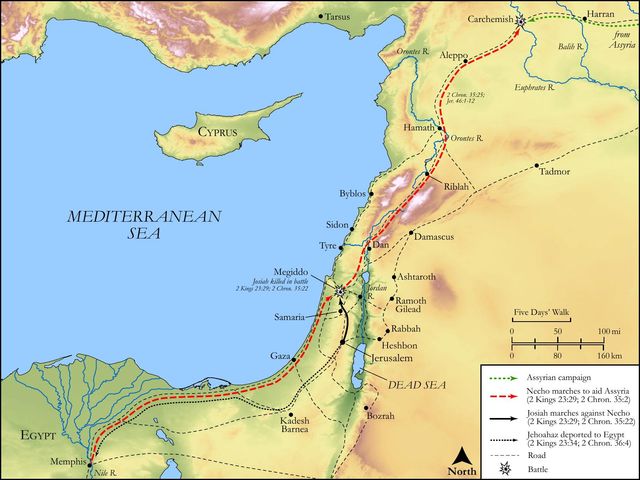
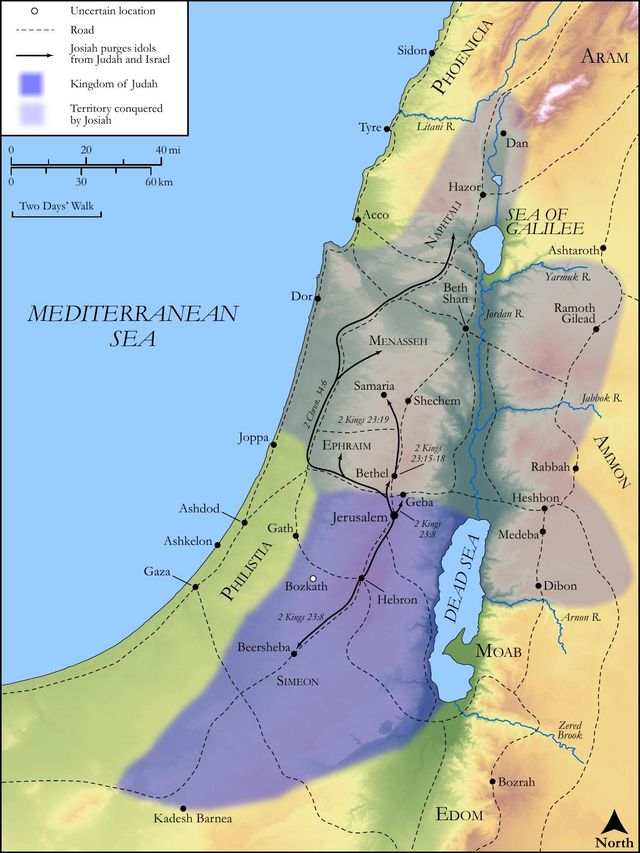
See on the biblical-era maps
Study this verse
Public-domain commentary
Matthew Henry
From his Commentary on the Whole Bible. Henry comments on passages, not single verses — this entry covers 2 Chronicles 35:1–19. His three-level outline is real structure in the source text, so it is rendered as structure.
The destruction which Josiah made of idols and idolatry was more largely related in the Kings, but just mentioned here in the foregoing chapter (v. 33); but his solemnizing the passover, which was touched upon there (Kg2 23:21), is very particularly related here. Many were the feasts of the Lord, appointed by the ceremonial law, but the passover was the chief. It began them all in the night wherein Israel came out of Egypt; it concluded them all in the night wherein Christ was betrayed; and in the celebration of it Hezekiah and Josiah, those two great reformers, revived religion in their day. The ordinance of the Lord's supper resembles the passover more than it does any of the Jewish festivals; and the due observance of that ordinance, according to the rule, is an instance and means both of the growing purity and beauty of churches and of the growing piety and devotion of particular Christians. Religion cannot flourish where that passover is either wholly neglected or not duly observed; return to that, revive that, make a solemn business of that affecting binding ordinance, and then, it is to be hoped, there will be a reformation in other instances also.
In the account we had of Hezekiah's passover the great zeal of the people was observable, and the transport of devout affection that they were in; but little of the same spirit appears here. It was more in compliance with the king that they all kept the passover (Ch2 35:17, Ch2 35:18) than from any great inclination they had to it themselves. Some pride they took in this form of godliness, but little pleasure in the power of it. But, whatever defect there was among the people in the spirit of the duty, both the magistrates and the ministers did their part and took care that the external part of the service should be performed with due solemnity.
I.The king exhorted and directed, quickened and encouraged, the priests and Levites to do their office in this solemnity.
Perhaps he saw them remiss and indifferent, unwilling to go out of their road or mend their pace. If ministers are so, it is not amiss for any, but most proper for magistrates, to stir them up to their business. Say to Archippus, Take heed to thy ministry, Col 4:17. Let us see how this good king managed his clergy upon this occasion.
1.He reduced them to the office they were appointed to by the law of Moses (Ch2 35:6) and the order they were put into by David and Solomon, Ch2 35:4. He set them in their charge, Ch2 35:2. He did not cut them out new work, nor put them into any new method, but called them back to their institution. Their courses were settled in writing; let them have recourse to that writing, and marshal themselves according to the divisions of their families, Ch2 35:5. Our rule is settled in the written word; let magistrates take care that ministers walk according to that rule and they do their duty.
2.He ordered the ark to be put in its place. It should seem, it had of late been displaced, either by the wicked kings, to make room for their idols in the most holy place, or by Hezekiah, to make room for the workmen that repaired the temple. However it was, Josiah bids the Levites put the ark in the house (Ch2 35:3), and not carry it about from place to place, as perhaps of late they had done, justifying themselves therein by the practice before the temple was built. Now that the priests were discharged from this burden of the ark they must be careful in other services about it.
3.He charged them to serve God and his people Israel, Ch2 35:3. Ministers must look upon themselves as servants both to Christ and to his church for his sake, Co2 4:5. They must take care, and take pains, and lay out themselves to the utmost,
(1.)For the glory and honour of God, and to advance the interests of his kingdom among men. Paul, a servant of God, Tit 1:1.
(2.)For the welfare and benefit of his people, not as having dominion over their faith, but as helpers of their holiness and joy; and there will be no difficulty, in the strength of God, in honestly serving these two masters.
4.He charged them to sanctify themselves, and prepare their brethren, Ch2 35:6. Ministers' work must begin at home, and they must sanctify themselves in the first place, purify themselves from sin, sequester themselves from the world, and devote themselves to God. But it must not end there; they must do what they can to prepare their brethren by admonishing, instructing, exhorting, quickening, and comforting, them. The preparation of the heart is indeed from the Lord; but ministers must be instruments in his hand.
5.He encouraged them to the service, Ch2 35:2. He spoke comfortably to them, as Hezekiah did, Ch2 30:22. He promised them his countenance. Note, Those whom we charge we should encourage. Most people love to be commended, and will be wrought upon by encouragements more than by threats.
II.The king and the princes, influenced by his example, gave liberally for the bearing of the charges of this passover.
The ceremonial services were expensive, which perhaps was one reason why they had been neglected. People had not zeal enough to be at the charge of them; nor were they now very fond of them, for that reason, and therefore,
1.Josiah, at his own proper cost, furnished the congregation with paschal lambs, and other sacrifices, to be offered during the seven days of the feast. He allowed out of his own estate 30,000 lambs for passover offerings, which the offerers were to feast upon, and 3000 bullocks (Ch2 35:7) to be offered during the following seven days. Note, Those who are serious in religion should, when they persuade others to do that which is good, make it as cheap and easy to them as may be. And where God sows plentifully he expects to reap accordingly. It is to be feared that the congregation generally had not come provided; so that, if Josiah had not furnished them, the work of God must have stood still.
2.The chief of the priests, who were men of great estates, contributed towards the priests' charges, as Josiah did towards the people's. The princes (Ch2 35:8), that is, the chief of the priests, the princes of the holy tribe, rulers of the house of God, bore the priests' charges. And some of the rich and great men of the Levites furnished them also with cattle, both great and small, for offerings, Ch2 35:9. For, as to those that sincerely desire to be found in the way of their duty, Providence sometimes raises up friends to bear them out in it, beyond what they could have expected.
III.The priests and Levites performed their office very readily, Ch2 35:10.
They killed the paschal lambs in the court of the temple, the priests sprinkled the blood upon the altar, the Levites flayed them, and then gave the flesh to the people according to their families (Ch2 35:11, Ch2 35:12), not fewer than ten, nor more than twenty, to a lamb. They took it to their several apartments, roasted it, and ate it according to the ordinance, Ch2 35:13. As for the other sacrifices that were eucharistical, the flesh of them was boiled according to the law of the peace-offerings and was divided speedily among the people, that they might feast upon it as a token of their joy in the atonement made and their reconciliation to God thereby. And, lastly, The priests and Levites took care to honour God by eating of the passover themselves, Ch2 35:14. Let not ministers think that the care they take for the souls of others will excuse their neglect of their own, or that being employed so much in public worship will supersede the religious exercises of their closets and families. The Levites here mace ready for themselves and for the priests, because the priests were wholly taken up all day in the service of the altar; therefore, that they might not have their lamb to dress when they should eat it, the Levites got it ready for them against supper time. Let ministers learn hence to help one another, and to forward one another's work, as brethren, and fellow-servants of the same Master.
IV.The singers and porters attended in their places, and did their office, Ch2 35:15.
The singers with their sacred songs and music expressed and excited the joy of the congregation, and made the service very pleasant to them; and the porters at the gates took care that there should be no breaking in of any thing to defile or disquiet the assembly, nor going out of any from it, that none should steal away till the service was done. While they were thus employed their brethren the Levites prepared paschal lambs for them.
V.The whole solemnity was performed with great exactness, according to the law (Ch2 35:16, Ch2 35:17), and, upon that account, there was none like it since Samuel's time (Ch2 35:18), for in Hezekiah's passover there were several irregularities. And bishop Patrick observes that in this also it exceeded the other passovers which the preceding kings had kept, that though Josiah was by no means so rich as David, and Solomon, and Jehoshaphat, yet he furnished the whole congregation with beasts for sacrifice, both paschal and eucharistical, at his own proper cost and charge, which was more than any king ever did before him.
Continue studying 2 Chronicles 35:19 across the web’s major study libraries — every link below opens this exact verse, chapter, or book on the destination site.
Read & Compare
 BibleGatewayThis verse in more than 200 translations and 70 languages.
 Bible.comThe YouVersion reader — hundreds of translations, reading plans, and highlights.
 ESV.orgCrossway's official English Standard Version reader.
 NET BibleThe NET translation with 60,000+ translators' notes on every rendering decision.
 STEP BibleTyndale House's free study tool — original text, vocabulary, and scholarly resources.
 BibliaLogos Bible Software's free web reader.
 USCCBThe New American Bible (Revised Edition) with the U.S. bishops' study notes.
Commentaries
 BibleHub CommentariesDozens of classic commentaries on this verse, gathered on one page.
 StudyLightMore than 100 commentary sets — the largest collection on the web.
 BibleRefPlain-English commentary on what this verse means, verse by verse.
 Enduring WordDavid Guzik's free commentary on this chapter, widely used by Bible teachers.
 Bible Study ToolsVerse commentary alongside Greek and Hebrew study aids.
Original Language & Research
- BibleHub InterlinearThe verse word by word — original language, transliteration, and English.
- BibleHub LexiconEvery word's original-language definition and Strong's entry.
 Blue Letter BibleDeep-study tools — Strong's numbers, concordance, and word studies.
 SefariaThe Hebrew text with Rashi and centuries of Jewish commentary.
Sermons, Hymns & Audio


TrulyRandomVerse is not affiliated with these sites and doesn’t control their content. They’re linked because they’re genuinely useful.
Summary
Second Chronicles 35:19 serves as a concise, concluding statement to the detailed account of King Josiah's unparalleled Passover celebration. This verse precisely dates the event to the eighteenth year of Josiah's reign, emphasizing its historical significance as the apex of his religious reforms and a pivotal moment of national repentance and spiritual renewal in Judah's history, highlighting the meticulous adherence to God's commands.
Context
ShowHideLiterary Context
This verse acts as a concluding summary for the preceding detailed narrative of Josiah's magnificent Passover celebration, which spans 2 Chronicles 35:1-18. The preceding chapters, particularly 2 Chronicles 34, establish the foundation for this grand event, detailing Josiah's early reforms, the purification of the land, the repair of the Temple, and crucially, the discovery of the Book of the Law. The finding of the Law led to Josiah's personal repentance and a national covenant renewal, as recorded in 2 Chronicles 34:29-33. Therefore, 2 Chronicles 35:19 marks the culmination of this spiritual awakening, underscoring the unparalleled nature of this Passover as stated in 2 Chronicles 35:18. Following this high point, the narrative in 2 Chronicles 36 tragically recounts Judah's rapid decline after Josiah's death, making this Passover a poignant, final beacon of faithfulness before the impending exile.
Historical & Cultural Context
King Josiah, who began his reign at the tender age of eight, was one of Judah's most righteous kings, consistently doing "that which was right in the sight of the LORD" (2 Chronicles 34:2). His reign was characterized by extensive religious reforms aimed at purging idolatry and restoring true worship, a process that began in his twelfth year and intensified in his eighteenth, as detailed in 2 Chronicles 34:3-7. The eighteenth year of his reign (approximately 622 BC) was particularly momentous. During the Temple repairs, the Book of the Law was discovered, profoundly impacting Josiah and leading to a national covenant renewal. This discovery served as the catalyst for the grand Passover described in 2 Chronicles 35:1-18. The Passover itself, originally instituted in Exodus 12 as a remembrance of God's deliverance from Egypt, was a central annual feast. The chronicler emphasizes that this particular celebration under Josiah was unparalleled since the days of Samuel the prophet, and even among the kings of Israel, highlighting its immense scale, meticulous adherence to the Law, and profound spiritual depth, as noted in 2 Chronicles 35:18.
Key Themes
ShowHideThe account of Josiah's Passover, culminating in 2 Chronicles 35:19, contributes significantly to several major theological and narrative themes within the book of Chronicles. Firstly, it powerfully illustrates the theme of Obedience and Revival. Josiah's meticulous adherence to God's commands, sparked by the discovery of the Law, led to a profound national spiritual renewal, demonstrating that obedience to divine instruction can bring about widespread revival. Secondly, the narrative underscores the Centrality and Transformative Power of God's Word. The discovery of the Book of the Law was the direct catalyst for all of Josiah's reforms and the subsequent Passover, highlighting how a return to and diligent application of God's revealed truth can profoundly transform individuals and nations. Thirdly, the Passover serves as a powerful act of Covenant Renewal. By observing this foundational feast, Judah reaffirmed its covenant relationship with the LORD, remembering His past deliverance and recommitting to His laws, echoing the original institution of the Passover in Exodus 12:14. Finally, the entire narrative showcases the vital role of Godly Leadership. Josiah's personal piety and zealous, uncompromising leadership were instrumental in guiding the nation back to faithful worship and adherence to the Mosaic Law, demonstrating the significant impact a righteous ruler can have on the spiritual health of a people.
Exposition and Analysis
ShowHideKey Word Analysis
ShowHideThis term (H6453) refers to the annual Jewish festival commemorating the liberation of the Israelites from slavery in Egypt. Its name, derived from the verb "to pass over," recalls the tenth plague, where the angel of death "passed over" the homes of the Israelites whose doorposts were marked with the blood of a lamb (Exodus 12:13). The Passover was a foundational feast, symbolizing redemption and covenant relationship, requiring specific rituals including the sacrifice and eating of a lamb, and the removal of leaven. Josiah's meticulous observance of this feast, as highlighted in the preceding verses, underscores its profound spiritual and national significance.
The verb ʻâsâh (H6213) is a common Hebrew word meaning "to do," "to make," or "to perform." In this context, it implies more than a mere perfunctory observance. It signifies that the Passover was actively and thoroughly "made" or "done" in accordance with the Law's detailed requirements. This emphasizes the intentionality, completeness, and meticulousness with which Josiah and the people executed the celebration, reflecting a deep commitment to fulfilling God's commands as they had rediscovered them in the Book of the Law.
Verse Breakdown
ShowHide"In the eighteenth year of the reign of Josiah"
This precise chronological marker is crucial. It firmly anchors the unparalleled Passover celebration within a specific and highly significant period of Josiah's reign. The eighteenth year was the culmination of his extensive religious reforms, marked by the discovery of the Book of the Law (2 Chronicles 34:14) and the subsequent national covenant renewal (2 Chronicles 34:29-33). This timing underscores that the Passover was not a routine observance but a direct, zealous response to God's rediscovered Word and a profound act of national repentance and rededication.
"was this passover kept"
This phrase directly refers back to the detailed account in 2 Chronicles 35:1-18. The demonstrative "this" highlights the specific, unique, and unprecedented nature of this particular Passover, as explicitly stated in 2 Chronicles 35:18. It signifies that the celebration was not merely performed, but "kept" or observed with an unparalleled level of adherence to the Mosaic Law, reflecting the nation's commitment to the renewed covenant. This statement serves as a final, emphatic declaration of the event's historical and spiritual magnitude.
Literary Devices
ShowHide2 Chronicles 35:19 effectively employs several literary devices. Primarily, it functions as a Summarization or Concluding Statement, serving to cap off the extensive and detailed narrative of Josiah's Passover from 2 Chronicles 35:1-18. This concise summary provides a definitive end to the account, emphasizing its historical placement. Secondly, the verse acts as a Chronological Marker, precisely dating the event to "the eighteenth year of the reign of Josiah." This precision underscores the historical reliability of the account and highlights the significance of this specific year as a turning point in Judah's spiritual history. Finally, there is an element of Emphasis in the use of "this passover," subtly pointing back to the detailed description and the chronicler's assertion in 2 Chronicles 35:18 that this was a Passover unlike any other since the days of Samuel. The verse, though brief, thus serves to solidify the importance and uniqueness of Josiah's great celebration.
Theological and Thematic Connections
ShowHideThe precise dating of Josiah's Passover in 2 Chronicles 35:19 underscores the theological significance of divine timing and the culmination of God's work through faithful human instruments. This unparalleled celebration, prompted by the rediscovery of God's Law, demonstrates God's persistent grace in calling His people back to Himself, even after generations of apostasy. It highlights that true national revival is rooted in a return to biblical truth and a zealous commitment to corporate worship and covenant faithfulness. The meticulous keeping of the Passover, a memorial of God's redemptive act, served as a powerful reminder of His character and His covenant obligations to Israel, even as it foreshadowed a greater redemption.
Reflection and Application
ShowHideThe account of Josiah's unparalleled Passover, summarized in 2 Chronicles 35:19, offers profound lessons for believers today. Just as the discovery of the Law ignited a widespread spiritual revival in Judah, our own spiritual vitality, both individually and corporately, is inextricably linked to our engagement with God's Word. This narrative challenges us to consider the depth of our obedience and the sincerity of our worship. It reminds us that genuine spiritual transformation often begins with a renewed commitment to biblical truth, leading to repentance and a joyful, meticulous observance of God's commands. Moreover, Josiah's example highlights the transformative power of godly leadership and the importance of communal worship in fostering a vibrant faith. We are called to remember God's redemptive acts, to celebrate His faithfulness, and to live in continuous covenant with Him, allowing His Word to shape every aspect of our lives.
Questions for Reflection
ShowHideFAQ
ShowHideWhy is the specific timing of this Passover, "the eighteenth year of the reign of Josiah," so significant?
ShowHideThe eighteenth year of Josiah's reign (approximately 622 BC) marks the culmination of his extensive religious reforms, which began earlier in his reign. Crucially, it was during this year that the Book of the Law was discovered during Temple repairs. This discovery profoundly impacted Josiah, leading him to tear his clothes in repentance and initiate a national covenant renewal, as described in 2 Chronicles 34:19-33. The Passover celebration, therefore, was not a routine annual event but a direct, zealous response to God's rediscovered Word, making it a unique and unparalleled moment of national repentance, rededication, and spiritual revival, as explicitly stated in 2 Chronicles 35:18.
What made Josiah's Passover "unparalleled" compared to previous Passover celebrations?
ShowHideThe Chronicler explicitly states in 2 Chronicles 35:18 that "there was no passover like to that kept in Israel from the days of Samuel the prophet; neither did any of the kings of Israel keep such a passover as Josiah kept." This unparalleled nature stemmed from several factors: its immense scale, involving all of Judah and Israel (2 Chronicles 35:18); its meticulous adherence to the specific commands of the Law, which had largely been neglected for centuries; and the profound spiritual depth and unity of purpose among the participants, driven by a genuine national repentance and covenant renewal initiated by Josiah after the discovery of the Book of the Law. It represented a comprehensive return to God's prescribed worship.
Christ-Centered Fulfillment
ShowHideThe meticulous keeping of the Passover in 2 Chronicles 35:19, commemorating Israel's deliverance from Egypt through the blood of a lamb, finds its ultimate and perfect fulfillment in Jesus Christ. The New Testament consistently presents Jesus as the true and final Passover Lamb, whose sacrificial death accomplishes a far greater redemption than the Old Testament Passover ever could. As John the Baptist declared, Jesus is "the Lamb of God, who takes away the sin of the world!" The apostle Paul explicitly states, "Christ our Passover is sacrificed for us" (1 Corinthians 5:7), signifying that His shed blood provides deliverance from the bondage of sin and death. The communal meal of the Passover, which Josiah so diligently restored, is now superseded by the Christian celebration of the Lord's Supper, instituted by Christ Himself on the night before His crucifixion (Matthew 26:26-28). This new covenant meal commemorates His once-for-all sacrifice, inviting believers to participate in the spiritual reality of His redemptive work and anticipate His glorious return, fulfilling the shadows of the Old Testament feasts in a glorious, eternal reality.