


Matthew 21:19
Bible text: King James Version (1769 Blayney text) · Public domain
Bible text: King James Version with Strong's numbers · Public domain
Bible text: Berean Standard Bible · Public domain
Bible text: American Standard Version (1901) · Public domain
Bible text: World English Bible, Messianic edition · Public domain
Bible text: Geneva Bible (1599) · Public domain
Bible text: Young's Literal Translation · Public domain
- καὶkaiAndG2532CONJConjunction
- ἰδὼνidōnhaving seenG1492V-2AAP-NSMVerb 2nd Aorist Active Participle Nominative Singular Masculine
- συκῆνsukēnfig treeG4808N-ASFNoun Accusative Singular Feminine
- μίανmianoneG1520A-ASFAdjective Accusative Singular Feminine
- ἐπὶepialongG1909PREPPreposition
- τῆςtēstheG3588T-GSFDefinite article Genitive Singular Feminine
- ὁδοῦhodouroadG3598N-GSFNoun Genitive Singular Feminine
- ἦλθενēlthenHe cameG2064V-2AAI-3SVerb 2nd Aorist Active Indicative 3rd Singular
- ἐπ᾽ep᾽toG1909PREPPreposition
- αὐτὴνautēnitG846P-ASFPersonal pronoun Accusative Singular Feminine
- καὶkaiandG2532CONJConjunction
- οὐδὲνoudenno [thing]G3762A-ASNAdjective Accusative Singular Neuter
- εὗρενheurenfoundG2147V-2AAI-3SVerb 2nd Aorist Active Indicative 3rd Singular
- ἐνenonG1722PREPPreposition
- αὐτῇautēaitG846P-DSFPersonal pronoun Dative Singular Feminine
- εἰeionlyG1487CONDConjunction
- μὴmēexceptG3361PRT-NNegative Particle Negative
- φύλλαphullaleavesG5444N-APNNoun Accusative Plural Neuter
- μόνονmononaloneG3441A-ASNAdjective Accusative Singular Neuter
- καὶkaiAndG2532CONJConjunction
- λέγειlegeiHe saysG3004V-PAI-3SVerb Present Active Indicative 3rd Singular
- αὐτῇ·autēato itG846P-DSFPersonal pronoun Dative Singular Feminine
- μηκέτιmēketino moreG3371ADV-NAdverb or adverb and particle combined Negative
- ἐκekfromG1537PREPPreposition
- σοῦsouyouG4771P-2GSPersonal pronoun Genitive 2nd Singular
- καρπὸςkarposfruitG2590N-NSMNoun Nominative Singular Masculine
- γένηταιgenētaithere may beG1096V-2ADS-3SVerb 2nd Aorist Middle Deponent Subjunctive 3rd Singular
- εἰςeistoG1519PREPPreposition
- τὸνtontheG3588T-ASMDefinite article Accusative Singular Masculine
- αἰῶναaiōnaageG165N-ASMNoun Accusative Singular Masculine
- καὶkaiAndG2532CONJConjunction
- ἐξηράνθηexēranthēwitheredG3583V-API-3SVerb Aorist Passive Indicative 3rd Singular
- παραχρῆμαparachrēmaimmediatelyG3916ADVAdverb
- ἡhētheG3588T-NSFDefinite article Nominative Singular Feminine
- συκῆsukēfig treeG4808N-NSFNoun Nominative Singular Feminine
English is a literal word-by-word gloss of the Greek, not the KJV's wording. Why?
This is the original text the KJV's translators worked from — each Greek word with its own literal English meaning in this verse, prepared by scholars at Tyndale House, Cambridge. The KJV translates whole sentences, not word by word, so its wording differs: one Greek word can become several English words, and the KJV may choose “charity” where the gloss reads “love”. Both are faithful — they answer different questions. For the KJV's own rendering, switch to the KJV text.
Details
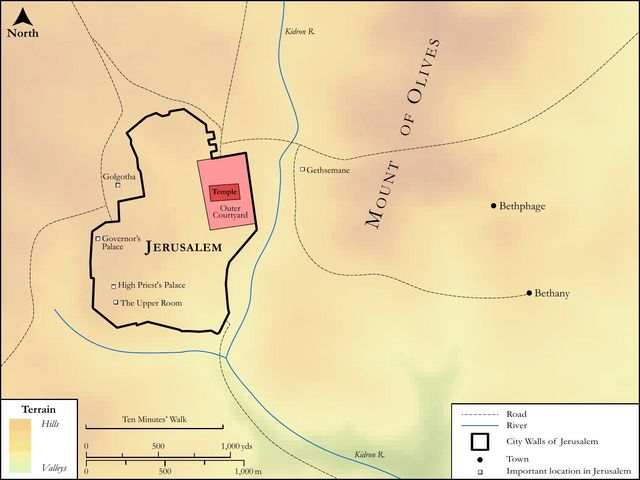
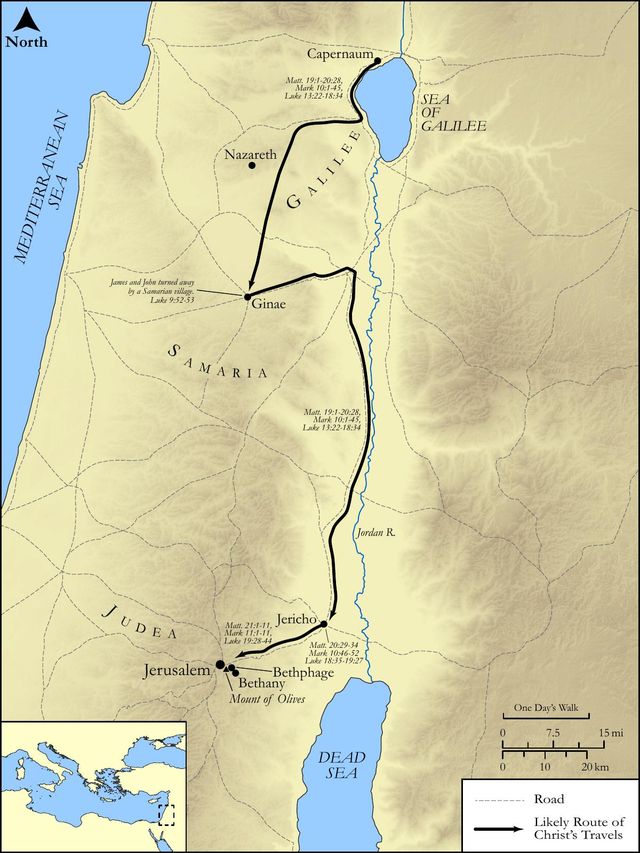
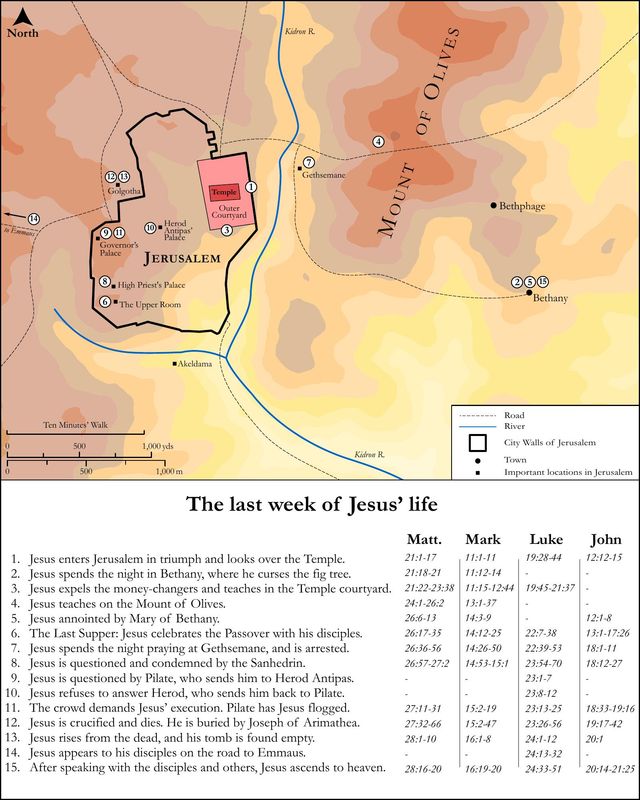
See on the biblical-era maps
Study this verse
Historical interpretation
Ten Centuries of Reception
10 surviving comments on this verse. Each one is dated, so this reads as a timeline rather than a list.
Select a marker to jump to its quote. Markers stagger vertically where authors wrote within a few decades of each other.
And because this plant was figuratively a living creature, having a soul, He speaks to it as though it heard. Let no fruit grow on thee henceforward for ever. Therefore is the Jewish synagogue barren, and shall continue so until the end of the world, when the multitude of the Gentiles shall come in; and the fig tree withered while Christ was yet sojourning in this life; and the disciples seeing by their spiritual discernment the mystery of the withered faith, wondered; and having faith, and not doubting, they bare it, and so it withers when their lifegiving virtue passes to the Gentiles; and by each one who is brought to the faith, that mountain Satan is lifted up and cast into the sea, that is, into the abyss.
For every man who is obedient to the word of God is Bethany, and Christ abides in him; but the wicked and the sinners He leaves. And when He has been with the righteous, He goes to other righteous after them, and accompanied by them; for it is not said that He left Bethany and went into the city. The Lord ever is an hungred among the righteous, desiring to eat among them the fruit of the Holy Spirit, which are love, joy, peace. But this fig tree which had leaves only without fruit, grew by the wayside.
Herein also we find proof of the Lord's goodness; where He was minded to show forth an instance of the salvation procured by His means, He exerted the power of His might on the persons of men; by healing their present sicknesses, encouraging them to hope for the future, and to look for the healing of their soul. But now when He would exhibit a type of His judgments on the rebellious, He represents the future by the destruction of a tree; Let no fruit grow on thee henceforward for ever.
And that is compared to a fig tree, because the Apostles being the first believers out of Israel, like green figs shall in the glory, and the time, of their resurrection, be before the rest.
This was at once a type of the Gentiles, and no small comfort to the Apostles; for that they might not be perplexed, contriving how having no education for the purpose they should preach the Gospel, these children going before them did away that fear; for He who made these to sing His praises, shall give speech to those. This miracle also shows that Christ was the Framer of nature; seeing the children spoke things full of meaning, and agreeing with the Prophets, whereas the men uttered things meaningless, and full of frenzy.
He came not because He was an hungred, but for His disciples' sake; for because He ever did good and inflicted suffering on none, it behoved that He should set forth an example of His power of punishment; and this He would not exert upon man, but upon a plant.
This was only a supposition of the disciples that it was cursed because it had not fruit; for another Evangelist says that it was not yet the season. Why then was it cursed? For the disciples' sake, that they might learn that He had power to wither up those who crucified Him. And He worked this miracle in that which of all plants is the most juicy, that the greatness of the miracle might be more apparent. And when aught of this kind is done to brutes or vegetables, ask not whether the fig were with justice withered up, seeing it was not the season for its fruit; for to enquire thus were extreme madness, for in such creatures there can be neither fault nor punishment; but consider the miracle, and admire the Worker of it.
And that you may learn that this was done for their sakes, to the end, namely, that they should be stirred up to confidence, hear what is said further. Jesus answered and said unto them, Verily I say unto you, if ye shall have faith.
This that the Lord speaks of He ascribes to prayer and faith; whence He continues, And all things whatsoever ye shall ask in prayer believing ye shall receive.
"Now in the morning as He returned into the city, He was an hungered." How is He an hungered in the morning? When He permits the flesh, then it shows its feeling. "And when He saw a fig tree in the way, He came to it, and found nothing thereon, but leaves only." Another evangelist saith, "The time of figs was not yet;" but if it was not time, how doth the other evangelist say, "He came, if haply He might find fruit thereon." Whence it is manifest that this belongs to the suspicion of His disciples, who were yet in a somewhat imperfect state. For indeed the evangelists in many places record the suspicions of the disciples.
Like as this then was their suspicion, so also was it too to suppose it was cursed for this cause, because of having no fruit. Wherefore then was it cursed? For the disciples' sakes, that they might have confidence. For because everywhere He conferred benefits, but punished no man; and it was needful that He should afford them a demonstrative proof of His power to take vengeance also, that both the disciples might learn, and the Jews, that being able to blast them that crucify Him, of His own will He submits, and does not blast them; and it was not His will to show forth this upon men; upon the plant did He furnish the proof of His might in taking vengeance. But when unto places, or unto plants, or unto brutes, any such thing as this is done, be not curious, neither say, how was the fig-tree justly dried up, if it was not the time of figs; for this it is the utmost trifling to say; but behold the miracle, and admire and glorify the worker thereof.
Since in the case also of the swine that were drowned, many have said this, working out the argument of justice; but neither there should one give heed, for these again are brutes, even as that was a plant without life.
Wherefore then was the act invested with such an appearance, and with this plea for a curse? As I said, this was the disciple's suspicion.
But if it was not yet time, vainly do some say the law is here meant. For the fruit of this was faith, and then was the time of this fruit, and it had indeed borne it; "For already are the fields white to harvest," saith He; and, "I sent you to reap that whereon ye bestowed no labor."
Not any therefore of these things doth He here intimate, but it is what I said, He displays His power to punish, and this is shown by saying, "The time was not yet," making it clear that of this special purpose He went, and not for hunger, but for His disciples' sake, who indeed marvelled exceedingly, although many miracles had been done greater; but, as I said, this was strange, for now first He showed forth His power to take vengeance. Wherefore not in any other, but in the moistest of all planted things did He work the miracle, so that hence also the miracle appeared greater.
(Verse 18 and following) But when he returned to the city in the morning, he was hungry. And seeing a fig tree by the road, he went to it and found nothing on it except leaves. And he said to it, 'May no fruit ever come from you again!' And immediately the fig tree withered. And when the disciples saw it, they marveled, saying, 'How did the fig tree wither at once?' After the darkness of the night had dispersed, as the morning light shone and midday approached, during which the Lord was going to illuminate the world by means of his passion, when he returned to the city, he was hungry. Whether to reveal the truth of his human flesh or to hunger for the salvation of believers and to burn with incredulity towards the Jews. And when he saw a certain tree (which we understand to be the Synagogue and assembly of the Jews) by the road, for it had the Law and therefore it was by the road, because it did not believe in the way, he came to it, standing namely and immobile, and not having the feet of the Gospel: and he found nothing in it, except leaves alone, the noise of promises, Pharisaic traditions, and the ostentation of the Law, and the ornaments of words without any fruits of truth. And another evangelist says: For the time had not yet come (Mark 10:13); either because the time of the salvation of Israel had not yet come, since the Gentile people had not yet entered, or because the time of faith had passed, because, coming to him first, and rejected, it had passed to the nations. And he said to him: May no fruit ever be born from you, either forever or for eternity: for both αἰὼν (( Al. αἰῶνα)) in Greek means. And the little bed was dried up, which did not have the food that the hungry Lord desired. Likewise, the leaves withered, so that only the trunk remained, and with the branches broken, the root revived. If it wishes to believe in the last times, may the shoot of faith sprout, and may the Scripture be fulfilled, saying: 'There is hope for a tree.' (Job 14:7). However, according to the letter, the Lord, who was to suffer among the peoples and bear the scandal of the cross, had to strengthen the hearts of his disciples with the anticipation of a sign. And the disciples were amazed, saying: How did it wither immediately? Therefore, by the same power, could the Savior also dry up his enemies, unless he had awaited their salvation through repentance.
Hence it is to be understood that the Lord was in so great poverty, and so far from having courted any one, that He had found in all that city neither entertainer, nor abode, but He made His home in a little village, in the house of Lazarus and his sisters; for their village was Bethany; and it follows, and He lodged there.
When the shades of night were dispersed, and He was returning to the city, the Lord was an hungred, thus showing the reality of His human body.
The Lord about to suffer among the nations, and to take upon Him the offence of the Cross, sought to strengthen the minds of His disciples by a previous miracle; whence it follows, And seeing a fig-tree by the wayside, He came to it, and found nothing thereon, but leaves only.
For ever, (in sempiternum,) or, To the end of the world, (in sæculum,) for the Greek word αἰῶγ signifies both.
The Gentile dogs bark against us, affirming that the Apostles had not faith, because they were not able to remove mountains. To whom we answer, that many wonders were done by the Lord which are not written; and therefore we believe the Apostles to have done some not written; and that they were therefore not written, that the unbelieving might not have in them larger room for cavilling. For let us ask them, do they believe the miracles which are written, or do they not? And when they look incredulous, we can then establish that they who believe not the lesser would not have believed the greater.
The tree which He saw by the wayside we understand as the synagogue, which was nigh to the way inasmuch as it had the Law, but yet believed not on the way, that is, on Christ.
(de Cons. Ev. ii. 68.) It must be considered that Mark relates the wonder of the disciples at the withering of the tree, and the answer of the Lord concerning faith, to have been not on the day following the cursing of the tree, but on the third day after; and that on the second day Mark relates the casting of the merchants out of the Temple, which he had omitted on the first day. On the second day then he says that He went forth out of the city in the evening, and that as they passed by in the morning, the disciples then saw that the fig tree was withered. But Matthew speaks as though all this had been done on the day following. This must be so taken as that when Matthew, having related that the fig tree was dried up, adds immediately, omitting all the events of the second day, And when the disciples saw if, they marvelled, he yet meant that it was on another day that they marvelled. For the tree must be supposed to have withered at the time it was cursed, not at the time they saw it. For they did not see it withering, but when it was withered, and by that they understood that it had withered immediately upon the Lord's words.
A bad man is better overcome by giving way to him than by replying to him; for wickedness is not instructed but stimulated by reproof. The Lord accordingly sought by withdrawing Himself to check those whom His words could not check; whence it is said, And He left them, and went out of the city into Bethany.
Seeking surely to lodge in the body where His spirit also reposed; for so it is with all holy men, they love to be not where sumptuous banquets are, but where holiness flourishes.
For had His hunger been as man for carnal food, He would not have hungred in the morning; he truly hungers in the morning who hungers after the salvation of others.
Also the fig in respect of the multitude of seeds under one skin is as it were an assembly of the faithful. But He finds nothing on it but leaves only, that is, pharisaical traditions, an outward show of the Law without the fruits of truth.
Or; Into the sea, that is, into the world where the waters are salt, i. e. the people are wicked.
That is, nigh to the world; for if a man lives nigh to the world, he cannot preserve in himself the fruit of righteousness.
But whenever we are not heard when we pray, it is either because we ask something adverse to the means of our salvation; or because the perverseness of those for whom we ask hinders its being granted to them; or because the performance of our request is put off to a future time, that our desires may wax stronger, and so may have more perfect capacity for the joys they seek after.
And he avenges his exclusion from the elect by more cruel treatment of the reprobate.
(ap. Anselm.) For in permitting His flesh to suffer that which properly pertains to flesh, He fore-shews His passion. Mark the earnest zeal of the active labourer, Who is said to have gone early into the city to preach, and to gain some to His Father.
(ord.) The Creator does no wrong to the owner, but His creature at His will is converted to the profit of others.
Continue studying Matthew 21:19 across the web’s major study libraries — every link below opens this exact verse, chapter, or book on the destination site.
Read & Compare
 BibleGatewayThis verse in more than 200 translations and 70 languages.
 Bible.comThe YouVersion reader — hundreds of translations, reading plans, and highlights.
 ESV.orgCrossway's official English Standard Version reader.
 NET BibleThe NET translation with 60,000+ translators' notes on every rendering decision.
 STEP BibleTyndale House's free study tool — original text, vocabulary, and scholarly resources.
 BibliaLogos Bible Software's free web reader.
 USCCBThe New American Bible (Revised Edition) with the U.S. bishops' study notes.
Commentaries
 BibleHub CommentariesDozens of classic commentaries on this verse, gathered on one page.
 StudyLightMore than 100 commentary sets — the largest collection on the web.
 BibleRefPlain-English commentary on what this verse means, verse by verse.
 Enduring WordDavid Guzik's free commentary on this chapter, widely used by Bible teachers.
 Bible Study ToolsVerse commentary alongside Greek and Hebrew study aids.
Original Language & Research
- BibleHub InterlinearThe verse word by word — original language, transliteration, and English.
- BibleHub LexiconEvery word's original-language definition and Strong's entry.
 Blue Letter BibleDeep-study tools — Strong's numbers, concordance, and word studies.
 CNTR CollationThe earliest Greek manuscripts of this verse, collated letter by letter.
Sermons, Hymns & Audio


TrulyRandomVerse is not affiliated with these sites and doesn’t control their content. They’re linked because they’re genuinely useful.
Summary
Matthew 21:19 recounts Jesus' encounter with a barren fig tree on His way to Jerusalem. Finding only leaves and no fruit, He pronounces a curse upon it, causing it to wither instantly. This dramatic event serves as a powerful prophetic parable, symbolizing God's impending judgment on Israel's religious leadership for their outward show of piety (leaves) without genuine spiritual fruit (righteousness, faith, and justice), and simultaneously demonstrating Jesus' divine authority and power over both nature and spiritual realities.
Context
ShowHideLiterary Context
This incident is strategically placed in Matthew's narrative, occurring immediately after Jesus' triumphal entry into Jerusalem and just before His cleansing of the Temple. The fig tree's barrenness and subsequent judgment serve as a vivid, acted-out parable that foreshadows and underscores the reasons for the Temple's defilement and the religious leaders' spiritual emptiness. It provides a visual commentary on the hypocrisy Jesus confronts in the Temple. Furthermore, the disciples' reaction and Jesus' subsequent teaching on faith and prayer in Matthew 21:20-22 directly link the fig tree's withering to lessons for His followers.
Historical & Cultural Context
The event takes place in the spring, during the Passover season, as Jesus travels from Bethany to Jerusalem. In Judea, fig trees typically produced small, edible early figs (known as "brebas") by late March or early April, even before the main crop, and often concurrently with the emergence of leaves. The presence of abundant leaves on the tree would normally indicate the expectation of fruit. Therefore, for Jesus to find a tree full of leaves but utterly devoid of fruit was a clear sign of its deceptive unfruitfulness. This cultural expectation of fruit from a leafy fig tree makes its barrenness particularly poignant and symbolic, drawing a parallel to Israel's outward religious display without inward spiritual substance.
Key Themes
ShowHideThe central theme is judgment on barrenness and hypocrisy. The fig tree, outwardly flourishing with leaves but inwardly unproductive, powerfully symbolizes Israel's religious establishment, which maintained an outward show of piety and adherence to the Law but lacked the genuine spiritual fruit of righteousness, justice, and faith. This echoes the Old Testament prophetic tradition where Israel is often depicted as a vineyard or fig tree expected to yield fruit for God, as seen in Isaiah 5:1-7. Another key theme is divine authority and power. Jesus' ability to instantly wither the fig tree demonstrates His absolute sovereignty not only over creation but also as the one who possesses the authority to judge. This miracle serves as a tangible display of His power to bring about immediate consequences for spiritual unfruitfulness, reinforcing His claims as the Messiah. Finally, the subsequent discussion in Matthew 21:20-22 introduces the theme of faith and prayer, indicating that while the fig tree incident is a judgment, it also holds a lesson for believers regarding the power of genuine faith.
Exposition and Analysis
ShowHideKey Word Analysis
ShowHideThis verb signifies not merely a physical observation but a deeper perception or understanding. When Jesus "saw" the fig tree, it implies He perceived its true spiritual condition—its outward appearance of life (leaves) belied its inward barrenness (no fruit). This seeing is linked to knowing, suggesting a divine discernment of the tree's spiritual state, which then prompted His action.
This word emphasizes the absolute and complete absence of fruit. It's not just "little" or "some," but "not even one." This stark negation highlights the utter emptiness and unproductivity of the tree, making its judgment entirely just in the context of its deceptive appearance.
This verb means to dry up, to desiccate, or to shrivel. The use of this term, combined with "presently" (G3916, parachrēma), underscores the immediate, supernatural, and irreversible nature of the judgment. The tree did not slowly decline; it experienced a sudden and complete desiccation, demonstrating the swiftness and certainty of divine judgment when fruitfulness is absent.
Verse Breakdown
ShowHide"And when he saw a fig tree in the way, he came to it"
This sets the scene, depicting Jesus' intentional approach to the tree. His "seeing" implies a discerning gaze, not just a casual glance, recognizing its potential or expected fruitfulness given its location "in the way" (along a common path) and its leafy appearance.
"and found nothing thereon, but leaves only"
This is the pivotal observation. The presence of leaves indicated a tree ready to bear fruit, or at least early fruit. The discovery of "nothing thereon, but leaves only" reveals a deceptive outward show without any corresponding inner reality or productivity. This barrenness, despite the promise of leaves, is the catalyst for Jesus' action.
"and said unto it, 'Let no fruit grow on thee henceforward for ever.'"
This is Jesus' pronouncement of judgment. It is a direct, authoritative curse that condemns the tree to perpetual barrenness. The phrase "henceforward for ever" signifies an irreversible and eternal state of unfruitfulness, emphasizing the finality of the judgment.
"And presently the fig tree withered away"
The immediate consequence of Jesus' words. The word "presently" (Greek, parachrēma) highlights the instantaneous and supernatural nature of the event. The tree's rapid desiccation confirms Jesus' divine authority and the swiftness and certainty of the judgment He pronounced.
Literary Devices
ShowHideThe primary literary device at play in Matthew 21:19 is Symbolism. The fig tree itself is a powerful symbol, widely understood to represent the nation of Israel, particularly its religious leadership. Its abundant leaves symbolize the outward show of piety, religious observances, and adherence to the Law, while its lack of fruit symbolizes the absence of true spiritual righteousness, justice, and faith. This act is also a Prophetic Act, serving as a living parable or an acted-out prophecy. Jesus often taught through parables, and here, He performs one. His action is not merely an expression of frustration but a symbolic demonstration of God's impending judgment on an unfruitful Israel, which, despite its outward religious fervor, failed to produce the fruit of genuine obedience and spiritual vitality. The immediate and dramatic nature of the tree's withering also employs Dramatic Irony, as the tree's promising appearance (leaves) stands in stark contrast to its barren reality and swift demise, mirroring the spiritual state of those who appear righteous but are spiritually dead.
Theological and Thematic Connections
ShowHideThe cursing of the fig tree is a profound theological statement on God's expectation of fruitfulness from His people and the consequences of spiritual barrenness. It underscores the principle that outward religious observance without inward transformation and genuine obedience is ultimately condemned. This incident serves as a stark warning against hypocrisy and a reminder that God desires and demands true spiritual fruit, not just a facade of religiosity. It also highlights Jesus' role as the divine judge, demonstrating His authority to assess and condemn spiritual unfruitfulness.
Reflection and Application
ShowHideThe account of the fig tree challenges believers to deeply examine their own lives, moving beyond superficial religious activity to cultivate genuine spiritual fruit. It prompts us to ask whether our outward expressions of faith (church attendance, biblical knowledge, good deeds) are truly accompanied by the inward transformation wrought by the Holy Spirit—the "fruit of the Spirit" such as love, joy, peace, patience, kindness, goodness, faithfulness, gentleness, and self-control. This passage serves as a potent reminder that God values authentic spiritual life and productivity over mere appearance. It calls us to repentance for any areas of barrenness and to a renewed commitment to abiding in Christ, the true Vine, so that we may bear much fruit for His glory.
Questions for Reflection
ShowHideFAQ
ShowHideWhy did Jesus curse an innocent fig tree?
ShowHideJesus' action was not an arbitrary act of anger or a display of petulance towards an "innocent" tree. Instead, it was a profound prophetic act—a living parable designed to convey a crucial spiritual truth. The fig tree, in this context, was a symbol for Israel, particularly its religious leaders, who presented an outward show of piety and adherence to the Law (represented by the leaves) but lacked the genuine spiritual fruit of righteousness, justice, and faith (represented by the absent figs). Just as the fig tree promised fruit but delivered none, the religious establishment of Jesus' day offered a facade of godliness without true spiritual substance. Jesus' cursing of the tree was a symbolic judgment, foreshadowing the spiritual desolation and impending judgment upon those who were spiritually barren despite their religious pretensions, as further emphasized by His cleansing of the Temple immediately following this event.
Christ-Centered Fulfillment
ShowHideThe cursing of the fig tree finds its ultimate Christ-centered fulfillment in several profound ways. First, Jesus, as the true Israel, embodies the very fruitfulness that the nation failed to produce. Where Israel was a barren fig tree, Jesus is the True Vine, from whom all genuine spiritual fruit flows. His life was one of perfect obedience, righteousness, and love, fulfilling God's expectation of fruitfulness. Second, this event underscores Jesus' absolute divine authority, not only as the Son of God with power over creation but also as the ultimate Judge. His pronouncement of judgment on the fig tree foreshadows His role as the one who will ultimately judge all nations and individuals based on the fruit of their lives, as described in passages like Matthew 25:31-46. Finally, while the fig tree represents judgment on barrenness, Christ also offers the way to true fruitfulness. Through His atoning work on the cross and the gift of the Holy Spirit, believers are empowered to bear the "fruit of the Spirit" (Galatians 5:22-23), transforming barren lives into productive ones that glorify God. Thus, the fig tree incident, while a warning, ultimately points to Christ as the source of life and the means by which humanity can escape spiritual barrenness and enter into a life of abundant fruitfulness.