


Luke 22:51
- ἀποκριθεὶςapokritheisAnsweringG611V-AOP-NSMVerb Aorist Passive Deponent Participle Nominative Singular Masculine
- δὲdenowG1161CONJConjunction
- ὁho<the>G3588T-NSMDefinite article Nominative Singular Masculine
- ἸησοῦςIēsousJesusG2424N-NSM-PNoun Nominative Singular Masculine Individual
- εἶπεν·eipensaidG2036V-2AAI-3SVerb 2nd Aorist Active Indicative 3rd Singular
- ἐᾶτεeatedo allowG1439V-PAM-2PVerb Present Active Imperative 2nd Plural
- ἕωςhe'ōs[only] as far asG2193PREPPreposition
- τούτουtoutouthis!G3778D-GSNDemonstrative pronoun Genitive Singular Neuter
- καὶkaiAndG2532CONJConjunction
- ἁψάμενοςhapsamenoshaving touchedG681V-AMP-NSMVerb Aorist Middle Participle Nominative Singular Masculine
- τοῦtoutheG3588T-GSNDefinite article Genitive Singular Neuter
- ὠτίουōtiouearG5621N-GSNNoun Genitive Singular Neuter
- αὐτοῦautouof himG846P-GSMPersonal pronoun Genitive Singular Masculine
- ἰάσατοiasatoHe healedG2390V-ADI-3SVerb Aorist Middle Deponent Indicative 3rd Singular
- αὐτόνautonhimG846P-ASMPersonal pronoun Accusative Singular Masculine
English is a literal word-by-word gloss of the Greek, not the KJV's wording. Why?
This is the original text the KJV's translators worked from — each Greek word with its own literal English meaning in this verse, prepared by scholars at Tyndale House, Cambridge. The KJV translates whole sentences, not word by word, so its wording differs: one Greek word can become several English words, and the KJV may choose “charity” where the gloss reads “love”. Both are faithful — they answer different questions. For the KJV's own rendering, switch to the KJV text.
Details
See on the biblical-era map
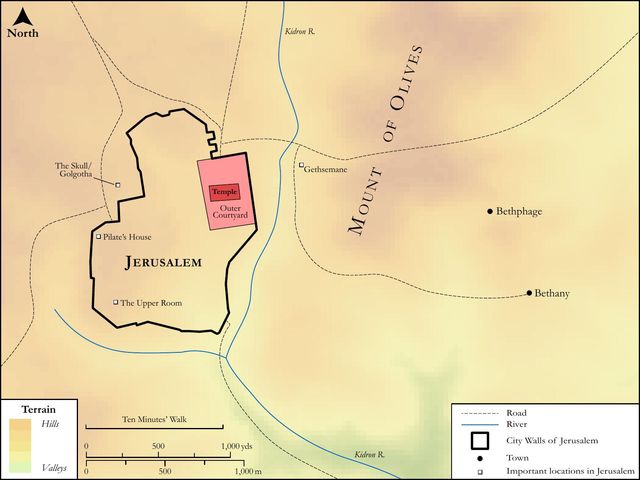


Study this verse
Public-domain commentary
Matthew Henry
From his Commentary on the Whole Bible. Henry comments on passages, not single verses — this entry covers Luke 22:47–53. His three-level outline is real structure in the source text, so it is rendered as structure.
Satan, finding himself baffled in his attempts to terrify our Lord Jesus, and so to put him out of the possession of his own soul, betakes himself (according to his usual method) to force and arms, and brings a party into the field to seize him, and Satan was in them. Here is,
I.The marking of him by Judas.
Here a numerous party appears, and Judas at the head of them, for he was guide to them that took Jesus; they knew not where to find him, but he brought them to the place: when they were there, they knew not which was he, but Judas told them that whomsoever he should kiss, that same was he; so he drew near to him to kiss him, according to the wonted freedom and familiarity to which our Lord Jesus admitted his disciples. Luke takes notice of the question Christ asked him, which we have not in the other evangelists: Judas, betrayest thou the Son of man with a kiss? What! Is this the signal? Luk 22:48. Must the Son of man be betrayed, as if any thing could be concealed from him, and a plot carried on against him unknown to him? Must one of his own disciples betray him, as if he had been a hard Master to them, or deserved ill at their hands? Must he be betrayed with a kiss? Must the badge of friendship be the instrument of treachery? Was ever a love-token so desecrated and abused? Note, Nothing can be a greater affront or grief to the Lord Jesus than to be betrayed, and betrayed with a kiss, by those that profess relation to him and an affection for him. Those do so who, under pretence of zeal for his honour, persecute his servants, who, under the cloak of a seeming affection for the honour of free grace, give a blow to the root of holiness and strictness of conversation. Many instances there are of Christ's being betrayed with a kiss, by those who, under the form of godliness, fight against the power of it. It were well if their own consciences would put this question to them, which Christ here puts to Judas, Betrayest thou the Son of man with a kiss? And will he not resent it? Will he not revenge it?
II.The effort which his disciples made for his protection (Luk 22:49):
When they saw what would follow, that those armed men were come to seize him, they said, "Lord, shall we smite with the sword? Thou didst allow us to have two swords, shall we now make use of them? Never was there more occasion; and to what purpose should we have them if we do not use them?" They asked the question as if they would not have drawn the sword without commission from their Master, but they were in too much haste and too much heat to stay for an answer. But Peter, aiming at the head of one of the servants of the high priest, missed his blow, and cut off his right ear. As Christ, by throwing them to the ground that came to take him, showed what he could have done, so Peter, by this exploit, showed what he could have done too in so good a cause if he had had leave. The other evangelists tell us what was the check Christ gave to Peter for it. Luke here tells us, 1. How Christ excused the blow: Suffer ye thus far, v. 51. Dr. Whitby thinks he said this to his enemies who came to take him, to pacify them, that they might not be provoked by it to fall upon the disciples, whom he had undertaken the preservation of: "Pass by this injury and affront; it was without warrant from me, and there shall not be another blow struck." Though Christ had power to have struck them down, and struck them dead, yet he speaks them fair, and, as it were, begs their pardon for an assault made upon them by one of his followers, to teach us to give good words even to our enemies. 2. How he cured the wound, which was more than amends sufficient for the injury: He touched his ear, and healed him; fastened his ear on again, that he might not so much as go away stigmatized, though he well deserved it. Christ hereby gave them a proof, (1.) Of his power. He that could heal could destroy if he pleased, which should have obliged them in interest to submit to him. Had they returned the blow upon Peter, he would immediately have healed him; and what could not a small regiment do that had such a surgeon to it, immediately to help the sick and wounded? (2.) Of his mercy and goodness. Christ here gave an illustrious example to his own rule of doing good to them that hate us, as afterwards he did of praying for them that despitefully use us. Those who render good for evil do as Christ did. One would have thought that this generous piece of kindness should have overcome them, that such coals, heaped on their heads, should have melted them, that they could not have bound him as a malefactor who had approved himself such a benefactor; but their hearts were hardened.
III.Christ's expostulation with the officers of the detachment that came to apprehend him, to show what an absurd thing it was for them to make all this rout and noise, v. 52, 53. Matthew relates it as said to the multitude. Luke tells us that it was said to the chief priests and captains of the temple the latter commanded the several orders of the priests, and therefore are here put between the chief priests and the elders, so that they were all ecclesiastics, retainers to the temple, who were employed in this odious piece of service; and some of the first rank too disparaged themselves so far as to be seen in it. Now see here,
1.How Christ reasons with them concerning their proceedings. What occasion was there for them to come out in the dead of the night, and with swords and staves?
(1.)They knew that he was one that would not resist, nor raise the mob against them; he never had done any thing like this. Why then are ye come out as against a thief?
(2.)They knew he was one that would not abscond, for he was daily with them in the temple, in the midst of them, and never sought to conceal himself, nor did they offer to lay hands on him. Before his hour was come, it was folly for them to think to take him; and when his hour was come it was folly for them to make all this ado to take him.
2.How he reconciles himself to their proceedings; and this we had not before: "But this is your hour, and the power of darkness. How hard soever it may seem that I should be thus exposed, I submit, for so it is determined. This is the hour allowed you to have your will against me. There is an hour appointed me to reckon for it. Now the power of darkness, Satan, the ruler of the darkness of this world, is permitted to do his worst, to bruise the heel of the seed of the woman, and I resolve to acquiesce; let him do his worst. The Lord shall laugh at him, for he sees that his day, his hour, is coming." Psa 37:13. Let this quiet us under the prevalency of the church's enemies; let it quiet us in a dying hour, that,
(1.)It is but an hour that is permitted for the triumph of our adversary, a short time, a limited time.
(2.)It is their hour, which is appointed them, and in which they are permitted to try their strength, that omnipotence may be the more glorified in their fall.
(3.)It is the power of darkness that rides master, and darkness must give way to light, and the power of darkness be made to truckle to the prince of light. Christ was willing to wait for his triumphs till his warfare was accomplished, and we must be so too.
Historical interpretation
Nine Centuries of Reception
12 surviving comments on this verse. Each one is dated, so this reads as a timeline rather than a list.
Select a marker to jump to its quote. Markers stagger vertically where authors wrote within a few decades of each other.
Not fearing the power that had flattened them, they stretched out their impure hands and seized him who was purifying them. “Simon cut off the ear of one of them.” The good Lord in his gentleness took it and put it back in its elevated place on the body, as a figure of him who had fallen into the lower abyss because of his sins. “Put your sword back again into its place.” He whose word was a sword did not need a sword. Just as he restored the ear that was cut off back to its place, he could have separated the members that were joined. Unsatisfied with showing the intensity of his power with a single example, he showed it to all those who “retreated and fell backwards to the ground.” The one whose ear had been healed would not be the only one to benefit from grace. He allowed all that were about to apprehend him to benefit from it, so that they would certainly know whom they were going to arrest. The grace of him who had restored the ear to its place made those who “fell backwards to the ground” able to get up again.
Since our Lord was the fulfillment of justice and the beginning of mercy, he put the sword in its sheath and put justice back in its place again. He then healed the ear through mercy. He put the ear back in its place and made good the imperfection of justice through fruitful mercy. He whose ear had been healed expressed his gratitude for this love with hatred. Those who had “fallen backwards to the ground” and had been raised up again through Christ, thanked him for his help with chains. “They bound him,” said the Evangelist, “and led him away.”
Understand, if you can, how the pain of a healthy right hand escaping touch flees, and wounds are healed not by ointment but by touch. The clay recognizes its potter, and the flesh follows the hand of its Master; for as he wills, the Creator restores his work. Thus elsewhere does sight return to the blind man, when mud spread over his eyes as if it had returned to nature, is reformed. He could have commanded, but he preferred to work; so that we may know that it is he who from the clay of the earth fashioned the various organs of our body with different functions, and infused them with the vigor of the mind.
For Peter being well versed in the law, and full of ardent affection, knowing that it was counted righteousness in Phineas that he had killed the sacrilegious persons, struck the High Priest's servant.
The Lord in wiping away the bloody wounds, conveyed thereby a divine mystery, namely, that the servant of the prince of this world, not by the condition of His nature but by guilt, should receive a wound on the ear, for that he had not heard the words of wisdom. Or, by Peter so willingly striking the ear, he taught that he ought not to have a ear outwardly, who had not one in a mystery. But why did Peter do this? Because he especially obtained the power of binding and loosing; therefore by his spiritual sword he takes away the interior ear of him who understandeth not. But the Lord Himself restores the hearing, showing that even they, if they would turn, might be saved, who inflicted the wounds in our Lord's Passion; for that all sin may be washed away in the mysteries of faith.
For just as incurable wounds yield neither to severe nor soothing remedies, so the soul when once it is taken captive, and has sold itself to any particular sin, will reap no benefit from admonition. And so it was with Judas, who desisted not from His betrayal, though deterred by Christ by every manner of warning. Hence it follows, And drew near unto Jesus to kiss him.
(Conc. 1. de Laz.) Now we must not depart from admonishing our brethren, albeit nothing comes of our words. For even the streams though no one drink therefrom still flow on, and him whom thou hast not persuaded to-day, peradventure thou mayest to-morrow. For the fisherman after drawing empty nets the whole day, when it was now late takes a fish. And thus our Lord, though He knew that Judas was not to be converted, yet ceased not to do such things as had reference to him. It follows, But Jesus said unto him, Judas, betrayest thou the Son of man with a kiss?
And He gives him his proper name, which was rather like one lamenting and recalling him, than one provoked to anger.
But He said not, "Betrayest thou thy Master, thy Lord, thy Benefactor," but the Son of man, that is, the humble and meek, who though He were not thy Master and Lord, forasmuch as He has borne himself so gently toward thee, should have never been betrayed by thee.
For they had come at night fearing an outbreak of the multitude, therefore He says, "What need was there of these arms against one who was always with you?" as it follows, When I was daily with you.
(de Con. Ev. lib. iii. c. 5.) Now Luke says, But Jesus answered and said, Suffer ye thus far; which is what Matthew records, Put thy sword up into its sheath. Nor will it move you as contrary thereto, that Luke says here that our Lord answered, Suffer ye thus far, as if He had so spoken after the blow to show that what was done had pleased Him so far, but He did not wish it to proceed farther, seeing that in these words which Matthew has given, it may rather be implied that the whole circumstance in which Peter used the sword was displeasing to our Lord. For the truth is, that upon their asking, Lord, shall we strike with the sword? He then answered, Suffer ye thus far, that is, be not troubled with what is about to happen. They must be permitted to advance so far, that is, to take Me, and so to fulfil the things which were written of Me. For he would not say, And Jesus answering, unless He answered this question, not Peter's deed. But between the delay of their words of question to our Lord and His answer, Peter in the eagerness of defence struck the blow. And two things cannot be said, though one may be said and another may be done, at the same time. Then, as Luke says, He healed him who was struck, as it follows, And he touched his ear, and healed him.
The blessed disciples, wounded with the prodding of divine love, drew their swords to repel the attack. Christ would not permit this, but he rebuked Peter, saying, “Put your sword into its sheath; for all who have taken swords shall die by swords.” In this, he gave us a pattern of the way in which we must hold on by our love for him and of the extent to which the burning zeal of our piety may proceed. He does not want us to use swords to resist our enemies. He would rather have us use love and prudence.… The Savior moderates the unmeasured heat of the holy apostles. By preventing the example of such an act, he declares that those who are the leaders in his religion have no need in any way whatsoever of swords. With divine dignity, Christ healed him who received the blow and gave this godlike sign for their condemnation to those who came to seize him.
For the Lord is never forgetful of His lovingkindness. While they are bringing death upon the righteous, He heals the wounds of His persecutors.
Or that servant is the Jewish people sold by the High Priests to an unlawful obligation, who, by the Passion of our Lord, lost their right ear; that is, the spiritual understanding of the law. And this ear indeed is cut off by Peter's sword, not that he takes away the sense of understanding from those that hear, but manifests it withdrawn by the judgment of God from the careless. But the same right ear in those who among the same people have believed, is restored by the Divine condescension to its former office.
It follows, Then said Jesus unto them, Are ye come out as against a thief with swords and slaves? &c.
As if He says, Therefore are ye assembled against Me in darkness, because your power, wherewith ye are thus armed against the light of the world, is in darkness. But it is asked, how Jesus is said to be addressing the chief priests, the officers of the temple, and the elders, who came to Him, whereas they are reported not to have gone of themselves, but to have sent their servants while they waited in the hall of Caiaphas? The answer then to this contradiction is, that they came not by themselves, but by those whom they sent to take Christ in the power of their command.
And when he touched his ear, he healed him. The Lord never forgets his compassion, even preventing his enemies from being harmed. They inflict death on the just one, while he heals the wounds of the persecutors: mystically teaching that even they can be healed, if they are converted, who are wounded in agreement with his death. According to the allegory, this servant is the people of the Jews, subjected to the obedience of the chief priests, so much so that by their influence they asked for Barabbas to be released, and Jesus, whom they had just been singing Hosanna to as the son of David and king, to be crucified. In the Lord's Passion, they lost the right ear, that is, the spiritual understanding of the law, being content only with the left, that is, the benefit of the letter. This ear is cut off by Peter's sword, not because he takes away the understanding from those listening, but reveals the neglect removed by divine judgment. But the same right ear was, by divine dignity, restored to its original function in those who chose to believe from the same people. Alternatively: the ear cut off for the Lord, and healed by the Lord, signifies hearing renewed after the old state is removed, so that it is in the newness of the spirit, and not in the oldness of the letter. Whoever is granted this by Christ will also be granted to reign with Christ. Hence, it is fitting that Malchus, the name of that servant, is interpreted as king or one destined to reign. But that he was found a servant also pertains to that old condition which generates servitude, which is Hagar. But when health approached, freedom was also symbolized.
But Jesus answered and said: "Permit it thus far." It should not be thought that He was pleased with what had happened up to this point, but rather He did not want it to proceed any further. In the words which Matthew records the Lord is said to have spoken: "Put your sword back in its place; for all who take the sword will perish by the sword" (Matthew 26). It was understood rather that the entire action, wherein Peter used the sword, was displeasing to the Lord. For it is more accurate that when they asked Him, saying: "Lord, should we strike with the sword?" then He responded: "Permit it thus far," meaning: do not be concerned with what is about to happen, they must be allowed to proceed up to this point, that is, to apprehend Me, and that what is written about Me may be fulfilled. But in the intervening time between the words of those questioning the Lord and His responding, Peter, in his eagerness to defend and with greater commotion for the Lord, struck. But it could not also be spoken at the same time that which could be done at the same time. For He would not have said: "But Jesus answered," unless He was responding to their questioning. For concerning Peter's action, Matthew alone states what He judged. Where Matthew also did not say: "Jesus answered Peter: 'Put your sword back,'" but said: "Then Jesus said to him: 'Put your sword back,'" which appears the Lord said after the fact.
That is, that they should not be overcome by temptation, for not to be led into temptation is not to be overwhelmed by it. Or He simply bids us pray that our life may be quiet, and we be not cast into trouble of any kind. For it is of the devil and presumptuous, for a man to throw himself into temptation. Therefore James said not, "Cast yourselves into temptation," but, When ye are fallen, count it all joy, (Jam. 1:2.) making a voluntary act out of an involuntary.
The disciples are inflamed with zeal, and unsheath their swords. But whence have they swords? Because they had slain the lamb, and had departed from the feast. Now the other disciples ask whether they should strike; but Peter, always fervent in defence of his Master, waits not for permission, but straightway strikes the servant of the High Priest; as it follows, And one of them smote, &c.
(non occ.) After first mentioning the prayer of Christ, St. Luke goes on to speak of His betrayal wherein He is betrayed by His disciple, saying, And while he yet spake, behold a multitude, and he that was called Judas.
Continue studying Luke 22:51 across the web’s major study libraries — every link below opens this exact verse, chapter, or book on the destination site.
Read & Compare
 BibleGatewayThis verse in more than 200 translations and 70 languages.
 Bible.comThe YouVersion reader — hundreds of translations, reading plans, and highlights.
 ESV.orgCrossway's official English Standard Version reader.
 NET BibleThe NET translation with 60,000+ translators' notes on every rendering decision.
 STEP BibleTyndale House's free study tool — original text, vocabulary, and scholarly resources.
 BibliaLogos Bible Software's free web reader.
 USCCBThe New American Bible (Revised Edition) with the U.S. bishops' study notes.
Commentaries
 BibleHub CommentariesDozens of classic commentaries on this verse, gathered on one page.
 StudyLightMore than 100 commentary sets — the largest collection on the web.
 BibleRefPlain-English commentary on what this verse means, verse by verse.
 Enduring WordDavid Guzik's free commentary on this chapter, widely used by Bible teachers.
 Bible Study ToolsVerse commentary alongside Greek and Hebrew study aids.
Original Language & Research
- BibleHub InterlinearThe verse word by word — original language, transliteration, and English.
- BibleHub LexiconEvery word's original-language definition and Strong's entry.
 Blue Letter BibleDeep-study tools — Strong's numbers, concordance, and word studies.
 CNTR CollationThe earliest Greek manuscripts of this verse, collated letter by letter.
Sermons, Hymns & Audio


TrulyRandomVerse is not affiliated with these sites and doesn’t control their content. They’re linked because they’re genuinely useful.
Summary
Luke 22:51 captures a profound moment during Jesus' arrest in the Garden of Gethsemane, where, immediately after Peter's impulsive act of violence, Jesus commands His disciples to cease their resistance. In an astonishing display of divine compassion and authority, He then touches the severed ear of the high priest's servant, Malchus, and miraculously heals him. This act underscores Jesus' unwavering commitment to non-violence, His boundless mercy even toward His adversaries, and His sovereign power, even as He willingly submits to the path of suffering and crucifixion.
Context
ShowHideLiterary Context
This verse is situated at a pivotal juncture in Luke's narrative, following Jesus' agonizing prayer in Gethsemane and the arrival of the arresting party led by Judas Iscariot. The disciples, witnessing the betrayal and impending arrest of their Lord, react with fear and a desire to defend Him. Luke 22:49-50 specifically describes one of them (identified as Simon Peter in John 18:10) asking, "Lord, shall we smite with the sword?" and then immediately striking the high priest's servant, cutting off his right ear. Luke 22:51 is Jesus' immediate and decisive response to this act of violence, halting further conflict and demonstrating His kingdom's true nature. It serves as a final, powerful illustration of His character and mission before His trial and crucifixion.
Historical & Cultural Context
The arrest of Jesus occurred during the Passover festival, a time of heightened religious and political tension in Jerusalem. Judea was under Roman occupation, and the Jewish religious authorities (the Sanhedrin, led by the high priest) sought to maintain order and prevent any uprising that might provoke Roman intervention. The presence of temple guards and elders indicates an official, albeit clandestine, operation sanctioned by the Jewish leadership. The disciples' readiness to use swords reflects a common expectation among some Jews for a Messiah who would lead a military revolt against Roman oppression, a notion Jesus consistently subverted. Jesus' healing of a servant of the high priest, a figure representing the very authority seeking His death, was a culturally shocking act of grace, transcending the expected retribution of the time.
Key Themes
ShowHideLuke 22:51 powerfully contributes to several overarching themes in Luke's Gospel and the broader biblical narrative. It highlights Jesus' compassion and mercy, even towards His enemies, echoing His teaching to love those who persecute you. It underscores the theme of non-violence and the nature of Jesus' kingdom, which is "not of this world" (John 18:36). The miraculous healing reaffirms Jesus' divine power and authority, demonstrating His ability to perform miracles even when He is seemingly powerless and vulnerable, about to be taken captive. Finally, it emphasizes Jesus' submission to the Father's will, as He prevents any resistance that would thwart the divine plan for His arrest and crucifixion, a submission foreshadowed in His prayer in Gethsemane.
Exposition and Analysis
ShowHideKey Word Analysis
ShowHideThis word (G1439), often translated as "to let be," "permit," or "leave alone," carries the sense of allowing something to happen or ceasing an action. In this context, Jesus' command "Suffer ye thus far" is a direct imperative for His disciples to stop their physical resistance and allow the arrest to proceed. It signifies a cessation of violence and a submission to the unfolding events, embodying Jesus' willingness to endure the path set before Him.
The verb (G680) means "to attach oneself to" or "to touch" in various implied relations. Here, it describes Jesus' physical contact with the severed ear. This touch is not merely incidental; in the Gospels, Jesus' touch often precedes or accompanies miraculous healing, signifying His personal engagement, compassion, and the transfer of divine power. It is a deliberate act of intervention and restoration.
This term (G2390) is a standard Greek verb for "to cure" or "to make whole," used for both literal physical healing and figurative spiritual restoration. In this instance, it denotes a complete and instantaneous restoration of the severed ear, a powerful and undeniable miracle performed by Jesus. The use of this word emphasizes the completeness and supernatural nature of the restoration, highlighting Jesus' divine capacity to mend what is broken.
Verse Breakdown
ShowHide"And Jesus answered and said, Suffer ye thus far."
This clause reveals Jesus' immediate and authoritative response to Peter's violent act. His command, "Suffer ye thus far," functions as a definitive halt to the disciples' physical resistance. It signifies His rejection of violence as a means to advance His kingdom and His willingness to submit to the Father's plan, even if it meant His arrest and eventual crucifixion. This statement prevents further bloodshed and underscores His control over the situation, despite His apparent vulnerability.
"And he touched his ear, and healed him."
This second clause describes Jesus' astonishing act of compassion and miraculous power. In the midst of His own betrayal and impending suffering, Jesus extends grace to an adversary. His physical touch, followed by instantaneous healing, demonstrates His divine authority over physical ailments and His boundless mercy. This act is a final, public display of His redemptive mission to bring wholeness and restoration, even to those who oppose Him, contrasting sharply with the hostility of the moment.
Literary Devices
ShowHideLuke 22:51 is rich with Irony, as Jesus, the one being arrested and seemingly powerless, exercises ultimate power by performing a miracle of healing on His captor. This act subverts expectations, demonstrating that His authority is not derived from worldly force but from divine grace. There is also strong Contrast between Peter's impulsive violence and Jesus' calm, compassionate response. This highlights the fundamental difference between the kingdom of God, which operates through love and sacrifice, and the kingdoms of this world, which often resort to force. The healing itself carries Symbolism, as the restoration of the ear could represent the spiritual healing and ability to "hear" the truth that Jesus offers, even to those who are spiritually deaf or hostile to Him.
Theological and Thematic Connections
ShowHideLuke 22:51 profoundly illustrates the core theological tenets of Christ's character and mission. It showcases His divine compassion, extending grace even to those who are actively participating in His betrayal and arrest. This act is a living embodiment of His teaching to love one's enemies and pray for those who persecute you, revealing that His kingdom is not advanced through violence or retaliation, but through sacrificial love and supernatural power. It underscores the theme of submission to God's sovereign will, as Jesus prevents any resistance that would hinder the unfolding of the divine plan for humanity's salvation. This miracle, performed at the very moment of His capture, serves as a final testament to His identity as the Son of God, whose power is demonstrated not in escaping suffering, but in transforming it with grace.
Reflection and Application
ShowHideLuke 22:51 offers a powerful and counter-cultural challenge to believers in every age. In a world often characterized by retaliation, injustice, and the cycle of violence, Jesus' example calls us to a radically different response. When faced with opposition, betrayal, or even direct harm, are we quick to draw our own "swords" of anger, harsh words, or vengeful actions, or do we, like Jesus, choose the path of compassion and grace? This verse reminds us that true strength is found not in asserting our power or defending our rights through force, but in extending mercy and trusting in God's ultimate sovereignty. It challenges us to embody Christ's love in hostile environments, demonstrating that His kingdom operates on principles entirely distinct from worldly power dynamics. Our call is to be agents of healing and reconciliation, even when it costs us dearly, reflecting the very heart of our Savior.
Questions for Reflection
ShowHideFAQ
ShowHideWhy did Jesus heal the ear of His captor, Malchus?
ShowHideJesus healed Malchus's ear for several profound reasons. First, it was a direct demonstration of His divine power, even as He was being arrested. This miracle served as undeniable evidence of His identity, performed at a moment when His authority might seem to be diminished. Second, it was a powerful act of compassion and mercy, embodying His teaching to love one's enemies and showing grace even to those who sought His harm. Third, it was a symbolic rejection of violence as a means to advance God's kingdom. By healing the wound inflicted by His disciple, Jesus underscored that His mission was not one of worldly conquest but of spiritual redemption and reconciliation. This act prevented further escalation of violence and affirmed His willing submission to the Father's plan for His crucifixion.
What is the meaning of Jesus' phrase "Suffer ye thus far"?
ShowHideThe phrase "Suffer ye thus far" (KJV), or more accurately translated as "No more of this!" or "Stop!" or "Permit even this," is Jesus' direct command to His disciples to cease their physical resistance. It's an imperative to halt the violence initiated by Peter's sword. This command signals Jesus' absolute rejection of armed defense in His arrest and His full acceptance of the path of suffering and sacrifice that lay before Him. He was not to be rescued by human force, but would willingly lay down His life according to the divine will, as He had prayed in Gethsemane.
Is this miracle of healing Malchus's ear recorded in other Gospels?
ShowHideThe incident of the disciple striking the high priest's servant is recorded in all four Gospels, but only Luke explicitly mentions Jesus' healing of the ear. Matthew 26:51-52 and Mark 14:47 describe the disciple's act and Jesus' rebuke of the violence. John 18:10-11 identifies the disciple as Simon Peter and the servant as Malchus, and records Jesus' command to Peter to put away his sword, emphasizing His acceptance of the "cup" of suffering. Luke's account uniquely highlights Jesus' compassionate and miraculous act of healing, further emphasizing His character as the compassionate Savior even in His darkest hour.
Christ-Centered Fulfillment
ShowHideLuke 22:51 stands as a profound Christ-centered fulfillment, revealing the very heart of God's redemptive plan. Jesus' act of healing Malchus's ear, even as He is being betrayed and arrested, is a microcosm of His entire mission. It foreshadows the ultimate healing He would accomplish on the cross—not just of a severed ear, but of humanity's severed relationship with God due to sin. His willingness to submit to arrest, preventing His disciples from fighting, points to His greater submission to the Father's will to become the sacrificial Lamb of God, who takes away the sin of the world (John 1:29). The physical healing of Malchus prefigures the spiritual healing available to all who believe, a healing that comes "by His stripes" (Isaiah 53:5). Jesus, the sympathetic High Priest (Hebrews 4:15), demonstrated that His power was not for self-preservation, but for the reconciliation of all things to God through His blood (Colossians 1:19-20). This moment in Gethsemane encapsulates the essence of Christ's example of suffering for righteousness, calling His followers to imitate His non-retaliatory love and trust in divine sovereignty (1 Peter 2:21-24).