


Judges 20:22
Bible text: King James Version (1769 Blayney text) · Public domain
Bible text: King James Version with Strong's numbers · Public domain
Bible text: Berean Standard Bible · Public domain
Bible text: American Standard Version (1901) · Public domain
Bible text: World English Bible, Messianic edition · Public domain
Bible text: Geneva Bible (1599) · Public domain
Bible text: Young's Literal Translation · Public domain
- וַיִּתְחַזֵּקvai·yit·cha·Zekand it showed itself strongH2388Conj-w ¦ V-Hithpael-ConsecImperf-3msVerb Hithpael Consecutive Imperfect 3rd Singular Masculineוַandיִּתְחַזֵּקit showed itself strong
- הָעָםha·'Amthe peopleH5971Art ¦ N-msNoun Singular Masculine Absoluteהָtheעָםpeople
- אִישׁ'ish[the] man ofH376N-mscNoun Singular Masculine Construct
- יִשְׂרָאֵלYis·ra·'ElIsraelH3478N-properNoun Proper Location
- וַיֹּסִפוּvai·yo·Si·fuand they repeatedH3254Conj-w ¦ V-Hiphil-ConsecImperf-3mpVerb Hiphil Consecutive Imperfect 3rd Plural Masculineוַandיֹּסִפוּthey repeated
- לַעֲרֹךְla·'a·Rokhto deployH6186Prep-l ¦ V-Qal-InfVerb Qal Infinitive Constructלַtoעֲרֹךְdeploy
- מִלְחָמָהmil·cha·MahbattleH4421N-fsNoun Singular Feminine Absolute
- בַּמָּקוֹםba·ma·Komin the placeH4725Prep-b ¦ N-msNoun Singular Masculine Absoluteבַּin theמָּקוֹםplace
- אֲשֶׁר'a·SherwhereH834RelParticle Relative
- עָרְכוּ'A·re·khuthey had deployedH6186V-Qal-Perf-3cpVerb Qal Perfect 3rd Plural common gender
- שָׁםshamthereH8033AdvAdverb
- בַּיּוֹםbai·Yomon the dayH3117Prep-b ¦ N-msNoun Singular Masculine Absoluteבַּon theיּוֹםday
- הָרִאשׁוֹןha·ri·Shon<the> firstH7223Art ¦ Adj-msAdjective Numerical Position Singular Masculine Absoluteהָ<the>רִאשׁוֹןfirst
English is a literal word-by-word gloss of the Hebrew, not the KJV's wording. Why?
This is the original text the KJV's translators worked from — each Hebrew word with its own literal English meaning in this verse, prepared by scholars at Tyndale House, Cambridge. The KJV translates whole sentences, not word by word, so its wording differs: one Hebrew word can become several English words, and the KJV may choose “the LORD” where the gloss reads “Yahweh”. Both are faithful — they answer different questions. For the KJV's own rendering, switch to the KJV text.
Details
See on the biblical-era maps
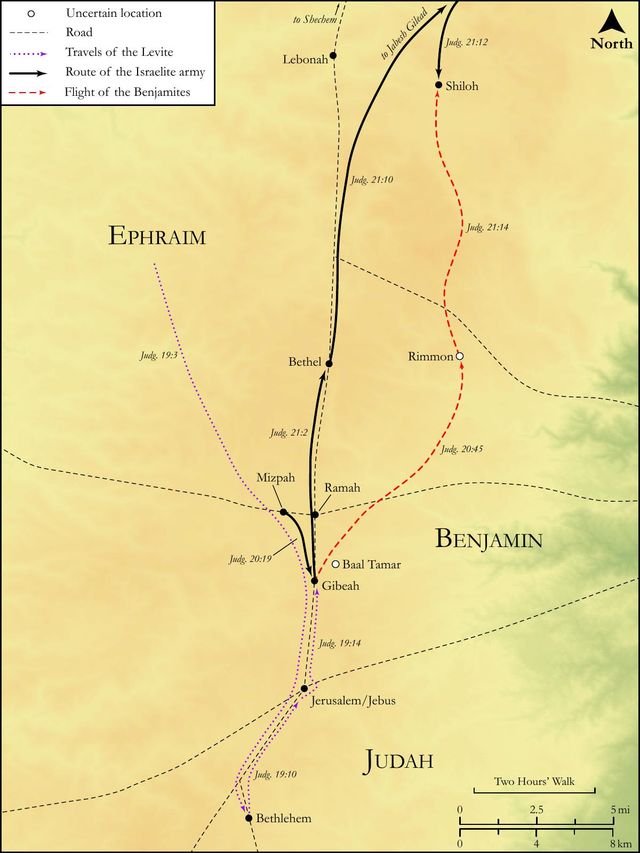
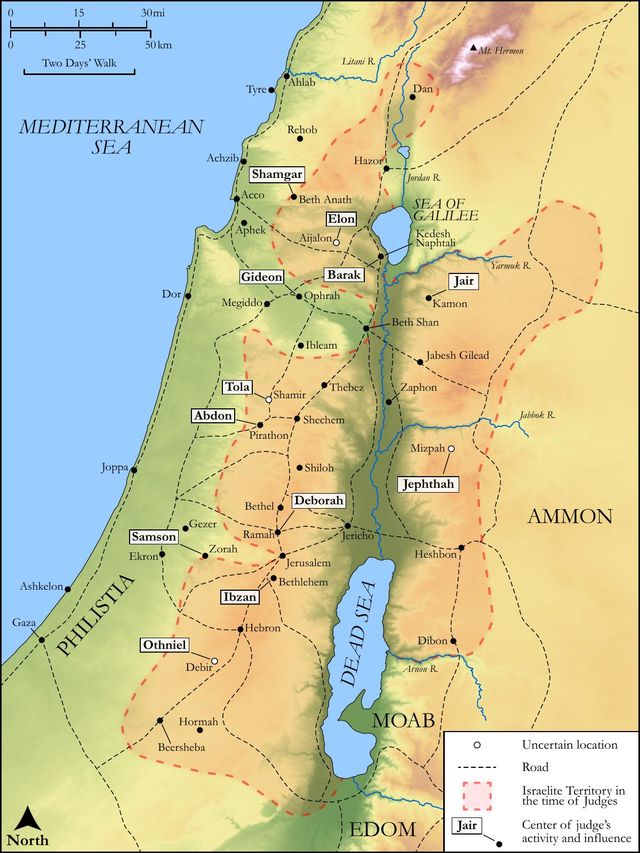
Study this verse
Public-domain commentary
Matthew Henry
From his Commentary on the Whole Bible. Henry comments on passages, not single verses — this entry covers Judges 20:18–25. His two-level outline is real structure in the source text, so it is rendered as structure.
We have here the defeat of the men of Israel in their first and second battle with the Benjamites.
I.Before their first engagement they asked counsel of God concerning the order of their battle and were directed, and yet they were sorely beaten. They did not think it was proper to ask of God whether they should go up at all against Benjamin (the case was plain enough, the men of Gibeah must be punished for their wickedness, and Israel must inflict the punishment or it will not be done), but "Who shall go first?" (Jdg 20:18), that is, "Who shall be general of our army?" for, which soever tribe was appointed to go first, the prince of that tribe must be looked upon as commander-in-chief of the whole body. For, if they had meant it of the order of their march only, it would have been proper to ask, "Who shall go next?" and then, "Who next?" But, if they know that Judah must go first, they know they must all observe the orders of the prince of that tribe. This honour was done to Judah because our Lord Jesus was to spring from that tribe, who was in all things to have the pre-eminence. The tribe that went up first had the most honourable post, but withal the most dangerous, and probably lost most in the engagement. Who would strive for precedency that sees the peril of it? Yet though Judah, that strong and valiant tribe, goes up first, and all the tribes of Israel attend them, little Benjamin (so he is called, Psa 68:27), is too hard for them all. The whole army lays siege to Gibeah, Jdg 20:19. The Benjamites advance to raise the siege, and the army prepares to give them a warm reception (Jdg 20:20). But between the Benjamites that attacked them in the front with incredible fury, and the men of Gibeah that sallied out upon their rear, they were put into confusion and lost 22,000 men, Jdg 20:21. Here were no prisoners taken, for there was no quarter given, but all put to the sword.
II.Before their second engagement they again asked counsel of God, and more solemnly than before; for they wept before the Lord until evening (Jdg 20:23), lamenting the loss of so many brave men, especially as it was a token of God's displeasure and would give occasion to the Benjamites to triumph in the success of their wickedness. Also at this time they did not ask who should go up first, but whether they should go up at all. The intimate a reason why they should scruple to do it, especially now that Providence had frowned upon them, because Benjamin was their brother, and a readiness to lay down their arms if God should so order them. God bade them go up; he allowed the attempt, for, though Benjamin was their brother, he was a gangrened member of their body and must be cut off. Upon this they encouraged themselves, perhaps more in their own strength than in the divine commission, and made a second attempt upon the forces of the rebels, in the same place where the former battle was fought (Jdg 20:22), with the hope of retrieving their credit upon the same spot of ground where they had lost it, which they would not superstitiously change, as if there were any thing unlucky in the place. But they were this second time repulsed, with the loss of 18,000 men, Jdg 20:25. The former day's loss and this amounted to 40,000, which was just a tenth part of the whole army, and the same number that they had drawn out by lot to fetch victuals, Jdg 20:10. They decimated themselves for that service, and now God again decimated them for the slaughter. But what shall we say to these things, that so just and honourable a cause should thus be put to the worst once and again? Were they not fighting God's battle against sin? Had they not his commission? What, and yet miscarry thus!
1.God's judgments are a great deep, and his way is in the sea. Clouds and darkness are often round about him, but judgment and justice are always the habitation of his throne. We may be sure of the righteousness, when we cannot see the reasons, of God's proceedings.
2.God would hereby show them, and us in them, that the race is not to the swift nor the battle to the strong, that we are not to confide in numbers, which perhaps the Israelites did with too much assurance. We must never lay the weight on an arm of flesh, which only the Rock of ages will bear.
3.God designed hereby to correct Israel for their sins. They did well to show such a zeal against the wickedness of Gibeah: but were there not with them, even with them, sins against the Lord their God? Those must be made to know their own iniquity that are forward in condemning the iniquity of others. Some think it was a rebuke to them for not witnessing against the idolatry of Micah and the Danites, by which their religion was corrupted, as they now did against the lewdness of Gibeah and the Benjamites, by which the public peace was disturbed, though God had particularly ordered them to levy war upon idolaters, Deu 13:12, etc.
4.God would hereby teach us not to think it strange if a good cause should suffer defeat fore a while, nor to judge of the merits of it by the success of it. The interest of grace in the heart, and of religion in the world, may be foiled, and suffer great loss, and seem to be quite run down, but judgment will be brought forth to victory at last. Vincimur in praelio, sed non in bello - We are foiled in a battle, but not in the whole campaign. Right may fall, but it shall arise.
Historical interpretation
Historical reception
1 surviving comment on this verse from the historical church.
Trusting in their strength: The Lord suffered them to be overthrown and many of them to be slain, though their cause was just; partly in punishment of the idolatry which they exercised or tolerated in the tribe of Dan, and elsewhere; and partly because they trusted in their own strength; and therefore, though he bid them fight, he would not give them the victory, till they were thoroughly humbled and had learned to trust in him alone.
Continue studying Judges 20:22 across the web’s major study libraries — every link below opens this exact verse, chapter, or book on the destination site.
Read & Compare
 BibleGatewayThis verse in more than 200 translations and 70 languages.
 Bible.comThe YouVersion reader — hundreds of translations, reading plans, and highlights.
 ESV.orgCrossway's official English Standard Version reader.
 NET BibleThe NET translation with 60,000+ translators' notes on every rendering decision.
 STEP BibleTyndale House's free study tool — original text, vocabulary, and scholarly resources.
 BibliaLogos Bible Software's free web reader.
 USCCBThe New American Bible (Revised Edition) with the U.S. bishops' study notes.
Commentaries
 BibleHub CommentariesDozens of classic commentaries on this verse, gathered on one page.
 StudyLightMore than 100 commentary sets — the largest collection on the web.
 BibleRefPlain-English commentary on what this verse means, verse by verse.
 Enduring WordDavid Guzik's free commentary on this chapter, widely used by Bible teachers.
 Bible Study ToolsVerse commentary alongside Greek and Hebrew study aids.
Original Language & Research
- BibleHub InterlinearThe verse word by word — original language, transliteration, and English.
- BibleHub LexiconEvery word's original-language definition and Strong's entry.
 Blue Letter BibleDeep-study tools — Strong's numbers, concordance, and word studies.
 SefariaThe Hebrew text with Rashi and centuries of Jewish commentary.
Sermons, Hymns & Audio


TrulyRandomVerse is not affiliated with these sites and doesn’t control their content. They’re linked because they’re genuinely useful.
Summary
Judges 20:22 marks a pivotal and somber moment in the tragic civil war between the tribes of Israel and Benjamin, illustrating the profound and almost desperate determination of the Israelite forces. After enduring two devastating defeats and suffering immense casualties, the remaining ten tribes, despite their deep discouragement and numerical depletion, consciously strengthened their resolve and meticulously re-formed their battle lines. Crucially, they did so in the very same location where they had previously faced defeat, underscoring their unwavering commitment to confronting the egregious sin of Gibeah and pursuing what they perceived as divine justice, even in the face of overwhelming adversity and significant loss. This verse highlights their human tenacity and sets the stage for a deeper spiritual reckoning.
Context
ShowHideLiterary Context
Judges 20:22 is situated immediately after two crushing and unexpected defeats for the combined Israelite forces against the smaller tribe of Benjamin, as vividly detailed in Judges 20:21 and Judges 20:25. These staggering losses, totaling 40,000 men, were not only militarily disastrous but deeply demoralizing for a nation that had ostensibly sought divine counsel. The preceding narrative, particularly in Judges 19, meticulously describes the horrific atrocity committed by the men of Gibeah, which ignited this bloody civil conflict. While the Israelites had initially sought the Lord's guidance (though perhaps with a presumptuous spirit, as implied by their lack of deeper repentance, seen in Judges 20:18), their repeated failures highlight a profound spiritual issue within the nation. This verse serves as a critical turning point, as their continued persistence, born of sheer desperation, compels them to seek the Lord more earnestly and humbly in the subsequent verses (Judges 20:26-28), ultimately leading to a decisive victory.
Historical & Cultural Context
The book of Judges chronicles a tumultuous period in Israel's history following the conquest of Canaan, characterized by a conspicuous absence of central authority, widespread spiritual apostasy, and rampant moral decay. This era is famously summarized by the recurring refrain, "every man did that which was right in his own eyes" (Judges 21:25). This civil war, sparked by an abhorrent act of violence and sexual depravity, exemplifies the chaos and societal breakdown that resulted from such a state of spiritual anarchy. The concept of corporate responsibility and justice was paramount in ancient Israel; the other tribes felt compelled to punish Benjamin for the heinous crime committed in Gibeah, as the entire tribe was implicated by their refusal to surrender the perpetrators. Warfare was a common means of resolving disputes, and the Israelites, as a covenant people, were expected to seek divine guidance before engaging in battle. However, their initial inquiries, while outwardly pious, seem to have lacked the necessary humility and contrite repentance, suggesting a superficial reliance on God rather than a deep, submissive alignment with His will. The repeated battles in the same location also speak to the strategic importance of the terrain and the remarkable tenacity of both sides.
Key Themes
ShowHideJudges 20:22 contributes significantly to several major themes present throughout the book of Judges and the broader biblical narrative. Firstly, it powerfully highlights the theme of perseverance amidst adversity, showcasing the Israelites' remarkable determination and sheer human grit even after devastating losses. This resolve, though initially perhaps misguided in its spiritual depth, ultimately serves as a catalyst, driving them to a more profound and humble seeking of God's face. Secondly, the verse underscores the dire cost of sin and the pervasive consequences of moral decay. The entire narrative of Judges 19-21 functions as a stark and sobering warning about the societal breakdown and self-destruction that occur when God's covenant law and moral standards are disregarded. Thirdly, it subtly but powerfully introduces the theme of divine sovereignty and the absolute necessity of true repentance. While Israel "encouraged themselves," their self-reliance proved utterly insufficient. Their subsequent, more humble, and contrite seeking of God's face (Judges 20:26) is what ultimately secures divine favor and victory, illustrating that God's overarching plan unfolds even through human failure, persistent struggle, and the painful process of learning true dependence.
Exposition and Analysis
ShowHideKey Word Analysis
ShowHideThe Hebrew verb חָזַק (H2388, châzaq) is a primitive root meaning "to fasten upon; hence, to seize, be strong (figuratively, courageous, causatively strengthen, cure, help, repair, fortify), obstinate." In this context, the Hithpael stem (reflexive) indicates a deliberate, internal act of self-fortification. It is not a spontaneous burst of emotion but a conscious exertion of will and resolve. After two crushing defeats and immense casualties, the Israelites had to actively "brace themselves," "take courage," or "steel their resolve" to continue the fight. This points to a deep-seated determination, whether born of righteous indignation, stubborn pride, or a desperate hope, to see the conflict through. It signifies a profound act of human will to overcome despair.
The Hebrew verb עָרַךְ (H6186, ʻârak) is a primitive root meaning "to set in a row, i.e., arrange, put in order (in a very wide variety of applications); put (set) (the battle, self) in array, compare, direct, equal, esteem, estimate, expert (in war), furnish, handle, join (battle), ordain, (lay, put, reckon up, set) (in) order, prepare, tax, value." The inclusion of "again" (H3254, yâçaph, "to add or augment, to continue to do a thing") and the reference to "the first day" emphasize the methodical, disciplined, and persistent nature of their preparation. Despite their losses and demoralization, they were not a disorganized mob. They meticulously re-established their military formations and tactical plans, demonstrating a persistent and professional approach to warfare, even if their spiritual alignment was still in question. This speaks to their military discipline and unwavering commitment to the objective.
Verse Breakdown
ShowHide"And the people the men of Israel"
This phrase specifically refers to the collective military force drawn from the ten tribes of Israel, excluding Benjamin, who had gathered to confront the offending tribe. It underscores the unified, national response to the horrific atrocity committed in Gibeah, emphasizing the corporate nature of their action and the widespread indignation that fueled this civil war.
"encouraged themselves"
This clause reveals the internal psychological and spiritual state of the Israelite army. After suffering two devastating defeats and incurring massive casualties, they were undoubtedly disheartened, weary, and fearful. This act was a conscious, deliberate effort to bolster their own morale, to find inner strength and resolve to continue fighting despite the heavy losses and the apparent lack of divine favor in the previous engagements. It speaks volumes about their human resilience, tenacity, and determination.
"and set their battle again in array"
This signifies a deliberate, organized, and professional military action. Despite their crippling losses, they did not retreat in disarray or abandon the conflict. Instead, they meticulously re-formed their battle lines and prepared for a third engagement. The crucial word "again" (Hebrew, yâçaph) indicates a renewed and persistent effort to confront the enemy, demonstrating their unwavering commitment to the cause, even if their understanding of God's will and their own spiritual standing was still imperfect.
"in the place where they put themselves in array the first day"
This specific detail emphasizes the continuity and stubborn persistence of the conflict in the exact same geographical location. It highlights their refusal to concede the battlefield and their determination to confront Benjamin on the very ground where they had previously suffered defeat. This repetition of location underscores the intensity, prolonged nature, and strategic importance of this internal tribal war, suggesting a deep-seated resolve to see justice done, regardless of the cost.
Literary Devices
ShowHideThe verse employs several significant literary devices that enrich its meaning and impact. Repetition is prominently featured in the phrase "set their battle again in array in the place where they put themselves in array the first day." This reiteration emphasizes the cyclical nature of their struggle and their unwavering, almost stubborn, persistence in confronting the enemy on the same ground. It highlights their methodical approach to warfare despite their setbacks. There is a palpable sense of Irony present; despite their self-encouragement and meticulous preparation, their previous two attempts had ended in disastrous defeat, suggesting that human effort and military prowess alone, without proper divine alignment and humble repentance, are utterly insufficient. This ironic contrast powerfully underscores the deeper spiritual lesson of the narrative. The verse also utilizes Foreshadowing, as the Israelites' sheer tenacity and refusal to quit, though initially born of human resolve, ultimately leads them to a more profound and contrite seeking of God's face in the subsequent verses, which is a necessary prerequisite for their eventual, divinely-granted victory.
Theological and Thematic Connections
ShowHideJudges 20:22 offers a profound theological lesson on the nature of perseverance, particularly in the face of spiritual and physical setbacks. While the Israelites' initial "encouragement" might have stemmed from a misguided sense of self-reliance, stubborn pride, or even a superficial understanding of God's will, their relentless pursuit of justice, despite overwhelming losses, eventually drove them to a deeper, more humble dependence on God. This narrative highlights that true, biblically-informed perseverance is not merely about human grit or willpower but about learning to align one's will with God's, especially when one's own strength proves insufficient. It underscores the biblical principle that while God often calls us to exert ourselves and engage in the struggle, our ultimate strength, wisdom, and success come from Him, particularly after we have been humbled by our own limitations and failures. The Israelites' experience here serves as a powerful reminder that God, in His sovereign wisdom, uses even our failures and persistent struggles to refine our faith, deepen our humility, and draw us into a more authentic and dependent relationship with Him.
Reflection and Application
ShowHideJudges 20:22 provides a complex yet vital lesson for contemporary believers on the nature of perseverance and the path to true spiritual victory. In our own lives, we frequently face "battles"—whether against sin, in our ministries, within our families, or in our personal struggles—where we instinctively "encourage ourselves" through sheer willpower, determination, or various self-help strategies. Like the Israelites, we might even seek God's counsel, but perhaps superficially, without the deep humility, earnest repentance, and complete surrender necessary for true divine favor and empowered action. When setbacks inevitably occur, whether in our spiritual walk, our vocations, or our personal endeavors, this verse challenges us to critically examine the source of our strength and resolve. Are we primarily relying on our own ability to "set our battle again in array," or are we, through our persistence in the face of failure and our acknowledgment of our own limitations, being driven to a more profound and contrite dependence on God? True spiritual progress and breakthrough often emerge not from avoiding failure, but from how we respond to it: by humbly seeking God's face, acknowledging our utter inadequacy, and allowing Him to strengthen us in ways our own self-encouragement never could. This passage calls us to persevere, not in our own strength or wisdom, but in a way that ultimately leads us to lean more fully and exclusively on the Lord.
Questions for Reflection
ShowHideFAQ
ShowHideWhy did Israel lose twice despite asking God for guidance?
ShowHideThe narrative suggests that while Israel did inquire of the Lord, their initial approach may have been presumptuous or lacked the necessary humility and comprehensive repentance. In Judges 20:18, they asked, "Who shall go up first for us to the battle against the children of Benjamin?" The Lord answered, "Judah shall go up first." This was a tactical instruction, but it did not fully address the deeper spiritual condition of the nation or the profound sin that had brought them to this devastating civil war. It is highly probable that God allowed these initial, crushing defeats to humble them, to expose the inadequacy of their own strength and perceived righteousness, and to drive them to a more earnest and contrite seeking of His face. This is precisely what happens after the second defeat, when they go up to the house of God, weep bitterly, fast, and offer burnt offerings and peace offerings before the Lord (Judges 20:26). Their initial inquiry was perhaps more about gaining a divine endorsement for their pre-determined plans than a humble, submissive plea for God's overarching will and His mercy.
What does "encouraged themselves" truly imply in this context?
ShowHideThe phrase "encouraged themselves" (Hebrew: châzaq) implies a deliberate, conscious act of self-fortification and resolve. It means they actively strengthened their own spirits, wills, and determination. This was not a spontaneous emotional outburst but a methodical and intentional decision to steel themselves for continued battle despite the immense losses and the severe psychological toll of two previous defeats. It highlights their remarkable human tenacity, stubbornness, and resilience in the face of overwhelming odds. While admirable in its display of perseverance, it also stands in stark contrast to the divine strength and encouragement that God provides when His people are truly aligned with His will and dependent upon Him. Their self-encouragement, while enabling them to continue the fight, was ultimately insufficient to secure victory until they coupled it with genuine repentance, profound humility, and a deeper, more complete reliance on God's power and guidance.
Christ-Centered Fulfillment
ShowHideJudges 20:22, with its stark depiction of Israel's self-encouragement and persistent, yet initially futile, efforts in battle, powerfully foreshadows the ultimate inadequacy of human strength and the profound, absolute necessity of divine intervention, perfectly fulfilled in the person and work of Jesus Christ. The Israelites "encouraged themselves" and "set their battle again in array," demonstrating a human resolve that, while commendable in its tenacity, could not secure true victory until they were humbled and turned to God in genuine repentance. This narrative deeply mirrors the universal human condition: our best efforts to overcome sin, to achieve righteousness, or to fight our spiritual battles often fall desperately short, leaving us defeated and disheartened, much like Israel after their two crushing losses. We, too, are prone to "encouraging ourselves" through self-help, moral striving, or religious rituals, only to find our strength and righteousness utterly insufficient to conquer the forces of sin and death.
However, in Christ, we find the ultimate "encouragement" and the perfect "setting in array" for victory. Jesus, the true Israel and the perfect Son, perfectly fulfilled the Law and offered Himself as the ultimate, once-for-all sacrifice, achieving a decisive and eternal victory over sin, death, and the powers of darkness where humanity consistently failed (Hebrews 9:26). He is the one who, unlike the faltering Israelites, never needed to "encourage himself" in the face of the ultimate spiritual battle, for He was always perfectly aligned with the Father's will, drawing His strength from divine communion and perfect obedience (John 5:19). His crucifixion was the ultimate "battle array," where He triumphed over principalities and powers, not by human might but by divine love, perfect obedience, and sacrificial suffering (Colossians 2:15). Our perseverance in the Christian life is not rooted in our own ability to "encourage ourselves," but in the indwelling Holy Spirit, who empowers us and enables us to "be strong in the Lord, and in the power of his might" (Ephesians 6:10). Christ is the Lamb of God who takes away the sin of the world (John 1:29), and through His finished work, our failures are redeemed, our weaknesses are made strong, and our ultimate victory is secured, not by our own self-encouragement, but by His perfect, unwavering strength and triumphant grace.