


Joshua 20:3
Bible text: King James Version (1769 Blayney text) · Public domain
Bible text: Berean Standard Bible · Public domain
Bible text: American Standard Version (1901) · Public domain
Bible text: World English Bible, Messianic edition · Public domain
Bible text: Geneva Bible (1599) · Public domain
Bible text: Young's Literal Translation · Public domain
- לָנוּסla·Nusto fleeH5127Prep-l ¦ V-Qal-InfVerb Qal Infinitive Constructלָtoנוּסflee
- שָׁמָּהSha·mahthere towardsH8033Adv ¦ SfxAdverbשָׁמָּthereהtowards
- רוֹצֵחַro·Tze·acha killerH7523V-Qal-Prtcpl-msVerb Qal Participle Singular Masculine Absolute
- מַכֵּהma·keh[who] strikes downH5221V-Hiphil-Prtcpl-msVerb Hiphil Participle Singular Masculine Construct
- נֶפֶשׁNe·fesh<of> a personH5315N-fsNoun Singular Feminine Absolute
- בִּשְׁגָגָהbish·ga·Gahby inadvertenceH7684Prep-b ¦ N-fsNoun Singular Feminine Absoluteבִּbyשְׁגָגָהinadvertence
- בִּבְלִיbiv·liwith notH1097Prep-b ¦ N-mscNoun Singular Masculine Constructבִּwithבְלִיnot
- דָעַתDa·'atknowledgeH1847N-fsNoun Singular Feminine Absolute
- וְהָיוּve·ha·Yuand they will becomeH1961Conj-w ¦ V-Qal-ConsecPerf-3cpVerb Qal Consecutive Perfect 3rd Plural common genderוְandהָיוּthey will become
- לָכֶםla·Khemfor <the> youPrep-l ¦ 2mpSuffix Personal 2nd Plural Masculineלָfor <the>כֶםyou
- לְמִקְלָטle·mik·Lat<into> a refugeH4733Prep-l ¦ N-msNoun Singular Masculine Absoluteלְ<into>מִקְלָטa refuge
- מִגֹּאֵלmi·go·'Elfrom [the] avenger ofH1350Prep-m ¦ V-Qal-Prtcpl-msVerb Qal Participle Singular Masculine Constructמִfromגֹּאֵל[the] avenger of
- הַדָּםha·Dam<the> bloodH1818Art ¦ N-msNoun Singular Masculine Absoluteהַ<the>דָּםblood
English is a literal word-by-word gloss of the Hebrew, not the KJV's wording. Why?
This is the original text the KJV's translators worked from — each Hebrew word with its own literal English meaning in this verse, prepared by scholars at Tyndale House, Cambridge. The KJV translates whole sentences, not word by word, so its wording differs: one Hebrew word can become several English words, and the KJV may choose “the LORD” where the gloss reads “Yahweh”. Both are faithful — they answer different questions. For the KJV's own rendering, switch to the KJV text.
Details
See on the biblical-era maps
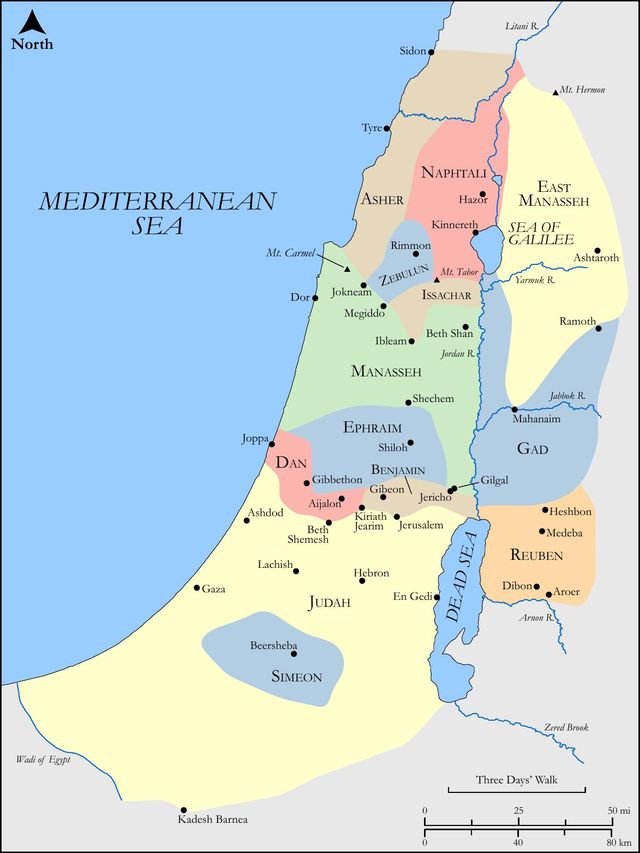
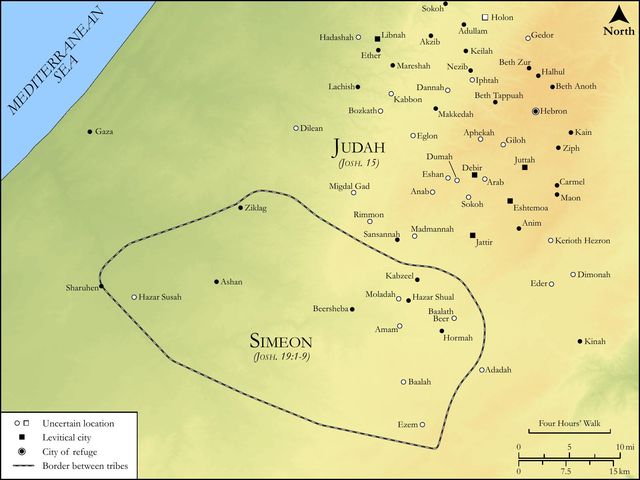
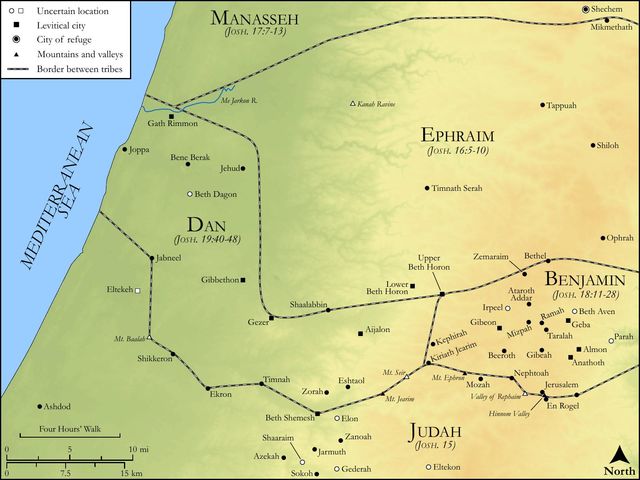
Study this verse
Public-domain commentary
Matthew Henry
From his Commentary on the Whole Bible. Henry comments on passages, not single verses — this entry covers Joshua 20:1–6.
Many things were by the law of Moses ordered to be done when they came to Canaan and this among the rest, the appointing of sanctuaries for the protecting of those that were guilty of casual murder, which was a privilege to all Israel, since no man could be sure but some time or other it might be his own case; and it was for the interest of the land that the blood of an innocent person, whose hand only was guilty but not his heart, should not be shed, no, not by the avenger of blood: of this law, which was so much for their advantage, God here reminds them, that they might remind themselves of the other laws he had given them, which concerned his honour. 1. Orders are given for the appointing of these cities (Jos 20:2), and very seasonably at this time when the land was newly surveyed, and so they were the better able to divide the coasts of it into three parts, as God had directed them, in order to the more convenient situation of these cities of refuge, Deu 19:3. Yet it is probable that it was not done till after the Levites had their portion assigned them in the next chapter, because the cities of refuge were all to be Levites' cities. As soon as ever God had given them cities of rest, he bade them appoint cities of refuge, to which none of them knew but they might be glad to escape. Thus God provided, not only for their ease at all times, but for their safety in times of danger, and such times we must expect and prepare for in this world. And it intimates what God's spiritual Israel have and shall have, in Christ and heaven, not only rest to repose themselves in, but refuge to secure themselves in. And we cannot think these cities of refuge would have been so often and so much spoken of in the law of Moses, and have had so much care taken about them (when the intention of them might have been effectually answered, as it is in our law, by authorizing the courts of judgment to protect and acquit the manslayer in all those cases wherein he was to have privilege of sanctuary), if they were not designed to typify the relief which the gospel provides for poor penitent sinners, and their protection from the curse of the law and the wrath of God, in our Lord Jesus, to whom believers flee for refuge (Heb 6:18), and in whom they are found (Phi 3:9) as in a sanctuary, where they are privileged from arrests, and there is now no condemnation to them, Rom 8:1. 2. Instructions are given for the using of these cities. The laws in this matter we had before, Num 35:10, etc., where they were opened at large. (1.) It is supposed that a man might possibly kill a person, it might be his own child or dearest friend, unawares and unwittingly (Jos 20:3), not only whom he hated not, but whom he truly loved beforetime (Jos 20:5); for the way of man is not in himself. What reason have we to thank God who has kept us both from slaying and from being slain by accident! In this case, it is supposed that the relations of the person slain would demand the life of the slayer, as a satisfaction to that ancient law that whoso sheds man's blood, by man shall his blood be shed. (2.) It is provided that if upon trial it appeared that the murder was done purely by accident, and not by design, either upon an old grudge or a sudden passion, then the slayer should be sheltered from the avenger of blood in any one of these cities, Jos 20:4-6. By this law he was entitled to a dwelling in that city, was taken into the care of the government of it, but was confined to it, as prisoner at large; only, if he survived the high priest, then, and not till then, he might return to his own city. And the Jews say, "If he died before the high priest in the city of his refuge and exile, and was buried there, yet, at the death of the high priest, his bones should be removed with respect to the place of his fathers' sepulchres."
Continue studying Joshua 20:3 across the web’s major study libraries — every link below opens this exact verse, chapter, or book on the destination site.
Read & Compare
 BibleGatewayThis verse in more than 200 translations and 70 languages.
 Bible.comThe YouVersion reader — hundreds of translations, reading plans, and highlights.
 ESV.orgCrossway's official English Standard Version reader.
 NET BibleThe NET translation with 60,000+ translators' notes on every rendering decision.
 STEP BibleTyndale House's free study tool — original text, vocabulary, and scholarly resources.
 BibliaLogos Bible Software's free web reader.
 USCCBThe New American Bible (Revised Edition) with the U.S. bishops' study notes.
Commentaries
 BibleHub CommentariesDozens of classic commentaries on this verse, gathered on one page.
 StudyLightMore than 100 commentary sets — the largest collection on the web.
 BibleRefPlain-English commentary on what this verse means, verse by verse.
 Enduring WordDavid Guzik's free commentary on this chapter, widely used by Bible teachers.
 Bible Study ToolsVerse commentary alongside Greek and Hebrew study aids.
Original Language & Research
- BibleHub InterlinearThe verse word by word — original language, transliteration, and English.
- BibleHub LexiconEvery word's original-language definition and Strong's entry.
 Blue Letter BibleDeep-study tools — Strong's numbers, concordance, and word studies.
 SefariaThe Hebrew text with Rashi and centuries of Jewish commentary.
Sermons, Hymns & Audio


TrulyRandomVerse is not affiliated with these sites and doesn’t control their content. They’re linked because they’re genuinely useful.
Summary
Joshua 20:3 articulates the divine mandate for the establishment of Cities of Refuge in ancient Israel, designated havens for individuals who had caused an accidental death. This verse specifically outlines that these cities were to serve as immediate sanctuary for those who killed "unawares and unwittingly," providing protection from the "avenger of blood" and ensuring an opportunity for due legal process rather than immediate, retaliatory justice. It underscores God's meticulous provision for both justice and mercy within the Mosaic legal framework, clearly distinguishing between intentional murder and unintentional manslaughter.
Context
ShowHideLiterary Context
Joshua 20:3 is situated within the broader narrative of the division of the land of Canaan among the Israelite tribes, following their successful conquest. Chapter 20 specifically details the implementation of a command first given by God through Moses in the wilderness, as recorded in Numbers 35 and reiterated in Deuteronomy 19. The verses immediately preceding Joshua 20:3 (Joshua 20:1-2) record the Lord's direct instruction to Joshua to "appoint out for you cities of refuge." This verse, therefore, serves as the foundational statement of purpose for these cities, explaining why they were to be established and who they were intended to protect, thereby fulfilling a crucial aspect of Israel's legal and social structure as they settled the promised land.
Historical & Cultural Context
In Israel and among the nations round about, the concept of blood vengeance (lex talionis) was widespread, where the closest male relative of a murdered person, known as the "avenger of blood," had the right and often the societal expectation to exact retribution. This system, while ensuring some form of justice, often led to escalating blood feuds that could destabilize communities. The Israelite Cities of Refuge, however, introduced a unique and divinely ordained modification to this custom. While acknowledging the role of the "avenger of blood," God's law provided a crucial distinction between premeditated murder and accidental death. These cities functioned as legal sanctuaries, offering temporary asylum until a formal trial could be held at the city gate by the elders, thereby preventing immediate, unchecked vengeance and ensuring a measure of due process that was remarkably advanced for its time.
Key Themes
ShowHideJoshua 20:3 profoundly contributes to several overarching themes within the book of Joshua and the Pentateuch. Foremost among these is the theme of Divine Justice and Mercy, demonstrating God's balanced character in upholding the sanctity of human life while simultaneously providing grace for unintentional wrongdoing. The establishment of these cities highlights God's meticulous care for the social order of Israel, preventing chaotic blood feuds and ensuring stability. It also underscores the Sanctity of Life, as even unintentional killing required a specific legal framework, emphasizing the value of human life created in God's image (Genesis 9:6). Furthermore, the system emphasizes the critical Distinction Between Intentional and Unintentional Acts, a principle foundational to biblical law, as seen in earlier stipulations in Exodus 21:13 and detailed in Numbers 35:22-25. The Cities of Refuge thus served as tangible expressions of God's righteous governance and compassionate provision for His people.
Exposition and Analysis
ShowHideKey Word Analysis
ShowHideThe King James Version translates two distinct but related Hebrew concepts with this compound phrase. Shᵉgâgâh (H7684) refers to a "mistake or inadvertent transgression," emphasizing an action committed by error or unintentionally, without malicious intent. Daʻath (H1847), derived from the root "to know," here implies a lack of knowledge or awareness, reinforcing the idea that the act was not premeditated or done with hostile forethought. Together, these terms precisely define the type of killer eligible for refuge, sharply distinguishing them from those who commit murder with forethought or hatred, who would not receive protection and would face capital punishment.
The Hebrew word miqlâṭ literally means "a place of reception" or "asylum." It refers to a designated safe haven or sanctuary. In the context of the Cities of Refuge, it signifies a physical location of immediate safety and protection from the "avenger of blood" until a legal process could determine the slayer's intent. This term highlights the protective and sheltering function of these cities, embodying God's provision for those in distress and emphasizing the concept of a divinely appointed sanctuary.
This phrase translates the Hebrew go'ēl haddām, literally "kinsman-redeemer of blood." In ancient Israelite society, the go'el (H1350) was the closest male relative who had the right and duty to protect the family's interests, including property, freedom, and, in this case, the life of a family member. If a kinsman was murdered, the go'el haddām was obligated to avenge the death. The word dâm (H1818) refers to "blood" as that which, when shed, causes death, or figuratively, "bloodshed." The Cities of Refuge served as a divinely sanctioned barrier against this familial retribution for unintentional acts, ensuring that justice was administered through a legal process rather than immediate, potentially misdirected, vengeance.
Verse Breakdown
ShowHide"That the slayer that killeth [any] person unawares [and] unwittingly may flee thither"
This clause establishes the specific condition and purpose for the Cities of Refuge. It identifies the intended beneficiary – a "slayer" (one who has caused death) – but immediately qualifies this by emphasizing the unintentional nature of the act ("unawares [and] unwittingly"). The phrase "may flee thither" indicates the prescribed action for such a person, highlighting the urgency and necessity of seeking asylum in these designated cities. This flight was not an escape from justice, but a flight to justice, providing a temporary sanctuary where their case could be fairly judged.
"and they shall be your refuge from the avenger of blood"
This second clause clarifies the protective function of the Cities of Refuge. "They" refers to the cities themselves, which are explicitly declared as a "refuge" (a place of safety and asylum). The protection offered is specifically "from the avenger of blood," the kinsman who, by societal custom and divine allowance (for intentional murder), had the right to exact retribution. This provision underscores God's desire to regulate vengeance, prevent chaotic blood feuds, and ensure that only truly guilty parties faced the ultimate penalty, after due legal process and a clear distinction of intent.
Literary Devices
ShowHideJoshua 20:3 employs several significant literary devices that enhance its meaning and impact. The verse primarily functions as a Legal Mandate, articulating a specific divine law concerning the Cities of Refuge. The precise and repetitive language, particularly "unawares [and] unwittingly," serves as Emphasis to underscore the critical distinction between accidental death and premeditated murder, a foundational principle in biblical jurisprudence. This clear Contrast between unintentional and intentional acts is central to the legal framework. Furthermore, the concept of "refuge" itself carries profound Symbolism, representing God's provision of safety, mercy, and a place of due process amidst a world prone to escalating violence. The explicit mention of the "avenger of blood" also serves as a Foil, highlighting the perilous situation the accidental slayer faces outside these cities and thus emphasizing the life-saving nature of the divine provision.
Theological and Thematic Connections
ShowHideJoshua 20:3, in its establishment of the Cities of Refuge, beautifully illustrates the tension and harmony between God's justice and His mercy. While God demands accountability for the taking of human life, reflecting the sanctity of life created in His image, He also provides a pathway for grace and due process for those whose actions were unintentional. This system prevented unchecked vengeance and ensured that judgment was administered fairly, not impulsively. It reveals a God who is meticulously concerned with the details of human society, providing structures that uphold righteousness while extending compassion. The Cities of Refuge stand as a testament to God's character as both righteous Judge and compassionate Provider, offering a sanctuary for the genuinely repentant and distinguishing between degrees of culpability, ultimately pointing to a deeper spiritual reality of refuge.
Reflection and Application
ShowHideThe ancient provision of the Cities of Refuge holds profound implications for our understanding of God's character and our own lives. It reminds us that God is not only a God of perfect justice, who demands accountability for all actions, but also a God of profound mercy, who makes provision for human weakness, error, and unintentional sin. This balance should shape our own approach to justice and compassion, prompting us to seek understanding and due process rather than immediate condemnation or vengeance. Spiritually, we are all, in a sense, "slayers" in need of refuge, having sinned against a holy God, whether intentionally or through ignorance. The Cities of Refuge foreshadow the ultimate sanctuary available to us. We are called to extend grace and understanding, recognizing the complexities of human actions, while upholding righteousness. This passage encourages us to rely on God's provision for safety and forgiveness, knowing that true refuge is found in Him, a refuge that offers both protection and the opportunity for restoration.
Questions for Reflection
ShowHideFAQ
ShowHideWere the Cities of Refuge only for Israelites?
ShowHideNo, the Cities of Refuge were explicitly established for both Israelites and foreigners residing among them. Numbers 35:15 states, "These six cities shall be a refuge, both for the children of Israel, and for the stranger, and for the sojourner among them: that every one that killeth any person unawares may flee thither." This demonstrates God's impartial justice and mercy, extending protection and due process to all who lived under His law, regardless of their ethnic origin. It highlights the universality of God's concern for human life and fair judgment, showing His character is not limited by national boundaries.
Christ-Centered Fulfillment
ShowHideThe Cities of Refuge in the Old Testament serve as a powerful type or shadow pointing to the ultimate spiritual refuge found in Jesus Christ. Just as the unintentional slayer fled to a physical city for protection from the avenger of blood, so too does humanity, guilty of sin (whether intentional or in ignorance), find ultimate sanctuary and salvation in Christ. He is our true High Priest, as highlighted in Hebrews 4:14-16, who intercedes on our behalf and provides access to grace and mercy in our time of need. Moreover, Jesus is our divine "refuge" from the condemnation of sin and the wrath of God, as proclaimed in Psalm 46:1 and echoed throughout the New Testament (e.g., Hebrews 6:18). Through His atoning sacrifice on the cross, He has disarmed the "avenger" of our souls – sin and death – and offers forgiveness and eternal life to all who "flee" to Him in faith. He is the Lamb of God who takes away the sin of the world, providing the ultimate propitiation and a secure dwelling place for all who believe, a refuge that is eternal, perfectly just, and infinitely merciful.