


Joshua 20:4
Bible text: King James Version (1769 Blayney text) · Public domain
Bible text: King James Version with Strong's numbers · Public domain
Bible text: Berean Standard Bible · Public domain
Bible text: American Standard Version (1901) · Public domain
Bible text: World English Bible, Messianic edition · Public domain
Bible text: Geneva Bible (1599) · Public domain
Bible text: Young's Literal Translation · Public domain
- וְנָסve·Nasand he will fleeH5127Conj-w ¦ V-Qal-ConsecPerf-3msVerb Qal Consecutive Perfect 3rd Singular Masculineוְandנָסhe will flee
- אֶל'eltoH413PrepPreposition
- אַחַת'a·ChatoneH259Adj-fsAdjective Numerical Singular Feminine Absolute
- מֵהֶעָרִיםme·he·'a·Rimof the citiesH5892Prep-m ¦ Art ¦ N-mpNoun Plural Masculine Absoluteמֵofהֶtheעָרִיםcities
- הָאֵלֶּהha·'E·leh<the> theseH428Art ¦ PrtParticle Demonstrativeהָ<the>אֵלֶּהthese
- וְעָמַדve·'a·Madand he will standH5975Conj-w ¦ V-Qal-ConsecPerf-3msVerb Qal Consecutive Perfect 3rd Singular Masculineוְandעָמַדhe will stand
- פֶּתַחPe·tach[the] entrance ofH6607N-mscNoun Singular Masculine Construct
- שַׁעַרSha·'ar[the] gate ofH8179N-mscNoun Singular Masculine Construct
- הָעִירha·'Irthe cityH5892Art ¦ N-fsNoun Singular Feminine Absoluteהָtheעִירcity
- וְדִבֶּרve·di·Berand he will speakH1696Conj-w ¦ V-Piel-ConsecPerf-3msVerb Piel Consecutive Perfect 3rd Singular Masculineוְandדִבֶּרhe will speak
- בְּאָזְנֵיbe·'a·ze·Neiin [the] ears ofH241Prep-b ¦ N-fdcNoun Dual Feminine Constructבְּinאָזְנֵי[the] ears of
- זִקְנֵיzik·Nei[the] elders ofH2205Adj-mpcAdjective Plural Masculine Construct
- הָעִירha·'irthe cityH5892Art ¦ N-fsNoun Singular Feminine Absoluteהָtheעִירcity
- הַהִיאha·Hi'<the> thatH1931Art ¦ Pro-3fsPronoun Personal 3rd Singular Feminineהַ<the>הִיאthat
- אֶת'et<obj.>H853DirObjMParticle Object Indicator
- דְּבָרָיוde·va·Ravhis wordsH1697N-mpc ¦ 3msNoun Plural Masculine Constructדְּבָרָיwordsוhis
- וְאָסְפוּve·'a·se·Fuand they will gatherH622Conj-w ¦ V-Qal-ConsecPerf-3cpVerb Qal Consecutive Perfect 3rd Plural common genderוְandאָסְפוּthey will gather
- אֹתוֹ'o·To<obj.> himH853DirObjM ¦ 3msParticle Object Indicatorאֹת<obj.>וֹhim
- הָעִירָהha·'I·rahthe city towardsH5892Art ¦ N-fs ¦ SfxNoun Singular Feminine Absoluteהָtheעִירָcityהtowards
- אֲלֵיהֶם'a·lei·Hemto themselvesH413Prep ¦ 3mpPreposition Definiteאֲלֵיtoהֶםthemselves
- וְנָתְנוּve·na·te·nuand they will giveH5414Conj-w ¦ V-Qal-ConsecPerf-3cpVerb Qal Consecutive Perfect 3rd Plural common genderוְandנָתְנוּthey will give
- לוֹloto <the> himPrep-l ¦ 3msSuffix Personal 3rd Singular Masculineלto <the>וֹhim
- מָקוֹםma·Koma placeH4725N-msNoun Singular Masculine Absolute
- וְיָשַׁבve·ya·Shavand he will dwellH3427Conj-w ¦ V-Qal-ConsecPerf-3msVerb Qal Consecutive Perfect 3rd Singular Masculineוְandיָשַׁבhe will dwell
- עִמָּם'i·Mamwith themH5973Prep ¦ 3mpPreposition Definiteעִמָּwithםthem
English is a literal word-by-word gloss of the Hebrew, not the KJV's wording. Why?
This is the original text the KJV's translators worked from — each Hebrew word with its own literal English meaning in this verse, prepared by scholars at Tyndale House, Cambridge. The KJV translates whole sentences, not word by word, so its wording differs: one Hebrew word can become several English words, and the KJV may choose “the LORD” where the gloss reads “Yahweh”. Both are faithful — they answer different questions. For the KJV's own rendering, switch to the KJV text.
Details
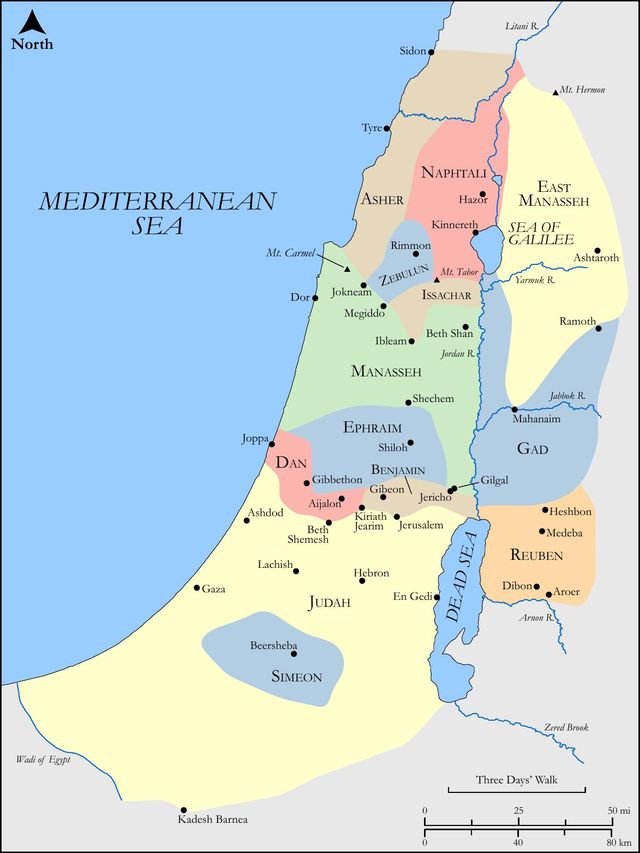
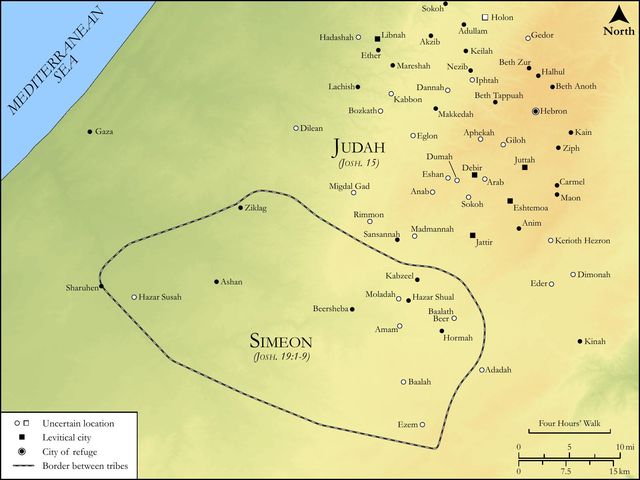
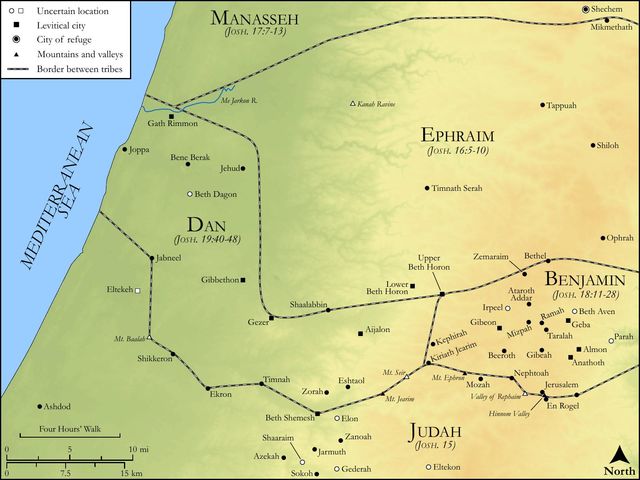
See on the biblical-era maps
Study this verse
Public-domain commentary
Matthew Henry
From his Commentary on the Whole Bible. Henry comments on passages, not single verses — this entry covers Joshua 20:1–6.
Many things were by the law of Moses ordered to be done when they came to Canaan and this among the rest, the appointing of sanctuaries for the protecting of those that were guilty of casual murder, which was a privilege to all Israel, since no man could be sure but some time or other it might be his own case; and it was for the interest of the land that the blood of an innocent person, whose hand only was guilty but not his heart, should not be shed, no, not by the avenger of blood: of this law, which was so much for their advantage, God here reminds them, that they might remind themselves of the other laws he had given them, which concerned his honour. 1. Orders are given for the appointing of these cities (Jos 20:2), and very seasonably at this time when the land was newly surveyed, and so they were the better able to divide the coasts of it into three parts, as God had directed them, in order to the more convenient situation of these cities of refuge, Deu 19:3. Yet it is probable that it was not done till after the Levites had their portion assigned them in the next chapter, because the cities of refuge were all to be Levites' cities. As soon as ever God had given them cities of rest, he bade them appoint cities of refuge, to which none of them knew but they might be glad to escape. Thus God provided, not only for their ease at all times, but for their safety in times of danger, and such times we must expect and prepare for in this world. And it intimates what God's spiritual Israel have and shall have, in Christ and heaven, not only rest to repose themselves in, but refuge to secure themselves in. And we cannot think these cities of refuge would have been so often and so much spoken of in the law of Moses, and have had so much care taken about them (when the intention of them might have been effectually answered, as it is in our law, by authorizing the courts of judgment to protect and acquit the manslayer in all those cases wherein he was to have privilege of sanctuary), if they were not designed to typify the relief which the gospel provides for poor penitent sinners, and their protection from the curse of the law and the wrath of God, in our Lord Jesus, to whom believers flee for refuge (Heb 6:18), and in whom they are found (Phi 3:9) as in a sanctuary, where they are privileged from arrests, and there is now no condemnation to them, Rom 8:1. 2. Instructions are given for the using of these cities. The laws in this matter we had before, Num 35:10, etc., where they were opened at large. (1.) It is supposed that a man might possibly kill a person, it might be his own child or dearest friend, unawares and unwittingly (Jos 20:3), not only whom he hated not, but whom he truly loved beforetime (Jos 20:5); for the way of man is not in himself. What reason have we to thank God who has kept us both from slaying and from being slain by accident! In this case, it is supposed that the relations of the person slain would demand the life of the slayer, as a satisfaction to that ancient law that whoso sheds man's blood, by man shall his blood be shed. (2.) It is provided that if upon trial it appeared that the murder was done purely by accident, and not by design, either upon an old grudge or a sudden passion, then the slayer should be sheltered from the avenger of blood in any one of these cities, Jos 20:4-6. By this law he was entitled to a dwelling in that city, was taken into the care of the government of it, but was confined to it, as prisoner at large; only, if he survived the high priest, then, and not till then, he might return to his own city. And the Jews say, "If he died before the high priest in the city of his refuge and exile, and was buried there, yet, at the death of the high priest, his bones should be removed with respect to the place of his fathers' sepulchres."
Continue studying Joshua 20:4 across the web’s major study libraries — every link below opens this exact verse, chapter, or book on the destination site.
Read & Compare
 BibleGatewayThis verse in more than 200 translations and 70 languages.
 Bible.comThe YouVersion reader — hundreds of translations, reading plans, and highlights.
 ESV.orgCrossway's official English Standard Version reader.
 NET BibleThe NET translation with 60,000+ translators' notes on every rendering decision.
 STEP BibleTyndale House's free study tool — original text, vocabulary, and scholarly resources.
 BibliaLogos Bible Software's free web reader.
 USCCBThe New American Bible (Revised Edition) with the U.S. bishops' study notes.
Commentaries
 BibleHub CommentariesDozens of classic commentaries on this verse, gathered on one page.
 StudyLightMore than 100 commentary sets — the largest collection on the web.
 BibleRefPlain-English commentary on what this verse means, verse by verse.
 Enduring WordDavid Guzik's free commentary on this chapter, widely used by Bible teachers.
 Bible Study ToolsVerse commentary alongside Greek and Hebrew study aids.
Original Language & Research
- BibleHub InterlinearThe verse word by word — original language, transliteration, and English.
- BibleHub LexiconEvery word's original-language definition and Strong's entry.
 Blue Letter BibleDeep-study tools — Strong's numbers, concordance, and word studies.
 SefariaThe Hebrew text with Rashi and centuries of Jewish commentary.
Sermons, Hymns & Audio


TrulyRandomVerse is not affiliated with these sites and doesn’t control their content. They’re linked because they’re genuinely useful.
Summary
Joshua 20:4 meticulously details the initial, critical procedure for an individual seeking sanctuary within one of Israel's divinely appointed Cities of Refuge. It outlines the manslayer's mandatory first step: presenting their case formally and publicly at the city gate before the assembled elders, who, upon hearing the declaration, were obligated to grant the individual provisional entry and a dwelling place within the city's protective walls. This verse underscores the immediate provision of a safe haven, pending a more thorough investigation into the circumstances of the accidental death, ensuring a balance of justice and mercy.
Context
ShowHideLiterary Context
Joshua 20 immediately follows the extensive account of the division of the land among the Israelite tribes in Joshua 13-19. This chapter, alongside Joshua 21, marks the culmination of Israel's establishment in the Promised Land, fulfilling specific divine commands given through Moses regarding their civil and religious infrastructure. Joshua 20:4 is an integral part of this broader legal framework for justice and mercy, demonstrating the practical implementation of the laws concerning unintentional homicide previously outlined in Numbers 35 and Deuteronomy 19. The verse specifically focuses on the initial, crucial step of seeking asylum, setting the stage for the subsequent legal proceedings that would ultimately determine the manslayer's fate.
Historical & Cultural Context
In ancient Israelite society, as among the nations round about, the concept of "blood vengeance" (the lex talionis) was deeply ingrained. A relative of the slain, known as the "avenger of blood" (Hebrew: go'el haddam), possessed the right and duty to pursue and execute the killer. To prevent unchecked vengeance and to provide a clear distinction between premeditated murder and accidental death, God established the Cities of Refuge. The "gate of the city" was not merely a physical entrance but the primary locus of public life, commerce, and, crucially, legal proceedings. It was here that the city elders, acting as local judges and authorities, convened to administer justice, hear disputes, and make communal decisions. The act of "declaring one's cause" at the gate was a formal, public plea for justice and protection, a recognized and solemn legal protocol in that era.
Key Themes
ShowHideJoshua 20:4 contributes significantly to several overarching themes within the book of Joshua and the broader Pentateuch. It exemplifies Divine Justice and Mercy, showcasing God's perfect balance in providing a system that ensures accountability for death while offering compassion and protection for the innocent. The requirement for the manslayer to "declare his cause" before the elders highlights the crucial theme of Due Process and Fair Hearing, emphasizing that protection was not automatic but contingent on a public presentation of facts and an initial evaluation by legitimate authorities. This also underscores Community Responsibility, as the elders, representing the community, bore the solemn duty to uphold justice and provide sanctuary, a responsibility further detailed in Numbers 35:24-25. Ultimately, the verse illustrates the theme of Sanctuary and Protection, revealing God's provision of a safe haven from the immediate threat of the avenger, ensuring the manslayer's safety until a proper trial could be held.
Exposition and Analysis
ShowHideKey Word Analysis
ShowHideThis verb, a primitive root, means "to speak" or "to arrange," but here it carries the specific weight of a formal, legal declaration or the pleading of one's case. It implies a detailed, coherent account of the circumstances surrounding the accidental death, presented with the intent to justify the plea for asylum. It is not a casual statement but a structured testimony, a public articulation of the facts.
Derived from the verb dâbar, this noun refers to a "word," "matter," or "thing," and adverbially, a "cause." In this context, it specifically refers to the manslayer's legal case or the explanation of the circumstances of the killing. It is the specific "matter" that needs to be communicated and heard by the elders for a just decision to be made.
This term refers to those who are "old" or "aged," signifying respected, experienced, and often older leaders of the community. They served as local magistrates and judges, responsible for upholding the law, resolving disputes, and maintaining social order. Their presence at the city gate signified the official judicial authority and the communal responsibility for justice and welfare.
More than just a physical entrance, the city gate in ancient Israel was the hub of public life. It was the marketplace, the place of social gathering, and, most importantly, the seat of justice where legal proceedings, judgments, and public announcements took place. Standing at the gate to "declare his cause" meant making a public, official appeal to the highest local authority, ensuring transparency and accountability.
Verse Breakdown
ShowHide"And when he that doth flee unto one of those cities shall stand at the entering of the gate of the city"
This clause sets the scene for the initial interaction. It describes the manslayer, having fled for his life, arriving at the designated sanctuary city. His posture of "standing at the entering of the gate" signifies a public, formal presentation, not a clandestine entry. This immediate and visible approach was crucial for initiating the legal process and signaling his intent to seek the city's protection.
"and shall declare his cause in the ears of the elders of that city"
This is the core requirement for provisional asylum. The manslayer must articulate, clearly and audibly, the circumstances of the accidental killing directly to the elders. This emphasizes the principle of due process and transparency. The elders, as the designated judicial body, were obligated to listen attentively and evaluate the initial merits of the case before granting entry. The phrase "in the ears" highlights the directness and formality of this oral declaration.
"they shall take him into the city unto them, and give him a place, that he may dwell among them"
This final clause outlines the elders' immediate responsibility and the outcome of a successful initial plea. Upon hearing and accepting the preliminary validity of the manslayer's cause, the elders were to provide him immediate sanctuary within the city walls. This provision of a "place" and permission to "dwell among them" ensured his safety from the avenger of blood until a full trial could be conducted at his original city, as prescribed by the Law. This demonstrates the community's responsibility to protect the innocent.
Literary Devices
ShowHideJoshua 20:4 functions primarily as a Legal Instruction or Procedural Directive, providing clear, step-by-step guidance for a specific legal scenario. The language is direct, prescriptive, and declarative, characteristic of legal texts designed to establish order and ensure justice. There is an implicit Contrast between the potential chaos and injustice of unchecked blood vengeance and the divinely ordained, orderly system of the Cities of Refuge, which prioritizes due process and mercy. The "gate" itself serves as a powerful Symbolism of public justice, authority, and community oversight, reinforcing the idea that legal matters were handled openly and by established leaders. The entire system of Cities of Refuge, of which this verse is a part, functions as a Type or foreshadowing of a greater spiritual refuge.
Theological and Thematic Connections
ShowHideJoshua 20:4 provides a profound glimpse into God's character, revealing Him as both perfectly just and abundantly merciful. The establishment of the Cities of Refuge, and the specific procedures for seeking asylum, demonstrate God's meticulous care for human life and His desire for order and fairness within His covenant people. It underscores that while sin (even unintentional killing) has consequences, God provides a way for redemption and protection for those who genuinely seek it. This system distinguished between degrees of culpability, preventing the innocent from suffering the same fate as the guilty, thereby upholding the sanctity of life and the principles of righteous judgment. It foreshadows the ultimate spiritual refuge found in God Himself, who is our ultimate sanctuary.
Reflection and Application
ShowHideJoshua 20:4, though detailing an ancient legal procedure, resonates with timeless principles applicable to our lives today. It reminds us of the divine imperative for justice tempered with mercy, urging us to consider the full context of situations before rendering judgment. The emphasis on "due process"—the need to hear a person's "cause" fully and fairly—is a foundational principle for any just society, whether in legal systems, interpersonal relationships, or church discipline. Spiritually, this passage invites us to reflect on where we seek refuge when we are in distress, when we have stumbled, or when we face the consequences of our actions, whether intentional or not. It points us to the ultimate sanctuary found in God, who offers not just temporary protection but eternal security and forgiveness through His Son. This verse challenges us to create communities that are safe havens, where truth can be spoken, justice pursued, and mercy extended.
Questions for Reflection
ShowHideFAQ
ShowHideWhat was the purpose of the city gate in ancient Israelite society?
ShowHideThe city gate was far more than just an entrance or exit point. It was the central hub of public life in ancient Israelite cities. All major legal proceedings, judicial hearings, and commercial transactions took place there. It was also a primary gathering place for social interaction, news dissemination, and public announcements. The elders, who served as the local governing and judicial body, would convene at the gate to administer justice, resolve disputes, and make decisions affecting the community. Thus, for the manslayer to "stand at the entering of the gate" was to present his case publicly and officially to the proper authorities, ensuring transparency in the legal process.
Who were the "elders" and what was their role in the Cities of Refuge?
ShowHideThe "elders" (Hebrew: zeqenim) were respected, experienced, and often older leaders of the community. They were the local magistrates and judges, responsible for upholding the law, maintaining order, and ensuring justice within their city. In the context of the Cities of Refuge, their role was critical. They were the first point of contact for the manslayer, tasked with hearing his initial declaration of cause. If the plea of unintentional killing seemed credible, they were responsible for granting him provisional entry and protection within the city walls, safeguarding him from the avenger of blood until a full trial could be held at his home city, as described in Numbers 35:24-25.
How did the Cities of Refuge distinguish between intentional and unintentional killing?
ShowHideThe system of Cities of Refuge was specifically designed to distinguish between premeditated murder and accidental death. Joshua 20:4 describes the initial step for someone claiming unintentional killing. After being granted provisional refuge, the manslayer would then be sent back to his original community to stand trial before its own elders. There, witnesses would be called, and evidence presented to determine the intent behind the killing (Numbers 35:22-25). If found guilty of intentional murder, he would be handed over to the avenger of blood for execution. If found innocent of premeditation, he would be returned to the City of Refuge, where he had to remain until the death of the reigning High Priest. This ensured justice while providing mercy for the truly accidental slayer, preventing arbitrary vengeance.
Christ-Centered Fulfillment
ShowHideThe Cities of Refuge, exemplified by the procedural details in Joshua 20:4, serve as a profound Old Testament type pointing to the ultimate refuge found in Jesus Christ. Just as the manslayer fled to a designated city for protection from the avenger of blood, so too do believers flee to Christ for sanctuary from the just wrath of God against sin and the condemnation of the law. The temporary nature of the earthly cities, with their limited protection until the death of the High Priest, beautifully foreshadows the eternal and complete atonement provided by Christ, our true and eternal High Priest. His sacrificial death on the cross is the definitive event that releases us from the spiritual "avenger"—the condemnation of the law and the power of sin. In Him, we find not merely a temporary dwelling but an eternal inheritance, a secure and unshakeable hope (Hebrews 6:18-19). He is the Lamb of God who takes away the sin of the world, offering perfect justice through His righteousness and boundless mercy through His atoning blood. Through faith in Him, we are granted a place not just within a physical city, but within the very presence of God, safe and secure in the kingdom of His beloved Son, where there is no condemnation for those who are in Christ Jesus.