


Joshua 18:22
Bible text: King James Version (1769 Blayney text) · Public domain
Bible text: King James Version with Strong's numbers · Public domain
Bible text: Berean Standard Bible · Public domain
Bible text: American Standard Version (1901) · Public domain
Bible text: World English Bible, Messianic edition · Public domain
Bible text: Geneva Bible (1599) · Public domain
Bible text: Young's Literal Translation · Public domain
- וּבֵיתu·Veitand BethH1026Conj-w ¦ N-properNoun Proper LocationוּandבֵיתBeth
- הָעֲרָבָהha·'a·ra·Vah<the> ArabahH1026Art ¦ N-properNoun Proper Locationהָ<the>עֲרָבָהArabah
- וּצְמָרַיִםu·tze·ma·Ra·yimand ZemaraimH6787Conj-w ¦ N-properNoun Proper LocationוּandצְמָרַיִםZemaraim
- וּבֵיתu·veitand Beth-H1008Conj-w ¦ N-properNoun Proper LocationוּandבֵיתBeth-
- אֵל'El-elH1008N-properNoun Proper Location
English is a literal word-by-word gloss of the Hebrew, not the KJV's wording. Why?
This is the original text the KJV's translators worked from — each Hebrew word with its own literal English meaning in this verse, prepared by scholars at Tyndale House, Cambridge. The KJV translates whole sentences, not word by word, so its wording differs: one Hebrew word can become several English words, and the KJV may choose “the LORD” where the gloss reads “Yahweh”. Both are faithful — they answer different questions. For the KJV's own rendering, switch to the KJV text.
Details
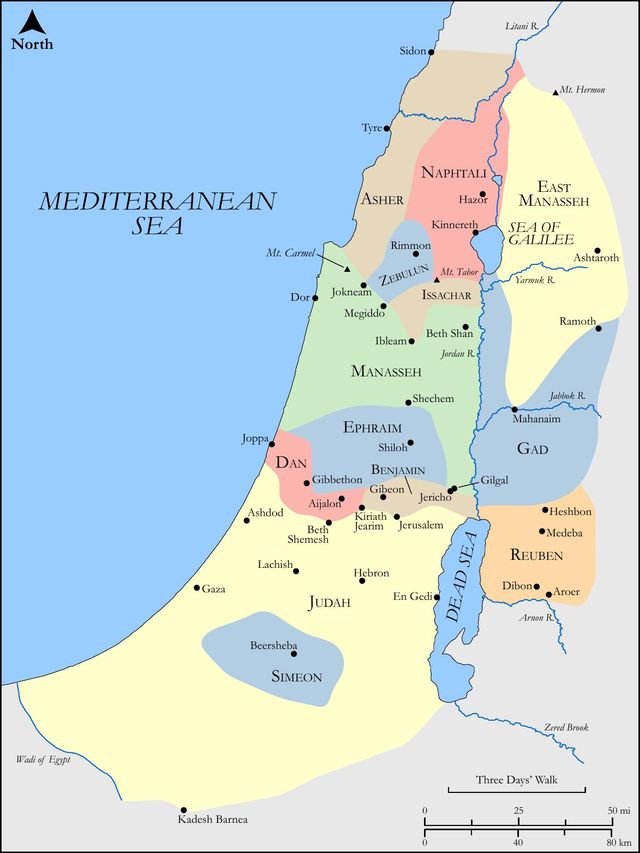
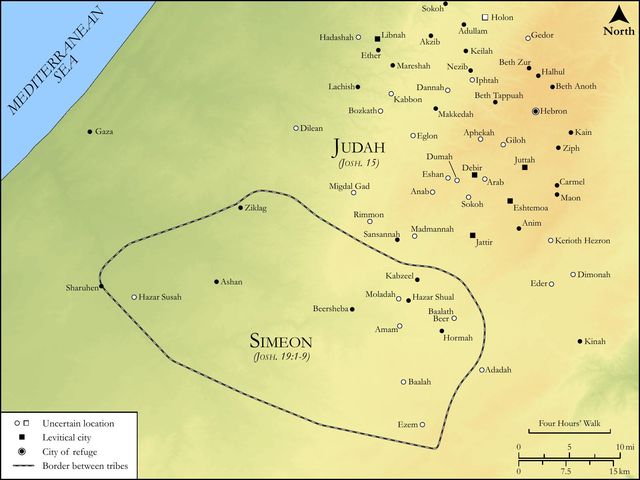
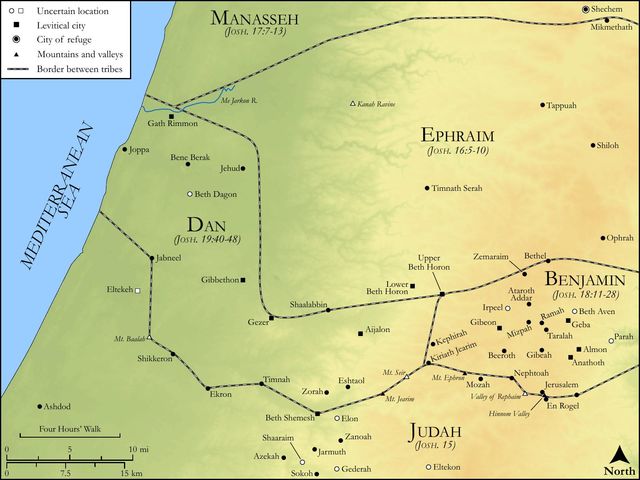
See on the biblical-era maps
Study this verse
Public-domain commentary
Matthew Henry
From his Commentary on the Whole Bible. Henry comments on passages, not single verses — this entry covers Joshua 18:11–28.
We have here the lot of the tribe of Benjamin, which Providence cast next to Joseph on the one hand, because Benjamin was own and only brother to Joseph, and was little Benjamin (Psa 68:27), that needed the protection of great Joseph, and yet had a better protector, for the Lord shall cover him all the day long, Deu 33:12. And it was next to Judah on the other hand, that this tribe might hereafter unite with Judah in an adherence to the throne of David and the temple at Jerusalem. Here we have, 1. The exact borders and limits of this tribe, which we need not be exact in the explication of. As it had Judah on the south and Joseph on the north, so it had Jordan on the east and Dan on the west. The western border is said to compass the corner of the sea southward (Jos 18:14), whereas no part of the lot of this tribe came near to the great sea. Bishop Patrick thinks the meaning is that it ran along in a parallel line to the great sea, though at a distance. Dr. Fuller suggests that since it is not called the great sea, but only the sea, which often signifies any lake or mere, it may be meant of the pool of Gibeon, which may be called a corner or canton of the sea; it is called the great waters of Gibeon (Jer 41:12), and it is compassed by the western border of this tribe. 2. The particular cities in this tribe, not all, but the most considerable. Twenty-six are here named. Jericho is put first, though dismantled, and forbidden to be rebuilt as a city with gates and walls, because it might be built and inhabited as a country village, and so was not useless to this tribe. Gilgal, where Israel first encamped when Saul was made king (Sa1 11:15), was in this tribe. It was afterwards a very profane place. Hos 9:15, All their wickedness is in Gilgal. Beth-el was in this tribe, a famous place. Though Benjamin adhered to the house of David, yet Beth-el, it seems, was in the possession of the house of Joseph (Jdg 1:23-25), and there Jeroboam set up one of his calves. In this tribe was Gibeon, where the altar was in the beginning of Solomon's time, Ch2 1:3. Gibeah likewise, that infamous place where the Levite's concubine was abused. Mizpeh, and near it Samuel's Ebenezer, and also Anathoth, Jeremiah's city, were in this tribe, as was the northern part of Jerusalem. Paul was the honour of this tribe (Rom 11:1; Phi 3:5); but where his land lay we know not: he sought the better country.
Continue studying Joshua 18:22 across the web’s major study libraries — every link below opens this exact verse, chapter, or book on the destination site.
Read & Compare
 BibleGatewayThis verse in more than 200 translations and 70 languages.
 Bible.comThe YouVersion reader — hundreds of translations, reading plans, and highlights.
 ESV.orgCrossway's official English Standard Version reader.
 NET BibleThe NET translation with 60,000+ translators' notes on every rendering decision.
 STEP BibleTyndale House's free study tool — original text, vocabulary, and scholarly resources.
 BibliaLogos Bible Software's free web reader.
 USCCBThe New American Bible (Revised Edition) with the U.S. bishops' study notes.
Commentaries
 BibleHub CommentariesDozens of classic commentaries on this verse, gathered on one page.
 StudyLightMore than 100 commentary sets — the largest collection on the web.
 BibleRefPlain-English commentary on what this verse means, verse by verse.
 Enduring WordDavid Guzik's free commentary on this chapter, widely used by Bible teachers.
 Bible Study ToolsVerse commentary alongside Greek and Hebrew study aids.
Original Language & Research
- BibleHub InterlinearThe verse word by word — original language, transliteration, and English.
- BibleHub LexiconEvery word's original-language definition and Strong's entry.
 Blue Letter BibleDeep-study tools — Strong's numbers, concordance, and word studies.
 SefariaThe Hebrew text with Rashi and centuries of Jewish commentary.
Sermons, Hymns & Audio


TrulyRandomVerse is not affiliated with these sites and doesn’t control their content. They’re linked because they’re genuinely useful.
Summary
Joshua 18:22, a concise enumeration of three towns—Betharabah, Zemaraim, and Bethel—serves as a powerful testament to God's meticulous faithfulness and the precise fulfillment of His covenant promises to Israel. This verse, embedded within the detailed account of the land allotment for the tribe of Benjamin, underscores the divine order and unwavering commitment with which God secured His people's inheritance, demonstrating that His grand purposes are realized even in the most specific geographical details.
Context
ShowHideLiterary Context
This verse is situated within the broader narrative of the division of the Promised Land among the Israelite tribes, specifically detailing the inheritance of Benjamin. Following the initial allotments to Judah, Ephraim, and Manasseh, Joshua 18 describes the process for the remaining seven tribes. The ark of the covenant was moved to Shiloh, where a meticulous survey of the land was conducted, and lots were cast under the leadership of Joshua and Eleazar the priest. Verses Joshua 18:11-28 meticulously list the boundaries and cities assigned to Benjamin, with Joshua 18:21-28 providing a catalog of their towns. Joshua 18:22 fits into this specific catalog, highlighting key settlements within the tribal territory. The meticulous nature of these lists emphasizes the thoroughness of the land distribution and the divine oversight of the process, ensuring no detail of God's promise was left unfulfilled.
Historical & Cultural Context
For ancient Israel, land was not merely property; it was a foundational element of their identity, security, and covenant relationship with God. The land was God's promised inheritance, first given to Abraham in Genesis 12:7. The division of this land was a direct fulfillment of centuries of divine promises and prophetic declarations. The process involved surveying the land and casting lots, a method understood in Israel as a way to discern divine will, as seen in Proverbs 16:33. This wasn't a random allocation but a divinely guided distribution, ensuring each tribe received its designated nachalah (inheritance). The inclusion of specific place names like Betharabah, Zemaraim, and Bethel reflects the reality of the conquest and settlement, marking tangible points within the newly acquired territory and solidifying Israel's claim to the land.
Key Themes
ShowHideThe meticulous listing of towns in Joshua 18 and specifically in verse 22 contributes to several overarching themes in the book of Joshua and the Pentateuch. Firstly, it powerfully illustrates Divine Faithfulness and Fulfillment. God's promises, made to the patriarchs (e.g., Genesis 13:15), are shown to be fulfilled with absolute precision, down to the geographical specifics. Secondly, it highlights Order and Precision in God's plan. The detailed surveys and lists underscore that God is a God of order, not chaos, meticulously orchestrating the establishment of His people in their promised land. This divine organization ensured justice and equity in the distribution of the inheritance. Finally, it emphasizes The Importance of Inheritance for Israel. The land was the physical manifestation of their covenant relationship with Yahweh, providing a secure homeland and a place to live out their identity as God's chosen people. The security of this inheritance was paramount to their national and spiritual well-being, as detailed throughout Deuteronomy.
Exposition and Analysis
ShowHideKey Word Analysis
ShowHideVerse Breakdown
ShowHide"And Betharabah"
This phrase introduces the first of three specific towns listed in this verse, underscoring the meticulous geographical detail provided in the land allotment. Betharabah served as a landmark, likely indicating a point on or near the eastern boundary of Benjamin's territory, extending towards the Jordan Valley and the Dead Sea region.
"and Zemaraim"
The conjunction "and" links Zemaraim, another specific town, to the list. Its inclusion further demonstrates the comprehensive nature of the survey and the precision with which the land was divided. While its exact location is debated today, its mention here confirms its importance as a known settlement within Benjamin's inheritance, possibly in the central highlands.
"and Bethel"
This final phrase in the verse names one of the most historically and spiritually significant cities in Israel. Its inclusion is highly significant, not just as a geographical marker, but as a deeply symbolic location. For Benjamin, possessing Bethel meant inheriting a site rich with patriarchal history and divine encounter, a place where God had revealed Himself powerfully to Jacob. Its presence solidifies the divine authority behind the land division, connecting the current generation's inheritance directly to the promises made to their forefathers.
Literary Devices
ShowHideJoshua 18:22 primarily employs Cataloging or Listing, a common literary device in the historical and legal books of Scripture. This technique involves presenting a detailed inventory of items, in this case, specific towns. The purpose of such a list is to convey completeness, precision, and authority. By meticulously naming each city, the text emphasizes that the land division was not arbitrary or vague, but a thorough and divinely ordained process, leaving no doubt about the extent and specifics of Benjamin's inheritance. The repetition of the conjunction "and" before each town name (a form of Polysyndeton) further reinforces this sense of comprehensive enumeration, adding a rhythmic quality that underscores the exhaustive nature of the list. Furthermore, the use of Toponymy (the study of place names) is crucial, as the names themselves, particularly "Bethel" ("house of God"), carry significant historical, cultural, and theological weight, enriching the narrative beyond mere geographical identification.
Theological and Thematic Connections
ShowHideJoshua 18:22, though a simple list of names, profoundly illustrates God's unwavering faithfulness and meticulous attention to detail in fulfilling His covenant promises. The precise allocation of land, down to specific towns like Betharabah, Zemaraim, and Bethel, serves as a tangible demonstration that God's word is reliable and His plans are executed with absolute precision. This level of detail assures us that God is not vague in His commitments; rather, He works out His purposes in the specific, tangible realities of His people's lives. For Israel, this meant a secure inheritance, a physical manifestation of their identity as God's chosen nation. For believers today, it provides a powerful foundation for trusting God's promises, knowing that if He was so faithful in the geographical details of an ancient covenant, He is equally faithful in the spiritual and eternal promises He has made to us.
Reflection and Application
ShowHideThe seemingly dry list of towns in Joshua 18:22 offers a profound spiritual lesson: God is a God of meticulous detail and unwavering faithfulness. Just as He precisely fulfilled His ancient promises to Israel, down to the exact geographical boundaries, He is equally attentive to the specifics of our lives and the promises He has made to us. This verse encourages us to trust in God's sovereignty and precision, even when our circumstances seem mundane or insignificant. It reminds us that God's grand narrative of redemption is woven through countless small, specific acts of faithfulness. We can find comfort in knowing that the God who cared about the precise location of Betharabah also cares about the intricate details of our daily existence, our struggles, our hopes, and our needs. He is not a God of vague generalities but of precise, purposeful action, working all things according to His perfect will, inviting us to find our security and identity in His steadfast character.
Questions for Reflection
ShowHideFAQ
ShowHideWhy are these specific cities listed, and what is their significance?
ShowHideThe listing of specific cities like Betharabah, Zemaraim, and Bethel in Joshua 18:22 serves multiple crucial purposes. Firstly, they act as precise geographical markers, defining the boundaries and extent of the territory allotted to the tribe of Benjamin. This meticulous detail underscores the thoroughness and divine authority of the land division process. Secondly, some of these cities, particularly Bethel, carry immense historical and religious significance, connecting the current generation's inheritance directly to the patriarchal narratives and God's covenant promises. Bethel, meaning "house of God," was where Jacob had his famous dream (see Genesis 28:19), making its inclusion a powerful reminder of God's enduring presence and faithfulness across generations.
How does the division of land by lot reflect God's involvement?
ShowHideIn ancient Israel, the casting of lots was not a random gamble but a recognized method for discerning God's will and ensuring an impartial, divinely guided outcome. Proverbs 16:33 states, "The lot is cast into the lap, but its every decision is from the Lord." Therefore, when the land was divided by lot at Shiloh, it signified that the allocation was not based on human preference or political maneuvering, but on God's sovereign design. This process ensured that each tribe received its designated inheritance directly from God, reinforcing the theological truth that the land was a gift from Yahweh and its distribution was under His direct control, fulfilling His promises to His people.
Christ-Centered Fulfillment
ShowHideThe precise and faithful fulfillment of God's promise of land to Israel, exemplified by the meticulous listing of towns like those in Joshua 18:22, foreshadows the ultimate and perfect fulfillment of God's redemptive plan in Jesus Christ. Just as Israel received a physical inheritance, believers in Christ receive a spiritual inheritance, an "inheritance that is imperishable, undefiled, and unfading, kept in heaven for you" (see 1 Peter 1:4). The earthly "house of God" (Bethel) in Benjamin's territory points to Jesus Himself as the true "house of God," the one in whom "all the fullness of God was pleased to dwell" (see Colossians 1:19). He is the ultimate meeting place between heaven and earth, the ladder to God, upon whom the angels of God ascend and descend (see John 1:51). The exactness of the land division in Joshua 18:22 testifies to God's meticulous care in His promises, a precision fully realized in the "fullness of time" when God sent His Son (see Galatians 4:4). Our true "place" and "inheritance" are found not in a geographical location, but in our union with Christ, who has gone to prepare a place for us in His Father's house (see John 14:2-3). The ultimate fulfillment of God's covenant is not merely a land, but an eternal kingdom and a new creation, secured by the Lamb of God who takes away the sin of the world (see John 1:29), leading us to the New Jerusalem, where God dwells with His people forever (see Revelation 21:1-4).