


Joshua 18:18
Bible text: King James Version (1769 Blayney text) · Public domain
Bible text: Berean Standard Bible · Public domain
Bible text: American Standard Version (1901) · Public domain
Bible text: World English Bible, Messianic edition · Public domain
Bible text: Geneva Bible (1599) · Public domain
Bible text: Young's Literal Translation · Public domain
- וְעָבַרve·'a·Varand it passes onH5674Conj-w ¦ V-Qal-ConsecPerf-3msVerb Qal Consecutive Perfect 3rd Singular Masculineוְandעָבַרit passes on
- אֶל'eltoH413PrepPreposition
- כֶּתֶףKe·tef[the] slopeH3802N-fscNoun Singular Feminine Construct
- מוּלmulopposite toH4136N-mscNoun Singular Masculine Construct
- הָעֲרָבָהha·'a·ra·Vahthe ArabahH6160Art ¦ N-fsNoun Singular Feminine AbsoluteהָtheעֲרָבָהArabah
- צָפוֹנָהtza·Fo·nahnorth -wardH6828N-fs ¦ SfxNoun Singular Feminine Absoluteצָפוֹנָnorthה-ward
- וְיָרַדve·ya·Radand it goes downH3381Conj-w ¦ V-Qal-ConsecPerf-3msVerb Qal Consecutive Perfect 3rd Singular Masculineוְandיָרַדit goes down
- הָעֲרָבָתָהha·'a·ra·Va·tahthe Arabah towardsH6160Art ¦ N-fs ¦ SfxNoun Singular Feminine AbsoluteהָtheעֲרָבָתָArabahהtowards
English is a literal word-by-word gloss of the Hebrew, not the KJV's wording. Why?
This is the original text the KJV's translators worked from — each Hebrew word with its own literal English meaning in this verse, prepared by scholars at Tyndale House, Cambridge. The KJV translates whole sentences, not word by word, so its wording differs: one Hebrew word can become several English words, and the KJV may choose “the LORD” where the gloss reads “Yahweh”. Both are faithful — they answer different questions. For the KJV's own rendering, switch to the KJV text.
Details
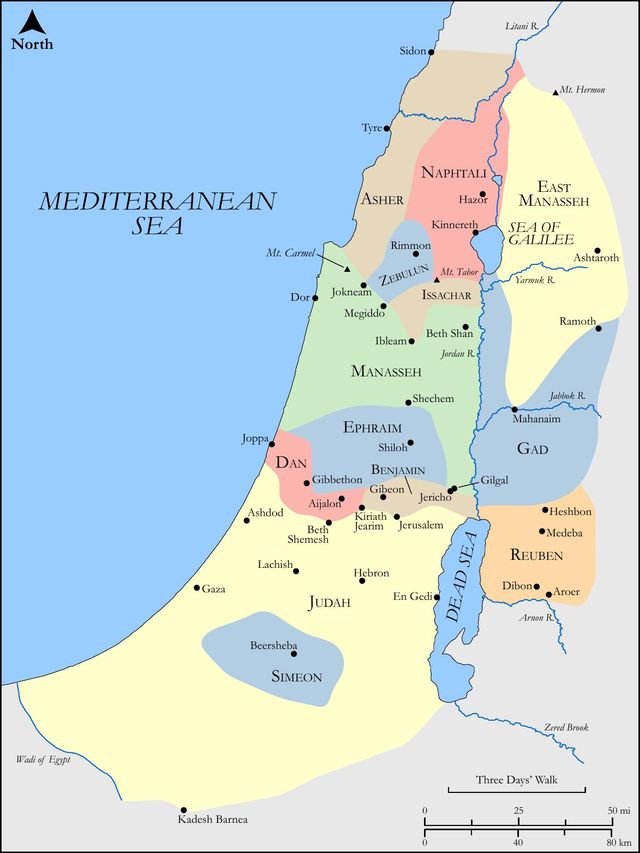
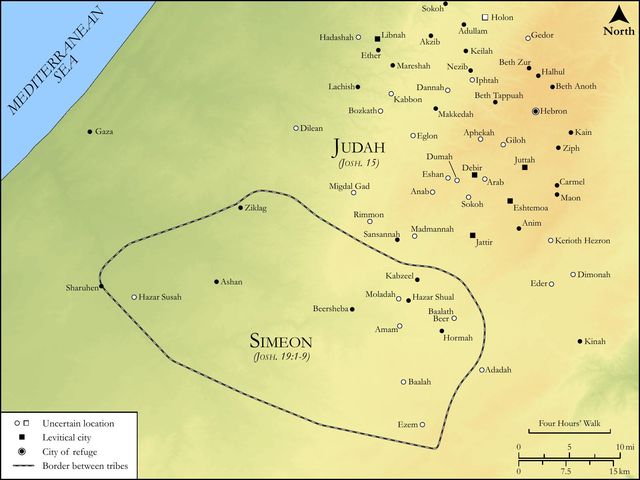
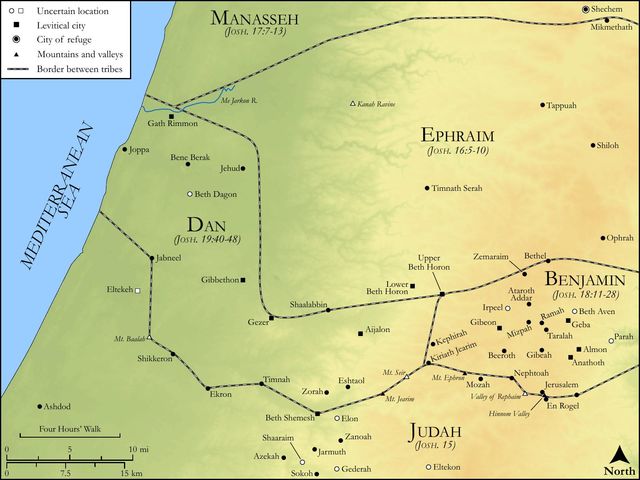
See on the biblical-era maps
Study this verse
Public-domain commentary
Matthew Henry
From his Commentary on the Whole Bible. Henry comments on passages, not single verses — this entry covers Joshua 18:11–28.
We have here the lot of the tribe of Benjamin, which Providence cast next to Joseph on the one hand, because Benjamin was own and only brother to Joseph, and was little Benjamin (Psa 68:27), that needed the protection of great Joseph, and yet had a better protector, for the Lord shall cover him all the day long, Deu 33:12. And it was next to Judah on the other hand, that this tribe might hereafter unite with Judah in an adherence to the throne of David and the temple at Jerusalem. Here we have, 1. The exact borders and limits of this tribe, which we need not be exact in the explication of. As it had Judah on the south and Joseph on the north, so it had Jordan on the east and Dan on the west. The western border is said to compass the corner of the sea southward (Jos 18:14), whereas no part of the lot of this tribe came near to the great sea. Bishop Patrick thinks the meaning is that it ran along in a parallel line to the great sea, though at a distance. Dr. Fuller suggests that since it is not called the great sea, but only the sea, which often signifies any lake or mere, it may be meant of the pool of Gibeon, which may be called a corner or canton of the sea; it is called the great waters of Gibeon (Jer 41:12), and it is compassed by the western border of this tribe. 2. The particular cities in this tribe, not all, but the most considerable. Twenty-six are here named. Jericho is put first, though dismantled, and forbidden to be rebuilt as a city with gates and walls, because it might be built and inhabited as a country village, and so was not useless to this tribe. Gilgal, where Israel first encamped when Saul was made king (Sa1 11:15), was in this tribe. It was afterwards a very profane place. Hos 9:15, All their wickedness is in Gilgal. Beth-el was in this tribe, a famous place. Though Benjamin adhered to the house of David, yet Beth-el, it seems, was in the possession of the house of Joseph (Jdg 1:23-25), and there Jeroboam set up one of his calves. In this tribe was Gibeon, where the altar was in the beginning of Solomon's time, Ch2 1:3. Gibeah likewise, that infamous place where the Levite's concubine was abused. Mizpeh, and near it Samuel's Ebenezer, and also Anathoth, Jeremiah's city, were in this tribe, as was the northern part of Jerusalem. Paul was the honour of this tribe (Rom 11:1; Phi 3:5); but where his land lay we know not: he sought the better country.
Continue studying Joshua 18:18 across the web’s major study libraries — every link below opens this exact verse, chapter, or book on the destination site.
Read & Compare
 BibleGatewayThis verse in more than 200 translations and 70 languages.
 Bible.comThe YouVersion reader — hundreds of translations, reading plans, and highlights.
 ESV.orgCrossway's official English Standard Version reader.
 NET BibleThe NET translation with 60,000+ translators' notes on every rendering decision.
 STEP BibleTyndale House's free study tool — original text, vocabulary, and scholarly resources.
 BibliaLogos Bible Software's free web reader.
 USCCBThe New American Bible (Revised Edition) with the U.S. bishops' study notes.
Commentaries
 BibleHub CommentariesDozens of classic commentaries on this verse, gathered on one page.
 StudyLightMore than 100 commentary sets — the largest collection on the web.
 BibleRefPlain-English commentary on what this verse means, verse by verse.
 Enduring WordDavid Guzik's free commentary on this chapter, widely used by Bible teachers.
 Bible Study ToolsVerse commentary alongside Greek and Hebrew study aids.
Original Language & Research
- BibleHub InterlinearThe verse word by word — original language, transliteration, and English.
- BibleHub LexiconEvery word's original-language definition and Strong's entry.
 Blue Letter BibleDeep-study tools — Strong's numbers, concordance, and word studies.
 SefariaThe Hebrew text with Rashi and centuries of Jewish commentary.
Sermons, Hymns & Audio


TrulyRandomVerse is not affiliated with these sites and doesn’t control their content. They’re linked because they’re genuinely useful.
Summary
Joshua 18:18 meticulously delineates a segment of the northern boundary for the tribe of Benjamin, specifically detailing its interaction with the prominent geographical feature of the Arabah. This verse, though a precise topographical marker, is crucial for understanding the systematic and divinely orchestrated division of the Promised Land among the Israelite tribes, underscoring God's unwavering faithfulness in fulfilling His ancient covenant promises to His people and establishing their secure inheritance.
Context
ShowHideLiterary Context
Joshua 18:18 is situated within the latter half of the book of Joshua, specifically in the detailed account of the land's distribution among the remaining seven Israelite tribes (Joshua 18:1-19:51). Following the initial military conquests and the strategic establishment of the Tabernacle at Shiloh, as recorded in Joshua 18:1, Joshua initiated a systematic process of surveying and assigning territory. The tribes of Judah, Ephraim, and Manasseh had already received their portions. The immediate preceding verses, Joshua 18:11-17, describe the intricate boundaries of the tribe of Benjamin's inheritance. This particular verse continues that meticulous geographical outline, focusing on a specific segment of Benjamin's northern border as it interacts with the Jordan Valley. The exceptional precision found here is characteristic of the entire land distribution narrative, emphasizing divine order, meticulous planning, and the tangible fulfillment of God's promises.
Historical & Cultural Context
The historical backdrop for Joshua 18:18 is the post-conquest period in Canaan, a time when Israel functioned as a tribal confederacy before the establishment of a monarchy. In Israel, land was not merely an economic asset but the very foundation of identity, lineage, and covenant relationship with God. Each tribe's inheritance was perceived as a direct and tangible fulfillment of God's promises to Abraham, particularly the pledge of land to his descendants, as seen in Genesis 12:7. The cultural practice of meticulously defining and marking boundaries, often utilizing prominent natural features like valleys, mountains, and rivers, was paramount. This precision was vital for preventing inter-tribal disputes, securing each family's ancestral possession, and ensuring the long-term stability of the Israelite confederation. The "Arabah" was a universally recognized geographical feature—a significant rift valley—making it an ideal and unmistakable landmark for clear demarcation.
Key Themes
ShowHideThis verse, along with the broader context of Joshua 18, contributes significantly to several overarching themes in the book of Joshua and the Pentateuch. Foremost is the theme of Divine Faithfulness and Fulfillment, as God meticulously delivers on His ancient promises to give Israel the land, a pledge first articulated in Genesis 15:18. The detailed delineation of each tribal boundary, including Benjamin's, serves as tangible proof of God's unwavering commitment to His covenant people. Another prominent theme is Order and Precision, reflecting God's nature as a God of perfect order, not chaos. The land was not distributed haphazardly but with careful surveying, clear demarcation, and divine oversight, ensuring justice and peace among the tribes. Finally, the theme of Inheritance and Possession is central; each tribe received a specific, defined inheritance, emphasizing the importance of actively taking possession of what God has given. This concept foreshadows the spiritual inheritance believers have in Christ, as described in Ephesians 1:11.
Exposition and Analysis
ShowHideKey Word Analysis
ShowHideThis primitive root signifies a transition, meaning "to cross over" or "to go along." In Joshua 18:18, it describes the movement or trajectory of the boundary line, indicating that it proceeded or extended in a particular direction. The use of this verb emphasizes the active progression and precise tracing of the border, highlighting the careful and intentional surveying of the land.
From a root suggesting sterility, this term refers to a desert or, more specifically, a sterile valley. With the definite article, it designates the great rift valley extending from the Sea of Galilee down to the Red Sea, commonly known as the Jordan Valley. Its inclusion as a boundary marker underscores its prominence as an unmistakable natural feature in the ancient landscape, providing a clear and enduring demarcation for tribal territories due to its distinct geographical characteristics.
This primitive root means "to descend" or "to go downwards." In the context of a geographical boundary, it signifies a change in elevation, indicating that the border line physically descended into a lower region. This detail confirms the physical interaction of the border with the natural topography, making the description concrete and verifiable, particularly as it relates to entering the deep depression of the Arabah.
Verse Breakdown
ShowHide"And passed along toward the side over against Arabah northward"
This initial clause describes a segment of Benjamin's northern boundary. It indicates that the border extended or ran alongside the Arabah (the Jordan Valley), proceeding in a northerly direction. The phrase "over against" suggests proximity or opposition, meaning the boundary was either immediately adjacent to the western edge of the valley or ran along a ridge overlooking it, establishing the general alignment of this specific border segment.
"and went down unto Arabah"
This second clause specifies a crucial topographical shift in the boundary line. After running alongside the Arabah, the border then physically descended into the valley itself. This implies that the boundary did not merely skirt the valley but entered it, perhaps crossing it or following a path within its lower elevations. This detail provides the precise point or segment where the border intersected with the prominent geographical feature of the Jordan Valley, completing the description of this particular boundary section.
Literary Devices
ShowHideJoshua 18:18 primarily employs Topographical Description, a literary device characterized by the precise and detailed mapping of geographical features to define boundaries. This meticulous attention to specific place names and natural landmarks, such as the "Arabah," is pervasive throughout the land distribution accounts in the book of Joshua. This detail is not merely descriptive but serves a profound theological purpose, emphasizing the tangible reality of God's fulfilled promises. The Precision and Detail evident in the language ("over against Arabah northward," "went down unto Arabah") highlight the divine order and intentionality behind the land's apportionment. The subtle Repetition of "Arabah" within the short verse reinforces its significance as the primary geographical marker for this segment of Benjamin's border, anchoring the description to an undeniable physical reality and underscoring its importance as a clear and unmistakable landmark.
Theological and Thematic Connections
ShowHideJoshua 18:18, with its precise geographical detail, stands as a powerful testament to God's unwavering faithfulness and meticulous care in fulfilling His covenant promises. The physical demarcation of Benjamin's territory, like that of all the tribes, was not a random act but a tangible manifestation of God's ancient pledge to Abraham to give his descendants a land. This divine precision underscores that God's word is reliable and that His plans are executed with perfect order and intentionality. The land inheritance was the very foundation of Israel's identity and existence as a nation, a physical embodiment of their covenant relationship with Yahweh. It teaches us that God's promises are concrete, dependable, and fulfilled in specific, measurable ways, even down to the precise boundaries of a tribal inheritance, demonstrating His absolute sovereignty over all creation and history.
Reflection and Application
ShowHideWhile Joshua 18:18 describes an ancient geographical boundary, its underlying principles offer timeless lessons for believers today. The meticulous detail in which God ensured the precise fulfillment of His promise to give Israel their land reminds us that God is a God of absolute faithfulness and precision. He is attentive to the specifics of our lives, caring about the "boundaries" and provisions He has set for us, both materially and spiritually. Just as the Israelites had to "go down unto Arabah" and actively take possession of their physical inheritance, believers are called to actively embrace and live within the spiritual inheritance they have been given in Christ. This means recognizing the blessings, purposes, and spiritual realities that are ours through faith, and walking in them with intentionality, gratitude, and obedience. It encourages us to trust in God's perfect timing and way, knowing that every promise He has made will be fulfilled, and that His detailed plans for our lives are for our good and His glory.
Questions for Reflection
ShowHideFAQ
ShowHideWhat is the significance of "Arabah" in this verse?
ShowHideThe "Arabah" (Hebrew: עֲרָבָה, ʻărâbâh') refers to the great geological rift valley that encompasses the Jordan Valley. In the context of Joshua 18:18, it specifically denotes the northern part of this valley, through which the Jordan River flows. Its significance lies in its role as a prominent and unmistakable natural landmark. By specifying that Benjamin's boundary ran "over against Arabah northward" and then "went down unto Arabah," the text uses this major geographical feature to provide a clear, precise, and enduring demarcation for the tribal territory, preventing future disputes and confirming the meticulous nature of the land distribution as divinely ordained.
Why are these geographical details so important in the book of Joshua?
ShowHideThe meticulous geographical details throughout the book of Joshua, particularly in chapters like Joshua 18, serve several crucial purposes. First, they powerfully demonstrate the fulfillment of God's covenant promises to Abraham and his descendants to give them the land of Canaan (Genesis 12:7). The detailed boundaries prove that God's word is faithful and precise. Second, they establish divine order and justice in the allocation of the land, ensuring each tribe received its rightful inheritance and minimizing potential conflicts. Third, these details were foundational for tribal identity and inheritance, rooting each family and clan in a specific, divinely appointed place. Finally, the accuracy of these descriptions underscores the historical veracity of the biblical narrative, showing a deep familiarity with the land and its features, thereby building confidence in the inspired text.
Does this verse have any relevance for believers today?
ShowHideAbsolutely. While Joshua 18:18 describes a physical boundary, it illustrates timeless spiritual principles. It highlights God's faithfulness and meticulous attention to detail in fulfilling His promises. Just as He precisely delivered the land to Israel, we can trust that He will fulfill His promises to us. It also speaks to the concept of inheritance and possession. The Israelites had to "go down unto Arabah" to claim their land; similarly, believers are called to actively embrace and live within the spiritual inheritance they have in Christ, which includes blessings, purpose, and the indwelling Holy Spirit (Ephesians 1:11). This verse encourages us to trust God's sovereignty over the "boundaries" of our lives and to walk confidently in the abundant spiritual provisions He has made available through His Son.
Christ-Centered Fulfillment
ShowHideJoshua 18:18, with its emphasis on the precise demarcation of a physical inheritance, finds its ultimate Christ-centered fulfillment in the spiritual inheritance and eternal dwelling place secured for believers through Jesus Christ. Just as the land of Canaan was a tangible fulfillment of God's promises to Abraham, so Christ is the ultimate fulfillment of all God's promises, providing a spiritual inheritance far surpassing any earthly territory. The meticulous detail in defining Benjamin's border foreshadows the divine precision with which God has established the New Covenant in Christ, where believers are given "every spiritual blessing in the heavenly places" (Ephesians 1:3). Jesus is the true "land" or "rest" into which believers enter by faith (Hebrews 4:9-10), and through Him, we are granted an "inheritance that is imperishable, undefiled, and unfading, kept in heaven for you" (1 Peter 1:4). The physical boundaries of Canaan were temporary and subject to human failure, but the spiritual boundaries of God's kingdom, established by the precious blood of the Lamb of God, who takes away the sin of the world, are eternal and secure. Ultimately, the meticulous division of the land points to the new heavens and new earth, where God's redeemed people will dwell with Him forever in a perfectly ordered and eternally possessed inheritance, a reality beautifully described in Revelation 21:1-4.