


Joshua 18:19
Bible text: King James Version (1769 Blayney text) · Public domain
Bible text: King James Version with Strong's numbers · Public domain
Bible text: Berean Standard Bible · Public domain
Bible text: American Standard Version (1901) · Public domain
Bible text: World English Bible, Messianic edition · Public domain
Bible text: Geneva Bible (1599) · Public domain
Bible text: Young's Literal Translation · Public domain
- וְעָבַרve·'a·Varand it passes onH5674Conj-w ¦ V-Qal-ConsecPerf-3msVerb Qal Consecutive Perfect 3rd Singular Masculineוְandעָבַרit passes on
- הַגְּבוּלha·ge·Vulthe borderH1366Art ¦ N-msNoun Singular Masculine Absoluteהַtheגְּבוּלborder
- אֶל'eltoH413PrepPreposition
- כֶּתֶףKe·tef[the] slope ofH3802N-fscNoun Singular Feminine Construct
- בֵּיתbeitBethH1031N-properNoun Proper Location
- חָגְלָהcha·ge·LahHoglahH1031N-properNoun Proper Location
- צָפוֹנָהtza·fo·Nahnorth -wardH6828N-fs ¦ SfxNoun Singular Feminine Absoluteצָפוֹנָnorthה-ward
- וְהָיוּve·ha·yahand they areH1961Conj-w ¦ V-Qal-ConsecPerf-3cpVerb Qal Consecutive Perfect 3rd Plural common genderוְandהָיוּthey are
- תֹּצְאוֹתto·tze·'o·tav[the] extremities ofH8444N-fpcNoun Plural Feminine Construct
- הַגְּבוּלha·ge·Vulthe territoryH1366Art ¦ N-msNoun Singular Masculine Absoluteהַtheגְּבוּלterritory
- אֶל'eltoH413PrepPreposition
- לְשׁוֹןle·Shon[the] bay ofH3956N-cscNoun Singular common gender Construct
- יָםyom[the] Sea ofH3220N-mscNoun Singular Masculine Construct
- הַמֶּלַחha·Me·lach<the> SaltH4417Art ¦ N-msNoun Singular Masculine Absoluteהַ<the>מֶּלַחSalt
- צָפוֹנָהtza·Fo·nahnorth -wardH6828N-fs ¦ SfxNoun Singular Feminine Absoluteצָפוֹנָnorthה-ward
- אֶל'eltoH413PrepPreposition
- קְצֵהke·Tzeh[the] end ofH7097N-mscNoun Singular Masculine Construct
- הַיַּרְדֵּןhai·yar·Denthe JordanH3383Art ¦ N-properNoun Proper LocationהַtheיַּרְדֵּןJordan
- נֶגְבָּהNeg·bah[the] south towardsH5045N-ms ¦ SfxNoun Singular Masculine Absoluteנֶגְבָּ[the] southהtowards
- זֶהzehthisH2088PrtParticle Demonstrative
- גְּבוּלge·Vul[is the] border ofH1366N-mscNoun Singular Masculine Construct
- נֶגֶבNe·gev[the] southH5045N-msNoun Singular Masculine Absolute
English is a literal word-by-word gloss of the Hebrew, not the KJV's wording. Why?
This is the original text the KJV's translators worked from — each Hebrew word with its own literal English meaning in this verse, prepared by scholars at Tyndale House, Cambridge. The KJV translates whole sentences, not word by word, so its wording differs: one Hebrew word can become several English words, and the KJV may choose “the LORD” where the gloss reads “Yahweh”. Both are faithful — they answer different questions. For the KJV's own rendering, switch to the KJV text.
Details
See on the biblical-era maps
Study this verse
Public-domain commentary
Matthew Henry
From his Commentary on the Whole Bible. Henry comments on passages, not single verses — this entry covers Joshua 18:11–28.
We have here the lot of the tribe of Benjamin, which Providence cast next to Joseph on the one hand, because Benjamin was own and only brother to Joseph, and was little Benjamin (Psa 68:27), that needed the protection of great Joseph, and yet had a better protector, for the Lord shall cover him all the day long, Deu 33:12. And it was next to Judah on the other hand, that this tribe might hereafter unite with Judah in an adherence to the throne of David and the temple at Jerusalem. Here we have, 1. The exact borders and limits of this tribe, which we need not be exact in the explication of. As it had Judah on the south and Joseph on the north, so it had Jordan on the east and Dan on the west. The western border is said to compass the corner of the sea southward (Jos 18:14), whereas no part of the lot of this tribe came near to the great sea. Bishop Patrick thinks the meaning is that it ran along in a parallel line to the great sea, though at a distance. Dr. Fuller suggests that since it is not called the great sea, but only the sea, which often signifies any lake or mere, it may be meant of the pool of Gibeon, which may be called a corner or canton of the sea; it is called the great waters of Gibeon (Jer 41:12), and it is compassed by the western border of this tribe. 2. The particular cities in this tribe, not all, but the most considerable. Twenty-six are here named. Jericho is put first, though dismantled, and forbidden to be rebuilt as a city with gates and walls, because it might be built and inhabited as a country village, and so was not useless to this tribe. Gilgal, where Israel first encamped when Saul was made king (Sa1 11:15), was in this tribe. It was afterwards a very profane place. Hos 9:15, All their wickedness is in Gilgal. Beth-el was in this tribe, a famous place. Though Benjamin adhered to the house of David, yet Beth-el, it seems, was in the possession of the house of Joseph (Jdg 1:23-25), and there Jeroboam set up one of his calves. In this tribe was Gibeon, where the altar was in the beginning of Solomon's time, Ch2 1:3. Gibeah likewise, that infamous place where the Levite's concubine was abused. Mizpeh, and near it Samuel's Ebenezer, and also Anathoth, Jeremiah's city, were in this tribe, as was the northern part of Jerusalem. Paul was the honour of this tribe (Rom 11:1; Phi 3:5); but where his land lay we know not: he sought the better country.
Continue studying Joshua 18:19 across the web’s major study libraries — every link below opens this exact verse, chapter, or book on the destination site.
Read & Compare
 BibleGatewayThis verse in more than 200 translations and 70 languages.
 Bible.comThe YouVersion reader — hundreds of translations, reading plans, and highlights.
 ESV.orgCrossway's official English Standard Version reader.
 NET BibleThe NET translation with 60,000+ translators' notes on every rendering decision.
 STEP BibleTyndale House's free study tool — original text, vocabulary, and scholarly resources.
 BibliaLogos Bible Software's free web reader.
 USCCBThe New American Bible (Revised Edition) with the U.S. bishops' study notes.
Commentaries
 BibleHub CommentariesDozens of classic commentaries on this verse, gathered on one page.
 StudyLightMore than 100 commentary sets — the largest collection on the web.
 BibleRefPlain-English commentary on what this verse means, verse by verse.
 Enduring WordDavid Guzik's free commentary on this chapter, widely used by Bible teachers.
 Bible Study ToolsVerse commentary alongside Greek and Hebrew study aids.
Original Language & Research
- BibleHub InterlinearThe verse word by word — original language, transliteration, and English.
- BibleHub LexiconEvery word's original-language definition and Strong's entry.
 Blue Letter BibleDeep-study tools — Strong's numbers, concordance, and word studies.
 SefariaThe Hebrew text with Rashi and centuries of Jewish commentary.
Sermons, Hymns & Audio


TrulyRandomVerse is not affiliated with these sites and doesn’t control their content. They’re linked because they’re genuinely useful.
Summary
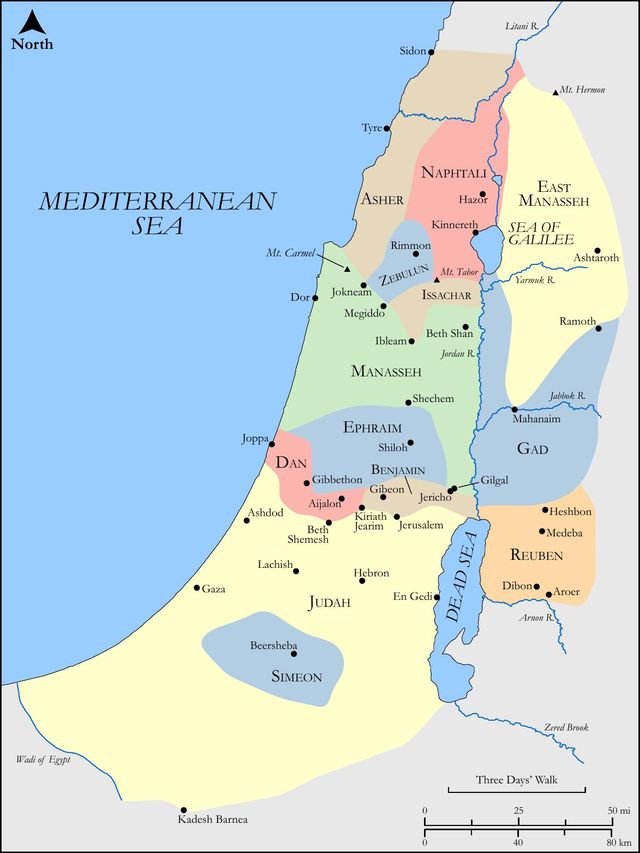
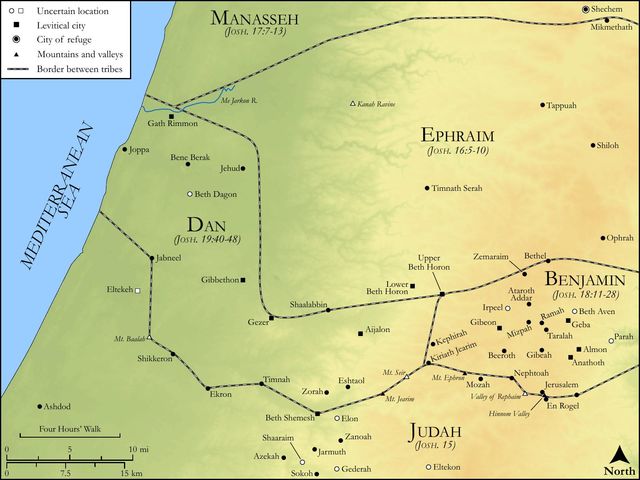
Joshua 18:19 offers a meticulously detailed description of a significant portion of the southern boundary for the tribe of Benjamin's allotted territory. This verse precisely traces the border's progression northward from the landmark of Bethhoglah, culminating at the northernmost bay of the Salt Sea (the Dead Sea) and the southern confluence of the Jordan River. This specific geographical delineation marks the extreme southeastern boundary of Benjamin's inheritance, powerfully underscoring the divine precision, order, and faithfulness inherent in the distribution of the Promised Land among the Israelite tribes.
Context
ShowHideLiterary Context
Joshua 18:19 is situated within the extensive narrative block of Joshua 13-19, which meticulously details the division of the land of Canaan among the Israelite tribes after the initial conquests. Following the establishment of the tabernacle at Shiloh, a central sanctuary for worship and governance as recorded in Joshua 18:1, Joshua commissioned a survey team to map the remaining unconquered territory. This survey was crucial for the fair and orderly distribution of land to the seven tribes who had not yet received their inheritance, including Benjamin. Joshua 18:11-28 specifically outlines the boundaries and cities assigned to the tribe of Benjamin. Therefore, Joshua 18:19 serves as a critical geographical anchor within this detailed description, highlighting the precise eastern segment of Benjamin's southern border. The meticulous nature of these border descriptions, often referencing prominent natural landmarks, emphasizes the systematic and divinely guided process of land allocation.
Historical & Cultural Context
The allocation of land was not merely a logistical exercise but a foundational act for the identity, security, and future of the Israelite tribes. In Israel, land ownership was intrinsically linked to the people's national identity, economic stability, and perceived divine favor. For Israel, this process represented the tangible fulfillment of God's ancient covenant promises to Abraham, Isaac, and Jacob, reiterated to Moses and Joshua, that their descendants would inherit the land of Canaan (e.g., Genesis 12:7 and Deuteronomy 1:8). The method of division by lot, as seen in Joshua 18:10, underscored the belief that God Himself was orchestrating the distribution, ensuring divine sanction, fairness, and preventing tribal disputes. The detailed border descriptions, referencing well-known and immutable landmarks like the Salt Sea and the Jordan River, served as legal documents, establishing permanent tribal territories and solidifying their place within the covenant nation.
Key Themes
ShowHideJoshua 18:19, and the broader context of land distribution, contributes significantly to several overarching themes in the book of Joshua. Firstly, it powerfully illustrates Divine Precision and Order. The meticulous descriptions of boundaries, down to specific landmarks and directions, demonstrate God's exactness and the systematic way He fulfills His promises. Every tribe received a clearly defined inheritance, designed to prevent future disputes and ensure societal order and justice. Secondly, the verse highlights the Fulfillment of Promise. The physical possession and division of the land represent the tangible culmination of centuries of divine promises, affirming God's unwavering faithfulness to His covenant people. This act of giving the land is repeatedly emphasized as God's faithful work (e.g., Joshua 21:43-45). Thirdly, the concept of Inheritance is central. Each tribe received a permanent dwelling place, symbolizing their established identity, security, and future within the covenant nation of Israel. This specific border was an integral part of the inheritance given to Benjamin, a testament to God's detailed provision for His people.
Exposition and Analysis
ShowHideKey Word Analysis
ShowHideDerived from a root meaning "to twist" or "to bind," this term (H1366) properly refers to a cord, and by extension, a boundary line or the territory enclosed by such a line. In Joshua 18:19, "border" signifies the meticulously defined demarcation separating Benjamin's territory from that of Judah to its south. The repeated use of this term throughout the land allocation chapters emphasizes the legal, permanent, and divinely ordained nature of these divisions, ensuring clarity and preventing disputes among the tribes.
This ancient place name (H1031), meaning "house of a partridge" or "house of a circle/dance," identifies a specific town or locality that served as a crucial landmark for the boundary line. Its mention underscores the highly detailed and localized knowledge of the land possessed by the surveyors and the biblical author. As a fixed, identifiable point, Bethhoglah provided an unmistakable reference for tracing the intricate and precise lines of tribal inheritance, particularly in the challenging topography near the Jordan Valley and the Dead Sea.
This term (H3383), meaning "descender" or "the descending one," refers to the Jordan River, the principal river of Palestine. Flowing from north to south into the Dead Sea, the Jordan served as a major geographical and political boundary throughout Israel's history. In this verse, its "south end" refers to its confluence with the Salt Sea, marking a precise and undeniable termination point for Benjamin's southeastern border. The Jordan River, as an immutable natural feature, provided a clear and permanent marker for the divinely ordained land divisions.
Verse Breakdown
ShowHide"And the border passed along to the side of Bethhoglah northward:"
This opening clause establishes the initial trajectory and a key reference point for Benjamin's southern boundary. Starting from the vicinity of Bethhoglah, a known landmark situated in the Jordan Valley, the boundary line extended in a northerly direction. This indicates a movement along the eastern edge of the territory, defining its precise course as it ascends towards the northern reaches of the Salt Sea. The phrase "passed along" suggests a continuous, delineated line, not merely a point.
"and the outgoings of the border were at the north bay of the salt sea at the south end of Jordan:"
This segment specifies the precise termination point of this particular border section. "Outgoings" (Hebrew: tôwtsâʼâh) refers to the termination or end points of the boundary, where it "goes out" or concludes. It clarifies that this section of the border reached the northernmost inlet or "bay" of the Salt Sea (the Dead Sea), precisely where the Jordan River empties into it from the south. This confluence of the Jordan and the Dead Sea forms a distinct, unmistakable, and permanent geographical marker, solidifying the boundary's exact location and leaving no room for ambiguity.
"this [was] the south coast."
This concluding phrase succinctly summarizes the preceding geographical description, serving as a definitive statement. It confirms that the meticulously detailed line just described constituted the southern boundary, or "coast" (referring to the edge or boundary line), of the territory being delineated for the tribe of Benjamin. This declaration reinforces the legal and binding nature of the land allocation.
Literary Devices
ShowHideThe primary literary device employed in Joshua 18:19 is Topography, which is the detailed and precise description of geographical features and their arrangement. The verse is almost entirely composed of specific geographical markers—Bethhoglah, northward direction, north bay of the Salt Sea, south end of Jordan—to delineate a precise border. This meticulous topographical detail serves not only as a practical guide for ancient Israel but also as a literary technique to emphasize the Precision and Order of God's fulfillment of His promises. The exactness of the description underscores the divine hand in the land's distribution, leaving no room for ambiguity or dispute regarding tribal inheritances. Furthermore, the repeated emphasis on "border" (Hebrew: gᵉbûwl) and its "outgoings" (Hebrew: tôwtsâʼâh) can be seen as a form of subtle Repetition, reinforcing the legal and permanent nature of the land allocation. The very act of such detailed listing also functions as Affirmation, solidifying the reality and certainty of God's covenant promises being brought to fruition.
Theological and Thematic Connections
ShowHideJoshua 18:19, while seemingly a dry geographical detail, is profoundly theological in its implications. It stands as a testament to the meticulous faithfulness of God in fulfilling His ancient promises to Abraham, Isaac, and Jacob concerning the land (e.g., Genesis 15:18-21). The precise delineation of borders demonstrates God's commitment to order, justice, and the provision of a secure inheritance for His people. This divine precision ensures that each tribe receives its rightful portion, preventing chaos and dispute, and solidifying their identity within the covenant community. It underscores that God's promises are not vague aspirations but concrete realities, executed with exactitude. This passage also implicitly highlights the concept of rest for Israel, as they finally settle into the land promised to them for generations, fulfilling the divine intention of a secure dwelling place where they could worship God without fear.
Reflection and Application
ShowHideThe meticulous detail of Joshua 18:19, far from being an irrelevant historical note, offers profound insights for contemporary believers. It serves as a powerful reminder of God's unwavering faithfulness and His commitment to fulfilling every promise, down to the smallest detail. Just as He precisely delineated the boundaries for Benjamin, He meticulously orchestrates the details of our lives, providing for us and establishing "boundaries" that are for our ultimate good and flourishing. This verse encourages us to trust in God's sovereign plan, even when the path seems complex or the details overwhelming. It also speaks to the importance of "inheritance"—not just physical land, but the spiritual blessings and identity we receive in Christ. Understanding our spiritual boundaries and the "lot" God has given us—our unique gifts, callings, relationships, and spheres of influence—is crucial for living a life of purpose, contentment, and peace, respecting both our own sphere and that of others within the body of Christ. God's precision in the past assures us of His present and future care.
Questions for Reflection
ShowHideFAQ
ShowHideWhy is such a detailed geographical description important in the Bible?
ShowHideDetailed geographical descriptions, like that in Joshua 18:19, are crucial for several reasons, extending beyond mere historical record. First, they serve as historical and legal documentation, affirming the literal and precise fulfillment of God's ancient promises to Abraham regarding the land of Canaan (e.g., Genesis 12:7). These precise boundaries established the tribal identities and their specific inheritance, preventing future disputes and ensuring order within the newly settled nation. Second, they underscore the divine precision and meticulousness of God's work. It demonstrates that God's plans are not vague or abstract but are executed with exactness, down to every detail, reflecting His orderly character. Third, these details provide concrete anchors for understanding the biblical narrative, allowing readers to visualize the landscape and appreciate the real-world context of the events described, making the history more tangible and relatable. They transform abstract promises into tangible realities.
Christ-Centered Fulfillment
ShowHideWhile Joshua 18:19 describes a physical inheritance of land, it powerfully foreshadows the spiritual inheritance found in Christ. The precise boundaries given to Benjamin, and indeed to all the tribes, point to God's meticulous provision and the secure "place" He prepares for His people. This physical land was a type of rest and security, yet it was ultimately temporary and imperfect, often contested and eventually lost. In the New Testament, Jesus declares, "Blessed are the meek, for they shall inherit the earth," transforming the concept of inheritance from a physical territory to a spiritual reality encompassing the new creation and the Kingdom of God. Through His atoning work on the cross, Christ is our true "land" and "rest," offering an eternal inheritance that is "imperishable, undefiled, and unfading, kept in heaven for you" (1 Peter 1:4). He is the ultimate fulfillment of all God's promises, granting believers not merely a plot of land, but an eternal dwelling with God and a secure share in His glorious kingdom (Ephesians 1:11). Just as God meticulously divided the land for Israel, Christ meticulously secures our spiritual inheritance, ensuring our eternal place in Him, a place of perfect peace and unending communion with God.