


Joshua 18:20
Bible text: King James Version (1769 Blayney text) · Public domain
Bible text: King James Version with Strong's numbers · Public domain
Bible text: Berean Standard Bible · Public domain
Bible text: American Standard Version (1901) · Public domain
Bible text: World English Bible, Messianic edition · Public domain
Bible text: Geneva Bible (1599) · Public domain
Bible text: Young's Literal Translation · Public domain
- וְהַיַּרְדֵּןve·hai·yar·Denand the JordanH3383Conj-w ¦ Art ¦ N-properNoun Proper LocationוְandהַtheיַּרְדֵּןJordan
- יִגְבֹּלyig·bolit bordersH1379V-Qal-Imperf-3msVerb Qal Imperfect 3rd Singular Masculine
- אֹתוֹ'o·To<obj.> itH853DirObjM ¦ 3msParticle Object Indicatorאֹת<obj.>וֹit
- לִפְאַתlif·'atto [the] side ofH6285Prep-l ¦ N-fscNoun Singular Feminine Constructלִtoפְאַת[the] side of
- קֵדְמָהKe·de·maheast -wardH6924N-ms ¦ SfxNoun Singular Masculine Absoluteקֵדְמָeastה-ward
- זֹאתzotthisH2063PrtParticle Demonstrative
- נַחֲלַתna·cha·Lat[was] [the] inheritance ofH5159N-fscNoun Singular Feminine Construct
- בְּנֵיbe·Nei[the] descendants ofH1121N-mpcNoun Plural Masculine Construct
- בִנְיָמִןvin·ya·MinBenjaminH1144N-proper-mNoun Proper Masculine
- לִגְבוּלֹתֶיהָlig·vu·lo·Tei·hato its bordersH1367Prep-l ¦ N-fpc ¦ 3fsNoun Plural Feminine Constructלִtoגְבוּלֹתֶיbordersהָits
- סָבִיבsa·VivaroundH5439N-csNoun Singular common gender Absolute
- לְמִשְׁפְּחֹתָםle·mish·pe·cho·Tamto their clansH4940Prep-l ¦ N-fpc ¦ 3mpNoun Plural Feminine Constructלְtoמִשְׁפְּחֹתָclansםtheir
English is a literal word-by-word gloss of the Hebrew, not the KJV's wording. Why?
This is the original text the KJV's translators worked from — each Hebrew word with its own literal English meaning in this verse, prepared by scholars at Tyndale House, Cambridge. The KJV translates whole sentences, not word by word, so its wording differs: one Hebrew word can become several English words, and the KJV may choose “the LORD” where the gloss reads “Yahweh”. Both are faithful — they answer different questions. For the KJV's own rendering, switch to the KJV text.
Details
See on the biblical-era maps
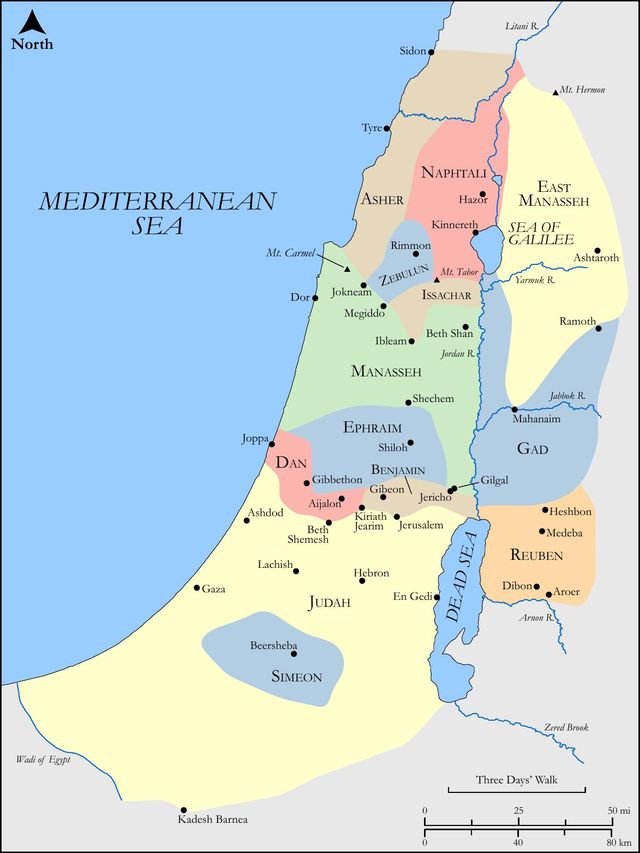
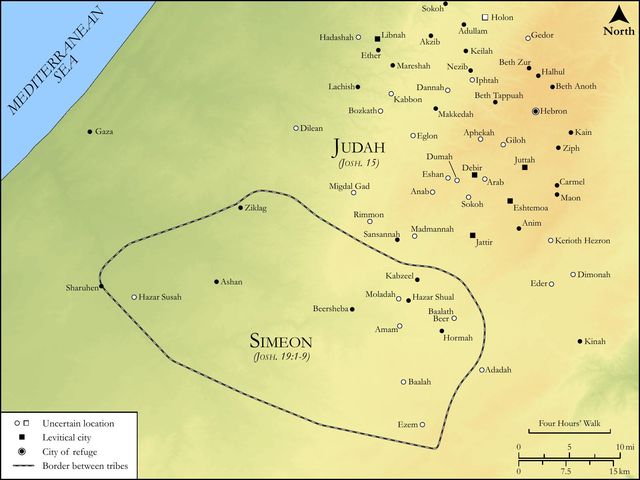
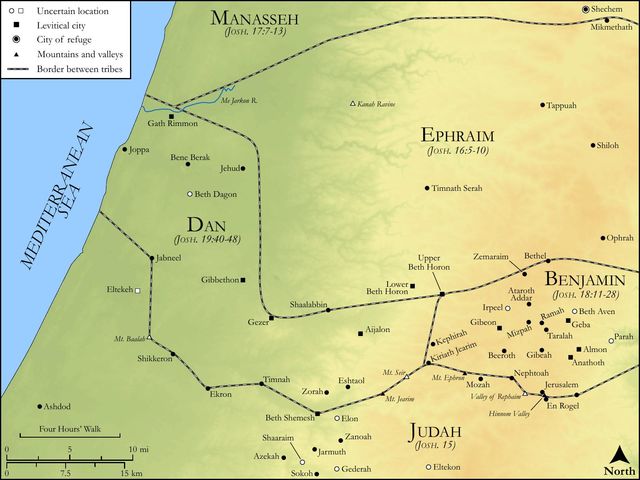
Study this verse
Public-domain commentary
Matthew Henry
From his Commentary on the Whole Bible. Henry comments on passages, not single verses — this entry covers Joshua 18:11–28.
We have here the lot of the tribe of Benjamin, which Providence cast next to Joseph on the one hand, because Benjamin was own and only brother to Joseph, and was little Benjamin (Psa 68:27), that needed the protection of great Joseph, and yet had a better protector, for the Lord shall cover him all the day long, Deu 33:12. And it was next to Judah on the other hand, that this tribe might hereafter unite with Judah in an adherence to the throne of David and the temple at Jerusalem. Here we have, 1. The exact borders and limits of this tribe, which we need not be exact in the explication of. As it had Judah on the south and Joseph on the north, so it had Jordan on the east and Dan on the west. The western border is said to compass the corner of the sea southward (Jos 18:14), whereas no part of the lot of this tribe came near to the great sea. Bishop Patrick thinks the meaning is that it ran along in a parallel line to the great sea, though at a distance. Dr. Fuller suggests that since it is not called the great sea, but only the sea, which often signifies any lake or mere, it may be meant of the pool of Gibeon, which may be called a corner or canton of the sea; it is called the great waters of Gibeon (Jer 41:12), and it is compassed by the western border of this tribe. 2. The particular cities in this tribe, not all, but the most considerable. Twenty-six are here named. Jericho is put first, though dismantled, and forbidden to be rebuilt as a city with gates and walls, because it might be built and inhabited as a country village, and so was not useless to this tribe. Gilgal, where Israel first encamped when Saul was made king (Sa1 11:15), was in this tribe. It was afterwards a very profane place. Hos 9:15, All their wickedness is in Gilgal. Beth-el was in this tribe, a famous place. Though Benjamin adhered to the house of David, yet Beth-el, it seems, was in the possession of the house of Joseph (Jdg 1:23-25), and there Jeroboam set up one of his calves. In this tribe was Gibeon, where the altar was in the beginning of Solomon's time, Ch2 1:3. Gibeah likewise, that infamous place where the Levite's concubine was abused. Mizpeh, and near it Samuel's Ebenezer, and also Anathoth, Jeremiah's city, were in this tribe, as was the northern part of Jerusalem. Paul was the honour of this tribe (Rom 11:1; Phi 3:5); but where his land lay we know not: he sought the better country.
Continue studying Joshua 18:20 across the web’s major study libraries — every link below opens this exact verse, chapter, or book on the destination site.
Read & Compare
 BibleGatewayThis verse in more than 200 translations and 70 languages.
 Bible.comThe YouVersion reader — hundreds of translations, reading plans, and highlights.
 ESV.orgCrossway's official English Standard Version reader.
 NET BibleThe NET translation with 60,000+ translators' notes on every rendering decision.
 STEP BibleTyndale House's free study tool — original text, vocabulary, and scholarly resources.
 BibliaLogos Bible Software's free web reader.
 USCCBThe New American Bible (Revised Edition) with the U.S. bishops' study notes.
Commentaries
 BibleHub CommentariesDozens of classic commentaries on this verse, gathered on one page.
 StudyLightMore than 100 commentary sets — the largest collection on the web.
 BibleRefPlain-English commentary on what this verse means, verse by verse.
 Enduring WordDavid Guzik's free commentary on this chapter, widely used by Bible teachers.
 Bible Study ToolsVerse commentary alongside Greek and Hebrew study aids.
Original Language & Research
- BibleHub InterlinearThe verse word by word — original language, transliteration, and English.
- BibleHub LexiconEvery word's original-language definition and Strong's entry.
 Blue Letter BibleDeep-study tools — Strong's numbers, concordance, and word studies.
 SefariaThe Hebrew text with Rashi and centuries of Jewish commentary.
Sermons, Hymns & Audio


TrulyRandomVerse is not affiliated with these sites and doesn’t control their content. They’re linked because they’re genuinely useful.
Summary
Joshua 18:20 precisely delineates the eastern boundary of the territory allotted to the tribe of Benjamin, affirming the Jordan River as its definitive demarcation. This verse solidifies Benjamin's inheritance, meticulously outlining its geographical limits "round about, according to their families," thereby underscoring God's unwavering faithfulness in fulfilling His covenant promises and the orderly administration of the Promised Land among the tribes of Israel. It highlights the deeply familial and divinely ordained nature of their territorial possession, which was central to their identity, stability, and future prosperity within the emerging nation.
Context
ShowHideLiterary Context
Joshua 18:20 serves as the concluding verse in the detailed description of Benjamin's tribal inheritance, which spans from Joshua 18:11 to Joshua 18:20. This section is part of the larger narrative in Joshua 18, where the remaining seven tribes, having not yet received their inheritance, are exhorted by Joshua to survey the land and divide it into seven parts (Joshua 18:3-6). Following the survey, Joshua casts lots at Shiloh (Joshua 18:10), and Benjamin's lot is drawn first among these remaining tribes. The preceding chapters detailed the inheritances of Judah, Ephraim, and Manasseh, making Benjamin's allotment a crucial next step in the systematic, divinely guided distribution of the land promised by God. The specificity of the boundaries, including the Jordan River, emphasizes the precision and finality of this sacred allocation.
Historical & Cultural Context
The division of the land was a foundational act for the nascent nation of Israel, transforming them from a nomadic people into a settled confederacy of tribes. In ancient Israel, land was intrinsically linked to identity, lineage, and covenant fulfillment. The concept of "inheritance" (Hebrew: nachalah) was not merely about possession but about a divinely granted, inalienable heritage passed down through families, ensuring tribal continuity, economic stability, and adherence to the Mosaic Law regarding land tenure. Benjamin's strategic location, nestled between the powerful tribes of Judah to the south and Ephraim to the north, was immensely significant. This positioning meant Benjamin would often be at the crossroads of major political and military developments, including the eventual location of Jerusalem, a city whose capture and full integration into Israelite territory proved complex, as seen in Judges 1:21. The meticulous detailing of borders, such as the Jordan River, was critical in a pre-modern society to prevent disputes and establish clear jurisdictional lines, reflecting both administrative necessity and divine order.
Key Themes
ShowHideThe meticulous detailing of Benjamin's boundaries, particularly the eastern border along the Jordan, powerfully underscores several key themes within the book of Joshua and the broader Pentateuch. Firstly, it highlights Divine Faithfulness and Fulfillment, demonstrating God's unwavering commitment to His covenant promises, specifically the grant of land to Abraham's descendants, as first articulated in Genesis 12:7 and reiterated throughout the wilderness wanderings (e.g., Deuteronomy 1:8). The systematic division of the land, tribe by tribe, is a tangible manifestation of God's word being brought to pass. Secondly, the emphasis on precise borders and the casting of lots at Shiloh (Joshua 18:10) illustrates Order and Administration, showcasing Joshua's leadership in implementing a divinely guided, orderly process of land allocation. This ensured each family and tribe received its rightful and defined portion, minimizing future territorial conflicts. Lastly, the phrase "according to their families" reinforces the theme of Tribal Identity and Inheritance, emphasizing that the land was not merely a geographical space but an integral part of each tribe's unique identity and future prosperity, reflecting the deep connection between land, lineage, and the perpetuation of God's promises to His people.
Exposition and Analysis
ShowHideKey Word Analysis
ShowHideRefers to the Jordan River, the principal river of Palestine, a major geographical feature that served as a natural eastern boundary for much of Israel's territory. Its mention here specifically delineates Benjamin's eastern limit, emphasizing a clear, divinely appointed border that was both physical and symbolic. The Jordan was a significant landmark in Israel's history, from the miraculous crossing under Joshua in Joshua 3 to its role in various prophetic narratives, marking a transition from wilderness to inheritance.
This term, derived from a primitive root meaning "to twist as a rope" or "to bound (as by a line)," denotes a fixed boundary or region. Its repeated use throughout Joshua 18 and other land distribution chapters underscores the precision and permanence of the tribal allotments. The "border" was not arbitrary but established by divine decree and human survey, ensuring each tribe's specific and inalienable inheritance. It speaks to God's orderliness and the security of the land grant.
A crucial theological term in the Old Testament, signifying something inherited, an occupancy, an heirloom, or generally an estate, patrimony, or portion. In this context, it emphasizes that Benjamin's land was not merely conquered territory but a sacred, permanent gift from God, a fulfillment of His covenant promises to Abraham and his descendants. This term elevates the land's significance beyond mere real estate to a spiritual endowment, a divinely secured possession.
This term, meaning "a family, i.e., circle of relatives; figuratively, a class (of persons), a species (of animals) or sort (of things); by extension a tribe or people," highlights the familial basis of the land distribution. The inheritance was not just for the tribe as a whole but was apportioned down to the family units within each tribe. This ensured social stability, fairness, and the preservation of lineage, reinforcing the deep connection between land, identity, and the perpetuation of God's covenant with each generation.
Verse Breakdown
ShowHide"And Jordan was the border of it on the east side."
This clause precisely defines the eastern limit of Benjamin's territory. The Jordan River, a prominent and unmistakable geographical feature, served as a clear and unchangeable boundary. This highlights the meticulousness of the land division and the geographical accuracy of the biblical record, providing a fixed point of reference for Benjamin's inheritance and demonstrating God's precise provision.
"This [was] the inheritance of the children of Benjamin,"
This declarative statement affirms that the previously described territory, now bounded on the east by the Jordan, was indeed the divinely allotted portion for the tribe of Benjamin. The term "inheritance" (Hebrew: nachălâh) emphasizes that this land was a sacred, permanent possession, a fulfillment of God's covenant promise rather than merely a conquered acquisition. It underscores the security and legitimacy of their claim, rooted in divine decree.
"by the coasts thereof round about, according to their families."
This concluding phrase reinforces the comprehensive nature of the inheritance ("round about," meaning encompassing all sides or environs) and, crucially, its distribution down to the familial level. The land was not merely for the tribe in general but was parceled out to the individual families and clans within Benjamin, ensuring that each household received its specific portion. This speaks to the meticulous detail of God's provision and the social structure of Israel, where land ownership was tied to lineage and provided a basis for identity and livelihood for generations.
Literary Devices
ShowHideThe verse, though brief and descriptive, employs several literary techniques that enhance its meaning and impact. Precision and Detailing are evident in the specific mention of "Jordan" and "east side," which anchors the abstract concept of inheritance in concrete geography. This meticulousness is characteristic of the land distribution accounts in Joshua, emphasizing the literal and accurate fulfillment of God's promises. The use of Repetition of terms like "border" and "inheritance" throughout Joshua 18 (and the book as a whole) reinforces their significance, highlighting the divine order and the secure nature of the land grants. Furthermore, the verse functions as a Fulfillment Narrative, serving as a concluding statement that marks the completion of Benjamin's specific allotment, a tangible manifestation of God's faithfulness to His covenant. The phrase "according to their families" also subtly uses Synecdoche, where "families" represents the individual households and clans that collectively make up the larger tribe, underscoring the granular level of God's provision and the foundational social structure of Israelite society.
Theological and Thematic Connections
ShowHideJoshua 18:20, in its precise delineation of Benjamin's eastern border along the Jordan, speaks volumes about God's character and His interaction with humanity. It is a profound testament to God's unwavering faithfulness to His covenant promises, particularly the land grant to Abraham's descendants. The meticulous detail in defining boundaries underscores God's commitment to order, justice, and the secure establishment of His people. This earthly inheritance foreshadows a greater, spiritual inheritance, demonstrating God's desire to provide a secure dwelling place for His people, both physically in the Promised Land and spiritually in His presence. The land was not merely a possession but a tangible sign of God's enduring covenant love and His meticulous care for each tribe and family, ensuring their identity and future within His divine plan.
Reflection and Application
ShowHideThe detailed account of Benjamin's inheritance, culminating in the clear demarcation of its eastern border by the Jordan, offers profound lessons for contemporary believers. Just as God meticulously provided a defined and secure inheritance for the tribe of Benjamin, He also provides a spiritual inheritance for us in Christ, a reality far surpassing any earthly possession. This reminds us of God's absolute faithfulness to His promises, even when the path to fulfillment seems long or challenging. We are called to recognize and live within the "borders" God has set for our lives—His commands, His will, and the spiritual gifts and callings He has given us. Operating within these divine boundaries brings security, purpose, and flourishing, preventing the spiritual "disputes" and aimlessness that come from straying outside of God's design. The familial basis of Benjamin's inheritance also highlights the importance of our spiritual family—the church—and the shared inheritance we have as co-heirs with Christ. It encourages us to steward our spiritual blessings and earthly resources with the same intentionality and gratitude that the Israelites were expected to show for their land, recognizing that all we have is a gift from God, to be used for His glory and the good of His kingdom.
Questions for Reflection
ShowHideFAQ
ShowHideWhy is the description of the tribal boundaries so detailed in the book of Joshua?
ShowHideThe meticulous detailing of tribal boundaries throughout Joshua, including Joshua 18:20, serves several crucial purposes. Firstly, it underscores God's faithfulness in literally fulfilling His covenant promise to Abraham to give his descendants the land of Canaan (Genesis 12:7). The precision demonstrates that this was not a vague promise but a concrete, tangible reality. Secondly, it provided legal and administrative clarity for the nascent nation of Israel, preventing future disputes over territorial claims among the tribes. Clear boundaries were essential for social order, justice, and the stability of the tribal confederacy. Lastly, the detail emphasizes the divine order and meticulousness of God's plan, showing that every aspect of Israel's establishment in the land was carefully orchestrated by Him.
What was the significance of Benjamin's location between Judah and Ephraim?
ShowHideBenjamin's strategic location, situated directly between the powerful southern tribe of Judah and the influential northern tribe of Ephraim, was highly significant. This positioning meant Benjamin often served as a geographical and political bridge between the two dominant tribal blocs. Historically, this location made Benjamin a key player in many of Israel's internal conflicts and alliances, particularly during the period of the Judges and the early monarchy. The city of Jerusalem, which eventually became the capital, was located within Benjamin's territory, though its capture was complex and involved both Judah and Benjamin (Judges 1:8 and Judges 1:21). This central position also exposed Benjamin to various cultural and military influences, shaping its unique tribal identity and often placing it at the heart of national events.
How does the concept of "inheritance" in Joshua relate to believers today?
ShowHideThe concept of "inheritance" (Hebrew: nachălâh) in Joshua 18:20, referring to a divinely granted and permanent possession, has profound spiritual parallels for believers today. While Israel received a physical land inheritance, Christians are promised a spiritual inheritance in Christ. This spiritual inheritance is not a geographical plot but encompasses eternal life, salvation, the indwelling Holy Spirit, adoption into God's family, and a future in God's heavenly kingdom (Ephesians 1:11; Colossians 3:24). Just as Benjamin's inheritance was secure and divinely appointed, our spiritual inheritance is guaranteed by God's faithfulness and the finished work of Christ. It reminds us that our ultimate hope and security are found not in earthly possessions but in the eternal blessings we have in Him, which are imperishable and undefiled.
Christ-Centered Fulfillment
ShowHideThe earthly inheritance granted to the tribe of Benjamin, meticulously defined by the Jordan River as its eastern border in Joshua 18:20, finds its ultimate and profound fulfillment in Jesus Christ. The Promised Land, with its secure boundaries and divinely appointed portions, served as a tangible, yet temporary, foreshadowing of the eternal inheritance that believers receive through Christ. Just as the land was a gift of God's faithfulness to Abraham's descendants, so too is our spiritual inheritance in Christ a gift of God's grace, secured by His new covenant. Jesus is the true and ultimate "land" or "rest" for His people, offering a permanent dwelling place and security that transcends any earthly territory (Hebrews 4:9-10). Through His atoning sacrifice, Christ has opened the way for us to become co-heirs with Him, receiving an "inheritance that is imperishable, undefiled, and unfading, kept in heaven for you" (1 Peter 1:4). The precise boundaries of Benjamin's land point to the certainty and security of God's promises, which are all "Yes" and "Amen" in Christ (2 Corinthians 1:20). Thus, the physical inheritance in Joshua culminates in the spiritual reality of belonging to God's eternal kingdom, where Christ Himself is our inheritance and our ultimate dwelling place, a new heaven and new earth where God Himself dwells with His people (Revelation 21:3).