


Joshua 18:21
Bible text: King James Version (1769 Blayney text) · Public domain
Bible text: Berean Standard Bible · Public domain
Bible text: American Standard Version (1901) · Public domain
Bible text: World English Bible, Messianic edition · Public domain
Bible text: Geneva Bible (1599) · Public domain
Bible text: Young's Literal Translation · Public domain
- וְהָיוּve·ha·Yuand they belongedH1961Conj-w ¦ V-Qal-ConsecPerf-3cpVerb Qal Consecutive Perfect 3rd Plural common genderוְandהָיוּthey belonged
- הֶעָרִיםhe·'a·Rimthe citiesH5892Art ¦ N-mpNoun Plural Masculine Absoluteהֶtheעָרִיםcities
- לְמַטֵּהle·ma·Tehto [the] tribe ofH4294Prep-l ¦ N-mscNoun Singular Masculine Constructלְtoמַטֵּה[the] tribe of
- בְּנֵיbe·Nei[the] descendants ofH1121N-mpcNoun Plural Masculine Construct
- בִנְיָמִןvin·ya·MinBenjaminH1144N-proper-mNoun Proper Masculine
- לְמִשְׁפְּחוֹתֵיהֶםle·mish·pe·cho·tei·Hemto their clansH4940Prep-l ¦ N-fpc ¦ 3mpNoun Plural Feminine Constructלְtoמִשְׁפְּחוֹתֵיclansהֶםtheir
- יְרִיחוֹye·ri·ChoJerichoH3405N-properNoun Proper Location
- וּבֵיתu·veitand BethH1031Conj-w ¦ N-properNoun Proper LocationוּandבֵיתBeth
- חָגְלָהcha·ge·LahHoglahH1031N-properNoun Proper Location
- וְעֵמֶקve·'E·mekand EmekH6010Conj-w ¦ N-mscNoun Singular Masculine ConstructוְandעֵמֶקEmek
- קְצִיץke·TzitzKezizH7104N-properNoun Proper Location
English is a literal word-by-word gloss of the Hebrew, not the KJV's wording. Why?
This is the original text the KJV's translators worked from — each Hebrew word with its own literal English meaning in this verse, prepared by scholars at Tyndale House, Cambridge. The KJV translates whole sentences, not word by word, so its wording differs: one Hebrew word can become several English words, and the KJV may choose “the LORD” where the gloss reads “Yahweh”. Both are faithful — they answer different questions. For the KJV's own rendering, switch to the KJV text.
Details
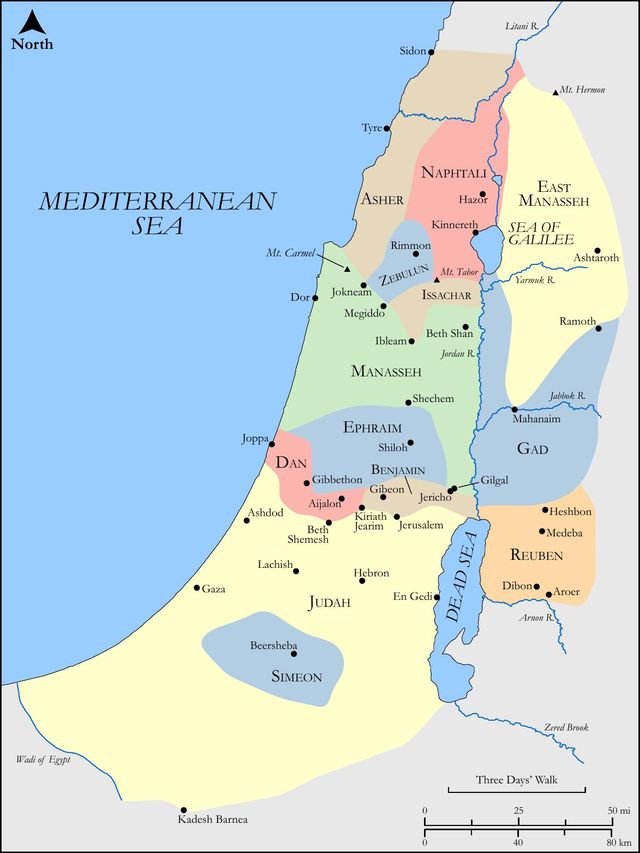
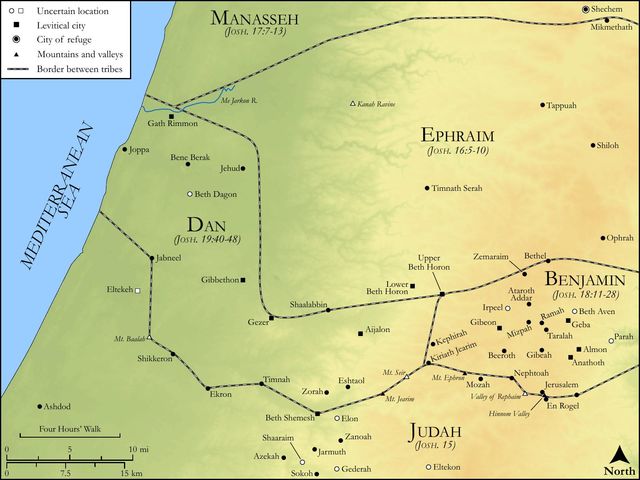
See on the biblical-era maps
Study this verse
Public-domain commentary
Matthew Henry
From his Commentary on the Whole Bible. Henry comments on passages, not single verses — this entry covers Joshua 18:11–28.
We have here the lot of the tribe of Benjamin, which Providence cast next to Joseph on the one hand, because Benjamin was own and only brother to Joseph, and was little Benjamin (Psa 68:27), that needed the protection of great Joseph, and yet had a better protector, for the Lord shall cover him all the day long, Deu 33:12. And it was next to Judah on the other hand, that this tribe might hereafter unite with Judah in an adherence to the throne of David and the temple at Jerusalem. Here we have, 1. The exact borders and limits of this tribe, which we need not be exact in the explication of. As it had Judah on the south and Joseph on the north, so it had Jordan on the east and Dan on the west. The western border is said to compass the corner of the sea southward (Jos 18:14), whereas no part of the lot of this tribe came near to the great sea. Bishop Patrick thinks the meaning is that it ran along in a parallel line to the great sea, though at a distance. Dr. Fuller suggests that since it is not called the great sea, but only the sea, which often signifies any lake or mere, it may be meant of the pool of Gibeon, which may be called a corner or canton of the sea; it is called the great waters of Gibeon (Jer 41:12), and it is compassed by the western border of this tribe. 2. The particular cities in this tribe, not all, but the most considerable. Twenty-six are here named. Jericho is put first, though dismantled, and forbidden to be rebuilt as a city with gates and walls, because it might be built and inhabited as a country village, and so was not useless to this tribe. Gilgal, where Israel first encamped when Saul was made king (Sa1 11:15), was in this tribe. It was afterwards a very profane place. Hos 9:15, All their wickedness is in Gilgal. Beth-el was in this tribe, a famous place. Though Benjamin adhered to the house of David, yet Beth-el, it seems, was in the possession of the house of Joseph (Jdg 1:23-25), and there Jeroboam set up one of his calves. In this tribe was Gibeon, where the altar was in the beginning of Solomon's time, Ch2 1:3. Gibeah likewise, that infamous place where the Levite's concubine was abused. Mizpeh, and near it Samuel's Ebenezer, and also Anathoth, Jeremiah's city, were in this tribe, as was the northern part of Jerusalem. Paul was the honour of this tribe (Rom 11:1; Phi 3:5); but where his land lay we know not: he sought the better country.
Continue studying Joshua 18:21 across the web’s major study libraries — every link below opens this exact verse, chapter, or book on the destination site.
Read & Compare
 BibleGatewayThis verse in more than 200 translations and 70 languages.
 Bible.comThe YouVersion reader — hundreds of translations, reading plans, and highlights.
 ESV.orgCrossway's official English Standard Version reader.
 NET BibleThe NET translation with 60,000+ translators' notes on every rendering decision.
 STEP BibleTyndale House's free study tool — original text, vocabulary, and scholarly resources.
 BibliaLogos Bible Software's free web reader.
 USCCBThe New American Bible (Revised Edition) with the U.S. bishops' study notes.
Commentaries
 BibleHub CommentariesDozens of classic commentaries on this verse, gathered on one page.
 StudyLightMore than 100 commentary sets — the largest collection on the web.
 BibleRefPlain-English commentary on what this verse means, verse by verse.
 Enduring WordDavid Guzik's free commentary on this chapter, widely used by Bible teachers.
 Bible Study ToolsVerse commentary alongside Greek and Hebrew study aids.
Original Language & Research
- BibleHub InterlinearThe verse word by word — original language, transliteration, and English.
- BibleHub LexiconEvery word's original-language definition and Strong's entry.
 Blue Letter BibleDeep-study tools — Strong's numbers, concordance, and word studies.
 SefariaThe Hebrew text with Rashi and centuries of Jewish commentary.
Sermons, Hymns & Audio


TrulyRandomVerse is not affiliated with these sites and doesn’t control their content. They’re linked because they’re genuinely useful.
Summary
Joshua 18:21 precisely enumerates three significant geographical locations—Jericho, Bethhoglah, and the valley of Keziz—as integral components of the initial land inheritance designated for the tribe of Benjamin. This verse serves as a meticulous record within the larger narrative of Israel's land distribution, underscoring God's unwavering faithfulness in fulfilling His covenant promises by providing His people with a clearly defined and secure territory in the Promised Land. It highlights the divine order, administrative detail, and the tangible reality of the inheritance process, ensuring each family received its designated portion as part of God's sovereign plan.
Context
ShowHideLiterary Context
Joshua 18:21 is situated within the meticulously detailed account of the land distribution among the Israelite tribes, following the establishment of the Tabernacle at Shiloh. Chapters 18 and 19 systematically record the territories assigned to the remaining seven tribes through the casting of lots before the Lord, a divinely sanctioned process. This particular verse, therefore, functions as a precise geographical marker within the northern boundary of Benjamin's inheritance, forming part of a comprehensive catalogue that validates the fulfillment of God's promise to Israel. The methodical listing of cities and boundaries throughout Joshua 18 and Joshua 19 emphasizes the divine order, the thoroughness with which Joshua and Eleazar executed the division of the land, and the legal precision of this foundational act for the nascent nation.
Historical & Cultural Context
The division of the land represented the culmination of Israel's forty-year wilderness journey and the initial conquest of Canaan. Land ownership in ancient Israel was not merely an economic or political matter but a foundational theological concept, symbolizing God's covenant faithfulness and the very identity of the nation. Each tribe's inheritance was considered permanent, passed down through families (Numbers 27:7-11), ensuring tribal continuity and preventing the accumulation of land by a few, thereby safeguarding fairness. The inclusion of Jericho in Benjamin's territory is particularly significant, as it was the first city conquered by Israel upon entering Canaan, its formidable walls famously falling by divine intervention as recorded in Joshua 6. Its reappearance here as an inherited city underscores the complete and irreversible nature of God's gift of the land, despite its initial destruction, signifying the comprehensive nature of God's promise and Israel's full possession.
Key Themes
ShowHideThis verse, along with the broader chapters it belongs to, contributes to several significant themes central to the book of Joshua and the Pentateuch. Foremost is the Fulfillment of Promise, demonstrating God's unwavering faithfulness to the covenant He made with Abraham, Isaac, and Jacob to give their descendants the land of Canaan as an eternal inheritance. The meticulous detail of the land distribution also highlights Divine Order and Administration, showcasing God's precision in His plans and the diligent execution by human leaders like Joshua and Eleazar. Furthermore, the assignment of distinct territories reinforced Tribal Identity and Inheritance, solidifying each tribe's unique place and responsibility within the larger nation of Israel, and serving as a tangible expression of their covenant relationship with God. This division was not arbitrary but a divinely guided process, ensuring justice and order among the people as they settled into their new homeland, as seen in the detailed boundaries described in Joshua 15 for Judah and Joshua 16 for the sons of Joseph.
Exposition and Analysis
ShowHideKey Word Analysis
ShowHideThis city name is derived from a root meaning "its month" or "fragrant." The former suggests a connection to the moon, possibly indicating a center of moon worship or a city named after a lunar deity in pre-Israelite times. The latter points to its nature as a fertile oasis, known for its date palms and balsam, making it a "fragrant" or pleasant place. Its inclusion in Benjamin's territory, despite its earlier destruction, underscores the complete transfer of sovereignty and the comprehensive nature of Israel's inheritance.
Meaning "house of a partridge" or "house of a circle/dance," this name could refer to a place abundant in partridges or a site historically associated with circular rituals or dances, perhaps even pagan practices before the Israelite conquest. Its specific mention indicates its function as a precise geographical marker, contributing to the detailed mapping of Benjamin's eastern border, near the Jordan Valley.
Derived from a root meaning "abrupt" or "cut off," this name likely describes a geographical feature such as a steep cliff, a sharp turn in a valley, or a place marking the "end" or "cutting off" point of a particular region. The "valley of Keziz" would thus serve as a distinct and easily identifiable landmark, crucial for defining and maintaining the precise boundaries of Benjamin's tribal inheritance.
Verse Breakdown
ShowHide"Now the cities of the tribe of the children of Benjamin"
This opening clause immediately establishes the focus of the verse: the specific tribal allotment for Benjamin, one of the twelve tribes of Israel. It emphasizes that the inheritance was not merely for individuals but for the collective tribal entity, which would then be subdivided among its constituent families. This highlights the foundational importance of tribal identity, lineage, and communal ownership in ancient Israelite society, reflecting God's ordered provision for His people.
"according to their families were"
This phrase further specifies the meticulous nature of the land distribution. It clarifies that the allocation within the tribe was not arbitrary but followed established family lines and patriarchal structures. This ensured fairness, continuity, and the preservation of each family's unique inheritance, reflecting God's meticulous care for every unit within the larger tribal framework. It underscores the principle that the land was a sacred trust, an inheritance to be passed down through generations, securing their identity and future.
"Jericho, and Bethhoglah, and the valley of Keziz"
This final clause lists three specific geographical locations that constituted part of Benjamin's inheritance. The inclusion of "Jericho" is highly significant, given its history as the first city conquered by Israel, symbolizing God's power and Israel's initial victory. "Bethhoglah" and "the valley of Keziz" provide further precise geographical markers, demonstrating the detailed and comprehensive nature of the land survey and the exact boundaries established by divine decree and human administration, leaving no ambiguity about the extent of Benjamin's territory.
Literary Devices
ShowHideJoshua 18:21 primarily employs Catalogue or List as a foundational literary device. This technique, prevalent in the genealogies, census lists and histories of Scripture, serves to provide an exhaustive and precise record of the cities allotted to the tribe of Benjamin. The meticulous enumeration of place names emphasizes the concrete reality and tangibility of the land inheritance, underscoring God's faithfulness in fulfilling His promises down to the specific geographical locations. This detailed listing also functions as a form of Verification and Legal Documentation, serving as an undeniable record that the land was indeed divided as commanded, thereby preventing future disputes regarding tribal boundaries and affirming the divine authority behind the distribution. Furthermore, the inclusion of Jericho, a city of immense historical and symbolic weight, injects a layer of Symbolism, reminding the reader of God's miraculous power, the complete subjugation of Canaanite strongholds, and the secure foundation upon which Israel's peaceful inheritance was built.
Theological and Thematic Connections
ShowHideJoshua 18:21, though a simple list of names, profoundly illustrates the meticulous faithfulness of God in fulfilling His covenant promises. The precise allocation of land to each tribe, down to specific cities and valleys, demonstrates that God's word is not vague but concrete, dependable, and executed with divine precision. This divine order ensures justice and stability among His people, providing a tangible inheritance that grounds their identity and future. The land was not merely property but a sacred trust, a physical manifestation of God's presence and provision among Israel. This act of distribution solidifies the nation's foundation, transitioning them from nomadic wanderers to settled inhabitants of the land promised to their forefathers, a testament to God's unwavering commitment to His covenant.
Reflection and Application
ShowHideThe detailed listing of cities in Joshua 18:21 might initially appear mundane, yet it offers profound insights for contemporary believers. It serves as a powerful testament to God's meticulous faithfulness, demonstrating that He is attentive to every detail of His promises and His people's lives. Just as He precisely fulfilled His word to Israel concerning their physical inheritance, He is equally faithful in fulfilling His spiritual promises to us, down to the smallest aspects of our existence. This verse encourages us to trust in God's sovereign providence, even when circumstances seem insignificant or administrative. It also prompts us to consider our own spiritual inheritance in Christ—the blessings, gifts, and responsibilities we have received. Like the Israelites, we are called to recognize, cherish, and faithfully steward what God has entrusted to us, living with intentionality and purpose for His glory. Our lives, resources, and callings are not accidental but part of a divine plan, meticulously ordered by a faithful God who cares for every detail of our journey.
Questions for Reflection
ShowHideFAQ
ShowHideWhy are these city lists so detailed in the book of Joshua?
ShowHideThe detailed city lists in Joshua, including Joshua 18:21, serve several crucial purposes. Firstly, they provide a meticulous historical and legal record of the land distribution, validating the fulfillment of God's ancient promises to Abraham, Isaac, and Jacob that their descendants would inherit the land of Canaan (e.g., Genesis 15:18-21). Secondly, these lists established clear and undisputed boundaries for each tribe, preventing future conflicts over territory and ensuring orderly governance and justice among the people. Thirdly, they underscored the divine authority and precision behind the entire process, demonstrating that the land was not acquired by chance or human might alone, but by God's sovereign design and meticulous administration through Joshua and Eleazar. Finally, they served as a tangible testament to the identity and inheritance of each tribal family within the nation of Israel, solidifying their place in the Promised Land.
What is the significance of Jericho being listed here again, given its destruction in Joshua 6?
ShowHideThe inclusion of Jericho in Benjamin's inheritance, despite its earlier destruction as detailed in Joshua 6, is highly significant. It signifies the complete and irreversible nature of God's gift of the land to Israel. Even though the city was razed and placed under a curse, the territory itself remained part of the Promised Land and was allotted to a tribe. This highlights that the land was given by divine decree, and its boundaries were established by God, regardless of the fate of individual cities or the curse upon its rebuilding (1 Kings 16:34). It also demonstrates that God's promises of inheritance were comprehensive, encompassing even the most challenging and symbolically charged locations, ensuring Israel's full possession of the land.
How does this ancient land division relate to believers today?
ShowHideWhile believers today do not inherit a physical land in Canaan, the principles embedded in Joshua 18:21 are profoundly relevant. This verse speaks to God's faithfulness in fulfilling His promises, His meticulous care for His people, and the concept of an inheritance. For Christians, our inheritance is spiritual, not geographical. We are heirs with Christ, receiving the blessings of salvation, eternal life, and spiritual gifts through the Holy Spirit (e.g., Ephesians 1:11-14). Just as the Israelites were called to steward their physical land, we are called to steward our spiritual inheritance—our faith, gifts, resources, and the gospel message—for God's glory. This verse reminds us that God's plans are precise and purposeful, and He faithfully provides for all our needs, both temporal and eternal, as we journey towards our ultimate heavenly home (e.g., 1 Peter 1:3-5). It assures us that our future in Christ is as certain and meticulously planned as Benjamin's ancient inheritance.
Christ-Centered Fulfillment
ShowHideThe meticulous division of the land in Joshua 18:21, ensuring each tribe received its precise inheritance, foreshadows the far greater and more glorious spiritual inheritance found in Jesus Christ. Just as the physical land provided a place of rest and security for Israel after their wilderness wanderings, Christ offers true and eternal rest for the soul, a rest that the law and the land of Canaan could not fully provide (Hebrews 4:8-10). The land of Canaan, with its specific boundaries and cities, was a shadow of the ultimate "Promised Land"—God's eternal kingdom, where believers, through faith in Christ, inherit all spiritual blessings. Jesus is the ultimate fulfillment of all God's promises, the true "place" prepared for His people in the Father's house (John 14:2-3). Through His atoning work on the cross, we are adopted into God's family, becoming co-heirs with Him, receiving an "inheritance that is imperishable, undefiled, and unfading, kept in heaven for you" (1 Peter 1:3-5). The precision in Joshua 18:21 points to the divine certainty of our spiritual inheritance in Christ, guaranteed by His finished work and secured by the Holy Spirit, who is the "guarantee of our inheritance until we acquire possession of it" (Ephesians 1:11-14). He is our true and eternal portion, far surpassing any earthly territory or temporal possession.