


Joshua 15:6
Bible text: King James Version (1769 Blayney text) · Public domain
Bible text: King James Version with Strong's numbers · Public domain
Bible text: Berean Standard Bible · Public domain
Bible text: American Standard Version (1901) · Public domain
Bible text: World English Bible, Messianic edition · Public domain
Bible text: Geneva Bible (1599) · Public domain
Bible text: Young's Literal Translation · Public domain
- וְעָלָהve·'a·Lahand it goes upH5927Conj-w ¦ V-Qal-ConsecPerf-3msVerb Qal Consecutive Perfect 3rd Singular Masculineוְandעָלָהit goes up
- הַגְּבוּלha·ge·Vulthe borderH1366Art ¦ N-msNoun Singular Masculine Absoluteהַtheגְּבוּלborder
- בֵּיתbeitBethH1031N-properNoun Proper Location
- חָגְלָהcha·ge·LahHoglahH1031N-properNoun Proper Location
- וְעָבַרve·'a·Varand it passes onH5674Conj-w ¦ V-Qal-ConsecPerf-3msVerb Qal Consecutive Perfect 3rd Singular Masculineוְandעָבַרit passes on
- מִצְּפוֹןmi·tze·Fonfrom [the] northH6828Prep-m ¦ N-fscNoun Singular Feminine Constructמִfromצְּפוֹן[the] north
- לְבֵיתle·Veitof BethH1026Prep-l ¦ N-properNoun Proper LocationלְofבֵיתBeth
- הָעֲרָבָהha·'a·ra·Vah<the> ArabahH1026Art ¦ N-properNoun Proper Locationהָ<the>עֲרָבָהArabah
- וְעָלָהve·'a·Lahand it goes upH5927Conj-w ¦ V-Qal-ConsecPerf-3msVerb Qal Consecutive Perfect 3rd Singular Masculineוְandעָלָהit goes up
- הַגְּבוּלha·ge·Vulthe borderH1366Art ¦ N-msNoun Singular Masculine Absoluteהַtheגְּבוּלborder
- אֶבֶן'E·ven[the] stone ofH68N-fscNoun Singular Feminine Construct
- בֹּהַןBo·hanBohanH932N-proper-mNoun Proper Masculine
- בֶּןben[the] son ofH1121N-mscNoun Singular Masculine Construct
- רְאוּבֵןre·'u·VenReubenH7205N-proper-mNoun Proper Masculine
English is a literal word-by-word gloss of the Hebrew, not the KJV's wording. Why?
This is the original text the KJV's translators worked from — each Hebrew word with its own literal English meaning in this verse, prepared by scholars at Tyndale House, Cambridge. The KJV translates whole sentences, not word by word, so its wording differs: one Hebrew word can become several English words, and the KJV may choose “the LORD” where the gloss reads “Yahweh”. Both are faithful — they answer different questions. For the KJV's own rendering, switch to the KJV text.
Details
See on the biblical-era maps
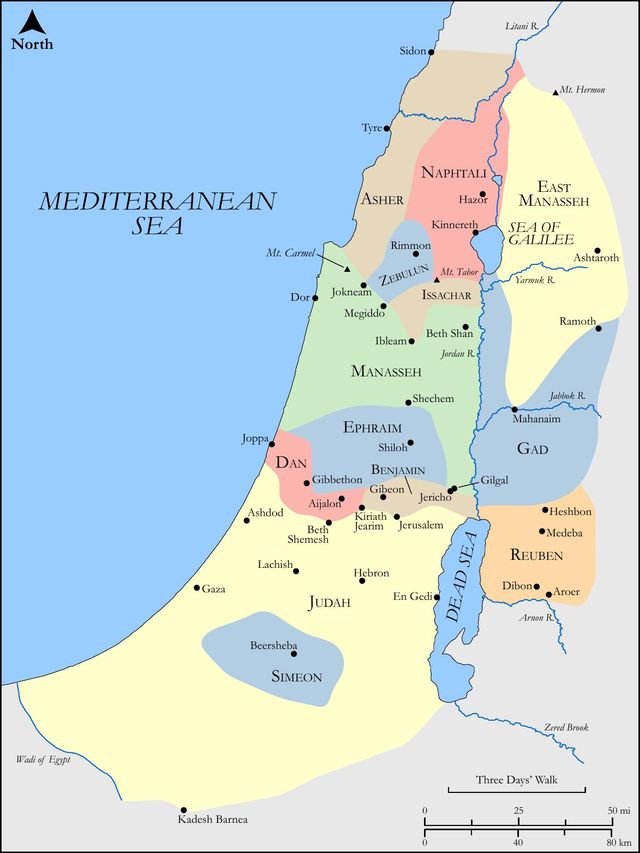
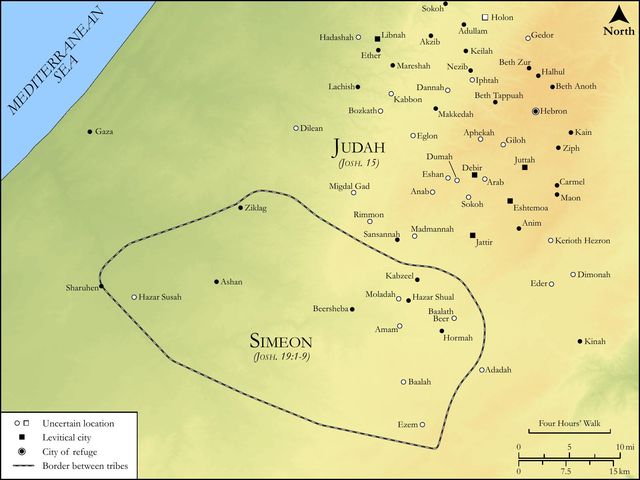
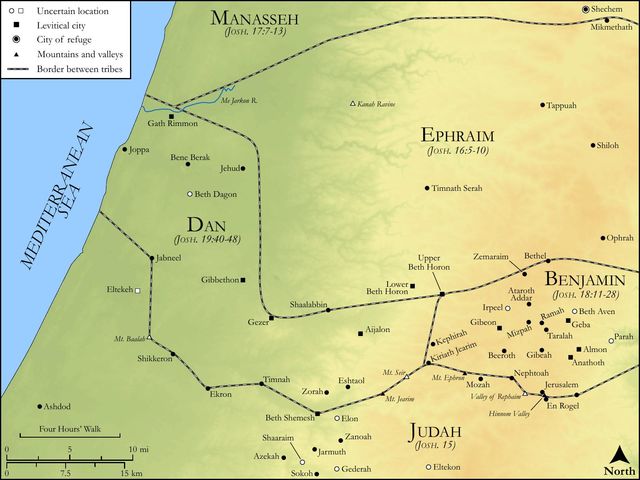
Study this verse
Public-domain commentary
Matthew Henry
From his Commentary on the Whole Bible. Henry comments on passages, not single verses — this entry covers Joshua 15:1–12.
Judah and Joseph were the two sons of Jacob on whom Reuben's forfeited birth-right devolved. Judah had the dominion entailed on him, and Joseph the double portion, and therefore these two tribes were first seated, Judah in the southern part of the land of Canaan and Joseph in the northern part, and on them the other seven did attend, and had their respective lots as appurtenances to these two; the lots of Benjamin, Simeon, and Dan, were appendant to Judah, and those of Issachar and Zebulun, Naphtali and Asher, to Joseph. These two were first set up to be provided for, it should seem, before there was such an exact survey of the land as we find afterwards, Jos 18:9. It is probable that the most considerable parts of the northern and southern countries, and those that lay nearest to Gilgal, and which the people were best acquainted with, were first put into two portions, and the lot was cast upon them between these two principal tribes, of the one of which Joshua was, and of the other Caleb, who was the first commissioner in this writ of partition; and, by the decision of that lot, the southern country, of which we have an account in this chapter, fell to Judah, and the northern, of which we have an account in the two following chapters, to Joseph. And when this was done there was a more equal dividend (either in quantity or quality) of the remainder among the seven tribes. And this, probably, was intended in that general rule which was given concerning this partition (Num 33:54), to the more you shall give the more inheritance, and to the fewer you shall give the less, and every man's inheritance shall be where his lot falleth; that is, "You shall appoint two greater portions which shall be determined by lot to those more numerous tribes of Judah and Joseph, and then the rest shall be less portions to be allotted to the less numerous tribes." The former was done in Gilgal, the latter in Shiloh.
In these verses, we have the borders of the lot of Judah, which, as the rest, is said to be by their families, that is, with an eye to the number of their families. And it intimates that Joshua and Eleazar, and the rest of the commissioners, when they had by lot given each tribe its portion, did afterwards (it is probable by lot likewise) subdivide those larger portions, and assign to each family its inheritance, and then to each household, which would be better done by this supreme authority, and be apt to give less disgust than if it had been left to the inferior magistrates of each tribe to make that distribution. The borders of this tribe are here largely fixed, yet not unalterably, for a good deal of that which lies within these bounds was afterwards assigned to the lots of Simeon and Dan. 1. The eastern border was all, and only, the Salt Sea, Jos 15:5. Every sea is salt, but this was of an extraordinary and more than natural saltness, the effects of that fire and brimstone with which Sodom and Gomorrah were destroyed in Abraham's time, whose ruins lie buried in the bottom of this dead water, which never either was moved itself or had any living thing in it. 2. The southern border was that of the land of Canaan in general, as will appear by comparing Jos 15:1-4 with Num 34:3-5. So that this powerful and warlike tribe of Judah guarded the frontiers of the whole land, on that side which lay towards their old sworn enemies (though their two fathers were twin-brethren), the Edomites. Our Lord therefore, who sprang out of Judah, and whose the kingdom is, shall judge the mount of Esau, Oba 1:21. 3. The northern border divided it from the lot of Benjamin. In this, mention is made of the stone of Bohan a Reubenite (Jos 15:6), who probably was a great commander of those forces of Reuben that came over Jordan, and died in the camp at Gilgal, and was buried not far off under this stone. The valley of Achor likewise lies upon this border (Jos 15:7), to remind the men of Judah of the trouble which Achan, one of their tribe, gave to the congregation of Israel, that they might not be too much lifted up with their services. This northern line touched closely upon Jerusalem (Jos 15:8), so closely as to include in the lot of this tribe Mount Zion and Mount Moriah, though the greater part of the city lay in the lot of Benjamin. 4. The west border went near to the great sea at first (Jos 15:12), but afterwards the lot of the tribe of Dan took off a good part of Judah's lot on that side; for the lot was only to determine between Judah and Joseph, which should have the north and which the south, and not immovably to fix the border of either. Judah's inheritance had its boundaries determined. Though it was a powerful warlike tribe, and had a great interest in the other tribes, yet they must not therefore be left to their own choice, to enlarge their possessions at pleasure, but must live so as that their neighbours might live by them. Those that are placed high yet must not think to be placed alone in the midst of the earth.
Historical interpretation
Historical reception
1 surviving comment on this verse from the historical church.
Everyone, therefore, who wants to enter into the portion of the children of Judah must first pass through the Salt Sea. That is to say, he must surmount the waves and billows of this life and escape from all things in this world that, by virtue of their own uncertainty and hazardousness, are compared with the waves of the sea. Then he may be able to reach the land of Judah and to approach the fountain of the sun. But what is the fountain of the sun, or of which sun? Of that sun, of course, about which it is written, "But for the ones fearing my name, the sun of righteousness will arise." Therefore you will find the fountain of this sun in the land of Judah, if you move away from the Salt Sea. Which fountain? That one of which Jesus said, "The water that I give will become a fountain of water leaping up into eternal life within the person who drinks from it." Therefore, when you have found the kind of fountain of this sun that we have described, you will also find its city.
Continue studying Joshua 15:6 across the web’s major study libraries — every link below opens this exact verse, chapter, or book on the destination site.
Read & Compare
 BibleGatewayThis verse in more than 200 translations and 70 languages.
 Bible.comThe YouVersion reader — hundreds of translations, reading plans, and highlights.
 ESV.orgCrossway's official English Standard Version reader.
 NET BibleThe NET translation with 60,000+ translators' notes on every rendering decision.
 STEP BibleTyndale House's free study tool — original text, vocabulary, and scholarly resources.
 BibliaLogos Bible Software's free web reader.
 USCCBThe New American Bible (Revised Edition) with the U.S. bishops' study notes.
Commentaries
 BibleHub CommentariesDozens of classic commentaries on this verse, gathered on one page.
 StudyLightMore than 100 commentary sets — the largest collection on the web.
 BibleRefPlain-English commentary on what this verse means, verse by verse.
 Enduring WordDavid Guzik's free commentary on this chapter, widely used by Bible teachers.
 Bible Study ToolsVerse commentary alongside Greek and Hebrew study aids.
Original Language & Research
- BibleHub InterlinearThe verse word by word — original language, transliteration, and English.
- BibleHub LexiconEvery word's original-language definition and Strong's entry.
 Blue Letter BibleDeep-study tools — Strong's numbers, concordance, and word studies.
 SefariaThe Hebrew text with Rashi and centuries of Jewish commentary.
Sermons, Hymns & Audio


TrulyRandomVerse is not affiliated with these sites and doesn’t control their content. They’re linked because they’re genuinely useful.
Summary
Joshua 15:6 precisely delineates a crucial segment of the northern boundary assigned to the tribe of Judah, tracing its course from the ancient settlement of Bethhogla, continuing along the northern edge of Betharabah, and culminating at the enduring landmark known as the "stone of Bohan the son of Reuben." This verse, an integral part of an extensive geographical record, powerfully underscores the divine precision involved in the allocation of the Promised Land and highlights the profound practical and theological significance of clearly defined territories for the identity, inheritance, and stability of God's chosen people.
Context
ShowHideLiterary Context
This verse is situated within Joshua 15, a chapter entirely devoted to the comprehensive and meticulous description of the vast territorial inheritance allotted to the tribe of Judah. Following the successful conquest of Canaan, detailed in earlier chapters, the land was systematically divided among the twelve tribes of Israel by lot, a process initiated in Joshua 14:1-2. The exhaustive listing of boundaries, commencing with Joshua 15:1, serves not merely as a geographical record but as a profound theological affirmation of God's unwavering faithfulness in fulfilling His ancient covenant promises to Abraham regarding the land (Genesis 15:18-21). The unparalleled precision of these descriptions underscores the immense legal and theological significance of each tribe's inheritance, establishing clear claims, preventing future disputes, and thereby laying the foundational groundwork for Israel's identity and enduring settlement in the Promised Land.
Historical & Cultural Context
The period immediately following the conquest of Canaan marked a pivotal transition for the Israelite tribes, shifting from a nomadic existence to a settled agrarian lifestyle. In this new phase, land ownership was of paramount importance, serving as the bedrock of economic stability, social identity, and tribal cohesion. In an era preceding modern surveying techniques, natural and man-made landmarks such as springs, hills, and prominent stones were indispensable for defining, recognizing, and enforcing territorial boundaries. The "stone of Bohan" exemplifies such a crucial landmark, functioning as an undeniable, permanent marker in the rugged landscape. Furthermore, the presence of a Reubenite landmark within Judah's territory highlights the shared knowledge and recognition of ancient geographical features among the tribes, even when their primary inheritances were separated by significant distances (Reuben's land was predominantly east of the Jordan River, while Judah's was west). This detailed demarcation was absolutely vital for establishing order, preventing inter-tribal conflict over resources, and ensuring the peaceful settlement of the new nation.
Key Themes
ShowHideJoshua 15:6 and the broader land distribution narrative contribute significantly to several profound theological and narrative themes. Firstly, it powerfully illustrates Divine Fulfillment, showcasing God's meticulous and unwavering faithfulness in bringing to pass His ancient promises to His people, providing them with a tangible and secure inheritance in the land He had sworn to give them (Numbers 34:1-12). Secondly, the precise demarcation emphasizes Order and Possession, highlighting God's desire for an orderly and stable society where each tribe possessed a clear, undisputed claim to its inheritance, thereby minimizing the potential for conflict and ensuring stable settlement. This divine order intrinsically reflects God's character as a God of peace, not confusion (1 Corinthians 14:33). Lastly, the land itself was inextricably linked to Identity and Inheritance for each tribe. Their assigned territory was not merely acreage but a tangible sign of their unique place within God's covenant nation, fundamentally defining their tribal identity and their share in the abundant blessings of the covenant. This inheritance was a physical manifestation of their belonging and God's provision.
Exposition and Analysis
ShowHideKey Word Analysis
ShowHideMeaning "House of the Partridge," this was an ancient town strategically located near the Jordan River and the Dead Sea, specifically within the Jordan Valley. Its mention in this verse indicates a pivotal point on Judah's eastern-to-northern border, underscoring its geographical importance as a recognizable and established landmark in the ancient landscape, serving as a fixed reference for the boundary line.
Meaning "House of the Desert," this refers to a town situated within the Arabah, the significant rift valley extending south from the Sea of Galilee through the Jordan Valley to the Gulf of Aqaba. Its inclusion signifies that the border passed through this relatively desolate but geographically distinct region, further pinpointing the precise and detailed path of Judah's northern boundary within a well-known topographical feature.
Identified as "the son of Reuben," the personal identity of Bohan is not extensively detailed in scripture beyond this mention and Joshua 18:17. However, the "stone of Bohan" was clearly a well-known and enduring landmark. Its naming after a son of Reuben, a tribe whose main inheritance was east of the Jordan, suggests it was an ancient, perhaps pre-Israelite, boundary marker or a point of reference mutually recognized by tribes on both sides of the Jordan, signifying its established and undeniable status as a fixed and authoritative point in the landscape.
Verse Breakdown
ShowHide"And the border went up to Bethhogla,"
This clause describes the initial segment of the boundary's trajectory, indicating an ascent in elevation or a movement towards higher ground as the line reached the vicinity of Bethhogla. This detail suggests a topographical change or a specific landmark that marked this point in Judah's meticulously defined territory, emphasizing the precision of the land allocation.
"and passed along by the north of Betharabah;"
From Bethhogla, the border continued its course, specifically skirting the northern side of Betharabah. This clarifies that the town of Betharabah itself was not encompassed within Judah's primary northern border but served as a critical reference point, with Judah's territory extending immediately to its north. This level of geographical detail highlights the meticulousness and exactitude of the land division process.
"and the border went up to the stone of Bohan the son of Reuben:"
The repetition of "went up" suggests another ascent or a significant topographical shift as the border reached this prominent and ancient landmark. The "stone of Bohan" served as a critical, identifiable, and permanent boundary marker. Its naming after a Reubenite, despite its location within Judah's sphere of influence, underscores its ancient and universally recognized status as a fixed point in the landscape, crucial for delineating the full extent of Judah's northern inheritance.
Literary Devices
ShowHideThe description in Joshua 15:6 primarily employs Topographical Listing, a pervasive and essential feature throughout the book of Joshua, particularly in chapters detailing land distribution. This meticulous enumeration of geographical points and landmarks serves to establish the legal and divine legitimacy of Israel's possession of the land, affirming God's faithfulness. The Repetition of the phrase "the border went up" (or similar directional verbs) emphasizes the careful, step-by-step delineation of the territory, reinforcing the precision, thoroughness, and divine authority behind the division process. Furthermore, the "stone of Bohan" functions as a powerful Symbolism. It is not merely a physical marker but a tangible representation of ancient claims, tribal identity, and the enduring nature of divinely ordained boundaries. Its very existence, named after a son of Reuben, speaks to a shared historical memory and the communal recognition of established landmarks across tribal lines, solidifying the collective understanding and acceptance of the land's sacred division.
Theological and Thematic Connections
ShowHideThe meticulous detail of Joshua 15:6, describing the precise boundaries of Judah's inheritance, stands as a profound testament to God's unwavering faithfulness and His absolute commitment to fulfilling His covenant promises. Just as God meticulously measured and apportioned the land to His people, ensuring every detail was accounted for, so too does He operate with divine precision and perfect order in all aspects of His redemptive plan for humanity. This passage powerfully reminds us that God is a God of order, not chaos, and that His promises are concrete, dependable, and eternally secure, providing an unshakeable foundation for His people's identity and future. The physical boundaries of the land, divinely established, foreshadow the spiritual boundaries and blessings God establishes for believers, providing a secure and eternal inheritance that cannot be taken away or diminished.
Reflection and Application
ShowHideWhile Joshua 15:6 may initially appear to be a dry geographical description, it carries profound spiritual weight and timeless relevance for contemporary believers. The meticulousness with which God allocated land to Judah speaks volumes about His immutable character: He is a God of precision, order, and absolute faithfulness to His promises. Just as He provided a tangible and secure inheritance for Israel, He has provided an even greater, spiritual inheritance for us in Christ, one that transcends earthly boundaries and temporal limitations. This passage invites us to cultivate a deep and abiding trust in God's detailed plans for our lives, knowing with certainty that He has meticulously prepared every step of our journey and every aspect of our spiritual inheritance. It also subtly reminds us of the profound importance of boundaries—spiritual, relational, and personal—for establishing peace, order, and security in our own lives, thereby reflecting God's own divine design. We are called to live within the "pleasant lines" that God has marked out for us, finding our ultimate identity and security not in fleeting earthly possessions, but in our eternal, divine inheritance in Him.
Questions for Reflection
ShowHideFAQ
ShowHideWhy is so much detail given to land boundaries in the book of Joshua?
ShowHideThe extensive detail regarding land boundaries in Joshua, as exemplified by Joshua 15:6, serves multiple crucial purposes. Firstly, it is a powerful testament to God's faithfulness in fulfilling His ancient covenant promises to Abraham, Isaac, and Jacob that their descendants would inherit the land of Canaan (Genesis 12:7). The precise demarcation proves that God's word is reliable and His promises are concrete and unchangeable. Secondly, these detailed descriptions functioned as vital legal documents in Israel, establishing clear and undisputed claims to territory for each tribe. This minimized inter-tribal disputes over resources and land, fostering essential order and stability within the nascent nation of Israel. Thirdly, the land was intrinsically linked to the identity and inheritance of each tribe. Their assigned territory defined their unique place within the twelve tribes and their share in the blessings of God's covenant, making the boundaries a vital part of their national and spiritual identity as God's chosen people.
Who was Bohan, and why is his stone significant?
ShowHideBohan is identified in Joshua 15:6 as "the son of Reuben." While the Bible provides no further personal details about him beyond this mention and Joshua 18:17, the "stone of Bohan" was clearly a prominent and well-known landmark used to define Judah's northern border. Its significance lies in several aspects: Firstly, it was a durable, natural marker in the landscape, providing a permanent and undeniable point of reference for the boundary in an era without modern surveying tools. Secondly, the fact that it was named after a Reubenite, even though Reuben's primary inheritance was east of the Jordan River (Joshua 13:15-23), suggests that this stone was an ancient, recognized landmark that predated the tribal divisions or was known and respected by multiple tribes. This indicates a shared geographical understanding and a common acceptance of established boundary points, reinforcing the legitimacy and divine authority of the land distribution.
What is the significance of "Bethhogla" and "Betharabah" in this verse?
ShowHide"Bethhogla" and "Betharabah" are two specific towns mentioned as key points along Judah's northern border in Joshua 15:6. "Bethhogla" (meaning "House of the Partridge") was a town located near the Jordan River and the Dead Sea, serving as a key geographical reference point in the eastern part of Judah's northern boundary. "Betharabah" (meaning "House of the Arabah") refers to a settlement situated within the Arabah, the great rift valley that encompasses the Jordan Valley. The mention of these towns, along with their specific relation to the border (e.g., "by the north of Betharabah"), provides precise topographical detail. They function as identifiable and well-known landmarks in the land, allowing for the clear, unambiguous, and legally binding delineation of Judah's vast territory. Their inclusion underscores the meticulous and divinely ordained nature of the land division, ensuring that every inch of the Promised Land was accounted for and properly assigned according to God's sovereign will.
Christ-Centered Fulfillment
ShowHideWhile Joshua 15:6 meticulously details a physical land inheritance, its deeper theological resonance profoundly points to the ultimate spiritual inheritance found in Jesus Christ. The land of Canaan, so carefully measured and given to Israel, was a powerful type and shadow of a greater reality: the eternal Kingdom of God and the immeasurable spiritual blessings bestowed upon all believers. Just as God faithfully provided a secure physical dwelling for His people in the Old Testament, so too does He provide an infinitely more secure spiritual dwelling and an eternal inheritance through His Son, Jesus Christ. Our true "Promised Land" is not a geographical location but a spiritual reality, a new creation in Christ where we are made "heirs according to the promise" (Galatians 3:29). Jesus Himself is the ultimate "boundary stone," defining the parameters of our salvation and the boundless extent of our spiritual blessings. Through His atoning work on the cross, we have been "blessed... with every spiritual blessing in the heavenly places in Christ" (Ephesians 1:3), and have obtained an "inheritance" that is "imperishable, undefiled, and unfading, kept in heaven for you" (1 Peter 1:4). The meticulous division of the land in Joshua, therefore, beautifully foreshadows God's perfect and precise plan for our redemption and our secure, eternal place in His Kingdom, where we will ultimately dwell with Him in the new heavens and new earth.