


Joshua 18:17
Bible text: King James Version (1769 Blayney text) · Public domain
Bible text: King James Version with Strong's numbers · Public domain
Bible text: Berean Standard Bible · Public domain
Bible text: American Standard Version (1901) · Public domain
Bible text: World English Bible, Messianic edition · Public domain
Bible text: Geneva Bible (1599) · Public domain
Bible text: Young's Literal Translation · Public domain
- וְתָאַרve·ta·'Arand it turnsH8388Conj-w ¦ V-Qal-ConsecPerf-3msVerb Qal Consecutive Perfect 3rd Singular Masculineוְandתָאַרit turns
- מִצָּפוֹןmi·tza·Fonfrom [the] northH6828Prep-m ¦ N-fsNoun Singular Feminine Absoluteמִfromצָּפוֹן[the] north
- וְיָצָאve·ya·Tza'and it goes outH3318Conj-w ¦ V-Qal-ConsecPerf-3msVerb Qal Consecutive Perfect 3rd Singular Masculineוְandיָצָאit goes out
- עֵין'einEnH5885N-properNoun Proper Location
- שֶׁמֶשׁShe·meshShemeshH5885N-properNoun Proper Location
- וְיָצָאve·ya·Tza'and it goes outH3318Conj-w ¦ V-Qal-ConsecPerf-3msVerb Qal Consecutive Perfect 3rd Singular Masculineוְandיָצָאit goes out
- אֶל'eltoH413PrepPreposition
- גְּלִילוֹתge·li·LotGelilothH1553N-properNoun Proper Location
- אֲשֶׁר'a·SherwhichH834RelParticle Relative
- נֹכַחNo·khach[is] oppositeH5227Adj-mscAdjective Numerical Singular Masculine Construct
- מַעֲלֵהma·'a·Leh[the] ascent ofH4608N-mscNoun Singular Masculine Construct
- אֲדֻמִּים'a·du·MimAdummimH131N-properNoun Proper Location
- וְיָרַדve·ya·Radand it goes downH3381Conj-w ¦ V-Qal-ConsecPerf-3msVerb Qal Consecutive Perfect 3rd Singular Masculineוְandיָרַדit goes down
- אֶבֶן'E·ven[the] stone ofH68N-fscNoun Singular Feminine Construct
- בֹּהַןBo·hanBohanH932N-proper-mNoun Proper Masculine
- בֶּןben[the] son ofH1121N-mscNoun Singular Masculine Construct
- רְאוּבֵןre·'u·VenReubenH7205N-proper-mNoun Proper Masculine
English is a literal word-by-word gloss of the Hebrew, not the KJV's wording. Why?
This is the original text the KJV's translators worked from — each Hebrew word with its own literal English meaning in this verse, prepared by scholars at Tyndale House, Cambridge. The KJV translates whole sentences, not word by word, so its wording differs: one Hebrew word can become several English words, and the KJV may choose “the LORD” where the gloss reads “Yahweh”. Both are faithful — they answer different questions. For the KJV's own rendering, switch to the KJV text.
Details
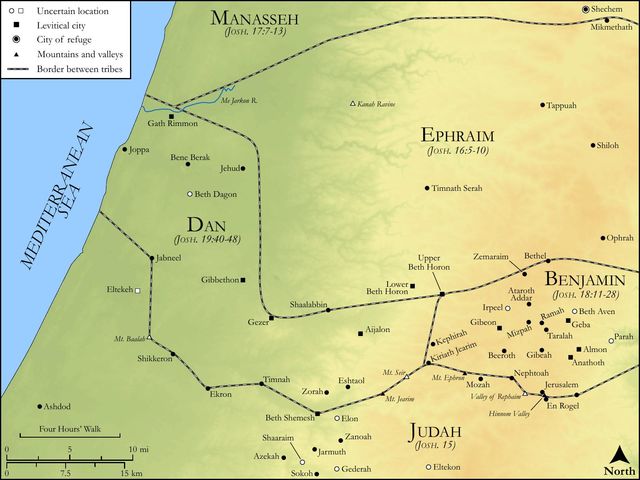
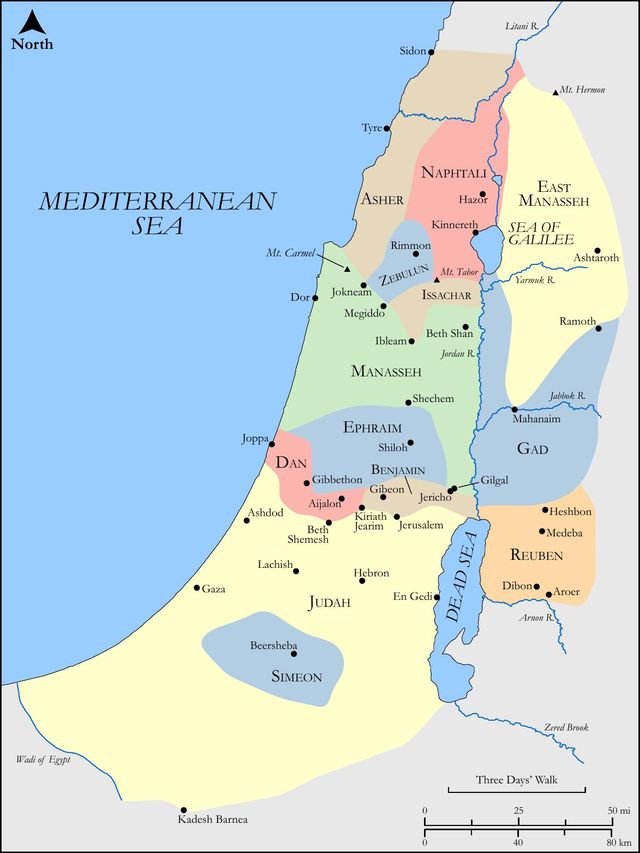
See on the biblical-era maps
Study this verse
Public-domain commentary
Matthew Henry
From his Commentary on the Whole Bible. Henry comments on passages, not single verses — this entry covers Joshua 18:11–28.
We have here the lot of the tribe of Benjamin, which Providence cast next to Joseph on the one hand, because Benjamin was own and only brother to Joseph, and was little Benjamin (Psa 68:27), that needed the protection of great Joseph, and yet had a better protector, for the Lord shall cover him all the day long, Deu 33:12. And it was next to Judah on the other hand, that this tribe might hereafter unite with Judah in an adherence to the throne of David and the temple at Jerusalem. Here we have, 1. The exact borders and limits of this tribe, which we need not be exact in the explication of. As it had Judah on the south and Joseph on the north, so it had Jordan on the east and Dan on the west. The western border is said to compass the corner of the sea southward (Jos 18:14), whereas no part of the lot of this tribe came near to the great sea. Bishop Patrick thinks the meaning is that it ran along in a parallel line to the great sea, though at a distance. Dr. Fuller suggests that since it is not called the great sea, but only the sea, which often signifies any lake or mere, it may be meant of the pool of Gibeon, which may be called a corner or canton of the sea; it is called the great waters of Gibeon (Jer 41:12), and it is compassed by the western border of this tribe. 2. The particular cities in this tribe, not all, but the most considerable. Twenty-six are here named. Jericho is put first, though dismantled, and forbidden to be rebuilt as a city with gates and walls, because it might be built and inhabited as a country village, and so was not useless to this tribe. Gilgal, where Israel first encamped when Saul was made king (Sa1 11:15), was in this tribe. It was afterwards a very profane place. Hos 9:15, All their wickedness is in Gilgal. Beth-el was in this tribe, a famous place. Though Benjamin adhered to the house of David, yet Beth-el, it seems, was in the possession of the house of Joseph (Jdg 1:23-25), and there Jeroboam set up one of his calves. In this tribe was Gibeon, where the altar was in the beginning of Solomon's time, Ch2 1:3. Gibeah likewise, that infamous place where the Levite's concubine was abused. Mizpeh, and near it Samuel's Ebenezer, and also Anathoth, Jeremiah's city, were in this tribe, as was the northern part of Jerusalem. Paul was the honour of this tribe (Rom 11:1; Phi 3:5); but where his land lay we know not: he sought the better country.
Continue studying Joshua 18:17 across the web’s major study libraries — every link below opens this exact verse, chapter, or book on the destination site.
Read & Compare
 BibleGatewayThis verse in more than 200 translations and 70 languages.
 Bible.comThe YouVersion reader — hundreds of translations, reading plans, and highlights.
 ESV.orgCrossway's official English Standard Version reader.
 NET BibleThe NET translation with 60,000+ translators' notes on every rendering decision.
 STEP BibleTyndale House's free study tool — original text, vocabulary, and scholarly resources.
 BibliaLogos Bible Software's free web reader.
 USCCBThe New American Bible (Revised Edition) with the U.S. bishops' study notes.
Commentaries
 BibleHub CommentariesDozens of classic commentaries on this verse, gathered on one page.
 StudyLightMore than 100 commentary sets — the largest collection on the web.
 BibleRefPlain-English commentary on what this verse means, verse by verse.
 Enduring WordDavid Guzik's free commentary on this chapter, widely used by Bible teachers.
 Bible Study ToolsVerse commentary alongside Greek and Hebrew study aids.
Original Language & Research
- BibleHub InterlinearThe verse word by word — original language, transliteration, and English.
- BibleHub LexiconEvery word's original-language definition and Strong's entry.
 Blue Letter BibleDeep-study tools — Strong's numbers, concordance, and word studies.
 SefariaThe Hebrew text with Rashi and centuries of Jewish commentary.
Sermons, Hymns & Audio


TrulyRandomVerse is not affiliated with these sites and doesn’t control their content. They’re linked because they’re genuinely useful.
Summary
Joshua 18:17 meticulously delineates a crucial segment of the southern boundary for the tribe of Benjamin, tracing its path through a series of ancient and prominent geographical landmarks. This precise description is far more than a mere geographical listing; it profoundly underscores the divine order, unwavering faithfulness, and meticulous provision inherent in God's allocation of the Promised Land, ensuring each tribe received its designated and indisputable inheritance in fulfillment of His ancient covenant promises.
Context
ShowHideLiterary Context
Joshua 18:17 is situated within the broader narrative of land distribution to the remaining seven tribes of Israel, specifically detailing the territory granted to Benjamin (Joshua 18:11-28). Following the initial, major allocations to Judah and the house of Joseph, the central sanctuary (the tabernacle) was moved to Shiloh, where Joshua, under divine guidance, cast lots for the remaining tribes (Joshua 18:10). This verse, in particular, outlines a critical portion of Benjamin's southern border, which simultaneously functioned as the northern border of Judah, thereby creating a shared and carefully defined demarcation. The highly detailed geographical descriptions found throughout this chapter, replete with specific directions and named landmarks, emphasize the meticulous, orderly, and legally binding nature of the division, leaving no ambiguity regarding tribal inheritances and preventing future disputes.
Historical & Cultural Context
In ancient Israel, land inheritance was absolutely foundational to tribal identity, economic stability, social structure, and covenant faithfulness. The precise delineation of boundaries, often marked by enduring natural features (like springs or distinctive rock formations) or by erected stones, was paramount to prevent future conflicts, as evidenced by explicit prohibitions against moving boundary markers (e.g., Deuteronomy 19:14). The mention of specific places such as "Enshemesh," "Geliloth," "Adummim," and the ancient "Stone of Bohan" highlights the reliance on established and universally recognizable landmarks in a pre-surveying era. These markers often carried deep historical or traditional significance, reinforcing their authority as undisputed points of demarcation. The "going up of Adummim" was a particularly well-known, notoriously difficult, and often dangerous ascent from the Jordan Valley towards Jerusalem, indicating a significant and unmistakable topographical feature.
Key Themes
ShowHideThe meticulous geographical descriptions in this verse and the surrounding passages contribute to several profound theological and narrative themes. Firstly, they powerfully demonstrate Divine Precision and Order, illustrating God's meticulous care in fulfilling His promises and establishing a structured, harmonious society for His people. Every landmark mentioned signifies God's deliberate, exact, and unchangeable provision. Secondly, the entire process of land distribution, of which this verse is an integral part, represents the tangible Fulfillment of God's Promises made centuries earlier to Abraham (e.g., Genesis 15:18) and his descendants. The physical possession of the land was the visible, undeniable sign of God's unwavering faithfulness to His covenant. Lastly, the emphasis on specific, enduring landmarks highlights the Significance of Boundaries and Inheritance. These markers were not merely geographical points but served as enduring testimonies to the tribal inheritances, legally defining what belonged to each family and tribe, providing security, identity, and a sense of belonging, much like the detailed account of Judah's inheritance in Joshua 15:1-12.
Exposition and Analysis
ShowHideKey Word Analysis
ShowHideMeaning "red spots." This refers to the distinctive reddish rock formations found along a notorious ascent from the Jordan Valley towards Jerusalem. The "going up of Adummim" was a well-known, difficult, and dangerous pass, making its reddish hue a prominent and unmistakable geographical feature that served as a clear boundary marker.
Meaning "circles." This term likely refers to a specific area characterized by circular or rolling hills, or perhaps a series of distinct regions. Its inclusion as a boundary point suggests it was a recognizable topographical feature or a named locality that helped delineate the border's path.
An orthographical variation of a word meaning "thumb." While the root suggests "thumb," in this context, it refers to Bohan, an Israelite, specifically "Bohan the son of Reuben." The "stone of Bohan" is a particularly unique and ancient landmark, suggesting an established memorial or tribal marker that predated the conquest of Canaan. Its inclusion highlights the deep historical roots and the venerable, undisputed nature of these ancient land divisions.
Verse Breakdown
ShowHide"And was drawn from the north"
This phrase establishes the starting point and general direction of the boundary segment for Benjamin. It indicates that the border is being traced from a northern point, moving southwards, thereby defining the southern edge of Benjamin's allotted territory.
"and went forth to Enshemesh"
From its northern origin, the boundary proceeds to the well-known landmark of Enshemesh, which means "Fountain of the Sun." This marks a specific, identifiable, and prominent natural spring that served as a crucial point of demarcation on the border.
"and went forth toward Geliloth"
The boundary continues its course, heading in the direction of Geliloth. This indicates a general trajectory towards another significant topographical feature or named region, further specifying the path of the border.
"which [is] over against the going up of Adummim"
This clause provides further geographical context for Geliloth, situating it "opposite" or in proximity to the ascent of Adummim. This clarifies the location by referencing another prominent and easily recognizable landmark, emphasizing the rugged and challenging terrain of the region through which the boundary passed.
"and descended to the stone of Bohan the son of Reuben"
The boundary then takes a downward turn, indicating a descent, likely towards the Jordan Valley. The "stone of Bohan" is a highly significant and ancient landmark, marking a crucial, enduring point where Benjamin's territory connected with Judah's, serving as a venerable, perhaps pre-Israelite conquest, marker.
Literary Devices
ShowHideThe primary literary device employed in Joshua 18:17, and indeed throughout the land distribution chapters, is Topographical Detail. The verse is saturated with specific geographical names and precise directional indicators ("from the north," "went forth," "toward," "over against," "descended"), demonstrating an almost cartographic precision. This detailed mapping serves to authenticate the divine allocation of land, leaving no room for ambiguity or dispute regarding tribal inheritances. The Repetition of phrases like "went forth" (H3318, yâtsâ') emphasizes the continuous and sequential tracing of the boundary, guiding the reader along the described path and reinforcing the thoroughness of the demarcation process. Furthermore, the mention of "the stone of Bohan the son of Reuben" functions as an Allusion to an ancient past, hinting at a history and established order that predates the Israelite conquest, lending an air of timeless authority and venerability to the boundary and the land claims.
Theological and Thematic Connections
ShowHideJoshua 18:17, though seemingly a dry geographical description, is profoundly theological. It powerfully illustrates God's character as a God of order, precision, and unwavering faithfulness. The meticulous detail in defining the tribal boundaries is not merely for administrative purposes but serves as a tangible demonstration of God fulfilling His covenant promises to Abraham and his descendants with exactitude. Every landmark mentioned is a testament to His precise provision and the certainty of His word, ensuring that His people receive their promised inheritance. This divine meticulousness in land allocation foreshadows God's care in establishing spiritual boundaries and inheritances for His people, ensuring that every promise made is fulfilled with absolute precision and security.
Reflection and Application
ShowHideThe precise and detailed nature of the land division in Joshua 18:17 offers profound spiritual lessons for believers today. Just as God meticulously ensured every tribe received its precise and indisputable inheritance, so too does He care for the intricate details of our lives, fulfilling His promises with accuracy and unwavering faithfulness. This passage encourages us to trust in His sovereign provision for our "boundaries," whether they are our unique callings, our current circumstances, or the spiritual blessings He has prepared for us. Understanding these divine boundaries, both physical and spiritual, provides a deep sense of security, purpose, and identity, much like the tribes knew their specific land. Moreover, the respect given to ancient landmarks like the Stone of Bohan reminds us of the importance of honoring established truths and the wisdom passed down through generations, especially the unchanging Word of God, which serves as our ultimate boundary marker and infallible guide for life and faith.
Questions for Reflection
ShowHideFAQ
ShowHideWhy are these geographical details so important in the Bible?
ShowHideThese geographical details are critically important for several reasons. Firstly, they demonstrate God's faithfulness and the literal fulfillment of His covenant promises to Abraham that his descendants would inherit a specific land (e.g., Genesis 15:18). Secondly, they provided the legal and practical basis for tribal identity, inheritance, and governance in ancient Israel, preventing disputes over territory. The meticulous descriptions underscore the divine order and precision in God's dealings with His people, showing that His provision is exact and intentional. They also serve as historical markers, rooting the biblical narrative in real-world geography and making the account verifiable and tangible, demonstrating God's work in concrete history.
Who was Bohan, and why is his stone significant?
ShowHideBohan was a son of Reuben, one of the twelve patriarchs and the eldest son of Jacob. The "stone of Bohan" is significant because it represents an ancient and enduring landmark, possibly predating the Israelite conquest of Canaan. Its existence suggests that certain boundary markers were already established and recognized even before the land was formally divided by Joshua. This stone served as a crucial, undisputed point on the shared border between the tribes of Benjamin and Judah, highlighting the continuity of land claims and the respect for established markers. It likely functioned as a memorial or a tribal marker from the patriarchal period, underscoring the deep historical roots and the sacred, enduring nature of these land divisions.
Christ-Centered Fulfillment
ShowHideWhile Joshua 18:17 describes a physical inheritance of land, it powerfully foreshadows the spiritual inheritance believers receive in Christ. Just as the tribes received their precise, divinely appointed portion of the Promised Land, so too do believers receive an inheritance that is "imperishable, undefiled, and unfading, kept in heaven for you" (1 Peter 1:4). Jesus, as the ultimate fulfillment of God's promises, is our true "Promised Land" and the substance of our inheritance. Through Him, we are made "heirs of God and co-heirs with Christ" (Romans 8:17), not of a physical territory, but of eternal life, righteousness, and all the spiritual blessings "in the heavenly places" (Ephesians 1:3). The meticulous precision of the land division in Joshua points to the absolute certainty and security of our spiritual inheritance in Christ, which is guaranteed by God's faithfulness, secured by His sacrifice, and sealed by the Holy Spirit (Ephesians 1:11-14). We are now part of a spiritual kingdom, looking forward to a "city that has foundations, whose architect and builder is God" (Hebrews 11:10), a heavenly inheritance far surpassing any earthly territory (Colossians 1:12).