


2 Chronicles 13:4
Bible text: King James Version (1769 Blayney text) · Public domain
Bible text: Berean Standard Bible · Public domain
Bible text: American Standard Version (1901) · Public domain
Bible text: World English Bible, Messianic edition · Public domain
Bible text: Geneva Bible (1599) · Public domain
Bible text: Young's Literal Translation · Public domain
- וַיָּקָםvai·Ya·komand he stoodH6965Conj-w ¦ V-Qal-ConsecImperf-3msVerb Qal Consecutive Imperfect 3rd Singular Masculineוַandיָּקָםhe stood
- אֲבִיָּה'a·vi·YahAbijahH29N-proper-mNoun Proper Masculine
- מֵעַלme·'Al<from> onH5921Prep-m ¦ PrepPrepositionמֵ<from>עַלon
- לְהַרle·Har<to> [the] mountain ofH2022Prep-l ¦ N-mscNoun Singular Masculine Constructלְ<to>הַר[the] mountain of
- צְמָרַיִםtze·ma·Ra·yimZemaraimH6787N-properNoun Proper Location
- אֲשֶׁר'a·SherwhichH834RelParticle Relative
- בְּהַרbe·Har[is] in [the] hill country ofH2022Prep-b ¦ N-mscNoun Singular Masculine Constructבְּ[is] inהַר[the] hill country of
- אֶפְרָיִם'ef·Ra·yimEphraimH669N-proper-mNoun Proper Masculine
- וַיֹּאמֶרvai·Yo·merand he saidH559Conj-w ¦ V-Qal-ConsecImperf-3msVerb Qal Consecutive Imperfect 3rd Singular Masculineוַandיֹּאמֶרhe said
- שְׁמָעוּנִיshe·ma·'U·nilisten to meH8085V-Qal-Imp-2mp ¦ 1csVerb Qal Imperative 2nd Plural Masculineשְׁמָעוּlisten toנִיme
- יָרָבְעָםya·ra·ve·'AmO JeroboamH3379N-proper-mNoun Proper Masculine
- וְכָלve·kholand allH3605Conj-w ¦ N-mscNoun Singular Masculine Constructוְandכָלall
- יִשְׂרָאֵלYis·ra·'ElIsraelH3478N-properNoun Proper Location
English is a literal word-by-word gloss of the Hebrew, not the KJV's wording. Why?
This is the original text the KJV's translators worked from — each Hebrew word with its own literal English meaning in this verse, prepared by scholars at Tyndale House, Cambridge. The KJV translates whole sentences, not word by word, so its wording differs: one Hebrew word can become several English words, and the KJV may choose “the LORD” where the gloss reads “Yahweh”. Both are faithful — they answer different questions. For the KJV's own rendering, switch to the KJV text.
Details
See on the biblical-era map
Study this verse
Public-domain commentary
Matthew Henry
From his Commentary on the Whole Bible. Henry comments on passages, not single verses — this entry covers 2 Chronicles 13:1–12. His four-level outline is real structure in the source text, so it is rendered as structure.
Abijah's mother was called Maachah, the daughter of Absalom, Ch2 11:20; here she is called Michaiah, the daughter of Uriel. It is most probable that she was a grand-daughter of Absalom, by his daughter Tamar (Sa2 14:27), and that her immediate father was this Uriel. But we are here to attend Abijah into the field of battle with Jeroboam king of Israel.
I.God gave him leave to engage with Jeroboam, and owned him in the conflict, though he would not permit Rehoboam to do it, Ch2 11:4.
1.Jeroboam, it is probable, was now the aggressor, and what Abijah did was in his own necessary defence. Jeroboam, it may be, happening to survive Rehoboam, claimed the crown of Judah be survivorship, at least hoped to get it from this young king, upon his accession to the throne. Against these impudent pretensions it was brave in Abijah to take up arms, and God stood by him.
2.When Rehoboam attempted to recover his ten tribes Jeroboam was upon his good behaviour, and there must be some trial of him; but now that he had discovered what manner of man he was, by setting up the calves and casting off the priests, Abijah is allowed to chastise him, and it does not appear that he intended any more; whereas Rehoboam aimed at no less than the utter reduction of the ten tribes, which was contrary to the counsel of God.
II.Jeroboam's army was double in number to that of Abijah (Ch2 13:3), for he had ten tribes to raise an army out of, while Abijah had but two.
Of the army on both sides it is said, they were mighty men, chosen men, and valiant; but the army of Judah consisted only of 400,000, while Jeroboam's army amounted to 800,000. The inferior number however proved victorious; for the battle is not always to the strong nor the cause to the majority.
III.Abijah, before he fought them, reasoned with them, to persuade them, though not to return to the house of David (that matter was settled by the divine determination and he acquiesced), yet to desist from fighting against the house of David. He would not have them withstand the kingdom of the Lord in the hands of the sons of David (Ch2 13:8), but at least to be content with what they had. Note, It is good to try reason before we use force. If the point may be gained by dint of argument, better so than by dint of sword. We must never fly to violent methods till all the arts of persuasion have been tried in vain. War must be the ultima ratio regum - the last resort of kings. Fair reasoning may do a great deal of good and prevent a good deal of mischief. How forcible are right words! Abijah had got with his army into the heart of their country; for he made this speech upon a hill in Mount Ephraim, where he might be heard by Jeroboam and the principal officers, with whom it is probable he desired to have a treaty, to which they consented. It has been usual for great generals to make speeches to their soldiers to animate them, and this speech of Abijah had some tendency to do this, but was directed to Jeroboam and all Israel. Two things Abijah undertakes to make out, for the satisfaction of his own men and the conviction of the enemy: -
1.That he had right on his side, a jus divinum - a divine right: "You know, or ought to know, that God gave the kingdom to David and his sons for ever" (Ch2 13:5), not by common providence, his usual way of disposing of kingdoms, but by a covenant of salt, a lasting covenant, a covenant made by sacrifice, which was always salted; so bishop Patrick. All Israel had owned that David was a king of God's making, and that God had entailed the crown upon his family; so that Jeroboam's taking the crown of Israel at first was not justifiable: yet it is not certain that Abijah referred chiefly to that, for he knew that Jeroboam had a grant from God of the ten tribes. His attempt, however, to disturb the peace and possession of the king of Judah was by no means excusable; for when the ten tribes were given to him two were reserved for the house of David. Abijah shows,
(1.)That there was a great deal of dishonesty and disingenuousness in Jeroboam's first setting himself up: He rebelled against his lord (Ch2 13:6) who had preferred him (Kg1 11:28), and basely took advantage of Rehoboam's weakness in a critical juncture, when, in gratitude to his old master and in justice to his title, he ought rather to have stood by him, and helped to secure the people in their allegiance to him, than to head a party against him and make a prey of him, which was unworthily done and what he could not expect to prosper in. Those that supported him are here called vain men (a character perhaps borrowed from Jdg 11:3), men that did not act from any steady principle, but were given to change, and men of Belial, that were for shaking off the yoke of government and setting those over them that would do just as they would have them do.
(2.)That there was a great deal of impiety in his present attempt; for, in fighting against the house of David, he fought against the kingdom of the Lord. Those who oppose right oppose the righteous God who sits in the throne judging right, and cannot promise themselves success in so doing. Right may indeed go by the worst for a time, but it will prevail at last.
2.That he had God on his side. This he insisted much upon, that the religion of Jeroboam and his army was false and idolatrous, but that he and his people, the men of Judah, had the pure worship of the true and living God among them. It appears from the character given of Abijah (Kg1 15:3) that he was not himself in this war chiefly from the religion of his kingdom. For,
(1.)Whatever he was otherwise, it should seem that he was no idolator, or, if he connived at the high places and images (Ch2 14:3, Ch2 14:5), yet he constantly kept up the temple-service.
(2.)Whatever corruptions there were in the kingdom of Judah, the state of religion among them was better than in the kingdom of Israel, with which they were now contending.
(3.)It is common for those that deny the power of godliness to boast of the form of it.
(4.)It was the cause of his kingdom that he was pleading; and, though he was not himself so good as he should have been, yet he hoped that, for the sake of the good men and good things that were in Judah, God would now appear for them. Many that have little religion themselves yet have so much sense and grace as to value it in others. See how he describes,
[1.]The apostasy of Israel from God. "You are a great multitude," said he, "far superior to us in number; but we need not fear you, for you have that among yourselves which is enough to ruin you. For," First, "You have calves for your gods (Ch2 13:8), that are unable to protect and help you and will certainly cause the true and living God to oppose you. Those will be Achans, troublers of your camp." Secondly, "You have base men for your priests, Ch2 13:9. You have cast off the tribes of Levi, and the house of Aaron, whom God appointed to minister in holy things; and, in conformity to the custom of the idolatrous nations, make any man a priest that has a mind to the office and will be at the charge of the consecration, though ever so much a scandal to the office." Yet such, though very unfit to be priests, were fittest of all to be their priests; for what more agreeable to gods that were no gods than priests that were no priests? Like to like, both pretenders and usurpers.
[2.]The adherence of Judah to God: "But as for us (Ch2 13:10) we have not forsaken God. Jehovah is our God, the God of our fathers, the God of Israel, who is able to protect us, and give us success. He is with us, for we are with him." First, "At home in his temple: We keep his charge, Ch2 13:10, Ch2 13:11. We worship no images, have no priests but what he has ordained, no rites of worship but what he has prescribed. Both the temple service and the temple furniture are of his appointing. His appointment we abide by, and neither add nor diminish. These we have the comfort of, these we now stand up in the defence of: so that upon a religious as well as a civil account we have the better cause. Secondly, Here in the camp; he is our captain, and we may therefore be sure that he is with us, because we are with him, Ch2 13:12. And, as a token of his presence, we have here with us his priests, sounding his trumpets according to the law, as a testimony against you, and an assurance to us that in the day of battle we shall be remembered before the Lord our God and saved from our enemies;" for so this sacred signal is explained, Num 10:9. Nothing is more effectual to embolden men, and put spirit into them, than to be sure that God is with them and fights for them. He concludes with fair warning to his enemies. "Fight not against the God of your fathers. It is folly to fight against the God of almighty power; but it is treachery and base ingratitude to fight against your fathers' God, and you cannot expect to prosper."
Continue studying 2 Chronicles 13:4 across the web’s major study libraries — every link below opens this exact verse, chapter, or book on the destination site.
Read & Compare
 BibleGatewayThis verse in more than 200 translations and 70 languages.
 Bible.comThe YouVersion reader — hundreds of translations, reading plans, and highlights.
 ESV.orgCrossway's official English Standard Version reader.
 NET BibleThe NET translation with 60,000+ translators' notes on every rendering decision.
 STEP BibleTyndale House's free study tool — original text, vocabulary, and scholarly resources.
 BibliaLogos Bible Software's free web reader.
 USCCBThe New American Bible (Revised Edition) with the U.S. bishops' study notes.
Commentaries
 BibleHub CommentariesDozens of classic commentaries on this verse, gathered on one page.
 StudyLightMore than 100 commentary sets — the largest collection on the web.
 BibleRefPlain-English commentary on what this verse means, verse by verse.
 Enduring WordDavid Guzik's free commentary on this chapter, widely used by Bible teachers.
 Bible Study ToolsVerse commentary alongside Greek and Hebrew study aids.
Original Language & Research
- BibleHub InterlinearThe verse word by word — original language, transliteration, and English.
- BibleHub LexiconEvery word's original-language definition and Strong's entry.
 Blue Letter BibleDeep-study tools — Strong's numbers, concordance, and word studies.
 SefariaThe Hebrew text with Rashi and centuries of Jewish commentary.
Sermons, Hymns & Audio


TrulyRandomVerse is not affiliated with these sites and doesn’t control their content. They’re linked because they’re genuinely useful.
Summary
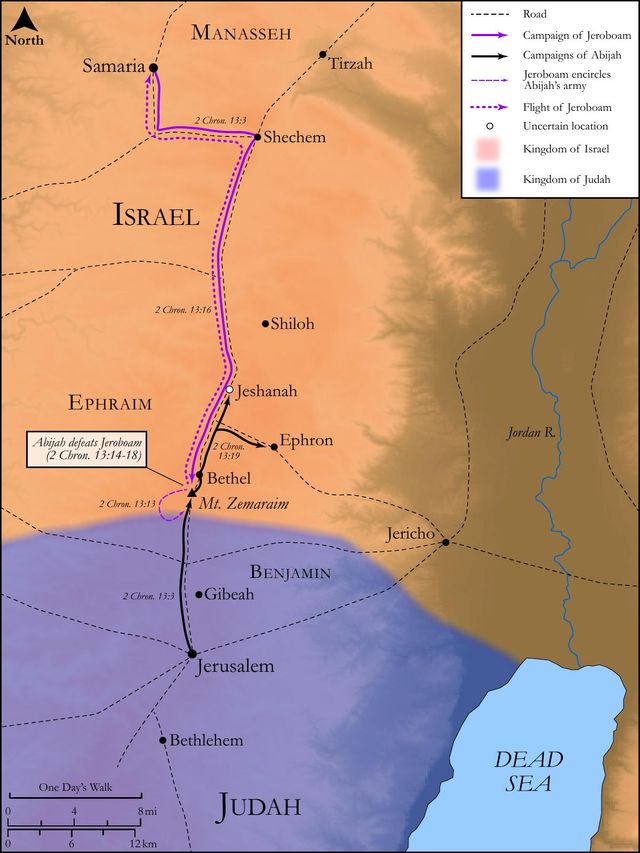
2 Chronicles 13:4 marks a pivotal moment in the ongoing conflict between the divided kingdoms of Judah and Israel, setting the stage for a significant theological and military confrontation. King Abijah of Judah strategically positions himself on Mount Zemaraim, a location within the northern kingdom's territory of Ephraim, to deliver a direct and authoritative address to his adversary, King Jeroboam, and the entire populace of Israel. This verse underscores Abijah's bold assertion of legitimacy and divine backing for the Davidic dynasty, signaling the imminent and decisive battle between the two estranged nations.
Context
ShowHideLiterary Context
This verse serves as the dramatic opening to Abijah's extensive and impassioned speech to Jeroboam and the armies of Israel, detailed in 2 Chronicles 13:5-12. The preceding verses (2 Chronicles 13:1-3) establish the beginning of Abijah's reign in Judah and the immense numerical strength of the opposing armies, setting the stage for a massive military confrontation. Following Abijah's powerful address, the narrative immediately shifts to the battle itself, highlighting Judah's reliance on God and their subsequent, divinely-granted victory (2 Chronicles 13:13-18). Thus, 2 Chronicles 13:4 functions as the critical prelude, emphasizing the rhetorical challenge that precedes the physical one, and framing the ensuing conflict as a theological dispute rather than merely a territorial one.
Historical & Cultural Context
The division of the united monarchy into the Northern Kingdom of Israel and the Southern Kingdom of Judah occurred after the death of Solomon, primarily due to Rehoboam's harsh policies and the northern tribes' rejection of the Davidic dynasty (1 Kings 12:16-19). By Abijah's reign, roughly two decades after the split, the schism was deeply entrenched, marked by political rivalry, religious apostasy in the North (Jeroboam's establishment of golden calves at Dan and Bethel, as seen in 1 Kings 12:28-30), and intermittent warfare. Abijah's choice of Mount Zemaraim, located in the heartland of Ephraim—a prominent tribe in the North—was a deliberate and provocative act. This strategic positioning, akin to an invading general addressing the enemy from their own soil, would have been understood as a profound challenge to Jeroboam's authority and a calculated attempt to demoralize or even sway elements within the Israelite army by appealing to their shared history and the true covenant.
Key Themes
ShowHideThe central themes emerging from this verse and its immediate context include Divine Sovereignty and Covenant Faithfulness, particularly concerning the Davidic Covenant, which Abijah invokes to assert Judah's legitimate claim to the throne. Another prominent theme is Legitimacy and Usurpation, as Abijah directly challenges Jeroboam's rule, portraying it as an illegitimate rebellion against God's chosen dynasty and a rejection of true worship. The verse also highlights the Consequences of Idolatry and Disobedience, which led to Israel's spiritual decline under Jeroboam, contrasting it with Judah's (albeit imperfect) adherence to the Jerusalem temple worship. Finally, Strategic Communication and Bold Leadership are evident in Abijah's decision to deliver a public, confrontational speech from a geographically significant location, demonstrating his resolve and reliance on God's backing, a theme echoed in Judah's later victories, such as those described in 2 Chronicles 14:11-12.
Exposition and Analysis
ShowHideKey Word Analysis
ShowHideDerived from H6965, this verb signifies more than merely rising to one's feet. In this context, it conveys a deliberate, authoritative, and decisive action, indicating a firm stand or preparation for an important declaration or confrontation. It is a posture of readiness and resolve, signaling that Abijah is about to deliver a weighty and significant pronouncement, not a casual remark, underscoring the gravity of the moment.
This geographical name (H6787), meaning "double fleece," is crucial due to its location "in mount Ephraim," placing it squarely within the Northern Kingdom's territory. Abijah's choice of this specific location for his address is highly symbolic and strategic. It represents a direct challenge to Jeroboam on his own ground, asserting Judah's claim to the entire land promised to David, and potentially aiming to sow dissent among the northern tribes by appealing to their shared history and the true covenant.
This imperative (H8085) is a forceful command for attention, often implying a demand for intelligent listening and obedience. It is a common rhetorical device in the speeches of Scripture, as when Moses called all Israel with "Hear, O Israel," used to silence an audience and demand their full and undivided focus before a critical message is delivered. It underscores the gravity of Abijah's impending speech, signaling that what follows is of utmost importance and requires careful consideration from both Jeroboam and all of Israel.
Verse Breakdown
ShowHide"And Abijah stood up upon mount Zemaraim"
This clause establishes the protagonist, King Abijah, his decisive action of "standing up," and his precise location on Mount Zemaraim. The act of "standing up" is deliberate and authoritative, signaling an imminent, formal address, while the choice of Mount Zemaraim, a high vantage point, would have ensured visibility and audibility for a large audience, underscoring the public and confrontational nature of Abijah's speech.
"which [is] in mount Ephraim"
This parenthetical clarification emphasizes the strategic and provocative nature of Abijah's position. Mount Ephraim was the heartland of the Northern Kingdom, the territory of the dominant tribe of Ephraim. By delivering his address from within enemy territory, Abijah not only asserted his daring but also symbolically challenged Jeroboam's dominion over the land, claiming a right to address all of Israel as the rightful heir of the Davidic covenant.
"and said, Hear me, thou Jeroboam, and all Israel;"
This final clause introduces Abijah's direct address, specifying his audience. The command "Hear me" is a powerful rhetorical opening, demanding immediate and undivided attention and signaling the profound importance of the message to follow. Addressing "Jeroboam, and all Israel" collectively underscores the comprehensive scope of his challenge, encompassing both the king and his entire kingdom, implying a call to repentance and a re-evaluation of their allegiance to the true God and His chosen dynasty.
Literary Devices
ShowHideThe verse effectively employs several literary devices to heighten its dramatic impact and convey its theological weight. Setting is crucial, as Abijah's deliberate choice of Mount Zemaraim in Ephraim is not arbitrary but a strategic and symbolic act. It transforms a mere physical location into a prominent stage for a significant confrontation, emphasizing the audacity of Abijah's challenge and his claim of authority over the entire land. The use of Direct Address ("Hear me, thou Jeroboam, and all Israel") immediately engages the audience within the narrative, creating a sense of immediacy and direct confrontation. This also functions as a powerful Rhetorical Device, a common convention of Hebrew speech to command attention and underscore the gravity of a weighty pronouncement. Furthermore, there is a clear element of Foreshadowing, as Abijah's bold stance and direct challenge hint at the decisive battle and the theological arguments that will follow, setting the tone for the ensuing conflict and Judah's eventual, divinely-aided victory.
Theological and Thematic Connections
ShowHide2 Chronicles 13:4 is deeply rooted in the Chronicler's theological agenda, which consistently emphasizes the enduring nature of the Davidic Covenant and the consequences of fidelity or apostasy. Abijah's public address from a strategic location underscores the belief that Judah, as the inheritor of the Davidic line, holds the legitimate claim to the throne and the true worship of Yahweh. The confrontation highlights the stark theological divide between the two kingdoms: Judah, imperfect yet clinging to the temple and the Davidic dynasty, and Israel, which had embraced idolatry and rejected God's chosen lineage. This verse thus serves as a theological declaration of war, asserting God's continued faithfulness to His covenant promises despite human rebellion and division, and setting the stage for a demonstration of divine justice and favor.
Reflection and Application
ShowHideAbijah's bold stance on Mount Zemaraim offers a powerful lesson in courageous leadership and the importance of standing for truth, even when facing overwhelming opposition or addressing a deeply divided audience. His willingness to confront Jeroboam and all Israel on their own ground, asserting the divine legitimacy of the Davidic covenant and the true worship of God, challenges believers today to consider where and how they are called to rebuke the powerful. This is not merely about physical location, but about taking a firm, principled stand in the face of spiritual or moral compromise. It reminds us that our authority, when aligned with God's truth, does not come from our own strength or position, but from the divine mandate we serve. Understanding the historical and theological roots of division, as Abijah did, is crucial for effective communication and for seeking reconciliation or upholding biblical principles in our own contexts, whether in personal relationships, community dynamics, or broader societal issues. It calls us to discern the spiritual battles behind the physical ones and to engage with conviction and reliance on God.
Questions for Reflection
ShowHideFAQ
ShowHideWhy was Mount Zemaraim a significant location for Abijah's speech?
ShowHideMount Zemaraim's significance lies in its strategic geographical and symbolic placement. It was located within the territory of Mount Ephraim, which was the heartland of the Northern Kingdom of Israel, a region dominated by the very tribes that had rebelled against the Davidic dynasty. By choosing this location, Abijah was not merely addressing Jeroboam from a distance; he was making a deliberate and provocative statement by entering enemy territory. This act served multiple purposes: it was a direct challenge to Jeroboam's authority on his own ground, a symbolic assertion of Judah's claim over all the tribes of Israel, and potentially an attempt to demoralize the Israelite forces or even sway some of their populace by appealing to their shared heritage and the true worship of God. It underscored the gravity of the situation and Abijah's unwavering resolve, much like a general addressing the opposing army from a prominent position within their lines, demonstrating his conviction in the legitimacy of his cause and the divine backing he claimed.
Christ-Centered Fulfillment
ShowHideAbijah's bold stand on Mount Zemaraim, asserting the divine legitimacy of the Davidic covenant against Jeroboam's rebellion and idolatry, powerfully foreshadows the ultimate King from David's line, Jesus Christ. Abijah's appeal to God's eternal covenant with David (2 Samuel 7:16) finds its perfect and eternal fulfillment in Christ, who is the true heir to David's throne (Luke 1:32-33). While Abijah's physical location was strategic, Christ's authority transcends all earthly boundaries, for "all authority in heaven and on earth has been given to me" (Matthew 28:18). Abijah called for Israel to "Hear me," but Jesus, the Word made flesh, is the ultimate voice of God, calling all humanity to hear and obey Him (John 10:27). Unlike Jeroboam's illegitimate rule and the Northern Kingdom's apostasy, Christ establishes a kingdom that is "not of this world" (John 18:36), yet it gathers people from every tribe and nation, uniting them under His righteous and eternal reign, fulfilling the promise that all nations would be blessed through Abraham's seed, the ultimate Son of David (Galatians 3:16). Abijah fought a physical battle for a divided kingdom; Christ, through His sacrifice and resurrection, conquers sin and death, establishing a spiritual kingdom that is unified and eternal, ultimately bringing true peace and reconciliation to all who believe.