


Judges 9:7
Bible text: King James Version (1769 Blayney text) · Public domain
Bible text: King James Version with Strong's numbers · Public domain
Bible text: Berean Standard Bible · Public domain
Bible text: American Standard Version (1901) · Public domain
Bible text: World English Bible, Messianic edition · Public domain
Bible text: Geneva Bible (1599) · Public domain
Bible text: Young's Literal Translation · Public domain
- וַיַּגִּדוּvai·ya·Gi·duand people toldH5046Conj-w ¦ V-Hiphil-ConsecImperf-3mpVerb Hiphil Consecutive Imperfect 3rd Plural Masculineוַandיַּגִּדוּpeople told
- לְיוֹתָםle·yo·Tamto JothamH3147Prep-l ¦ N-proper-mNoun Proper MasculineלְtoיוֹתָםJotham
- וַיֵּלֶךְvai·Ye·lekhand he wentH1980Conj-w ¦ V-Qal-ConsecImperf-3msVerb Qal Consecutive Imperfect 3rd Singular Masculineוַandיֵּלֶךְhe went
- וַיַּעֲמֹדvai·ya·'a·Modand he stoodH5975Conj-w ¦ V-Qal-ConsecImperf-3msVerb Qal Consecutive Imperfect 3rd Singular Masculineוַandיַּעֲמֹדhe stood
- בְּרֹאשׁbe·Roshon [the] top ofH7218Prep-b ¦ N-mscNoun Singular Masculine Constructבְּonרֹאשׁ[the] top of
- הַרhar[the] mountain ofH2022N-mscNoun Singular Masculine Construct
- גְּרִזִיםge·ri·ZimGerizimH1630N-properNoun Proper Location
- וַיִּשָּׂאvai·yi·Sa'and he lifted upH5375Conj-w ¦ V-Qal-ConsecImperf-3msVerb Qal Consecutive Imperfect 3rd Singular Masculineוַandיִּשָּׂאhe lifted up
- קוֹלוֹko·Lohis voiceH6963N-msc ¦ 3msNoun Singular Masculine Constructקוֹלvoiceוֹhis
- וַיִּקְרָאvai·yik·Ra'and he called outH7121Conj-w ¦ V-Qal-ConsecImperf-3msVerb Qal Consecutive Imperfect 3rd Singular Masculineוַandיִּקְרָאhe called out
- וַיֹּאמֶרvai·Yo·merand he saidH559Conj-w ¦ V-Qal-ConsecImperf-3msVerb Qal Consecutive Imperfect 3rd Singular Masculineוַandיֹּאמֶרhe said
- לָהֶםla·Hemto <the> themPrep-l ¦ 3mpSuffix Personal 3rd Plural Masculineלָto <the>הֶםthem
- שִׁמְעוּshim·'UlistenH8085V-Qal-Imp-2mpVerb Qal Imperative 2nd Plural Masculine
- אֵלַי'e·Laito meH413Prep ¦ 1csPreposition Definiteאֵלַtoיme
- בַּעֲלֵיba·'a·LeiO citizens ofH1167N-mpcNoun Plural Masculine Construct
- שְׁכֶםshe·KhemShechemH7927N-properNoun Proper Location
- וְיִשְׁמַעve·yish·Ma'so he may listenH8085Conj-w ¦ V-Qal-ConjImperf-3msVerb Qal Conjunction+Imperfect 3rd Singular Masculineוְsoיִשְׁמַעhe may listen
- אֲלֵיכֶם'a·lei·Khemto youH413Prep ¦ 2mpPreposition Definiteאֲלֵיtoכֶםyou
- אֱלֹהִים'E·lo·HimGodH430N-mpNoun Plural Masculine Absolute
English is a literal word-by-word gloss of the Hebrew, not the KJV's wording. Why?
This is the original text the KJV's translators worked from — each Hebrew word with its own literal English meaning in this verse, prepared by scholars at Tyndale House, Cambridge. The KJV translates whole sentences, not word by word, so its wording differs: one Hebrew word can become several English words, and the KJV may choose “the LORD” where the gloss reads “Yahweh”. Both are faithful — they answer different questions. For the KJV's own rendering, switch to the KJV text.
Details
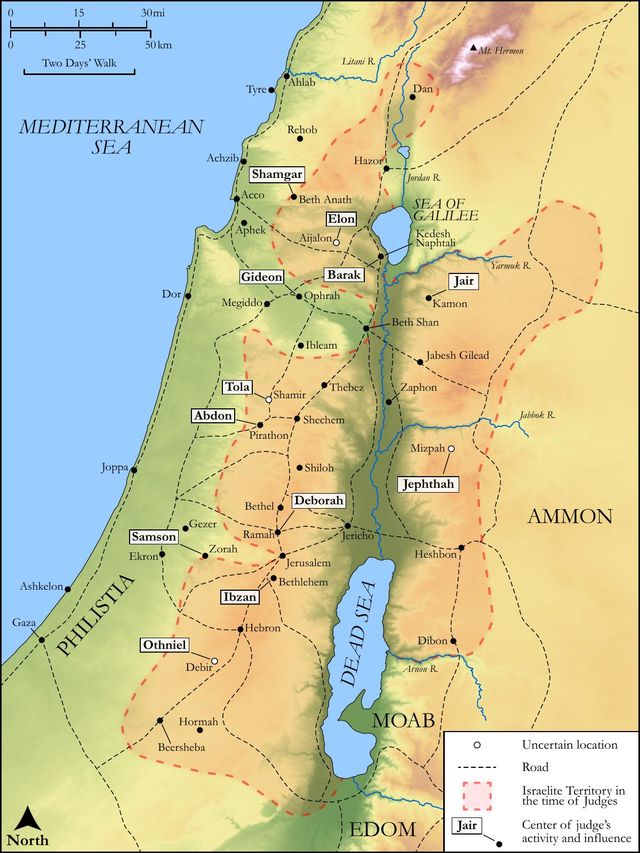
See on the biblical-era maps
Study this verse
Public-domain commentary
Matthew Henry
From his Commentary on the Whole Bible. Henry comments on passages, not single verses — this entry covers Judges 9:7–21. His four-level outline is real structure in the source text, so it is rendered as structure.
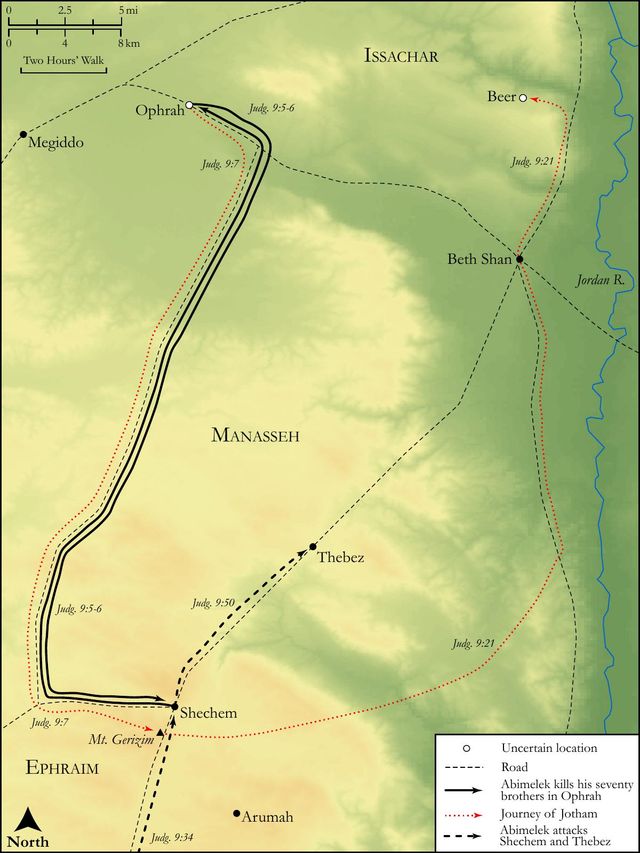
We have here the only testimony that appears to have been borne against the wicked confederacy of Abimelech and the men of Shechem. It was a sign they had provoked God to depart from them that neither any prophet was sent nor any remarkable judgment, to awaken this stupid people, and to stop the progress of this threatening mischief. Only Jotham, the youngest son of Gideon, who by a special providence escaped the common ruin of his family (Jdg 9:5), dealt plainly with the Shechemites, and his speech, which is here recorded, shows him to have been a man of such great ingenuity and wisdom, and really such an accomplished gentleman, that we cannot but the more lament the fall of Gideon's sons. Jotham did not go about to raise an army out of the other cities of Israel (in which, one would think, he might have made a good interest for his father's sake), to avenge his brethren's death, much less to set up himself in competition with Abimelech, so groundless was the usurper's suggestion that the sons of Gideon aimed at dominion (Jdg 9:2); but he contents himself with giving a faithful reproof to the Shechemites, and fair warning of the fatal consequences. He got an opportunity of speaking to them from the top of Mount Gerizim, the mount of blessings, at the foot of which probably the Shechemites were, upon some occasion or other, gathered together (Josephus says, solemnizing a festival), and it seems they were willing to hear what he had to say.
I.His preface is very serious:
"Hearken unto me, you men of Shechem, that God may hearken unto you, Jdg 9:7. As ever you hope to obtain God's favour, and to be accepted of him, give me a patient and impartial hearing." Note, Those who expect God to hear their prayers must be willing to hear reason, to hear a faithful reproof, and to hear the complaints and appeals of wronged innocency. If we turn away our ear from hearing the law, our prayer will be an abomination, Pro 28:9.
II.His parable is very ingenious - that when the trees were disposed to choose a king the government was offered to those valuable trees the olive, the fig-tree, and the vine, but they refused it, choosing rather to serve than rule, to do good than bear sway. But the same tender being made to the bramble he accepted it with vain-glorious exultation. The way of instruction by parables is an ancient way, and very useful, especially to give reproofs by.
1.He hereby applauds the generous modesty of Gideon, and the other judges who were before him, and perhaps of the sons of Gideon, who had declined accepting the state and power of kings when they might have had them, and likewise shows that it is in general the temper of all wise and good men to decline preferment and to choose rather to be useful than to be great.
(1.)There was no occasion at all for the trees to choose a king; they are all the trees of the Lord which he has planted (Psa 104:16) and which therefore he will protect. Nor was there any occasion for Israel to talk of setting a king over them; for the Lord was their king.
(2.)When they had it in their thoughts to choose a king they did not offer the government to the stately cedar, or the lofty pine, which are only for show and shade, and not otherwise useful till they are cut down, but to the fruit-trees, the vine and the olive. Those that bear fruit for the public good are justly respected and honoured by all that are wise more than those that affect to make a figure. For a good useful man some would even dare to die.
(3.)The reason which all these fruit-trees gave for their refusal was much the same. The olive pleads (Jdg 9:9), Should I leave my wine, wherewith both God and man are served and honoured? for oil and wine were used both at God's altars and at men's tables. And shall I leave my sweetness, saith the fig-tree, and my good fruit (Jdg 9:11), and go to be promoted over the trees? or, as the margin reads it, go up and down for the trees? It is intimated,
[1.]That government involves a man in a great deal both of toil and care; he that is promoted over the trees must go up and down for them, and make himself a perfect drudge to business.
[2.]That those who are preferred to places of public trust and power must resolve to forego all their private interests and advantages, and sacrifice them to the good of the community. The fig-tree must lose its sweetness, its sweet retirement, sweet repose, and sweet conversation and contemplation, if it go to be promoted over the trees, and must undergo a constant fatigue.
[3.]That those who are advanced to honour and dignity are in great danger of losing their fatness and fruitfulness. Preferment is apt to make men proud and slothful, and thus spoil their usefulness, with which in a lower sphere they honoured God and man, for which reason those that desire to do good are afraid of being too great.
2.He hereby exposes the ridiculous ambition of Abimelech, whom he compares to the bramble or thistle, Jdg 9:14. He supposes the trees to make their court to him: Come thou and reign over us, perhaps because he knew not that the first motion of Abimelech's preferment came from himself (as we found, Jdg 9:2), but thought the Shechemites had proposed it to him; however, supposing it so, his folly in accepting it deserved to be chastised. The bramble is a worthless plant, not to be numbered among the trees, useless and fruitless, nay, hurtful and vexatious, scratching and tearing, and doing mischief; it began with the curse, and its end is to be burned. Such a one was Abimelech, and yet chosen to the government by the trees, by all the trees; this election seems to have been more unanimous than any of the others. Let us not think it strange if we see folly set in great dignity (Ecc 10:6), and the vilest men exalted (Psa 12:8), and men blind to their own interest in the choice of their guides. The bramble, being chosen to the government, takes no time to consider whether he should accept it or no, but immediately, as if he had been born and bred to dominion, hectors, and assures them they shall find him as he found them. See what great swelling words of vanity he speaks (Jdg 9:15), what promises he makes to his faithful subjects: Let them come and trust in my shadow: a goodly shadow to trust in! How unlike to the shadow of a great rock in a weary land, which a good magistrate is compared to! Isa 32:2. Trust in his shadow! - more likely to be scratched if they came near him - more likely to be injured by him than benefited. Thus men boast of a false gift. Yet he threatens with as much confidence as he promises: If you be not faithful, let fire come out of the bramble (a very unlikely thing to emit fire) and devour the cedars of Lebanon - more likely to catch fire, and be itself devoured.
III.His application is very close and plain. In it,
1.He reminds them of the many good services his father had done for them, Jdg 9:17. He fought their battles, at the hazard of his own life, and to their unspeakable advantage. It was a shame that they needed to be put in mind of this.
2.He aggravates their unkindness to his father's family. They had not done to him according to the deserving of his hands, Jdg 9:16. Great merits often meet with very ill returns. especially to posterity, when the benefactor if forgotten, as Joseph was among the Egyptians. Gideon had left many sons that were an honour to his name and family, and these they had barbarously murdered; one son he had left that was the blemish of his name and family, for he was the son of his maid-servant, whom all that had any respect to Gideon's honour would endeavour to conceal, yet him they made their king. In both they put the utmost contempt imaginable upon Gideon.
3.He leaves it to the event to determine whether they had done well, whereby he lodges the appeal with the divine providence.
(1.)If they prospered long in this villany, he would give them leave to say they had done well, Jdg 9:19. "If your conduct towards the house of Gideon be such as can be justified at any bar of justice, honour, or conscience, much good may it do you with your new king." But,
(2.)If they had, as he was sure they had, dealt basely and wickedly in this matter, let them never expect to prosper, Jdg 9:20. Abimelech and the Shechemites, that had strengthened one another's hands in this villany, would certainly be a plague and ruin one to another. Let none expect to do ill and fare well.
Jotham, having given them this admonition, made a shift to escape with his life, Jdg 9:21. Either they could not reach him or they were so far convinced that they would not add the guilt of his blood to all the rest. But, for fear of Abimelech, he lived in exile, in some remote obscure place. Those whose extraction and education are ever so high know not to what difficulties and straits they may be reduced.
Continue studying Judges 9:7 across the web’s major study libraries — every link below opens this exact verse, chapter, or book on the destination site.
Read & Compare
 BibleGatewayThis verse in more than 200 translations and 70 languages.
 Bible.comThe YouVersion reader — hundreds of translations, reading plans, and highlights.
 ESV.orgCrossway's official English Standard Version reader.
 NET BibleThe NET translation with 60,000+ translators' notes on every rendering decision.
 STEP BibleTyndale House's free study tool — original text, vocabulary, and scholarly resources.
 BibliaLogos Bible Software's free web reader.
 USCCBThe New American Bible (Revised Edition) with the U.S. bishops' study notes.
Commentaries
 BibleHub CommentariesDozens of classic commentaries on this verse, gathered on one page.
 StudyLightMore than 100 commentary sets — the largest collection on the web.
 BibleRefPlain-English commentary on what this verse means, verse by verse.
 Enduring WordDavid Guzik's free commentary on this chapter, widely used by Bible teachers.
 Bible Study ToolsVerse commentary alongside Greek and Hebrew study aids.
Original Language & Research
- BibleHub InterlinearThe verse word by word — original language, transliteration, and English.
- BibleHub LexiconEvery word's original-language definition and Strong's entry.
 Blue Letter BibleDeep-study tools — Strong's numbers, concordance, and word studies.
 SefariaThe Hebrew text with Rashi and centuries of Jewish commentary.
Sermons, Hymns & Audio


TrulyRandomVerse is not affiliated with these sites and doesn’t control their content. They’re linked because they’re genuinely useful.
Summary
Judges 9:7 introduces Jotham, the youngest and sole surviving son of Gideon (Jerubbaal), as he strategically positions himself atop Mount Gerizim. From this elevated and historically significant vantage point, he lifts his voice to deliver a profound and urgent message to the men of Shechem. This verse serves as the dramatic prelude to Jotham's famous parable, a scathing indictment and prophetic warning against their treacherous act of anointing his half-brother, Abimelech, as king, highlighting the critical importance of heeding divine counsel.
Context
ShowHideLiterary Context
Judges 9:7 is a pivotal moment following a dark chapter in Israel's history. The preceding verses Judges 9:1-6 detail Abimelech's ruthless ambition: he conspires with the men of Shechem, his mother's relatives, to murder his seventy half-brothers—the legitimate heirs of Gideon—on a single stone. Only Jotham, Gideon's youngest son, manages to escape this brutal massacre. Having established Abimelech as their king, the men of Shechem have effectively rejected the legacy of Gideon, who had famously refused kingship, declaring that the Lord alone should rule over Israel, as stated in Gideon's refusal of kingship. Jotham's appearance on Mount Gerizim, immediately after Abimelech's coronation, sets the stage for his powerful and prophetic fable, which directly challenges Shechem's illegitimate choice and foreshadows the tragic consequences that will inevitably follow.
Historical & Cultural Context
The city of Shechem held immense historical and religious significance for Israel. It was here that Abraham first built an altar upon entering Canaan (Genesis 12:6-7), Jacob buried foreign gods (Genesis 35:4), and Joshua renewed the covenant with Israel (Joshua 24). Mount Gerizim, paired with Mount Ebal, was the site where Israel was commanded to proclaim blessings and curses upon entering the land (Deuteronomy 11:29). Jotham's choice of Mount Gerizim was thus highly symbolic, a place associated with divine blessing and the Law, from which he would pronounce a warning that would ultimately lead to a curse. His elevated position ensured his voice would carry across the valley to the city, symbolizing the moral high ground from which he spoke against the treachery below.
Key Themes
ShowHideThis verse introduces several crucial themes that permeate the narrative of Judges 9 and resonate throughout the book of Judges. Foremost is the theme of illegitimate authority and leadership, contrasting Abimelech's self-appointed, violent kingship with God's intended rule. Jotham's address highlights the folly and danger of choosing a leader based on human ambition and treachery rather than divine appointment or righteous character. Another key theme is the power of prophetic warning and the consequences of rejecting wisdom. Jotham's plea to "hearken" underscores the critical importance of listening to wise counsel and divine warnings, implying that the men of Shechem's willingness to heed his words will determine God's response to them. This sets up the overarching theme of divine justice and retribution, as the subsequent events of Judges 9 vividly demonstrate the swift and severe consequences that befall those who rebel against God's order and establish unjust rule, ultimately leading to the destruction of both Abimelech and Shechem.
Exposition and Analysis
ShowHideKey Word Analysis
ShowHideThe Hebrew verb שָׁמַע (shâmaʻ) is far more profound than merely "to hear" with one's ears. It encompasses the ideas of listening attentively, understanding, obeying, and responding. When Jotham urges the men of Shechem to "Hearken unto me," he is not simply requesting their auditory attention but demanding their careful consideration, acceptance, and ultimately, their obedience to his message. The reciprocal phrase, "that God may hearken unto you," reinforces this dynamic, suggesting that God's willingness to respond to their future cries or prayers is directly contingent upon their present receptivity and obedience to the truth being declared. It implies a covenantal relationship where human responsiveness to divine truth elicits divine responsiveness.
The specific location from which Jotham speaks, הַר גְּרִזִים (_har _Gᵉrizîym'__), is deeply significant. As noted in the context, this mountain was one of the two mountains (along with Mount Ebal) where the blessings for obedience to God's law were to be pronounced (Deuteronomy 27-28). The word har (H2022) means "mountain" or "range of hills," often used figuratively for promotion. Gᵉrizîym (H1630) is derived from a root meaning "cut up" or "rocky," describing the mountain's topography. By standing on Gerizim, Jotham symbolically invokes the covenant and its blessings, contrasting them with the curses that would inevitably follow Shechem's wicked actions. His choice of location imbues his message with prophetic authority, reminding the people of their foundational covenant obligations and the dire consequences of their deviation.
The word translated "men" in "ye men of Shechem" is בַּעַל (baʻal, H1167), which literally means "master" or "owner." When used in a construct phrase like "men of Shechem," it can denote "citizens" or "inhabitants" who are "masters" or "owners" of that place. This term carries a subtle irony here, as these "masters" of Shechem have just subjected themselves to the illegitimate rule of Abimelech, a "master" who will ultimately bring destruction upon them. It highlights their self-proclaimed authority and ownership, which stands in stark contrast to their actual spiritual and political subjugation to an ungodly leader.
Verse Breakdown
ShowHide"And when they told [it] to Jotham"
This opening clause establishes Jotham's awareness of the horrific events that have transpired—the murder of his brothers and the anointing of Abimelech. It implies that Jotham, though having escaped, was not oblivious to the political machinations and the great evil committed by Abimelech and the men of Shechem. This news serves as the catalyst for his courageous public address.
"he went and stood in the top of mount Gerizim"
Jotham's deliberate action of ascending Mount Gerizim is highly symbolic and strategic. It signifies his moral and spiritual elevation above the treachery below, providing him with a commanding physical position from which his voice could carry across the valley to the city of Shechem. This act is a dramatic and public declaration of his intent to confront the city's inhabitants.
"and lifted up his voice, and cried, and said unto them, Hearken unto me, ye men of Shechem"
This describes Jotham's powerful and urgent delivery. "Lifted up his voice and cried" (Hebrew: qara') indicates a public, authoritative, and passionate declaration, not a quiet conversation. It is a prophetic utterance, a call for immediate and serious attention. The direct address, "ye men of Shechem," makes it clear that his message is specifically for those who have participated in the conspiracy and supported Abimelech's illegitimate rule. The imperative "Hearken unto me" is a demand for their full attention and obedience.
"that God may hearken unto you"
This concluding phrase reveals the conditional nature of divine favor and the reciprocal relationship between human obedience and God's responsiveness. Jotham warns that if they refuse to "hearken" to his righteous counsel, God will likewise refuse to "hearken" to their cries in their time of trouble. It is a profound theological statement, implying that their current choice to reject God's order and embrace wickedness will have direct and severe consequences for their future relationship with God, leading to judgment rather than blessing or deliverance.
Literary Devices
ShowHideJudges 9:7 is rich with Symbolism. Jotham's choice to speak from Mount Gerizim is deeply symbolic, representing a place of divine blessing and covenant, from which he pronounces a warning that will lead to a curse. His elevated position also symbolizes his moral high ground over the treacherous actions of Abimelech and the men of Shechem. The act of "lifting up his voice and crying" is a form of Rhetoric, employing a dramatic, public, and urgent appeal designed to capture attention and convey the gravity of his message. There is also an element of Foreshadowing in this verse; Jotham's warning, particularly the reciprocal "that God may hearken unto you," subtly hints at the divine judgment that will inevitably fall upon Shechem and Abimelech, as detailed in the subsequent narrative. The very situation also presents a stark Irony: the men of Shechem, who should have been guided by the covenant principles associated with Gerizim, instead choose a ruthless, "worthless" king, setting themselves up for destruction.
Theological and Thematic Connections
ShowHideJudges 9:7 powerfully articulates the biblical principle that rejecting righteous counsel and embracing ungodly leadership leads to divine judgment. Jotham's courageous stand on Mount Gerizim, a place associated with covenant blessings and curses, underscores the reciprocal nature of humanity's relationship with God: our willingness to "hearken" (listen and obey) God's truth directly impacts His willingness to "hearken" (respond with favor) to us. This passage serves as a stark reminder that true authority flows from God, and any attempt to establish power through violence, treachery, or human ambition, outside of God's design, is inherently illegitimate and destined for ruin. It highlights God's unwavering commitment to justice and His ultimate sovereignty over human affairs, even when humanity chooses paths of rebellion.
Reflection and Application
ShowHideJotham's courageous act in Judges 9:7 is a profound call to discern and uphold righteous leadership, even when it is unpopular or dangerous. In a world often swayed by charisma, power, or self-interest, Jotham reminds us that true authority is rooted in integrity and divine alignment, not violence or manipulation. His plea to "hearken" is timeless, urging us to cultivate a posture of attentive listening and obedience to God's Word and the wise counsel He provides through His servants. Just as the men of Shechem faced dire consequences for ignoring Jotham's prophetic warning, we too are called to be diligent hearers and doers of God's Word (James 1:22). This verse challenges us to examine our own lives: Are we quick to embrace popular but ungodly paths, or do we seek and submit to God's righteous principles? Do we have the courage to rebuke the powerful when necessary, or do we remain silent in the face of injustice? Our willingness to "hearken" to God's voice today determines His responsiveness to our cries tomorrow, shaping our personal and communal destinies.
Questions for Reflection
ShowHideFAQ
ShowHideWhy did Jotham choose Mount Gerizim to deliver his message?
ShowHideJotham's choice of Mount Gerizim was highly strategic and symbolic. Geographically, it offered a commanding vantage point overlooking the city of Shechem, ensuring his voice would carry across the valley. Theologically, Mount Gerizim, along with Mount Ebal, was the site where Israel was commanded to proclaim blessings for obedience to God's law and curses for disobedience (Deuteronomy 11:29). By speaking from Gerizim, Jotham invoked this covenantal history, lending immense authority and gravity to his message. He was essentially reminding the men of Shechem of their covenant obligations and warning them that their choice to anoint Abimelech would lead to curses, not blessings.
What is the deeper meaning of "hearken" in Jotham's plea?
ShowHideThe Hebrew verb translated "hearken" is shama', which means much more than simply "to hear" aurally. It implies attentive listening, understanding, and, most importantly, obeying. When Jotham says, "Hearken unto me, ye men of Shechem, that God may hearken unto you," he is establishing a profound reciprocal relationship. He is not just asking for their attention but for their active reception and obedience to his prophetic warning. The implication is that God's willingness to respond to their prayers or cries for help in the future is contingent upon their present willingness to listen and obey His truth, delivered through Jotham. It underscores the principle that obedience to God's word is foundational for experiencing His favor and responsiveness.
How does Jotham's message in Judges 9:7 relate to the broader narrative of the book of Judges?
ShowHideJotham's message is a microcosm of the entire book of Judges, which chronicles Israel's cyclical descent into sin, oppression, and partial deliverance. The men of Shechem's rejection of God's true leadership (as represented by Gideon's refusal of kingship) and their embrace of Abimelech's illegitimate, violent rule perfectly illustrate Israel's spiritual decline. Jotham's warning, and the subsequent fulfillment of the curse in Judges 9, demonstrate God's unwavering justice and the inevitable consequences of forsaking Him and His righteous ways. It highlights the chaos and suffering that result when a people "do what is right in their own eyes" (Judges 21:25), rather than hearkening to God's voice.
Christ-Centered Fulfillment
ShowHideJotham's prophetic stand on Mount Gerizim, urging the men of Shechem to "hearken" lest God refuse to "hearken" to them, finds its ultimate fulfillment in Jesus Christ. Jotham, a lone voice of truth against a backdrop of treachery and illegitimate rule, foreshadows Christ, the ultimate Prophet and King, who stands as the singular voice of truth and righteousness in a fallen world. Unlike Abimelech, who seized power through violence, Jesus is the King who comes in humility, offering His life as a sacrifice (Philippians 2:5-8). He is the true Vine to whom we must "hearken" and abide in (John 15:5), the Good Shepherd whose voice His sheep know and follow (John 10:27). The reciprocal principle Jotham articulated—that God's hearkening to us depends on our hearkening to Him—is perfectly embodied in Christ. Through His atoning work, we are granted access to the Father, and our prayers are heard when we pray in His name and according to His will (John 14:13-14). Jotham's warning of judgment for rejecting righteous counsel points to Christ as the one who will ultimately judge all unrighteousness, establishing a kingdom that is eternal and just (Revelation 19:11-16). In Christ, the call to "hearken" becomes an invitation to life, peace, and eternal blessing, far surpassing the conditional promise offered from Mount Gerizim.