


Judges 9:16
Bible text: King James Version (1769 Blayney text) · Public domain
Bible text: King James Version with Strong's numbers · Public domain
Bible text: Berean Standard Bible · Public domain
Bible text: American Standard Version (1901) · Public domain
Bible text: World English Bible, Messianic edition · Public domain
Bible text: Geneva Bible (1599) · Public domain
Bible text: Young's Literal Translation · Public domain
- וְעַתָּהve·'a·Tahand nowH6258Conj-w ¦ AdvAdverbוְandעַתָּהnow
- אִם'imifH518PrtParticle Conditional
- בֶּאֱמֶתbe·'e·Metin faithfulnessH571Prep-b ¦ N-fsNoun Singular Feminine Absoluteבֶּinאֱמֶתfaithfulness
- וּבְתָמִיםu·ve·ta·Mimand in integrityH8549Conj-w ¦ Prep-b ¦ Adj-msAdjective Singular Masculine Absoluteוּandבְinתָמִיםintegrity
- עֲשִׂיתֶם'a·si·Temyou have actedH6213V-Qal-Perf-2mpVerb Qal Perfect 2nd Plural Masculine
- וַתַּמְלִיכוּva·tam·Li·khuand you have made kingH4427Conj-w ¦ V-Hiphil-ConsecImperf-2mpVerb Hiphil Consecutive Imperfect 2nd Plural Masculineוַandתַּמְלִיכוּyou have made king
- אֶת'et<obj.>H853DirObjMParticle Object Indicator
- אֲבִימֶלֶךְ'a·vi·Me·lekhAbimelechH40N-proper-mNoun Proper Masculine
- וְאִםve·'imand ifH518Conj-w ¦ PrtParticle Conditionalוְandאִםif
- טוֹבָהto·VahgoodH2896N-fsNoun Singular Feminine Absolute
- עֲשִׂיתֶם'a·si·Temyou have doneH6213V-Qal-Perf-2mpVerb Qal Perfect 2nd Plural Masculine
- עִם'imwithH5973PrepPreposition
- יְרֻבַּעַלye·ru·Ba·'alJerub-BaalH3378N-proper-mNoun Proper Masculine
- וְעִםve·'imand withH5973Conj-w ¦ PrepPrepositionוְandעִםwith
- בֵּיתוֹbei·Tohis houseH1004N-msc ¦ 3msNoun Singular Masculine Constructבֵּיתhouseוֹhis
- וְאִםve·'imand ifH518Conj-w ¦ PrtParticle Conditionalוְandאִםif
- כִּגְמוּלkig·Mulaccording to [the] dealing ofH1576Prep-k ¦ N-mscNoun Singular Masculine Constructכִּaccording toגְמוּל[the] dealing of
- יָדָיוya·Davhis handsH3027N-cdc ¦ 3msNoun Dual common gender Constructיָדָיhandsוhis
- עֲשִׂיתֶם'a·Si·temyou have doneH6213V-Qal-Perf-2mpVerb Qal Perfect 2nd Plural Masculine
- לוֹloto <the> himPrep-l ¦ 3msSuffix Personal 3rd Singular Masculineלto <the>וֹhim
English is a literal word-by-word gloss of the Hebrew, not the KJV's wording. Why?
This is the original text the KJV's translators worked from — each Hebrew word with its own literal English meaning in this verse, prepared by scholars at Tyndale House, Cambridge. The KJV translates whole sentences, not word by word, so its wording differs: one Hebrew word can become several English words, and the KJV may choose “the LORD” where the gloss reads “Yahweh”. Both are faithful — they answer different questions. For the KJV's own rendering, switch to the KJV text.
Details
See on the biblical-era maps
Study this verse
Public-domain commentary
Matthew Henry
From his Commentary on the Whole Bible. Henry comments on passages, not single verses — this entry covers Judges 9:7–21. His four-level outline is real structure in the source text, so it is rendered as structure.
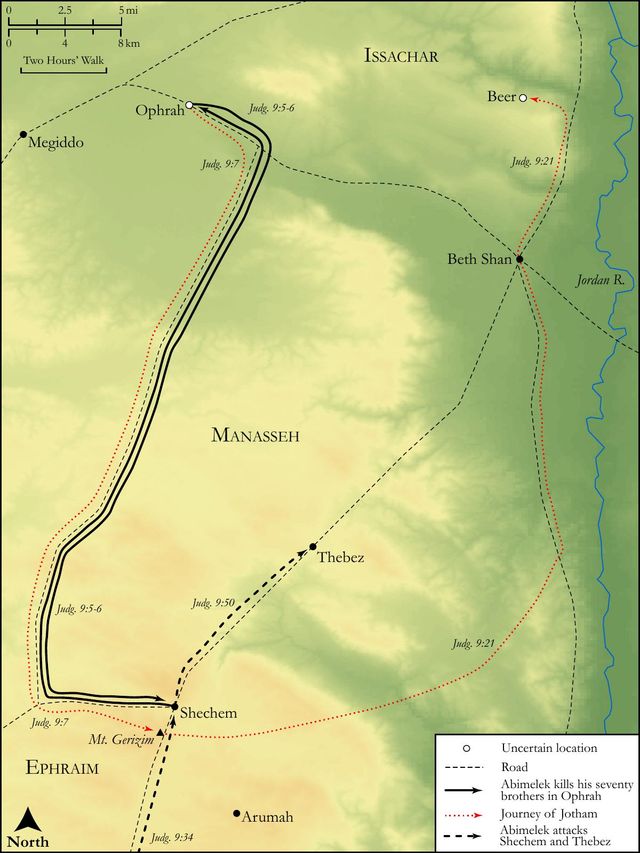
We have here the only testimony that appears to have been borne against the wicked confederacy of Abimelech and the men of Shechem. It was a sign they had provoked God to depart from them that neither any prophet was sent nor any remarkable judgment, to awaken this stupid people, and to stop the progress of this threatening mischief. Only Jotham, the youngest son of Gideon, who by a special providence escaped the common ruin of his family (Jdg 9:5), dealt plainly with the Shechemites, and his speech, which is here recorded, shows him to have been a man of such great ingenuity and wisdom, and really such an accomplished gentleman, that we cannot but the more lament the fall of Gideon's sons. Jotham did not go about to raise an army out of the other cities of Israel (in which, one would think, he might have made a good interest for his father's sake), to avenge his brethren's death, much less to set up himself in competition with Abimelech, so groundless was the usurper's suggestion that the sons of Gideon aimed at dominion (Jdg 9:2); but he contents himself with giving a faithful reproof to the Shechemites, and fair warning of the fatal consequences. He got an opportunity of speaking to them from the top of Mount Gerizim, the mount of blessings, at the foot of which probably the Shechemites were, upon some occasion or other, gathered together (Josephus says, solemnizing a festival), and it seems they were willing to hear what he had to say.
I.His preface is very serious:
"Hearken unto me, you men of Shechem, that God may hearken unto you, Jdg 9:7. As ever you hope to obtain God's favour, and to be accepted of him, give me a patient and impartial hearing." Note, Those who expect God to hear their prayers must be willing to hear reason, to hear a faithful reproof, and to hear the complaints and appeals of wronged innocency. If we turn away our ear from hearing the law, our prayer will be an abomination, Pro 28:9.
II.His parable is very ingenious - that when the trees were disposed to choose a king the government was offered to those valuable trees the olive, the fig-tree, and the vine, but they refused it, choosing rather to serve than rule, to do good than bear sway. But the same tender being made to the bramble he accepted it with vain-glorious exultation. The way of instruction by parables is an ancient way, and very useful, especially to give reproofs by.
1.He hereby applauds the generous modesty of Gideon, and the other judges who were before him, and perhaps of the sons of Gideon, who had declined accepting the state and power of kings when they might have had them, and likewise shows that it is in general the temper of all wise and good men to decline preferment and to choose rather to be useful than to be great.
(1.)There was no occasion at all for the trees to choose a king; they are all the trees of the Lord which he has planted (Psa 104:16) and which therefore he will protect. Nor was there any occasion for Israel to talk of setting a king over them; for the Lord was their king.
(2.)When they had it in their thoughts to choose a king they did not offer the government to the stately cedar, or the lofty pine, which are only for show and shade, and not otherwise useful till they are cut down, but to the fruit-trees, the vine and the olive. Those that bear fruit for the public good are justly respected and honoured by all that are wise more than those that affect to make a figure. For a good useful man some would even dare to die.
(3.)The reason which all these fruit-trees gave for their refusal was much the same. The olive pleads (Jdg 9:9), Should I leave my wine, wherewith both God and man are served and honoured? for oil and wine were used both at God's altars and at men's tables. And shall I leave my sweetness, saith the fig-tree, and my good fruit (Jdg 9:11), and go to be promoted over the trees? or, as the margin reads it, go up and down for the trees? It is intimated,
[1.]That government involves a man in a great deal both of toil and care; he that is promoted over the trees must go up and down for them, and make himself a perfect drudge to business.
[2.]That those who are preferred to places of public trust and power must resolve to forego all their private interests and advantages, and sacrifice them to the good of the community. The fig-tree must lose its sweetness, its sweet retirement, sweet repose, and sweet conversation and contemplation, if it go to be promoted over the trees, and must undergo a constant fatigue.
[3.]That those who are advanced to honour and dignity are in great danger of losing their fatness and fruitfulness. Preferment is apt to make men proud and slothful, and thus spoil their usefulness, with which in a lower sphere they honoured God and man, for which reason those that desire to do good are afraid of being too great.
2.He hereby exposes the ridiculous ambition of Abimelech, whom he compares to the bramble or thistle, Jdg 9:14. He supposes the trees to make their court to him: Come thou and reign over us, perhaps because he knew not that the first motion of Abimelech's preferment came from himself (as we found, Jdg 9:2), but thought the Shechemites had proposed it to him; however, supposing it so, his folly in accepting it deserved to be chastised. The bramble is a worthless plant, not to be numbered among the trees, useless and fruitless, nay, hurtful and vexatious, scratching and tearing, and doing mischief; it began with the curse, and its end is to be burned. Such a one was Abimelech, and yet chosen to the government by the trees, by all the trees; this election seems to have been more unanimous than any of the others. Let us not think it strange if we see folly set in great dignity (Ecc 10:6), and the vilest men exalted (Psa 12:8), and men blind to their own interest in the choice of their guides. The bramble, being chosen to the government, takes no time to consider whether he should accept it or no, but immediately, as if he had been born and bred to dominion, hectors, and assures them they shall find him as he found them. See what great swelling words of vanity he speaks (Jdg 9:15), what promises he makes to his faithful subjects: Let them come and trust in my shadow: a goodly shadow to trust in! How unlike to the shadow of a great rock in a weary land, which a good magistrate is compared to! Isa 32:2. Trust in his shadow! - more likely to be scratched if they came near him - more likely to be injured by him than benefited. Thus men boast of a false gift. Yet he threatens with as much confidence as he promises: If you be not faithful, let fire come out of the bramble (a very unlikely thing to emit fire) and devour the cedars of Lebanon - more likely to catch fire, and be itself devoured.
III.His application is very close and plain. In it,
1.He reminds them of the many good services his father had done for them, Jdg 9:17. He fought their battles, at the hazard of his own life, and to their unspeakable advantage. It was a shame that they needed to be put in mind of this.
2.He aggravates their unkindness to his father's family. They had not done to him according to the deserving of his hands, Jdg 9:16. Great merits often meet with very ill returns. especially to posterity, when the benefactor if forgotten, as Joseph was among the Egyptians. Gideon had left many sons that were an honour to his name and family, and these they had barbarously murdered; one son he had left that was the blemish of his name and family, for he was the son of his maid-servant, whom all that had any respect to Gideon's honour would endeavour to conceal, yet him they made their king. In both they put the utmost contempt imaginable upon Gideon.
3.He leaves it to the event to determine whether they had done well, whereby he lodges the appeal with the divine providence.
(1.)If they prospered long in this villany, he would give them leave to say they had done well, Jdg 9:19. "If your conduct towards the house of Gideon be such as can be justified at any bar of justice, honour, or conscience, much good may it do you with your new king." But,
(2.)If they had, as he was sure they had, dealt basely and wickedly in this matter, let them never expect to prosper, Jdg 9:20. Abimelech and the Shechemites, that had strengthened one another's hands in this villany, would certainly be a plague and ruin one to another. Let none expect to do ill and fare well.
Jotham, having given them this admonition, made a shift to escape with his life, Jdg 9:21. Either they could not reach him or they were so far convinced that they would not add the guilt of his blood to all the rest. But, for fear of Abimelech, he lived in exile, in some remote obscure place. Those whose extraction and education are ever so high know not to what difficulties and straits they may be reduced.
Continue studying Judges 9:16 across the web’s major study libraries — every link below opens this exact verse, chapter, or book on the destination site.
Read & Compare
 BibleGatewayThis verse in more than 200 translations and 70 languages.
 Bible.comThe YouVersion reader — hundreds of translations, reading plans, and highlights.
 ESV.orgCrossway's official English Standard Version reader.
 NET BibleThe NET translation with 60,000+ translators' notes on every rendering decision.
 STEP BibleTyndale House's free study tool — original text, vocabulary, and scholarly resources.
 BibliaLogos Bible Software's free web reader.
 USCCBThe New American Bible (Revised Edition) with the U.S. bishops' study notes.
Commentaries
 BibleHub CommentariesDozens of classic commentaries on this verse, gathered on one page.
 StudyLightMore than 100 commentary sets — the largest collection on the web.
 BibleRefPlain-English commentary on what this verse means, verse by verse.
 Enduring WordDavid Guzik's free commentary on this chapter, widely used by Bible teachers.
 Bible Study ToolsVerse commentary alongside Greek and Hebrew study aids.
Original Language & Research
- BibleHub InterlinearThe verse word by word — original language, transliteration, and English.
- BibleHub LexiconEvery word's original-language definition and Strong's entry.
 Blue Letter BibleDeep-study tools — Strong's numbers, concordance, and word studies.
 SefariaThe Hebrew text with Rashi and centuries of Jewish commentary.
Sermons, Hymns & Audio


TrulyRandomVerse is not affiliated with these sites and doesn’t control their content. They’re linked because they’re genuinely useful.
Summary
Judges 9:16 captures the searing irony and prophetic indictment delivered by Jotham, the sole surviving son of Gideon, to the citizens of Shechem. This verse, a rhetorical masterpiece, challenges the Shechemites to examine the moral integrity of their recent actions: the brutal murder of Gideon's seventy sons and the installation of the ruthless Abimelech, a half-brother, as their king. It subtly yet powerfully highlights their profound ingratitude and betrayal of Gideon's legacy, setting the stage for Jotham's subsequent curse which foretells the mutual destruction of Abimelech and the men of Shechem, a divine judgment for their treachery.
Context
ShowHideLiterary Context
Judges 9:16 is a pivotal moment within Jotham's impassioned speech, delivered from the secure height of Mount Gerizim to the men of Shechem. It immediately follows his famous parable of the trees, a satirical allegory designed to expose the folly and danger of their choice to crown Abimelech, the "bramble," as their king. The verse serves as a direct, ironic challenge to their conscience, contrasting their treacherous deeds with the righteous service of Gideon (Jerubbaal). This rhetorical setup prepares the audience for the severe curse that Jotham pronounces in the following verses, ensuring that the subsequent narrative of mutual destruction is understood as a direct consequence of their actions and a fulfillment of prophetic judgment.
Historical & Cultural Context
The setting is Shechem, a historically significant city in central Canaan, known for its strategic location and as a place where covenants were made (Joshua 24:1-28). The Shechemites, through their mother, had a familial connection to Abimelech, which they exploited to elevate him to power, despite his ruthless character. This event occurs in the chaotic period of the Judges, characterized by a lack of centralized leadership and a recurring cycle of apostasy, oppression, and deliverance. Gideon (Jerubbaal) had refused kingship for himself and his family (Judges 8:22-23), yet upon his death, his illegitimate son Abimelech violently seized power, a stark departure from the divinely appointed, charismatic leadership of the judges. The act of making Abimelech king represents a premature and ill-conceived attempt at monarchy, driven by self-interest and violence rather than divine guidance, foreshadowing the later struggles with kingship in Israel.
Key Themes
ShowHideThe verse powerfully encapsulates several key themes prevalent in the book of Judges and the broader biblical narrative. Betrayal and Ingratitude are central, as the Shechemites' actions represent a profound rejection of Gideon's selfless service in delivering Israel from Midianite oppression (Judges 7:22). Their repayment for his heroic deeds is the murder of his legitimate heirs. Rhetorical Irony is masterfully employed by Jotham; his opening phrase, "Now therefore, if ye have done truly and sincerely," is dripping with sarcasm, highlighting the stark contrast between their deceitful, murderous deeds and any pretense of integrity. This device exposes their hypocrisy and moral bankruptcy. Finally, the theme of Justice and Consequences is underscored, as Jotham's words are a prelude to the divine retribution that ultimately befalls both Abimelech and the men of Shechem, demonstrating the biblical principle that actions, especially those involving treachery and violence, inevitably lead to their just recompense (Galatians 6:7).
Exposition and Analysis
ShowHideKey Word Analysis
ShowHideThis word signifies truth, faithfulness, stability, and reliability. Jotham's use of "truly" is profoundly ironic, as the Shechemites' actions were anything but truthful or faithful. They had acted with deceit and treachery, betraying the trust and legacy of Gideon. The word highlights the moral chasm between their professed intentions (if any) and their actual deeds.
This term denotes completeness, integrity, blamelessness, or perfection. When applied to human conduct, it speaks of wholeheartedness and moral uprightness. Jotham's challenge, "if ye have done...sincerely," underscores the utter lack of integrity in their conspiracy with Abimelech. Their actions were motivated by selfish ambition and violence, completely devoid of the moral purity implied by tâmîym.
The noun gᵉmûwl refers to recompense, reward, or retribution, while yâd (in its plural form yâdâv) means "his hands." The phrase collectively means "according to the recompense of his deeds/hands." It directly points to Gideon's righteous and selfless service to Israel, particularly his deliverance from Midian. Jotham's statement sarcastically implies that the Shechemites' murderous actions against Gideon's family were the "reward" or "recompense" for his heroic efforts, thereby exposing the perverse nature of their ingratitude and injustice.
Verse Breakdown
ShowHide"Now therefore, if ye have done truly and sincerely, in that ye have made Abimelech king,"
This opening clause is a masterstroke of rhetorical irony. Jotham, knowing full well the deceit and brutality behind Abimelech's ascent, challenges the Shechemites to honestly assess their actions. The "if" clause is not an expression of doubt but a sarcastic invitation to self-condemnation. By using terms like "truly" and "sincerely," Jotham highlights the stark contrast between the moral uprightness these words imply and the treacherous, murderous means by which Abimelech was made king. The implication is clear: they have done anything but truly and sincerely.
"and if ye have dealt well with Jerubbaal and his house,"
This continues the ironic challenge, forcing the Shechemites to confront their treatment of Gideon (Jerubbaal) and his family. "Dealt well" is a euphemism for the horrific massacre of Gideon's seventy sons by Abimelech, with the Shechemites' complicity and support (Judges 9:5). Jotham points out the profound betrayal of the very family that had delivered them, emphasizing the depth of their ingratitude and the heinous nature of their actions.
"and have done unto him according to the deserving of his hands;"
This final clause underscores the perversion of justice. Gideon's "deserving of his hands" refers to his heroic and selfless leadership, his willingness to risk his life for Israel, and his refusal of kingship for personal gain. Yet, the "reward" he and his house received was betrayal and slaughter. Jotham's statement highlights the profound moral imbalance: those who should have been honored were instead repaid with the ultimate injustice, setting the stage for the inevitable divine retribution.
Literary Devices
ShowHideJotham's speech in Judges 9:16 is a powerful example of Rhetorical Irony and Sarcasm. The entire verse is framed as a conditional statement ("if ye have done..."), but the condition is presented as an impossibility given the Shechemites' actions. Jotham uses words like "truly," "sincerely," and "dealt well" to describe deeds that were, in fact, treacherous, deceitful, and murderous. This deliberate use of language to convey the opposite of its literal meaning serves to highlight the moral depravity and hypocrisy of the Shechemites. Furthermore, the verse functions as a form of Foreshadowing and Prophetic Indictment. While not an explicit curse in itself, it sets the moral groundwork for the curse that immediately follows (Judges 9:20), indicating that the subsequent destruction of Abimelech and Shechem is a just consequence of their actions, a divine response to their profound ingratitude and injustice.
Theological and Thematic Connections
ShowHideJudges 9:16 powerfully illustrates the biblical principle that actions have consequences, especially when those actions involve betrayal, violence, and a perversion of justice. It underscores the divine expectation of faithfulness and integrity, contrasting it sharply with the Shechemites' moral bankruptcy. The narrative serves as a stark reminder that God observes human conduct and holds individuals and communities accountable for their choices, particularly regarding leadership and loyalty. The ingratitude shown to Gideon's house and the elevation of a ruthless tyrant like Abimelech ultimately lead to self-destruction, demonstrating that those who sow injustice will reap calamity.
Reflection and Application
ShowHideJotham's piercing words in Judges 9:16 resonate deeply with contemporary issues of leadership, loyalty, and accountability. This passage challenges us to examine the integrity of our own choices, both individually and corporately. Are we truly and sincerely seeking justice and righteousness, or are our actions driven by self-interest, ambition, or convenience, even at the expense of others? The Shechemites' betrayal of Gideon's legacy serves as a potent warning against ingratitude and the dangers of elevating leaders who lack character and integrity. It reminds us that true leadership is about selfless service, not ruthless power grabs. When we compromise our values for perceived gain, or when we support those who act unjustly, we often set in motion a chain of consequences that can lead to mutual destruction. This text calls us to cultivate a spirit of gratitude, uphold justice, and choose leaders wisely, recognizing that moral choices have far-reaching implications, not only for ourselves but for the communities we inhabit.
Questions for Reflection
ShowHideFAQ
ShowHideWhat is the significance of Jotham's speech in Judges 9?
ShowHideJotham's speech, culminating in Judges 9:16-20, is highly significant for several reasons. First, it is a rare instance of direct prophetic indictment in the book of Judges, articulating divine judgment against the Shechemites and Abimelech. Second, his parable of the trees is one of the earliest and most vivid fables in biblical literature, offering a profound critique of kingship and the dangers of choosing an unworthy ruler. Third, it provides the moral and theological framework for understanding the subsequent narrative of mutual destruction in Judges 9, demonstrating that God's justice ultimately prevails. Jotham, as the sole survivor of Abimelech's massacre, becomes the voice of divine truth and righteous indignation.
Why does Jotham emphasize Gideon's "deserving of his hands" when addressing the Shechemites?
ShowHideJotham emphasizes Gideon's "deserving of his hands" to highlight the profound ingratitude and injustice of the Shechemites. Gideon (Jerubbaal) had faithfully served Israel, risking his life to deliver them from Midianite oppression (Judges 7:22) and refusing to establish a dynastic kingship (Judges 8:22-23). His "hands" had performed acts of selfless deliverance and leadership. By contrast, the Shechemites repaid his family with betrayal and murder, supporting Abimelech's usurpation. Jotham's rhetorical question forces them to confront the stark contrast between Gideon's righteous deeds and their perverse "repayment," underscoring the moral bankruptcy of their actions and the egregious nature of their ingratitude.
Christ-Centered Fulfillment
ShowHideJudges 9:16, with its themes of betrayal, ingratitude, and the just consequences of unrighteous leadership, finds its ultimate fulfillment and contrast in the person and work of Jesus Christ. While Jotham's speech condemns a people who repaid selfless service with treachery, Christ, the true King, was met with even greater rejection and betrayal, despite His perfect and ultimate service. He came to His own, and His own received Him not, ultimately delivering Him to crucifixion. Yet, unlike Abimelech, whose kingship brought destruction, Jesus' kingship is one of self-sacrificial love and eternal life. He is the Good Shepherd who lays down His life for the sheep, not a bramble that consumes. The justice foreshadowed in Jotham's curse against the wicked finds its ultimate expression in Christ's triumph over sin and death, and His future righteous judgment where every knee will bow and every tongue confess. The treachery against Gideon's house pales in comparison to the world's rejection of God's Son, yet through this ultimate betrayal, God brought about the ultimate redemption, fulfilling His promise of a righteous King whose reign will never end (Luke 1:33).