


Judges 8:35
Bible text: King James Version (1769 Blayney text) · Public domain
Bible text: Berean Standard Bible · Public domain
Bible text: American Standard Version (1901) · Public domain
Bible text: World English Bible, Messianic edition · Public domain
Bible text: Geneva Bible (1599) · Public domain
Bible text: Young's Literal Translation · Public domain
- וְלֹאve·lo'and notH3808Conj-w ¦ NegParticle Negativeוְandלֹאnot
- עָשׂוּ'a·Suthey didH6213V-Qal-Perf-3cpVerb Qal Perfect 3rd Plural common gender
- חֶסֶדChe·sedloyaltyH2617N-msNoun Singular Masculine Absolute
- עִם'imwithH5973PrepPreposition
- בֵּיתbeit[the] house ofH1004N-mscNoun Singular Masculine Construct
- יְרֻבַּעַלye·ru·Ba·'alJerub-BaalH3378N-proper-mNoun Proper Masculine
- גִּדְעוֹןgid·'onGideonH1439N-proper-mNoun Proper Masculine
- כְּכָלke·kholaccording to allH3605Prep-k ¦ N-mscNoun Singular Masculine Constructכְּaccording toכָלall
- הַטּוֹבָהha·to·Vahthe goodH2896Art ¦ N-fsNoun Singular Feminine Absoluteהַtheטּוֹבָהgood
- אֲשֶׁר'a·SherwhichH834RelParticle Relative
- עָשָׂה'a·Sahhe had doneH6213V-Qal-Perf-3msVerb Qal Perfect 3rd Singular Masculine
- עִם'imwithH5973PrepPreposition
- יִשְׂרָאֵלYis·ra·'ElIsraelH3478N-properNoun Proper Location
English is a literal word-by-word gloss of the Hebrew, not the KJV's wording. Why?
This is the original text the KJV's translators worked from — each Hebrew word with its own literal English meaning in this verse, prepared by scholars at Tyndale House, Cambridge. The KJV translates whole sentences, not word by word, so its wording differs: one Hebrew word can become several English words, and the KJV may choose “the LORD” where the gloss reads “Yahweh”. Both are faithful — they answer different questions. For the KJV's own rendering, switch to the KJV text.
Details
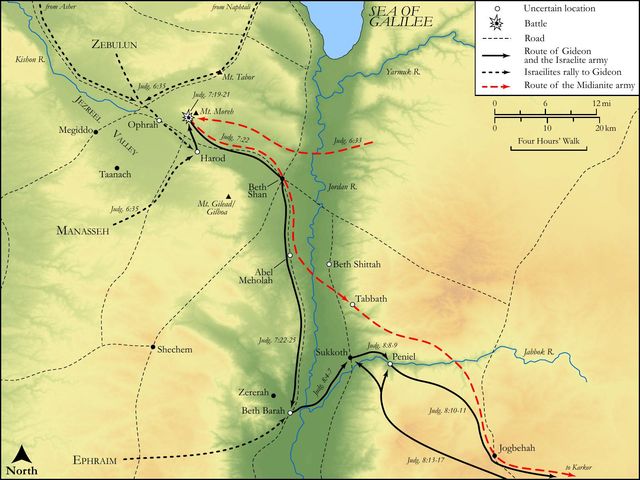
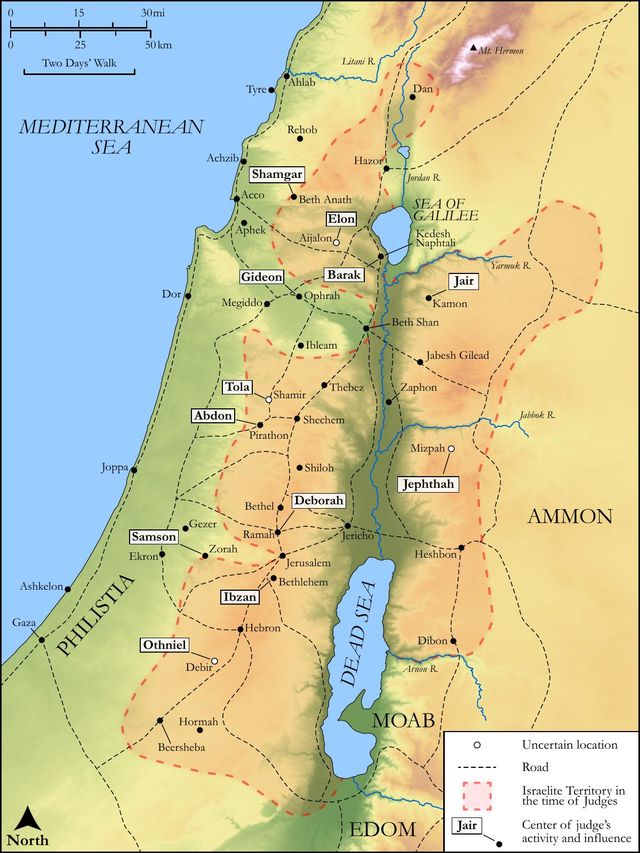
See on the biblical-era maps
Study this verse
Public-domain commentary
Matthew Henry
From his Commentary on the Whole Bible. Henry comments on passages, not single verses — this entry covers Judges 8:29–35.
We have here the conclusion of the story of Gideon. 1. He lived privately, Jdg 8:29. He was not puffed up with his great honours, did not covet a palace or castle to dwell in, but retired to the house he had lived in before his elevation. Thus that brave Roman Who was called from the plough upon a sudden occasion to command the army when the action was over returned to his plough again. 2. His family was multiplied. He had many wives (therein he transgressed the law); by them he had seventy sons (Jdg 8:30), but by a concubine he had one whom he named Abimelech (which signifies, my father a king), that proved the ruin of his family, Jdg 8:31. 3. He died in honour, in a good old age, when he had lived as long as he was capable of serving God and his country; and who would desire to live any longer? And he was buried in the sepulchre of his fathers. 4. After his death the people corrupted themselves, and went all to naught. As soon as ever Gideon was dead, who had kept them close to the worship of the God of Israel, they found themselves under no restraint, and then they went a whoring after Baalim, Jdg 8:33. They went a whoring first after another ephod (Jdg 8:27), for which irregularity Gideon had himself given them too much occasion, and now they went a whoring after another god. False worships made way for false deities. They now chose a new god (Jdg 5:8), a god of a new name, Baal-berith (a goddess, say some); Berith, some think, was Berytus, the place where the Phoenicians worshipped this idol. The name signifies the Lord of a covenant. Perhaps he was so called because his worshippers joined themselves by covenant to him, in imitation of Israel's covenanting with God; for the devil is God's ape. In this revolt of Israel to idolatry they showed, (1.) Great ingratitude to God (Jdg 8:34): They remembered not the Lord, not only who had delivered them into the hands of their enemies, to punish them for their idolatry, but who had also delivered them out of the hands of their enemies, to invite them back again into his service; both the judgments and the mercies were forgotten, and the impressions of them lost. (2.) Great ingratitude to Gideon, Jdg 8:35. A great deal of goodness he had shown unto Israel, as a father to his country, for which they ought to have been kind to his family when he was gone, for that is one way by which we ought to show ourselves grateful to our friends and benefactors, and may be returning their kindnesses when they are in their graves. But Israel showed not this kindness to Gideon's family, as we shall find in the next chapter. No wonder if those who forget their God forget their friends.
Continue studying Judges 8:35 across the web’s major study libraries — every link below opens this exact verse, chapter, or book on the destination site.
Read & Compare
 BibleGatewayThis verse in more than 200 translations and 70 languages.
 Bible.comThe YouVersion reader — hundreds of translations, reading plans, and highlights.
 ESV.orgCrossway's official English Standard Version reader.
 NET BibleThe NET translation with 60,000+ translators' notes on every rendering decision.
 STEP BibleTyndale House's free study tool — original text, vocabulary, and scholarly resources.
 BibliaLogos Bible Software's free web reader.
 USCCBThe New American Bible (Revised Edition) with the U.S. bishops' study notes.
Commentaries
 BibleHub CommentariesDozens of classic commentaries on this verse, gathered on one page.
 StudyLightMore than 100 commentary sets — the largest collection on the web.
 BibleRefPlain-English commentary on what this verse means, verse by verse.
 Enduring WordDavid Guzik's free commentary on this chapter, widely used by Bible teachers.
 Bible Study ToolsVerse commentary alongside Greek and Hebrew study aids.
Original Language & Research
- BibleHub InterlinearThe verse word by word — original language, transliteration, and English.
- BibleHub LexiconEvery word's original-language definition and Strong's entry.
 Blue Letter BibleDeep-study tools — Strong's numbers, concordance, and word studies.
 SefariaThe Hebrew text with Rashi and centuries of Jewish commentary.
Sermons, Hymns & Audio


TrulyRandomVerse is not affiliated with these sites and doesn’t control their content. They’re linked because they’re genuinely useful.
Summary
Judges 8:35 serves as a poignant epilogue to the era of Gideon, starkly revealing the rapid spiritual and moral decay within Israel following his death. This verse laments the nation's profound ingratitude, specifically highlighting their failure to extend "kindness" (Hebrew: ḥesed) to the family of Gideon, also known as Jerubbaal, despite the extensive "goodness" and deliverance he had faithfully provided to them. It underscores Israel's deep-seated forgetfulness, not only of their human deliverer but, by extension, of the God who worked through him, setting the stage for further apostasy and societal breakdown.
Context
ShowHideLiterary Context
Judges 8:35 concludes the narrative arc of Gideon's judgeship, immediately following the account of his death and burial in Ophrah. The preceding verses, Judges 8:33-34, detail Israel's swift relapse into idolatry, turning to the Baals and forgetting the Lord their God, who had delivered them from their enemies. This verse, therefore, acts as a crucial bridge, illustrating how their spiritual forgetfulness of God translated into a tangible social and moral failure: a profound ingratitude towards Gideon's family. It directly precedes the tragic narrative of Abimelech in Judges 9, where Gideon's seventy legitimate sons are brutally murdered, a horrific act that goes largely unpunished by the very people who had failed to show Gideon's house "kindness." The verse thus sets the stage for the subsequent chaos and serves as a poignant commentary on the ephemeral nature of Israel's loyalty.
Historical & Cultural Context
The period of the Judges (approximately 12th-11th centuries BC) was characterized by a decentralized tribal confederacy in Israel, lacking a central monarchy and often marked by cycles of apostasy, oppression, repentance, and deliverance. Loyalty and reciprocal "kindness" (Hebrew: ḥesed) were paramount in Israel, especially within tribal and covenantal frameworks. A benefactor's family was typically honored and protected, particularly after the benefactor's death. Gideon, though refusing kingship, had functioned as a de facto leader and deliverer for forty years (Judges 8:28). His actions brought peace and prosperity. The failure to show kindness to his household, therefore, was not merely a social slight but a profound breach of customary obligation and covenantal loyalty, reflecting a deeper societal decay stemming from their rejection of God's covenant. The mention of "Jerubbaal" (meaning "let Baal contend") in the same breath as Israel's turning to "Baalim" (Judges 8:33) adds a layer of ironic tragedy, as the people forgot the one who had challenged Baal, even as they embraced Baal worship.
Key Themes
ShowHideJudges 8:35 powerfully articulates several recurring themes within the book of Judges and broader biblical theology. Foremost is the theme of Ingratitude and Forgetfulness, where Israel's rapid turning away from God (Judges 8:33-34) is mirrored by their forgetfulness of Gideon's immense service. This human ingratitude is a symptom of a deeper spiritual amnesia, highlighting the fragility of human loyalty when untethered from divine faithfulness. Another key theme is the Consequences of Apostasy, as the lack of "kindness" towards Gideon's family directly foreshadows the breakdown of social order and justice, culminating in the horrific events of Judges 9. This demonstrates how spiritual decline inevitably leads to moral and societal disintegration. Finally, the verse reinforces the Cyclical Nature of Sin and Deliverance in Judges, where a period of peace following a deliverer's work is invariably followed by Israel's relapse into sin, setting the stage for the next round of divine judgment and oppression.
Exposition and Analysis
ShowHideKey Word Analysis
ShowHideThis is a profoundly rich theological term, often translated as "steadfast love," "loyal love," "mercy," or "covenant faithfulness." It denotes a deep, enduring commitment, often implying a reciprocal obligation within a relationship, particularly a covenantal one. In this context, the absence of chêçêd from the Israelites towards Gideon's household signifies a fundamental breach of loyalty and gratitude, far beyond a simple lack of politeness. It indicates a failure to uphold the moral and social obligations owed to the family of a great benefactor, reflecting a broken covenantal relationship, not just with Gideon's house, but ultimately with God Himself, whose chêçêd Israel consistently received but rarely reciprocated.
This term refers to the positive impact, benefit, prosperity, and welfare that Gideon had brought to Israel. It encompasses his military deliverance from the Midianites, the forty years of peace that followed, and his righteous refusal of kingship, which affirmed God's sole sovereignty. The contrast between Gideon's extensive "goodness" and Israel's subsequent lack of "kindness" underscores the depth of their ingratitude and the moral bankruptcy that had taken root.
This is Gideon's alternative name, meaning "Baal will contend" or "let Baal contend." It was given to him after he tore down his father's altar to Baal and cut down the Asherah pole (Judges 6:32). The use of this name in Judges 8:35 is highly significant and ironic. The people failed to show kindness to the house of the very man whose name was a testament to his challenge against Baal, at the very time they were turning back to Baal worship (Judges 8:33). This highlights the profound spiritual amnesia and moral blindness of the Israelites.
Verse Breakdown
ShowHide"Neither shewed they kindness"
This opening phrase immediately establishes the central theme of ingratitude. The negative "neither" emphasizes a complete absence of the expected and deserved reciprocal loyalty (chêçêd). It's not merely a passive omission but an active failure to uphold a moral and social obligation, signaling a deep-seated spiritual problem within the nation.
"to the house of Jerubbaal, [namely], Gideon"
This specifies the object of their neglect: Gideon's family. The inclusion of "Jerubbaal" is a deliberate literary choice, reminding the reader of Gideon's anti-Baal stance and adding a layer of tragic irony to Israel's subsequent apostasy. The "house" implies not just his immediate descendants but his entire lineage, who should have been afforded honor and protection according to societal norms for a national deliverer.
"according to all the goodness which he had shewed unto Israel"
This clause provides the measure of Israel's failure. Their ingratitude is magnified by the immense and comprehensive "goodness" (ṭôwb) Gideon had demonstrated. This "goodness" encompassed not just military victory but also the subsequent peace and stability he secured for forty years. The phrase "all the goodness" emphasizes the totality of his beneficial impact, making Israel's lack of "kindness" all the more reprehensible and indicative of their profound moral and spiritual decline.
Literary Devices
ShowHideJudges 8:35 employs several powerful literary devices to convey its message. Irony is prominent, as the people fail to show chêçêd to the house of "Jerubbaal," the one who contended with Baal, at the very moment they are returning to Baal worship. This highlights their spiritual blindness and forgetfulness. The verse also functions as Foreshadowing, setting the stage for the tragic events of Judges 9, where Abimelech, a son of Gideon, brutally murders his seventy half-brothers with no significant popular outcry, demonstrating the complete breakdown of social order and loyalty that stems from this initial ingratitude. Furthermore, there is a stark Contrast between Gideon's abundant "goodness" and Israel's complete lack of "kindness," emphasizing the moral chasm that has opened up within the nation. The use of the specific term chêçêd for "kindness" also imbues the verse with Theological Significance, elevating the failure beyond a mere social slight to a breach of covenantal loyalty, mirroring Israel's larger unfaithfulness to God.
Theological and Thematic Connections
ShowHideJudges 8:35 profoundly illustrates the interconnectedness of spiritual and social health. Israel's failure to show kindness to Gideon's house is not merely a social faux pas; it is a direct consequence and symptom of their deeper spiritual apostasy. When a people forget the Lord their God and His mighty acts of deliverance, their moral compass becomes disoriented, leading to a breakdown of loyalty, justice, and gratitude even towards human benefactors. This verse serves as a stark reminder that ingratitude, whether towards God or those He uses, is a corrosive force that undermines the very fabric of community and prepares the ground for further sin and suffering. It underscores the biblical principle that true societal well-being is rooted in faithfulness to God and a spirit of grateful remembrance.
Reflection and Application
ShowHideJudges 8:35 offers a sobering mirror for self-examination, challenging us to confront the human propensity for forgetfulness and ingratitude. Just as Israel quickly forgot Gideon's "goodness" and the peace he secured, we too can easily take for granted the blessings in our lives, both human and divine. This verse calls us to cultivate a deliberate and active spirit of gratitude. It reminds us that true spiritual health is not merely about avoiding overt sin, but also about nurturing virtues like loyalty, remembrance, and appreciative kindness towards those who have served us, and supremely, towards God who is the ultimate source of all goodness. Failing to acknowledge and honor those through whom God has worked can lead to a hardening of heart, a breakdown of community, and an open door for further spiritual decline. Let us therefore be vigilant in remembering God's chêçêd towards us and extending chêçêd to others, recognizing that gratitude is a cornerstone of a vibrant faith and a healthy community.
Questions for Reflection
ShowHideFAQ
ShowHideWhat is the significance of the name "Jerubbaal" in this verse?
ShowHideThe use of "Jerubbaal" (meaning "Baal will contend" or "let Baal contend") is highly significant and deeply ironic in Judges 8:35. This name was given to Gideon after he courageously tore down his father's altar to Baal and cut down the Asherah pole, challenging the idolatry prevalent in his community (Judges 6:32). By referring to him as "Jerubbaal" in this verse, the text subtly highlights the profound spiritual amnesia of the Israelites. They failed to show kindness to the family of the very man whose name was a living testament to his stand against Baal, even as they themselves were rapidly turning back to Baal worship after his death (Judges 8:33). It underscores the depth of their ingratitude and their complete abandonment of the spiritual principles Gideon embodied.
How does Israel's ingratitude towards Gideon's house relate to their relationship with God?
ShowHideIsrael's ingratitude towards Gideon's house is presented as a direct symptom and consequence of their deeper spiritual apostasy and forgetfulness of God. The Book of Judges consistently portrays a cycle where Israel forgets the Lord, turns to idolatry, faces oppression, cries out, and is delivered. In this instance, their failure to show "kindness" (chêçêd) to Gideon's family, despite the immense "goodness" he had shown them, mirrors their larger failure to maintain their covenantal loyalty (chêçêd) with God, who was the ultimate source of Gideon's power and their deliverance. When a people forget God and His mighty acts, their moral and social fabric unravels. This human ingratitude is a tangible manifestation of their broken relationship with the divine, setting the stage for further societal decay and divine judgment, as seen in the subsequent chapter with Abimelech's rise to power (Judges 9).
Christ-Centered Fulfillment
ShowHideJudges 8:35, with its poignant depiction of Israel's profound ingratitude towards their deliverer, Gideon, finds its ultimate and tragic fulfillment in the person and work of Jesus Christ. Just as Israel failed to show "kindness" to Gideon's "house" despite his immense "goodness," so too did humanity, and particularly Israel, reject the ultimate Deliverer, Jesus, who brought not just temporary peace but eternal salvation. Christ, the true Lamb of God who takes away the sin of the world, demonstrated unparalleled "goodness" through His life, teachings, miracles, and supremely, His atoning sacrifice on the cross (Romans 5:8). Yet, He was despised and rejected by men (Isaiah 53:3), crucified by those He came to save (Acts 2:23), and His "house" (His Church, His followers) has often faced persecution and rejection throughout history (John 15:18-20). The chêçêd (steadfast love) that Israel failed to show Gideon is precisely the chêçêd that God Himself poured out in Christ, offering grace and salvation to an ungrateful world (Ephesians 2:4-5). In Christ, we find the perfect embodiment of divine "goodness" that calls for our eternal "kindness" and grateful allegiance, offering a new covenant where God's chêçêd triumphs over human ingratitude (Hebrews 8:6-13).