


Job 5:22
Bible text: King James Version (1769 Blayney text) · Public domain
Bible text: Berean Standard Bible · Public domain
Bible text: American Standard Version (1901) · Public domain
Bible text: World English Bible, Messianic edition · Public domain
Bible text: Geneva Bible (1599) · Public domain
Bible text: Young's Literal Translation · Public domain
- לְשֹׁדle·Shodto destructionH7701Prep-l ¦ N-msNoun Singular Masculine Absoluteלְtoשֹׁדdestruction
- וּלְכָפָןu·le·kha·Fanand to famineH3720Conj-w ¦ Prep-l ¦ N-msNoun Singular Masculine Absoluteוּandלְtoכָפָןfamine
- תִּשְׂחָקtis·Chakyou will laughH7832V-Qal-Imperf-2msVerb Qal Imperfect 2nd Singular Masculine
- וּמֵחַיַּתu·me·chai·Yatand from [the] animal[s] ofH2416Conj-w ¦ Prep-m ¦ N-fscNoun Singular Feminine Constructוּandמֵfromחַיַּת[the] animal[s] of
- הָאָרֶץha·'A·retzthe earthH776Art ¦ N-fsNoun Singular Feminine Absoluteהָtheאָרֶץearth
- אַל'almay notH408NegParticle Negative
- תִּירָאti·Ra'you be afraidH3372V-Qal-Imperf-2msVerb Qal Imperfect 2nd Singular Masculine
English is a literal word-by-word gloss of the Hebrew, not the KJV's wording. Why?
This is the original text the KJV's translators worked from — each Hebrew word with its own literal English meaning in this verse, prepared by scholars at Tyndale House, Cambridge. The KJV translates whole sentences, not word by word, so its wording differs: one Hebrew word can become several English words, and the KJV may choose “the LORD” where the gloss reads “Yahweh”. Both are faithful — they answer different questions. For the KJV's own rendering, switch to the KJV text.
Details
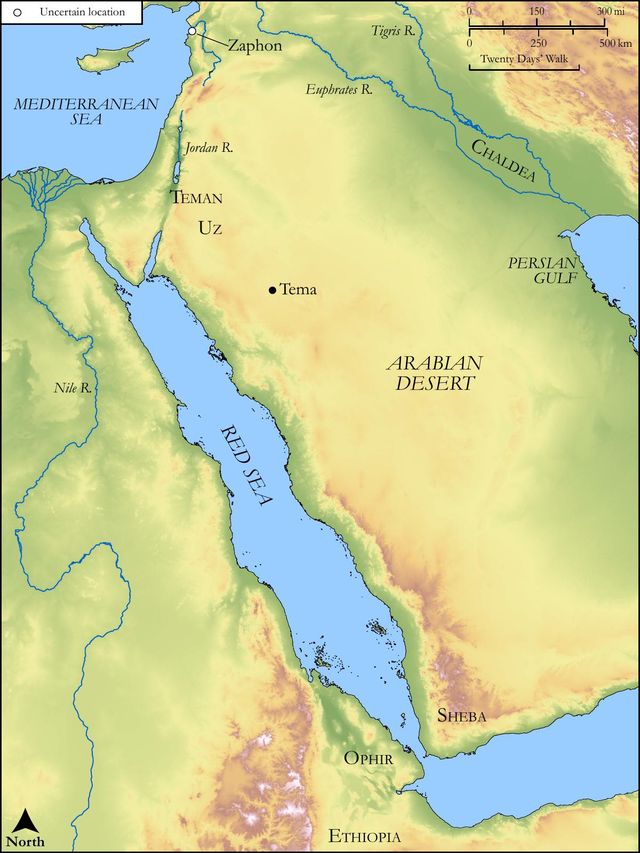
See on the biblical-era map
Study this verse
Public-domain commentary
Matthew Henry
From his Commentary on the Whole Bible. Henry comments on passages, not single verses — this entry covers Job 5:17–27. His four-level outline is real structure in the source text, so it is rendered as structure.
Eliphaz, in this concluding paragraph of his discourse, gives Job (what he himself knew not how to take) a comfortable prospect of the issue of his afflictions, if he did but recover his temper and accommodate himself to them. Observe,
I.The seasonable word of caution and exhortation that he gives him (Job 5:17):
"Despise not thou the chastening of the Almighty. Call it a chastening, which comes from the father's love and is designed for the child's good. Call it the chastening of the Almighty, with whom it is madness to contend, to whom it is wisdom and duty to submit, and who will be a God all-sufficient (for so the word signifies) to all those that trust in him. Do not despise it;" it is a copious word in the original. 1. "Be not averse to it. Let grace conquer the antipathy which nature has to suffering, and reconcile thyself to the will of God in it." We need the rod and we deserve it; and therefore we ought not to think it either strange or hard if we feel the smart of it. Let not the heart rise against a bitter pill or potion, when it is prescribed for our good. 2. "Do not think ill of it; do not put it from thee (as that which is either hurtful or at least not useful, which there is not occasion for nor advantage by) only because for the present it is not joyous, but grievous." We must never scorn to stoop to God, nor think it a thing below us to come under his discipline, but reckon, on the contrary, that God really magnifies man when he thus visits and tries him, Job 7:17, Job 7:18. 3. "Do not overlook and disregard it, as if it were only a chance, and the production of second causes, but take great notice of it as the voice of God and a messenger from heaven." More is implied than is expressed: "Reverence the chastening of the Lord; have a humble awful regard to this correcting hand, and tremble when the lion roars, Amo 3:8. Submit to the chastening, and study to answer the call, to answer the end of it, and then you reverence it." When God by an affliction draws upon us for some of the effects he has entrusted us with we must honour his bill by accepting it, and subscribing it, resigning him his own when he calls for it.
II.The comfortable words of encouragement which he gives him thus to accommodate himself to his condition, and (as he himself had expressed it) to receive evil at the hand of God, and not despise it as a gift not worth the accepting.
1.If his affliction was thus borne,
(1.)The nature and property of it would be altered. Though it looked like a man's misery, it would really be his bliss: Happy is the man whom God correcteth if he make but a due improvement of the correction. A good man is happy though he be afflicted, for, whatever he has lost, he has not lost his enjoyment of God nor his title to heaven. Nay, he is happy because he is afflicted; correction is an evidence of his sonship and a means of his sanctification; it mortifies his corruptions, weans his heart from the world, draws him nearer to God, brings him to his Bible, brings him to his knees, works him for, and so is working for him, a far more exceeding and eternal weight of glory. Happy therefore is the man whom God correcteth, Jam 1:12.
(2.)The issue and consequence of it would be very good, Job 5:18.
[1.]Though he makes sore the body with sore boils, the mind with sad thoughts, yet he binds up at the same time, as the skilful tender surgeon binds up the wounds he had occasion to make with his incision-knife. When God makes sores by the rebukes of his providence he binds up by the consolations of his Spirit, which oftentimes abound most as afflictions do abound, and counterbalance them, to the unspeakable satisfaction of the patient sufferers.
[2.]Though he wounds, yet his hands make whole in due time; as he supports his people, and makes them easy under their afflictions, so in due time he delivers them, and makes a way for them to escape. All is well again; and he comforts them according to the time wherein he afflicted them. God's usual method is first to wound and then to heal, first to convince and then to comfort, first to humble and then to exalt; and (as Mr. Caryl observes) he never makes a wound too great, too deep, for his own cure. Una eademque manus vulnus opemque tulit - The hand that inflicts the wound applies the cure. God tears the wicked and goes away; let those heal that will, if they can (Hos 5:14); but the humble and penitent may say, He has torn and he will heal us, Hos 6:1. This is general, but,
2.In the following verses Eliphaz addresses himself directly to Job, and gives him many precious promises of great and kind things which God would do for him if he did but humble himself under his hand. Though then they had no Bibles that we know of, yet Eliphaz had sufficient warrant to give Job these assurances, from the general discoveries God had made of his good will to his people. And, though in every thing which Job's friends said they were not directed by the Spirit of God (for they spoke both of God and Job some things that were not right), yet the general doctrines they laid down expressed the pious sense of the patriarchal age, and as St. Paul quoted Job 5:13 for canonical scripture, and as the command Job 5:17 is no doubt binding on us, so these promises here may be, and must be, received and applied as divine promises, and we may through patience and comfort of this part of scripture have hope. Let us therefore give diligence to make sure our interest in these promises, and then view the particulars of them and take the comfort of them.
(1.)It is here promised that as afflictions and troubles recur supports and deliverances shall be graciously repeated, be it ever so often: In six troubles he shall be ready to deliver thee; yea, and in seven, Job 5:19. This intimates that, as long as we are here in this world, we must expect a succession of troubles, that the clouds will return after the rain. After six troubles may come a seventh; after many, look for more; but out of them all will God deliver those that are his, Ti2 3:11; Psa 34:19. Former deliverances are not, as among men, excuses from further deliverances, but earnests of them, Pro 19:19.
(2.)That, whatever troubles good men may be in, there shall no evil touch them; they shall do them no real harm; the malignity of them, the sting, shall be taken out; they may hiss, but they cannot hurt, Psa 91:10. The evil one toucheth not God's children, Jo1 5:18. Being kept from sin, they are kept from the evil of every trouble.
(3.)That, when desolating judgments are abroad, they shall be taken under special protection, Job 5:20. Do many perish about them for want of the necessary supports of life? They shall be supplied. "In famine he shall redeem thee from death; whatever becomes of others, thou shalt be kept alive, Psa 33:19. Verily, thou shalt be fed, nay, even in the days of famine thou shalt be satisfied, Psa 37:3, Psa 37:19. In time of war, when thousands fall on the right and left hand, he shall redeem thee from the power of the sword. If God please, it shall not touch thee; or if it wound thee, if it kill thee, it shall not hurt thee; it can but kill the body, nor has it power to do that unless it be given from above."
(4.)That, whatever is maliciously said against them, it shall not affect them to do them any hurt, Job 5:21. "Thou shalt not only be protected from the killing sword of war, but shalt be hidden from the scourge of the tongue, which, like a scourge, is vexing and painful, though not mortal." The best men, and the most inoffensive, cannot, even in their innocency, secure themselves from calumny, reproach, and false accusation. From these a man cannot hide himself, but God can hide him, so that the most malicious slanders shall be so little heeded by him as not to disturb his peace, and so little heeded by others as not to blemish his reputation: and the remainder of wrath God can and does restrain, for it is owing to the hold he has of the consciences of bad men that the scourge of the tongue is not the ruin of all the comforts of good men in this world.
(5.)That they shall have a holy security and serenity of mind, arising from their hope and confidence in God, even in the worst of times. When dangers are most threatening they shall be easy, believing themselves safe; and they shall not be afraid of destruction, no, not when they see it coming (Job 5:21), nor of the beasts of the field when they set upon them, nor of men as cruel as beasts; nay, at destruction and famine thou shalt laugh (Job 5:22), not so as to despise any of God's chastenings or make a jest of his judgments, but so as to triumph in God, in his power and goodness, and therein to triumph over the world and all its grievances, to be not only easy, but cheerful and joyful, in tribulation. Blessed Paul laughed at destruction when he said, O death! where is thy sting? when, in the name of all the saints, he defied all the calamities of this present time to separate us from the love of God, concluding that in all these things we are more than conquerors, Rom 8:35, etc. See Isa 37:22.
(6.)That, being at peace with God, there shall be a covenant of friendship between them and the whole creation, Job 5:23. "When thou walkest over thy grounds thou shalt not need to fear stumbling, for thou shalt be at league with the stones of the field, not to dash thy foot against any of them, nor shalt thou be in danger from the beasts of the field, for they shall all be at peace with thee;" compare Hos 2:18, I will make a covenant for them with the beasts of the field. This implies that while man is at enmity with his Maker the inferior creatures are at war with him; but tranquillus Deus tranquillat omnia - a reconciled God reconciles all things. Our covenant with God is a covenant with all the creatures that they shall do us no hurt but be ready to serve us and do us good.
(7.)That their houses and families shall be comfortable to them, Job 5:24. Peace and piety in the family will make it so. "Thou shalt know and be assured that thy tabernacle is and shall be in peace; thou mayest be confident both of its present and its future prosperity." That peace is thy tabernacle (so the word is); peace is the house in which those dwell who dwell in God, and are at home in him. "Thou shalt visit" (that is, enquire into the affairs of) "thy habitation, and take a review of them, and shalt not sin." [1.] God will provide a settlement for his people, mean perhaps and movable, a cottage, a tabernacle, but a fixed and quiet habitation. "Thou shalt not sin," or wander; that is, as some understand it, "thou shalt not be a fugitive and a vagabond" (Cain's curse), "but shalt dwell in the land, and verily, not uncertainly as vagrants, shalt thou be fed." [2.] Their families shall be taken under the special protection of the divine Providence, and shall prosper as far as is for their good. [3.] They shall be assured of peace, and of the continuance and entail of it. "Thou shalt know, to thy unspeakable satisfaction, that peace is sure to thee and thine, having the word of God for it." Providence may change, but the promise cannot. [4.] They shall have wisdom to govern their families aright, to order their affairs with discretion, and to look well to the ways of their household, which is here called visiting their habitation. Masters of families must not be strangers at home, but must have a watchful eye over what they have and what their servants do. [5.] They shall have grace to manage the concerns of their families after a godly sort, and not to sin in the management of them. They shall call their servants to account without passion, pride, covetousness, worldliness, or the like; they shall look into their affairs without discontent at what is or distrust of what shall be. Family piety crowns family peace and prosperity. The greatest blessing, both in our employments and in our enjoyments, is to be kept from sin in them. When we are abroad it is comfortable to hear that our tabernacle is in peace; and when we return home it is comfortable to visit our habitation with satisfaction in our success, that we have not failed in our business, and with a good conscience, that we have not offended God.
(8.)That their posterity shall be numerous and prosperous. Job had lost all his children; "but," says Eliphaz, "if thou return to God, he will again build up thy family, and thy seed shall be many and as great as ever, and thy offspring increasing and flourishing as the grass of the earth (Job 5:25), and thou shalt know it." God has blessings in store for the seed of the faithful, which they shall have if they do not stand in their own light and forfeit them by their folly. It is a comfort to parents to see the prosperity, especially the spiritual prosperity, of their children; if they are truly good, they are truly great, how small a figure soever they may make in the world.
(9.)That their death shall be seasonable, and they shall finish their course, at length, with joy and honour, Job 5:26. It is a great mercy,
[1.]To live to a full age, and not to have the number of our months cut off in the midst. If the providence of God do not give us long life, yet, if the grace of God give us to be satisfied with the time allotted us, we may be said to come to a full age. That man lives long enough that has done his work and is fit for another world.
[2.]To be willing to die, to come cheerfully to the grave, and not to be forced thither, as he whose soul was required of him.
[3.]To die seasonably, as the corn is cut and housed when it is fully ripe; not till then, but then not suffered to stand a day longer, lest it shed. Our times are in God's hand; it is well they are so, for he will take care that those who are his shall die in the best time: however their death may seem to us untimely, it will be found not unseasonable.
3.In the last verse he recommends these promises to Job,
(1.)As faithful sayings, which he might be confident of the truth of: "Lo, this we have searched, and so it is. We have indeed received these things by tradition from our fathers, but we have not taken them upon trust; we have carefully searched them, have compared spiritual things with spiritual, have diligently studied them, and been confirmed in our belief of them from our own observation and experience; and we are all of a mind that so it is." Truth is a treasure that is well worth digging for, diving for; and then we shall know both how to value it ourselves and how to communicate it to others when we have taken pains in searching for it.
(2.)As well worthy of all acceptation, which he might improve to his great advantage: Hear it, and know thou it for thy good. It is not enough to hear and know the truth, but we must improve it, and be made wiser and better by it, receive the impressions of it, and submit to the commanding power of it. Know it for thyself (so the word is), with application to thyself, and thy own case; not only "This is true," but "this is true concerning me." That which we thus hear and know for ourselves we hear and know for our good, as we are nourished by the meat which we digest. That is indeed a good sermon to us which does us good.
Historical interpretation
Historical reception
2 surviving comments on this verse. Each one is dated, so this reads as a timeline rather than a list.
In holy Scripture complete peace is described in one way and initial peace in another. For “Truth” gave to his disciples peace from the beginning, when he said, “Peace I leave with you; my peace I give unto you.” And Simeon desired to have perfect peace. He sought it saying, “Now let your servant depart in peace, according to your word.” Our peace begins in longing for the Creator, but it is perfected by clarity of vision. Our peace will be perfect when our mind is neither blinded by ignorance nor moved by the assaults of the body. Forasmuch as we touch upon its first beginnings, when we either subject the soul to God or the flesh to the soul, the “tabernacle” of the righteous person is said to “have peace.” The body he inhabits through his mind is restrained from the evil motions of its desires under the controlling hand of righteousness. But what advantage is it to restrain the flesh by continence if the mind has not been taught to expand itself through compassion in the love of our neighbor? For the body’s chasteness is worth nothing if not recommended by sweetness of spirit.
47. For the lost shall then suffer ‘destruction and famine,’ when, being condemned in the last Judgment, they are parted asunder from the sight of ‘the Bread’ eternal. For it is written, Let the wicked be taken away, that he see not the glory of God. [Is. 26, 10. lxx.] And the Lord declares by His own lips, I am the living Bread, Which came down from heaven. [John 6, 51] Thus at one and the same time both ‘destruction and famine’ combine to torture those, who not only feel torments without, but farther suffer death within by the plague of starvation. Hell ‘destroys,’ in that it burns, famine kills, in that the Redeemer hides His face from them. For well and justly they have their recompense both within and without, in that the wretched people both by thought and by deed did commit offence. Whence it is well said by the Psalmist, Thou shalt make them as a fiery oven in the time of Thine anger: the Lord shall confound them in His wrath, and the fire shall devour them. [Ps. 21, 9] For that, which is ‘devoured’ by fire, is kindled from the outside. But an oven is set on fire within. And so in the time of God's anger all the unrighteous are both ‘made as a fiery oven,’ and also ‘devoured by the fire,’ in that at the appearing of the Judge, when all the multitude of them is banished from the sight of Him, both within the conscience is set on fire from the misery of want [‘Desiderium’], and without hell torments the flesh.
48. ‘The scourge of the tongue’ too may be understood to mean the sentence of the final doom, whereby the Just Judge saith to the lost, Depart from Me, ye cursed, into everlasting fire, prepared for the devil and his angels. [Matt. 25, 41] The righteous man then is ‘hidden from the scourge of the tongue,’ and from the coming woe, because in that exceeding strictness of doom, he is then comforted with the, mild voice of the Judge, when it is said, For I was an hungred, and ye gave Me meat: I was thirsty, and ye gave Me drink: I was a stranger, and ye took Me in: naked, and ye clothed Me: I was sick, and ye visited Me: I was in prison, and ye came unto Me. [ver. 35, 36.] Before which it is premised; Come, ye blessed of My Father, inherit the kingdom prepared for you from the foundation of the world. [ver. 34.] Therefore ‘in destruction and famine’ the righteous man ‘shall laugh;’ for, when the final vengeance smites all the wicked, he himself joys in the glory of a meet reward. Nor does he at that time any longer compassionate the damned by virtue of his human nature. For, incorporated into the Divine Justice by resemblance [per speciem], he is, by the unshaken force of interior strictness, made thoroughly firm. For the souls of the Elect, being reared up in the clear light of the Righteousness above, are touched by no sense of compassion, in that the height of their bliss makes them strangers to misery. Hence also it is well said by the Psalmist; The righteous also shall see this, and shall fear, and shall laugh at him, and shall say, Lo, this is the man that made not God his helper. [Ps. 52, 6. 7.] For now the righteous see the wicked and fear, then they shall see and laugh. For because they may now fall in imitation of them, here they are holden of fear, but because they cannot then advantage the damned, there they entertain no sympathy. Therefore, that they should not commiserate those that are doomed to eternal woe, they read in that very justice of the Judge wherein they exist in bliss. For, a thing which it is not right to imagine of them, they lower the character of the happiness vouchsafed them, if, when placed in the kingdom, they wish for something which they never can accomplish. But whosoever orders himself after the precepts of life, already tastes here below the first-fruits of that secure estate which shall last for ever, so that he has no fear of our old enemy; nor at the coming on of the crisis of death in any degree dreads his violent assault. For to the righteous the beginning of their recompense is most commonly nothing else than the very security of their minds in dying. Hence it is rightly added,
Neither shalt thou be afraid of the beast of the earth.
49. For our crafty foe is called ‘a beast of the earth,’ in that he ravins with the violence of his savage nature, to seize upon the souls of sinners at the hour of their death. For those whom he deludes by flattery during their lifetime, he seizes with cruelty when they are dying. Contrary whereunto the Lord gives a promise concerning the Church of the Elect through the Prophet, The evil beast shall not go up thereon. They then in dying fear the ‘beast of the earth,’ who when living fear not the power of their Maker. For good men, because they submit themselves from the core of their heart to the dread of God, put away every weight of fear arising from the adversary's coming. For it is hence that the Psalmist beseeches the Lord, in these words, Lest he tear my soul as a lion. [Ps. 7, 2] Hence again he says, Hear my voice, O God, in my prayer, preserve my soul from fear of the enemy. [Ps. 64, 1. 2.] For while they live they perfectly fear the Judge, that when they die they may not dread the accuser. Well then is it said, Neither shalt thou be afraid of the beast of the earth. As if it were in plain words, ‘Forasmuch as thou art not now overcome by the enemy in his alluring address, thou shalt not hereafter fear him in his rage. But when we live well, it is very needful to be on our guard, that the mind, looking down upon others, be not lifted up by the pride of standing alone. Hence it is that the blessing of fellowship is fitly called to mind, where the words are immediately introduced thereupon.
Continue studying Job 5:22 across the web’s major study libraries — every link below opens this exact verse, chapter, or book on the destination site.
Read & Compare
 BibleGatewayThis verse in more than 200 translations and 70 languages.
 Bible.comThe YouVersion reader — hundreds of translations, reading plans, and highlights.
 ESV.orgCrossway's official English Standard Version reader.
 NET BibleThe NET translation with 60,000+ translators' notes on every rendering decision.
 STEP BibleTyndale House's free study tool — original text, vocabulary, and scholarly resources.
 BibliaLogos Bible Software's free web reader.
 USCCBThe New American Bible (Revised Edition) with the U.S. bishops' study notes.
Commentaries
 BibleHub CommentariesDozens of classic commentaries on this verse, gathered on one page.
 StudyLightMore than 100 commentary sets — the largest collection on the web.
 BibleRefPlain-English commentary on what this verse means, verse by verse.
 Enduring WordDavid Guzik's free commentary on this chapter, widely used by Bible teachers.
 Bible Study ToolsVerse commentary alongside Greek and Hebrew study aids.
Original Language & Research
- BibleHub InterlinearThe verse word by word — original language, transliteration, and English.
- BibleHub LexiconEvery word's original-language definition and Strong's entry.
 Blue Letter BibleDeep-study tools — Strong's numbers, concordance, and word studies.
 SefariaThe Hebrew text with Rashi and centuries of Jewish commentary.
Sermons, Hymns & Audio


TrulyRandomVerse is not affiliated with these sites and doesn’t control their content. They’re linked because they’re genuinely useful.
Summary
Job 5:22, spoken by Eliphaz the Temanite, paints a vivid picture of the profound security and fearlessness experienced by a righteous individual under divine favor. This verse, embedded within Eliphaz's initial counsel to Job, asserts that one in right relationship with God would confidently "laugh" at the most devastating calamities—destruction and famine—and remain unafraid of wild beasts, thereby implying an immunity to the common, life-threatening dangers of that day as a direct blessing for piety and submission to God's discipline.
Context
ShowHideLiterary Context
Job 5:22 is a key component of Eliphaz's first speech to Job, specifically within a section (Job 5:17-27) where he articulates the blessings and prosperity awaiting those who humble themselves before God and accept His discipline. Following Job's raw and anguished lament in Job 3, Eliphaz attempts to provide an explanation for Job's immense suffering through the lens of traditional wisdom theology. This framework posits a direct, retributive correlation: sin leads to suffering, and righteousness leads to blessing and protection. This verse serves as a powerful illustration of the comprehensive protection Eliphaz believes God grants to the truly righteous, implicitly urging Job to repent so he might experience such security. It stands in stark contrast to Job's current reality, thereby highlighting Eliphaz's firm conviction that Job must have sinned to warrant such distress, and that restoration is contingent upon his confession and return to God.
Historical & Cultural Context
The lands of the patriarchs were a perilous environment where life was constantly exposed to a myriad of threats. Famine, often caused by drought or crop failure, was a recurring and devastating specter, capable of wiping out entire communities. "Destruction" frequently encompassed the ravages of warfare, banditry, societal collapse, or natural disasters like earthquakes. Wild animals—such as lions, bears, and venomous snakes—posed a constant and tangible threat to human life, livestock, and agricultural endeavors, particularly in uncultivated or remote areas. In such a precarious existence, the promise of immunity from these dangers was not merely desirable but indicative of exceptional divine favor and a state of profound well-being. The prevailing wisdom tradition, deeply ingrained in cultures influenced by retributive justice, often linked material prosperity, health, and safety directly to moral uprightness and adherence to divine law, a theological framework Eliphaz rigorously upholds.
Key Themes
ShowHideThis verse encapsulates several pivotal themes central to Eliphaz's argument and, by extension, to the broader theological discourse within the book of Job. The foremost theme is Divine Protection and Security, depicting an ideal state of unwavering safety from life's most formidable threats, whether natural or human-induced. The ability to "laugh" at such dangers signifies a profound sense of confidence and an utter absence of fear, rooted in a perceived divine protective hand. Closely intertwined is Fearlessness in Adversity, which portrays an individual unparalyzed by the prospect of natural disasters or predatory animals, showcasing an inner peace and outward resilience enabled by God's favor. Finally, and perhaps most critically for Eliphaz's argument, it strongly reflects the Blessings of Righteousness, where such comprehensive protection is presented as a direct, predictable consequence of living a righteous life and maintaining a right relationship with God. This aligns with his broader, albeit flawed, argument that Job's suffering must be a consequence of unconfessed sin, and that restoration would inevitably follow repentance, a concept further elaborated as Eliphaz describes a covenant with the very elements of nature in Job 5:23. While Eliphaz's specific application of this theology is later challenged and corrected by God Himself in Job 42:7, his description here nevertheless highlights a deep, universal human yearning for divine peace and safety in a chaotic and unpredictable world.
Exposition and Analysis
ShowHideKey Word Analysis
ShowHideThis verb, H7832, denotes a confident, almost dismissive attitude towards danger, rather than mockery or derision. It conveys a sense of security so complete that external threats hold no power or evoke no fear. It implies a state of profound inner peace and assurance that transcends the immediate, frightening external circumstances, suggesting a deep trust in a higher power.
This term, H7701, refers to violence, ravage, desolation, or ruin. It often carries the connotation of an overwhelming calamity, whether from natural forces, warfare, or societal breakdown. In this context, it represents the most severe forms of human-made or societal suffering and upheaval, signifying utter devastation.
This word, H3720, signifies hunger (as making one stoop with emptiness and pain) or scarcity of food. Famine was a constant and terrifying threat in that day, capable of wiping out entire populations and causing immense suffering. It represents a fundamental natural disaster that directly impacts survival and well-being.
Verse Breakdown
ShowHide"At destruction and famine thou shalt laugh:"
This clause presents a powerful and almost paradoxical image of absolute security and confidence. The righteous individual, under God's protective hand, will not merely survive but will possess such an inner peace and assurance that they can face the most devastating societal and natural calamities—such as war, economic collapse, and widespread hunger—with a spirit of fearlessness, even joy. The "laughing" here is not an act of derision towards suffering itself, but an expression of profound trust in divine providence that renders these existential threats impotent in their capacity to instill terror or steal one's peace. It suggests a state where one's inner disposition is unperturbed by external chaos.
"neither shalt thou be afraid of the beasts of the earth."
This second clause extends the promise of comprehensive protection to the realm of natural, untamed dangers. The righteous person will have no fear of wild animals, which in that day symbolized the untamed, dangerous, and unpredictable elements of the natural environment, posing direct physical threats to life and livelihood. This completes the picture of all-encompassing divine safeguarding, covering both human-induced and natural threats, ensuring a holistic and profound peace for the one favored by God.
Literary Devices
ShowHideJob 5:22 employs several potent literary devices to convey Eliphaz's message of divine protection and the ideal state of the righteous. The most prominent is Hyperbole, particularly evident in the phrase "thou shalt laugh" at destruction and famine. This is not meant to be taken literally as a mocking or flippant response to suffering, but rather as an exaggeration to emphasize an extraordinary degree of confidence, security, and freedom from fear. It vividly illustrates a state of profound inner peace that transcends external chaos and renders even the most terrifying threats powerless to disturb one's equanimity. The verse also utilizes Parallelism, specifically synonymous parallelism, where the two clauses reinforce and expand upon each other: "destruction and famine" in the first clause are paralleled by "beasts of the earth" in the second, both representing categories of severe, life-threatening dangers. This structure creates a comprehensive scope for the promised protection. Furthermore, the verse is rich in Imagery, painting a clear and striking picture of a person utterly secure and unafraid amidst the most terrifying dangers. The "beasts of the earth" can also be seen as a Metaphor for any untamed, wild, or uncontrollable forces that threaten human well-being, extending the literal meaning to encompass all forms of existential danger and chaos.
Theological and Thematic Connections
ShowHideWhile Eliphaz's specific application of this promise to Job's suffering was ultimately flawed—as the book of Job reveals that suffering is not always a direct consequence of sin, nor is righteousness always rewarded with immediate, tangible protection—the underlying truth about God's capacity and desire to protect and sustain His people is deeply rooted in biblical theology. This verse, though spoken from a limited human perspective, resonates with the broader biblical narrative of divine providence and care for the righteous. It speaks to a profound human yearning for security in a chaotic world, a security that the Bible consistently attributes to God's sovereign hand. The spiritual confidence described here, where one can face overwhelming threats without paralyzing fear, foreshadows the peace that God offers to those who trust in Him, even when physical immunity from suffering is not guaranteed. It points to a deeper, spiritual security that transcends temporal circumstances and finds its anchor in God's unchanging character and promises.
Reflection and Application
ShowHideJob 5:22, while part of a theological argument that the book of Job ultimately critiques, still offers profound insight for contemporary believers regarding the nature of trust and peace in God. It challenges us to consider the depth of our faith amidst life's inevitable "destructions" and "famines"—whether they manifest as personal crises, societal upheavals, or global calamities. While we may not literally "laugh" at every trial or be physically immune to all harm, the verse invites us to cultivate a spiritual confidence that allows us to face adversity with less fear and more resilience. Our ultimate security is not found in the absence of trouble, but in the unwavering presence and sovereignty of God, who works all things for the good of those who love Him. This means developing a faith that anchors us when external circumstances are turbulent, enabling us to experience a peace that transcends understanding. We are called to trust that God is at work even in suffering, transforming our perspective from one of dread to one of resilient hope, knowing that our ultimate destiny and spiritual well-being are eternally secure in His hands. This perspective allows us to "laugh" not at the suffering itself, but at the powerlessness of suffering to ultimately defeat the one who trusts in God.
Questions for Reflection
ShowHideFAQ
ShowHideIs Eliphaz's teaching in Job 5:22 entirely wrong?
ShowHideNo, Eliphaz's teaching in Job 5:22 is not entirely wrong, but it is incomplete and misapplied to Job's specific situation. The concept that God protects the righteous and grants them security is a recurring theme throughout Scripture (e.g., Psalm 34:19). However, Eliphaz operates under a rigid system of retributive justice, assuming that all suffering is a direct result of sin and all blessing a direct result of righteousness. The book of Job, in its entirety, challenges this simplistic view, demonstrating that righteous people can suffer immensely for reasons beyond their sin, often for God's sovereign purposes and to reveal deeper truths about His character. So, while God does provide protection and peace, it is not always in the immediate, physical, or predictable way Eliphaz suggests, nor is the absence of suffering always an indicator of righteousness. The ultimate peace God offers is often spiritual and eternal, transcending temporal circumstances.
How can one "laugh" at destruction and famine in a world full of suffering?
ShowHideThe phrase "thou shalt laugh" is a hyperbole, a literary exaggeration used to emphasize a profound state of security and inner peace, rather than a literal mocking of suffering. In a world full of real destruction and famine, a believer does not dismiss or ignore pain, but rather cultivates a deep, spiritual confidence in God's ultimate control and care. This "laughing" signifies a freedom from paralyzing fear, a trust that transcends circumstances. It is the peace of God that "surpasses all understanding" (as described in Philippians 4:7), which guards the heart and mind even amidst trials. It means knowing that while temporal calamities may occur and cause real pain, ultimate spiritual security and hope in God's eternal plan remain unshaken. This peace allows one to face adversity with courage, knowing that God is sovereign and faithful even in the midst of the storm.
Christ-Centered Fulfillment
ShowHideWhile Eliphaz's promise of protection in Job 5:22 was conditional upon human righteousness and largely limited to earthly security, its ultimate fulfillment and deepest meaning are found in Jesus Christ. Humanity's greatest "destruction" was the pervasive power of sin and death, and its most profound "famine" was spiritual separation from God, leading to an existential emptiness. Jesus, through His perfect life, atoning death on the cross, and glorious resurrection, has definitively conquered these ultimate threats. Believers in Christ are no longer under condemnation (Romans 8:1), having been delivered from the dominion of darkness and transferred into the kingdom of His beloved Son (Colossians 1:13). He faced the ultimate "beasts of the earth"—the spiritual principalities and powers, even Satan himself—and triumphed over them on the cross, disarming them and making a public spectacle of them (Colossians 2:15). Through Him, we are given a peace that the world cannot give, a peace that enables us to face earthly trials with an eternal perspective and an unshakeable hope (John 14:27). Our security is not based on our own flawed righteousness, but on His perfect righteousness imputed to us by faith (2 Corinthians 5:21). He is the true Lamb of God, who takes away the sin of the world, and through Him, we are freed from the ultimate fear of death and its lifelong bondage (Hebrews 2:14-15), enabling us to live with a confident hope that transcends all earthly destruction and famine, knowing our eternal destiny is secure in Him.