


Genesis 38:20
Bible text: King James Version (1769 Blayney text) · Public domain
Bible text: Berean Standard Bible · Public domain
Bible text: American Standard Version (1901) · Public domain
Bible text: World English Bible, Messianic edition · Public domain
Bible text: Geneva Bible (1599) · Public domain
Bible text: Young's Literal Translation · Public domain
- וַיִּשְׁלַחvai·yish·Lachand he sentH7971Conj-w ¦ V-Qal-ConsecImperf-3msVerb Qal Consecutive Imperfect 3rd Singular Masculineוַandיִּשְׁלַחhe sent
- יְהוּדָהye·hu·DahJudahH3063N-proper-mNoun Proper Masculine
- אֶת'et<obj.>H853DirObjMParticle Object Indicator
- גְּדִיge·Di[the] kid ofH1423N-mscNoun Singular Masculine Construct
- הָעִזִּיםha·'i·Zimthe goatsH5795Art ¦ N-mpNoun Plural Masculine Absoluteהָtheעִזִּיםgoats
- בְּיַדbe·Yadby [the] hand ofH3027Prep-b ¦ N-cscNoun Singular common gender Constructבְּbyיַד[the] hand of
- רֵעֵהוּre·'E·huhis friendH7453N-msc ¦ 3msNoun Singular Masculine Constructרֵעֵfriendהוּhis
- הָעֲדֻלָּמִיha·'a·du·la·Mithe AdullamiteH5726Art ¦ N-msNoun Gentilic Singular Masculine AbsoluteהָtheעֲדֻלָּמִיAdullamite
- לָקַחַתla·Ka·chatto takeH3947Prep-l ¦ V-Qal-InfVerb Qal Infinitive Constructלָtoקַחַתtake
- הָעֵרָבוֹןha·'e·ra·Vonthe pledgeH6162Art ¦ N-msNoun Singular Masculine Absoluteהָtheעֵרָבוֹןpledge
- מִיַּדmi·Yadfrom [the] hand ofH3027Prep-m ¦ N-cscNoun Singular common gender Constructמִfromיַּד[the] hand of
- הָאִשָּׁהha·'i·Shahthe womanH802Art ¦ N-fsNoun Singular Feminine Absoluteהָtheאִשָּׁהwoman
- וְלֹאve·Lo'and notH3808Conj-w ¦ NegParticle Negativeוְandלֹאnot
- מְצָאָהּme·tza·'Ahhe found herH4672V-Qal-Perf-3ms ¦ 3fsVerb Qal Perfect 3rd Singular Masculineמְצָאָhe foundהּher
English is a literal word-by-word gloss of the Hebrew, not the KJV's wording. Why?
This is the original text the KJV's translators worked from — each Hebrew word with its own literal English meaning in this verse, prepared by scholars at Tyndale House, Cambridge. The KJV translates whole sentences, not word by word, so its wording differs: one Hebrew word can become several English words, and the KJV may choose “the LORD” where the gloss reads “Yahweh”. Both are faithful — they answer different questions. For the KJV's own rendering, switch to the KJV text.
Details
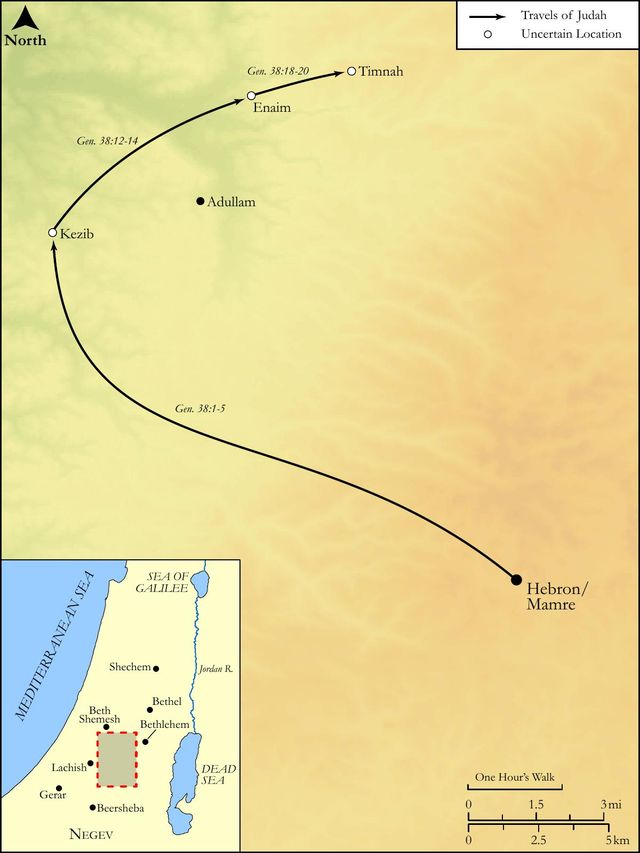
See on the biblical-era maps


Study this verse
Public-domain commentary
Matthew Henry
From his Commentary on the Whole Bible. Henry comments on passages, not single verses — this entry covers Genesis 38:12–23. His two-level outline is real structure in the source text, so it is rendered as structure.
It is a very ill-favoured story that is here told concerning Judah; one would not have expected such folly in Israel. Judah had buried his wife; and widowers have need to stand upon their guard with the utmost caution and resolution against all fleshly lusts. He was unjust to his daughter-in-law, either through negligence or design, in not giving her his surviving son, and this exposed her to temptation.
I.Tamar wickedly prostituted herself as a harlot to Judah, that, if the son might not, the father might raise up seed to the deceased.
Some excuse this by suggesting that, though she was a Canaanite, yet she had embraced the true religion, and believed the promise made to Abraham and his seed, particularly that of the Messiah, who was to descend from the loins of Judah, and that she was therefore thus earnestly desirous to have a child by one of that family that she might have the honour, or at least stand fair for the honour, of being the mother of the Messiah. And, if this was indeed her desire, it had its success; she is one of the four women particularly named in the genealogy of Christ, Mat 1:3. Her sinful practice was pardoned, and her good intention was accepted, which magnifies the grace of God, but can by no means be admitted to justify or encourage the like. Bishop Patrick thinks it probable that she hoped Shelah, who was by right her husband, might have come along with his father, and that he might have been allured to her embraces. There was a great deal of plot and contrivance in Tamar's sin.
1.She took an opportunity for it, when Judah had a time of mirth and feasting with his sheep-shearers. Note, Time of jollity often prove times of temptation, particularly to the sin of uncleanness; when men are fed to the full, the reins are apt to be let loose.
2.She exposed herself as a harlot in an open place, Gen 38:14. Those that are, and would be, chaste, must be keepers at home, Tit 2:5. It should seem, it was the custom of harlots, in those times, to cover their faces, that, though they were not ashamed, yet they might seem to be so. The sin of uncleanness did not then go so barefaced as it does now.
II.Judah was taken in the snare, and though it was ignorantly that he was guilty of incest with his daughter-in-law (not knowing who she was), yet he was willfully guilty of fornication: whoever she was, he knew she was not his wife, and therefore not to be touched. Nor was his sin capable, in the least, of such a charitable excuse as some make for Tamar, that though the action was bad the intention possibly might be good. Observe,
1.Judah's sin began in the eye (Gen 38:15): He saw her. Note, Those have eyes, and hearts too, full of adultery (as it is Pe2 2:14), that catch at every bait that presents itself to them and are as tinder to every spark. We have need to make a covenant with our eyes, and to turn them from beholding vanity, lest the eye infect the heart.
2.It added to the scandal that the hire of a harlot (than which nothing is more infamous) was demanded, offered, and accepted - a kid from the flock, a goodly price at which her chastity and honour were valued! Nay, had the consideration been thousands of rams, and ten thousand rivers of oil, it had not been a valuable consideration. The favour of God, the purity of the soul, the peace of conscience, and the hope of heaven, are too precious to be exposed to sale at any such rates; the Topaz of Ethiopia cannot equal them: what are those profited that lose their souls to gain the world?
3.It turned to the reproach of Judah that he left his jewels in pawn for a kid. Note, Fleshly lusts are not only brutish, but sottish, and ruining to men's secular interests. It is plain that whoredom, as well as wine, and new wine, takes away the heart first, else it would never take away the signet and the bracelets.
III.He lost his jewels by the bargain; he sent the kid, according to this promise, to redeem his pawn, but the supposed harlot could not be found. He sent it by his friend (who was indeed his back-friend, because he was aiding and abetting in his evil deeds) the Adullamite, who came back without the pledge. It is a good account (if it be but true) of any place which they here gave, there is no harlot in this place; for such sinners are the scandals and plagues of any place. Judah sits down content to lose his signet and his bracelets, and forbids his friend to make any further enquiry after them, giving this reason, lest we be shamed, Gen 38:23. Either,
1.Lest his sin should come to be known publicly, and be talked of. Fornication and uncleanness have ever been looked upon as scandalous things and the reproach and shame of those that are convicted of them. Nothing will make those blush that are not ashamed of these.
2.Lest he should be laughed at as a fool for trusting a strumpet with his signet and his bracelets. He expresses no concern about the sin, to get that pardoned, only about the shame, to prevent that. Note, There are many who are more solicitous to preserve their reputation with men than to secure the favour of God and a good conscience; lest we be shamed goes further with them than lest we be damned.
Continue studying Genesis 38:20 across the web’s major study libraries — every link below opens this exact verse, chapter, or book on the destination site.
Read & Compare
 BibleGatewayThis verse in more than 200 translations and 70 languages.
 Bible.comThe YouVersion reader — hundreds of translations, reading plans, and highlights.
 ESV.orgCrossway's official English Standard Version reader.
 NET BibleThe NET translation with 60,000+ translators' notes on every rendering decision.
 STEP BibleTyndale House's free study tool — original text, vocabulary, and scholarly resources.
 BibliaLogos Bible Software's free web reader.
 USCCBThe New American Bible (Revised Edition) with the U.S. bishops' study notes.
Commentaries
 BibleHub CommentariesDozens of classic commentaries on this verse, gathered on one page.
 StudyLightMore than 100 commentary sets — the largest collection on the web.
 BibleRefPlain-English commentary on what this verse means, verse by verse.
 Enduring WordDavid Guzik's free commentary on this chapter, widely used by Bible teachers.
 Bible Study ToolsVerse commentary alongside Greek and Hebrew study aids.
Original Language & Research
- BibleHub InterlinearThe verse word by word — original language, transliteration, and English.
- BibleHub LexiconEvery word's original-language definition and Strong's entry.
 Blue Letter BibleDeep-study tools — Strong's numbers, concordance, and word studies.
 SefariaThe Hebrew text with Rashi and centuries of Jewish commentary.
Sermons, Hymns & Audio


TrulyRandomVerse is not affiliated with these sites and doesn’t control their content. They’re linked because they’re genuinely useful.
Summary
Judah's immediate effort to fulfill his promise to the woman he encountered, sending his trusted friend, Hirah the Adullamite, with a young goat to retrieve his personal pledge. This verse marks a pivotal moment of failed retrieval, as Hirah "found her not," thereby ensuring the pledge remained with Tamar and setting the stage for the dramatic revelation of her identity and Judah's subsequent public accountability in the unfolding narrative of divine providence amidst human imperfection.
Context
ShowHideLiterary Context
Genesis 38 serves as a significant narrative interlude, purposefully interrupting the main storyline of Joseph's life to focus on Judah, Jacob's fourth son. This chapter provides a stark contrast to Joseph's integrity in Egypt, highlighting the moral failings within Jacob's family. Specifically, Genesis 38:20 follows Judah's illicit encounter with Tamar, whom he mistook for a prostitute, and his giving of a personal pledge—his signet, cord, and staff—as security for a promised payment (Genesis 38:16-18). The failure to retrieve this pledge, as stated in this verse, is crucial for the subsequent plot development, leading directly to Tamar's public accusation and Judah's forced confession in Genesis 38:24-26. This interlude ultimately underscores the complex and often flawed human instruments through whom God works to preserve the messianic lineage.
Historical & Cultural Context
The practice of giving a "pledge" (Hebrew: 'erabon) was a common and legally binding custom in the days of the patriarchs, serving as a guarantee or security deposit for a future transaction or obligation. Judah's pledge of his signet, staff, and cord were not merely trinkets but highly personal and authoritative items, akin to a signature or identification. The sending of a "friend" or trusted associate like Hirah the Adullamite was also a customary way to conduct sensitive or discreet business, allowing Judah to maintain a degree of separation and avoid personal embarrassment in retrieving his pledge from someone he believed to be a cultic prostitute. Furthermore, the societal emphasis on male lineage and the levirate marriage custom (as seen in Genesis 38:8) provides the backdrop for Tamar's desperate and unconventional actions to secure her rightful place and ensure the continuation of her deceased husband's line.
Key Themes
ShowHideGenesis 38:20 contributes to several overarching themes within the chapter and the broader book of Genesis. It powerfully illustrates the consequences of sin and moral compromise, showing how Judah's attempt to cover up his illicit encounter immediately unravels. The verse also highlights divine sovereignty and providence, demonstrating God's ability to work through human imperfection and even sin to accomplish His ultimate purposes, particularly in preserving the messianic lineage through Judah, from whom the Messiah would eventually come (Matthew 1:3). Furthermore, the unretrieved pledge underscores the theme of integrity and accountability, as Judah's inability to reclaim his identifying items ensures his undeniable responsibility for Tamar's pregnancy, forcing him into public confession and acknowledging her greater righteousness (Genesis 38:26).
Exposition and Analysis
ShowHideGenesis 38:20 succinctly describes Judah's failed attempt to discreetly conclude his illicit affair, a failure that becomes instrumental in the unfolding of divine providence. The verse details his delegation of the task to a trusted friend, the promised payment, and the crucial outcome of not finding the woman.
Key Word Analysis
ShowHideThis verb signifies "to send away, for, or out," indicating Judah's deliberate act of delegating the task to Hirah. It implies an attempt to distance himself from the direct retrieval, perhaps to maintain discretion or avoid personal embarrassment. The act of sending rather than going himself underscores Judah's desire for a quick, quiet resolution to his moral lapse.
The term refers to a "young goat," specifically a "she-goat." This was the agreed-upon payment for the sexual encounter, representing a valuable commodity in that day. The sending of the kid signifies Judah's intention to fulfill his part of the illicit agreement, a testament to the binding nature of even informal pledges in that culture.
Derived from a root meaning "to exchange" or "to be security," this word denotes a "pawn" or "security deposit." In this context, it refers to Judah's signet, cord, and staff, which he gave to Tamar as a guarantee. The pledge is the central object of the verse's purpose, and its unretrieved status becomes the irrefutable evidence that exposes Judah's actions.
This crucial phrase, using a verb meaning "to attain, find, or acquire," highlights the immediate and decisive failure of Hirah's mission. The inability to "find" Tamar is not accidental but part of her deliberate plan, ensuring Judah's identifying pledge remains in her possession. This failure is the narrative's turning point, preventing Judah from quietly erasing his tracks and setting the stage for his public confrontation.
Verse Breakdown
ShowHide"And Judah sent the kid by the hand of his friend the Adullamite"
This clause establishes Judah's initiative to fulfill his obligation. He dispatches Hirah, a trusted companion from Adullam, a city near Judah's residence, to deliver the promised payment—a young goat. This action reveals Judah's immediate concern with upholding his word, even in a morally compromised situation, while also seeking to maintain a degree of separation from the direct transaction.
"to receive his pledge from the woman's hand"
The purpose of Hirah's mission is explicitly stated: to retrieve the personal items Judah had given as security. This highlights the significance of the pledge as a binding guarantee in the patriarchal age. Judah's desire to reclaim these items underscores their value as symbols of his identity and authority, which he would not want to leave in the possession of a perceived harlot.
"but he found her not"
This concluding phrase is the dramatic pivot of the verse. Despite Hirah's efforts, the woman (Tamar) is nowhere to be found. This failure to locate her is not a mere inconvenience; it is a divinely orchestrated absence that ensures Judah's pledge remains with Tamar, setting the stage for his inescapable accountability and the preservation of the messianic lineage through unconventional means.
Literary Devices
ShowHideThe narrative of Genesis 38:20 employs several literary devices. Irony is prominent, as Judah's attempt to discreetly cover up his sin by sending a friend to retrieve his pledge ultimately leads to greater exposure and public humiliation. His desire for secrecy is thwarted by Tamar's calculated disappearance, ensuring his identifying items remain as irrefutable evidence. The unretrieved pledge also serves as Foreshadowing, hinting at the inevitable revelation of Judah's paternity and his later confession. Furthermore, the "pledge" itself functions as Symbolism, representing not only a legal guarantee in the immediate context but also foreshadowing the concept of a divine guarantee, particularly the Holy Spirit as the "earnest" of our inheritance in the New Testament. The entire episode is a masterful display of narrative tension, building towards Judah's confrontation and the unexpected means by which God's redemptive plan unfolds.
Theological and Thematic Connections
ShowHideGenesis 38:20 powerfully illustrates the theological truth that human attempts to conceal sin or circumvent divine purposes are ultimately futile. Judah's inability to retrieve his pledge ensures his accountability, demonstrating that God's sovereign plan will prevail even through the moral failings and unconventional actions of individuals. This narrative underscores God's commitment to His covenant promises, particularly the preservation of the messianic lineage, by working through complex and often messy human circumstances to achieve His redemptive ends. It serves as a profound reminder that while sin has consequences, God's grace and providential hand can redeem and redirect even the darkest human choices for His glory and the advancement of His kingdom.
Reflection and Application
ShowHideGenesis 38:20 offers a potent lesson on the futility of attempting to hide or discreetly manage moral compromises. Judah's immediate, yet unsuccessful, effort to retrieve his pledge highlights a common human tendency to avoid accountability for wrongdoing. His actions remind us that sin, particularly that which involves deception or impurity, often leads to greater entanglement and eventual exposure rather than quiet resolution. For believers, this narrative underscores the importance of living with integrity and transparency, understanding that true peace comes not from covering up our faults but from confessing them and seeking God's forgiveness and transformation. It also encourages us to trust in God's overarching sovereignty, recognizing that even when human choices are flawed, His purposes will ultimately prevail, and He can redeem any situation for His glory. We are called to live in a manner that honors God, knowing that our actions, both good and bad, have consequences and are seen by Him.
Questions for Reflection
ShowHideFAQ
ShowHideWhy did Judah send a friend instead of going himself?
ShowHideJudah likely sent Hirah the Adullamite, his trusted friend, for several pragmatic and social reasons. Primarily, it allowed him to maintain discretion and distance himself from the illicit encounter, thus avoiding personal embarrassment and public association with a perceived harlot. In the households of the patriarchs, it was common practice to send a trusted servant or friend for such errands, especially those of a sensitive or potentially disreputable nature. His desire to avoid direct involvement underscores his attempt to quickly and quietly resolve the situation without further personal exposure, though this attempt ultimately failed.
What is the significance of the "pledge" in this narrative?
ShowHideThe "pledge"—Judah's signet, cord, and staff—is of paramount significance because it serves as irrefutable, tangible evidence of Judah's identity and, crucially, his paternity of Tamar's child. Among the patriarchs, such personal items functioned as a binding guarantee, akin to a modern signature or collateral. Its unretrieved status ensures that Judah cannot deny his responsibility when Tamar later reveals her pregnancy. This forces him to acknowledge his fault and, remarkably, to declare Tamar more righteous than himself (Genesis 38:26), as she was seeking to preserve the family line, a duty Judah had neglected.
How does this chapter, particularly this verse, contribute to the larger narrative of Genesis?
ShowHideGenesis 38, including Genesis 38:20, is a vital narrative interlude that highlights the moral decline within Jacob's family, particularly Judah's personal failings, while simultaneously demonstrating God's sovereign preservation of the messianic lineage. It contrasts sharply with Joseph's faithfulness in Egypt, showing that God's plan progresses despite human sin and moral compromise. This chapter ensures the continuation of the line through which the Messiah would eventually come, emphasizing God's remarkable ability to work through flawed individuals and unconventional circumstances to fulfill His redemptive purposes.
Christ-Centered Fulfillment
ShowHideGenesis 38:20 and the broader, complex narrative of Judah and Tamar, despite its moral ambiguities, profoundly points towards Christ by illustrating God's unwavering commitment to His redemptive plan through the lineage of Judah. Even Judah's sin and Tamar's unconventional actions are divinely woven into the tapestry that leads to the birth of Jesus, the Messiah (Matthew 1:3). This episode underscores that God's grace and sovereignty can redeem and work through human brokenness and imperfection, ensuring the fulfillment of His promises. Just as Judah's pledge served as a guarantee, so Christ himself is the ultimate "pledge" or "earnest" of God's covenant promises to humanity, guaranteeing our salvation and future inheritance (2 Corinthians 1:22; Ephesians 1:14). Through this messy human story, we see God's faithfulness in preserving the line of the "Lion of Judah" (Revelation 5:5), who would ultimately take away the sin of the world and perfectly embody the ultimate guarantee of God's love and faithfulness.