


Genesis 38:21
Bible text: King James Version (1769 Blayney text) · Public domain
Bible text: Berean Standard Bible · Public domain
Bible text: American Standard Version (1901) · Public domain
Bible text: World English Bible, Messianic edition · Public domain
Bible text: Geneva Bible (1599) · Public domain
Bible text: Young's Literal Translation · Public domain
- וַיִּשְׁאַלvai·yish·'Aland he askedH7592Conj-w ¦ V-Qal-ConsecImperf-3msVerb Qal Consecutive Imperfect 3rd Singular Masculineוַandיִּשְׁאַלhe asked
- אֶת'et<obj.>H853DirObjMParticle Object Indicator
- אַנְשֵׁי'an·Shei[the] men ofH582N-mpcNoun Plural Masculine Construct
- מְקֹמָהּme·ko·Mahher placeH4725N-msc ¦ 3fsNoun Singular Masculine Constructמְקֹמָplaceהּher
- לֵאמֹרle·Mor<to> sayingH559Prep-l ¦ V-Qal-InfVerb Qal Infinitive Constructלֵ<to>אמֹרsaying
- אַיֵּה'ai·Yehwhere?H346InterrogParticle Interrogative
- הַקְּדֵשָׁהha·ke·de·Shah[is] the cult prostituteH6948Art ¦ Adj-fsAdjective Singular Feminine Absoluteהַ[is] theקְּדֵשָׁהcult prostitute
- הִואhi'sheH1931Pro-3fsPronoun Personal 3rd Singular Feminine
- בָעֵינַיִםva·'ei·Na·yim[was] at <the> EnaimH5879Prep-b ¦ N-properNoun Proper Locationבָ[was] at <the>עֵינַיִםEnaim
- עַל'alatH5921PrepPreposition
- הַדָּרֶךְha·Da·rekhthe roadH1870Art ¦ N-csNoun Singular common gender Absoluteהַtheדָּרֶךְroad
- וַיֹּאמְרוּvai·Yo·me·Ruand they saidH559Conj-w ¦ V-Qal-ConsecImperf-3mpVerb Qal Consecutive Imperfect 3rd Plural Masculineוַandיֹּאמְרוּthey said
- לֹאlo'notH3808NegParticle Negative
- הָיְתָהha·ye·Tahshe wasH1961V-Qal-Perf-3fsVerb Qal Perfect 3rd Singular Feminine
- בָזֶהva·Zehin this [place]H2088Prep-b ¦ PrtParticle Demonstrativeבָinזֶהthis [place]
- קְדֵשָׁהke·de·Shaha cult prostituteH6948Adj-fsAdjective Singular Feminine Absolute
English is a literal word-by-word gloss of the Hebrew, not the KJV's wording. Why?
This is the original text the KJV's translators worked from — each Hebrew word with its own literal English meaning in this verse, prepared by scholars at Tyndale House, Cambridge. The KJV translates whole sentences, not word by word, so its wording differs: one Hebrew word can become several English words, and the KJV may choose “the LORD” where the gloss reads “Yahweh”. Both are faithful — they answer different questions. For the KJV's own rendering, switch to the KJV text.
Details
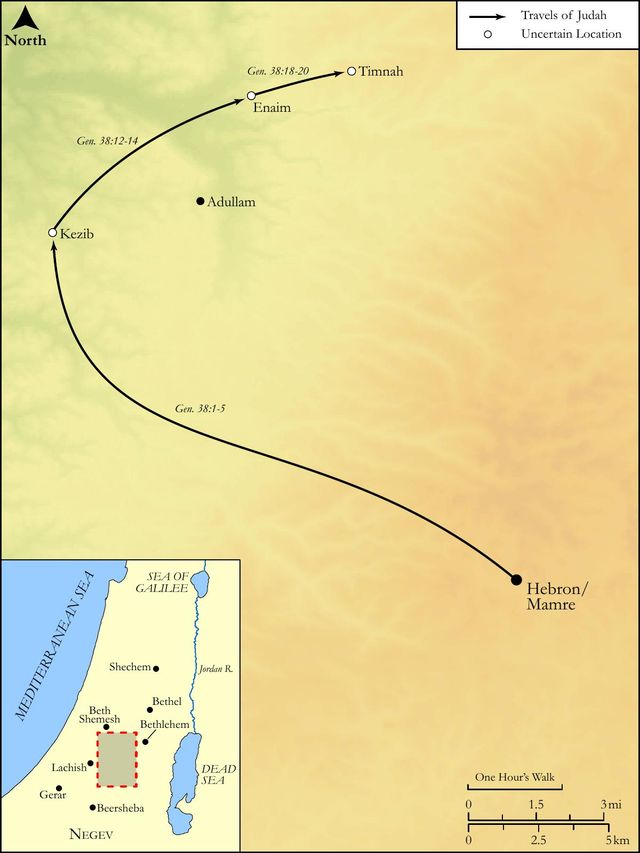
See on the biblical-era maps


Study this verse
Public-domain commentary
Matthew Henry
From his Commentary on the Whole Bible. Henry comments on passages, not single verses — this entry covers Genesis 38:12–23. His two-level outline is real structure in the source text, so it is rendered as structure.
It is a very ill-favoured story that is here told concerning Judah; one would not have expected such folly in Israel. Judah had buried his wife; and widowers have need to stand upon their guard with the utmost caution and resolution against all fleshly lusts. He was unjust to his daughter-in-law, either through negligence or design, in not giving her his surviving son, and this exposed her to temptation.
I.Tamar wickedly prostituted herself as a harlot to Judah, that, if the son might not, the father might raise up seed to the deceased.
Some excuse this by suggesting that, though she was a Canaanite, yet she had embraced the true religion, and believed the promise made to Abraham and his seed, particularly that of the Messiah, who was to descend from the loins of Judah, and that she was therefore thus earnestly desirous to have a child by one of that family that she might have the honour, or at least stand fair for the honour, of being the mother of the Messiah. And, if this was indeed her desire, it had its success; she is one of the four women particularly named in the genealogy of Christ, Mat 1:3. Her sinful practice was pardoned, and her good intention was accepted, which magnifies the grace of God, but can by no means be admitted to justify or encourage the like. Bishop Patrick thinks it probable that she hoped Shelah, who was by right her husband, might have come along with his father, and that he might have been allured to her embraces. There was a great deal of plot and contrivance in Tamar's sin.
1.She took an opportunity for it, when Judah had a time of mirth and feasting with his sheep-shearers. Note, Time of jollity often prove times of temptation, particularly to the sin of uncleanness; when men are fed to the full, the reins are apt to be let loose.
2.She exposed herself as a harlot in an open place, Gen 38:14. Those that are, and would be, chaste, must be keepers at home, Tit 2:5. It should seem, it was the custom of harlots, in those times, to cover their faces, that, though they were not ashamed, yet they might seem to be so. The sin of uncleanness did not then go so barefaced as it does now.
II.Judah was taken in the snare, and though it was ignorantly that he was guilty of incest with his daughter-in-law (not knowing who she was), yet he was willfully guilty of fornication: whoever she was, he knew she was not his wife, and therefore not to be touched. Nor was his sin capable, in the least, of such a charitable excuse as some make for Tamar, that though the action was bad the intention possibly might be good. Observe,
1.Judah's sin began in the eye (Gen 38:15): He saw her. Note, Those have eyes, and hearts too, full of adultery (as it is Pe2 2:14), that catch at every bait that presents itself to them and are as tinder to every spark. We have need to make a covenant with our eyes, and to turn them from beholding vanity, lest the eye infect the heart.
2.It added to the scandal that the hire of a harlot (than which nothing is more infamous) was demanded, offered, and accepted - a kid from the flock, a goodly price at which her chastity and honour were valued! Nay, had the consideration been thousands of rams, and ten thousand rivers of oil, it had not been a valuable consideration. The favour of God, the purity of the soul, the peace of conscience, and the hope of heaven, are too precious to be exposed to sale at any such rates; the Topaz of Ethiopia cannot equal them: what are those profited that lose their souls to gain the world?
3.It turned to the reproach of Judah that he left his jewels in pawn for a kid. Note, Fleshly lusts are not only brutish, but sottish, and ruining to men's secular interests. It is plain that whoredom, as well as wine, and new wine, takes away the heart first, else it would never take away the signet and the bracelets.
III.He lost his jewels by the bargain; he sent the kid, according to this promise, to redeem his pawn, but the supposed harlot could not be found. He sent it by his friend (who was indeed his back-friend, because he was aiding and abetting in his evil deeds) the Adullamite, who came back without the pledge. It is a good account (if it be but true) of any place which they here gave, there is no harlot in this place; for such sinners are the scandals and plagues of any place. Judah sits down content to lose his signet and his bracelets, and forbids his friend to make any further enquiry after them, giving this reason, lest we be shamed, Gen 38:23. Either,
1.Lest his sin should come to be known publicly, and be talked of. Fornication and uncleanness have ever been looked upon as scandalous things and the reproach and shame of those that are convicted of them. Nothing will make those blush that are not ashamed of these.
2.Lest he should be laughed at as a fool for trusting a strumpet with his signet and his bracelets. He expresses no concern about the sin, to get that pardoned, only about the shame, to prevent that. Note, There are many who are more solicitous to preserve their reputation with men than to secure the favour of God and a good conscience; lest we be shamed goes further with them than lest we be damned.
Continue studying Genesis 38:21 across the web’s major study libraries — every link below opens this exact verse, chapter, or book on the destination site.
Read & Compare
 BibleGatewayThis verse in more than 200 translations and 70 languages.
 Bible.comThe YouVersion reader — hundreds of translations, reading plans, and highlights.
 ESV.orgCrossway's official English Standard Version reader.
 NET BibleThe NET translation with 60,000+ translators' notes on every rendering decision.
 STEP BibleTyndale House's free study tool — original text, vocabulary, and scholarly resources.
 BibliaLogos Bible Software's free web reader.
 USCCBThe New American Bible (Revised Edition) with the U.S. bishops' study notes.
Commentaries
 BibleHub CommentariesDozens of classic commentaries on this verse, gathered on one page.
 StudyLightMore than 100 commentary sets — the largest collection on the web.
 BibleRefPlain-English commentary on what this verse means, verse by verse.
 Enduring WordDavid Guzik's free commentary on this chapter, widely used by Bible teachers.
 Bible Study ToolsVerse commentary alongside Greek and Hebrew study aids.
Original Language & Research
- BibleHub InterlinearThe verse word by word — original language, transliteration, and English.
- BibleHub LexiconEvery word's original-language definition and Strong's entry.
 Blue Letter BibleDeep-study tools — Strong's numbers, concordance, and word studies.
 SefariaThe Hebrew text with Rashi and centuries of Jewish commentary.
Sermons, Hymns & Audio


TrulyRandomVerse is not affiliated with these sites and doesn’t control their content. They’re linked because they’re genuinely useful.
Summary
Genesis 38:21 recounts the failed attempt by Judah's friend, Hirah the Adullamite, to locate the "harlot" Judah had encountered by the wayside, in order to retrieve pledges and deliver payment. The local men's emphatic denial of any such woman's presence in their vicinity underscores the remarkable effectiveness of Tamar's disguise and highlights Judah's initial, futile effort to discreetly manage the consequences of his illicit encounter, setting the stage for the dramatic and divinely orchestrated revelation of Tamar's identity and her righteous pursuit of justice.
Context
ShowHideLiterary Context
This verse is a pivotal moment within the Judah and Tamar narrative, an extended interlude (Genesis 38) that dramatically interrupts the main storyline of Joseph's rise and fall in Egypt. Immediately preceding this verse, Judah, having mistakenly identified his widowed daughter-in-law Tamar as a common prostitute, engaged in an illicit encounter with her. As pledges for future payment, he left his personal signet, cord, and staff. Genesis 38:21 details Judah's subsequent attempt to fulfill his part of the bargain by sending his friend, Hirah, with a young goat to retrieve these valuable personal items. The local men's inability to confirm the "harlot's" presence directly thwarts Judah's desire for a discreet resolution, forcing a confrontation that is crucial for the unfolding of the narrative and the preservation of Judah's lineage. This episode serves as a stark contrast to Joseph's moral integrity, which is highlighted in the preceding and subsequent chapters of Genesis.
Historical & Cultural Context
The narrative of Genesis 38 is deeply embedded in the customs of the patriarchal household, particularly concerning levirate marriage (yibbum). According to this custom, a brother or close male relative was obligated to marry his deceased brother's widow to raise offspring in the deceased's name, ensuring the continuation of the family line and inheritance. Judah's failure to give his youngest son, Shelah, to Tamar after his two elder sons died (as promised in Genesis 38:11) left Tamar in a precarious and vulnerable position. Her disguise as a "harlot" by the wayside, though scandalous, was a desperate, culturally informed act to force Judah to fulfill his familial duty and secure her future and the family's lineage. The "way side" was a known location for such encounters, making Judah's assumption about Tamar's identity plausible within the cultural context, yet the men's denial reveals the unique nature of Tamar's strategic deception.
Key Themes
ShowHideGenesis 38:21 contributes significantly to several overarching themes within the book of Genesis and biblical theology. Firstly, it highlights the theme of divine sovereignty working through flawed human actions; despite Judah's moral failings and Tamar's unconventional methods, God's plan for the preservation of the covenant line remains on track. Secondly, it underscores the theme of human sin and its consequences, as Judah's casual sin leads to a complex predicament that he attempts to cover up, only to be thwarted. Thirdly, the narrative explores justice and righteousness, particularly as Tamar's desperate actions are ultimately affirmed by Judah himself as "more righteous" than his own neglect. Finally, and most crucially, this verse is integral to the theme of lineage and covenant preservation, as the events ensure the birth of Perez, through whom the Messianic line of David and ultimately Jesus Christ would descend, demonstrating God's faithfulness to His promises even amidst human imperfection, as seen in the genealogies of Ruth 4:12 and Matthew 1:3.
Exposition and Analysis
ShowHideKey Word Analysis
ShowHideThis term specifically refers to a "female devotee (i.e. prostitute)." While often translated as "harlot" or "whore," it can carry the connotation of a cultic prostitute, though in this context, it broadly refers to a professional prostitute. The irony here is profound: Tamar was not a professional cultic or common prostitute, but a desperate widow acting under disguise to secure her rights and lineage. Judah's use of this term reflects his assumption about her identity based on her appearance and location, an assumption that proves incorrect and leads to his eventual humiliation.
This word literally means "eye" and by extension refers to outward appearance, sight, or presence. In this context, "openly" (often translated as "in the open" or "publicly") suggests that the woman was visible and accessible, operating in plain sight. This reinforces Judah's expectation that she would be easily found and recognized by the local men. The fact that they deny her presence, despite her having been "openly" there, highlights the effectiveness of Tamar's disguise and the transient nature of her presence for her specific purpose.
Meaning "a road (as trodden); figuratively, a course of life or mode of action." "By the way side" indicates a public road or path, a common place for travelers and for those who might offer services, including prostitution, to pass by. This detail further grounds Judah's belief that the woman was a common prostitute. The "way side" here serves as a symbolic location where public and private spheres intersect, and where Judah's private sin is exposed to the potential for public scrutiny, which he desperately tries to avoid.
Verse Breakdown
ShowHide"Then he asked the men of that place, saying,"
This clause establishes the setting and the action. "He" refers to Hirah the Adullamite, Judah's friend, who has been dispatched to retrieve the pledges given to the woman. The "men of that place" are the local inhabitants of Enaim, where the encounter occurred. Hirah's inquiry is a direct fulfillment of Judah's instruction, indicating Judah's desire to discreetly settle his debt and recover his valuable personal items.
"Where [is] the harlot, that [was] openly by the way side?"
This is Hirah's direct question, reflecting Judah's perception of Tamar's identity and the nature of their encounter. The phrase "openly by the way side" implies a public, recognizable presence. The question is posed with an expectation of a simple answer, revealing Judah's assumption that the woman was a known figure in that locality, easily identifiable to the residents. The use of "harlot" (qᵉdêshâh) underscores Judah's misjudgment of Tamar's true identity and motives.
"And they said, There was no harlot in this [place]."
This response from the local men is the pivotal moment of the verse. Their unequivocal denial serves multiple narrative functions: it confirms the absolute effectiveness of Tamar's disguise, as she was not a local or a permanent fixture; it immediately thwarts Judah's attempt at a discreet cover-up, preventing him from easily dismissing the encounter; and it sets the stage for the dramatic revelation of Tamar's identity, forcing Judah to confront the true consequences of his actions and his failure to uphold his familial duties.
Literary Devices
ShowHideGenesis 38:21 is rich with Irony. The primary irony lies in Judah's assumption and Hirah's inquiry about a "harlot" who was "openly by the way side," when the woman was, in fact, his widowed daughter-in-law, Tamar, acting with a specific, righteous purpose. The local men's denial, "There was no harlot in this place," further deepens this irony, as it is literally true—Tamar was not a professional harlot, nor was she a permanent resident of that area. This denial also serves as Foreshadowing, hinting that Judah's attempt to quietly resolve his sin will fail, and a more public and dramatic confrontation is imminent. The "way side" itself can be seen as a Symbolic Setting, representing a place of moral ambiguity and public exposure, where Judah's private transgression is brought into the light, ultimately leading to his public confession and a turning point in his character.
Theological and Thematic Connections
ShowHideGenesis 38:21, though seemingly a minor detail in the broader narrative, profoundly illustrates God's sovereign hand at work even amidst human sin and deception. Judah's attempt to discreetly manage his illicit encounter is divinely thwarted, preventing a simple cover-up and forcing a confrontation that is essential for the preservation of the covenant lineage. This verse underscores that God's purposes are not dependent on human perfection but can unfold through the most unconventional and morally complex circumstances, demonstrating His faithfulness to His promises despite human failings. It highlights the theme of divine providence, where seemingly random events or human missteps are orchestrated to achieve a greater redemptive plan.
Reflection and Application
ShowHideGenesis 38:21 offers a powerful reflection on the human tendency to conceal sin and avoid public shame, mirroring Judah's attempt to discreetly resolve his illicit encounter. Yet, it profoundly demonstrates that God's sovereign plan often unfolds through imperfect individuals and unconventional circumstances, ensuring His ultimate purposes are achieved regardless of human failings or attempts at cover-up. The verse, within its broader context, reminds us that while sin may seek darkness, divine providence can bring hidden truths to light and even use morally ambiguous situations to advance a greater, righteous agenda, particularly in the preservation of His covenant promises and the lineage of salvation. It challenges us to consider our own attempts at secrecy and control, and to trust in God's overarching plan, even when it involves uncomfortable revelations or unexpected turns.
Questions for Reflection
ShowHideFAQ
ShowHideWhy couldn't Hirah find the "harlot" in that place?
ShowHideHirah could not find the "harlot" because Tamar was not a professional harlot who regularly plied her trade there. She had adopted the disguise for a specific, singular purpose—to confront Judah and secure her lineage due to his failure to uphold his levirate duty. Once her objective was achieved and she had secured the pledges, she departed, leaving no trace of the "harlot" Judah expected to find. Her disguise was so effective and her presence so transient that the local men genuinely had no knowledge of such a woman operating in their vicinity, leading to their truthful denial.
Was Tamar truly a "harlot" in the eyes of God?
ShowHideWhile Tamar adopted the appearance and role of a "harlot" (Hebrew: qᵉdêshâh) for her specific act, her motivation was not prostitution for gain but a desperate pursuit of justice and the preservation of her family line, which Judah had neglected. The narrative, particularly Judah's later confession in Genesis 38:26, suggests that her actions, though unconventional and ethically complex, were ultimately deemed "more righteous" than Judah's failure to uphold his familial duty. Her inclusion in the Messianic genealogy in Matthew 1:3 further indicates that her actions, despite their scandalous nature, were ultimately used by God for His redemptive purposes, demonstrating His ability to work through imperfect human agents and situations.
Christ-Centered Fulfillment
ShowHideThe seemingly scandalous events of Genesis 38, including the specific detail of Judah's failed attempt to find the "harlot" in Genesis 38:21, are paradoxically crucial for the Christ-centered fulfillment of God's redemptive plan. This interlude ensures the continuation of Judah's lineage through Tamar, leading directly to the birth of Perez and Zerah. It is through Perez that the Davidic line, and ultimately the lineage of Jesus Christ, is established, as explicitly stated in the genealogies of Ruth 4:12 and Matthew 1:3. Thus, this verse, by highlighting the effectiveness of Tamar's disguise and the divine orchestration that thwarts Judah's cover-up, underscores God's sovereign ability to work through human sin, deception, and unconventional circumstances to faithfully preserve the covenant line that would ultimately bring forth the Messiah, Jesus Christ, the Lamb of God who takes away the sin of the world. This narrative reminds us that God's plan of salvation is not contingent on human perfection but is a testament to His grace and unwavering commitment to His promises, culminating in the person and work of Christ, who came to redeem even the most broken and complex aspects of human history.