


Genesis 24:54
Bible text: King James Version (1769 Blayney text) · Public domain
Bible text: Berean Standard Bible · Public domain
Bible text: American Standard Version (1901) · Public domain
Bible text: World English Bible, Messianic edition · Public domain
Bible text: Geneva Bible (1599) · Public domain
Bible text: Young's Literal Translation · Public domain
- וַיֹּאכְלוּvai·yo·khe·Luand they ateH398Conj-w ¦ V-Qal-ConsecImperf-3mpVerb Qal Consecutive Imperfect 3rd Plural Masculineוַandיֹּאכְלוּthey ate
- וַיִּשְׁתּוּvai·yish·Tuand they drankH8354Conj-w ¦ V-Qal-ConsecImperf-3mpVerb Qal Consecutive Imperfect 3rd Plural Masculineוַandיִּשְׁתּוּthey drank
- הוּאhu'heH1931Pro-3msPronoun Personal 3rd Singular Masculine
- וְהָאֲנָשִׁיםve·ha·'a·na·Shimand the menH582Conj-w ¦ Art ¦ N-mpNoun Plural Masculine Absoluteוְandהָtheאֲנָשִׁיםmen
- אֲשֶׁר'a·SherwhoH834RelParticle Relative
- עִמּוֹi·Mo[were] with himH5973Prep ¦ 3msPreposition Definiteעִמּ[were] withוֹhim
- וַיָּלִינוּvai·ya·Li·nuand they stayed [the] nightH3885Conj-w ¦ V-Qal-ConsecImperf-3mpVerb Qal Consecutive Imperfect 3rd Plural Masculineוַandיָּלִינוּthey stayed [the] night
- וַיָּקוּמוּvai·ya·Ku·muand they aroseH6965Conj-w ¦ V-Qal-ConsecImperf-3mpVerb Qal Consecutive Imperfect 3rd Plural Masculineוַandיָּקוּמוּthey arose
- בַבֹּקֶרva·Bo·kerin the morningH1242Prep-b ¦ N-msNoun Singular Masculine Absoluteבַin theבֹּקֶרmorning
- וַיֹּאמֶרvai·Yo·merand he saidH559Conj-w ¦ V-Qal-ConsecImperf-3msVerb Qal Consecutive Imperfect 3rd Singular Masculineוַandיֹּאמֶרhe said
- שַׁלְּחֻנִיsha·le·Chu·nisend away meH7971V-Piel-Imp-2mp ¦ 1csVerb Piel Imperative 2nd Plural Masculineשַׁלְּחֻsend awayנִיme
- לַאדֹנִיLa·do·Nito my masterH113Prep-l ¦ N-msc ¦ 1csNoun Singular Masculine Constructלַtoאדֹנִmasterיmy
English is a literal word-by-word gloss of the Hebrew, not the KJV's wording. Why?
This is the original text the KJV's translators worked from — each Hebrew word with its own literal English meaning in this verse, prepared by scholars at Tyndale House, Cambridge. The KJV translates whole sentences, not word by word, so its wording differs: one Hebrew word can become several English words, and the KJV may choose “the LORD” where the gloss reads “Yahweh”. Both are faithful — they answer different questions. For the KJV's own rendering, switch to the KJV text.
Details
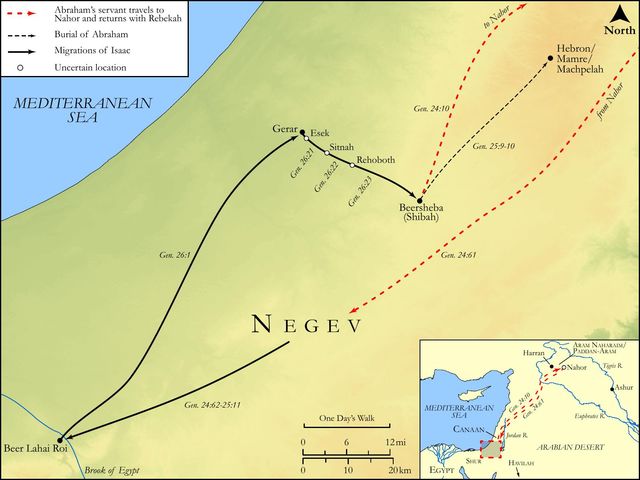
See on the biblical-era maps


Study this verse
Public-domain commentary
Matthew Henry
From his Commentary on the Whole Bible. Henry comments on passages, not single verses — this entry covers Genesis 24:54–61.
Rebekah is here taking leave of her father's house; and 1. Abraham's servant presses for a dismission. Though he and his company were very welcome, and very cheerful there, yet he said, Send me away (Gen 24:54), and again, Gen 24:56. He knew his master would expect him home with some impatience; he had business to do at home which wanted him, and therefore, as one that preferred his work before his pleasure, he was for hastening home. Note, Lingering and loitering no way become a wise and good man; when we have despatched our business abroad we must not delay our return to our business at home, nor be longer from it than needs must; for as a bird that wanders from her nest so is he that wanders from his place, Pro 27:8. 2. Rebekah's relations, from natural affection and according to the usual expression of kindness in that case, solicit for her stay some time among them, Gen 24:55. They could not think of parting with her on a sudden, especially as she was about the remove so far off and it was not likely that they would ever see one another again: Let her stay a few days, at least ten, which makes it as reasonable a request as the reading in the margin seems to make it unreasonable, a year, or at least ten months. They had consented to the marriage, and yet were loth to part with her. Note, It is an instance of the vanity of this world that there is nothing in it so agreeable but it has its alloy. Nulla est sincera voluptas - There is no unmingled pleasure. They were pleased that they had matched a daughter of their family so well, and yet, when it came to the last, it was with great reluctance that they sent her away. 3. Rebekah herself determined the matter. To her they appealed, as it was fit they should (Gen 24:57): Call the damsel (who had retired to her apartment with a modest silence) and enquire at her mouth. Note, As children ought not to marry without their parents' consent, so parents ought not to marry them without their own. Before the matter is resolved on, "Ask at the damsel's mouth;" she is a party principally concerned, and therefore ought to be principally consulted. Rebekah consented, not only to go, but to go immediately: I will go, Gen 24:58. We may hope that the notice she had taken of the servant's piety and devotion gave her such an idea of the prevalence of religion and godliness in the family she was to go to made her desirous to hasten thither, and willing to forget her own people and her father's house, where religion had not so much the ascendant. 4. Hereupon she is sent away with Abraham's servant; not, we may suppose, the very next day after, but very quickly: her friends see that she has a good heart on it, and so they dismiss her, (1.) With suitable attendants - her nurse (Gen 24:59), her damsels, Gen 24:61. It seems, then, that when she went to the well for water it was not because she had not servants at command, but because she took a pleasure in works of humble industry. Now that she was going among strangers, it was fit she should take those with her with whom she was acquainted. Here is nothing said of her portion. Her personal merits were a portion in her, she needed none with her, nor did that ever come into the treaty of marriage. (2.) With hearty good wishes: They blessed Rebekah, Gen 24:60. Note, When our relations are entering into a new condition, we ought by prayer to recommend them to the blessing and grace of God. Now that she was going to be a wife, they prayed that she might be a mother both of a numerous and of a victorious progeny. Perhaps Abraham's servant had told them of the promise God had lately made to his master, which it is likely, Abraham acquainted his household with, that God would multiply his seed as the stars of heaven, and that they should possess the gate of their enemies (Gen 22:17), to which promise they had an eye in this blessing, Be thou the mother of that seed.
Continue studying Genesis 24:54 across the web’s major study libraries — every link below opens this exact verse, chapter, or book on the destination site.
Read & Compare
 BibleGatewayThis verse in more than 200 translations and 70 languages.
 Bible.comThe YouVersion reader — hundreds of translations, reading plans, and highlights.
 ESV.orgCrossway's official English Standard Version reader.
 NET BibleThe NET translation with 60,000+ translators' notes on every rendering decision.
 STEP BibleTyndale House's free study tool — original text, vocabulary, and scholarly resources.
 BibliaLogos Bible Software's free web reader.
 USCCBThe New American Bible (Revised Edition) with the U.S. bishops' study notes.
Commentaries
 BibleHub CommentariesDozens of classic commentaries on this verse, gathered on one page.
 StudyLightMore than 100 commentary sets — the largest collection on the web.
 BibleRefPlain-English commentary on what this verse means, verse by verse.
 Enduring WordDavid Guzik's free commentary on this chapter, widely used by Bible teachers.
 Bible Study ToolsVerse commentary alongside Greek and Hebrew study aids.
Original Language & Research
- BibleHub InterlinearThe verse word by word — original language, transliteration, and English.
- BibleHub LexiconEvery word's original-language definition and Strong's entry.
 Blue Letter BibleDeep-study tools — Strong's numbers, concordance, and word studies.
 SefariaThe Hebrew text with Rashi and centuries of Jewish commentary.
Sermons, Hymns & Audio


TrulyRandomVerse is not affiliated with these sites and doesn’t control their content. They’re linked because they’re genuinely useful.
Summary
Genesis 24:54 captures a pivotal moment in the narrative of Abraham's servant, detailing the conclusion of a night of hospitality with Rebekah's family immediately following the successful arrangement of her marriage to Isaac. Despite the customary warmth and welcome, the verse highlights the servant's unwavering diligence and profound sense of duty as he rises early the next morning, expressing an urgent desire to return to his master, Abraham, with the news of his mission accomplished.
Context
ShowHideLiterary Context
This verse is situated at a critical juncture within Genesis chapter 24, a meticulously crafted narrative detailing Abraham's divinely guided quest to secure a wife for his son Isaac from among his own kin in Mesopotamia. The preceding verses recount the servant's providential encounter with Rebekah at the well, the confirmation of her identity as Abraham's relative, and the eager consent of her family for her to accompany the servant back to Canaan. Verse 54 serves as a brief interlude of rest and hospitality before the servant, driven by an extraordinary sense of responsibility, presses for an immediate departure. It underscores the servant's single-minded focus on his mission, contrasting the natural inclination to linger with his profound commitment to Abraham. The swift transition from feasting and lodging to an urgent request for departure emphasizes the narrative's focus on divine providence and the faithful execution of a sacred trust.
Historical & Cultural Context
Among Abraham's kin, hospitality was not merely a social custom but a sacred duty, often considered a moral imperative and a sign of honor and respect. Sharing a meal and providing lodging, as Rebekah's family does for Abraham's servant and his men, created a bond and signified acceptance and goodwill. This act of hospitality would typically invite a period of extended rest and fellowship. However, the servant's immediate request to depart the very next morning, despite the customary expectation for guests to stay longer, reveals a distinctive character trait and highlights the unique nature of his mission. His actions would have been understood by the original audience as a remarkable display of diligence and faithfulness, prioritizing the master's business above personal comfort or prolonged social engagement. The concept of a trusted servant or envoy (often referred to as a "steward" or "chief servant") acting with absolute fidelity to their master's instructions was highly valued in this cultural milieu.
Key Themes
ShowHideGenesis 24:54 contributes significantly to several overarching themes within the chapter and the broader book of Genesis. Foremost among these is Divine Providence, as God's hand is clearly seen guiding every step of the servant's journey, from the specific well to the willing family (e.g., Genesis 24:27). The servant's urgency reflects his recognition of this divine leading and his desire to complete the task God has blessed. Another prominent theme is Faithful Stewardship and Diligence. The servant exemplifies what it means to be a trustworthy agent, prioritizing his master's interests above his own comfort or convenience. His immediate desire to return underscores the importance of fulfilling commitments and reporting back, a model of integrity and responsibility. This also ties into the theme of Covenant Fulfillment, as the servant's mission is part of God's larger plan to establish Abraham's lineage and fulfill the promises made to him, ensuring the continuation of the covenant line through Isaac and Rebekah, as seen in the broader narrative of Genesis.
Exposition and Analysis
ShowHideKey Word Analysis
ShowHideThis primitive root signifies the act of consuming food, literally or figuratively. In this context, "eat and drink" refers to the shared meal provided by Rebekah's family, a customary act of hospitality that cemented the agreement and offered sustenance after the journey and negotiations. It implies a moment of rest and communal fellowship, albeit brief.
This root means "to stop (usually over night)" or "to lodge." It indicates that the servant and his men accepted the hospitality offered and stayed overnight, implying a period of rest. The phrase "tarried all night" simply denotes the duration of their stay until the morning, without any hidden or complex linguistic nuances beyond its plain meaning of remaining for the night.
This primitive root is rich in meaning, encompassing "to send away, for, or out" in a variety of applications. Here, it is an urgent request for permission to depart. The servant's use of this verb immediately upon rising underscores his profound sense of duty and his singular focus on completing his mission and reporting back to Abraham, rather than lingering for further hospitality or celebration.
Verse Breakdown
ShowHide"And they did eat and drink, he and the men that [were] with him,"
This clause describes the immediate aftermath of the successful marriage negotiations. It highlights the customary practice of hospitality, where a shared meal signified acceptance, goodwill, and the sealing of an agreement. The servant and his entourage were welcomed and provided for, a common courtesy extended to travelers and a sign of the family's affirmation of the proposed union.
"and tarried all night;"
This phrase confirms that the hospitality extended to the servant included lodging. They rested for the night, indicating a natural pause in their journey after the significant events of the day. This brief respite, however, sets the stage for the servant's subsequent display of diligence.
"and they rose up in the morning,"
This simple statement marks the transition from the period of rest to the resumption of the servant's mission. The early rising emphasizes the servant's promptness and his internal drive to complete his task without delay. It signals the end of the interlude and the beginning of the final phase of his assignment.
"and he said,"
This introduces the servant's direct speech, which is the crux of this verse. His words reveal his character and priorities. The immediate nature of his address upon rising underscores his single-minded focus and determination.
"Send me away unto my master."
This is the servant's urgent request. Despite the warmth of the hospitality and the momentous success of his mission, he does not wish to linger. His immediate desire to return to Abraham ("my master") demonstrates his profound sense of responsibility, faithfulness, and accountability. He considers his task incomplete until he has delivered Rebekah to Isaac and reported back to the one who sent him, prioritizing duty above all else.
Literary Devices
ShowHideThe verse employs several literary devices to convey its profound message. Characterization is central, as the servant's words and actions vividly portray his unwavering diligence, faithfulness, and single-mindedness. His immediate request to depart, despite the customary expectations of hospitality, highlights his exceptional commitment to his master's business. The Narrative Pacing is also significant; the quick transition from the act of eating and drinking and lodging to the servant's urgent request for departure creates a sense of immediacy and purpose, emphasizing that the servant views his mission as incomplete until he has returned. There is also an element of Foreshadowing or Typology, as the servant's faithful completion of his mission and eager return to his master subtly prefigures the ultimate faithful Servant, Jesus Christ, and His return to the Father after accomplishing His redemptive work. The motif of Hospitality serves as a cultural backdrop, against which the servant's unique dedication is thrown into sharper relief.
Theological and Thematic Connections
ShowHideThe servant's actions in Genesis 24:54 provide a powerful illustration of diligent and faithful stewardship, a theme deeply woven throughout biblical theology. His refusal to linger, even after a successful and momentous undertaking, underscores the principle that true commitment involves seeing a task through to its complete fulfillment, prioritizing the master's will above personal comfort or delay. This exemplifies a profound sense of accountability and devotion, reflecting a heart that understands its purpose and responsibilities. It teaches us that our work, whether spiritual or temporal, should be undertaken with integrity and a sense of divine calling, always with an eye toward rendering a faithful account to the one who entrusted us with the task.
Reflection and Application
ShowHideGenesis 24:54 offers a timeless lesson on the virtues of diligence, faithfulness, and unwavering commitment to one's calling. The servant's immediate desire to return to Abraham, even after the successful completion of his arduous journey, challenges us to examine our own approach to the responsibilities and divine assignments God has placed before us. Are we prone to complacency once a significant milestone is reached, or do we maintain a spirit of urgency and accountability until the task is fully completed and reported? This verse reminds us that true spiritual maturity involves a steadfast resolve to honor our commitments, whether in our professional lives, our family relationships, or our service within the church. It calls us to cultivate a heart that is eager to report back to our ultimate Master, God Himself, with a joyful account of how we have stewarded the gifts, opportunities, and ministries He has entrusted to us. Like the servant, we are to be people who prioritize the Master's business, resisting the temptation to linger in comfort when there is still a sacred duty to fulfill. We are called to work heartily, as unto the Lord, knowing that our labor in Him is never in vain.
Questions for Reflection
ShowHideFAQ
ShowHideWhy is the servant's immediate departure so emphasized in this narrative, given the cultural importance of hospitality?
ShowHideThe emphasis on the servant's prompt departure, despite the customary expectation of extended hospitality in that day, serves to powerfully underscore his extraordinary diligence, unwavering faithfulness, and profound sense of responsibility to Abraham. Having successfully completed his critical mission to secure a bride for Isaac, he does not succumb to the natural inclination to linger or become complacent. Instead, his immediate request to "Send me away unto my master" (as seen in Genesis 24:54) highlights his singular focus on his duty. This demonstrates that he considered his task incomplete until he had delivered Rebekah to Isaac and personally reported back to Abraham. It is a testament to his integrity and dedication, providing a powerful biblical example of what it means to be a trustworthy and faithful steward, prioritizing the will and business of the one who sent him above personal comfort or social convention.
Christ-Centered Fulfillment
ShowHideThe diligent and faithful service of Abraham's unnamed servant, who, having completed his mission to secure a bride for Isaac, eagerly desired to return to his master, beautifully prefigures the ultimate faithful Servant, Jesus Christ. Sent by His Heavenly Father on the supreme mission of redemption, Christ perfectly accomplished His task through His obedient life, atoning death on the cross, and glorious resurrection. Just as the servant's return brought joy and fulfillment to Abraham, so too did Christ's ascension and return to the Father signify the triumphant completion of His redemptive work, as He declared, "It is finished!" He now sits at the right hand of God, having secured His bride, the Church, through His own sacrificial love (as described in Ephesians 5:25-27). The servant's eager anticipation of returning to report to Abraham foreshadows Christ's own eager anticipation of His glorious return to gather His Church, demonstrating the ultimate fulfillment of divine mission, perfect faithful stewardship, and the consummation of God's redemptive plan for His people (foretold in passages like John 14:3 and Revelation 22:20).