


Ezekiel 40:43
Bible text: King James Version (1769 Blayney text) · Public domain
Bible text: Berean Standard Bible · Public domain
Bible text: American Standard Version (1901) · Public domain
Bible text: World English Bible, Messianic edition · Public domain
Bible text: Geneva Bible (1599) · Public domain
Bible text: Young's Literal Translation · Public domain
- וְהַשְׁפַתַּיִםve·hash·fa·Ta·yimand the hooksH8240Conj-w ¦ Art ¦ N-mdNoun Dual Masculine Absoluteוְandהַtheשְׁפַתַּיִםhooks
- טֹפַחTo·facha hand breadthH2948N-msNoun Singular Masculine Absolute
- אֶחָד'e·ChadoneH259Adj-fsAdjective Numerical Singular Feminine Absolute
- מוּכָנִיםmu·kha·Nim[were] establishedH3559V-Hophal-PassPrtcpl-mpVerb Hophal Participle Passive Plural Masculine Absolute
- בַּבַּיִתba·Ba·yitin the insideH1004Prep-b ¦ N-msNoun Singular Masculine Absoluteבַּin theבַּיִתinside
- סָבִיבsa·Vivall aroundH5439N-csNoun Singular common gender Absolute
- סָבִיבsa·Vivall aroundH5439N-csNoun Singular common gender Absolute
- וְאֶלve·'eland [was] toH413Conj-w ¦ PrepPrepositionוְandאֶל[was] to
- הַשֻּׁלְחָנוֹתha·shul·cha·Notthe tablesH7979Art ¦ N-fpNoun Plural Feminine Absoluteהַtheשֻּׁלְחָנוֹתtables
- בְּשַׂרbe·Sar[the] flesh ofH1320N-mscNoun Singular Masculine Construct
- הַקָּרְבָןha·ka·re·Vanthe offeringH7133Art ¦ N-msNoun Singular Masculine Absoluteהַtheקָּרְבָןoffering
English is a literal word-by-word gloss of the Hebrew, not the KJV's wording. Why?
This is the original text the KJV's translators worked from — each Hebrew word with its own literal English meaning in this verse, prepared by scholars at Tyndale House, Cambridge. The KJV translates whole sentences, not word by word, so its wording differs: one Hebrew word can become several English words, and the KJV may choose “the LORD” where the gloss reads “Yahweh”. Both are faithful — they answer different questions. For the KJV's own rendering, switch to the KJV text.
Details
See on the biblical-era map
Study this verse
Public-domain commentary
Matthew Henry
From his Commentary on the Whole Bible. Henry comments on passages, not single verses — this entry covers Ezekiel 40:39–49. His two-level outline is real structure in the source text, so it is rendered as structure.
In these verses we have an account,
I.Of the tables that were in the porch of the gates of the inner court.
We find no description of the altars of burnt-offerings in the midst of that court till Eze 43:13. But, because the one altar under the law was to be exchanged for a multitude of tables under the gospel, here is early notice taken of the tables, at our entrance into the inner court; for till we come to partake of the table of the Lord we are but professors at large; our admission to that is our entrance into the inner court. But in this gospel-temple we meet with no altar till after the glory of the Lord has taken possession of it, for Christ is our altar, that sanctifies every gift. Here were eight tables provided, whereon to slay the sacrifices, Eze 40:41. We read not of any tables for this purpose either in the tabernacle or in Solomon's temple. But here they are provided, to intimate the multitude of spiritual sacrifices that should be brought to God's house in gospel-times, and the multitude of hands that should be employed in offering up those sacrifices. Here were the shambles for the altar; here were the dressers on which they laid the flesh of the sacrifice, the knives with which they cut it up, and the hooks on which they hung it up, that it might be ready to be offered on the altar (Eze 40:43), and there also they washed the burnt-offerings (Eze 40:38), to intimate that before we draw near to God's altar we must have every thing in readiness, must wash our hands, our hearts, those spiritual sacrifices, and so compass God's altar.
II.The use that some of the chambers mentioned before were put to.
1.Some were for the singers, Eze 40:44. It should seem they were first provided for before any other that attended this temple-service, to intimate, not only that the singing of psalms should still continue a gospel-ordinance, but that the gospel should furnish all that embrace it with abundant matter for joy and praise, and give them occasion to break forth into singing, which is often foretold concerning gospel times, Psa 96:1; Psa 98:1. Christians should be singers. Blessed are those that dwell in God's house, they will be still praising him.
2.Others of them were for the priests, both those that kept the charge of the house, to cleanse it, and to see that none came into it to pollute it, and to keep it in good repair (Eze 40:45), and those that kept the charge of the altar (Eze 40:46), that came near to the Lord to minister to him. God will find convenient lodging for all his servants. Those that do the work of his house shall enjoy the comforts of it.
III.Of the inner court, the court of the priests, which was fifty yards square, Eze 40:47.
The altar that was before the house was placed in the midst of this court, over-against the three gates, and, standing in a direct line with the three gates of the outer court, when the gates were set open all the people in the outer court might through them be spectators of the service done at the altar. Christ is both our altar and our sacrifice, to whom we must look with an eye of faith in all our approaches to God, and he is salvation in the midst of the earth (Psa 74:12), to be looked unto from all quarters.
IV.Of the porch of the house.
The temple is called the house, emphatically, as if no other house were worthy to be called so. Before this house there was a porch, to teach us not to rush hastily and inconsiderately into the presence of God, but gradually, that is, gravely, and with solemnity, passing first through the outer court, then the inner, then the porch, ere we enter into the house. Between this porch and the altar was a place where the priests used to pray, Joe 2:17. In the porch, besides the posts on which the doors were hung, there were pillars, probably for state and ornament, like Jachin and Boaz - He will establish; in him is strength, Eze 40:49. In the gospel church every thing is strong and firm, and every thing ought to be kept in its place and to be done decently and in order.
Historical interpretation
Two Centuries of Reception
9 surviving comments on this verse. Each one is dated, so this reads as a timeline rather than a list.
Select a marker to jump to its quote. Markers stagger vertically where authors wrote within a few decades of each other.
(Verse 35 and following) 'And he brought me to the gate that faced the north, and he measured it according to the higher measurements: its chamber, its facade, its vestibule, and its windows all around: it was fifty cubits long and twenty-five cubits wide. Its vestibule faced the outer court, and its palm tree engravings on its facade on both sides, and its staircase with eight steps.' And at each treasury there shall be a door in the gates (or fronts) of the doors: there they shall wash the holocaust. And at the entrance of the gate, there shall be two tables on this side, and two tables on that side, upon which the holocaust shall be immolated, and for sin, and for trespass. And on the outer side, which goes to the gate that leads to the north, there shall be two tables, and on the other side, before the vestibule of the gate, there shall be two tables. Four tables on this side, and four tables on that side: by the sides of the gate, there were eight tables, upon which they shall immolate (or used to immolate): but there were four tables for holocaust made of square stones, of one cubit and a half long, and of one cubit and a half wide, and of one cubit high, upon which the vessels were laid in which the holocaust and the victims are immolated. And their lips were a cubit long, turned inward all around; but on the tables were the flesh of the offering.» There is much disagreement in this testimony between the Hebrew Truth and the edition of the Seventy Interpreters. For what we have said: There they shall wash the burnt offering, and in the vestibule of the gate there are two tables on this side, and again: That the burnt offering and the sin offering be offered on them, is not found in the Seventy, but it is added in many copies from Theodotion. Again, when we said: And their lips turned inward by one palm's measure all around, Seventy translated it, and having the measurement of a span all around. Whether this word is Hebrew or Greek, we cannot know, except only that for 'gisum,' Symmachus and Theodotion translated it as 'lips,' Aquila's first edition translated it as 'ἐπιστάσεις' in the plural number; the second translated it as 'lips': for which in Hebrew it is written as 'Asephathaim'(). And when we say, above the tables however the meats of the offering, the Seventy put from their own, and they put coverings on the tables from above, so that they may be protected from rain and dryness. But that which they have given in Hebrew names, Thee, and Elau, and Elalamoth, and Aelam, what it signifies, and we have shown above, and our translation can show from the context: it is not necessary to often remind the reader about this, and to doubt their prudence and effort. Therefore, he is brought again to the gate that looked towards the North: but not as before to the outer courtyard, but to the inner one. For in what follows it is said: Its vestibule looked towards the outer courtyard, showing that this courtyard was inside. Through this, the progress of the one entering is shown; for in each place there are specific names and measures, and windows all around filled with the light of knowledge, showing all things, and through fifty and twenty-five cubits are the sacraments of divine sense and remission placed, as positioned in the vestibule of the inner courtyard, that we may see the exterior: contemplating knowledge of past and present, through which we may come to double palms and victories, and understand the mysteries of the eight degrees, having entered the treasuries, in which the riches of the temple are contained, and our prayers are cleansed from all the filth of sin; and tables are placed on both sides, so that the burnt offering may be first offered.
The diligent shepherd follows the custom of his father, and Gesaque, the barker of Sydon, etc., all of which the sacred fire consumes, first for sin, and finally for ignorance: whether we commit them knowingly or unknowingly. On the outer side, next to the Seventy, there was a man-made stream that carried away the ashes of the burnt offering and the harmfulness of the flesh externally: either there were two tables, and on the other side of the vestibule of the same gate there were two tables, that is, four on each side, four here and four there, and behind, or on the side of these there were eight other tables, so that they make a total of sixteen tables: by this number the mysteries of the prophets are shown, so that whatever we offer through the Gospel dispensation, we may affirm as foretold by their prophecies. And there are four tables made of square stones, and these themselves are for sacrifice and burnt offering (also called holocausts). These are living stones that are rolled upon the earth, and they have with them a corner stone, by which the walls of the old and new Covenant are held together. Now the number four signifies the Gospel sacraments, having in length and width one and a half cubits, that is, a square, which, when joined together, make three cubits, which three cubits have one cubit in height, so that the mysteries of the Trinity may preserve the measure of one cubit, that is, the divine majesty, as the Lord tells the disciples: Go, baptize all nations in the name of the Father, and of the Son, and of the Holy Spirit (Matthew 28:19). The name of God, as it were, is of one (or, one) cubit in height, which encompasses three properties, and always accepts the holocaust offerings of our oblations. Above these, however, are four tables of holocausts built with living stones, the length, width, and height of which have been described; vessels are placed in them in which the holocaust of the martyrs is offered, of whom it is said: Precious in the sight of the Lord is the death of his saints (Ps. 116:15); and their victims, who, through self-control and the holiness of their bodies, offer their souls as a sacrifice to the Lord. I believe that the meaning of these tables is contained in the books of Matthew, Luke, Mark, and John, which are about the apostles. Above these tables there was a curved crown on the inside, encircling the edges, to contain the sacrificial offerings and prevent them from flowing freely. It also held the meat of the offering, or as the Septuagint translated: 'And the tables themselves were covered on top, because of the violence of the rain and the excessive dryness of the summer sun, so that the meat placed on top could say with the prophet: “By day the sun will not harm us nor the moon by night."' (Psalm 121:6). One of which, with excessive rains and storms, dissolves the offerings of tribulations; the other, with violent heat, dries up whatever has been offered. Forgive me, reader, for the difficulty of the places; or if you can find something better, teach us: we gladly learn what we do not know.
But upon the tables, the flesh of the offering.
Let it be permitted amid these things to bring forward the words of the holy Gospel to our midst, whose sacred history through the miracle it narrates announces the wondrous things that are done daily. For when the weary and fasting crowds had come together to the Lord, the Lord said to His disciples: I have compassion on the multitude, because behold they have now persevered with me three days and have nothing to eat; and if I send them away fasting to their homes, they will faint on the way; for some of them have come from far away. The crowd perseveres with the Lord for three days when the multitude of the faithful, turning away through penance from the sins they have committed, converts itself to God in work, in speech, and in thought. The Lord does not wish to send them away fasting to their home, lest they faint on the way, because indeed converted sinners faint on the way of the present life if they are dismissed into their own conscience without the nourishment of holy teaching. Therefore, lest they grow weary on the journey of this pilgrimage, they must be fed with holy admonition. But the pious sentiment which proceeded from the mouth of Truth must be carefully considered, in which it is said: For some of them have come from far away. There is one who, having experienced nothing of fraud and nothing of carnal corruption, hastened to the service of almighty God. This one did not come from far away, because through incorruption and innocence he was near. Another, stained by no immodesty, defiled by no shameful acts, but having experienced only marriage, was converted to spiritual ministry. Neither did this one come from far away, because having used the permitted union, he did not stray through unlawful things. But others after carnal shameful acts, others after false testimonies, others after committed thefts, others after inflicted violence, others after perpetrated homicides return to penance and are converted to the service of almighty God: these indeed come to the Lord from far away. For the more anyone has strayed in wicked deeds, the farther he has departed from the almighty Lord. For also the prodigal son, who abandoned his father, went away into a far country, in which he fed swine, because he nourished vices. Let nourishment therefore be given even to those who come from far away, because to converted sinners the foods of holy doctrine must be offered, so that they may restore in God the strength they lost in shameful acts. These often need to be satisfied by teachers with more abundant foods of doctrine, the more they came exhausted by greater vices. And when they have now begun to confess the evils they committed, and by confessing to abandon them and punish them with weeping, it is necessary that holy teachers earnestly pray for their sins, so that they may bring the flesh of offering to the Lord's table. As often as they do this, in that they intercede for the sins of others, they wipe away their own more fully before the eyes of God, because by that very charity they justify themselves, by which with wondrous piety they sacrifice themselves in lamentations for the iniquities of others. Nor should it be burdensome for teachers to pour out tears for converted sinners, when even He Himself who created all things, having become man, poured out His blood on the cross for our iniquities, who lives and reigns with the Father in the unity of the Holy Spirit, God, forever and ever. Amen.
Turned inward all around.
Perhaps, however, the discourse concerns the teacher's guardianship of discipline. And it often happens that one who knows how to speak the rule of discipline does not know how to maintain it, because either, moved by excessive zeal, he moderates himself too little through gentleness; or, calm with excessive gentleness, he inflames himself too little against vices with the spur of zeal. For with great consideration we must weigh what is written, that on the vessels of the temple, among the crowns and interwoven bands, oxen and lions and cherubim were carved, and beneath the oxen and lions hung straps. Indeed, crowns signify the mark of victory, while interwoven bands signify the unanimity of concord; but the cherubim are called the fullness of knowledge. For priests and teachers, among the crowns and interwoven bands, that is, among the strength of good work by which they run toward victory, and the concord of charity, by which they do not differ from one another, are designated by oxen and lions and cherubim, because in the fullness of knowledge which they have, it is necessary that they hold both the gentleness of oxen and the fervor of lions, so that in the discipline which they preach, they may be both kindled by holy zeal and tranquil from paternal sweetness. Let straps hang down beneath them, so that the reins of their discipline by which they themselves are bound they may also carefully extend to their subjects. For straps to hang down beneath them is to hold the bonds of guardianship over subjects. These are rightly maintained when neither the gentleness of oxen is lost in the fervor of zeal, nor the terror of lions is diminished in gentleness. Indeed, there ought to be such discretion that discipline is neither excessive nor mercy lax, lest if fault is forgiven in a disorderly manner, he who is culpable be bound more gravely in guilt; and again, lest if fault is retained immoderately, he who is being corrected become so much the worse, inasmuch as he considers that nothing is being done toward him from the grace of kindness. Therefore, harshness must be shown to the wicked in outward display, charity in the mind; so that both the harsh display may restrain the offender, and the keeping of charity may not lose the reward of gentleness.
Behold, while I speak, Joseph stirs the mind to come forth himself as a witness to demonstrate what I am saying. Certainly, when he narrated to his brothers the dream he had seen about his advancement, through what he innocently related, he aroused the stings of malice against himself. By those same brothers he was sold to the Ishmaelites, led into Egypt, and by the wondrous dispensation of the almighty Lord was set over that same Egypt. And when famine arose in the land of Canaan, the brothers came to Egypt, found Joseph set over Egypt, and worshipped him with their necks bowed to the ground. And because they could not change God's counsel, they worshipped because they sold him whom they had sold lest they should worship. Then that man of God himself, full of the spirit of discernment, recognized his brothers without being recognized. But mindful of their fault and forgiving of the injury, he neither strove to repay the evils of his brothers nor to release them without purification. For with suspicious voice he immediately said: "You are spies; you have come to see the weaker parts of the land. Now I shall take trial of you. By the life of Pharaoh, you shall not go out from here." O what a lance in the heart! They had come as strangers, they were fleeing the danger of famine, they had not received the grain they sought, and they saw themselves besides being struck by the hurling of accusation. Amid these things they are led to prison, and, brought out after three days, they are still terrified in the same harshness. Now they return to their heart, now the memory of fault strikes the mind, and they speak among themselves: "Rightly do we suffer these things, because we sinned against our brother, seeing the anguish of his soul when he pleaded with us, and we did not listen; therefore this tribulation has come upon us." In these things, however, Joseph's heart is conquered by love; he seeks a private place, he releases in weeping what he owed to piety. He returns severe to his brothers, so that their tormented soul might be freed from fault. After this, one is bound in chains, the others are dismissed with grain, so that one brother might come, whom they had said they had as the youngest. Afterward the brother came. Piety conquered his mind when the innocent brother was seen; but harshness remained in outward show, so that the guilty brothers might be purged. Grain is given, a cup is hidden in the sack of the younger brother, an accusation of theft is raised against them. A messenger is sent to bring them back; it is decreed that he with whom the cup was found be consigned to slavery. It is found in the sack of the youngest brother. Then Benjamin is brought back, all the afflicted brothers follow. O torments of mercy! He tortures, and he loves. Therefore having returned, prostrate on the ground with tears, they beg pardon. For remembering what they had promised the father concerning him, they were wasting away with unbearable grief. Then piety, enclosed and no longer able to restrain itself, burst forth into the open, and shook out the tears of charity from the countenance of severity. The anger that appeared and was not was wiped away; the mercy that was and did not appear was shown. Thus the holy man both forgave and avenged the crime of his brothers. Thus he held clemency in vigor, so that to his offending brothers he was neither merciful without punishment, nor strict without compassion.
Behold, this is the teaching of discipline: to know how to pardon faults with discernment, and to cut them away with compassion. But those who do not have the spirit of discernment either dismiss sins in such a way that they do not correct them, or strike as if correcting in such a way that they do not forgive. Therefore, the teacher who must speak about the moderation of discipline should know himself to be a table of God, and should bend back the basin within, so that what he speaks in teaching, he vigilantly performs under the spirit of discernment. Nor, if he considers that certain things are lacking in himself, ought he to fall silent from preaching about them. For his position demands that he speak. Therefore, let him challenge himself with his own words; and if he does not speak because he does not practice, let him practice because he is compelled to speak. Therefore, where he sees himself fulfilling in deed what he says, there let him admonish his hearers, and kindle their minds to the pursuit of good work. But where he does not yet see himself having fulfilled what he speaks, let him likewise inflame himself to the good things about which he admonishes his hearers, so that he himself may also learn at the same time in practice what truth speaks through him in preaching. For often what we do not know by living, when compelled by the duty of teaching, we learn by speaking; and while the guilt of our laziness is born in the mind through reflection, a compunction suddenly arising pierces that same mind, and aroused by its own voice, it awakens in action, which previously lay torpid in idleness without a voice.
Upon which they place the vessels in which the holocaust and victim are immolated.
Whence it openly follows: Upon which they place the vessels in which the holocaust and victim are immolated. For what are the souls of the faithful, if not holy vessels that receive words of piety, so that from their minds a holocaust of life and prayer may be offered? Hence it is that Paul, when he was still unlearned in the calling of faith, because he had already received the words of the Lord and was full of heavenly grace, is called a vessel, when it is said: He is a vessel of election to me. Hence the prophet admonishes pastors and teachers, saying: Be cleansed, you who bear the vessels of the Lord. For they carry the vessels of the Lord as if upon a table, who by instructing support the life of the faithful, so that at some time they may lead them to the Lord for holocaust and sacrifice. But neither should this be regarded carelessly, that in these same vessels holocaust and victim are said to be offered. For a holocaust, as we also said above, is a victim, yet a victim is not always a holocaust, because when something is offered in part and retained in part, it is indeed a sacrifice, but it is not a holocaust. But truly in the great multitude of the faithful there are some who leave all things that are of the world, bestow all that they possess, reserve nothing for themselves, yearn from their inmost being for the eternal homeland, and slay themselves wholly in tears. These evidently are vessels upon the table, in which a holocaust is offered. And there are others who bear care for their own household, think of their children, and preserve an inheritance for them, who nevertheless, mindful of the eternal judgment, bestow mercy upon the poor, and give them food and clothing from whatever portion they have determined. These indeed are vessels upon the table, in which a victim is offered, not a holocaust. Because indeed the patience and teaching of the saints, by admonishing and sustaining, by persuading and frightening, instruct the hearts of some to such a degree that they abandon all things and kindle themselves wholly in the love of the Lord, while they instruct others to this degree, that because they are not able to leave all things, they may at least become merciful in whatever part they are able, and divide the care of the flesh with the care of the soul, the tables of the Lord constructed of squared stones bear vessels in which holocaust and victim are offered, because both the perfect, as has been said, when they abandon all things, kindle their whole heart in the love of the Lord, and the imperfect offer a sacrifice, which they have devoted in part.
Turned inward all around.
It must be carefully considered what is said, that the lips of these same tables are turned inward. For the lips of the tables are turned inward when teachers recall to their conscience by silent thought what they say, when they subtly examine themselves whether they do what they speak. Rightly, moreover, when the lips of the tables are said to be turned inward, it is also added "all around," so that they do not consider themselves in just one part and neglect to weigh themselves in another, but inspect themselves everywhere, and, insofar as they are able, strive to fulfill in deed each thing they teach, lest if those who preach pretend not to do good, they become destroyers of themselves while cultivating others. O teacher, behold you are now a table, you now carry vessels, you now sustain in faithful vessels the weight of holocaust and sacrifice, but turn the lip inward, that is, recall your speech to your heart. Hear what you say, do what you preach. For if you neglect to fulfill what you preach, you sow a harvest for others, and you yourself fast from participation in the grain. Hence it is written: "Whose harvest the hungry shall eat." For the hungry eats the harvest of the teacher who speaks good things but does not do them, because he who hungers for the bread of justice performs the commands he hears, and he himself who labored in sowing has no fruit. Hence Solomon says: "The sluggard hides his hand under his armpit and does not bring it to his mouth." No one is so lazy as to think it labor to bring his hand back to his mouth even for eating. But the sluggard does not bring his hand to his mouth, who does not want to do what he says. Hence again it is said of those who teach well and act badly: "The sons of Ephraim, bending the bow and shooting arrows, were turned back on the day of battle." They bend the bow and shoot arrows, who set forth the sentences of Sacred Scripture and strike the vices of their hearers with right words; but they are turned back on the day of battle, because they retreat after themselves in the temptation of vices, and do not want to oppose their breast, because they do not resist in the struggle of temptations. Hence again it is said: "You have turned back the help of his sword, and you have not assisted him in war." For the sword of the teacher is the word of God. Hence it is said through Paul: "And the sword of the Spirit, which is the word of God." Therefore Almighty God, when He sees that a teacher does not want to do what he says, turns back the sword of his help on the day of battle, because in the struggle of temptations He does not permit the words of doctrine that He gave to be a help to him. He has therefore a sword, but it does not help him in war, because when the adversity of temptation has broken forth, he forgets the word he was teaching. For behold, perhaps the teacher has a sermon about patience; by the mastery of his teaching he is compelled to say how patience should be maintained against losses inflicted, against insults heard. But when he himself has been provoked by either loss or insult, forgetting what he had taught, he exceeds measure either in injuring his neighbor or in returning insult more heavily. In these matters, therefore, let him consider that he is a table of God, let him turn his lip inward, let him keep what he preaches. For it is written: "In your patience you shall possess your souls." And again it is written: "The learning of a man is known through patience." If therefore patience is the indicator of learning, each one is shown to be learned to the degree that he has been patient. Hence it is that that good disciple who saw his master taken up into the air, through the affection of great charity cried out, saying: "My father, my father, the chariot of Israel and its driver." What is it, dearest brothers, that Elijah is called the chariot of Israel and its driver, unless because the driver urges on, the chariot carries? Therefore the teacher who both sustains the morals of the people through patience and teaches with the words of sacred eloquence is called both chariot and driver. Chariot, because by tolerating he carries; driver, because by exhorting he urges on. Chariot, because he endures evils; driver, because he exercises the people with good admonitions.
And their edges were of one palm, turned inward all around.
There follows: And their edges were of one palm, turned inward all around. What does it mean that the borders of the tables are measured by a palm-span, except that in a palm-span the hand is stretched out, and the holy fathers and teachers preach those things in which the works of their hearers are stretched forth? For we stretch out the hand, as it were, when we extend our works. Therefore let every teacher speak, let him exercise the heart of his hearer, let him shake off the torpor of the idle. When he has stretched them toward good works, let him show that he has a palm-span on his lips. It must also be considered that in a palm-span the greatest and smallest fingers are stretched out. What is signified by the greater and smaller finger, except the greatest and smallest action? Therefore let the tables have a palm-span on their borders, so that in the preaching of their teachers one may do great works, yet not omit to do even the smallest things. Let one be so attentive to the smallest things that one is not sluggish in doing the greater. Hence Truth says through the Gospel: "Woe to you, scribes and Pharisees, hypocrites, because you tithe mint and dill and cumin, and have neglected the weightier matters of the law: judgment, mercy, and faith; these things you ought to have done, and not to have omitted those." For through judgment, mercy, and faith, the greater finger of action is shown. But through mint, dill, and cumin, without doubt the smallest finger is represented. Therefore these things ought to have been done, and those not omitted, because if we wish to measure our work by a palm-span, it is necessary that the smallest finger be stretched out in such a way that the greater finger is not drawn back.
Turned inward all around.
But perhaps the teacher's discourse is against vainglory, and while wonderfully insinuating how it ought to be avoided, he seeks vainglory by those very words with which he argues against that same vainglory. If therefore he desires to obtain what he forbids, the table does not turn its lip inward. But the table of the Lord, constructed from squared stones, will have its lip turned inward if one strives to hear what he says. For it is written: "Do nothing through contention, nor through vainglory." And again the excellent preacher says the same: "Nor seeking glory from men, neither from you, nor from others." For to seek passing praise from the labor of preaching, what else is it than to sell a great thing for a cheap price? But there is grave danger in the words of teaching, because often the favors of hearers follow the speech of teachers, and when teachers, from that good reputation they have gained, are unwilling to appear lesser in their sayings, the word of teaching which they began out of love for almighty God for the purpose of gaining the souls of hearers, they afterward labor at for the purpose of gaining praises. And those who first sought spiritual profits in the words of God afterward pursue temporal favors. Whence it happens that whether any right works or holy words of teaching perish in the judgment of almighty God, when through these anyone pants after passing favors. Hence indeed through the prophet it is said to Judea what the incautious mind discovers in itself, if at least after fault it carefully examines its thoughts: "The Lord called your name a fruitful olive, beautiful, fruit-bearing, splendid. At the sound of great speech a fire blazed in it, and its branches were burned." For the Lord calls a fruitful and beautiful, fruit-bearing and splendid olive one whose either efficacy in work or holy endeavors in words of knowledge He approves. But at the sound of great speech a fire blazed in it, because when someone begins to be praised, he perhaps blushes to appear lesser than he is called, and strives to be what may be said of him. For the sound of great speech is the favor of the flatterer. Whence it is written: "He who blesses his neighbor with a loud voice, rising in the night, is like one who curses." At the sound of great speech therefore a fire blazed in it, because in the greatness of favor a flame is kindled in the heart from love of praise. But all the branches of the olive are burned, because before the eyes of almighty God, both the things well done and the things knowingly spoken perish, when they are no longer done from love of the Lord, but from the intention of passing praise. For thus often a sinister thought is joined to a good thought, so that scarcely does the mind itself that generates those thoughts recognize it. Whence the excellent preacher, when speaking subtly he said: "The word of God is living and effective, and more piercing than any two-edged sword, and reaching even to the division of soul and spirit," immediately added: "of joints also and marrows, and a discerner of the thoughts and intentions of the heart."
For the word of God distinguishes joints and marrow, because it discerns the thoughts and intentions of the heart. By joints, indeed, bones are joined to bones. And often while we do something with right thinking, we suddenly turn aside to the love of praise, and we do for praise what we had first begun to do for truth, because thoughts are joined to thoughts, as if certain joints are made in the spirit. But the bones that are joined in the joint also have marrow. The holy preacher brought this out more clearly when he added: "The discerner of thoughts and intentions of the heart." For our joints are our thoughts, but the marrow is our intentions. And often we think one thing, yet what we intend through our thinking is another. For if someone, with a reward of money proposed, defends the case of an orphan or widow, and perhaps entering the Church says to God in his prayers: "You see that I defend the case of the orphan and widow," this person without doubt knows what he thinks, but is ignorant of where his thought is directed. For he thinks one thing and intends another. For he seeks not the defense of the orphan or widow, but the reward of money. For take away the temporal reward, and he does not defend the orphan and widow. Therefore the word of God is the discerner of thoughts and intentions of the heart, because it does not look at what you think within yourself, but through the marrow of the joint, that is, through the intention of the thought, it sees what you seek to receive. It remains therefore that when a teacher speaks, as if at God's table he should always turn his lip inward, lest he either begin to speak with evil intention, or when he has begun well, seduced by favors, he turn aside to another desire.
But upon the tables, the flesh of the offering.
Behold, moreover, when the rim of the table is extended by a palm's breadth—that is, when through the teacher's mouth there is disputation against vices, and the heart of the hearers is kindled to good works—many who hear his words recognize how great and what kind of evils they have committed; and they come to him confessing, and with tears they ask him to become an intercessor for their sins, so that he himself by praying may wipe away the faults which he has made manifest by preaching. Whence it is also added: "But upon the tables, the flesh of the offering." For when the holy teachers pour out prayers to the Almighty Lord on behalf of penitent and confessing sinners, by the very fact that they seek pardon for their carnal life, they carry the flesh of the offering to the Lord's table. Therefore, in order that there may be converted and weeping souls for whom they may intercede, it is necessary that they first preach to those same persons while they are still in sin; and when they have already begun to abandon their sins and hasten toward innocence, the growth of preaching must increase in the mouth of the teacher toward them, and he must press upon certain ones with the word of his teaching all the more vehemently as he considers them to have fallen more grievously, knowing indeed that he himself will receive the reward of great recompense in proportion to how much he raises others from deeper sins through his words.
And their edges were of one palm.
But well, when the edges of the tables are measured, and the measure is said to be a palm, "one" is added, so that from the preaching of the teachers, just as unity is held in faith, so also unity of minds may be preserved in work, lest through the good work which one does, another break forth into the evil of discord. For we ought to do good works in such a way that through these also we preserve unanimity with those with whom we live, insofar as we rightly can—that is, not abandoning what we do, but forestalling with good persuasions the evil of discord that we fear. Thus Paul, preserving the unity of the palm in his works, was forbidding discord from being generated, when he saw that the Corinthians now wanted to receive back a certain one who had fallen and been cast out from the Church, saying: "If you have forgiven anyone anything, so have I. For what I have forgiven, if I have forgiven anything, was for your sake in the person of Christ, lest we be outwitted by Satan." Who indeed is accustomed to generate evils from goods, and to drag what is done in charity toward discord. Whence he also immediately added concerning him, saying: "For we are not ignorant of his designs." But a teacher who through the good things he preaches forms right action in his hearers, if he does not bind the minds of those working to unanimity, has a palm in the edges, but does not have that unity of the palm which has been spoken of.
Continue studying Ezekiel 40:43 across the web’s major study libraries — every link below opens this exact verse, chapter, or book on the destination site.
Read & Compare
 BibleGatewayThis verse in more than 200 translations and 70 languages.
 Bible.comThe YouVersion reader — hundreds of translations, reading plans, and highlights.
 ESV.orgCrossway's official English Standard Version reader.
 NET BibleThe NET translation with 60,000+ translators' notes on every rendering decision.
 STEP BibleTyndale House's free study tool — original text, vocabulary, and scholarly resources.
 BibliaLogos Bible Software's free web reader.
 USCCBThe New American Bible (Revised Edition) with the U.S. bishops' study notes.
Commentaries
 BibleHub CommentariesDozens of classic commentaries on this verse, gathered on one page.
 StudyLightMore than 100 commentary sets — the largest collection on the web.
 BibleRefPlain-English commentary on what this verse means, verse by verse.
 Enduring WordDavid Guzik's free commentary on this chapter, widely used by Bible teachers.
 Bible Study ToolsVerse commentary alongside Greek and Hebrew study aids.
Original Language & Research
- BibleHub InterlinearThe verse word by word — original language, transliteration, and English.
- BibleHub LexiconEvery word's original-language definition and Strong's entry.
 Blue Letter BibleDeep-study tools — Strong's numbers, concordance, and word studies.
 SefariaThe Hebrew text with Rashi and centuries of Jewish commentary.
Sermons, Hymns & Audio


TrulyRandomVerse is not affiliated with these sites and doesn’t control their content. They’re linked because they’re genuinely useful.
Summary
Ezekiel 40:43 offers a precise glimpse into the functional mechanics of the visionary temple, detailing hooks and tables specifically designed for the preparation of sacrificial offerings. These seemingly minor architectural elements underscore the profound divine emphasis on order, purity, and the ongoing necessity of atonement within God's sacred space. This verse, therefore, contributes significantly to the overarching picture of a meticulously ordered and holy sanctuary, revealing deep theological truths about worship, sin, and God's provision for reconciliation within the Old Covenant sacrificial system.
Context
ShowHideLiterary Context
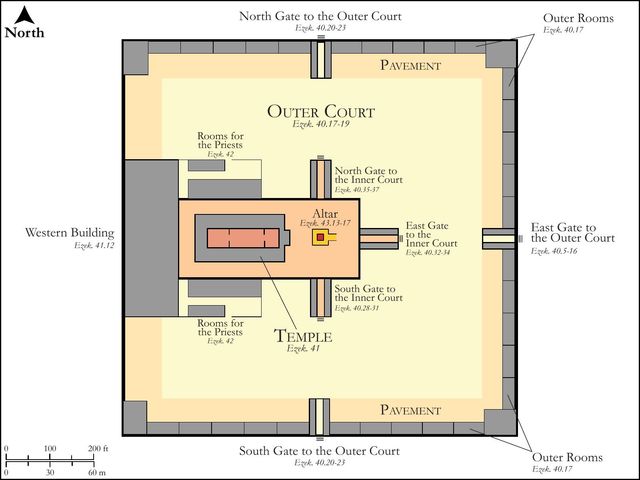
Ezekiel 40:43 is intricately woven into the expansive temple vision that dominates chapters 40-48 of Ezekiel. This monumental vision signifies a pivotal shift in Ezekiel's prophetic message, transitioning from pronouncements of judgment against Judah and surrounding nations (chapters 1-39) to a detailed and hopeful blueprint of future restoration and the re-establishment of God's presence among His people. The vision commences with Ezekiel being transported by God to a very high mountain, where he encounters a celestial guide who meticulously measures the temple complex, its gates, courts, and chambers, as detailed in Ezekiel 40:1-3. This specific verse, describing the hooks and tables, is situated within the detailed account of the temple's functional areas, particularly those dedicated to the processing of sacrifices. Its inclusion highlights the divine precision and practical necessity embedded within the sacred architecture, emphasizing that every aspect of worship in this future temple is divinely ordained.
Historical & Cultural Context
The temple vision was revealed to Ezekiel during the Babylonian exile, a period marked by profound national devastation and spiritual despair for the Israelites. Jerusalem had been utterly destroyed, and Solomon's Temple, the heart of their worship and national identity, lay in ruins following the siege of 586 BC. Far from their homeland, the exiles grappled with questions of God's faithfulness and their future. In this bleak historical context, Ezekiel's vision served as a powerful message of hope, divine faithfulness, and the promise of a future restoration. It offered a tangible, divinely revealed assurance that God's glory would return to a purified sanctuary and a restored people. Culturally, the temple was the epicenter of Israelite religious life, where the elaborate sacrificial system was performed to achieve atonement for sin. The description of specific implements like hooks and tables for preparing offerings would have immediately resonated with the exiles, reminding them of the sacred rituals central to their faith and the meticulous care required in handling holy things.
Key Themes
ShowHideThis verse, along with the broader temple vision, illuminates several foundational theological themes. Firstly, Divine Order and Precision are paramount; every dimension, every fixture, and every function within the temple is divinely ordained and meticulously detailed, underscoring God's absolute demand for order, holiness, and exactitude in worship and life. Secondly, the Centrality of Sacrifice and Atonement remains a dominant theme; despite the vision's future orientation, the practicalities of preparing offerings underscore the enduring need for expiation of sin to approach a holy God. The sacrificial system, though temporary, was God's ordained means of dealing with sin under the Old Covenant, foreshadowing a greater reality. Thirdly, the vision speaks powerfully to God's Enduring Presence and Restoration. After the departure of God's glory from the first temple, a tragic event recounted in Ezekiel 10, this vision promises its glorious return, signifying a renewed covenant relationship and a future where God dwells among His people in holiness and peace, as promised in Ezekiel 37:26-28.
Exposition and Analysis
ShowHideKey Word Analysis
ShowHideThis term refers to a "two-pronged hook" or a "double stall." In the context of the temple and its sacrificial system, these were specific implements used for flaying, hanging, or processing sacrificial animals. Their presence indicates the practical, physical labor involved in preparing the offerings, underscoring the tangible and often bloody reality of the sacrificial system.
This word denotes a "palm-breadth" or "hand-breadth," which was a specific unit of measurement, roughly equivalent to 3-4 inches. Describing the hooks as "an hand broad" emphasizes their substantial size and robust construction, signifying they were built to withstand the weight and demands of handling animal carcasses. This detail highlights the meticulousness of the divine blueprint and the practical functionality required for sacred work.
This term refers to "flesh" generally, often implying its freshness, and by extension, the body or even a person. In the context of sacrifice, it specifically denotes the meat of the animal offering. Its mention here highlights that the purpose of these fixtures was the preparation of the physical components of the sacrifice, which were essential for the ritualistic atonement and consumption by priests or worshippers.
Derived from the root meaning "to draw near," this term refers to "something brought near the altar," specifically a sacrificial present or oblation. It encompasses any offering made to God, emphasizing the act of presentation and dedication. The "flesh of the offering" thus refers to the part of the sacrifice that was presented to God, whether consumed on the altar as a burnt offering or by the priests and worshippers as part of a peace offering.
Verse Breakdown
ShowHide"And within were hooks, an hand broad, fastened round about:"
This clause describes the presence and nature of specific fixtures located within the temple area, most likely in the outer or inner court where sacrificial preparations took place. The "hooks" were substantial, measuring "an hand broad," indicating their sturdy construction and suitability for handling large animal carcasses. Their systematic placement, "fastened round about," suggests an organized and efficient setup for the orderly processing of sacrificial animals, emphasizing the practical and methodical aspects of the temple's operations.
"and upon the tables was the flesh of the offering."
This second clause specifies the function of other furniture within the same area: "tables." These tables served as surfaces for the "flesh of the offering," referring to the prepared meat of the sacrificial animals. This indicates that after the animals were slaughtered and perhaps flayed using the hooks, their flesh was then placed on these tables for further preparation, cutting, or portioning before being brought to the altar for burning or distributed according to the specific sacrificial laws. This further underscores the meticulousness, sanctity, and practicality surrounding every step of the sacrificial ritual.
Literary Devices
ShowHideEzekiel 40:43, characteristic of the entire temple vision, is primarily defined by Detailed Description and Precision. The prophet's meticulous enumeration of measurements, materials, and functional elements, such as the hooks and tables, serves to convey the divine origin and perfect nature of the envisioned sanctuary. This profound level of detail is not merely architectural; it is deeply theological, emphasizing God's absolute demand for order, purity, and exactitude in worship. The inclusion of these practical elements also functions as a form of Realism within a visionary context, grounding the spiritual blueprint in tangible, functional components necessary for the operation of the sacrificial system. Furthermore, the entire sacrificial system, including these preparatory elements, functions as Typology and Foreshadowing. While not directly symbolic in their immediate function, these items are part of a larger system that prefigures the greater, ultimate sacrifice. They make the mundane details of Old Testament worship rich with New Testament significance, pointing toward the perfect work of Christ.
Theological and Thematic Connections
ShowHideEzekiel 40:43, with its focus on the practicalities of sacrifice, profoundly connects to the broader biblical theology of atonement and the nature of worship. The presence of hooks and tables for preparing the "flesh of the offering" underscores the stark reality that sin requires a costly, bloody sacrifice. This meticulous preparation highlights the seriousness of approaching a holy God and the necessity of a divinely appointed means of reconciliation. The Old Testament sacrificial system, though temporary, was God's gracious provision for covering sin and maintaining fellowship with His people. It served as a pedagogical tool, teaching Israel about the gravity of sin, the holiness of God, and the principle of substitutionary atonement. Thus, this verse, far from being a mere architectural footnote, is a testament to the enduring biblical truth that "without the shedding of blood there is no forgiveness."
Reflection and Application
ShowHideEzekiel 40:43, while detailing ancient temple mechanics, offers profound insights for contemporary believers. The meticulousness with which the sacrificial offerings were handled—from the hooks for flaying to the tables for preparation—serves as a powerful reminder of the reverence and intentionality God expects in worship. Our worship, though no longer involving animal sacrifices, should be characterized by a similar level of preparation, sincerity, and deep respect for God's holiness. This verse calls us to consider the "flesh of our offering"—our lives, our time, our talents, our resources—and how we present them to God. Are we offering Him our best, prepared with care and devotion, or are we giving Him what is convenient or leftover? Furthermore, this verse deepens our appreciation for the ultimate sacrifice of Jesus Christ. The cumbersome, bloody, and repetitive nature of the Old Testament system, hinted at by these practical tools, highlights the immense grace and perfection of Christ's singular, all-sufficient sacrifice, which fulfilled all these types and shadows, providing a perfect and permanent means of atonement.
Questions for Reflection
ShowHideFAQ
ShowHideWhat is the significance of the "hooks" and "tables" in Ezekiel's vision?
ShowHideThe hooks and tables described in Ezekiel 40:43 are significant because they represent the practical, functional aspects of the sacrificial system within the envisioned temple. The hooks (Hebrew: shâphâth) were likely used for hanging and flaying sacrificial animals, while the tables (Hebrew: shulchân) served as surfaces for preparing the "flesh of the offering" (Hebrew: bâsâr of the qorbân). Their inclusion emphasizes the meticulous detail of God's blueprint for the temple, highlighting the divine demand for order, purity, and precision in all aspects of worship. These seemingly minor details underscore the reality of the sacrificial rituals and the seriousness with which offerings were to be handled in the presence of a holy God.
Does Ezekiel's temple vision, including these details, describe a literal future temple or is it symbolic?
ShowHideThe interpretation of Ezekiel's temple vision is a subject of ongoing theological discussion. Some interpret it as a literal blueprint for a future temple that will be built during a millennial reign, with the details like hooks and tables being actual physical components. Others view the vision primarily as symbolic, representing the Church, the eternal state, or a spiritual reality where God's presence and principles of worship are fully realized, rather than a physical structure with animal sacrifices. A third view suggests a combination, where the vision has both literal and symbolic elements. Regardless of the precise interpretation, the details like the hooks and tables consistently point to the importance of God's holiness, the necessity of atonement, and the order required in approaching Him. The New Testament teaches that Christ's sacrifice fulfilled the need for animal sacrifices, so any future literal temple would likely not involve them in the same way, as articulated in Hebrews 10:1-18.
Christ-Centered Fulfillment
ShowHideEzekiel 40:43, with its vivid depiction of hooks and tables for preparing "the flesh of the offering," finds its profound Christ-centered fulfillment in the person and work of Jesus Christ. The elaborate, bloody, and repetitive sacrificial system of the Old Covenant, of which these temple fixtures were an integral part, served as a powerful type and shadow pointing to the ultimate, perfect sacrifice. The animals prepared on these hooks and tables were merely temporary coverings for sin, unable to truly cleanse the conscience or take away guilt, as revealed in Hebrews 10:4. Jesus, however, is the true Lamb of God who takes away the sin of the world, whose body was the ultimate "flesh of the offering" given once for all. His single, perfect sacrifice on the cross rendered all previous animal sacrifices obsolete, fulfilling their purpose and providing eternal redemption, as affirmed in Hebrews 9:12. Thus, the meticulous preparation described in Ezekiel foreshadows the flawless purity and divine perfection of Christ's offering, which required no hooks or tables for repeated preparation, but was a singular, sufficient act of love and atonement, establishing a new covenant and opening a new and living way to God.