


Ezekiel 40:41
Bible text: King James Version (1769 Blayney text) · Public domain
Bible text: Berean Standard Bible · Public domain
Bible text: American Standard Version (1901) · Public domain
Bible text: World English Bible, Messianic edition · Public domain
Bible text: Geneva Bible (1599) · Public domain
Bible text: Young's Literal Translation · Public domain
- אַרְבָּעָה'ar·ba·'AhfourH702Adj-csAdjective Numerical Singular common gender Absolute
- שֻׁלְחָנוֹתshul·cha·NottablesH7979N-fpNoun Plural Feminine Absolute
- מִפֹּהmi·Pohfrom hereH6311Prep-m ¦ AdvAdverbמִfromפֹּהhere
- וְאַרְבָּעָהve·'ar·ba·'Ahand fourH702Conj-w ¦ Adj-csAdjective Numerical Singular common gender Absoluteוְandאַרְבָּעָהfour
- שֻׁלְחָנוֹתshul·cha·NottablesH7979N-fpNoun Plural Feminine Absolute
- מִפֹּהmi·Pohfrom hereH6311Prep-m ¦ AdvAdverbמִfromפֹּהhere
- לְכֶתֶףle·Khe·tef[were] to [the] side ofH3802Prep-l ¦ N-fscNoun Singular Feminine Constructלְ[were] toכֶתֶף[the] side of
- הַשָּׁעַרha·Sha·'arthe gateH8179Art ¦ N-msNoun Singular Masculine Absoluteהַtheשָּׁעַרgate
- שְׁמוֹנָהshe·mo·NaheightH8083Adj-csAdjective Numerical Singular common gender Absolute
- שֻׁלְחָנוֹתshul·cha·NottablesH7979N-fpNoun Plural Feminine Absolute
- אֲלֵיהֶם'a·lei·Hem[which] to themH413Prep ¦ 3mpPrepositionאֲלֵי[which] toהֶםthem
- יִשְׁחָטוּyish·Cha·tupeople slaughterH7819V-Qal-Imperf-3mpVerb Qal Imperfect 3rd Plural Masculine
English is a literal word-by-word gloss of the Hebrew, not the KJV's wording. Why?
This is the original text the KJV's translators worked from — each Hebrew word with its own literal English meaning in this verse, prepared by scholars at Tyndale House, Cambridge. The KJV translates whole sentences, not word by word, so its wording differs: one Hebrew word can become several English words, and the KJV may choose “the LORD” where the gloss reads “Yahweh”. Both are faithful — they answer different questions. For the KJV's own rendering, switch to the KJV text.
Details
See on the biblical-era map
Study this verse
Public-domain commentary
Matthew Henry
From his Commentary on the Whole Bible. Henry comments on passages, not single verses — this entry covers Ezekiel 40:39–49. His two-level outline is real structure in the source text, so it is rendered as structure.
In these verses we have an account,
I.Of the tables that were in the porch of the gates of the inner court.
We find no description of the altars of burnt-offerings in the midst of that court till Eze 43:13. But, because the one altar under the law was to be exchanged for a multitude of tables under the gospel, here is early notice taken of the tables, at our entrance into the inner court; for till we come to partake of the table of the Lord we are but professors at large; our admission to that is our entrance into the inner court. But in this gospel-temple we meet with no altar till after the glory of the Lord has taken possession of it, for Christ is our altar, that sanctifies every gift. Here were eight tables provided, whereon to slay the sacrifices, Eze 40:41. We read not of any tables for this purpose either in the tabernacle or in Solomon's temple. But here they are provided, to intimate the multitude of spiritual sacrifices that should be brought to God's house in gospel-times, and the multitude of hands that should be employed in offering up those sacrifices. Here were the shambles for the altar; here were the dressers on which they laid the flesh of the sacrifice, the knives with which they cut it up, and the hooks on which they hung it up, that it might be ready to be offered on the altar (Eze 40:43), and there also they washed the burnt-offerings (Eze 40:38), to intimate that before we draw near to God's altar we must have every thing in readiness, must wash our hands, our hearts, those spiritual sacrifices, and so compass God's altar.
II.The use that some of the chambers mentioned before were put to.
1.Some were for the singers, Eze 40:44. It should seem they were first provided for before any other that attended this temple-service, to intimate, not only that the singing of psalms should still continue a gospel-ordinance, but that the gospel should furnish all that embrace it with abundant matter for joy and praise, and give them occasion to break forth into singing, which is often foretold concerning gospel times, Psa 96:1; Psa 98:1. Christians should be singers. Blessed are those that dwell in God's house, they will be still praising him.
2.Others of them were for the priests, both those that kept the charge of the house, to cleanse it, and to see that none came into it to pollute it, and to keep it in good repair (Eze 40:45), and those that kept the charge of the altar (Eze 40:46), that came near to the Lord to minister to him. God will find convenient lodging for all his servants. Those that do the work of his house shall enjoy the comforts of it.
III.Of the inner court, the court of the priests, which was fifty yards square, Eze 40:47.
The altar that was before the house was placed in the midst of this court, over-against the three gates, and, standing in a direct line with the three gates of the outer court, when the gates were set open all the people in the outer court might through them be spectators of the service done at the altar. Christ is both our altar and our sacrifice, to whom we must look with an eye of faith in all our approaches to God, and he is salvation in the midst of the earth (Psa 74:12), to be looked unto from all quarters.
IV.Of the porch of the house.
The temple is called the house, emphatically, as if no other house were worthy to be called so. Before this house there was a porch, to teach us not to rush hastily and inconsiderately into the presence of God, but gradually, that is, gravely, and with solemnity, passing first through the outer court, then the inner, then the porch, ere we enter into the house. Between this porch and the altar was a place where the priests used to pray, Joe 2:17. In the porch, besides the posts on which the doors were hung, there were pillars, probably for state and ornament, like Jachin and Boaz - He will establish; in him is strength, Eze 40:49. In the gospel church every thing is strong and firm, and every thing ought to be kept in its place and to be done decently and in order.
Historical interpretation
Two Centuries of Reception
2 surviving comments on this verse. Each one is dated, so this reads as a timeline rather than a list.
Select a marker to jump to its quote. Markers stagger vertically where authors wrote within a few decades of each other.
(Verse 35 and following) 'And he brought me to the gate that faced the north, and he measured it according to the higher measurements: its chamber, its facade, its vestibule, and its windows all around: it was fifty cubits long and twenty-five cubits wide. Its vestibule faced the outer court, and its palm tree engravings on its facade on both sides, and its staircase with eight steps.' And at each treasury there shall be a door in the gates (or fronts) of the doors: there they shall wash the holocaust. And at the entrance of the gate, there shall be two tables on this side, and two tables on that side, upon which the holocaust shall be immolated, and for sin, and for trespass. And on the outer side, which goes to the gate that leads to the north, there shall be two tables, and on the other side, before the vestibule of the gate, there shall be two tables. Four tables on this side, and four tables on that side: by the sides of the gate, there were eight tables, upon which they shall immolate (or used to immolate): but there were four tables for holocaust made of square stones, of one cubit and a half long, and of one cubit and a half wide, and of one cubit high, upon which the vessels were laid in which the holocaust and the victims are immolated. And their lips were a cubit long, turned inward all around; but on the tables were the flesh of the offering.» There is much disagreement in this testimony between the Hebrew Truth and the edition of the Seventy Interpreters. For what we have said: There they shall wash the burnt offering, and in the vestibule of the gate there are two tables on this side, and again: That the burnt offering and the sin offering be offered on them, is not found in the Seventy, but it is added in many copies from Theodotion. Again, when we said: And their lips turned inward by one palm's measure all around, Seventy translated it, and having the measurement of a span all around. Whether this word is Hebrew or Greek, we cannot know, except only that for 'gisum,' Symmachus and Theodotion translated it as 'lips,' Aquila's first edition translated it as 'ἐπιστάσεις' in the plural number; the second translated it as 'lips': for which in Hebrew it is written as 'Asephathaim'(). And when we say, above the tables however the meats of the offering, the Seventy put from their own, and they put coverings on the tables from above, so that they may be protected from rain and dryness. But that which they have given in Hebrew names, Thee, and Elau, and Elalamoth, and Aelam, what it signifies, and we have shown above, and our translation can show from the context: it is not necessary to often remind the reader about this, and to doubt their prudence and effort. Therefore, he is brought again to the gate that looked towards the North: but not as before to the outer courtyard, but to the inner one. For in what follows it is said: Its vestibule looked towards the outer courtyard, showing that this courtyard was inside. Through this, the progress of the one entering is shown; for in each place there are specific names and measures, and windows all around filled with the light of knowledge, showing all things, and through fifty and twenty-five cubits are the sacraments of divine sense and remission placed, as positioned in the vestibule of the inner courtyard, that we may see the exterior: contemplating knowledge of past and present, through which we may come to double palms and victories, and understand the mysteries of the eight degrees, having entered the treasuries, in which the riches of the temple are contained, and our prayers are cleansed from all the filth of sin; and tables are placed on both sides, so that the burnt offering may be first offered.
The diligent shepherd follows the custom of his father, and Gesaque, the barker of Sydon, etc., all of which the sacred fire consumes, first for sin, and finally for ignorance: whether we commit them knowingly or unknowingly. On the outer side, next to the Seventy, there was a man-made stream that carried away the ashes of the burnt offering and the harmfulness of the flesh externally: either there were two tables, and on the other side of the vestibule of the same gate there were two tables, that is, four on each side, four here and four there, and behind, or on the side of these there were eight other tables, so that they make a total of sixteen tables: by this number the mysteries of the prophets are shown, so that whatever we offer through the Gospel dispensation, we may affirm as foretold by their prophecies. And there are four tables made of square stones, and these themselves are for sacrifice and burnt offering (also called holocausts). These are living stones that are rolled upon the earth, and they have with them a corner stone, by which the walls of the old and new Covenant are held together. Now the number four signifies the Gospel sacraments, having in length and width one and a half cubits, that is, a square, which, when joined together, make three cubits, which three cubits have one cubit in height, so that the mysteries of the Trinity may preserve the measure of one cubit, that is, the divine majesty, as the Lord tells the disciples: Go, baptize all nations in the name of the Father, and of the Son, and of the Holy Spirit (Matthew 28:19). The name of God, as it were, is of one (or, one) cubit in height, which encompasses three properties, and always accepts the holocaust offerings of our oblations. Above these, however, are four tables of holocausts built with living stones, the length, width, and height of which have been described; vessels are placed in them in which the holocaust of the martyrs is offered, of whom it is said: Precious in the sight of the Lord is the death of his saints (Ps. 116:15); and their victims, who, through self-control and the holiness of their bodies, offer their souls as a sacrifice to the Lord. I believe that the meaning of these tables is contained in the books of Matthew, Luke, Mark, and John, which are about the apostles. Above these tables there was a curved crown on the inside, encircling the edges, to contain the sacrificial offerings and prevent them from flowing freely. It also held the meat of the offering, or as the Septuagint translated: 'And the tables themselves were covered on top, because of the violence of the rain and the excessive dryness of the summer sun, so that the meat placed on top could say with the prophet: “By day the sun will not harm us nor the moon by night."' (Psalm 121:6). One of which, with excessive rains and storms, dissolves the offerings of tribulations; the other, with violent heat, dries up whatever has been offered. Forgive me, reader, for the difficulty of the places; or if you can find something better, teach us: we gladly learn what we do not know.
Four tables on this side, and four tables on that side, by the sides of the gate.
But let it be said: Four tables on this side, and four tables on that side by the sides of the gate. For while faith and life, doctrine and prophecy are kept in the minds of the good, our gate, that is the understanding of sacred speech, has four tables on its side. And when holy preaching maintains patience and kindness in progressing peoples, which previously kept circumcision and sacrifice in carnal ones, four tables are shown as if from the other side as well. All of which together make eight for immolation, namely four interior ones for the holocaust, but four exterior ones for the sacrifice, because both those who in the holy Church keep faith, life, patience and kindness, undoubtedly now excel in the highest virtues; and those who in the synagogue knew doctrine and prophecy, circumcision and sacrifice, by offering some things and retaining other things for themselves, gave the victim of their devotion to the almighty Lord.
Continue studying Ezekiel 40:41 across the web’s major study libraries — every link below opens this exact verse, chapter, or book on the destination site.
Read & Compare
 BibleGatewayThis verse in more than 200 translations and 70 languages.
 Bible.comThe YouVersion reader — hundreds of translations, reading plans, and highlights.
 ESV.orgCrossway's official English Standard Version reader.
 NET BibleThe NET translation with 60,000+ translators' notes on every rendering decision.
 STEP BibleTyndale House's free study tool — original text, vocabulary, and scholarly resources.
 BibliaLogos Bible Software's free web reader.
 USCCBThe New American Bible (Revised Edition) with the U.S. bishops' study notes.
Commentaries
 BibleHub CommentariesDozens of classic commentaries on this verse, gathered on one page.
 StudyLightMore than 100 commentary sets — the largest collection on the web.
 BibleRefPlain-English commentary on what this verse means, verse by verse.
 Enduring WordDavid Guzik's free commentary on this chapter, widely used by Bible teachers.
 Bible Study ToolsVerse commentary alongside Greek and Hebrew study aids.
Original Language & Research
- BibleHub InterlinearThe verse word by word — original language, transliteration, and English.
- BibleHub LexiconEvery word's original-language definition and Strong's entry.
 Blue Letter BibleDeep-study tools — Strong's numbers, concordance, and word studies.
 SefariaThe Hebrew text with Rashi and centuries of Jewish commentary.
Sermons, Hymns & Audio


TrulyRandomVerse is not affiliated with these sites and doesn’t control their content. They’re linked because they’re genuinely useful.
Summary
Ezekiel 40:41 describes a precise architectural detail within the visionary temple complex shown to the prophet Ezekiel: eight tables, symmetrically placed four on each side of a gate, specifically designated for the slaughtering of sacrifices. This detail underscores the meticulous order and functional purpose of the divine blueprint for worship, emphasizing the practical necessities for the sacrificial system in the restored temple.
Context
ShowHideLiterary Context
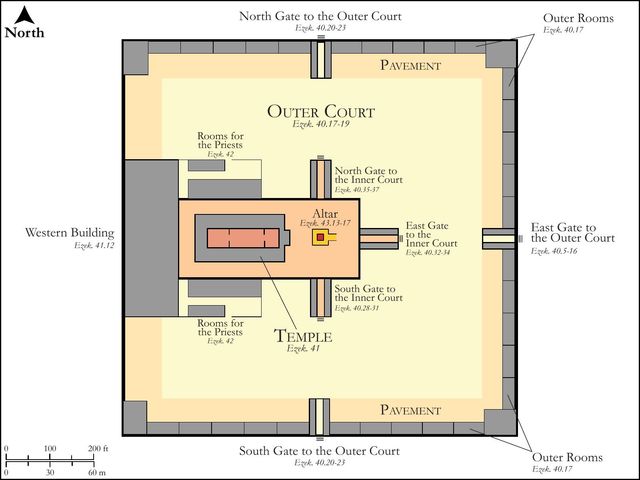
Ezekiel 40:41 is situated within a lengthy and highly detailed vision of a new temple, spanning Ezekiel 40 through Ezekiel 48. The preceding verses, Ezekiel 40:38-40, describe chambers where offerings were washed and prepared, leading directly into the specific placement of these tables. The overall narrative flow of Ezekiel 40 focuses on the precise measurements and layout of the outer court, inner court, and various gates and chambers, all meticulously detailed by the angelic guide. This particular verse contributes to the comprehensive picture of a fully functional temple, designed to facilitate the sacrificial rituals central to Israelite worship.
Historical & Cultural Context
The vision of the temple was given to Ezekiel during the Babylonian exile, around 573 BC, a time when the Jerusalem Temple had been destroyed (in 586 BC) and the people were far from their homeland and traditional worship practices. For the exiled Israelites, this vision offered profound hope and assurance of God's continued presence and future restoration. The detailed descriptions of the temple, including sacrificial provisions, would have resonated deeply with a people whose identity was intricately linked to the Mosaic covenant and its sacrificial system, as outlined in books like Leviticus. The practice of slaughtering sacrifices on tables or similar platforms was part of the order of worship appointed for the temple, ensuring cleanliness and order in the ritual process.
Key Themes
ShowHideThis verse, like much of Ezekiel 40, contributes to several overarching themes. Firstly, it highlights Divine Order and Precision, evident in the exact number and symmetrical placement of the tables. Every aspect of God's design for worship is meticulously planned, reflecting His perfect nature. Secondly, it underscores the theme of Restoration and Future Worship, providing a tangible blueprint for a renewed covenant relationship and proper worship in a restored land, a stark contrast to the defiled temple of Ezekiel's earlier prophecies (e.g., Ezekiel 8). Finally, the mention of "slew their sacrifices" points directly to the continued necessity of Atonement and Holiness within the covenant framework, even in this future, idealized temple. The sacrificial system, with its inherent cost and blood, remained central to addressing sin and maintaining fellowship with a holy God, foreshadowing the ultimate sacrifice detailed in the New Testament (e.g., Hebrews 9:22).
Exposition and Analysis
ShowHideKey Word Analysis
ShowHideFrom שָׁלַח; a table (as spread out); by implication, a meal; table. In the context of the temple and sacrifices, it refers to a sturdy, flat platform or slab specifically designed for the preparation and slaughtering of sacrificial animals. Its function is practical and ritualistic, not for eating.
From an unused root meaning to clothe; the shoulder (proper, i.e. upper end of the arm; as being the spot where the garments hang); figuratively, side-piece or lateral projection of anything; arm, corner, shoulder(-piece), side, undersetter. In this architectural context, it denotes a lateral projection or an adjacent area. The phrase "by the side of the gate" indicates the tables' precise placement immediately next to the gate structure, highlighting their accessibility and integration into the flow of sacrificial activity.
A primitive root; to slaughter (in sacrifice or massacre); kill, offer, shoot out, slay, slaughter. This word emphasizes the solemn and purposeful act of taking an animal's life as part of the offering process, underscoring the gravity and physicality of atonement.
Verse Breakdown
ShowHide"Four tables [were] on this side, and four tables on that side,"
This clause establishes the symmetrical and orderly placement of the tables. The repetition of "four tables" emphasizes the precise count and balanced arrangement, indicating a well-planned and efficient system for handling offerings. This symmetry suggests divine order and completeness in the temple's design.
"by the side of the gate;"
This phrase specifies the exact location of these tables. Their proximity to the gate implies they are situated in an area of high traffic and easy access for those bringing offerings into the temple complex. This placement is practical, facilitating the initial stages of the sacrificial process immediately upon entry.
"eight tables, whereupon they slew [their sacrifices]."
This final clause summarizes the total number of tables and explicitly states their function. The total of "eight tables" (four on each side) provides ample space for the preparation and slaughter of numerous animals, indicating the scale of worship envisioned. The purpose, "whereupon they slew their sacrifices," clearly defines these as sacrificial tables, central to the ritualistic act of atonement and offering to God.
Literary Devices
ShowHideThe primary literary device at play in Ezekiel 40:41, and indeed throughout the entire temple vision, is Detailed Description. Ezekiel's account is replete with precise measurements, counts, and spatial relationships, creating a vivid mental blueprint of the complex. The meticulous enumeration of "four tables... and four tables... eight tables" exemplifies this. This serves to emphasize the Divine Order and Precision inherent in God's plan, leaving no room for ambiguity or human improvisation. Furthermore, the functional description of the tables ("whereupon they slew their sacrifices") employs Metonymy, where the tables themselves stand in for the entire process and purpose of the sacrificial system. The physical objects represent the theological reality of atonement and worship. The vision as a whole also functions as Symbolism, where the physical temple and its components symbolize God's presence, holiness, and the future restoration of His people and their worship.
Theological and Thematic Connections
ShowHideEzekiel 40:41, with its description of tables for slaughtering sacrifices, serves as a powerful reminder of the Old Covenant's sacrificial system and its inherent purpose: to provide a means of atonement for sin and to facilitate fellowship between a holy God and His sinful people. The meticulous detail in the temple's design underscores God's demand for order, purity, and intentionality in worship, reflecting His own perfect character. While the physical sacrifices pointed forward to a greater reality, they were absolutely essential for dealing with sin under the Mosaic Law, emphasizing the gravity of sin and the cost required for reconciliation. This passage, therefore, connects deeply to the biblical themes of holiness, atonement, and the divine provision for humanity's sin problem, setting the stage for the ultimate fulfillment found in Christ.
Reflection and Application
ShowHideEzekiel's vision of the temple, including these sacrificial tables, offers profound lessons for believers today, even though the Old Testament sacrificial system has been fulfilled in Christ. It reminds us that worship is not haphazard but requires intentionality, preparation, and reverence for God's holiness. The very existence of tables for slaughtering sacrifices highlights the seriousness of sin and the costly nature of atonement. For us, this translates into a deep appreciation for the finished work of Christ on the cross. Our worship should reflect the awe and gratitude for His ultimate sacrifice, recognizing that our access to God comes at an infinite cost. Furthermore, the divine precision in the temple's design calls us to live lives of order and purpose, aligning our actions and attitudes with God's perfect will, understanding that He cares about every detail of our obedience and devotion.
Questions for Reflection
ShowHideFAQ
ShowHideWhat is the significance of "eight tables" for slaughtering sacrifices?
ShowHideThe mention of "eight tables" (four on each side of the gate) signifies a highly organized and efficient system for handling the large volume of sacrifices expected in the restored temple. The number eight, often associated with new beginnings or superabundance in biblical numerology, could also subtly point to the comprehensive and complete nature of worship in this future era. Practically, it ensures that multiple offerings could be prepared simultaneously, emphasizing the scale and importance of the sacrificial system in God's design for the restored community.
How do these tables relate to other parts of the temple vision in Ezekiel?
ShowHideThese tables are an integral part of the broader vision of the new temple in Ezekiel 40-48. They are specifically located near the outer gate, following descriptions of various chambers and courts. Their function directly supports the sacrificial rituals detailed throughout the vision, which culminate in the description of the altar and the glory of God returning to the temple (Ezekiel 43:1-5). The meticulous detail of these tables, along with other architectural features, underscores the functionality and divine order of the entire complex, designed for proper worship and the maintenance of holiness.
Christ-Centered Fulfillment
ShowHideEzekiel 40:41, with its stark depiction of tables for "slew [their sacrifices]," powerfully foreshadows the ultimate and perfect sacrifice of Jesus Christ. The Old Testament sacrificial system, meticulously detailed in the Mosaic Law and envisioned in Ezekiel's temple, served as a crucial shadow pointing to the coming reality. The blood shed on these tables, an indispensable requirement for atonement under the Old Covenant (Hebrews 9:22), finds its complete and final fulfillment in the singular, unrepeatable sacrifice of the Lamb of God on the cross. Jesus, as both the High Priest and the spotless offering, entered the true, heavenly tabernacle "once for all" (Hebrews 9:12), rendering the physical tables and animal sacrifices obsolete. The "eight tables" in Ezekiel's vision, designed for the continuous shedding of blood, are ultimately replaced by the singular, efficacious act of Christ's death, which fully cleanses us from sin (1 John 1:7) and grants us direct access to God's presence (Hebrews 10:19-20). Thus, these tables, while central to Old Covenant worship, ultimately point to the cross where the ultimate Lamb was slain, securing eternal redemption for all who believe.