


Ezekiel 26:14
- וּנְתַתִּיךְu·ne·ta·Tikhand I will make youH5414Conj-w ¦ V-Qal-ConsecPerf-1cs ¦ 2fsVerb Qal Consecutive Perfect 1st Singular common genderוּandנְתַתִּיI will makeךְyou
- לִצְחִיחַlitz·Chi·achinto bareness ofH6706Prep-l ¦ N-mscNoun Singular Masculine Constructלִintoצְחִיחַbareness of
- סֶלַעSe·la'rockH5553N-msNoun Singular Masculine Absolute
- מִשְׁטַחmish·Tacha spreading place ofH4894N-mscNoun Singular Masculine Construct
- חֲרָמִיםcha·ra·MimnetsH2764N-mpNoun Plural Masculine Absolute
- תִּהְיֶהtih·Yehyou will beH1961V-Qal-Imperf-2msVerb Qal Imperfect 2nd Singular Masculine
- לֹאlo'notH3808NegParticle Negative
- תִבָּנֶהti·ba·Nehyou will be builtH1129V-Niphal-Imperf-3fsVerb Niphal Imperfect 3rd Singular Feminine
- עוֹדodagainH5750Adj-msAdjective Numerical Singular Masculine Absolute
- כִּיkiforH3588PrtParticle Conditional
- אֲנִי'a·NiIH589Pro-1csPronoun Personal 1st Singular common gender
- יְהוָהYah·wehYahwehH3068N-properNoun Proper Title
- דִּבַּרְתִּיdi·Bar·tiI have spokenH1696V-Piel-Perf-1csVerb Piel Perfect 1st Singular common gender
- נְאֻםne·'Um[the] utterance ofH5002N-mscNoun Singular Masculine Construct
- אֲדֹנָי'a·do·Nai[the] LordH136N-properNoun Proper Title
- יְהוִהYah·wehYahwehH3069N-properNoun Proper Title
English is a literal word-by-word gloss of the Hebrew, not the KJV's wording. Why?
This is the original text the KJV's translators worked from — each Hebrew word with its own literal English meaning in this verse, prepared by scholars at Tyndale House, Cambridge. The KJV translates whole sentences, not word by word, so its wording differs: one Hebrew word can become several English words, and the KJV may choose “the LORD” where the gloss reads “Yahweh”. Both are faithful — they answer different questions. For the KJV's own rendering, switch to the KJV text.
Details
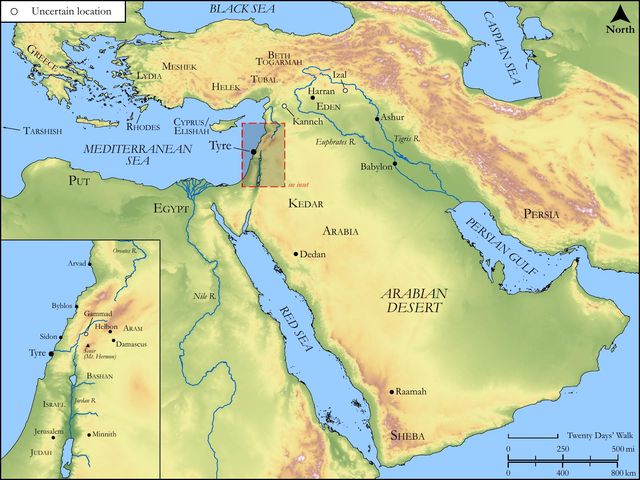
See on the biblical-era map
Study this verse
Public-domain commentary
Matthew Henry
From his Commentary on the Whole Bible. Henry comments on passages, not single verses — this entry covers Ezekiel 26:1–14. His three-level outline is real structure in the source text, so it is rendered as structure.
This prophecy is dated in the eleventh year, which was the year that Jerusalem was taken, and in the first day of the month, but it is not said what month, some think the month in which Jerusalem was taken, which was the fourth month, others the month after; or perhaps it was the first month, and so it was the first day of the year. Observe here,
I.The pleasure with which the Tyrians looked upon the ruins of Jerusalem.
Ezekiel was a great way off, in Babylon, but God told him what Tyrus said against Jerusalem (Eze 26:2): "Aha! she is broken, broken to pieces, that was the gates of the people, to whom there was a great resort and where there was a general rendezvous of all nations, some upon one account and some upon another, and I shall get by it; all the wealth, power, and interest, which Jerusalem had, it is hoped, shall be turned to Tyre, and so now that she is laid waste I shall be replenished." We do not find that the Tyrians had such a hatred and enmity to Jerusalem and the sanctuary as the Ammonites and Edomites had, or were so spiteful and mischievous to the Jews. They were men of business, and of large acquaintance and free conversation, and therefore were not so bigoted, and of such a persecuting spirit, as the narrow souls that lived retired and knew not the world. All their care was to get estates, and enlarge their trade, and they looked upon Jerusalem not as an enemy, but as a rival. Hiram, king of Tyre, was a good friend to David and Solomon, and we do not read of any quarrels the Jews had with the Tyrians; but Tyre promised herself that the fall of Jerusalem would be an advantage to her in respect of trade a commerce, that now she shall have Jerusalem's customers, and the great men from all parts that used to come to Jerusalem for the accomplishing of themselves, and to spend their estates there, will now come to Tyre and spend them there; and whereas many, since the Chaldean army became so formidable in those parts, had retired into Jerusalem, and brought their estates thither for safety, as the Rechabites did, now they will come to Tyre, which, being in a manner surrounded with the sea, will be thought a place of greater strength than Jerusalem, and thus the prosperity of Tyre will rise out of the ruins of Jerusalem. Note, To be secretly pleased with the death or decay of others, when we are likely to get by it, with their fall when we may thrive upon it, is a sin that does most easily beset us, but is not thought to be such a bad thing, and so provoking to God, as really it is. We are apt to say, when those who stand in our light, in our way, are removed, when they break of fall into disgrace, "We shall be replenished now that they are laid waste." But this comes from a selfish covetous principle, and a desire to be placed alone in the midst of the earth, as if we grudged that any should live by us. This comes from a want of that love to our neighbour as to ourselves which the law of God so expressly requires, and from that inordinate love of the world as our happiness which the love of God so expressly forbids. And it is just with God to blast the designs and projects of those who thus contrive to raise themselves upon the ruins of others; and we see they are often disappointed.
II.The displeasure of God against them for it.
The providence of God had done well for Tyrus. Tyrus was a pleasant and wealthy city, and might have continued so if she had, as she ought to have done, sympathized with Jerusalem in her calamities and sent her an address of condolence; but when, instead of that, she showed herself pleased with her neighbour's fall, and perhaps sent an address of congratulation to the conquerors, then God says, Behold, I am against thee, O Tyrus! Eze 26:3. And let her not expect to prosper long if God be against her.
1.God will bring formidable enemies upon her: Many nations shall come against thee, an army made up of many nations, or one nation that shall be as strong as many. Those that have God against them may expect all the creatures against them; for what peace can those have with whom God is at war? They shall come pouring in as the waves of the sea, one upon the neck of another, with an irresistible force. The person is named that shall bring this army upon them - Nebuchadnezzar king of Babylon, a king of kings, that had many kings tributaries to him and dependents on him, besides those that were his captives, Song 2:37, 38. He is that head of gold. He shall come with a vast army, horses and chariots, etc., all land-forces. We do not find that he had any naval force, or any thing wherewith he might attack it by sea, which made the attempt the more difficult, as we find Eze 29:18, where it is called a great service which he served against Tyrus. He shall besiege it in form (Eze 26:8), make a fort, and cast a mount, and (Eze 26:9) shall set engines of war against the walls. His troops shall be so numerous as to raise a dust that shall cover the city, Eze 26:10. They shall make a noise that shall even shake the walls; and they shall shout at every attack, as soldiers do when they enter a city that is broken up; the horses shall prance with so much fury and violence that they shall even tread down the streets though so ever well paved.
2.They shall do terrible execution.
(1.)The enemy shall make themselves masters of all their fortifications, shall destroy the walls and break down the towers, Eze 26:4. For what walls are so strongly built as to be a fence against the judgments of God? Her strong garrisons shall go down to the ground, Eze 26:11. And the walls shall be broken down, Eze 26:12. The city held out a long siege, but it was taken at last.
(2.)A great deal of blood shall be shed: Her daughters who are in the field, the cities upon the continent, which were subject to Tyre as the mother-city, the inhabitants of them shall be slain by the sword, Eze 26:6. The invaders begin with those that come first in their way. And (Eze 26:11) he shall slay thy people with the sword; not only the soldiers that are found in arms, but the burghers, shall be put to the sword, the king of Babylon being highly incensed against them for holding out so long.
(3.)The wealth of the city shall all become a spoil to the conqueror (Eze 26:12): They shall make a prey of the merchandise. It was in hope of the plunder that the city was set upon with so much vigour. See the vanity of riches, that they are kept for the owners to their hurt; they entice and recompense thieves, and not only cease to benefit those who took pains for them and were duly entitled to them, but are made to serve their enemies, who are thereby put into a capacity of doing them so much the more mischief.
(4.)The city itself shall be laid in ruins. All the pleasant houses shall be destroyed (Eze 26:12), such as were pleasantly situated, beautified, and furnished, shall become a heap of rubbish. Let none please themselves too much in their pleasant houses, for they know not how soon they may see the desolation of them. Tyre shall be utterly ruined; the enemy shall not only pull down the houses, but shall carry away the stones and the timber, and shall lay them in the midst of the water, not to be recovered, or ever made use of again. Nay (Eze 26:4), I will scrape her dust from her; not only shall the loose dust be blown away, but the very ground it stands upon shall be torn up by the enraged enemy, carried off, and laid in the midst of the water, Eze 26:12. The foundation is in the dust; that dust shall be all taken away, and then the city must fall of course. When Jerusalem was destroyed it was ploughed like a field, Mic 3:12. But the destruction of Tyre is carried further than that; the very soil of it shall be scraped away, and it shall be made like the top of a rock (Eze 26:4, Eze 26:14), pure rock that has no earth to cover it; it shall only be a place for the spreading of nets (Eze 26:5, Eze 26:14); it shall serve fishermen to dry their nets upon and mend them.
(5.)There shall be a full period to all its mirth and joy (Eze 26:13): I will cause the noise of thy songs to cease. Tyre had been a joyous city (Isa 23:7).; with her songs she had courted customers to deal with her in a way of trade. But now farewell all her profitable commerce and pleasant conversation; Tyre is no more a place either of business or of sport. Lastly, It shall be built no more (Eze 26:14), not built any more as it had been, with such state and magnificence, nor built any more in the same place, within the sea, nor built any where for a long time; the present inhabitants shall be destroyed or dispersed, so that this Tyre shall be no more. For God has spoken it (Eze 26:5, Eze 26:14); and when what he has said is accomplished they shall know thereby that he is the Lord, and not a man that he should lie nor the son of man that he should repent.
Historical interpretation
Historical reception
3 surviving comments on this verse. Each one is dated, so this reads as a timeline rather than a list.
(Verse 35, 36, and following) And I will bring you into a desert of peoples, and there I will judge you face to face. Just as I contended with your fathers in the desert of the land of Egypt, so I will judge you, says the Lord. And I will subject you to my scepter, and I will bring you into the bonds of the covenant, and I will choose from among you the transgressors and the wicked: from their place of residence I will bring them out, and they will not enter the land of Israel, and you will know that I am the Lord. Thus says the Lord: I will do for you who are in Babylon, and now serve idols, what I did for your ancestors in Egypt. I will lead you into the desert of the peoples, and there I will judge you face to face, just as I contended with them in judgment when they came out of Egypt. And after I have judged you, I will subject you to my scepter and rule, and I will make a covenant with you and bring you into your land with the bonds of love, so that bound by my love, you will never be able to depart from me. But I will choose from among you the transgressors and the wicked, who persist in the hardness of their hearts in evil deeds, not for possession, but for rejection. And I will indeed bring them out of the land of their dwelling, so that when they are brought out, they will not enter the land of Israel; but they will perish in various regions. And by the distinction between good and evil, you shall know that I am the Lord, who judges all things. The rest of the discourse hastens, and we briefly go through each point, in order to provide only the meaning to the readers.
(Verse 6 onward.) For thus says the Lord: Behold, I will bring against Tyre (or against you, O Tyre) Nebuchadnezzar king of Babylon, from the north, the king of kings, with horses, and chariots, and horsemen, and a great gathering of people. He will kill your daughters in the field with the sword, and he will surround you with fortifications, and he will build up a siege mound against you, and he will lift up a shield against you, and he will temper vineyards, and rams (or spears), against your walls, and he will destroy your towers in his armor. The inundation of his horses will cover you with their dust; your walls will shake at the sound of the horsemen, chariots, and wheels. When he enters your gates, they will be broken down as if by the entrance of a ravaged city (or as if entering a city from the field). His horses will trample all your streets; he will kill your people with the sword, and your noble statues will fall to the ground (or the wealth of your strength will be brought down to the ground). They will plunder your wealth, destroy your businesses, and tear down your walls. They will overthrow your magnificent houses and throw your stones, wood, and dust into the midst of the waters. I will silence the multitude of your singers and the sound of your harps will no longer be heard. And I will make you a very clear (or shining) rock. You will be the drying up of the snares, and you will not be built up any longer, because I have spoken, says the Lord God. I have joined together the two editions according to custom, and I have joined together from the side those things in which they disagree, providing brevity of volumes. Therefore, what he had said, I will make many nations ascend to you as the fluctuating sea ascends, and Tyre will be a plunder for the nations, then it makes it more evident that the Lord will bring King Nebuchadnezzar of Babylon from the North, the king of kings, with horses and chariots, and with an infinite multitude of armies, who will first overturn the cities and fortresses subject to Tyre on the seashore, and afterwards will cause Tyre to be besieged, and he will attack it with an army, and with a wall, and with fortifications, and with ropes, and with battering rams and destroy the walls, and his cavalry will be such a multitude that the foundations of the city will be moved by the dust of the cavalry and the sound of the howling army, and the noise of the wheels and the neighing of the horses, and thus he will enter the city with the walls scattered, as if he were entering safely from the field, and there will be such security for the conquering army that the hooves of the horses will trample the streets of Tyre and all the people in the middle of the city will fall down, and the once noble statues or all the substance will fall to the ground, and none of the former riches will be preserved in the captured city, but even the noble houses will be destroyed along with the walls, and the cruelty of the victors will be so great that the remaining wood and stones that were burned will be thrown into the middle of the sea, and either Nebuchadnezzar or the Lord himself will cause all the joy of the city to cease, which used to resound in songs and psalms, and even the ground will be dried up. And what follows: You shall not be built up any more, seems to raise the question of how it is that we see today the most noble and beautiful city of Phoenicia, Tyre, which was not built thereafter. But how can they maintain that Tyre will suffer these things in the final time, if afterwards it is not to be built? But how can they preserve the person of Nebuchadnezzar, especially since we read in the following passages that Nebuchadnezzar besieged Tyre, and did not receive the reward of his labor, and therefore Egypt was delivered to him because he served the purposes of God in the siege of Tyre? They say that the Greeks and Phoenicians, especially Nicolaus of Damascus, and others among the Barbarians who contradict this history, have read histories and found nothing about the siege of the city of Tyre by the Chaldeans, even though we can prove that many things are said in the Scriptures that are not found in Greek volumes; and we should not acquiesce to their authority, whose treachery and lies we detest. Therefore, what is said, 'you shall be no more,' can be understood to mean that the queen of nations will no longer exist, nor will she have her own sovereignty, as she had under Hiram and other kings; but she will be subject either to the Chaldeans, or the Macedonians, or the Ptolemies, and finally to the Roman kings. But there is no doubt that by anagoge, Nebuchadnezzar, the king of Babylon who came from the North, is understood to be the devil, who, although he is a very harsh and adverse wind, is called by the name of the right hand, presuming for himself the dignity of the name. He is the king of kings and of all kingdoms, which he shows to the Lord, and he said to him: All these things have been given to me, and I will give them to you if you fall down and worship me (Matthew 4:9). He has horses and chariots, of which it is written: The deceitful horse is for salvation (Psalm 32:17). And: All those who mounted the horses fell asleep (Ps. LXXV). And in another place: He threw the horse and rider into the sea (Exod. XV, 1). This man kills the daughters of Tyre, souls placed in distress and in a certain prison of sin, in the wide field and countryside, and surrounds Tyre with his fortifications, so as to hold her captive, and no one from the kingdom of Babylon can escape his rule. He will destroy the walls and topple the towers, and whatever he had by way of doctrines, he will shake in terror with the onslaught of his horses, the sound of the riders' horses and chariots, and he will enter her gates without any hindrance, and the streets of the city: For wide and spacious is the way that leads to destruction (Matth. VII, 13), his horses' hooves will trample, and all the substance or noble statues, with which they fashioned false images for themselves, about which it is written: O Lord, you will scatter their images in your city (Ps. LXXII, 20), he will cast down to the ground, and with the walls destroyed, even the noble houses that he prepared for himself will be overthrown, in which he rejoiced, and he will come to such great desolation, that its stones and the wood with which he built the walls, and the cement he made, will be cast into the depths, and his songs and music, on which he relied in the wisdom of this world, and every sound of the lyres will no longer be heard, and his fishing will cease, and he will be made low, like the drying of reeds, and will no longer be rebuilt, because according to the judgment of the Lord, Nabuchodonosor has been utterly destroyed, as the Apostle also says: I have handed them over to Satan, so that they may learn not to blaspheme (I Tim. I, 20). The places are difficult, and the wise and diligent reader should forgive my effort. Or if he can find something better, I will adopt his opinion: provided he knows the leniency he will grant me, and that he will receive it from others.
(Verse 27, 29 onwards) Therefore speak to the house of Israel, son of man, and tell them: Thus says the Lord God: Moreover, your fathers have blasphemed against me and have treated me with contempt, even as they spurned me. And I brought them into the land that I had lifted my hand to give them ((Vulgate adds: that land)): they saw every high hill and every leafy tree, and there they offered their sacrifices and presented there the irritation of their offerings, and they placed there the fragrance of their sweetness, and they poured out their ((Vulgate is silent on this)) libations there. And I said to them, 'What is the high place to which you are going?' And its name was called the High Place until this day. Therefore speak to the house of Israel, son of man, and say to them, 'Thus says the Lord God: As for your fathers, they have provoked Me to anger by their iniquities, by the fact that they have fallen away from Me. So I brought them into the land that I had lifted My hand in an oath to give them.' They saw every high hill and every leafy tree, and there they offered their sacrifices. They also presented there the provocation of their gifts, and they set there their pleasing aroma, and they poured out there their drink offerings. And I said to them: What is abbana, because you enter there? And they called its name abbana until this day. I wanted, he said, to scatter them in the wilderness, and to give them not good precepts, so that they would sacrifice to idols what they should have offered to me, and consecrate all their first-fruits to them by fire, so that I might kill them and destroy them. But when he says, I wanted, he shows that he did not do what he wanted. And that which follows: 'And they shall know that I am the Lord,' is not found in the Septuagint. For it did not seem fitting to them to know after their destruction that he himself is the Lord. But you, son of man, speak again to them, that is, to the elders of the house of Israel, who have come to inquire of you: Your fathers, from whom you have descended, have also blasphemed against me and held me in contempt; after I brought them into the land which I had given them to possess, they turned against me to provoke me. For when they saw every high hill and leafy tree, they would sacrifice on the mountains and in the groves and thickets, and offer victims to the idols, and pour out libations. And when I saw this, I said to them: What is this, Bama? for it is called high: or why do you enter into such a place which you have chosen for yourselves in all the hills, so that even today these places are called Bamoth, and the ancient error retains its original name? Regarding Bama, which we translate as excelsum, there is an error in the Septuagint edition, where it is written as ἀββανὰ, which does not resonate in the Hebrew language. Bama can mean 'in which' if the two syllables are divided into two words, but in the present context, that sense does not fit. However, wherever it is written in the Books of Kings and Chronicles: 'The people still sacrificed and offered incense on the high places,' Bama in the singular and Bamoth in the plural mean 'high places.'
Continue studying Ezekiel 26:14 across the web’s major study libraries — every link below opens this exact verse, chapter, or book on the destination site.
Read & Compare
 BibleGatewayThis verse in more than 200 translations and 70 languages.
 Bible.comThe YouVersion reader — hundreds of translations, reading plans, and highlights.
 ESV.orgCrossway's official English Standard Version reader.
 NET BibleThe NET translation with 60,000+ translators' notes on every rendering decision.
 STEP BibleTyndale House's free study tool — original text, vocabulary, and scholarly resources.
 BibliaLogos Bible Software's free web reader.
 USCCBThe New American Bible (Revised Edition) with the U.S. bishops' study notes.
Commentaries
 BibleHub CommentariesDozens of classic commentaries on this verse, gathered on one page.
 StudyLightMore than 100 commentary sets — the largest collection on the web.
 BibleRefPlain-English commentary on what this verse means, verse by verse.
 Enduring WordDavid Guzik's free commentary on this chapter, widely used by Bible teachers.
 Bible Study ToolsVerse commentary alongside Greek and Hebrew study aids.
Original Language & Research
- BibleHub InterlinearThe verse word by word — original language, transliteration, and English.
- BibleHub LexiconEvery word's original-language definition and Strong's entry.
 Blue Letter BibleDeep-study tools — Strong's numbers, concordance, and word studies.
 SefariaThe Hebrew text with Rashi and centuries of Jewish commentary.
Sermons, Hymns & Audio


TrulyRandomVerse is not affiliated with these sites and doesn’t control their content. They’re linked because they’re genuinely useful.
Summary
Ezekiel 26:14 delivers an unyielding and definitive prophecy concerning the once-mighty Phoenician city of Tyre, declaring its ultimate and permanent desolation. This verse foretells that Tyre, renowned for its strategic island fortress, immense wealth, and bustling maritime trade, will be reduced to a barren, exposed rock, stripped of all its structures and significance, becoming merely a drying ground for fishermen's nets, never to be rebuilt, thus serving as an enduring testament to the Lord God's sovereign judgment.
Context
ShowHideLiterary Context
This verse is situated within a series of divine oracles against foreign nations, a significant portion of Ezekiel's prophetic book spanning Ezekiel 25-32. More specifically, Ezekiel 26:14 forms the climactic conclusion to a detailed prophecy against Tyre that commences in Ezekiel 26:1. The preceding verses (Ezekiel 26:7-13) meticulously describe the instruments of God's judgment, particularly the impending siege by Nebuchadnezzar of Babylon, and the subsequent plundering and destruction of the city's mainland component. However, verse 14 transcends the immediate conquest, pronouncing a state of perpetual ruin, emphasizing that Tyre will not merely suffer defeat but will be utterly and eternally laid waste, standing in stark contrast to its former glory and commercial splendor detailed in the subsequent lament found in Ezekiel 27.
Historical & Cultural Context
Tyre was a preeminent Phoenician city-state, uniquely positioned on the Mediterranean coast with a substantial part of its urban center built upon an island, making it appear impregnable. It garnered immense wealth through its extensive maritime trade networks, its renowned purple dye industry, and its formidable defenses. Culturally, Tyre was a vibrant hub of commerce, innovation, and, notably, pagan worship, with Baal being a prominent deity. The prophecy against Tyre was delivered around 587 BC, shortly after the fall of Jerusalem, an event over which Tyre reportedly rejoiced, declaring, "Aha! The gateway of the peoples is broken; it has swung open to me. I shall be replenished, now that she is laid waste" (Ezekiel 26:2). This gloating over the destruction of God's people, combined with Tyre's pervasive pride, self-sufficiency, and idolatry, provoked divine wrath. The historical fulfillment involved two major phases: Nebuchadnezzar's arduous 13-year siege of mainland Tyre (586-573 BC), which left it largely devastated, and, more definitively, Alexander the Great's siege in 332 BC. Alexander famously used the rubble and debris of the old mainland city to construct a massive causeway to the island city, effectively scraping the mainland site clean and preventing its future rebuilding, thus fulfilling the prophecy of its permanent desolation.
Key Themes
ShowHideEzekiel 26:14 powerfully encapsulates several core theological and narrative themes prevalent throughout the book of Ezekiel. Firstly, it underscores Divine Sovereignty and Judgment, demonstrating unequivocally that no nation, regardless of its power, wealth, or perceived invincibility, lies beyond God's ultimate authority and righteous reckoning. Tyre's dramatic downfall serves as a vivid illustration of God's absolute control over human history and His unwavering justice against pride, wickedness, and hostility toward His people, a truth echoed in Daniel 4:17. Secondly, the verse emphasizes the Irreversibility and Certainty of God's Word. The categorical declaration "thou shalt be built no more" signifies a permanent and complete desolation, underscoring the absolute certainty and finality of God's prophetic pronouncements, much like the unwavering nature of His promises described in Isaiah 55:11. Finally, it powerfully showcases the Humiliation of Human Pride. A city that boasted of its splendor, wisdom, and impregnable defenses (Ezekiel 28:2-5) is reduced to a barren rock, a place of no significance other than for drying nets, contrasting sharply with its former glory and serving as a timeless warning against self-exaltation and reliance on human strength.
Exposition and Analysis
ShowHideKey Word Analysis
ShowHideFrom an unused root signifying "to be lofty," this term refers to a craggy rock, a cliff, or metaphorically, a fortress. In the context of Ezekiel 26:14, its use emphasizes the barren, exposed, and utterly stripped-bare nature of Tyre. It highlights a complete removal of all human-made structures, leaving only the raw, natural stone, a stark contrast to its former status as a fortified and prosperous city. This imagery conveys a profound sense of desolation and the irreversible loss of its former identity.
A primitive root meaning "to build" (both literally and figuratively), "to make," or "to repair." The definitive negative phrasing, "thou shalt be built no more," signifies a permanent and absolute cessation of construction, restoration, or re-establishment. This is a categorical statement that Tyre's former glory, its physical structures, and its commercial prominence will never be re-established, marking an eternal and irreversible desolation that sets it apart from other conquered cities.
This word can denote a physical net (for fishing or hunting) or, more commonly in other contexts, a "doomed object" or "utter destruction." Here, it primarily refers to fishing nets, creating a powerful image of a desolate, coastal area suitable only for the most basic, humble, and non-commercial activity. This stands in stark contrast to Tyre's former bustling commercial harbors and global trade, symbolizing a complete reduction to insignificance. The subtle secondary meaning of "doomed object" also resonates with Tyre's prophetic fate.
Verse Breakdown
ShowHide"And I will make thee like the top of a rock"
This opening clause pronounces Tyre's utter and irreversible desolation. The city, once a magnificent and seemingly impregnable island fortress, is prophesied to be stripped bare of all its grand structures and inhabitants, becoming a barren, exposed, and uninhabitable place. This vivid simile signifies a complete and irreversible removal of its former identity, glory, and any semblance of its past splendor, leaving only the raw, unadorned landscape.
"thou shalt be [a place] to spread nets upon"
This powerful and humiliating image illustrates the depth of Tyre's reduction and loss of significance. Instead of bustling ports, grand palaces, and thriving markets, the site will be fit only for the humble, mundane activity of fishermen drying their nets. This symbolizes a complete collapse of its commercial and political importance, transforming a global trade center into a mere coastal wasteland, a monument to its downfall.
"thou shalt be built no more"
This is the most definitive and categorical declaration of permanent ruin within the verse. Unlike many ancient cities that were conquered, destroyed, and subsequently rebuilt, Tyre is condemned to an eternal state of desolation. This phrase underscores the finality and absolute nature of God's judgment, ensuring that its former splendor and strategic importance will never be restored, marking it as a unique and perpetual ruin.
"for I the LORD have spoken [it], saith the Lord GOD"
This concluding phrase serves as an emphatic divine seal, a double attestation to the absolute authority and certainty behind the entire prophecy. The use of both "I the LORD have spoken" (YHWH) and "saith the Lord GOD" (Adonai YHWH) reinforces that this is not a mere human prediction but an unchangeable, sovereign decree from the Creator and Sustainer of all things, guaranteeing its precise and complete fulfillment without any possibility of reversal.
Literary Devices
ShowHideEzekiel 26:14 employs several potent literary devices to convey its message of irreversible judgment and divine authority. Simile is prominently featured in the phrase "I will make thee like the top of a rock," vividly comparing the once-grand and fortified city of Tyre to a barren, exposed, and desolate surface. This comparison powerfully emphasizes its complete stripping away and reduction to nothingness. This imagery is further enhanced by the detailed Imagery of the site becoming "a place to spread nets upon," painting a stark and humiliating picture of a desolate coastline fit only for humble fishing activities, a profound contrast to Tyre's former bustling commercial harbors, opulent wealth, and global influence. The declaration "thou shalt be built no more" utilizes Hyperbole to underscore the absolute and permanent nature of the destruction, suggesting an eternal desolation that transcends typical urban cycles of destruction and rebuilding, emphasizing the finality of God's decree. Finally, the concluding declaration, "for I the LORD have spoken [it], saith the Lord GOD," serves as an emphatic Divine Attestation or Divine Oath, lending an undeniable authority, certainty, and solemnity to the prophecy, reinforcing the theme of God's unwavering sovereignty and the absolute reliability of His divine word.
Theological and Thematic Connections
ShowHideEzekiel 26:14 stands as a stark testament to God's absolute sovereignty over nations and His unwavering commitment to justice. It profoundly reveals that human pride, self-sufficiency, and hostility towards God's people and His divine order inevitably invite severe divine judgment. The prophecy's precise and remarkable historical fulfillment serves as a powerful demonstration of the reliability and veracity of God's prophetic word, proving beyond doubt that what He declares will indeed come to pass, regardless of how improbable or impossible it may seem from a human perspective. This passage underscores the transient and ephemeral nature of all earthly power, wealth, and glory when compared to the enduring, ultimate, and unchallengeable authority of the Lord God, reminding us that true security, lasting significance, and eternal flourishing are found only in humble submission to and dependence upon Him.
Reflection and Application
ShowHideEzekiel 26:14, though a specific prophecy of judgment against an ancient city, carries profound and timeless implications for believers and societies today. It serves as a potent reminder that all earthly power, wealth, and perceived security are ultimately fleeting and entirely subject to the sovereign will and righteous judgment of God. We are called to examine our own hearts, our communal values, and our national priorities for any hint of the pervasive pride, self-sufficiency, and idolatry that characterized Tyre. Do we, individually or corporately, place our ultimate trust in economic strength, technological advancements, military might, or cultural influence more than we trust in the living God? This verse challenges us to radically reorient our priorities, recognizing that true and lasting security, peace, and significance come not from accumulating worldly treasures or building impregnable fortresses of human ingenuity, but from cultivating humility before God, living in obedience to His word, and seeking His kingdom first. It encourages us to live with an eternal perspective, understanding that God's word is utterly reliable, His justice will ultimately prevail, and every word He has spoken will be precisely fulfilled, offering both a warning to the proud and an assurance to the faithful.
Questions for Reflection
ShowHideFAQ
ShowHideWhat was the profound significance of Tyre's destruction being prophesied as becoming "like the top of a rock" and the categorical declaration "thou shalt be built no more"?
ShowHideThe profound significance lies in the absolute completeness, permanence, and humiliation of Tyre's desolation. Tyre was not just any city; it was a formidable maritime power built partly on a rocky island, renowned for its seemingly impregnable defenses, towering structures, and immense wealth. To be made "like the top of a rock" meant it would be utterly stripped bare of all its buildings, its very foundations scraped clean, leaving only the exposed, barren rock surface. This imagery vividly depicts a state of utter ruin and the complete removal of its former identity and glory. The categorical phrase "thou shalt be built no more" is a definitive, irreversible decree, distinguishing Tyre's fate from other conquered cities that often rose again. This was dramatically fulfilled when Alexander the Great, during his siege in 332 BC, used the vast rubble and debris of the old mainland city to construct a massive causeway to the island, effectively scraping the site clean and preventing any future rebuilding of the mainland city. This action turned the site into a desolate expanse, suitable only for humble activities like drying fishing nets, precisely as prophesied in Ezekiel 26:5. This dual prophecy underscored the finality of God's judgment and the permanent cessation of Tyre's former prominence.
Christ-Centered Fulfillment
ShowHideWhile Ezekiel 26:14 directly concerns the historical judgment of ancient Tyre, its Christ-centered fulfillment is found in the broader, enduring theological principles it embodies: God's unwavering sovereignty over all nations, the absolute certainty of His prophetic word, and the ultimate triumph of His kingdom over all earthly powers and human pride. Tyre's profound pride, self-sufficiency, and ultimate downfall serve as a powerful Old Testament type, foreshadowing the inevitable judgment upon all who reject God's authority, exalt themselves against Him, and live in defiance of His righteous standards. In the person of Jesus Christ, we see the perfect embodiment of God's righteous judgment and His redemptive power. Jesus, the Lamb of God who takes away the sin of the world, came into the world not to condemn it but to save it through His atoning sacrifice (John 3:17). Yet, He also unequivocally warned of the impending, irreversible judgment for those who refuse to believe in Him and persist in their rebellion (John 3:18). The finality and permanence of Tyre's destruction point to the ultimate and irreversible nature of God's eschatological judgment at the end of the age, when every knee will bow and every tongue confess that Jesus Christ is Lord, to the glory of God the Father (Philippians 2:10-11). For those who are in Christ, however, the certainty of God's word brings not the terror of condemnation but the glorious assurance of eternal life, the promise of resurrection, and the hope of a new heaven and a new earth, where righteousness dwells and there will be no more curse or desolation (Revelation 21:1-4; 2 Peter 3:13), a stark and beautiful contrast to the permanent desolation pronounced upon those who defy the Living God.