


Ezekiel 26:5
- מִשְׁטַחmish·Tacha spreading place ofH4894N-mscNoun Singular Masculine Construct
- חֲרָמִיםcha·ra·MimnetsH2764N-mpNoun Plural Masculine Absolute
- תִּהְיֶהtih·Yehit will beH1961V-Qal-Imperf-3fsVerb Qal Imperfect 3rd Singular Feminine
- בְּתוֹךְbe·Tokhin [the] middle ofH8432Prep-b ¦ N-mscNoun Singular Masculine Constructבְּinתוֹךְ[the] middle of
- הַיָּםhai·Yamthe seaH3220Art ¦ N-msNoun Singular Masculine Absoluteהַtheיָּםsea
- כִּיkiforH3588PrtParticle Conditional
- אֲנִי'a·NiIH589Pro-1csPronoun Personal 1st Singular common gender
- דִבַּרְתִּיdi·Bar·tiI have spokenH1696V-Piel-Perf-1csVerb Piel Perfect 1st Singular common gender
- נְאֻםne·'Um[the] utterance ofH5002N-mscNoun Singular Masculine Construct
- אֲדֹנָי'a·do·Nai[the] LordH136N-properNoun Proper Title
- יְהוִהYah·wehYahwehH3069N-properNoun Proper Title
- וְהָיְתָהve·ha·ye·Tahand it will becomeH1961Conj-w ¦ V-Qal-ConsecPerf-3fsVerb Qal Consecutive Perfect 3rd Singular Feminineוְandהָיְתָהit will become
- לְבַזle·Vaz<into> spoilH957Prep-l ¦ N-msNoun Singular Masculine Absoluteלְ<into>בַזspoil
- לַגּוֹיִםla·go·Yimfor the nationsH1471Prep-l ¦ N-mpNoun Plural Masculine Absoluteלַfor theגּוֹיִםnations
English is a literal word-by-word gloss of the Hebrew, not the KJV's wording. Why?
This is the original text the KJV's translators worked from — each Hebrew word with its own literal English meaning in this verse, prepared by scholars at Tyndale House, Cambridge. The KJV translates whole sentences, not word by word, so its wording differs: one Hebrew word can become several English words, and the KJV may choose “the LORD” where the gloss reads “Yahweh”. Both are faithful — they answer different questions. For the KJV's own rendering, switch to the KJV text.
Details
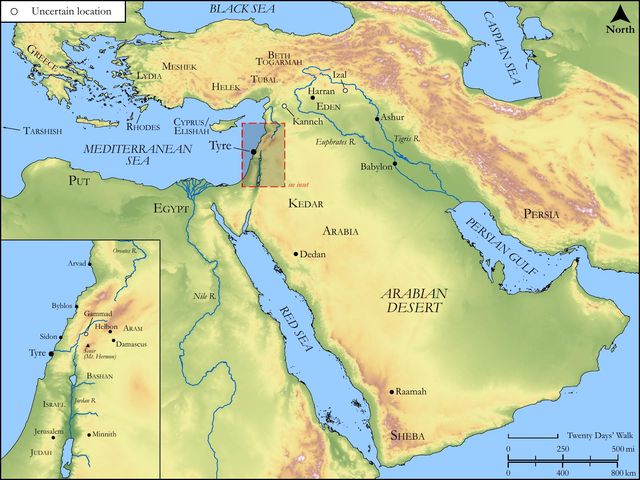
See on the biblical-era map
Study this verse
Public-domain commentary
Matthew Henry
From his Commentary on the Whole Bible. Henry comments on passages, not single verses — this entry covers Ezekiel 26:1–14. His three-level outline is real structure in the source text, so it is rendered as structure.
This prophecy is dated in the eleventh year, which was the year that Jerusalem was taken, and in the first day of the month, but it is not said what month, some think the month in which Jerusalem was taken, which was the fourth month, others the month after; or perhaps it was the first month, and so it was the first day of the year. Observe here,
I.The pleasure with which the Tyrians looked upon the ruins of Jerusalem.
Ezekiel was a great way off, in Babylon, but God told him what Tyrus said against Jerusalem (Eze 26:2): "Aha! she is broken, broken to pieces, that was the gates of the people, to whom there was a great resort and where there was a general rendezvous of all nations, some upon one account and some upon another, and I shall get by it; all the wealth, power, and interest, which Jerusalem had, it is hoped, shall be turned to Tyre, and so now that she is laid waste I shall be replenished." We do not find that the Tyrians had such a hatred and enmity to Jerusalem and the sanctuary as the Ammonites and Edomites had, or were so spiteful and mischievous to the Jews. They were men of business, and of large acquaintance and free conversation, and therefore were not so bigoted, and of such a persecuting spirit, as the narrow souls that lived retired and knew not the world. All their care was to get estates, and enlarge their trade, and they looked upon Jerusalem not as an enemy, but as a rival. Hiram, king of Tyre, was a good friend to David and Solomon, and we do not read of any quarrels the Jews had with the Tyrians; but Tyre promised herself that the fall of Jerusalem would be an advantage to her in respect of trade a commerce, that now she shall have Jerusalem's customers, and the great men from all parts that used to come to Jerusalem for the accomplishing of themselves, and to spend their estates there, will now come to Tyre and spend them there; and whereas many, since the Chaldean army became so formidable in those parts, had retired into Jerusalem, and brought their estates thither for safety, as the Rechabites did, now they will come to Tyre, which, being in a manner surrounded with the sea, will be thought a place of greater strength than Jerusalem, and thus the prosperity of Tyre will rise out of the ruins of Jerusalem. Note, To be secretly pleased with the death or decay of others, when we are likely to get by it, with their fall when we may thrive upon it, is a sin that does most easily beset us, but is not thought to be such a bad thing, and so provoking to God, as really it is. We are apt to say, when those who stand in our light, in our way, are removed, when they break of fall into disgrace, "We shall be replenished now that they are laid waste." But this comes from a selfish covetous principle, and a desire to be placed alone in the midst of the earth, as if we grudged that any should live by us. This comes from a want of that love to our neighbour as to ourselves which the law of God so expressly requires, and from that inordinate love of the world as our happiness which the love of God so expressly forbids. And it is just with God to blast the designs and projects of those who thus contrive to raise themselves upon the ruins of others; and we see they are often disappointed.
II.The displeasure of God against them for it.
The providence of God had done well for Tyrus. Tyrus was a pleasant and wealthy city, and might have continued so if she had, as she ought to have done, sympathized with Jerusalem in her calamities and sent her an address of condolence; but when, instead of that, she showed herself pleased with her neighbour's fall, and perhaps sent an address of congratulation to the conquerors, then God says, Behold, I am against thee, O Tyrus! Eze 26:3. And let her not expect to prosper long if God be against her.
1.God will bring formidable enemies upon her: Many nations shall come against thee, an army made up of many nations, or one nation that shall be as strong as many. Those that have God against them may expect all the creatures against them; for what peace can those have with whom God is at war? They shall come pouring in as the waves of the sea, one upon the neck of another, with an irresistible force. The person is named that shall bring this army upon them - Nebuchadnezzar king of Babylon, a king of kings, that had many kings tributaries to him and dependents on him, besides those that were his captives, Song 2:37, 38. He is that head of gold. He shall come with a vast army, horses and chariots, etc., all land-forces. We do not find that he had any naval force, or any thing wherewith he might attack it by sea, which made the attempt the more difficult, as we find Eze 29:18, where it is called a great service which he served against Tyrus. He shall besiege it in form (Eze 26:8), make a fort, and cast a mount, and (Eze 26:9) shall set engines of war against the walls. His troops shall be so numerous as to raise a dust that shall cover the city, Eze 26:10. They shall make a noise that shall even shake the walls; and they shall shout at every attack, as soldiers do when they enter a city that is broken up; the horses shall prance with so much fury and violence that they shall even tread down the streets though so ever well paved.
2.They shall do terrible execution.
(1.)The enemy shall make themselves masters of all their fortifications, shall destroy the walls and break down the towers, Eze 26:4. For what walls are so strongly built as to be a fence against the judgments of God? Her strong garrisons shall go down to the ground, Eze 26:11. And the walls shall be broken down, Eze 26:12. The city held out a long siege, but it was taken at last.
(2.)A great deal of blood shall be shed: Her daughters who are in the field, the cities upon the continent, which were subject to Tyre as the mother-city, the inhabitants of them shall be slain by the sword, Eze 26:6. The invaders begin with those that come first in their way. And (Eze 26:11) he shall slay thy people with the sword; not only the soldiers that are found in arms, but the burghers, shall be put to the sword, the king of Babylon being highly incensed against them for holding out so long.
(3.)The wealth of the city shall all become a spoil to the conqueror (Eze 26:12): They shall make a prey of the merchandise. It was in hope of the plunder that the city was set upon with so much vigour. See the vanity of riches, that they are kept for the owners to their hurt; they entice and recompense thieves, and not only cease to benefit those who took pains for them and were duly entitled to them, but are made to serve their enemies, who are thereby put into a capacity of doing them so much the more mischief.
(4.)The city itself shall be laid in ruins. All the pleasant houses shall be destroyed (Eze 26:12), such as were pleasantly situated, beautified, and furnished, shall become a heap of rubbish. Let none please themselves too much in their pleasant houses, for they know not how soon they may see the desolation of them. Tyre shall be utterly ruined; the enemy shall not only pull down the houses, but shall carry away the stones and the timber, and shall lay them in the midst of the water, not to be recovered, or ever made use of again. Nay (Eze 26:4), I will scrape her dust from her; not only shall the loose dust be blown away, but the very ground it stands upon shall be torn up by the enraged enemy, carried off, and laid in the midst of the water, Eze 26:12. The foundation is in the dust; that dust shall be all taken away, and then the city must fall of course. When Jerusalem was destroyed it was ploughed like a field, Mic 3:12. But the destruction of Tyre is carried further than that; the very soil of it shall be scraped away, and it shall be made like the top of a rock (Eze 26:4, Eze 26:14), pure rock that has no earth to cover it; it shall only be a place for the spreading of nets (Eze 26:5, Eze 26:14); it shall serve fishermen to dry their nets upon and mend them.
(5.)There shall be a full period to all its mirth and joy (Eze 26:13): I will cause the noise of thy songs to cease. Tyre had been a joyous city (Isa 23:7).; with her songs she had courted customers to deal with her in a way of trade. But now farewell all her profitable commerce and pleasant conversation; Tyre is no more a place either of business or of sport. Lastly, It shall be built no more (Eze 26:14), not built any more as it had been, with such state and magnificence, nor built any more in the same place, within the sea, nor built any where for a long time; the present inhabitants shall be destroyed or dispersed, so that this Tyre shall be no more. For God has spoken it (Eze 26:5, Eze 26:14); and when what he has said is accomplished they shall know thereby that he is the Lord, and not a man that he should lie nor the son of man that he should repent.
Historical interpretation
Historical reception
3 surviving comments on this verse. Each one is dated, so this reads as a timeline rather than a list.
(Chapter 26) And it came to pass in the eleventh year, in the first month, on the first day of the month, the word of the Lord came to me, saying: Son of man, because Tyre (or Sidon) has said of Jerusalem: Aha, the gate of the peoples is broken, it is turned to me, I shall be filled, it has become desolate; therefore thus says the Lord God: Behold, I am against you, Tyre (or Sidon), and I will bring many nations against you, as the sea brings up its waves. And they will break down the walls of Tyre, and destroy its towers, and I will sweep away its dust from it, and make it a shining rock. The drying up of the fishing nets will be in the midst of the sea, for I have spoken, says the Lord God, and it will be a plunder to the nations. Also, her daughters in the field will be killed by the sword, and they will know that I am the Lord. Accordingly, the order of prophecies is woven together. He spoke against the sons of Ammon and Moab and Seir, who are also Edomites, and against the Philistines who are on the coast, and who hold the same boundary on the shore of the sea. After the Philistines, the region of Phoenicia follows, whose metropolis is the city of Tyre, which is called Sor in Hebrew and Syriac. And because Jerusalem was captured, it also rejoiced and insulted, saying: The gates of the peoples are broken, I have the safest harbor, and when they are destroyed, all the multitude turns to me, which was ruled by its authority, and because it is deserted, therefore I will be filled, and whatever was full before will be turned into a wilderness. Therefore, because you have spoken these things and insulted the ruins of Jerusalem, which was destroyed by the judgement of God because of its sins, I will not come against you through messengers or through anyone else, but I myself will be against you, Tyre, and I will cause the Babylonians to rise up like the waves of the sea against you, along with many nations, with which the walls and towers of your city will be destroyed to the point where they will fall to the ground and its dust will be scraped off or blown in various directions, and it will be humiliated to the point where it will be compared to the shiniest rocks. And there will be such great desolation in the once most populous city that fishing nets will be spread out a For I, the Lord, have spoken, and my words cannot be made void, and I will deliver them to be plundered by the nations. Also her daughters, who are in the countryside or in the field, that is, on the coast of Phoenicia, cities and towns, villages and castles, will be killed by the sword: metaphorically, because he called them daughters, he puts the killing by the sword, so that they may know by the end of things that I am the Lord, who commanded these things to happen. According to the tropology, since the Hebrew word Sor is translated into distress, every soul that is occupied with disturbances can be called Sor, which, when she sees Jerusalem being overthrown by the judgment of God for her sins and vices, in which the temple and the vision of peace were, she exults and thinks that the once famous empire of the city is to be transferred to herself. And this is also accepted in conflicting doctrines and in worldly men, when they see a holy man fall through negligence and rejoice and exult, as if their own resurrection were the downfall of others. Therefore the Lord threatens that He Himself will fight against such men and cause many nations, like sea waves, to rise up against them, destroying in them everything that seems most fortified and strong, and thus overturning all their arguments, so that they are reduced to dust. He should also cause the nets and fishing equipment by which the multitude was previously deceived to cease, and to be spread out and dried in the deserted soil of the city, so that other fishermen may take their place, whom the Lord has sent to fish. Moreover, he should cause his daughters, who were previously kept as if in a bridal chamber and were not easily believed by anyone in mystical and more secret teachings, to go forth and be extended in public, and to be cut down with the sword of the Church, so that they may understand that He himself is the Lord, who both temporarily left Jerusalem on account of its sins and destroyed the defenses of Tyre on account of its insolence and joy.
(Verse 35, 36, and following) And I will bring you into a desert of peoples, and there I will judge you face to face. Just as I contended with your fathers in the desert of the land of Egypt, so I will judge you, says the Lord. And I will subject you to my scepter, and I will bring you into the bonds of the covenant, and I will choose from among you the transgressors and the wicked: from their place of residence I will bring them out, and they will not enter the land of Israel, and you will know that I am the Lord. Thus says the Lord: I will do for you who are in Babylon, and now serve idols, what I did for your ancestors in Egypt. I will lead you into the desert of the peoples, and there I will judge you face to face, just as I contended with them in judgment when they came out of Egypt. And after I have judged you, I will subject you to my scepter and rule, and I will make a covenant with you and bring you into your land with the bonds of love, so that bound by my love, you will never be able to depart from me. But I will choose from among you the transgressors and the wicked, who persist in the hardness of their hearts in evil deeds, not for possession, but for rejection. And I will indeed bring them out of the land of their dwelling, so that when they are brought out, they will not enter the land of Israel; but they will perish in various regions. And by the distinction between good and evil, you shall know that I am the Lord, who judges all things. The rest of the discourse hastens, and we briefly go through each point, in order to provide only the meaning to the readers.
(Verse 27, 29 onwards) Therefore speak to the house of Israel, son of man, and tell them: Thus says the Lord God: Moreover, your fathers have blasphemed against me and have treated me with contempt, even as they spurned me. And I brought them into the land that I had lifted my hand to give them ((Vulgate adds: that land)): they saw every high hill and every leafy tree, and there they offered their sacrifices and presented there the irritation of their offerings, and they placed there the fragrance of their sweetness, and they poured out their ((Vulgate is silent on this)) libations there. And I said to them, 'What is the high place to which you are going?' And its name was called the High Place until this day. Therefore speak to the house of Israel, son of man, and say to them, 'Thus says the Lord God: As for your fathers, they have provoked Me to anger by their iniquities, by the fact that they have fallen away from Me. So I brought them into the land that I had lifted My hand in an oath to give them.' They saw every high hill and every leafy tree, and there they offered their sacrifices. They also presented there the provocation of their gifts, and they set there their pleasing aroma, and they poured out there their drink offerings. And I said to them: What is abbana, because you enter there? And they called its name abbana until this day. I wanted, he said, to scatter them in the wilderness, and to give them not good precepts, so that they would sacrifice to idols what they should have offered to me, and consecrate all their first-fruits to them by fire, so that I might kill them and destroy them. But when he says, I wanted, he shows that he did not do what he wanted. And that which follows: 'And they shall know that I am the Lord,' is not found in the Septuagint. For it did not seem fitting to them to know after their destruction that he himself is the Lord. But you, son of man, speak again to them, that is, to the elders of the house of Israel, who have come to inquire of you: Your fathers, from whom you have descended, have also blasphemed against me and held me in contempt; after I brought them into the land which I had given them to possess, they turned against me to provoke me. For when they saw every high hill and leafy tree, they would sacrifice on the mountains and in the groves and thickets, and offer victims to the idols, and pour out libations. And when I saw this, I said to them: What is this, Bama? for it is called high: or why do you enter into such a place which you have chosen for yourselves in all the hills, so that even today these places are called Bamoth, and the ancient error retains its original name? Regarding Bama, which we translate as excelsum, there is an error in the Septuagint edition, where it is written as ἀββανὰ, which does not resonate in the Hebrew language. Bama can mean 'in which' if the two syllables are divided into two words, but in the present context, that sense does not fit. However, wherever it is written in the Books of Kings and Chronicles: 'The people still sacrificed and offered incense on the high places,' Bama in the singular and Bamoth in the plural mean 'high places.'
Continue studying Ezekiel 26:5 across the web’s major study libraries — every link below opens this exact verse, chapter, or book on the destination site.
Read & Compare
 BibleGatewayThis verse in more than 200 translations and 70 languages.
 Bible.comThe YouVersion reader — hundreds of translations, reading plans, and highlights.
 ESV.orgCrossway's official English Standard Version reader.
 NET BibleThe NET translation with 60,000+ translators' notes on every rendering decision.
 STEP BibleTyndale House's free study tool — original text, vocabulary, and scholarly resources.
 BibliaLogos Bible Software's free web reader.
 USCCBThe New American Bible (Revised Edition) with the U.S. bishops' study notes.
Commentaries
 BibleHub CommentariesDozens of classic commentaries on this verse, gathered on one page.
 StudyLightMore than 100 commentary sets — the largest collection on the web.
 BibleRefPlain-English commentary on what this verse means, verse by verse.
 Enduring WordDavid Guzik's free commentary on this chapter, widely used by Bible teachers.
 Bible Study ToolsVerse commentary alongside Greek and Hebrew study aids.
Original Language & Research
- BibleHub InterlinearThe verse word by word — original language, transliteration, and English.
- BibleHub LexiconEvery word's original-language definition and Strong's entry.
 Blue Letter BibleDeep-study tools — Strong's numbers, concordance, and word studies.
 SefariaThe Hebrew text with Rashi and centuries of Jewish commentary.
Sermons, Hymns & Audio


TrulyRandomVerse is not affiliated with these sites and doesn’t control their content. They’re linked because they’re genuinely useful.
Summary
Ezekiel 26:5 delivers a stark prophecy concerning the once-mighty Phoenician city of Tyre, declaring that its strategic island location, formerly a bustling commercial hub, would be utterly desolated and reduced to a barren rock suitable only for fishermen to spread their nets. This divine decree, powerfully affirmed by the sovereign Lord GOD, underscores the certainty of His judgment and the inevitable downfall of human pride and worldly power, as Tyre's immense wealth and formidable fortifications would ultimately become a spoil for the nations.
Context
ShowHideLiterary Context
Ezekiel 26:5 is embedded within a significant block of prophecies against foreign nations (Ezekiel 25-32), with chapters 26-28 specifically targeting Tyre. This particular oracle immediately follows pronouncements against Ammon, Moab, Edom, and Philistia (Ezekiel 25), highlighting a broader divine judgment against nations that opposed God's people or exalted themselves. The extensive nature of the prophecy against Tyre reflects its immense power and the severity of its offense. Chapter 26 meticulously details the physical destruction of Tyre, emphasizing its dramatic transformation from a glorious maritime power to a desolate ruin. The preceding verses (Ezekiel 26:1-4) establish the primary reason for Tyre's judgment: its malicious rejoicing over Jerusalem's destruction, viewing it as a commercial opportunity to expand its own dominance. This verse, therefore, serves as a pivotal declaration of the irreversible nature of Tyre's impending doom, setting the stage for the more detailed lament and vivid description of its commercial splendor and subsequent collapse found in Ezekiel 27.
Historical & Cultural Context
Ancient Tyre was a preeminent Phoenician city-state, renowned for its unparalleled maritime trade, skilled artisans, and virtually impregnable fortifications. It comprised a mainland settlement and a formidable island city, situated approximately half a mile offshore in the Mediterranean Sea. Its strategic location made it a dominant force in international commerce, facilitating trade with nations across the known world, as elaborately detailed in Ezekiel 27:12-25. Culturally, Tyre was deeply rooted in pagan worship, particularly of Melqart, its patron deity, and its immense wealth fostered a spirit of profound arrogance and self-sufficiency, leading its inhabitants to believe themselves invincible. This hubris, coupled with its opportunistic and hostile stance against Jerusalem's downfall, directly provoked divine judgment. The prophecy in Ezekiel 26:5, foretelling its transformation into a "place for the spreading of nets," dramatically contrasts with its historical reality as a bustling, prosperous port and a symbol of human achievement and commercial might.
Key Themes
ShowHideThe verse powerfully articulates several key themes pervasive throughout the book of Ezekiel and broader prophetic literature. Firstly, Divine Judgment and Sovereignty are paramount; the emphatic phrase "saith the Lord GOD" unequivocally asserts that Tyre's downfall is not a mere geopolitical event but a direct, certain, and divinely orchestrated act of judgment against its pride and wickedness. This highlights God's absolute control over all nations and their destinies, a theme powerfully echoed in passages like Psalm 33:10-11. Secondly, Complete Desolation is vividly portrayed through the imagery of a "place for the spreading of nets in the midst of the sea." This metaphor signifies a radical reversal of Tyre's former glory, transforming it from a vibrant center of global commerce into a barren, forgotten rock, emphasizing the ephemeral nature of worldly power and wealth. This stark contrast is further elaborated in the lament over Tyre's fall in Ezekiel 27:32-36. Thirdly, Prophetic Certainty is underscored by the declaration "for I have spoken it." This phrase emphasizes the infallibility of God's word and the inevitability of His declared purposes, serving as a foundational principle of biblical prophecy, as seen in Isaiah 55:11. The historical fulfillment of this prophecy, particularly through the sieges by Nebuchadnezzar and Alexander the Great, stands as a profound testament to this certainty.
Exposition and Analysis
ShowHideKey Word Analysis
ShowHideDerived from the root shaṭaḥ, meaning "to spread out," refers to a "spreading-place." In this context, it vividly depicts a flat, open area specifically used for laying out fishing nets to dry. This imagery is crucial as it contrasts sharply with Tyre's former identity as a densely populated, fortified city, emphasizing its complete reduction to a desolate, utilitarian space for humble, solitary activities, a stark reversal of its once-bustling commercial life.
Primarily meaning "a net" (either literal or figurative), but also carries the profound connotation of a "doomed object," "utter destruction," or something "devoted" to destruction. While the primary sense here is fishing nets, the dual meaning subtly reinforces the idea that Tyre itself, once a powerful and seemingly invincible entity, is now destined for utter destruction, becoming a place associated with what is "doomed" or "devoted" to divine judgment.
H136 and H3069. This compound divine title emphasizes God's absolute sovereignty and covenant faithfulness. ʼĂdônây (Lord) signifies absolute mastery, ownership, and authority, while Yᵉhôvih (GOD, a variant of YHWH, the covenant name) highlights His personal, unchanging, self-existent, and faithful nature. The combination "Lord GOD" underscores that this is not merely a human prediction but an unchallengeable, divinely authored decree from the supreme Ruler of the universe, who is also faithful to His word and purposes.
Verse Breakdown
ShowHide"It shall be [a place for] the spreading of nets in the midst of the sea"
This clause paints a striking and ironic picture of Tyre's future state. The once-proud, bustling island city, a hub of global commerce and a symbol of human ingenuity and immense wealth, will be reduced to a barren, exposed rock. The phrase "in the midst of the sea" specifically refers to the island portion of Tyre, which was its most formidable and renowned part, believed to be impregnable. The image of "spreading of nets" signifies the complete cessation of its former glorious activities—no more ships laden with exotic goods, no more merchants, no more grand palaces—only the humble, solitary work of fishermen, drying their nets on its desolate stones, a testament to its utter ruin.
"for I have spoken [it], saith the Lord GOD"
This is the divine warrant for the prophecy's absolute certainty and inevitability. The declaration "I have spoken it" (Hebrew: dibbarti) emphasizes that this is a direct, unchangeable, and authoritative decree from God Himself. It is not a human prediction, a mere possibility, or a conditional warning, but a settled divine purpose that will assuredly come to pass. The accompanying "saith the Lord GOD" reinforces the absolute authority, infallibility, and sovereign power of the speaker, linking the prophecy directly to the supreme and covenant-keeping God, thereby guaranteeing its inevitable fulfillment.
"and it shall become a spoil to the nations"
This final clause describes the practical and devastating outcome of God's judgment. Tyre, with all its accumulated wealth, its valuable goods, its strategic assets, and its very infrastructure, will be plundered and taken as booty by various foreign powers. This refers to the historical sieges and eventual destruction, first by Nebuchadnezzar's Babylonian forces, and later, more completely and decisively, by Alexander the Great, who famously used the rubble of the mainland city to build a causeway to the island, fulfilling the prophecy of its being scraped bare like a "bare rock" (Ezekiel 26:4).
Literary Devices
ShowHideEzekiel 26:5 employs several powerful literary devices to convey its message of divine judgment and complete desolation. Symbolism is central, with the "spreading of nets" serving as a potent symbol of utter ruin, reversal of fortune, and the reduction of grandeur to insignificance. What was once a mighty fortress and commercial metropolis will become a mere drying rack for humble fishermen's tools, symbolizing its complete loss of power, wealth, and identity. The phrase "in the midst of the sea" further emphasizes the isolation and vulnerability of the island city, which was ironically once its greatest strength and defense. Hyperbole is also present in the dramatic contrast between Tyre's former glory and its prophesied abject state; while Tyre was not literally wiped off the map, its commercial and political significance was utterly destroyed and irrevocably diminished, fulfilling the spirit and intent of the prophecy. Finally, the repeated use of the Divine Oracle formula, "for I have spoken it, saith the Lord GOD," functions as a powerful rhetorical device, emphasizing the absolute certainty, unchallengeable authority, and divine origin of the prophecy, leaving no doubt as to its inevitable and precise fulfillment.
Theological and Thematic Connections
ShowHideEzekiel 26:5 stands as a profound theological statement on God's absolute sovereignty over all nations and His unwavering commitment to justice. It powerfully illustrates that no human power, however fortified by immense wealth, formidable military might, or strategic geographical location, can ultimately withstand the divine decree. The prophecy against Tyre serves as a timeless warning against the dangers of pride, self-sufficiency, and hostility towards God's purposes, demonstrating that God will humble those who exalt themselves and rejoice in the downfall of His people. It underscores the transient nature of all worldly empires and the enduring reliability and infallibility of God's prophetic word, reminding us that His purposes will always prevail, even amidst the rise and fall of human kingdoms and the shifting tides of history.
Reflection and Application
ShowHideEzekiel 26:5 offers a sobering and profound reflection on the futility of placing ultimate trust in worldly achievements, material wealth, or human strength. The dramatic fall of Tyre, a city that epitomized commercial success, architectural grandeur, and seemingly impregnable defense, serves as a powerful reminder that all earthly kingdoms and their glories are ultimately ephemeral, transient, and subject to the sovereign will of God. For us today, this verse calls for a profound humility, urging us to deeply examine where our true security, identity, and hope lie. Are we building our lives on foundations that are transient and vulnerable, or on the eternal and unchanging character and promises of God? It challenges us to align our hearts, our pursuits, and our allegiances with God's purposes, rather than succumbing to the arrogance and self-sufficiency that often accompany worldly success. Furthermore, the absolute certainty of God's spoken word in this prophecy should instill in believers a deep and unwavering confidence in His promises and warnings, knowing that what He declares will undoubtedly come to pass. This should lead us to greater reverence for His authoritative Word and a steadfast reliance on His unchanging nature in every circumstance.
Questions for Reflection
ShowHideFAQ
ShowHideHow was the prophecy of Ezekiel 26:5 historically fulfilled?
ShowHideThe prophecy against Tyre saw a remarkable, multi-stage fulfillment over several centuries. Initially, the powerful Babylonian king Nebuchadnezzar besieged mainland Tyre for an arduous 13 years (circa 586-573 BC), though he did not conquer the island city itself. This protracted siege, however, significantly weakened Tyre and led to the plundering of its mainland assets, fulfilling the "spoil to the nations" aspect. The more dramatic and complete fulfillment came nearly 250 years later, in 332 BC, when Alexander the Great besieged the island city. To reach the seemingly impregnable island, Alexander famously used the rubble, timber, and debris of the old mainland city to construct a massive causeway, nearly half a mile long, connecting the mainland to the island. This act literally scraped the mainland city "like the top of a rock" (as prophesied in Ezekiel 26:4), and the island city, once conquered, was largely destroyed and its inhabitants enslaved or executed. From that point on, the island of Tyre never fully regained its former glory as a dominant commercial power, eventually dwindling into a minor fishing village, thus fulfilling the vivid imagery of it becoming "a place for the spreading of nets in the midst of the sea."
What is the significance of the phrase "saith the Lord GOD" in this verse?
ShowHideThe phrase "saith the Lord GOD" (Hebrew: nᵉʼum ʼĂdônây Yᵉhôvih) is a crucial and frequently used prophetic formula, particularly prominent in the book of Ezekiel and other prophetic literature. Its significance is multifaceted and profound: Firstly, it unequivocally establishes the divine origin of the message, indicating that the words are not merely Ezekiel's own thoughts, political analyses, or human predictions, but a direct, authoritative revelation from God Himself. Secondly, it emphasizes the absolute authority of the speaker; ʼĂdônây (Lord) denotes God's supreme mastery, ownership, and sovereign power over all creation, and Yᵉhôvih (GOD, the sacred covenant name YHWH) highlights His self-existence, faithfulness, and unchanging nature. Together, they underscore that the decree is from the supreme Ruler of the universe, who is both powerful and true to His word. Thirdly, it conveys prophetic certainty and infallibility. When God "speaks" or "declares," it is not a suggestion, a possibility, or a conditional statement, but a definite and unchangeable declaration that will assuredly come to pass. In the context of Tyre's destruction, this formula assures the audience—both Ezekiel's contemporaries and future generations—that this judgment is an unalterable divine purpose, thereby guaranteeing its precise historical fulfillment. This divine assurance is a recurring and foundational theme throughout the biblical narrative, as seen in Numbers 23:19.
Christ-Centered Fulfillment
ShowHideWhile Ezekiel 26:5 directly prophesies the judgment of an ancient city, its profound theological undercurrents find ultimate Christ-centered fulfillment in the broader biblical narrative of God's absolute sovereignty over all creation and His decisive triumph over all forms of human pride, rebellion, and worldly systems. Tyre, with its immense wealth, commercial prowess, and self-sufficient spirit, symbolizes the worldly kingdoms and human achievements that often set themselves in opposition to God's righteous rule. The prophecy of its utter desolation foreshadows the ultimate dismantling of all earthly powers, empires, and structures that oppose the reign of God, as definitively revealed and established in Jesus Christ. Just as Tyre's former glory was reduced to a mere place for drying nets, so too will all human empires and their transient achievements ultimately fade and be judged before the eternal and unshakable Kingdom of God, which is inaugurated and consummated through Jesus Christ.
Christ's coming marks the definitive turning point in this cosmic drama of divine judgment and redemption. He is the true and rightful King, to whom all authority in heaven and on earth has been given (Matthew 28:18). His perfect life, atoning death, and glorious resurrection demonstrate God's ultimate judgment on sin, pride, and rebellion, while simultaneously offering redemption, reconciliation, and the promise of a new creation. The "spoil to the nations" finds its ultimate reversal and transformation in Christ, who, by His triumph on the cross, disarmed the spiritual powers and authorities that held humanity captive (Colossians 2:15) and now gathers His own redeemed people from every nation, tribe, and tongue to inherit an everlasting kingdom (Revelation 7:9-10). The absolute certainty of God's spoken word, "I have spoken it, saith the Lord GOD," finds its most glorious and unwavering fulfillment in Christ, through whom all of God's magnificent promises are a resounding "Yes" and "Amen" (2 Corinthians 1:20). The final desolation of all that opposes God, and the establishment of His eternal reign, will culminate in Christ's triumphant return, when He will judge the living and the dead and usher in the new heavens and new earth, where righteousness dwells and there will be no more sea, symbolizing the end of chaotic, rebellious forces and the complete triumph of His peaceful dominion (Revelation 21:1). Thus, Tyre's judgment serves as a profound microcosm of the ultimate divine judgment that prepares the way for the universal and eternal reign of Christ.